Pipeline Management for Agents: Tracking Every Deal From Lead to Closing
Turn this article into takeaways for your work.


Each assistant summarizes the article only for you and suggests best practices for your work.
According to the National Association of Realtors, the typical individual agent closed nine transaction sides in 2025, with more experienced agents averaging around ten. Nine or ten deals a year sounds manageable until you consider that each one is moving through multiple stages simultaneously, at different speeds, with different risks of falling apart. Without a system to track all of it at once, deals don't fail because agents aren't working hard. They fail because nobody was watching the right thing at the right moment.
Pipeline management is the discipline of tracking every active relationship, buyer and seller, lead and client, through defined stages so you always know where things stand and what needs attention today. It's less exciting than prospecting and less satisfying than closing, but it's the difference between a busy agent and a genuinely productive one.
Why Busy Isn't the Same as Productive
An agent without pipeline discipline is always busy. Phone ringing, showings scheduled, emails piling up. But busy time and productive time aren't the same thing. Without a clear view of your whole pipeline, you respond to whatever feels urgent in the moment, usually the loudest client, rather than whatever is actually most at risk of falling through.
A deal quietly stalling in inspection negotiations doesn't announce itself the way a new lead's phone call does. Pipeline management is what makes the quiet, at-risk deals visible before they become lost deals.
Defining Your Pipeline Stages
Before you can manage a pipeline, you need consistent stage definitions for both sides of your business.
Buyer-side stages typically run: new lead, qualified, active search, under contract, in escrow, closed. Map these against your buyer journey stages so the terminology stays consistent across your business.
Seller-side stages typically run: new lead, listing appointment scheduled, listed, active/under contract, in escrow, closed.
Keep the stage list short enough to scan at a glance but specific enough that two deals in the same stage are genuinely at similar points. Too many stages and the pipeline view becomes cluttered. Too few and you lose the ability to spot exactly where things are getting stuck.
The Weekly Pipeline Review Ritual
Block a fixed time each week, ideally the same time every week, to review your entire pipeline stage by stage. This isn't optional busywork. It's the single habit that catches problems early enough to fix them.
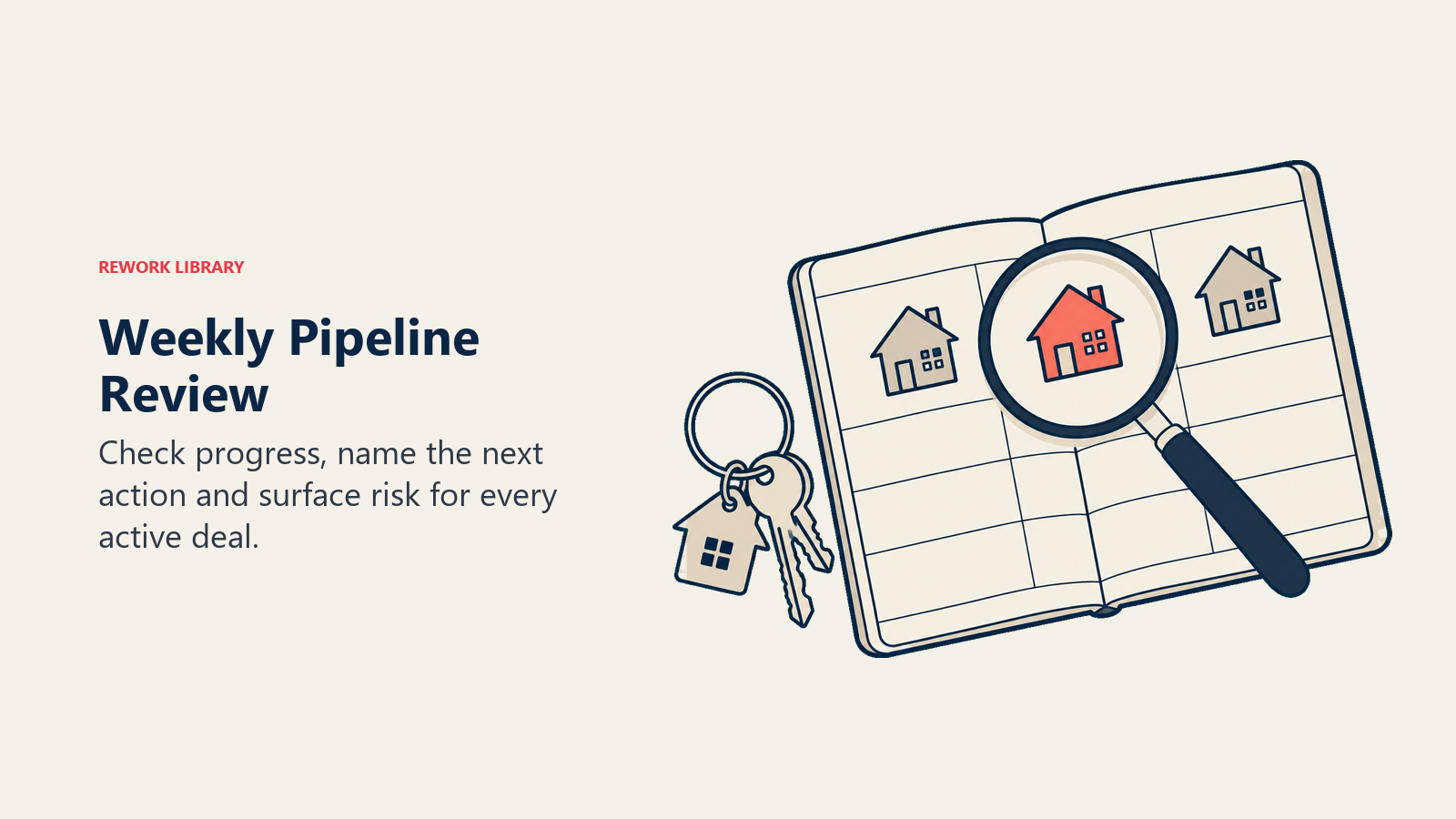
Walk through every active deal and ask three questions: Has this moved forward since last week? Is there a scheduled next action, and who owns it? Is anything here at risk that I haven't addressed?
Deals with no movement in two consecutive weekly reviews deserve a direct check-in call, not just another automated touch. Silence in a pipeline is rarely good news, and catching it early gives you room to fix whatever's causing the stall.
Forecasting: Turning Pipeline Into Predictable Income
A well-maintained pipeline does more than organize your work, it lets you forecast. Assign a rough probability to each stage based on your own historical close rates: a new qualified buyer lead might carry a 15% chance of closing within 90 days, while a buyer under contract might carry an 85% chance barring something unusual.
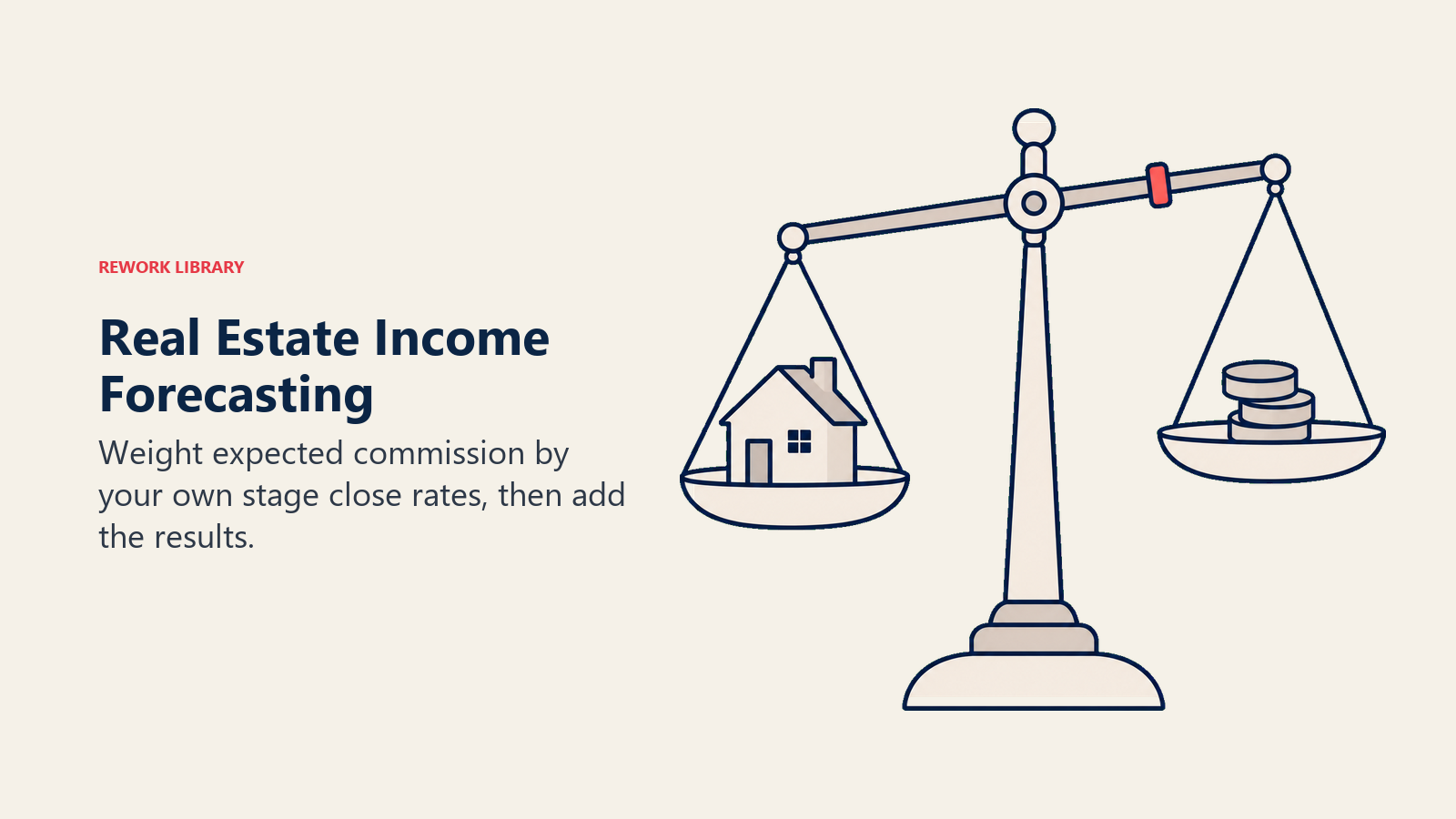
Multiply expected commission by stage probability across your whole pipeline and you get a realistic forecast of income over the coming months, not just a hopeful guess. This matters most when your real estate sales cycle runs long, since income from today's activity often won't land for months.
Revisit and adjust your stage probabilities every quarter based on your actual results. If deals in "active search" are closing at a much higher or lower rate than your assumption, update the number.
Spotting and Reviving Stalled Deals
Every pipeline stage has a typical time window. A buyer sitting in "active search" for six months without narrowing their criteria is stalled. A seller's listing sitting sixty days without a serious offer despite reasonable pricing is stalled. A contract sitting in escrow past its expected closing date without a clear reason is stalled.
Flag anything that's exceeded its normal window during your weekly review, and treat each one as its own small project: what's actually causing the delay, and what's the next concrete action to unstick it? This same instinct applies directly to your deal fallout prevention process, catching problems while they're still fixable instead of after a deal has already collapsed.
Pipeline Capacity: How Many Deals Can You Actually Handle
Not every stage demands the same amount of your time. A buyer in early active search might need a weekly check-in. A buyer under contract heading toward closing might need daily attention through inspection and financing contingencies.
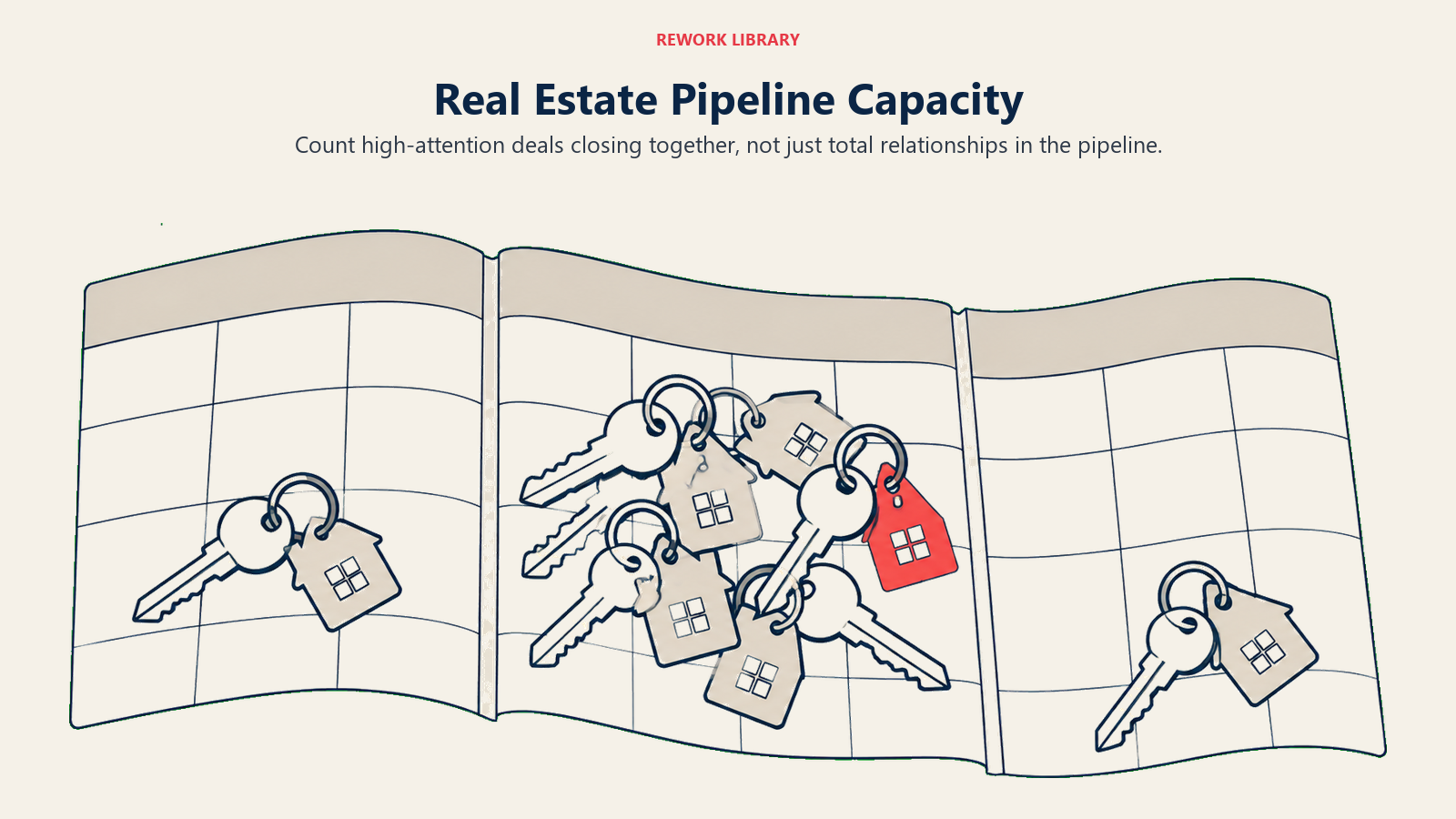
Track not just how many deals you're carrying, but how many are in high-attention stages simultaneously. An agent who looks fine on paper with twelve total pipeline relationships can be genuinely overloaded if five of them are all approaching closing in the same two-week window. Use your pipeline view to spot these capacity crunches before they happen, and either bring in help or adjust your prospecting pace accordingly.
CRM Pipeline Views and Reporting
Your real estate CRM should give you a single visual view of every active deal by stage, similar to a sales pipeline board. If you're managing this in scattered notes, sticky reminders, or memory, you're carrying unnecessary risk regardless of how organized you feel day to day.
Set up your CRM's pipeline view to show, at minimum, current stage, days in that stage, next scheduled action, and estimated close date for every active relationship. This view should be the first thing you open during your weekly review, not something you reconstruct from memory each time.
Pair this with your broader real estate metrics and KPIs tracking so pipeline health connects directly to the numbers that actually predict your income.
Pipeline Management for Teams vs Solo Agents
A solo agent manages one pipeline and one calendar. A team introduces a second layer: whose pipeline is this, and where does accountability sit when a deal spans multiple people?
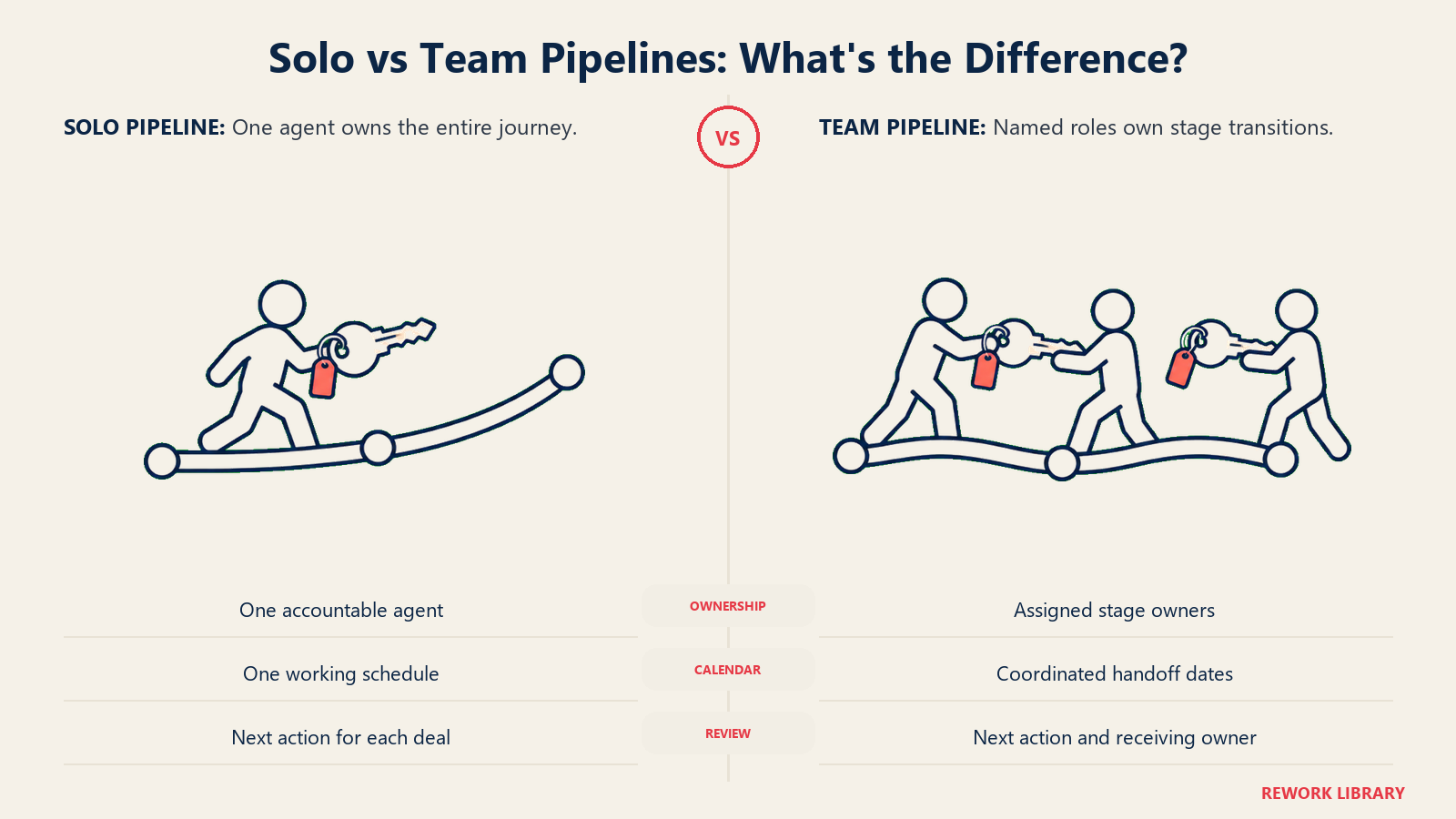
On a team, assign clear ownership for every stage transition, particularly the handoff points. Reference your real estate team structure to make sure pipeline ownership matches your actual role definitions, buyer specialists own their stages, listing specialists own theirs, and transaction coordinators take over once a deal reaches contract. Ambiguous ownership is where team pipelines quietly fail even when individual people are working hard.
Common Pipeline Management Mistakes
Tracking pipeline in your head. This works until it doesn't, usually right when volume increases past what any memory can reliably hold.
Reviewing only when something goes wrong. Reactive pipeline checks catch problems after they've already become expensive. Weekly reviews catch them while they're still small.
No stage-exit criteria. If it's unclear what actually moves a deal from one stage to the next, deals sit indefinitely in stages that no longer reflect reality.
Confusing activity with progress. A dozen showings scheduled this week feels productive, but if none of them move a buyer closer to an offer, your pipeline hasn't actually advanced.
Building the Habit
Pipeline management isn't a system you install once. It's a habit you protect every week, even during your busiest stretches, especially during your busiest stretches, since that's exactly when deals are most likely to slip through unnoticed.
Start simple: one consistent weekly time block, one clean CRM view, and three honest questions asked of every active deal. That habit alone, held consistently, will surface more revenue than almost any new lead source you could add this quarter.
Frequently Asked Questions about Pipeline Management for Agents
How often should I review my pipeline?
Weekly, at a fixed time, is the minimum for staying ahead of stalled deals. Agents managing a high volume of active buyers and sellers simultaneously often benefit from a lighter daily glance in addition to the full weekly review.
What's the biggest sign a pipeline needs better management?
Deals falling apart that felt "fine" the week before. That surprise almost always means a problem was building quietly for weeks without anyone noticing, which is exactly what a consistent weekly review is designed to catch.
How many stages should my pipeline have?
Enough to distinguish meaningfully different points in the process, typically five to seven per side (buyer or seller), but not so many that tracking becomes tedious. If two deals in the same stage feel like they're at very different points, add a stage; if stages feel redundant, combine them.
Can pipeline management help with forecasting income?
Yes. Assigning a rough close probability to each stage and multiplying it against expected commission gives a realistic income forecast, which matters especially when your sales cycle runs several months from first contact to closing.
Related Resources
Pipeline Structure & Metrics:
- Real Estate Sales Cycle - The full timeline your pipeline stages should reflect
- Real Estate Metrics & KPIs - The numbers that connect to pipeline health
- Buyer Journey Stages - Aligning pipeline stages with the buyer's actual experience
Keeping Deals on Track:
- Contract to Closing Pipeline - Managing the highest-risk stage in detail
- Deal Fallout Prevention - Catching at-risk deals before they collapse
- Real Estate CRM Selection - Choosing a system that can actually show you your whole pipeline

Sales Director
On this page
- Why Busy Isn't the Same as Productive
- Defining Your Pipeline Stages
- The Weekly Pipeline Review Ritual
- Forecasting: Turning Pipeline Into Predictable Income
- Spotting and Reviving Stalled Deals
- Pipeline Capacity: How Many Deals Can You Actually Handle
- CRM Pipeline Views and Reporting
- Pipeline Management for Teams vs Solo Agents
- Common Pipeline Management Mistakes
- Building the Habit
- Related Resources