Does AI Flatten the Org Chart? Separating the Claim From the Evidence
Turn this article into takeaways for your work.


Each assistant summarizes the article only for you and suggests best practices for your work.
Delayering means removing a level of management between the top of a company and frontline work. AI genuinely absorbs some of what a layer used to do, mainly routine information-passing and status-checking, but not the coordination, judgment, and accountability that were the actual reason most layers existed. Companies that cut a layer for cost and label it an AI strategy usually find that out the hard way.
That gap is the whole subject of this article. Org charts have been getting flatter, on paper, since well before large language models existed. What changed in 2025 and 2026 is the press release: "AI efficiency" now sits at the top of layoff announcements where "restructuring" used to sit. Some of that is real. A lot of it is relabeling. The frontier firm and the agent boss covers the cultural version of this shift; this article stays with the structure itself.
Key Facts
- Average people reporting to one manager rose from 10.9 in 2024 to 12.1 in 2025, nearly 50% higher than when Gallup began tracking in 2013. The median has held steady at five to six, meaning a shrinking number of very large teams pulls the average up. Source: Gallup, "Span of Control: What's the Optimal Team Size for Managers?"
- Bain's benchmark database shows the average company runs 8-9 layers between its top leader and the frontline (7 or fewer at best-in-class companies), with average spans of 6-7 direct reports (10-15 at best-in-class companies). Clients acting on a spans-and-layers review improved spans by 24% and cut layers by 14% on average. Source: Bain & Company, "Streamlining Spans and Layers"
- McKinsey estimates rightsizing spans and layers typically frees up 10-15% of managerial cost, and the right span depends on the type of work: a "coach" managing novel problems needs a far smaller span than a "coordinator" managing repeatable output. Source: McKinsey, "How to Identify the Right Spans of Control for Your Organization"
- Amazon cut roughly 14,000 corporate roles in October 2025, with CEO Andy Jassy framing the goal as an organization with "fewer layers and more ownership" built for the AI era. Source: CNBC, "Amazon laying off about 14,000 corporate workers"
- Uber cut about 3,300 roles (10% of staff) in September 2026, targeting a 20% reduction in managers and removing staff more than seven layers below the CEO. CEO Dara Khosrowshahi's stated reason was accumulated bureaucracy, not AI. Source: TechCrunch, "Uber is laying off 10% of staff, or 3,300 people"
- Oxford Economics' Ben May, on the wave of AI-attributed layoffs: "We suspect some firms are trying to dress up layoffs as a good news story rather than a bad one, for example by pointing to technological change instead of past overhiring." Source: CBS News, "More companies are pointing to AI as they lay off employees"
Why Layers Exist in the First Place
Before asking whether AI removes a layer, it helps to be precise about what a layer is for. Org-design theory answered this decades before anyone had heard of a large language model, and the answer holds up: layers exist to process information, coordinate work, and exercise control, jobs that look similar from the outside but fail in different ways when you cut them.
The information-processing view
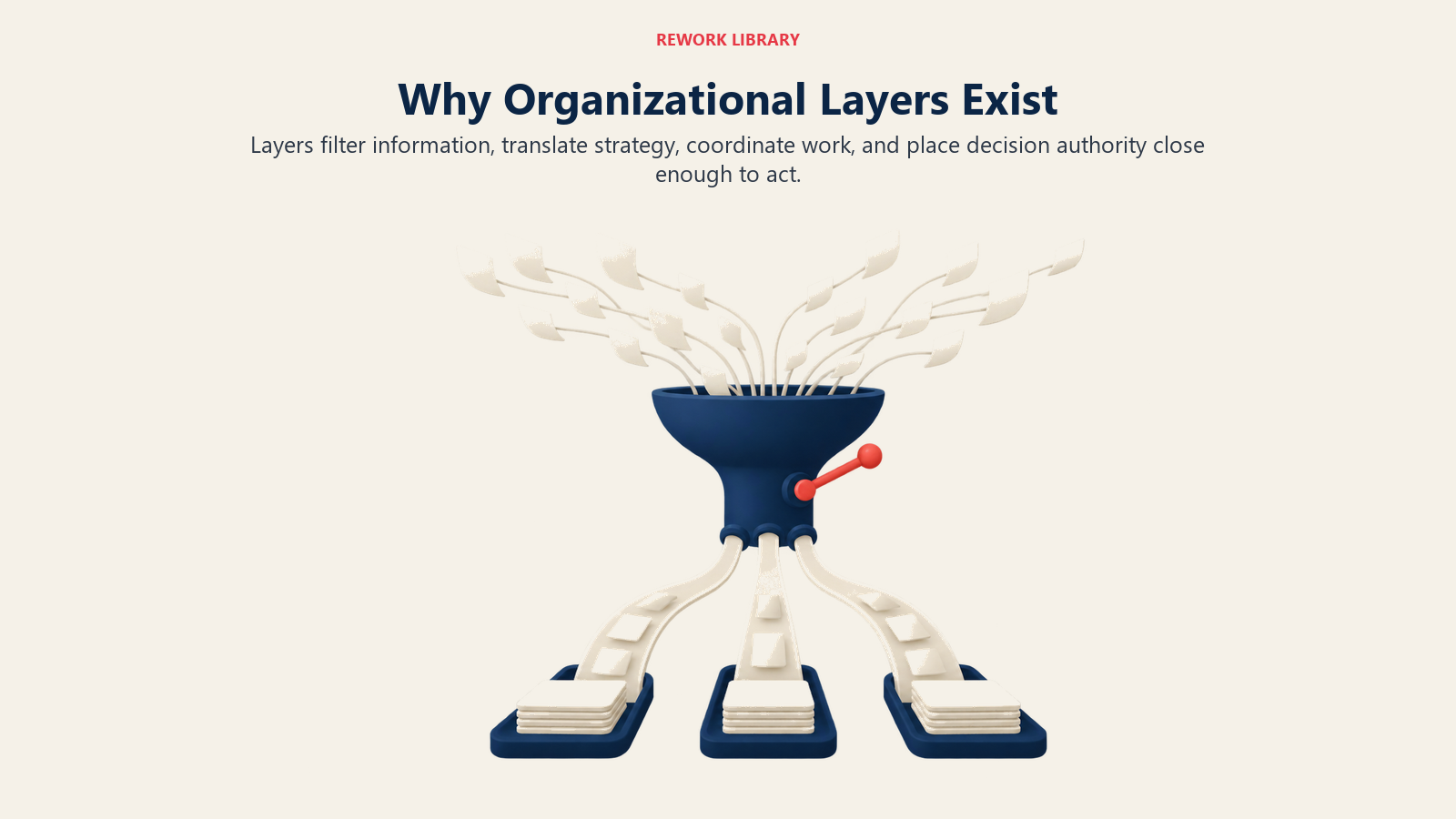
Organizational theorist Jay Galbraith argued that structure is fundamentally a response to uncertainty: the less a task's requirements can be specified in advance, the more information has to flow up, across, and down the organization to get the work done correctly. A layer of management, in this view, is a switchboard. It filters noise moving up (so the CEO isn't reading every customer complaint) and translates strategy moving down (so a frontline team knows what a quarterly goal means for their Tuesday). Cut the switchboard without replacing its function, and information backs up or arrives in the wrong shape for whoever receives it.
Coordination and control (the middle line)
Henry Mintzberg's breakdown of an organization into five parts, the strategic apex, the middle line, the operating core, the technostructure, and support staff, places middle managers structurally between the people who set direction and the people who do the work. Their job there is coordination (making sure teams pulling in slightly different directions still ship one coherent thing) and control (catching problems before they become someone else's emergency). His point, still correct, is that once an organization outgrows casual, everyone-just-talks coordination, something has to take over that job, and a layer of management is usually the cheapest thing that can.
Two other things layers do, less often named but just as real: they compress decision cycles by giving someone authority to decide without escalating everything, and they build a career ladder that shows people how expertise turns into scope. None of those functions, information filtering, coordination, control, and the ladder, are new problems generative AI introduced. They're why management hierarchy exists at all, in factories and hospitals long before software. Team Topologies for human-plus-agent teams goes a level below the layer itself, into how the shape of an individual team changes once part of its capacity is an agent rather than a person.
What AI Actually Absorbs, and What It Doesn't
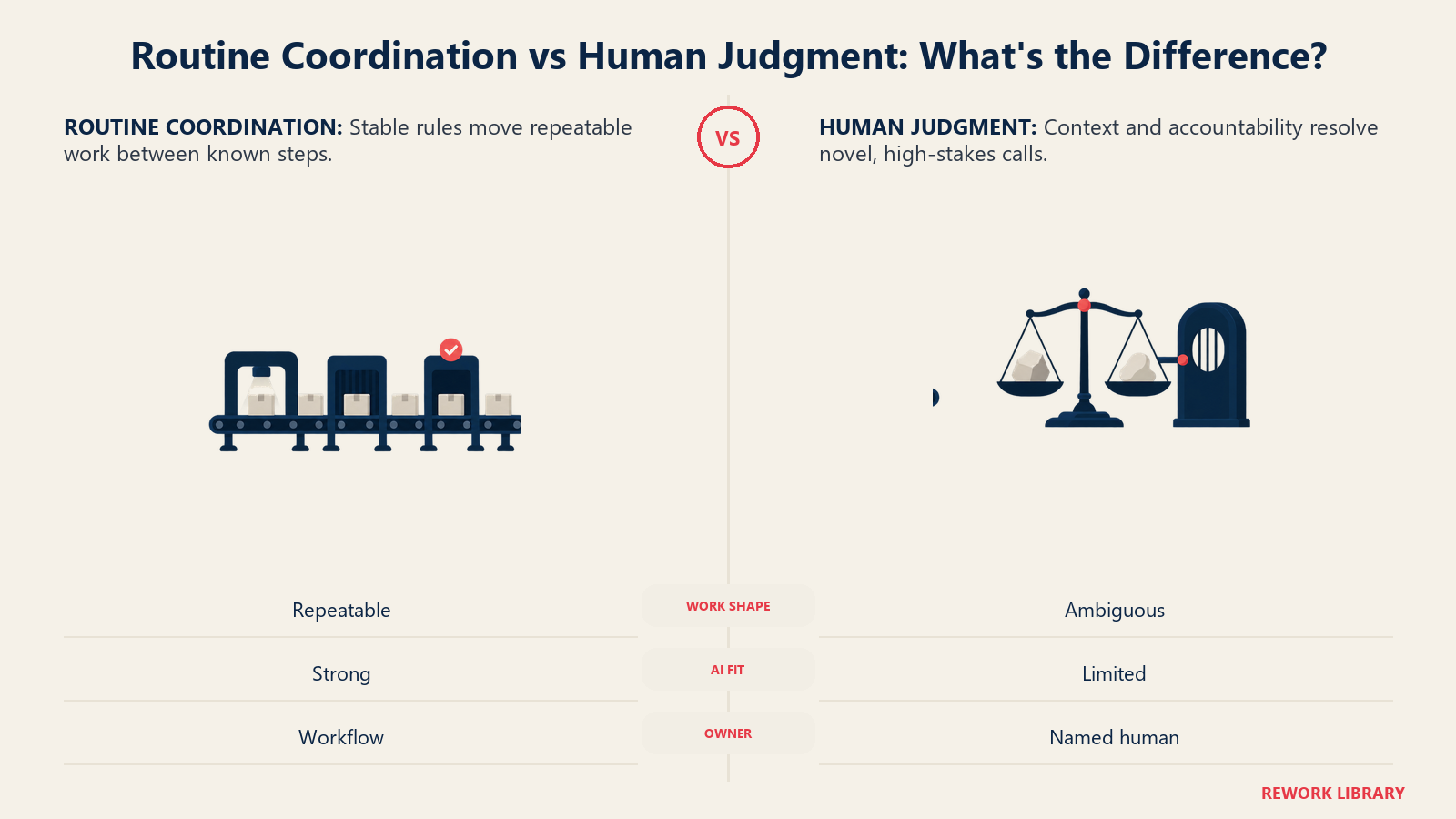
This is where the flattening claim has to get specific instead of rhetorical. Which jobs AI changes rather than replaces makes this case at the task level: AI reshapes pieces of a job, not the whole job. The same logic applies one level up, to the functions inside a layer rather than the layer as one unit. AI is good at some of those functions and bad at others.
| What a layer does | Does AI genuinely absorb it | What that implies for org design |
|---|---|---|
| Status aggregation and reporting up | Largely yes. Dashboards and agents that compile updates from source systems do this reliably. | The "roll up status" part of a manager's week shrinks. This is what most delayering announcements are actually describing. |
| Routine coordination between teams doing repeatable work | Partially. Workflow tools can hand off standard tasks between teams without a human broker when the interface is well-defined. | Spans can widen safely here. This is the closest thing to a genuine, defensible AI flattening case. |
| Judgment calls on ambiguous, high-stakes, or novel problems | No, not reliably. Models perform well inside a known "capability frontier" and worse just outside it, without signaling which side a problem sits on. | The manager who makes this call isn't replaceable by a dashboard. Cutting this for cost and hoping AI covers the gap is where things go wrong quietly. |
| Coaching, development, and career-ladder judgment | No. This requires context about a person's growth and trust built over time that no current system produces credibly. | If bundled into a role that gets cut, this needs an explicit new home. It rarely gets one automatically. |
| Political and organizational translation (why a decision was made, who signs off) | No. This is tacit, relationship-dependent knowledge that lives in people, not documents an agent can retrieve. | Removing the layer that held it resurfaces the same friction two levels up, later and more expensively. |
Read across the rows and a pattern shows up: AI is strongest where a layer's job was closest to message-passing, and weakest where it was closest to judgment, the same split augmentation vs. automation draws at the individual-task level. Companies that flatten by cutting message-passing work first, while admitting the judgment work still needs a home, end up with a structure that holds. Companies that cut headcount first and assume judgment work gets absorbed by whoever's left rediscover the missing function later, as a quality problem or a burned-out survivor doing two people's judgment calls for one salary. Keeping human judgment sharp covers this erosion at the individual level; it happens structurally too, when a layer built for judgment gets treated as if it only did reporting.
Removing a Layer Is Not the Same as Removing a Manager
This distinction gets collapsed constantly in coverage of AI-driven restructuring, and the two moves carry almost opposite risk.
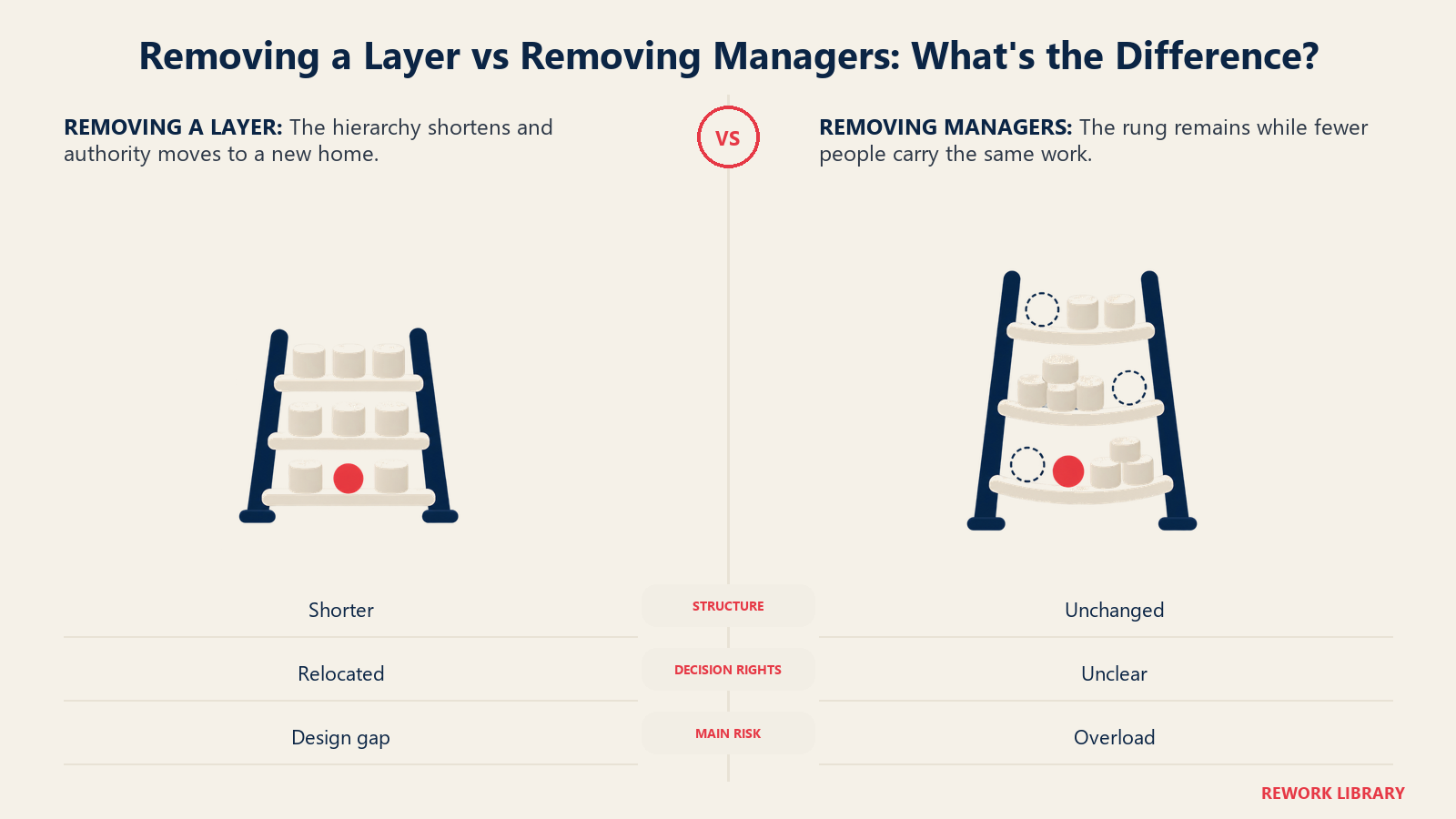
Removing a layer means eliminating a rung of the hierarchy: the people who did that job are reassigned, promoted, moved into individual-contributor roles, or let go, and the reporting structure genuinely gets shorter. Amazon's push, per Jassy's own framing, was explicitly this: raise the ratio of employees to managers, require more direct reports per manager, and cut the number of rungs a decision has to travel through. That's a structural change to the shape of the organization.
Removing managers without removing a layer is a headcount reduction dressed up in org-design language. The rung still exists on paper, still people whose job is coordination and supervision, just fewer of them, each carrying a wider span. Gallup's data on the average span climbing to 12.1 direct reports, against a median that has barely moved, fits that pattern: fewer people absorbing the same coordination and judgment work rather than a genuine redesign. The middle manager role doesn't disappear here. It gets heavier, quietly, for whoever's left holding it.
The test is simple: did decision rights and judgment calls actually move somewhere else, a peer team, an agent workflow, an explicit new process, or did they just pile onto fewer people at the same title? The first is delayering. The second is understaffing a layer that still exists, and it shows up as burnout long before it shows up as a line item.
When Delayering for Cost Gets a Name Change to "AI Strategy"
Two 2025-2026 restructurings make a useful pair because the press covered them almost identically, and they were not the same thing.
Amazon's roughly 14,000-role cut in October 2025 came with explicit AI framing: leadership described a company that needed to be "organized more leanly, with fewer layers and more ownership," with AI-driven efficiency named as part of the rationale. Whether AI actually caused that reduction, or was a convenient frame for a decision with other drivers, is a fair question. But the structural claim, fewer layers, wider spans, is at least a real change with a checkable target.
Uber's roughly 3,300-role cut in September 2026 targeted nearly the identical outcome, a 20% reduction in managers and removal of staff more than seven layers below the CEO, but Khosrowshahi's stated reason was accumulated bureaucracy, not AI. No AI framing appeared in the company's public reasoning. That contrast is instructive: two similar structural moves, one wrapped in AI language and one not, because one CEO chose not to make a claim the restructuring didn't need.
That gap is now a documented pattern, not a hunch. Oxford Economics' analysis of the 2025-2026 layoff wave concluded that most employers "don't appear to be replacing a significant number of workers with AI," and its lead researcher, Ben May, put the incentive plainly: attributing cuts to AI "conveys a more positive message to investors" than admitting the real driver was past overhiring or softer demand. The AI productivity paradox covers the adjacent version of this problem, high reported adoption with little measured financial return, and the same caution applies here: a company announcing "AI-driven delayering" has told you its preferred story, not necessarily its actual one.
None of this means every AI-framed restructuring is fake. It means the label now does marketing work as much as descriptive work, and a leader deciding whether to cut a layer should ask what function AI is absorbing, not accept "AI efficiency" as self-explaining. If you can't name which layer function actually moved to a system, you haven't found an AI case for delayering. You've found a budget target wearing one.
A Practical Test: Does This Layer Still Earn Its Place?
Before cutting a layer, or deciding a wider span is safe, work through four questions specific to the actual work that layer does, not the org chart in the abstract.
1. What share of this layer's time is status aggregation versus judgment? If a manager spends most of a week compiling updates, chasing status, and reformatting information for someone above them, that's the function AI absorbs cleanly. If most of the week is spent making calls on ambiguous problems, that function doesn't disappear just because the reporting part did. This is also the question that decides whether a genuine human in the loop still needs to sit at that level, or whether the loop has already moved down to whoever's doing the work directly.
2. Where does the tacit knowledge live if this role goes away? Every layer accumulates context nobody writes down: why a past decision was made, which stakeholder actually has veto power, what "good" looks like for this team. If nobody has mapped where that knowledge goes when the role is cut, it doesn't relocate. It's lost, and it resurfaces as a repeated mistake elsewhere.
3. Does removing this layer widen a span past what the remaining work supports? Bain's benchmark spread, roughly 6-7 direct reports at an average company against 10-15 at a best-in-class one, isn't a universal number; it depends on whether the work is standardized (wider spans are safer) or judgment-heavy and novel (narrower spans hold up better). Cutting a layer without checking which kind of work survivors actually do turns a defensible change into an accountability vacuum. Span of control when agents do the work works through how to set that number by team type instead of a single company-wide ratio.
4. Can you name what specifically replaces the coordination this layer did? Agentic workflows and AI orchestration tools can genuinely take over routine, well-defined handoffs between teams. If the honest answer is "someone will figure it out," that's not a redesign. It's a gap with a delayed discovery date.
A layer that scores mostly judgment, unmapped knowledge, and no clear replacement earns its place regardless of what any AI vendor's roadmap promises next quarter. One that scores mostly status aggregation, documented, and clear system replacement is a legitimate delayering candidate, and cutting it is a structural improvement, not a story.
What Leaders Should Actually Do With This
Run the four-question test on the actual layer before setting a headcount target, not after. A target set first ("cut management cost by 15%") and rationalized second with an org-design framework almost always lands on cutting people, because the target came from finance, not from the functions a layer performs. AI workforce strategy for executives makes the same case from the planning side: start from what the tasks actually require, not from a headcount number finance picked first.
Separate the announcement from the mechanism internally, even if the press release blends them. If a restructuring genuinely removes status-aggregation work through better tooling, say that to the people staying. If it's a cost reduction using AI language because the market rewards that framing right now, the people doing the remaining coordination and judgment work deserve to know their jobs got heavier, not automated. Building an AI-ready culture depends on that honesty holding up under pressure, not just when the news is good.
And track the metric that actually reveals which kind of change happened: average span alongside median span, the way Gallup does, rather than one average that a handful of oversized teams can distort. If your average span jumps but the median barely moves, you haven't flattened the organization. You've concentrated more coordination and judgment onto fewer people and called the result a redesign.
Frequently Asked Questions about AI and Org Design
Does AI actually flatten organizations?
Partially. AI reliably absorbs status aggregation and some routine coordination between teams doing standardized work. It does not reliably absorb judgment calls, coaching, or the tacit organizational knowledge a layer often holds, so genuine flattening only happens where the first category was most of a layer's job.
What is the difference between removing a layer and removing managers?
Removing a layer means the reporting structure itself gets shorter, with decision rights genuinely moving elsewhere. Removing managers without removing the layer means the same coordination work still exists but spreads across fewer people at wider spans, a headcount cut wearing org-design language.
Why do organizational layers exist in the first place?
Jay Galbraith's information-processing view and Henry Mintzberg's model of the middle line both frame layers as a response to the volume of information and coordination a growing organization needs to process: filtering information moving up, translating strategy moving down, and exercising judgment that would otherwise need constant escalation.
How many management layers should a company have?
Bain's benchmark data puts the average company at 8-9 layers, with best-in-class companies at 7 or fewer, though the right number depends on the type of work. The question is whether each layer does coordination and judgment work that would otherwise fail, not whether it matches a benchmark.
Is it true that companies are just using AI as an excuse for layoffs?
In some documented cases, yes. Oxford Economics found most employers don't appear to be replacing a significant share of workers with AI, and its researchers describe some companies framing ordinary cost-cutting as an AI story because it reads better to investors than admitting the real cause.
What should a leader check before cutting a management layer?
Four things: how much of its time is status aggregation versus judgment, where the tacit knowledge goes if the role disappears, whether the resulting span still matches the type of work survivors do, and whether a named, specific system replaces the coordination the layer used to do.
Does a wider span of control mean an organization is more efficient?
Not automatically. Gallup's data shows the average span climbing toward 12 direct reports while the median has barely moved, meaning a shrinking number of oversized teams drives the average. A wide span works when the work is standardized; the same span on judgment-heavy, novel work usually shows up later as quality problems or burnout.
Does Rework help with this kind of org-design decision?
Rework's People app centralizes the workforce data (reporting lines, span of control, role scope) a spans-and-layers review actually needs, so the review starts from real numbers instead of an org chart nobody has updated in a year.
The org chart is not the thing that gets flatter or not. The functions inside each box, filtering information, coordinating work, exercising judgment, developing people, are what actually move when a layer changes, and each moves at a different speed. A company that can point to specifically which function an AI system took over has a real delayering story. One that can only point to a smaller headcount number and a press release mentioning AI has a budget decision with better branding, and the coordination work that layer used to do hasn't gone anywhere. It has just landed on somebody's desk without a title for it yet.

Co-Founder, Rework.com
On this page
- Key Facts
- Why Layers Exist in the First Place
- The information-processing view
- Coordination and control (the middle line)
- What AI Actually Absorbs, and What It Doesn't
- Removing a Layer Is Not the Same as Removing a Manager
- When Delayering for Cost Gets a Name Change to "AI Strategy"
- A Practical Test: Does This Layer Still Earn Its Place?
- What Leaders Should Actually Do With This