Span of Control When Agents Do the Work: How Many People Can One Manager Lead?
Turn this article into takeaways for your work.


Each assistant summarizes the article only for you and suggests best practices for your work.
Span of control is the number of people who report directly to one manager. It has always depended on the nature of the work, not a fixed ratio, and AI does not change that principle so much as it complicates the inputs. AI can shrink the coordination work that used to eat a manager's day, which supports a wider span. It can also hand that manager a new supervisory job, catching the errors AI agents make, which supports a narrower one. Both effects are real, they often show up on the same team at once, and no single company-wide number captures either of them, a theme this collection returns to throughout what the future of work actually means.
Key Facts
- The average number of direct reports per manager rose from 10.9 in 2024 to 12.1 in 2025, a nearly 50% increase since Gallup first measured span of control in 2013. Source: Gallup, "Span of Control: What's the Optimal Team Size for Managers?"
- McKinsey's span-of-control framework sorts managerial work into five archetypes: player/coach (3 to 5 direct reports), coach (6 to 7), supervisor (8 to 10), facilitator (11 to 15), and coordinator (15 or more), and states there is no single correct number across them. Source: McKinsey, "How to identify the right spans of control for your organization"
- Bain's benchmarking finds the average company runs a span of 6 to 7 across 8 to 9 layers, while best-in-class companies reach spans of 10 to 15 across no more than 7 layers, with skills-based roles closer to 6 to 8 and standardized, task-based roles running 15 or more. Source: Bain & Company, "How to streamline spans and layers"
- Gartner forecast in October 2024 that by 2026, 20% of organizations will use AI to flatten their structure, eliminating more than half of current middle-management positions. Source: Gartner forecast, reported via BusinessWorld
- Revelio Labs, tracking more than 100 million employment profiles, found middle-management job postings running 42% below their April 2022 peak as of October 2025, with no recovery, versus a milder, since-recovered dip in entry-level postings. Source: Revelio Labs, "2025 Workforce Insights Wrapped"
- Microsoft's 2025 Work Trend Index describes the "Frontier Firm," where AI agents work inside daily workflows and every employee, manager included, takes on an "agent boss" role directing and correcting agent output as part of the job. Source: Microsoft WorkLab, "The 2025 Annual Work Trend Index"
What Actually Determines Span of Control
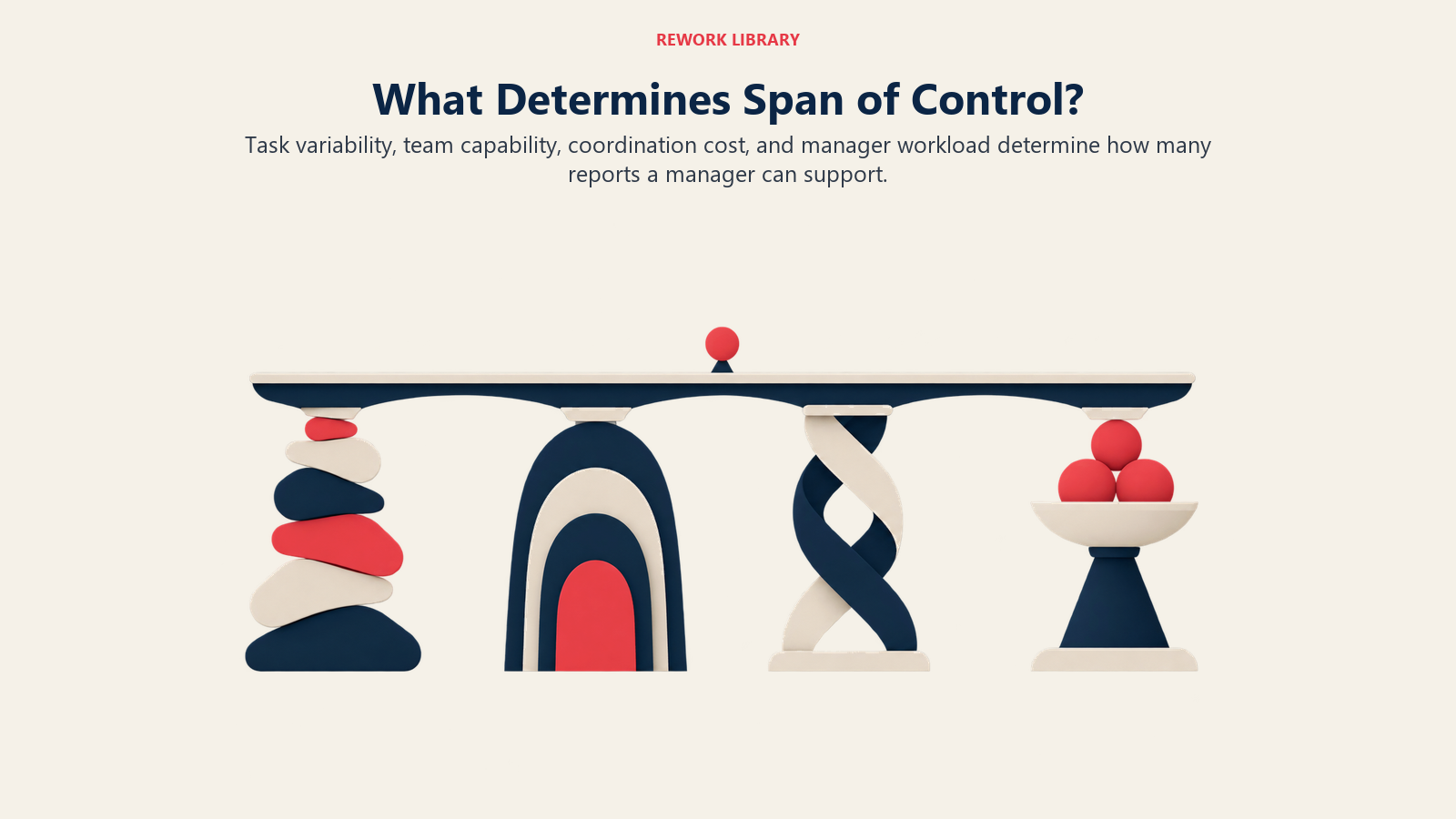
Long before anyone attached the word "agent" to an org chart, management researchers had already worked out that span of control is a function of the work itself, not a preference or a headcount target. Four factors do most of the explaining, and they still hold once AI enters the picture.
Task variability
The more a manager's direct reports face novel, ambiguous problems that do not repeat in the same shape twice, the fewer of them one person can effectively support. A player/coach handling strategic, one-off work tops out around 3 to 5 direct reports in McKinsey's framework, because each report's problem needs individual attention. A coordinator overseeing routine, repeatable work can run 15 or more, because most questions have already been answered once.
Interdependence
Work that requires constant handoffs between team members takes more of a manager's time to keep aligned than work each person can complete independently. A tightly coupled product squad, where one person's output is the next person's input daily, needs closer oversight per head than account managers each running their own book of business.
Coaching and development need
Junior or newly promoted employees need more frequent one-on-ones, feedback, and course-correction than experienced people doing familiar work. A team still building judgment justifies a tighter span than a team of veterans who mostly need blockers removed and direction communicated.
Standardization of the work
The more a task follows a documented process with a clear definition of correct, the less a manager needs to personally verify each instance of it. Call-center and accounts-payable roles, where McKinsey's facilitator and coordinator archetypes sit, tolerate wide spans because exceptions are rare and easy to spot.
None of these four factors is new. What changes with AI is that agents now sit inside the calculation on both sides, sometimes reducing the burden a factor creates and sometimes adding a new one that did not exist before.
Why AI Pushes Span in Both Directions at Once
Most discussion of AI and org design treats span of control as something AI simply widens, on the logic that agents absorb routine work and free up managerial time. That is half the story, and treating it as the whole story is how a span that looks right on a slide breaks in practice.
The case for wider spans
Agents genuinely remove a chunk of what used to consume a manager's week: chasing status updates, compiling reports, scheduling, drafting the first version of a performance summary. Managing agents as part of the team increasingly means the coordination overhead that used to justify a tight span, keeping ten people synchronized by hand, gets absorbed by tooling instead of a calendar. Bain's benchmarking already shows best-in-class companies running spans of 10 to 15 without agents in the picture at all, purely through better standardization. AI extends the same logic for teams doing standardized, well-documented work: an agent can hold the shared playbook a coordinator archetype relies on, exactly the kind of role suited to the widest spans in McKinsey's model.
The case for narrower spans
At the same time, a manager whose team increasingly works through agents has picked up a supervisory job that did not exist five years ago: verifying that agent output is correct, not just that a person's output is complete. This is the same shift covered in from doer to orchestrator, applied one level up. Verifying an agent's confident, well-formatted, sometimes-wrong output is a different cognitive task than checking a person's work, and it does not scale the way status-checking did. A manager reviewing five people's agent-assisted output is not doing five times the reviewing a manager checking one person's would do, it can be closer to five times the vigilance, because keeping human judgment sharp under a wider span gets harder exactly when the volume of agent-produced material goes up.
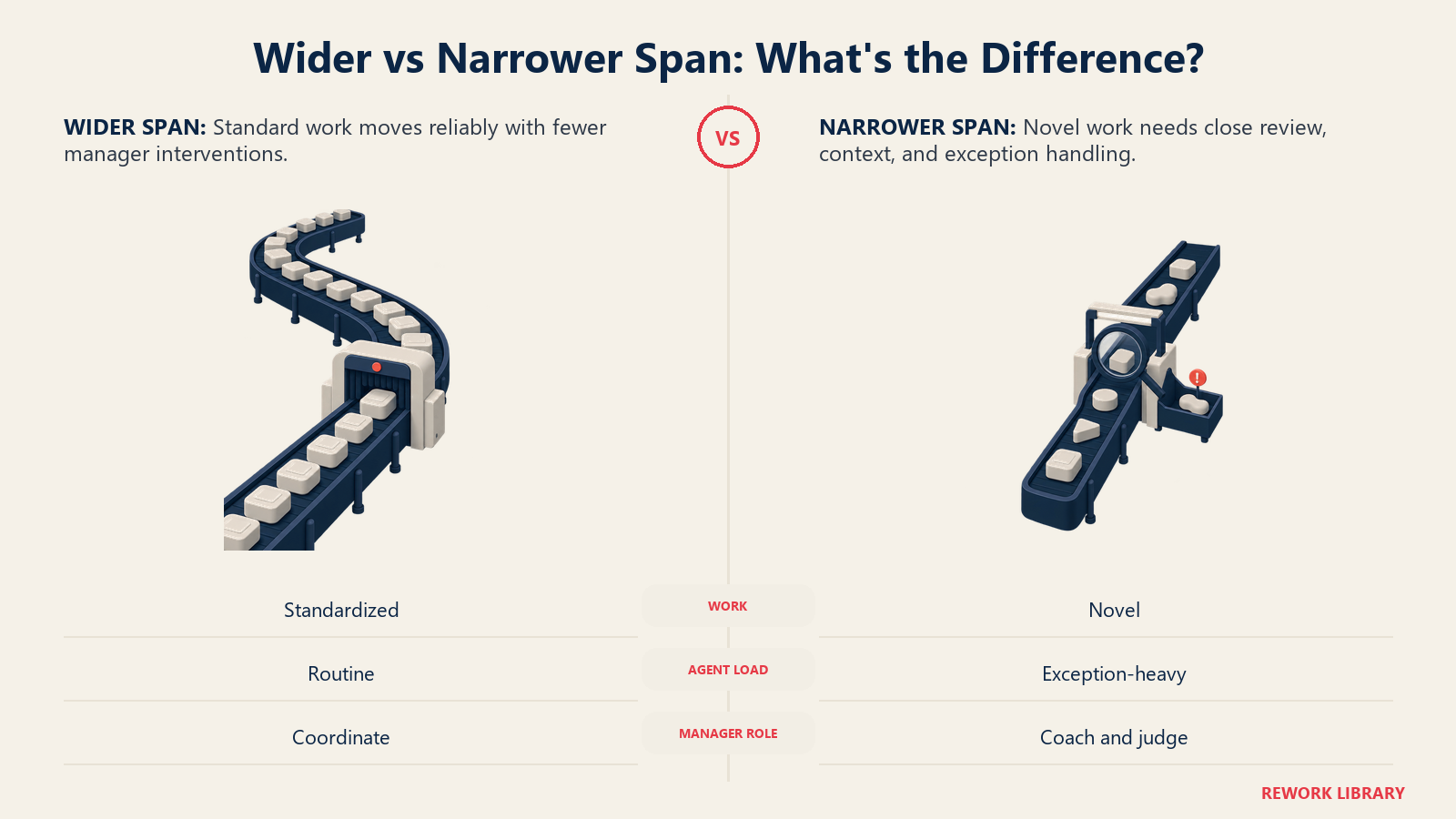
Put the two effects together and AI does not move span of control in one direction. It removes low-judgment coordination load, which supports going wider, and adds judgment-heavy verification load, which supports going narrower. Which one dominates depends entirely on what the team actually does.
Supervising People vs. Supervising Agent Output
These are not the same skill, and collapsing them into one job description is where span-of-control decisions go wrong right now.
Supervising people means managing motivation, development, workload, and interpersonal friction, work that scales with headcount roughly as it always has. A manager with twelve direct reports has twelve one-on-ones and twelve development plans to track, regardless of what tools anyone uses.
Supervising agent output means something closer to quality assurance on a process a person is accountable for but did not personally execute, a version of AI orchestration happening one level above the individual contributor. It does not scale with headcount the same way. A manager overseeing three people who each run five agent workflows is effectively responsible for the correctness of fifteen processes, not three, even though the headcount math says three. This is where the agent boss framing Microsoft uses gets useful: it names a real, distinct responsibility rather than folding it quietly into "management" as if the job had not changed.
A manager's realistic span is a function of two loads that need adding together: how many people they can reasonably develop, and how many agent-mediated workflows they can reasonably verify. A team where every person runs several agentic workflows can hit its verification ceiling well before its people-management ceiling, and a manager tracking headcount alone will not see it coming.
Span Creep: The Hidden Cost of Delayering
Delayering, removing a layer of management and redistributing its reports across the managers who remain, is one of the most common organizational responses to AI adoption right now, and it is also where span of control quietly turns into a cost nobody budgeted for.
Gartner's forecast that a fifth of organizations will use AI to flatten their structure by 2026, cutting more than half of current middle-management roles, is already visible in hiring data. Revelio Labs found middle-management job postings still running 42% below their April 2022 peak as of October 2025 with no sign of recovery, a deeper and more persistent drop than the milder, since-recovered dip seen in entry-level postings. Middle management is not simply pausing hiring. It is being structurally reduced.
The problem is not delayering itself. Bain's own benchmarking shows companies that widen spans and cut layers deliberately, based on the four factors above, can save tens of millions of dollars a year while speeding up decisions. The problem is span creep: cutting a layer first and figuring out the new span second, so survivors inherit whatever headcount lands on them rather than a span sized to the actual work. That is the same mistake behind the AI productivity paradox: changing the structure, or adding a tool, without redesigning what runs through it rarely delivers the promised gain. A manager who absorbs a former peer's five reports on top of their own eight is not automatically running a supervisor archetype's span of 8 to 10. If half of those thirteen people run agent-assisted workflows the manager now has to verify, the real load looks closer to a player/coach's 3 to 5, stretched to nearly triple.
What span creep actually costs
Three costs show up quickly once a span outruns what the work supports, and none of them show up on the org chart that caused them.
Verification gets skipped, not slowed. A manager who cannot review every agent-assisted output in the time available does not review it more efficiently. They review less of it, and a human in the loop that exists on paper but not in practice is not a safeguard at all.
Coaching becomes reactive. Psychological safety depends partly on a direct report believing their manager has the bandwidth to notice a real problem before it becomes a crisis, the same bandwidth an AI-ready culture assumes managers actually have. A span stretched past what coaching needs turns every one-on-one into a status update instead of a development conversation.
Decisions slow down, the opposite of the intended effect. Bain's research is explicit that the point of cutting layers is faster decisions. A manager buried under an unmanaged span becomes a bottleneck for exactly the approvals the flatter structure was supposed to speed up, which is how a delayering initiative sold on agility quietly produces the opposite result within a year.
Setting Span by Team Type, Not One Company-Wide Ratio
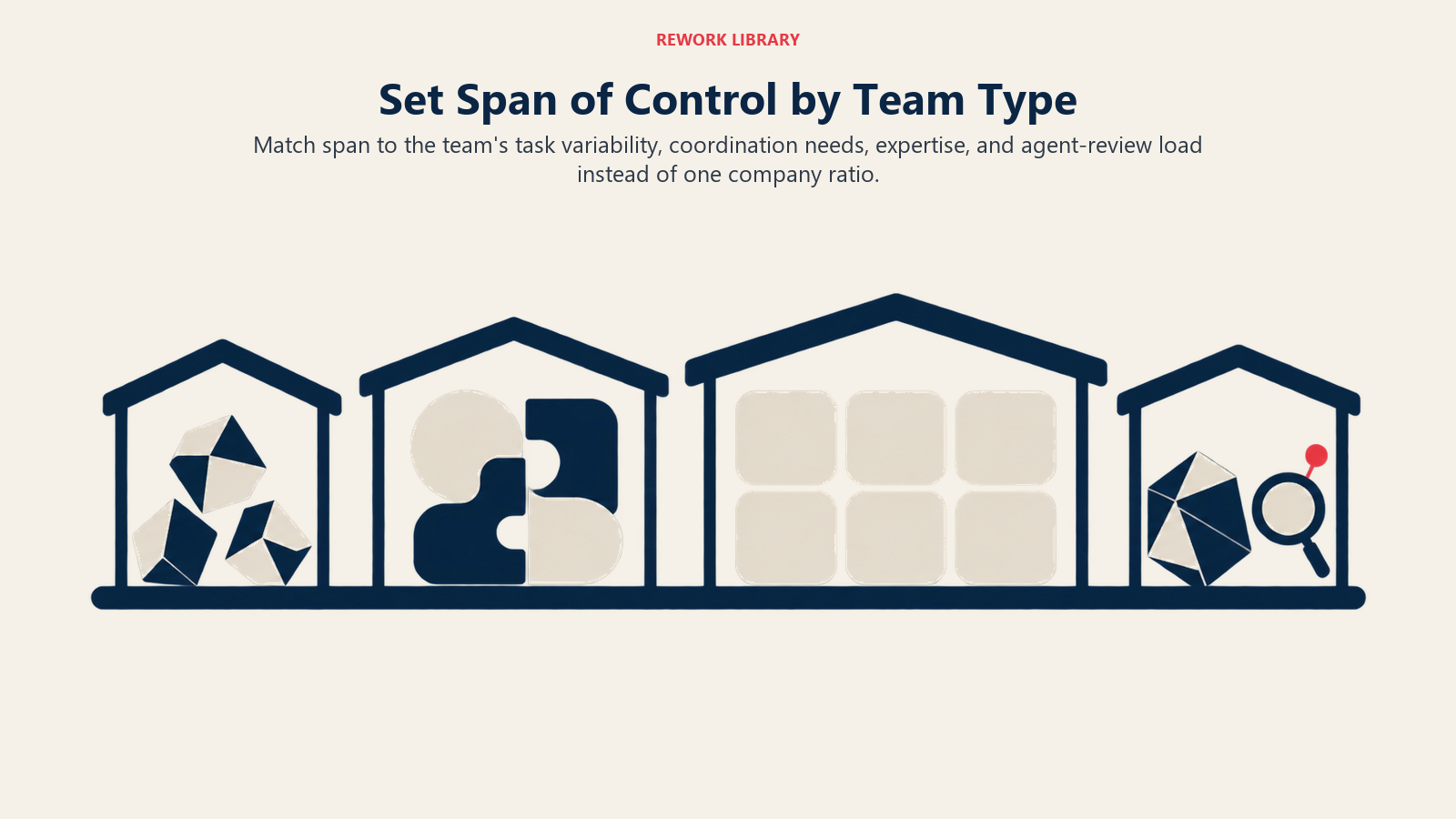
The table below applies the four classic drivers, plus the agent-verification load, to a handful of common team types. Treat it as a starting range to test against your own team's actual work, not a benchmark to hit for its own sake.
| Team type | Primary span driver | Suggested range | Why |
|---|---|---|---|
| Strategic or novel work (new product, M&A integration, executive team) | Task variability, low standardization | 3 to 6 | Each report's problem is different enough that shared playbooks and agent templates help less; coaching load is high |
| Skilled knowledge work with agent-assisted drafting (analysts, marketers, engineers) | Coaching need plus agent-verification load | 5 to 8 | Development need stays real even as agents absorb first-draft work; verifying agent output adds load a pure headcount ratio misses |
| Standardized professional work (accounting, established sales process, senior individual contributors) | Standardization, moderate interdependence | 8 to 12 | Documented process and experienced people reduce both coaching and verification load per head |
| Highly standardized, agent-heavy operations (support triage, back-office processing, call routing) | Standardization, low task variability | 12 to 20 | Agents can hold much of the shared playbook; exceptions are rare enough that a manager can spot-check rather than verify everything |
| Newly delayered or interim teams (post-restructure, absorbed reports) | Unclear, often exceeds actual capacity | Reassess against the rows above, do not default to the inherited number | The span was set by an org chart event, not by task variability, interdependence, coaching need, or agent-verification load |
Work through the table by asking four questions about the team in front of you, not the industry average: how much does the work vary from instance to instance, how tightly does one person's output depend on another's, how much coaching does this specific group of people need right now, and how many agent-mediated workflows will the manager actually have to verify rather than just approve. A team can move down a row as its work standardizes and its people gain experience, and it can move up a row the moment agent adoption adds a new verification burden nobody accounted for.
There Is No Single Correct Span Number
It is worth saying plainly, because so much writing on this topic implies otherwise: there is no credible research that produces one correct span-of-control figure, with or without AI in the picture. McKinsey's own framework spans a five-times range, from 3 to more than 15, depending entirely on the nature of the work. Bain's benchmarking shows well-run companies clustering around 10 to 15 for some roles and far lower for others in the same organization. Any consultant, vendor, or LinkedIn post offering a single number, "the optimal span is seven" or "AI means every manager should now handle twenty," is compressing four variables plus a fifth, newly relevant one, agent-verification load, into a figure that cannot survive contact with an actual team's work.
The useful question is never "what is the right span." It is "what does this team's mix of variability, interdependence, coaching need, and agent-verification load actually support," asked fresh for every team rather than answered once for the whole company.
Putting This to Work Before the Next Reorg
The org chart is usually the last thing redesigned deliberately and the first thing cut when cost pressure hits. Before the next round of delayering lands on your desk as a target headcount ratio, run the four-factor and agent-load test on the teams that will actually absorb the change, not the org chart as a whole. A span that looks efficient on paper and buries managers in unverifiable agent output is not a leaner structure, it is a slower, riskier one wearing a leaner structure's clothes. Get the team-by-team math right first, and the ratio you eventually report to the board will describe real capacity, not a target real teams have to bend themselves around.
Frequently Asked Questions about Span of Control and AI
What is span of control?
Span of control is the number of people who report directly to one manager. It has always depended on factors like task variability, interdependence, coaching need, and how standardized the work is, rather than on a single ideal number that applies across every team.
Does AI increase or decrease the ideal span of control?
Both, depending on the team. AI reduces coordination overhead like status updates and reporting, which supports wider spans for standardized work. It also creates a new supervisory task, verifying agent output for errors, which supports narrower spans for teams doing judgment-heavy, agent-assisted work. The net effect depends on which factor dominates for a specific team.
What is the average number of direct reports per manager right now?
Gallup found the average span of control reached 12.1 direct reports in 2025, up from 10.9 in 2024 and nearly 50% higher than when Gallup first measured it in 2013. That average sits well above McKinsey's suggested range for coaching-heavy or strategic work, which is one sign that spans are widening faster than the work behind them is standardizing in many organizations.
Is there a correct span-of-control number for the AI era?
No credible research supports a single figure. McKinsey's own framework ranges from 3 to more than 15 direct reports depending on the type of managerial work, and that range holds even before adding agent-verification load into the calculation. Any single number offered as a universal target should be treated with skepticism.
What is span creep?
Span creep is when a manager's span grows because of an organizational event, like delayering or a colleague's departure, rather than because the underlying work supports it. The manager inherits reports and workflows sized by an org chart decision instead of by task variability, interdependence, coaching need, or how much agent output they realistically need to verify.
Why are companies cutting middle-management roles right now?
Gartner forecast in 2024 that 20% of organizations would use AI to flatten their structure by 2026, eliminating more than half of current middle-management positions, largely to speed up decisions and reduce cost. Revelio Labs' hiring data shows middle-management job postings already running 42% below their 2022 peak with no recovery, suggesting the shift is well underway rather than purely theoretical.
What is the difference between supervising people and supervising agent output?
Supervising people involves coaching, motivation, and development, and it scales roughly with headcount. Supervising agent output involves verifying correctness across a growing number of agent-run workflows, and it can scale faster than headcount if each person on a team runs multiple workflows a manager is accountable for checking.
How should a leader actually set span of control instead of picking a number?
Work through the team's task variability, interdependence, coaching need, and standardization, then add how many agent-mediated workflows the manager will realistically need to verify rather than just approve. Set the span for that specific team's mix of factors, and revisit it as the work standardizes or agent adoption changes the verification load, rather than applying one company-wide ratio.
What is the biggest risk of delayering without addressing span of control directly?
The intended benefit, faster decisions, tends to reverse. A manager whose span exceeds what the work supports becomes a bottleneck for the same approvals the flatter structure was meant to speed up, while verification gets quietly skipped and coaching turns reactive, none of which shows up on the org chart that caused it.

Co-Founder, Rework.com
On this page
- Key Facts
- What Actually Determines Span of Control
- Task variability
- Interdependence
- Coaching and development need
- Standardization of the work
- Why AI Pushes Span in Both Directions at Once
- The case for wider spans
- The case for narrower spans
- Supervising People vs. Supervising Agent Output
- Span Creep: The Hidden Cost of Delayering
- What span creep actually costs
- Setting Span by Team Type, Not One Company-Wide Ratio
- There Is No Single Correct Span Number
- Putting This to Work Before the Next Reorg