Reinforcing Culture Through Recognition: Why You Get More of What You Celebrate
Turn this article into takeaways for your work.


Each assistant summarizes the article only for you and suggests best practices for your work.
Updated August 2026
Reinforcing culture through recognition means using praise, thanks, and visible acknowledgment to repeat the specific behaviors an organization wants more of. It works because recognition operates as a behavioral signal, not a nicety: whatever gets celebrated in front of a team is what the team learns to do again, and whatever goes unnoticed quietly stops happening, regardless of what the values statement says.
Most companies already believe in recognition in the abstract. They run an "employee of the month" board, send a birthday card, hand out a gift card at the quarterly meeting. Almost none of that changes behavior, because it isn't built to. Real recognition is a culture mechanism with specific design requirements: it has to be tied to a value, delivered with enough detail that the behavior is legible, and repeated often enough that people believe it's real. Get those three things right and recognition becomes one of the cheapest, fastest levers a company has for turning a values statement into something people actually do.
Recognition as a Culture Mechanism, Not a Perk
Culture is often described as "the way things are done here," but that phrase hides the actual mechanism. Things get done a certain way because certain behaviors are rewarded and others aren't, and reward doesn't have to mean money. Attention is a reward. Public credit is a reward. A manager stopping mid-meeting to say "that's exactly the kind of judgment call we want more of" is a reward, and it costs nothing but a sentence.
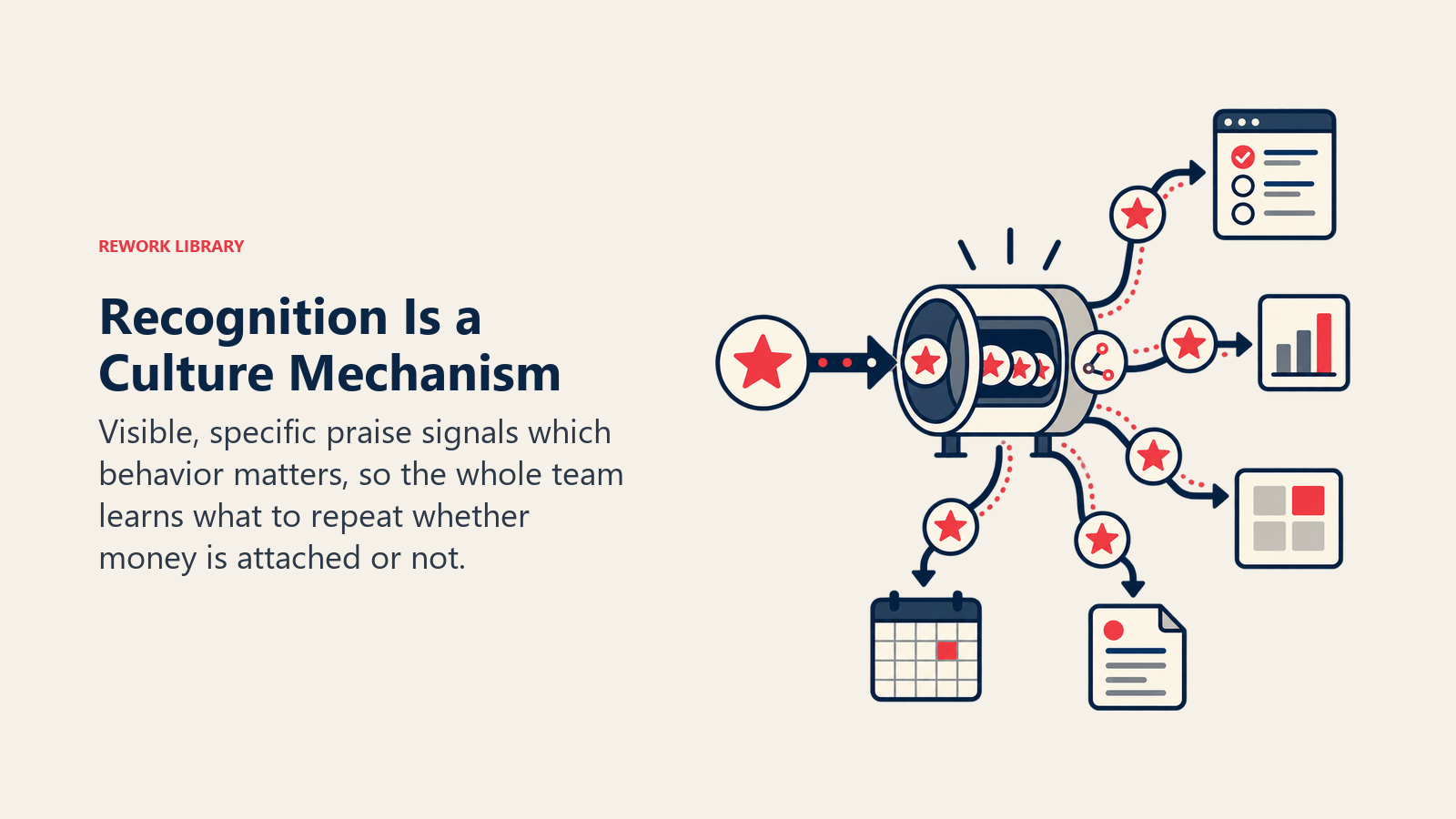
This is the operant logic behind what business culture actually is: a system of shared values and unwritten rules that people learn largely by watching what happens to others. Recognition is one of the fastest ways that learning happens, because it's public, specific, and immediate in a way a values workshop never is. A new hire who sees a colleague praised by name for flagging a risk early learns more about what the company actually values in that thirty seconds than in an entire onboarding deck.
You Get More of What You Celebrate
The simplest way to say this: whatever a team celebrates, it gets more of, and whatever it ignores, it gets less of, whether or not anyone intended that outcome. A sales team that only celebrates closed deals will get people who chase closes and go quiet about the deals that fell apart from a bad process. A team that also celebrates the rep who flagged a risky contract term before it became a problem will get more people willing to slow down and flag things. Nobody has to announce a new value for this shift to happen. The celebration itself is the announcement.
This is why recognition and stated values drift apart so easily. A company can put "collaboration" on the wall and still run a recognition culture that only ever singles out individual heroics, because that's what gets noticed in the moment. The wall says one thing. The applause says another. Employees believe the applause.
Recognition vs. Reward: Why the Distinction Matters
Recognition and financial reward often get bundled into the same conversation, but they do different jobs. A bonus tells someone the company can afford to pay for an outcome. Recognition tells them, and everyone watching, exactly which behavior produced it. A bonus paid quietly and privately reinforces almost nothing beyond the individual's own motivation. The same bonus, announced with the specific reason behind it in front of the team, becomes a culture signal the bonus alone never was. Money changes an individual's incentives. Visible, specific recognition changes what the whole team believes gets valued.
Key Facts
- Employees who received high-quality recognition in 2022 were 45% less likely to have left their job by 2024. Source: Workhuman / Gallup
- More than half (55%) of U.S. employees receive no recognition at all, or recognition that doesn't fulfill any of Gallup's five recognition pillars; those who get even one pillar are 2.9 times as likely to be engaged. Source: Gallup
- Recognized employees are up to 10 times as likely to strongly agree they belong at their organization. Source: Gallup
- If a 10,000-employee organization doubled the share of workers who strongly agree they were recognized for good work in the past week, Gallup modeling puts the productivity gain at roughly $92 million in added employee output. Source: Gallup
- Peer-to-peer recognition programs were 35.7% more likely to have a positive impact on financial results than manager-only recognition programs. Source: SHRM / Globoforce, Fall 2012 report
- 42% of senior executives now strongly agree recognition must be a key pillar of their engagement and retention strategy, up from 28% two years earlier. Source: Workhuman / Gallup
Peer-to-Peer vs. Top-Down Recognition
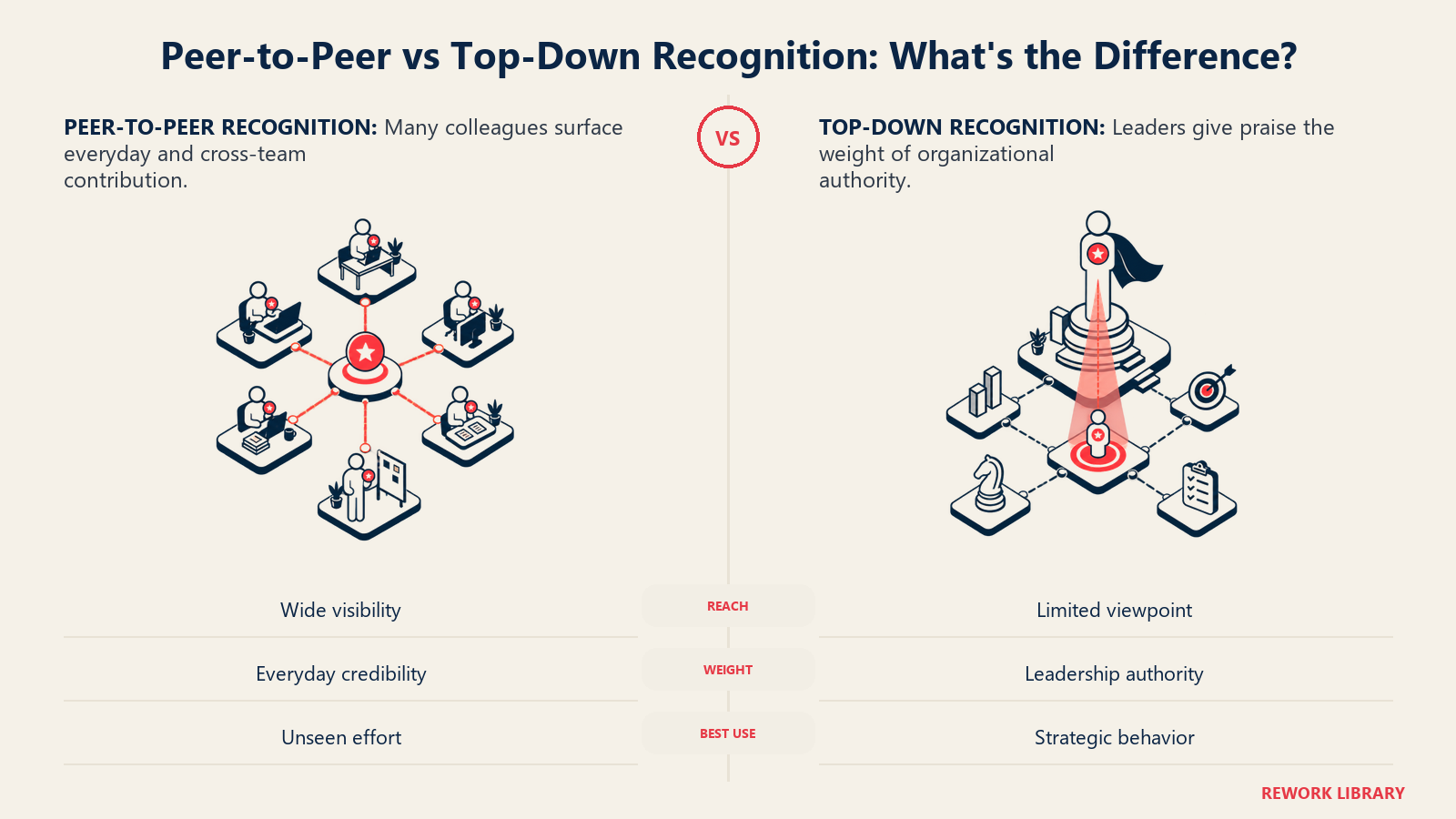
Most recognition programs default to top-down: a manager praises a direct report, or a leadership team hands out an annual award. That's not wrong, but it's incomplete, and treating it as the whole system is where a lot of recognition efforts stall out.
What Top-Down Recognition Does Well
A manager's praise carries authority a peer's doesn't. When a leader publicly credits someone for a specific behavior, it signals that the behavior matters at the level decisions get made, not just at the level of being a nice colleague. Top-down recognition is also the mechanism leadership actually has for shaping culture: what a leader chooses to notice in front of a room tells everyone in that room what the leader is actually paying attention to, regardless of what's in the strategy deck.
The failure mode is visibility. A manager only sees a fraction of the behavior on their own team, and almost none of it on adjacent teams. Praise concentrated in one manager's hands inevitably reflects that manager's blind spots, and over time it starts to look like favoritism even when it isn't, simply because it keeps landing on the same few people who happen to be visible.
What Peer-to-Peer Adds
Peers see things managers structurally can't: who actually helped when a project went sideways, who answered a Slack question at 9pm without being asked, who quietly covered for a teammate out sick. None of that shows up in a manager's dashboard. A peer-to-peer recognition channel, whether it's a dedicated tool or just a public Slack channel with a habit attached, surfaces behavior that would otherwise go completely unseen.
It also solves a scale problem top-down recognition can't. One manager, however well-intentioned, can only notice so much. A team of twenty peers noticing on each other's behalf multiplies the surface area for catching good behavior by an order of magnitude, which is a large part of why peer programs outperform manager-only recognition on financial impact in the research above.
Combining Both, Not Choosing One
The strongest recognition systems don't pick a lane. Peer recognition catches the everyday behaviors nobody above would ever see; top-down recognition adds the weight of "this matters at the level the company runs on." Used together, they cover both the volume problem and the authority problem that either one alone leaves open.
| Dimension | Top-Down Recognition | Peer-to-Peer Recognition |
|---|---|---|
| Main strength | Signals what leadership actually values | Catches behavior managers structurally can't see |
| Main weakness | Limited visibility, concentrated in one person's blind spots | Can drift toward popularity over performance without a values anchor |
| Best for | High-stakes moments, strategic behaviors, promotions | Everyday follow-through, unseen effort, cross-team help |
| Failure mode if used alone | Recognition becomes rare and feels political | Recognition becomes frequent but shallow, a "thanks" with no weight |
| Fix | Pair with a peer channel to widen visibility | Anchor to named values so it stays credible, not just friendly |
Values-Based Recognition: Tying Praise to What You Actually Want More Of
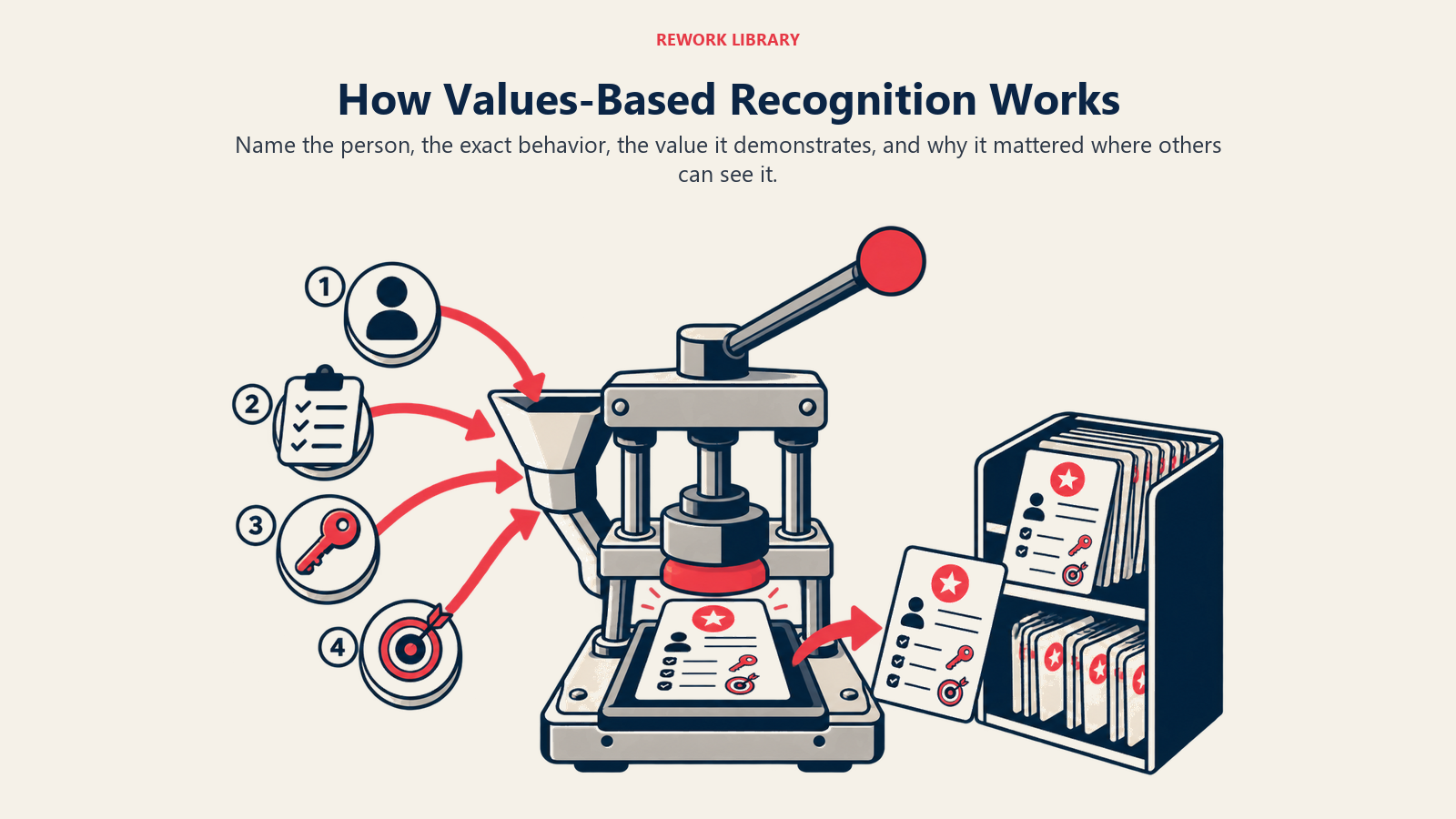
Generic praise ("great job," "thanks for this") feels nice and does almost nothing for culture, because it doesn't tell anyone what specifically to repeat. Values-based recognition names the behavior and connects it explicitly to a stated value, which is the difference between recognition that reinforces culture and recognition that's just politeness.
Generic Praise vs. Values-Based Praise
"Nice work on the client call" tells the room nothing repeatable. "You told the client the timeline was going to slip before they asked, and that's exactly the transparency we say we want" tells the room precisely what to do next time a deadline gets shaky. The second version does everything the first one does emotionally, plus it functions as a culture instruction. This is the same behavior-not-vibes discipline that makes defining company values actually usable: a value only becomes real once it's tied to a specific, nameable action, and recognition is where that connection gets made in public, over and over.
How to Build a Values-Based Recognition Habit
Values-based recognition doesn't require new software to start. It requires a habit and a template: name the person, name the specific thing they did, name the value it demonstrates, and say it somewhere others can see it. A weekly team meeting, a pinned Slack message, a five-minute segment in a standup, any of these work as long as the habit repeats on a predictable cadence and the value gets named out loud every time, not implied.
Over time, this habit does something a values poster never can: it builds a living library of "here's what the value actually looks like when someone does it," told through real examples instead of abstractions. New hires learn the culture faster from six months of these stories than from any onboarding document, which is the same mechanism covered in onboarding for culture: people copy what they see rewarded, not what they're told to believe.
Cadence and Specificity: Why "Employee of the Month" Fails
The most common recognition program in corporate history is also one of the least effective, and it's worth understanding exactly why, because the same two flaws show up in almost every recognition program that quietly stops working.
The Cadence Problem
Recognition that happens once a month, or once a quarter, is too rare to function as a behavioral signal. By the time the award gets announced, the behavior it's supposedly reinforcing happened weeks ago, disconnected from the moment it mattered. Behavior gets reinforced by proximity: praise close to the action teaches something. Praise a month later reads as ceremony. A weekly or even daily recognition cadence, even a small one, does more culture work than a single large annual award, because it stays close enough to the behavior to actually shape what happens next.
The Specificity Problem
"Employee of the month" also tends to reward a person rather than a behavior, which is a subtle but important failure. Once someone wins, the rest of the team learns almost nothing about what to repeat, because the citation is usually vague ("consistently great work") rather than tied to a single, nameable action. Specific recognition, even something as small as "you rewrote that onboarding doc after getting three confused questions in a row, and that's the kind of initiative we want," teaches the entire team a concrete lesson an award plaque never does.
Fixing Both at Once
The fix isn't more elaborate software or a bigger budget. It's smaller, more frequent, more specific recognition, distributed across more people, tied explicitly to a value each time. A program that recognizes five people a week for a specific, named behavior will move culture further than one that recognizes one person a month for being generally excellent.
Recognition in Remote and Distributed Teams
Recognition that used to happen by accident in an office, a manager overhearing a good call, a colleague noticing someone stayed late to help, doesn't happen automatically once a team goes remote. That loss compounds the challenges already covered in culture on remote and hybrid teams: recognition has to become deliberate precisely because the incidental version disappears.
What Gets Lost Without the Hallway
A remote employee who quietly fixes a problem before it becomes visible gets zero credit unless someone chooses to surface it, because there's no hallway conversation to catch it in. The asymmetry is real: loud, visible work gets seen on video calls and in shared documents, while quiet, high-value work often goes completely unnoticed unless a deliberate system exists to catch it. Left unmanaged, remote recognition systematically rewards visibility over contribution, which is its own kind of culture drift.
Building Deliberate Remote Recognition
The fix is the same principle as office recognition, just intentional instead of incidental: a standing weekly ritual (a channel, a segment of a team call, a recurring async post) where recognition happens on a fixed cadence rather than whenever someone happens to remember. Asynchronous recognition has one advantage the office never had: it's permanent and searchable. A written "here's what you did and why it mattered" message becomes something a person can revisit on a hard day, which a hallway comment never was. Remote teams that build this habit early often end up with more durable recognition than office teams that relied on hallway luck.
When Recognition Backfires: Tokenism and Inequity
Recognition isn't automatically good just because it's happening. Done carelessly, it can actively damage trust and morale faster than no recognition program at all, because it looks like fairness while quietly reinforcing the opposite.
Recognition Inequity: Who Actually Gets Seen
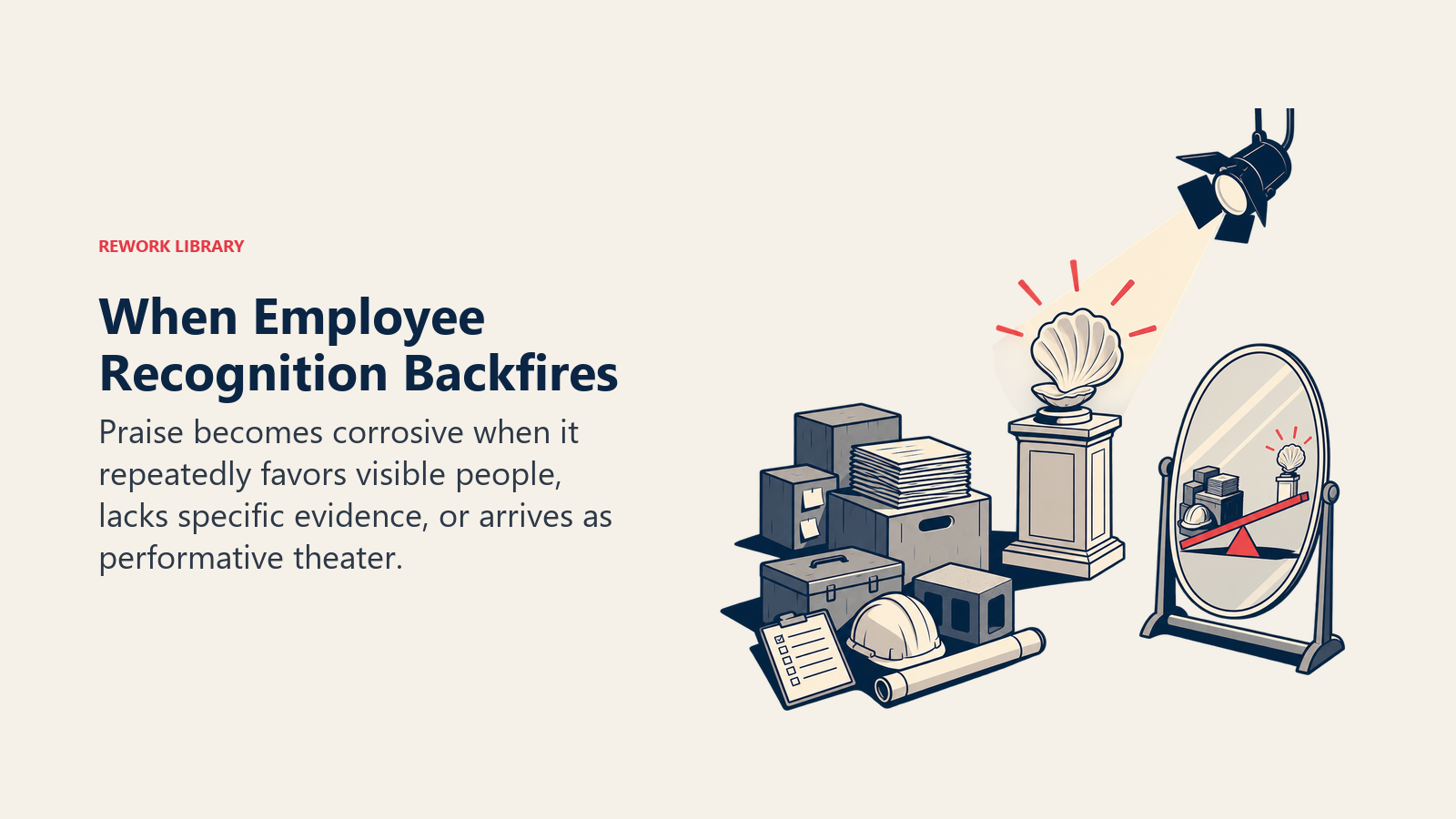
Recognition tends to concentrate on whoever is already visible: the loudest voice in meetings, the person whose manager happens to be paying close attention, the employee whose work naturally produces demo-able output. Quiet, essential work, the kind that keeps things running rather than launching something new, gets systematically overlooked unless someone deliberately looks for it. Left unchecked, a recognition program can end up rewarding the same handful of people every quarter, which teaches everyone else a corrosive lesson: effort here only counts if it's already visible to the right person. This is one more reason recognition and DEI in culture sit closer together than most programs acknowledge; a recognition list that never varies is itself a diagnostic worth reading.
Tokenism and Performative Praise
Recognition backfires just as badly when it's performative: praise handed out to check a box, disconnected from anything the person actually did, or recognition timed suspiciously close to a survey or an audit. Employees notice the pattern fast, and once they conclude that recognition is theater rather than a genuine signal, they stop trusting any of it, including the recognition that was actually earned. A single hollow "recognition moment" staged for optics can quietly poison months of real ones that came before it.
How to Guard Against Backfire
A few habits keep recognition credible instead of corrosive: track who gets recognized over a quarter, not just a week, and look for patterns that skew toward the same few names. Make specificity mandatory, since vague praise is where performative recognition hides most easily. And treat recognition data the same way you'd treat engagement survey data: as a signal worth auditing periodically, not a program you set up once and never revisit.
Recognizing Good Judgment in the Age of AI
AI-assisted work is changing what's actually worth recognizing, and it's worth being direct about the risk here. As AI tools handle more first-draft output, it becomes tempting to recognize volume: who shipped the most, who cleared the most tickets, who generated the most content. That's exactly the wrong metric to celebrate, because AI tools have made raw output cheap for almost everyone at once. Rewarding volume in a world where volume is easy just rewards whoever has the loosest judgment about what's worth shipping.
What's actually scarce, and worth recognizing, is judgment: the person who caught that an AI-drafted contract clause didn't match the actual deal terms, the one who used an agent to handle a routine task and spent the freed-up time on something that genuinely needed a human, the one who was honest that an AI-assisted deliverable needed a second pass before it went to a client. These are the behaviors that determine whether human-agent teams actually work well together or quietly accumulate cultural debt: unreviewed shortcuts and unexamined assumptions baked into work nobody has time to double-check.
The recognition habit here is the same one that works everywhere else in this article, just pointed at a newer behavior: name the specific judgment call, name why it mattered, say it in front of the team. "You caught that the AI summary missed a caveat the client needed" is a values-based recognition moment the same way catching a risky contract term is. Do this consistently and a team learns that careful, honest judgment about AI-assisted work is what actually gets celebrated here, not raw throughput. Skip it, and the team learns the opposite by default, simply because volume is easier to notice than judgment ever is.
Building a Recognition System That Reinforces the Right Culture
None of the above requires new software to start. It requires a habit: pick a cadence, require specificity, name the value every time, and mix peer and top-down channels instead of relying on just one. Where a system does help is consistency at scale: making sure recognition actually happens on the cadence you committed to, rather than the first thing that slips when a quarter gets busy, and keeping a record that lets you audit who's actually getting seen over time rather than trusting anecdote. That's closer to what Rework's People app is built to support: the operational backbone underneath recognition, not a replacement for a manager who's actually paying attention.
The throughline across every section here is the same: culture isn't set by the values on the wall. It's set by what gets noticed, named, and celebrated out loud, week after week, in front of the people watching. Get that consistent and specific, and the values statement finally starts describing something real. Leave it random, rare, or hollow, and the wall keeps saying one thing while the applause quietly teaches everyone something else, which is the version most employees have already learned to believe.
Where to Go Next
- What is business culture?, for the broader system recognition operates inside
- Building a feedback culture, the sibling practice that makes recognition credible
- The link between culture and performance, for how these behavioral signals compound over time
- How to measure company culture, for tracking whether recognition is actually reaching everyone

Co-Founder, Rework.com
On this page
- Recognition as a Culture Mechanism, Not a Perk
- You Get More of What You Celebrate
- Recognition vs. Reward: Why the Distinction Matters
- Key Facts
- Peer-to-Peer vs. Top-Down Recognition
- What Top-Down Recognition Does Well
- What Peer-to-Peer Adds
- Combining Both, Not Choosing One
- Values-Based Recognition: Tying Praise to What You Actually Want More Of
- Generic Praise vs. Values-Based Praise
- How to Build a Values-Based Recognition Habit
- Cadence and Specificity: Why "Employee of the Month" Fails
- The Cadence Problem
- The Specificity Problem
- Fixing Both at Once
- Recognition in Remote and Distributed Teams
- What Gets Lost Without the Hallway
- Building Deliberate Remote Recognition
- When Recognition Backfires: Tokenism and Inequity
- Recognition Inequity: Who Actually Gets Seen
- Tokenism and Performative Praise
- How to Guard Against Backfire
- Recognizing Good Judgment in the Age of AI
- Building a Recognition System That Reinforces the Right Culture
- Where to Go Next