Culture and Engagement Surveys: A Practical Guide
Turn this article into takeaways for your work.


Each assistant summarizes the article only for you and suggests best practices for your work.
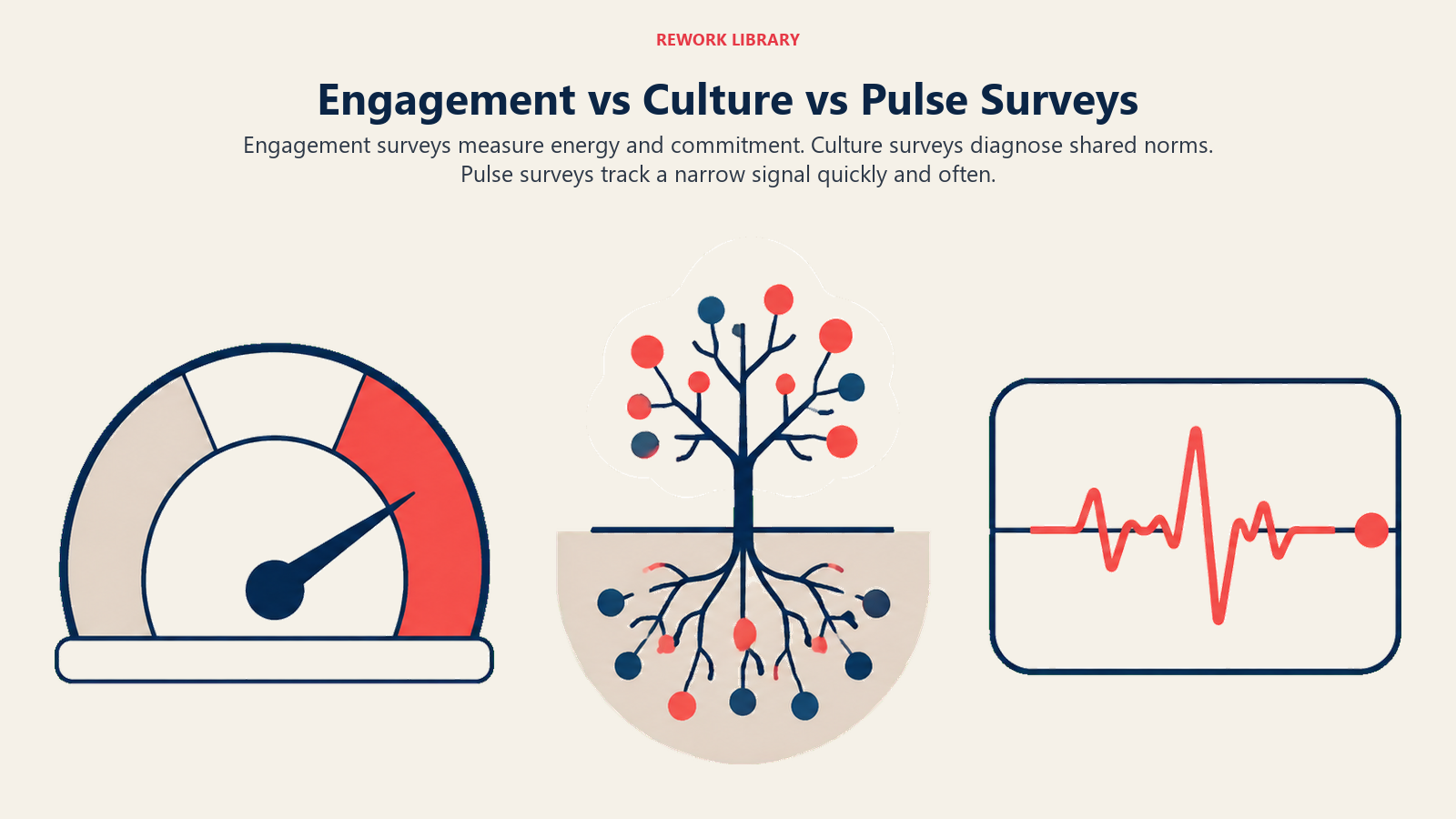
An engagement survey measures how motivated and committed people feel about their work and their employer. A culture survey measures the deeper values, norms, and behaviors that produce that feeling in the first place. They are not the same instrument, they answer different questions, and most companies run one of them, call it "measuring culture," and never notice the gap.
That gap is expensive. A team can score fine on engagement (people like their manager, the pay feels fair) while sitting on top of a culture problem engagement questions were never built to catch: a promotion system rewarding the wrong behavior, or a team that has learned speaking up costs more than it's worth. This is the deep dive on the survey instrument: engagement versus culture versus pulse formats, what to actually ask, how often to run it, how to get answers people mean, and why closing the loop kills more programs than bad questions ever do. For the fuller toolkit, including eNPS, the OCAI, focus groups, and behavioral signals, see how to measure company culture; this article stays focused on the survey itself.
Engagement Survey vs. Culture Survey vs. Pulse Survey
These three terms get used interchangeably, and that's the first source of bad data. Each one answers a different question, and picking the wrong one is how organizations end up with dashboards nobody trusts.
| Survey type | What it actually asks | Typical length | Typical cadence |
|---|---|---|---|
| Engagement survey | Do people feel motivated, supported, and committed right now? | 30 to 60 questions | Annual or twice a year |
| Culture survey | What are the actual shared values, norms, and behaviors, and do they match what leadership claims? | 40 to 80 questions, often including forced-choice or scenario items | Every one to two years, or triggered by a merger, reorg, or leadership change |
| Pulse survey | Is a specific, narrow signal trending up or down since last time? | 5 to 10 questions | Weekly, monthly, or quarterly |
An engagement survey is a mood check with structure: Gallup's Q12, the best-known example, asks whether people know what's expected of them, have what they need to do the job, feel their opinions count, and have a chance to grow. A culture survey goes underneath that mood to the system producing it, closer to what the Organizational Culture Assessment Instrument (OCAI) does when it scores how the company operates today against a set of competing culture types. A pulse survey isn't trying to diagnose anything. It's a thermometer you check often enough to notice a fever before it becomes a crisis.
Where eNPS Fits
Employee Net Promoter Score is a specific pulse question: "How likely are you to recommend this company as a place to work, zero to ten?" It's cheap and easy to run often, but a poor stand-alone diagnostic, since a single number tells you the temperature moved without telling you why. Treat it as one pulse input, not a replacement for the other two.
What to Actually Measure
The instinct with a new survey is to ask about everything: pay, benefits, the cafeteria, the new logo. Resist it. A long survey with soft, scattered questions produces a low completion rate and answers that don't point anywhere. A short survey built around categories that actually predict behavior produces a trend line you can act on.
The Question Categories That Matter
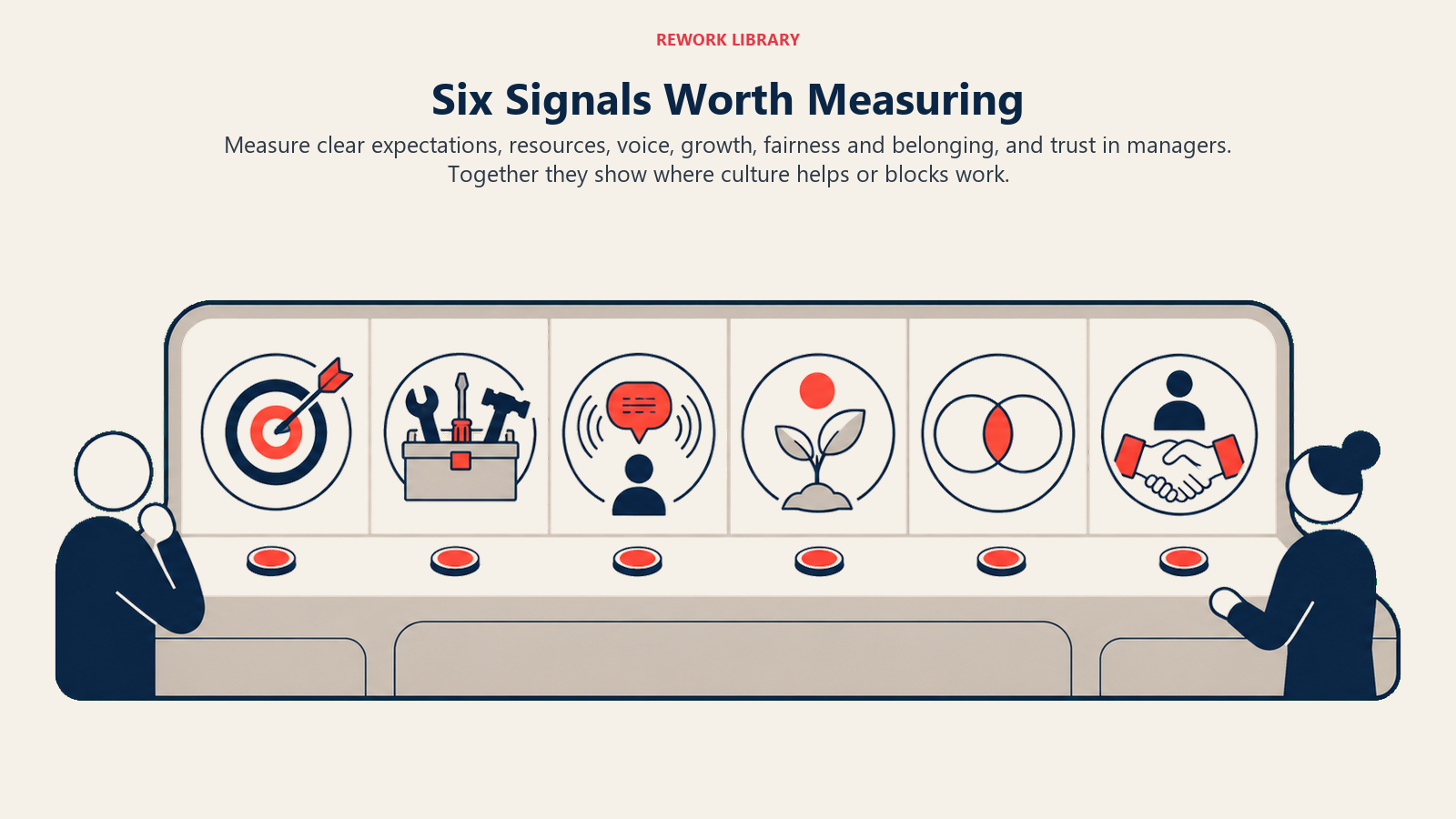
Clarity of expectations. Do people know what's expected of them this week, not just in the abstract job description. Confusion here quietly drives most of the "why isn't this done yet" friction between managers and teams.
Resources and support. Do people have the tools, information, and authority to make the calls their role requires.
Voice. Do people believe their opinions actually count. Most organizations badly overestimate how well they're doing on this one: Gallup's Q2 2025 data found only 28% of employees strongly agree their opinions count at work, a gap between a leader's assumption and the real number that a survey is supposed to surface. Source: Gallup
Growth. Is someone actively developing this person, or have they been left to figure out their own trajectory. Stagnation here is a quiet predictor of a resignation nobody saw coming.
Belonging and fairness. Do people feel they're evaluated by the same standard as everyone else and belong on the team regardless of background or tenure.
Manager relationship and trust in leadership. Since managers account for most of the variance in how engaged their teams feel, a company-wide average hides exactly the data that would let someone act. Source: Gallup Trust compounds too: workers who trust their manager most report being 72% more motivated than those who trust them least. Source: PwC
Good Questions vs. Bad Questions
The difference between a question that produces action and one that produces a shrug usually comes down to specificity: answerable from lived experience, not opinion about the company in the abstract.
| Weak question | Why it fails | Stronger version |
|---|---|---|
| "Are you happy at work?" | Too vague to act on, and mood is not the same as engagement | "In the past month, did you have what you needed to do your best work?" |
| "Is communication good here?" | "Good" means something different to every respondent | "When leadership makes a decision that affects my team, I understand the reasoning behind it." |
| "Do you like your manager?" | Measures likability, not the behaviors that predict performance | "My manager gives me feedback that helps me improve, not just feedback that's easy to deliver." |
| "Is our culture inclusive?" | Abstract and self-reporting; almost everyone answers favorably | "I've seen someone challenge a decision in a meeting without it costing them anything." |
| "Rate your overall satisfaction 1 to 10" | A single number with no diagnostic value on its own | Pair a numeric item with one open-text follow-up: "What's the main reason for that score?" |
The pattern across every "stronger version" is the same: ask about a specific, recent, observable moment instead of a general feeling. A behavioral question is harder to answer with the safe, generic response that protects the person giving it.
Key Facts
- Business units in the top half of Gallup's Q12 engagement meta-analysis had nearly double the odds of overall success versus the bottom half, and top-percentile units posted 21% higher profitability and 17% higher productivity. Source: Gallup Q12 Meta-Analysis, 11th Edition
- Only 28% of employees strongly agreed their opinions count at work in Gallup's Q2 2025 data, one of the clearest gaps between leader assumption and reality. Source: Gallup
- Workers who trust their direct manager most report being 72% more motivated than workers who trust them least. Source: PwC, 2025 Global Workforce Hopes and Fears Survey
- Just 7% of employees say their company sends too many surveys; the bigger driver is the belief that answering never leads to visible change. Source: Culture Amp
- Perceptyx's updated sentiment-analysis model achieved a 25% improvement in accuracy reading open-text survey comments, now matching or exceeding human raters. Source: Perceptyx
- 65% of organizations say their culture needs to change significantly because of AI, but only 5% report strong progress, a gap that starts with most never adding AI-specific survey questions. Source: Deloitte, 2026 Global Human Capital Trends
Annual vs. Pulse: Choosing Your Cadence
The cadence question is where most survey programs go wrong before a single question gets written, because leaders default to whichever cadence their previous employer used rather than what the organization actually needs.
Annual for Depth, Pulse for Speed
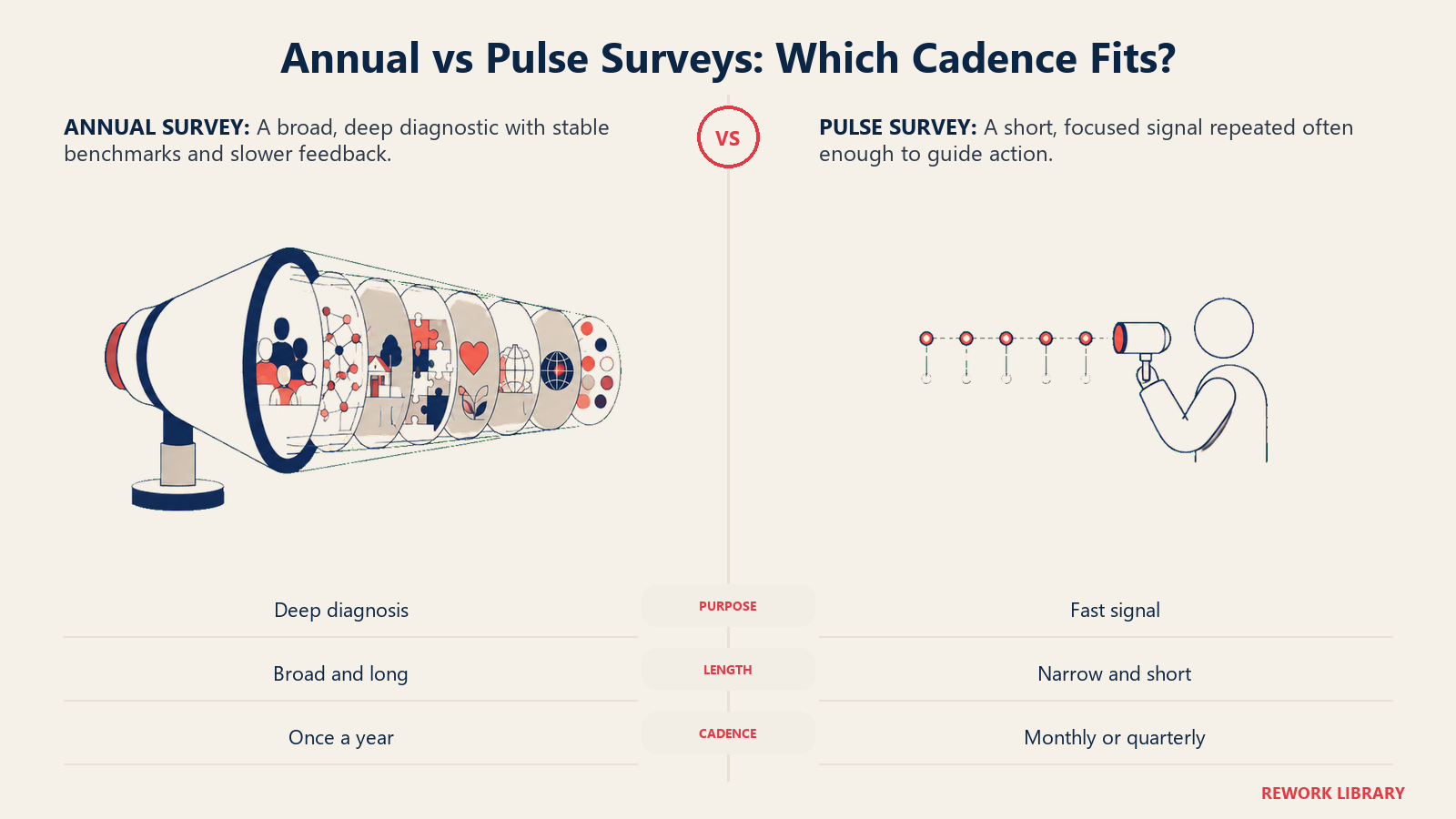
A longer annual or biannual survey is the only format with enough questions to support real benchmarking against industry norms and your own prior years, and it's what most vendor analytics are built around. Its weakness is speed: a problem that started in March doesn't surface until the next survey window, by which point it may already show up as resignations. A short, frequent pulse (five to ten questions, monthly or quarterly) trades that depth for speed, catching a dip while it's still cheap to fix, though it can't diagnose a root cause on its own. It tells you something moved, not why.
A Blended Cadence That Works
Most organizations that get real value from surveying run both on different jobs. A longer survey once or twice a year sets the benchmark and does the deep diagnostic work. A short pulse tracks the categories that matter most (voice, manager trust, workload) between the bigger surveys and flags a problem early. National culture shapes the interpretation too: teams shaped by more indirect or hierarchical norms may need a different pulse framing than teams used to blunt, low-context feedback, covered in high-context versus low-context cultures.
Getting Honest Answers: Anonymity and Psychological Safety
None of the above matters if people don't answer honestly, which is harder than most rollouts assume.
Anonymity Alone Doesn't Buy Trust
Technical anonymity, no name attached to a response, is the baseline, not the finish line. If employees suspect a small team size or a distinctive comment could still identify them, they self-censor regardless of the privacy policy. Reporting results for a team of four effectively de-anonymizes every response, so most mature programs suppress results below a minimum group size, commonly five.
The Real Driver of Honesty
The deeper driver isn't the anonymity setting. It's whether people already believe speaking up is safe, the same condition behind psychological safety at work. A team that has learned raising a concern gets held against you will give cautious, flattened answers no matter how the tool is configured, the same dynamic behind why teams stay silent in meetings. Uniformly positive scores next to high turnover or low internal mobility are a signal to look closer, not a reason to relax.
Closing the Loop: Where Most Survey Programs Die
The Close-the-Loop Failure
Here is the single most common way a survey program collapses. Round one goes well: good response rate, a few clear findings. Leadership reviews the results privately, adjusts a policy nobody explains, and moves on. Round two gets a noticeably lower response rate, and by round three the survey is barely worth running. Everyone assumes the drop is survey fatigue. It's usually broken trust: people answered honestly once, saw no visible change, and updated their belief that answering is worth the effort.
What Closing the Loop Actually Looks Like
Closing the loop means telling people what the data showed and what's being done, even when the answer is "we heard this, and we're not changing it right now, here's why." Silence after a survey reads as "nothing happened" whether or not something did. It also means pushing accountability down to the level that can act: a company-wide average is nearly impossible for anyone to own, while a team-level result reviewed with that manager is something specific someone answers for, the same logic behind culture architecture. Responding quickly and visibly is its own discipline, closer to building a feedback culture than to running a bigger survey next time.
Survey Fatigue and Vanity Metrics
"Survey fatigue" gets blamed for almost every drop in response rate, and it's usually the wrong diagnosis. As the Culture Amp data above shows, only a small share of employees actually say their company surveys too often. The real driver is the action gap: people don't mind answering; they mind answering into a void.
Vanity metrics make that void easier to hide. A 95% completion rate looks great in a leadership deck but says nothing about honesty on a team that doesn't trust its answers are protected. Flat, uniformly positive scores paired with a high response rate often mean caution, not health. The fix isn't a shorter survey or a bigger incentive to respond. It's visibly closing the loop before asking for a new one, and cutting results by team and manager instead of publishing a company-wide average that flatters everyone and informs no one.
Vendors and Frameworks: A Brief Field Guide
You don't need to evaluate every platform on the market, just know what category a tool belongs to before a vendor conversation starts.
| Tool or framework | Best known for | Good fit for |
|---|---|---|
| Gallup Q12 | The original, most validated 12-item engagement instrument | A benchmarked annual engagement baseline |
| Culture Amp | Engagement and culture surveys with built-in action-planning workflows | Tracking the survey and follow-through in one place |
| Perceptyx | Large-scale continuous listening with AI-driven comment analysis | Enterprises running frequent pulses at scale |
| Qualtrics EmployeeXM / Glint | Enterprise-grade listening with heavy customization | Complex orgs with dedicated people-analytics teams |
| Officevibe, Workleap, Lattice | Lightweight pulse tools built into people-management suites | Small and mid-market teams without a separate platform |
| OCAI (Competing Values Framework) | A structured diagnostic of culture type, not a platform | Checking whether culture fits strategy, detailed in the Competing Values Framework |
None of these fixes a broken close-the-loop habit by itself. A platform automates the reminders and the dashboard; it can't make a leader read the results or a manager act on them.
Surveying Culture in the Age of AI
Two AI-related shifts are changing what a survey program looks like, worth being honest about rather than treating either as settled.
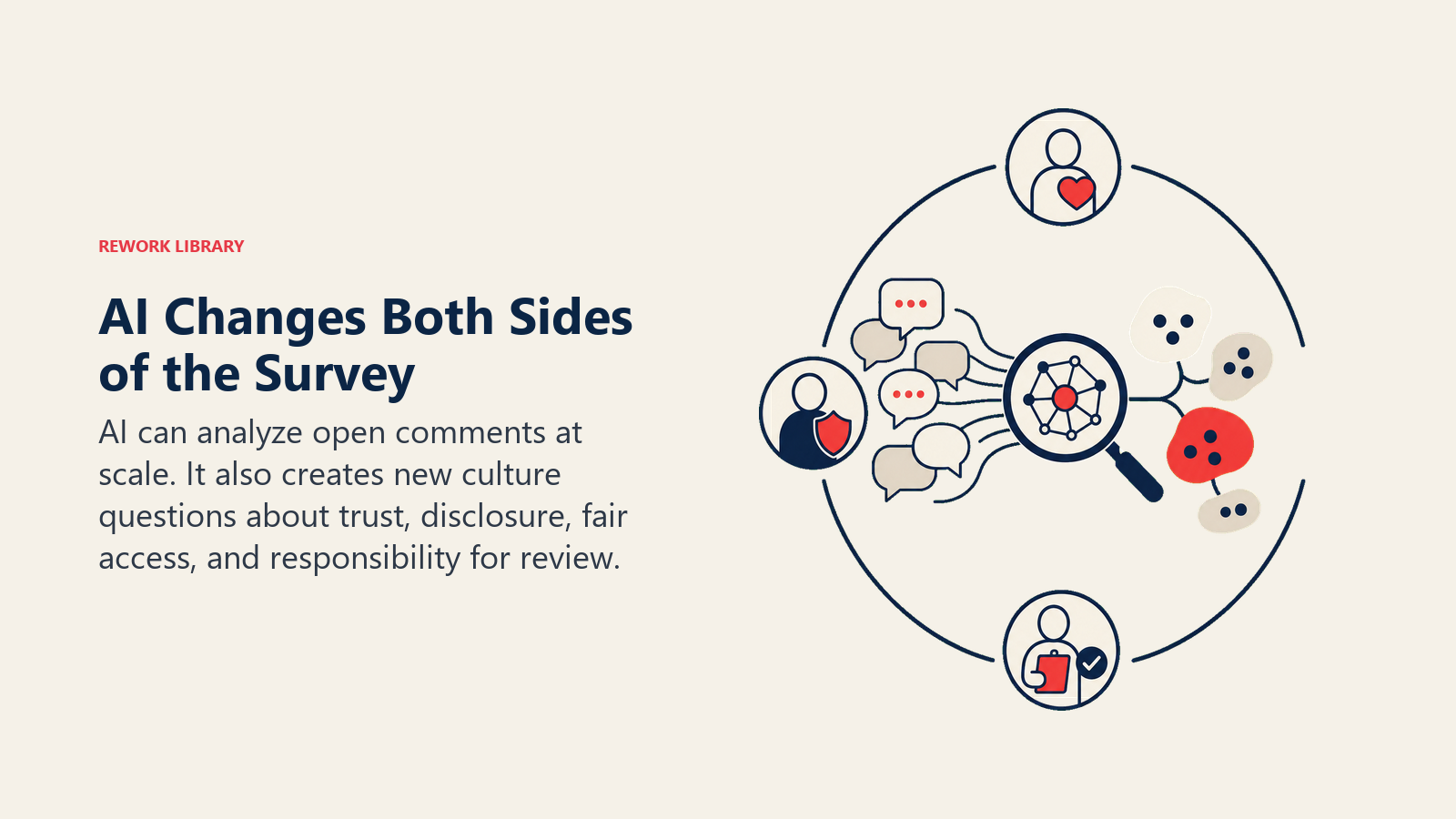
The first is on the analysis side, and it's a genuine improvement. Reading thousands of open-text comments by hand used to be the bottleneck that kept qualitative follow-up impractical at scale, which is why so many surveys stuck to numeric scales alone. Perceptyx's latest model reports a 25% accuracy improvement reading open-text comments, now matching or exceeding trained human raters, so someone can act on thousands of comments instead of skimming a sample.
The second is newer and less settled: surveys increasingly need to ask about AI itself, not just use AI to analyze answers. AI cultural debt is the quiet erosion of trust, fairness, and accountability norms that builds up when AI tools roll out faster than anyone tracks their effect on people, invisible on a standard adoption dashboard. Deloitte's 2026 Human Capital Trends research found 65% of organizations believe their culture needs to change significantly because of AI, but only 5% report real progress, a gap that starts with most companies never asking the question. A few additions to an existing pulse (trust in AI-assisted work, disclosure norms, equal access to tools) cost little and catch a problem months before it shows up as an attrition number nobody can explain.
Where to Go Next
A survey is one instrument in a larger measurement system. From here:
- How to measure company culture, for the fuller toolkit beyond surveys: eNPS, the OCAI, focus groups, behavioral signals, and exit data
- What is business culture?, for the underlying models a survey is actually trying to assess
- Psychological safety at work, for the condition that determines whether your survey answers are honest in the first place
- AI cultural debt, for the fuller playbook on measuring and paying down AI's effect on trust and fairness norms
- Talent density and psychological safety, for the leading-indicator behaviors worth watching before they show up as a lagging survey score
A survey is not the culture. It's a flashlight, and it only helps if someone looks where it points and acts on what they see. Ask a few specific questions often, protect the answers well enough that people tell the truth, and close the loop out loud, especially when the finding stings. Do that and people keep answering honestly. Skip the follow-through even once and the next survey measures nothing but polite silence.

Co-Founder, Rework.com
On this page
- Engagement Survey vs. Culture Survey vs. Pulse Survey
- Where eNPS Fits
- What to Actually Measure
- The Question Categories That Matter
- Good Questions vs. Bad Questions
- Key Facts
- Annual vs. Pulse: Choosing Your Cadence
- Annual for Depth, Pulse for Speed
- A Blended Cadence That Works
- Getting Honest Answers: Anonymity and Psychological Safety
- Anonymity Alone Doesn't Buy Trust
- The Real Driver of Honesty
- Closing the Loop: Where Most Survey Programs Die
- The Close-the-Loop Failure
- What Closing the Loop Actually Looks Like
- Survey Fatigue and Vanity Metrics
- Vendors and Frameworks: A Brief Field Guide
- Surveying Culture in the Age of AI
- Where to Go Next