Culture and DEI: Building an Inclusive Company Culture
Turn this article into takeaways for your work.


Each assistant summarizes the article only for you and suggests best practices for your work.
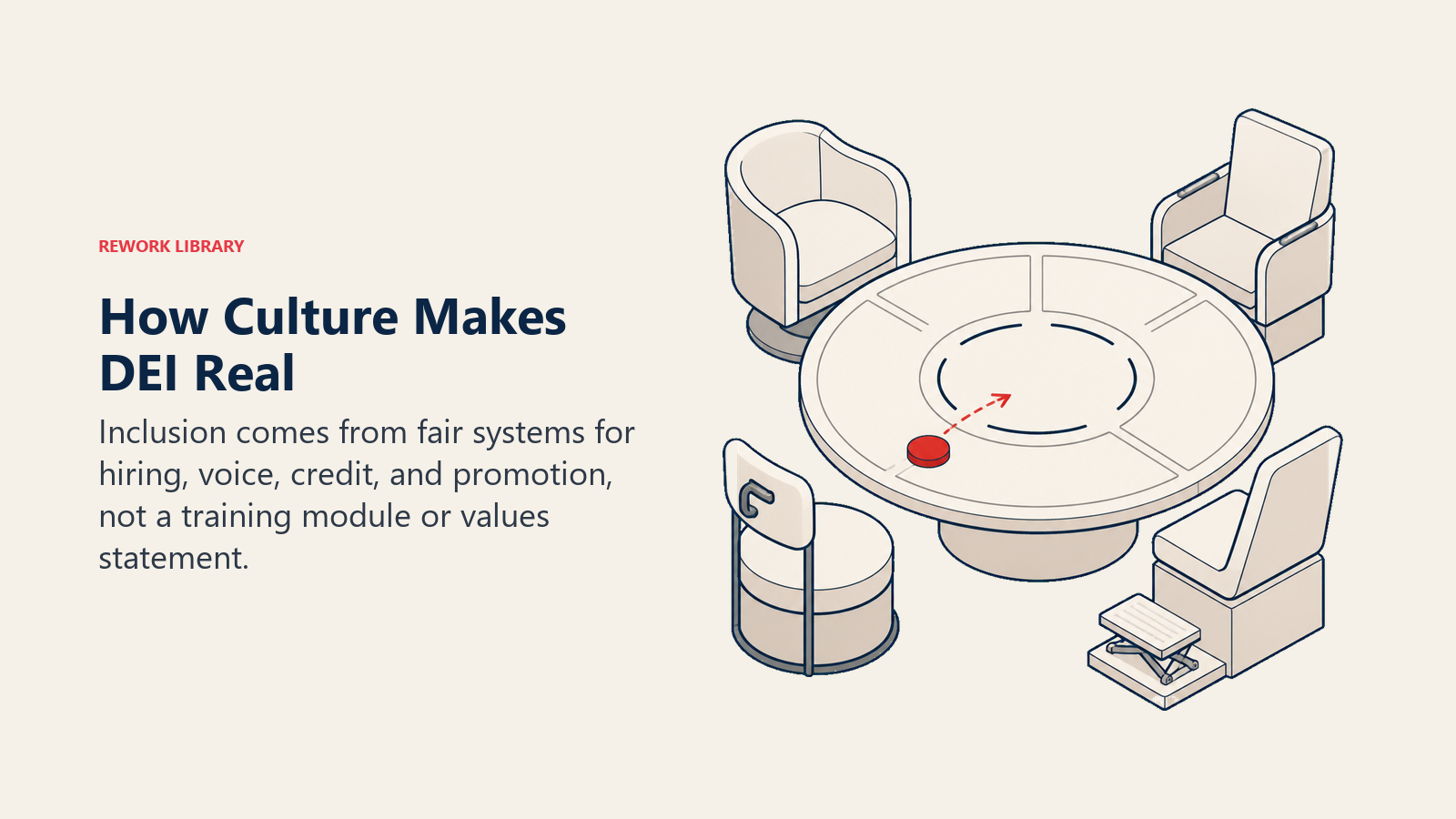
Diversity, equity, and inclusion work when they change how decisions actually get made: who gets hired, whose ideas get airtime in a meeting, who gets stretched onto a hard project. An inclusive culture is not a training module or a values slide. It is a byproduct of fair systems, run consistently.
That framing matters because DEI has become one of the most contested topics in American business. Some of that contest is political theater. Some is a fair critique of programs that measured activity instead of outcomes. Both can be true at once, and a leader building a genuinely inclusive team has to hold them together instead of picking a side. This article does that: what the evidence supports, what it doesn't, why the backlash happened, and what still works regardless of the political weather.
What Inclusive Culture Actually Means, and Why It Is Not a Program
Most companies built their DEI function the way they built every other HR initiative: a policy, a training module, an employee resource group, a diversity dashboard in the annual report. None of that is wrong on its own. All of it is insufficient, because inclusion is not a thing you install. It is a pattern that either shows up or doesn't in the moments nobody is grading.
Watch who gets interrupted in a meeting and who gets the benefit of the doubt when a project slips. Watch whose idea gets credited when two people say the same thing five minutes apart. Watch who gets pulled into the stretch assignment that leads to the next promotion, and who gets left doing solid, invisible work. That is where inclusion actually lives, in the same layer of daily behavior that shapes business culture generally. A DEI statement sits at the level of espoused values in Schein's three levels of culture, what an organization says it believes. Inclusion sits at the level of enacted behavior, much harder to fake and much harder to change. That is the biggest reason well-funded DEI programs so often produce a diverse hiring slate and a culture that still feels exclusive six months later: representation changed, but the systems that decide who gets heard, credited, and promoted did not.
Diversity, Equity, Inclusion, and Belonging Are Four Different Things
These four words get used as a single blur, which is where most DEI strategy goes wrong, because each one requires a different fix.
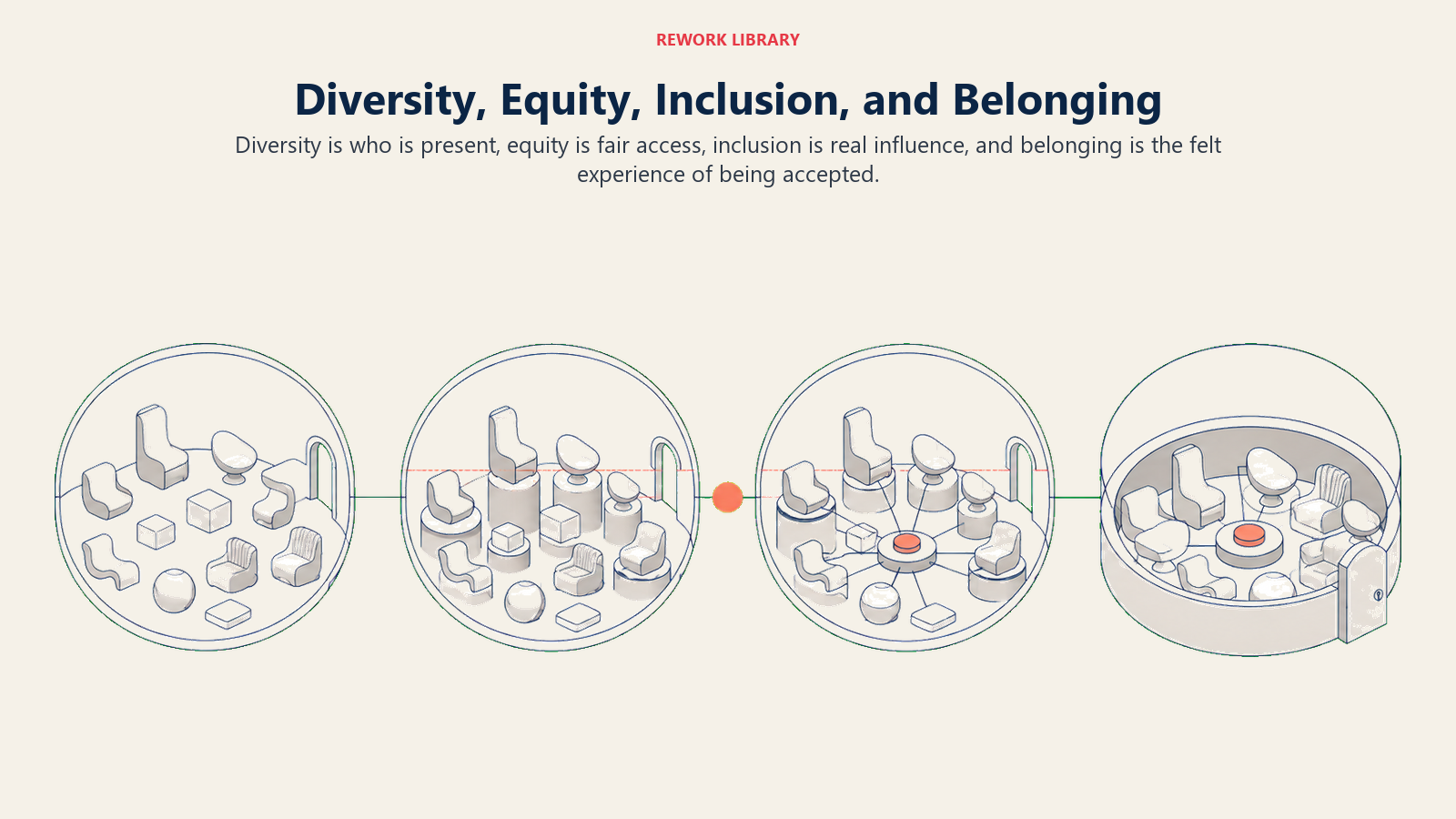
| Term | What it measures | What it looks like broken |
|---|---|---|
| Diversity | The mix of identities, backgrounds, and perspectives present | A leadership team that looks nothing like the workforce it leads |
| Equity | Whether different starting points get a genuinely fair shot | A flat leave policy that quietly disadvantages a primary caregiver |
| Inclusion | Whether people present actually get heard and given real influence | A diverse slate producing a team where one kind of person always has final say |
| Belonging | The felt experience of being accepted, not just tolerated | Technically included in every meeting, never invited to the real conversation |
Equity trips people up most, because it gets confused with equality. Equality means giving everyone the same resources. Equity means giving people what they specifically need to reach the same starting line, sometimes different things for different people. A standard onboarding process is equal. Pairing it with a sponsor who can decode the unwritten rules for a first-generation professional is equitable.
A company can hire for diversity and still fail at every other layer: a demographically varied workforce that runs on one narrow definition of "professional," where success means suppressing anything that doesn't match the founders. That is diversity without inclusion, one of the most common and least discussed failure modes in this space.
Key Facts
- Top-quartile companies for executive-team ethnic and cultural diversity were 39% more likely to financially outperform bottom-quartile peers, across 1,265 companies in 23 countries. Source: McKinsey, Diversity Matters Even More
- Companies with above-average leadership-team diversity reported innovation revenue of 45% of total revenue, versus 26% for below-average teams, plus roughly 9 points higher EBIT margin. Source: BCG, How Diverse Leadership Teams Boost Innovation
- An independent replication found no statistically significant link between McKinsey's diversity metrics and financial outperformance from 2015 to 2019, and flagged likely reverse causation: profitable firms diversify, not the other way round. Source: Green and Hand, Econ Journal Watch
- An analysis of 829 U.S. companies over three decades found mandatory diversity training does not increase representation and can raise resentment when compulsory; mentoring and targeted recruiting worked measurably better. Source: Dobbin and Kalev, Harvard Business Review
- Employees with a strong sense of belonging show roughly 56% higher job performance and about 75% fewer sick days than employees who feel excluded. Source: BetterUp
- Women hold just 29% of U.S. C-suite roles, with a wide race gap: 22% White versus 7% women of color. Source: McKinsey and LeanIn, Women in the Workplace 2025
- An audit of over 4 million job applications across 156 large employers found AI hiring algorithms produced outcomes consistent with bias against roughly 26% of Black applicants and 15% of Asian applicants. Source: Stanford Report
The Evidence: Does Diversity Actually Improve Performance?
This gets asked in every boardroom conversation about DEI budget, and the honest answer is more complicated than either side of the current debate wants it to be.
The Case For
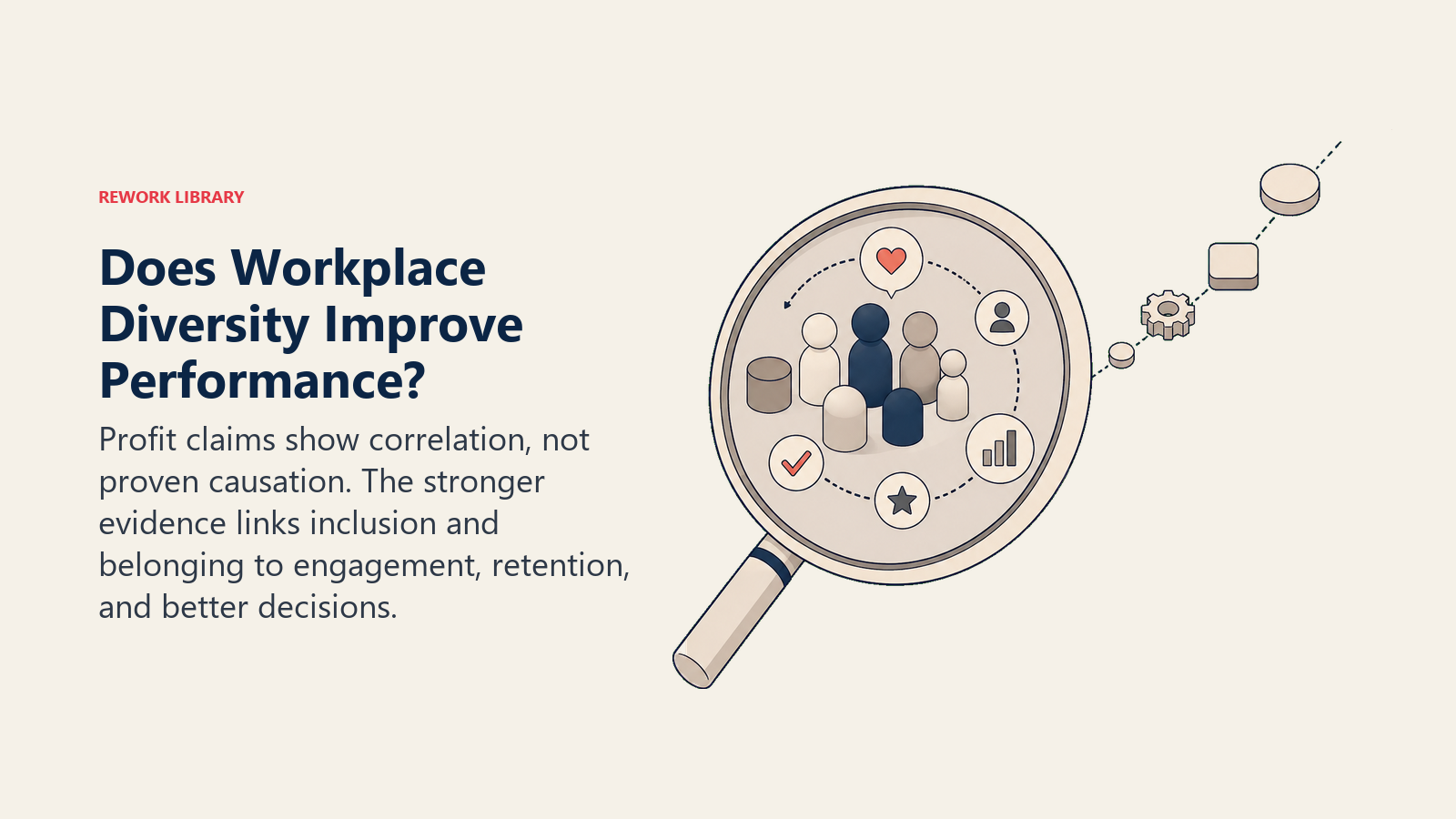
The headline numbers are real and widely cited: McKinsey finds a consistent correlation between executive-team diversity and financial outperformance, and BCG links diverse leadership teams to higher innovation revenue and margins. Beyond firm performance, the research on inclusion and belonging at the team level sits on firmer ground, because it measures something closer and more direct, engagement, retention, sick days, rather than a distal outcome like profit with dozens of other causes. Google's Project Aristotle study, which found psychological safety was the top predictor of high-performing teams, points the same way.
The Case Against
The firm-performance numbers have not held up well under scrutiny. When accounting researchers tried to replicate McKinsey's methodology on the same public data, they found no statistically significant link between the diversity metrics and outperformance, and raised a credible concern: the data measured diversity at the end of the window it supposedly predicted, so the more defensible reading is that success lets a company afford to diversify, not the reverse. McKinsey's response, pressed by journalists, was that its work always identified correlation, not causation, a fair statement of the statistics but not how the findings were marketed for a decade.
What Survives the Scrutiny
Strip away the contested claim that diversity directly causes higher profit, and what remains is still substantial. Inclusion and belonging, measured as felt experience rather than headcount, show a consistent, well-replicated relationship with engagement, retention, and individual performance. Homogeneous groups make worse decisions on novel problems than diverse groups with the psychological safety to disagree, a finding that shows up across decades of small-group research independent of the corporate diversity literature. The honest summary for a budget decision: don't lean on "39% more likely to outperform" as causal law, but do treat inclusion, belonging, and psychological safety as drivers of engagement and retention that are much harder to dispute.
The 2024-2026 DEI Backlash: What Happened and Why
Starting in 2024 and accelerating through 2025, a wave of large U.S. companies pulled back publicly stated DEI commitments. Walmart, Lowe's, Ford, Toyota, Molson Coors, Harley-Davidson, Brown-Forman, Salesforce, and IBM scaled back diversity programs, ended diversity-linked executive pay, or dropped outside diversity benchmarking within roughly an 18-month window, per Forbes and other outlets. Some didn't eliminate the underlying work; they renamed it "inclusion and belonging" and kept the substance while dropping language that had become a liability.
Why Companies Pulled Back
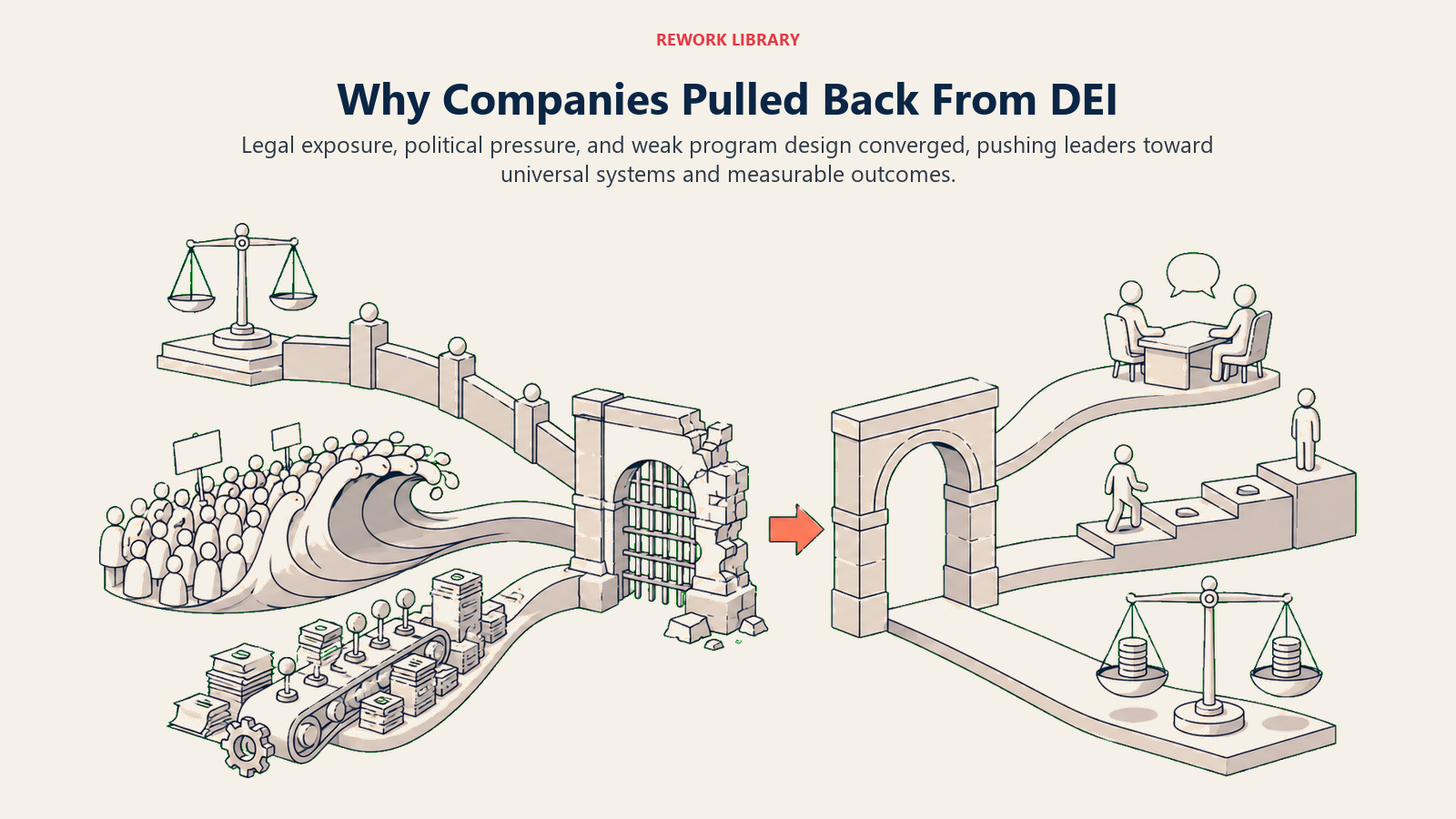
Three separate forces converged, and keeping them separate matters because each carries a different implication for a leader.
The first is legal. The Supreme Court's 2023 ruling ending race-conscious admissions in higher education chilled corporate programs that used identity as a criterion for access, such as fellowships open only to specific demographic groups. Several states then passed anti-DEI laws targeting public institutions and, in some cases, contractors. In January 2025, the federal administration issued executive orders ending DEI programs across the federal government and requiring federal contractors to certify they do not run programs it considers illegal preferencing, a shift law firms tracking the orders documented in detail. That raised real legal exposure for any program allocating opportunity by identity category rather than by criteria applied equally to everyone.
The second is political and reputational. Organized social-media campaigns, most visibly led by activist Robby Starbuck, targeted companies with boycott threats over DEI, and several responded within days regardless of whether the program had caused any legal or performance problem. That is pressure, not evidence.
The third is a substantive critique that predates the backlash by years: many programs leaned on the exact tools Dobbin and Kalev found don't work (mandatory training, toothless grievance systems, unaccountable task forces) while skipping the ones that do (structured hiring, transparent promotion criteria, targeted mentoring). Some of what got cut in 2024 and 2025 was performative and had earned the cut on the merits, independent of the politics.
What This Means for Leaders Now
Whatever the label, the practical shift is away from identity-based access (a fellowship open to one group, a hiring target tied to a protected category) and toward outcome-based, universally applied systems: structured interviews for everyone, transparent promotion rubrics for everyone, pay equity audits that fix unexplained gaps regardless of why they exist. That lowers legal exposure and, per Dobbin and Kalev, was probably the more effective approach all along. It is not a retreat from inclusion. It is a retreat from the mechanisms carrying the most legal risk while producing the weakest evidence of working.
What an Inclusive Culture Actually Looks Like
Psychological Safety Comes First
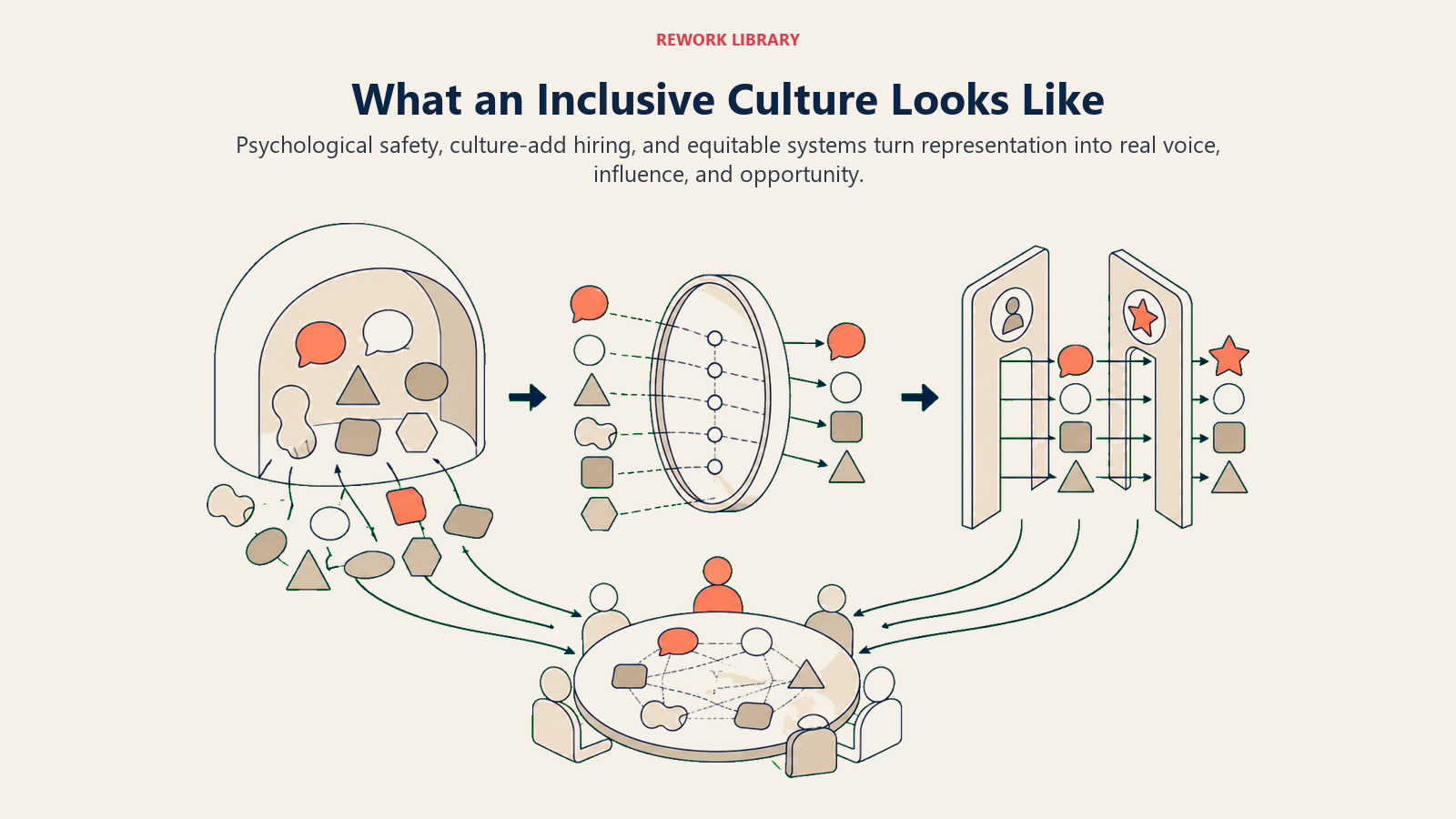
None of the representation work matters if people don't feel safe using their voice once they are in the room. Psychological safety, the belief that you can raise a concern or disagree with a senior person without being punished for it, is consistently the strongest predictor of whether a diverse team actually benefits from its diversity or just looks diverse in the org chart. Six different backgrounds and one person allowed to speak freely is not meaningfully more inclusive than a homogeneous team.
Hiring for Culture Add, Not Culture Fit
The interview question "would I grab a beer with this person" quietly filters for people who remind the interviewer of themselves, compounding into a workforce that looks and thinks alike no matter how the job postings are worded. Culture add over culture fit reframes the question from "does this person feel familiar" to "does this person share our values and bring something we don't already have," scored on a rubric instead of a private gut feeling.
Equitable Systems Beat Good Intentions
Structured interviews with a shared scorecard close a meaningful chunk of the gap unstructured, gut-feel interviewing opens up. Transparent promotion criteria remove the ambiguity that otherwise lets bias fill in the blanks. Sponsorship, a senior person actively spending their own credibility on someone's next opportunity, moves people forward faster than mentorship, which mostly offers advice for free. Regular pay equity audits catch drift before it hardens into a gap that takes years and a lawsuit to unwind. None of this requires an identity-based program. It requires building a culture of accountability for whether these systems produce fair outcomes, checked with real data instead of good intentions.
Why DEI Programs Fail Without Culture Change
The Dobbin and Kalev research explains why so much DEI spending produced so little durable change. Mandatory training treats bias as a knowledge problem people will fix once they understand it, when the research shows the opposite: a forced compliance module can activate defensiveness and measurably increase resentment. A grievance system without teeth signals that complaints get logged, not acted on. A task force with no budget, no authority, and no connection to hiring or promotion is theater, and employees know theater when they see it.
The pattern underneath is the same one behind most failed culture-change efforts: leadership changed the messaging layer (a values statement, a training requirement, a task force) without touching the systems layer (who gets hired, who gets promoted, what gets measured, what gets tolerated from a high performer). A DEI program that never reaches hiring criteria, promotion rubrics, or the performance measurement that shapes culture will not move outcomes, no matter how well funded.
Practical Inclusion Practices That Actually Move the Needle
A short list of practices earns its place here because each targets a system, not a sentiment.
Structure the interview before you meet the candidate. Same questions, same order, a shared rubric scored independently before interviewers compare notes. This closes more of the bias gap than almost anything else here, and it's nearly free to implement.
Publish promotion criteria and calibrate them across managers. Define what "leadership potential" looks like in actual behavior, and check that managers apply the same bar to everyone.
Run pay equity audits on a fixed schedule, not just when someone complains. Unexplained gaps compound quietly for years, and by the time someone notices, the fix is expensive and the trust damage is done.
Replace one-off bias training with structural fixes, plus optional learning. Keep training available for people who want it, but never make it the only thing a DEI budget funds.
Build sponsorship into how the organization already works. Ask senior leaders to name specific people whose next stretch assignment they're personally accountable for, then check whether it happened.
Watch who gets interrupted and who gets credited in meetings, and fix it out loud. This costs nothing, and it signals whether inclusion is real or aspirational in a moment everyone can see.
Inclusion in the Age of AI
AI is now involved in hiring, performance reviews, and promotion recommendations at a growing share of large companies, and it inherits bias at scale rather than removing it. The Stanford-led audit above found AI hiring algorithms produced outcomes consistent with bias against roughly one in four Black applicants and about 15% of Asian applicants, and estimated tens of thousands of additional qualified applications would have advanced under equal treatment. This isn't new; researchers have documented name-based hiring discrimination in human-run processes for over two decades. What's new is scale: a biased algorithm applies the same pattern to every application it touches, with no manager present to notice and intervene.
The practical implication matches the broader lesson here: don't assume a tool is neutral because it's automated, audit any AI system in people decisions for disparate outcomes on a fixed schedule, and keep a human in the loop until the audit clears it. Team norms for when AI is and isn't appropriate in people decisions are worth setting on purpose, the broader subject of AI etiquette at work.
Where to Go Next
- Psychological safety at work, for the behaviors that let a diverse team actually benefit from its diversity
- Culture fit vs culture add, for how to hire for shared values without hiring the same person twice
- The link between culture and performance, for how culture connects to the metrics leadership tracks
- Managing a multicultural team, for the cross-cultural half of inclusion once a team spans countries, not just identities
Frequently Asked Questions about Culture and DEI
What does DEI actually stand for and mean?
DEI stands for diversity, equity, and inclusion. Diversity is the mix of backgrounds and perspectives present. Equity is whether people with different starting points get a genuinely fair shot. Inclusion is whether people present actually get heard and given real influence over decisions.
What is the difference between equity and equality?
Equality means giving everyone the same resources. Equity means giving people what they specifically need to reach a comparable starting point, sometimes different things for different people. A flat parental leave policy is equal; pairing it with return-to-work support for a caregiving employee is equitable.
Does diversity actually improve company performance, or has that been debunked?
It's genuinely mixed. The widely cited McKinsey and BCG correlations between diversity and financial performance haven't held up under independent replication, and the causal story may run in reverse: profitable companies can afford to diversify. Evidence that inclusion and belonging improve engagement and retention is on firmer ground, since those outcomes are measured more directly.
Why are so many companies scaling back DEI programs in 2024 through 2026?
Three forces converged: legal exposure after the 2023 Supreme Court ruling on race-conscious admissions plus new anti-DEI state laws, political pressure from organized campaigns, and a fair critique that many programs used tools, like mandatory training, that research shows don't work. Some companies cut substance; others rebranded as "inclusion and belonging" while keeping the underlying work.
Does mandatory diversity training actually work?
Not on its own. An analysis of 829 companies over three decades found it doesn't increase representation in management and can raise resentment when compulsory. Voluntary training paired with structured hiring and targeted mentoring works measurably better.
What is culture add and how is it different from culture fit?
Culture fit asks whether a candidate feels familiar, filtering for people who resemble the people already there. Culture add asks whether a candidate shares the organization's values while bringing something the team doesn't already have, scored on a rubric instead of a gut feeling.
Can AI hiring tools make inclusion worse instead of better?
Yes, when unaudited. A study of AI hiring algorithms across 156 employers and 4 million-plus applications found outcomes consistent with bias against roughly one in four Black applicants and about 15% of Asian applicants, applying that pattern at a scale no human reviewer ever could.
What actually builds an inclusive culture, if programs alone don't work?
Systems that produce fair outcomes by default: structured interviews with shared rubrics, calibrated promotion criteria, regular pay equity audits, sponsorship built into how leaders already operate, and psychological safety strong enough that people use their voice. These change the default, rather than relying on goodwill.
DEI became a target partly because too much of it was built to be seen rather than to work: a training module, a task force, a diversity number on the cover of a report. None of that makes a culture inclusive. What does is whether the systems that decide who gets hired, heard, credited, and promoted produce a fair result by default, whether anyone is watching that quarter or not. That work outlasts any political cycle, because it was never really about the label.

Co-Founder, Rework.com
On this page
- What Inclusive Culture Actually Means, and Why It Is Not a Program
- Diversity, Equity, Inclusion, and Belonging Are Four Different Things
- Key Facts
- The Evidence: Does Diversity Actually Improve Performance?
- The Case For
- The Case Against
- What Survives the Scrutiny
- The 2024-2026 DEI Backlash: What Happened and Why
- Why Companies Pulled Back
- What This Means for Leaders Now
- What an Inclusive Culture Actually Looks Like
- Psychological Safety Comes First
- Hiring for Culture Add, Not Culture Fit
- Equitable Systems Beat Good Intentions
- Why DEI Programs Fail Without Culture Change
- Practical Inclusion Practices That Actually Move the Needle
- Inclusion in the Age of AI
- Where to Go Next