Culture and Customer Experience: Why the Service-Profit Chain Still Works
Turn this article into takeaways for your work.


Each assistant summarizes the article only for you and suggests best practices for your work.
The service-profit chain is a model, first published in Harvard Business Review in 1994, that links internal workplace quality to employee satisfaction, employee satisfaction to customer satisfaction and loyalty, and customer loyalty to revenue growth and profit. In plain terms: how you treat the people who serve your customers is not a soft HR concern sitting apart from the business. It is one of the more direct levers you have on growth.
That claim is easy to nod along to and easy to ignore in practice. Most executives will say, if asked, that happy employees make happy customers. Far fewer companies design their operating model, their metrics, or their meeting cadence as if that were literally true. This article walks through where the service-profit chain comes from, what the actual data says about the employee-to-customer link, what frontline empowerment looks like when a company takes it seriously, and where AI agents fit into a chain that was built around human frontline workers.
What the Service-Profit Chain Actually Says
James Heskett, W. Earl Sasser, and Leonard Schlesinger built the service-profit chain from years of studying service companies that consistently outperformed their category. Their argument, laid out in the original HBR piece and later expanded in their book The Service Profit Chain, was that profit and growth follow a specific, traceable sequence rather than showing up as a direct result of pricing or marketing decisions.
The Five Links, in Order
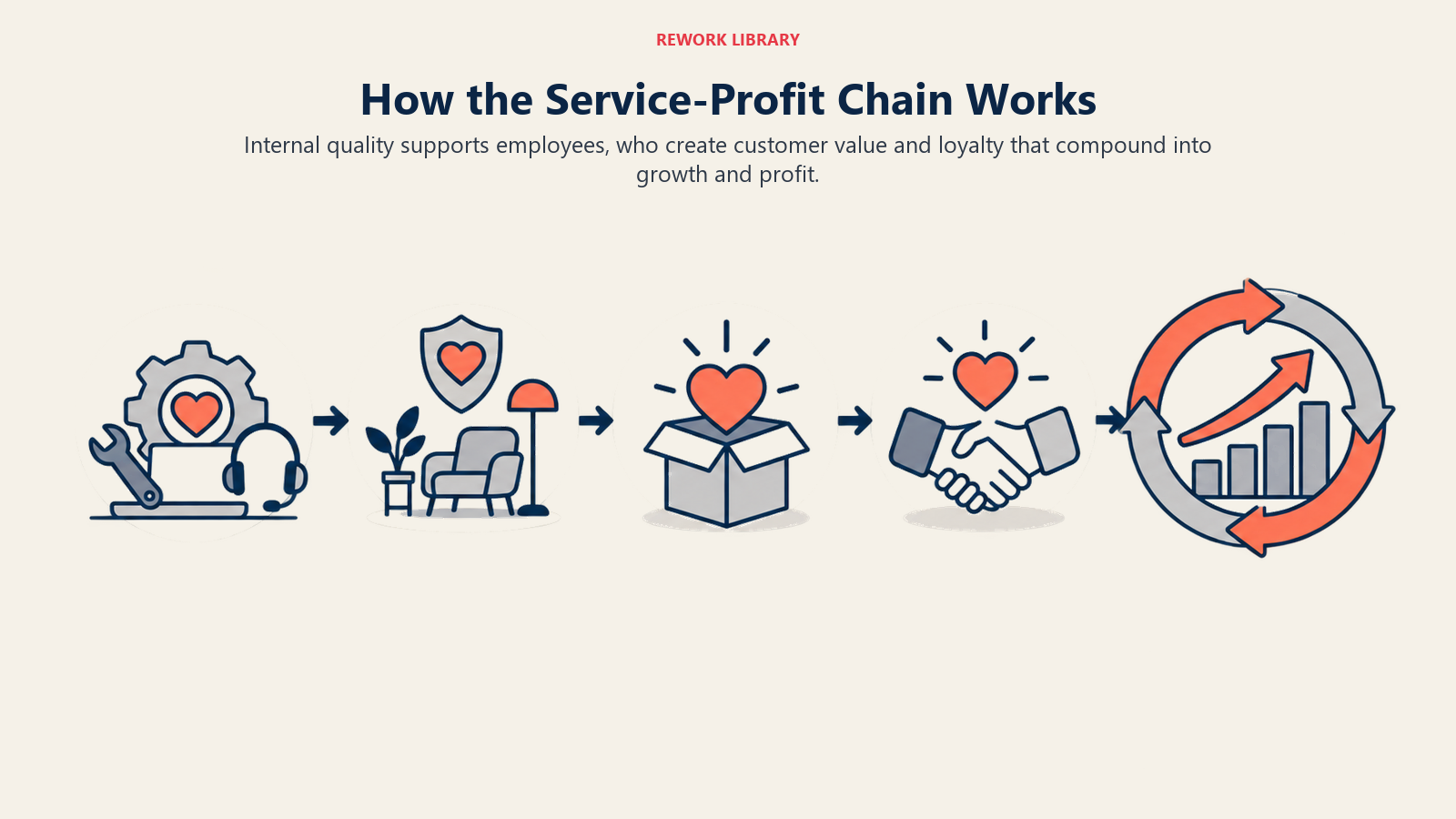
The chain runs like this: internal service quality drives employee satisfaction, employee satisfaction drives employee retention and productivity, retained and productive employees create external service value for customers, service value drives customer satisfaction and loyalty, and loyalty drives revenue growth and profit. Each link depends on the one before it. Skip a step, for example investing in customer-facing technology while ignoring how supported employees feel using it, and the chain tends to break quietly rather than dramatically.
| Link in the chain | What it actually means | Where it commonly breaks |
|---|---|---|
| Internal service quality | Workplace design, tools, training, and decision authority given to frontline staff | Underinvested tools, unclear authority, thin training |
| Employee satisfaction | How employees feel about the job, not just pay | Burnout, unclear expectations, no recognition |
| Employee retention and productivity | Tenure and output of the people who touch customers | High turnover resets institutional knowledge |
| External service value | What the customer actually experiences during an interaction | Value promised in marketing, not delivered in practice |
| Customer satisfaction and loyalty | Whether the customer stays and refers others | One bad frontline interaction can undo years of goodwill |
Heskett and his co-authors were explicit that the starting point is internal, not external. Most companies build their strategy from the customer end backward, deciding what experience they want to deliver and then figuring out how to staff it. The service-profit chain argues the more reliable starting point is upstream: build the internal conditions that let employees actually deliver that experience, and the customer outcomes tend to follow. This is closely related to the broader case made in the link between culture and performance, which covers how the same upstream-to-downstream logic shows up in operating metrics well beyond customer service specifically.
Does the Employee-to-Customer Link Actually Hold Up in the Data
Frameworks age well when the underlying claim keeps getting reconfirmed by new data, decades after the original research. The service-profit chain has had that happen more than once.
Key Facts
- Each 1-star improvement in an employer's Glassdoor rating (out of 5) is associated with a statistically significant 1.3-point increase in customer satisfaction on the American Customer Satisfaction Index, based on a panel of 293 large employers across 13 industries from 2008 to 2018. Source: Glassdoor Economic Research
- That employee-to-customer satisfaction effect is more than twice as large in high customer-contact sectors, retail, food service, tourism, financial services, and healthcare, than in low-contact sectors, where employees rarely interact directly with customers. Source: Glassdoor Economic Research
- Gartner's February 2026 survey of 321 customer service and support leaders found 91% are under pressure to implement AI, while a separate survey of 3,566 B2B and B2C customers found 87% say a company using generative AI for service must still provide access to a human agent. Source: Gartner
- Gartner predicts that half of the companies that cut customer service staff because of AI between 2023 and 2026 will have rehired for those roles by 2027, citing degraded customer experience as a leading cause. Source: Gartner
- Google's Project Aristotle, a two-year study of more than 180 internal teams, found psychological safety was the single strongest factor separating its highest-performing teams from the rest, ahead of individual skill or team composition. Source: Google re:Work
The Glassdoor and ACSI numbers matter because they are not a single company's case study or a consultant's anecdote. They are a large, multi-year, cross-industry panel with company and year effects statistically controlled for, which is about as close as this kind of research gets to isolating the employee-to-customer relationship from everything else moving in a given year. And the finding that the effect roughly doubles in high-contact sectors is exactly what the service-profit chain would predict: the more of the customer's actual experience runs through a human employee's judgment and mood, the more that employee's own satisfaction shows up in the customer's rating.
Frontline Empowerment: Where the Chain Becomes Visible
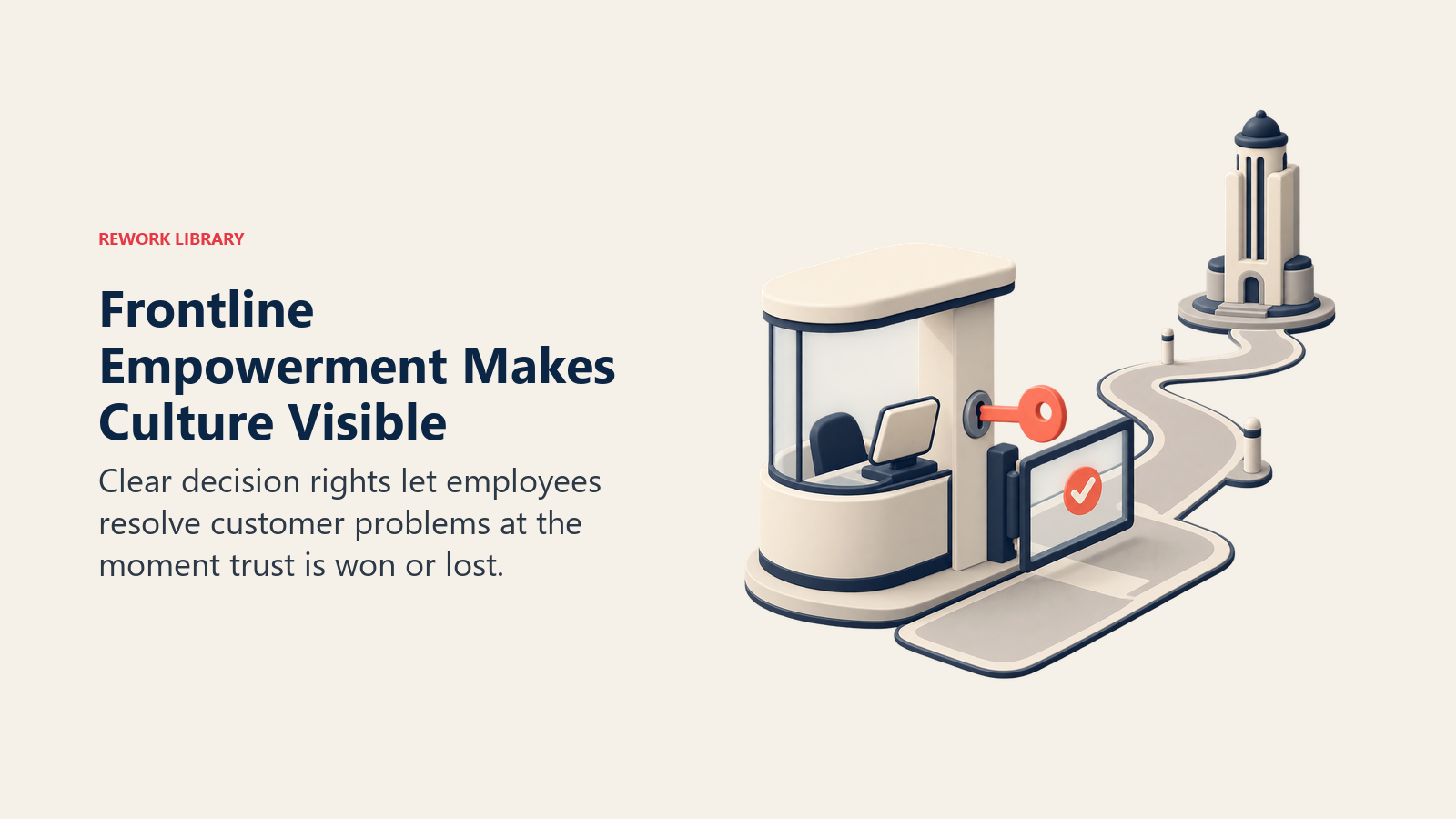
The service-profit chain is a description of a pattern. Frontline empowerment is the operational choice that makes the pattern real inside a specific company. It means giving the people closest to the customer enough authority, information, and trust to solve a problem without escalating it through three layers of approval first.
The Ritz-Carlton $2,000 Rule
The Ritz-Carlton's best-known policy, introduced under founding president Horst Schulze, allows any employee to spend up to $2,000 per incident to resolve a guest's problem, without asking a manager for permission. The number itself is less important than what it signals: the company decided in advance that trusting a housekeeper or a front-desk clerk to make that judgment call, on the spot, beats routing every service recovery decision through a hierarchy that the guest is standing in front of and waiting on. The rule only works because it is backed by training on when and how to use it, which is the internal service quality link in the chain doing its job before the customer ever notices anything.
Southwest and the Employees-First Bet
Herb Kelleher built Southwest Airlines' culture on an explicit, unusual ordering: employees first, customers second, shareholders third. Kelleher's own framing of the logic was direct: treat employees well, and they treat customers well, and that is what keeps customers coming back and shareholders satisfied. It reads as a soft statement until you notice the sequence he chose. He did not put the customer first and hope employee treatment would sort itself out downstream. He treated employee experience as the input and customer loyalty as the output, which is the service-profit chain's core claim stated as a leadership philosophy rather than an academic model.
Both examples share a structural feature worth naming: the empowerment is not a slogan on a wall. It is a specific, bounded rule that a frontline employee can actually invoke in the moment a customer needs it, backed by leadership that will defend the decision afterward instead of second-guessing it. That backing is itself a form of building trust in the workplace, and it tends to fail fast the first time a manager overrules an employee's good-faith call in front of the team.
Psychological Safety Behind the Counter
Frontline empowerment on paper does nothing if the person on the phone or at the counter is afraid to use it. This is where psychological safety at work connects directly to customer experience rather than staying an abstract team dynamics concept.
A frontline employee facing an angry customer is making a rapid series of judgment calls: how much to bend a policy, whether to escalate, how much personal warmth to extend to someone who is currently being difficult. Every one of those calls carries risk for the employee if the culture punishes mistakes. An employee who has watched a colleague get reprimanded for a judgment call that didn't work out will default to the safest, most rigid interpretation of policy the next time, because the safest option for the employee and the best option for the customer are not always the same thing, and fear reliably wins that trade-off. This is the same mechanism covered in why teams stay silent in meetings, applied to a customer-facing moment instead of a conference room.
The fix is not a different customer service script. It is the same fix that works for innovation and for internal decision-making: employees need real evidence, not a values poster, that a good-faith attempt to help a customer will be backed by their manager even when the outcome is imperfect. Companies that get service recovery right tend to debrief hard calls without assigning blame for the ones that didn't land cleanly, which is the same blameless-review discipline behind building a culture of accountability.
What Breaks the Chain
The service-profit chain fails in patterns that are easy to recognize once you know what to look for, because they are the same handful of failure modes showing up in different departments.
Turnover resets everything downstream. A frontline role with high turnover never accumulates the institutional knowledge, comfort with edge cases, or trust with recurring customers that make the chain's later links work. This is a direct extension of culture and employee retention: every dollar spent acquiring customers is partly wasted if the employee who would have kept them loyal quits eight months in.
Metrics measure the wrong thing. A contact center optimized purely for average handle time will train employees to end calls fast, which is the opposite behavior a genuinely satisfied customer usually needs. The chain gets undermined by its own scorecard, not by bad intentions.
Authority and accountability are mismatched. Holding a frontline employee accountable for a customer's satisfaction score while denying them the authority to actually fix the customer's problem is a structurally unfair setup, and employees notice the mismatch quickly. It produces the same learned helplessness that shows up in signs of a toxic culture: people stop trying to solve problems they have no real power over.
Culture debt accumulates invisibly. Deloitte's 2026 Human Capital Trends research describes a related pattern it calls AI cultural debt, where organizations adopt new tools faster than they update the norms, training, and trust structures around them. In a customer-facing context this shows up as employees who have an AI copilot on their screen but no clear guidance on when to trust it, when to override it, or how much authority they still have to deviate from what it suggests. See AI cultural debt for the fuller pattern.
Measuring the Chain Without Faking the Numbers
Companies serious about the service-profit chain track both ends of it deliberately, rather than assuming a strong brand or a decent NPS score means the internal half is healthy.
On the employee side, that usually starts with how to measure company culture and a clean read on what is eNPS, the employee equivalent of Net Promoter Score. The two shouldn't be tracked in isolation. A useful discipline is to actually plot frontline eNPS against the customer satisfaction scores for the same team or location over time, the way the Glassdoor-ACSI research did at scale. Most companies have both numbers sitting in different systems and never look at them side by side, which means they are sitting on the exact correlation the service-profit chain predicts and not using it.
On the customer side, the standard scores, CSAT, NPS, churn, matter less in isolation than in combination with a segmentation by which team, location, or channel produced the interaction. A company-wide NPS can look acceptable while masking a specific location or shift with a genuinely broken internal culture, because the good numbers from elsewhere paper over it in the average.
Culture and Customer Experience in the Age of AI
AI agents are now a real part of the frontline in a growing share of companies, and the service-profit chain, built entirely around human employees, needs an honest update rather than a wholesale rewrite.
Will AI Augment or Degrade the Chain
The evidence so far points toward augmentation being the more common and more durable pattern, with degradation as a real and specific risk rather than an inevitability. Gartner's own research found that as of its October 2025 survey, only 20% of organizations had reduced customer service headcount because of AI, a smaller shift than the public narrative around AI replacing service jobs would suggest. At the same time, Gartner explicitly warns that companies pursuing aggressive headcount cuts risk operational disruption and degraded customer experience, and separately predicts that half of the companies that already cut staff due to AI between 2023 and 2026 will rehire by 2027.
That is the service-profit chain reasserting itself in a new form. Cutting the frontline workforce without protecting the internal service quality link, training, escalation paths, and genuine authority for the humans who remain, produces the same broken chain it always has. AI changes the tools available at the front line. It does not repeal the sequence connecting internal conditions to customer outcomes.
Human Escalation as a Cultural Choice
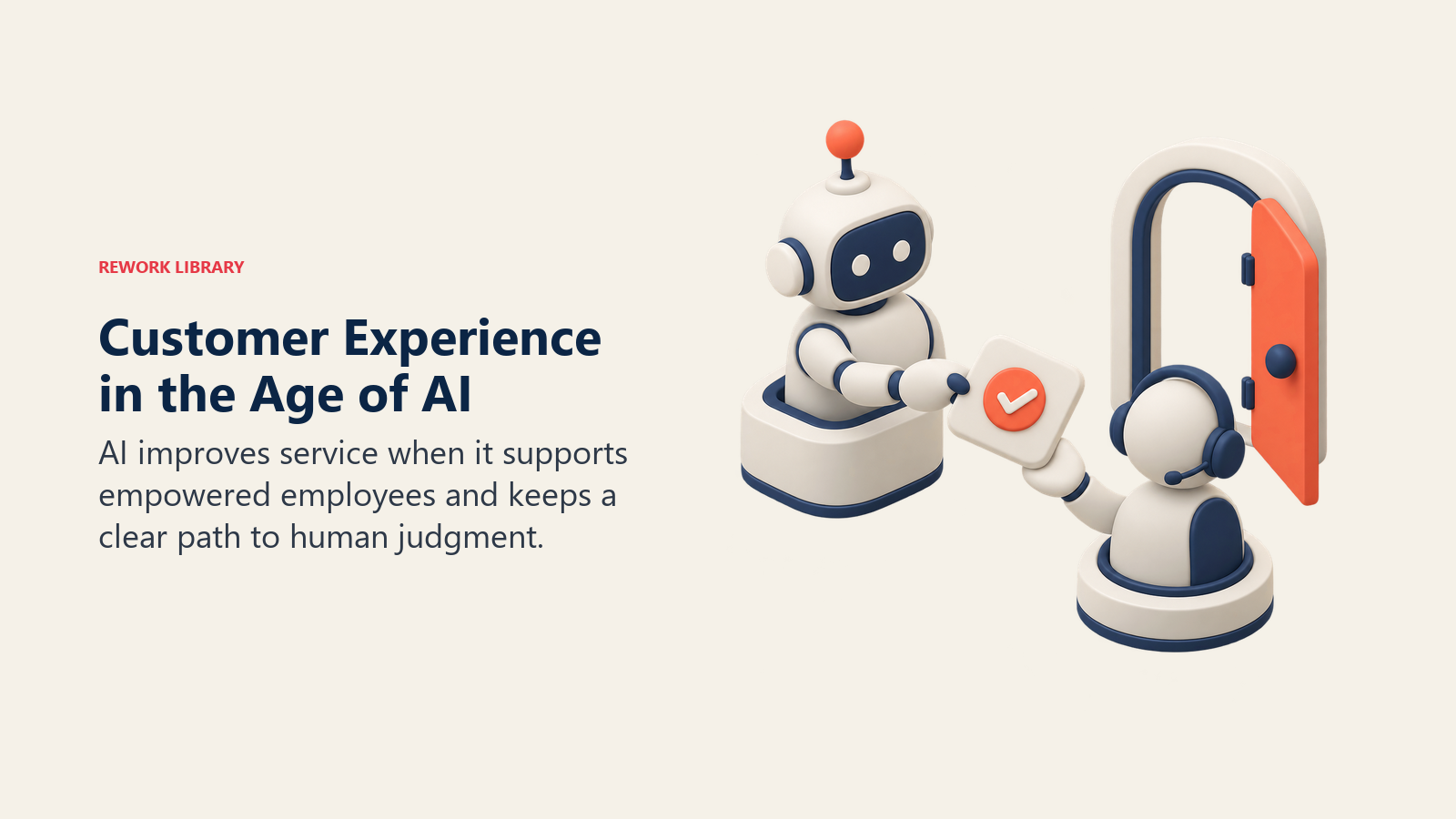
The 87% of customers in Gartner's 2026 survey who say they need access to a human agent even when a company uses generative AI for service are describing a cultural expectation as much as a technical preference. What they are really asking for is the same thing frontline empowerment has always been about: confidence that if the standard path fails to solve their problem, someone with real judgment and real authority is reachable and will help.
Whether that escalation path is fast, well-staffed, and staffed by people with actual decision authority, or a dead end designed to discourage escalation, is a culture decision, not a technology decision. A company can deploy the most capable AI agent available and still fail the customer at exactly the moment that matters most, if the human backstop behind it is under-resourced or lacks the same empowerment the Ritz-Carlton gave its housekeeping staff decades ago. Human-agent teams culture covers the broader shift in how humans and AI systems divide labor and trust inside a team, and trust when your teammate is AI covers the specific question of how much authority a human should extend to an AI agent's recommendation in a live customer moment.
The honest summary for a leader deciding how to deploy AI in customer service: the chain still runs from internal conditions to customer outcomes. AI can improve almost every link in that chain, faster answers, better information at the point of service, less rote work for humans to burn out on. It can also break every one of those same links if deployed as a cost-cutting move disconnected from the culture and training that made the human version of the chain work in the first place.
Building a Culture That Shows Up in the Customer Experience
None of this requires a large program or a rebrand. It requires a small number of deliberate choices, repeated consistently.
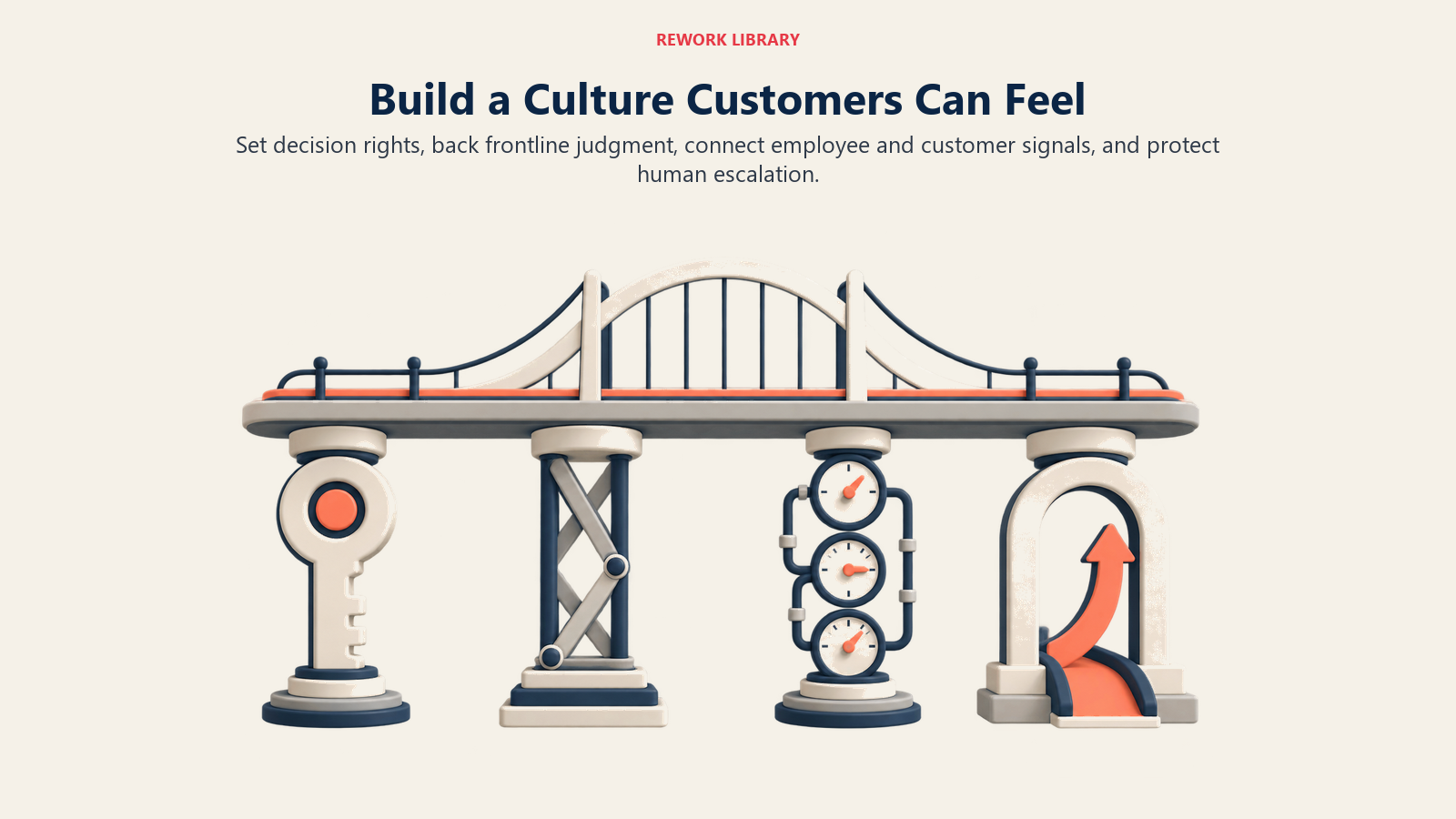
Give frontline employees a real, bounded decision right, something closer to the Ritz-Carlton's specific dollar figure than a vague instruction to "use good judgment," so people know exactly what they are allowed to do without asking.
Back the decision after the fact. The first time a manager publicly overrules a good-faith frontline call, the empowerment policy stops being real for that entire team, no matter what the handbook still says.
Measure eNPS and CSAT side by side, by team and location, not just at the company level, so a specific broken pocket of the organization can't hide inside an acceptable company average.
Treat AI as a tool inside the chain, not a replacement for it. Deploying an AI agent without updating training, escalation authority, and trust norms around it is how AI cultural debt accumulates specifically in customer-facing teams.
Keep the human escalation path genuinely staffed and genuinely empowered. It is the part of the chain customers reach for exactly when everything else has already failed them, which makes it the worst possible place to under-invest.
The operational discipline behind all five of these, keeping frontline authority rules consistent across locations, tracking eNPS and CSAT without the numbers living in separate systems nobody cross-references, and making sure escalation paths don't silently degrade as headcount or tools change, is unglamorous work that tends to fall through the cracks between HR, ops, and support leadership. That coordination gap is the kind of thing Rework's Work Ops and People tools exist to close, not a substitute for the leadership choices above.
Where to Go Next
- What is business culture, for the foundational models this article builds on
- The link between culture and performance, for how the same upstream logic shows up beyond customer-facing roles
- Psychological safety at work, for the trust mechanism behind every frontline judgment call
- Building a culture of accountability, for how blameless review differs from blame culture in service recovery
Frequently Asked Questions about Culture and Customer Experience
What is the service-profit chain?
The service-profit chain is a model, published by Heskett, Sasser, and Schlesinger in Harvard Business Review in 1994, that links internal workplace quality to employee satisfaction, employee satisfaction to employee retention and service value, and service value to customer satisfaction, loyalty, and ultimately revenue growth and profit.
Is there real data showing employee culture affects customer satisfaction?
Yes. A Glassdoor Economic Research study combining roughly 863,000 employer reviews with American Customer Satisfaction Index data across 293 large employers found that each 1-star improvement in a company's Glassdoor rating was associated with a statistically significant 1.3-point increase in customer satisfaction, an effect more than twice as strong in high customer-contact industries.
What does frontline empowerment actually mean in practice?
It means giving employees who interact directly with customers real, bounded authority to solve problems without escalating through multiple layers of approval. The Ritz-Carlton's rule allowing any employee to spend up to $2,000 per incident to resolve a guest issue, without manager sign-off, is the most cited example.
How does psychological safety connect to customer service specifically?
Frontline employees make rapid judgment calls under pressure, how far to bend a policy, whether to escalate, how much personal warmth to extend. If they have seen a colleague punished for a call that didn't work out, they default to the safest, most rigid option, which is often the worst outcome for the customer. Psychological safety is what lets employees make the judgment call the situation actually needs.
Is AI replacing human customer service employees?
Not at the pace often assumed. Gartner's October 2025 survey found only 20% of organizations had reduced customer service headcount due to AI, and Gartner separately predicts that half of the companies that did cut staff due to AI between 2023 and 2026 will rehire by 2027, citing degraded customer experience as a factor.
Do customers still want to reach a human when a company uses AI for service?
Yes. Gartner's 2026 survey of 3,566 B2B and B2C customers found that 87% say a company using generative AI for customer service must still provide access to a human agent, reflecting an expectation that a real escalation path with genuine authority remains available when AI can't resolve the issue.
What is AI cultural debt, and how does it show up in customer service?
AI cultural debt describes organizations adopting AI tools faster than they update the training, trust norms, and decision authority around them. In customer service, it shows up as employees given an AI copilot but no clear guidance on when to trust it, when to override it, or how much independent authority they still have during a live customer interaction.
What is the single biggest way companies break the service-profit chain?
Holding frontline employees accountable for customer satisfaction scores while denying them the authority to actually fix the customer's problem. The mismatch between accountability and authority is structurally unfair, and employees learn quickly to stop trying, which shows up as the same disengagement seen in other forms of toxic culture.
Customers do not experience your mission statement, your values deck, or your quarterly strategy memo. They experience a specific interaction with a specific person, or increasingly an AI agent operating inside rules that person's culture set. The service-profit chain has held up for three decades and counting because it names something leaders already suspect but rarely build their operating model around: the fastest way to a better customer experience runs through the people, and now the systems, standing closest to the customer, not around them.

Co-Founder, Rework.com
On this page
- What the Service-Profit Chain Actually Says
- The Five Links, in Order
- Does the Employee-to-Customer Link Actually Hold Up in the Data
- Key Facts
- Frontline Empowerment: Where the Chain Becomes Visible
- The Ritz-Carlton $2,000 Rule
- Southwest and the Employees-First Bet
- Psychological Safety Behind the Counter
- What Breaks the Chain
- Measuring the Chain Without Faking the Numbers
- Culture and Customer Experience in the Age of AI
- Will AI Augment or Degrade the Chain
- Human Escalation as a Cultural Choice
- Building a Culture That Shows Up in the Customer Experience
- Where to Go Next