Psychological Safety at Work: What It Is and How to Build It
Turn this article into takeaways for your work.


Each assistant summarizes the article only for you and suggests best practices for your work.
Psychological safety at work is the shared belief within a team that no one will be embarrassed, rejected, or punished for speaking up: for asking a question, admitting a mistake, raising a concern, or challenging a decision. Harvard Business School professor Amy Edmondson coined the term in 1999, and it has since become one of the most researched, most misunderstood conditions in organizational life.
Misunderstood because most leaders hear "psychological safety" and picture a soft, feel-good workplace where nobody gets criticized. That is backwards. Psychologically safe teams argue more, not less. They just argue about ideas instead of staying quiet and letting bad ones ship unchallenged. This article covers the definition, the four stages a team moves through, why Google's own research named it the top driver of team performance, how to build and measure it at the system level rather than just the manager level, and why it matters even more now that AI is doing part of the work.
What Psychological Safety Is (and What It Isn't)
Edmondson's own definition is precise: psychological safety is "a shared belief held by members of a team that the team is safe for interpersonal risk-taking." Two words carry the weight there. Shared, because it is a property of the team or the room, not a personality trait an individual carries with them everywhere. Someone can speak freely in one meeting and go silent in the next one, depending entirely on who else is in the room and what has happened there before. And risk-taking, because the whole concept only matters in moments where speaking up genuinely could cost something: looking uninformed, contradicting a senior person, admitting a number is wrong, or saying an idea everyone else seems to like actually has a hole in it.
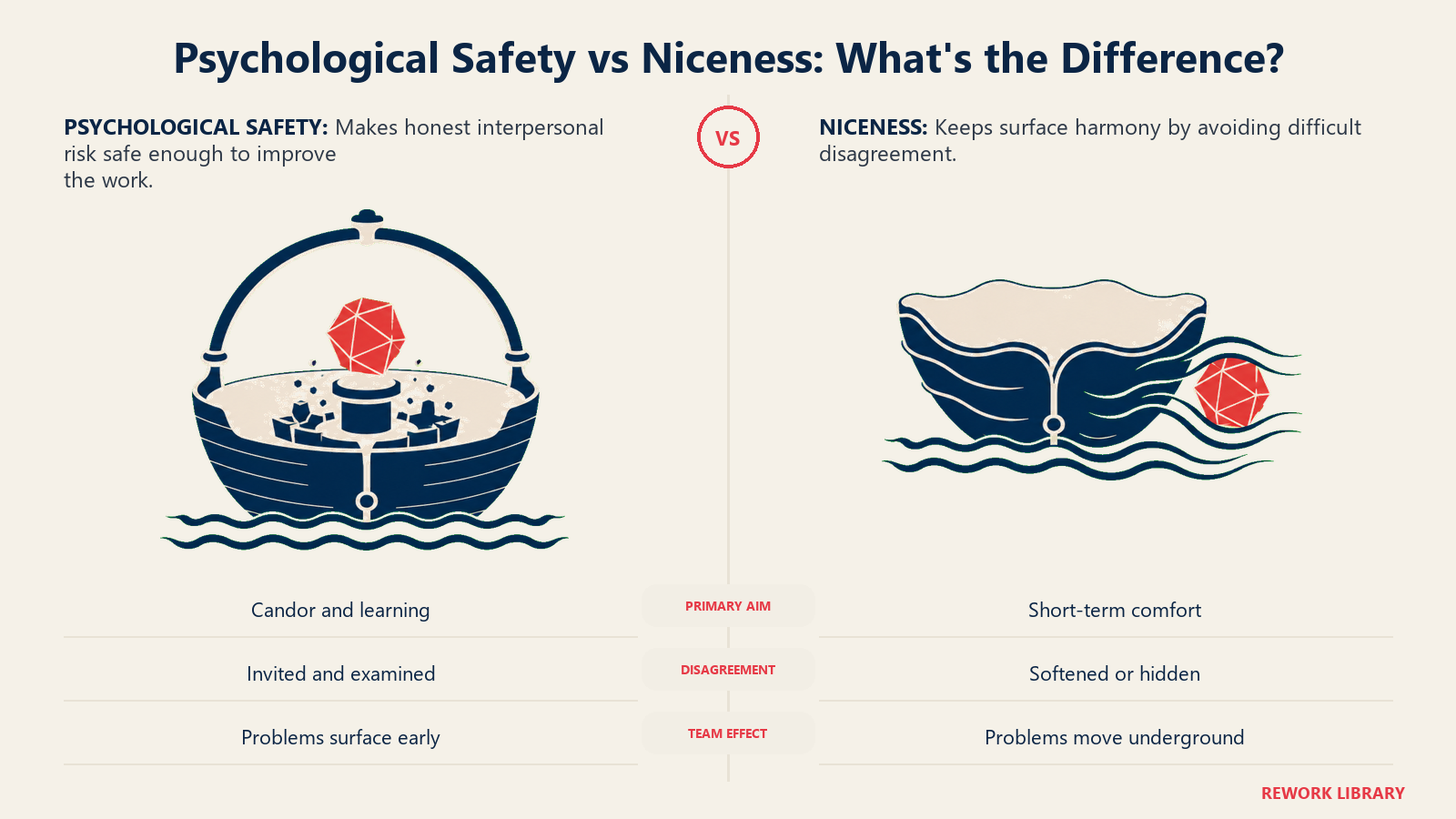
That framing also explains what psychological safety is not. It is not comfort. It is not the absence of tension, disagreement, or accountability. It is not a manager who never gives hard feedback, and it is not a team where everyone agrees to avoid conflict. A team can be psychologically safe and still hold each other to a demanding standard; in fact, the research below suggests the highest-performing teams do both at once, treating candor and safety as partners rather than opposites.
Psychological Safety vs. Niceness
The confusion between safety and niceness is the single most common way this concept gets diluted into nothing. A "nice" team smooths over disagreement to keep the mood pleasant, which usually means the real disagreement goes underground and resurfaces later as a missed deadline, a quiet resignation, or a decision nobody actually agreed with in the room. A psychologically safe team does the opposite: it surfaces the disagreement early, in the open, because everyone trusts that raising it will not cost them socially or professionally. Niceness protects feelings in the moment. Safety protects the work over time.
Key Facts
- Only about 3 in 10 US employees strongly agree that their opinions count at work; Gallup research suggests doubling that ratio is associated with 27% less turnover, 40% fewer safety incidents, and a 12% productivity gain. Source: Forbes / Gallup
- Google's two-year Project Aristotle study of more than 180 teams found psychological safety was the single strongest predictor of team effectiveness, ahead of skill mix, seniority, and team size. Source: Google re:Work
- In a Harvard Business Review-covered BetterUp Labs and Stanford Social Media Lab survey of 1,150 US workers, 41% had received AI-generated "workslop" in the past month, each incident costing nearly two hours to sort out, and over half said it made them trust the sender less. Source: Harvard Business Review
- 45% of employees admit to hiding their AI use at work, and the top reasons are fear of being judged or seen as cutting corners, not the job-security fears most employers assume. Source: Yahoo Finance / Slingshot by Infragistics
- Psychology Today's 2026 review of AI-enabled teams argues that AI mistakes create a unique "trust ambiguity" because people cannot question a model's reasoning the way they can question a colleague's, which raises the bar for psychological safety rather than lowering it. Source: Psychology Today
The Four Stages of Psychological Safety
Researcher Timothy Clark's model, laid out in his book The 4 Stages of Psychological Safety, breaks the concept into a sequence rather than a single on/off state. Each stage has to be earned before the next one becomes possible, which is why two teams can both claim to be "psychologically safe" while behaving completely differently.
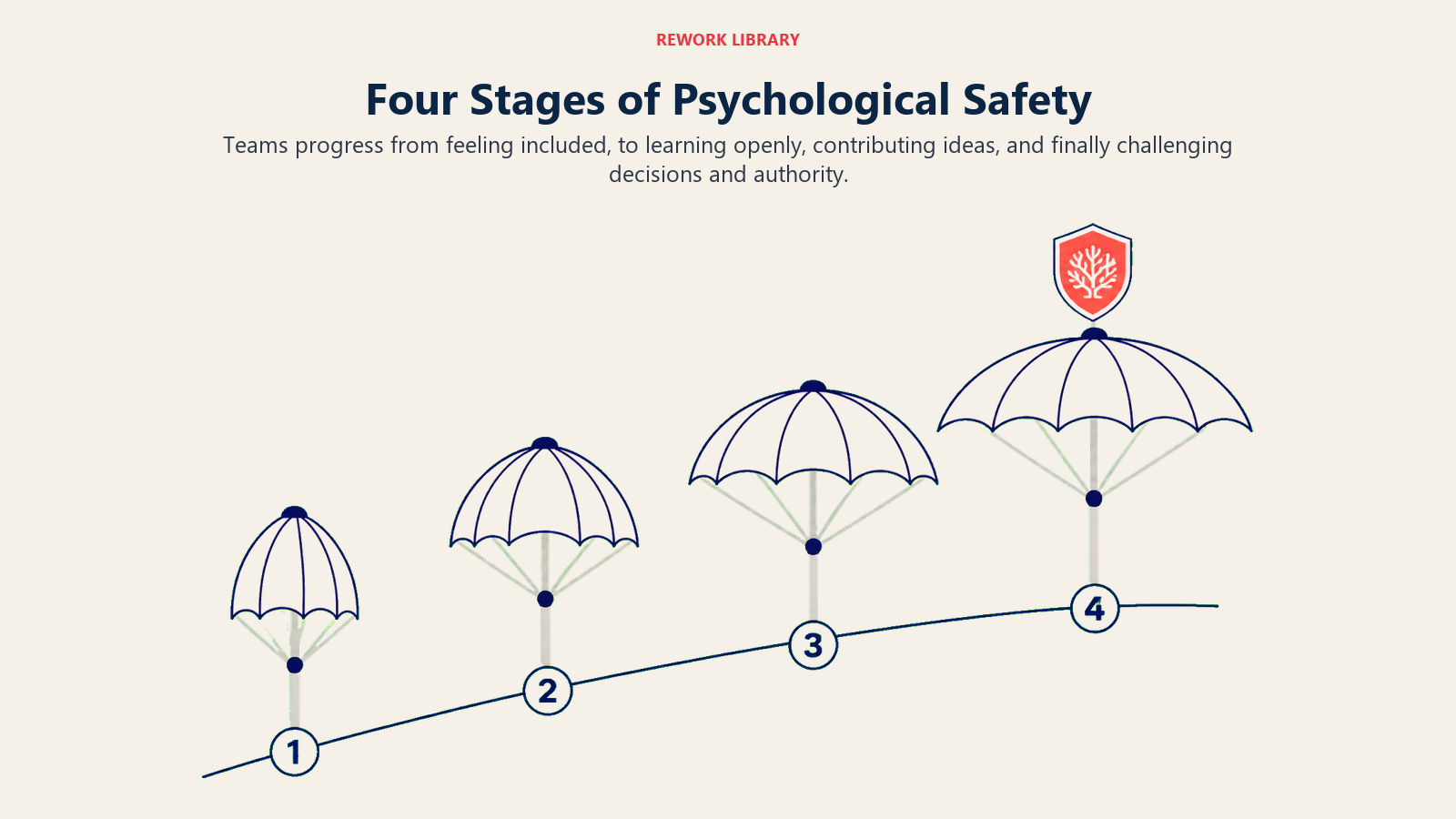
| Stage | What people feel safe to do | What it looks like when missing |
|---|---|---|
| 1. Inclusion safety | Show up as themselves and be treated as part of the group | New hires get left out of key threads; someone's accent or background becomes a running joke |
| 2. Learner safety | Ask questions, admit confusion, make mistakes while learning | People nod along in training rather than admit they didn't follow it |
| 3. Contributor safety | Apply their skills and offer ideas without over-justifying every suggestion | Junior staff wait to be asked before ever volunteering a solution |
| 4. Challenger safety | Question the plan, the process, or the person in charge | Everyone privately knows a decision is wrong, and nobody says so in the room |
Most teams get stuck at stage one or two. People feel included and can ask a clarifying question without embarrassment, but they still hang back from offering an unsolicited idea, and almost nobody challenges a senior person's plan out loud. That gap between stage two and stage four is exactly where most of the value in this article lives, because why teams stay silent in meetings is, in Clark's terms, usually a challenger-safety problem wearing a "we're all aligned" disguise. Source: LeaderFactor
Why Psychological Safety Drives Performance: Google's Project Aristotle
For two years, Google's People Analytics team studied 180 of its own teams, testing the obvious hypotheses first: did the best teams have the most experienced people, the clearest goals, the strongest technical skills? None of those factors reliably separated high performers from the rest. What did was psychological safety. Teams where members felt safe taking interpersonal risks consistently outperformed teams that had better credentials on paper but less trust in the room.
The mechanism is not mysterious once you see it. A team's actual output is bounded by what its members are willing to say, not by what they know. A senior engineer who spots a flaw in the architecture but stays quiet because the plan came from the VP contributes nothing with that knowledge. A team member who has a half-formed idea that could work, but assumes it will sound silly, keeps it to themselves. Psychological safety is the mechanism that converts what people privately know into what the team collectively acts on. Skill and experience only matter if people are willing to use them out loud, and that willingness is exactly what Google's data isolated as the deciding factor.
The System Behind Psychological Safety, Not Just the Manager's Style
Most advice on this topic treats psychological safety as a leadership personality trait: some managers are naturally warmer, so their teams feel safer. That is true as far as it goes, but it puts the whole burden on one person's temperament and ignores the systems around them that either reinforce safety or quietly undermine it, no matter how warm that manager is.
Three systems matter more than most leaders realize. First, how bad news travels upward. If a team's only channel for surfacing a problem is a skip-level meeting that happens once a quarter, safety at the team level cannot compensate for a structure that punishes speed. Second, what gets rewarded in performance reviews. A system that only credits individual output, never the person who flagged a flaw before it became expensive, is training people to stay quiet no matter what a manager says in a one-on-one. Third, what happens to the last person who spoke up. Every team keeps a mental ledger of how that went, and one bad outcome, one person who got quietly punished for raising a concern, resets the ledger for everyone watching, regardless of how many other people had a fine experience.
This is the same systems logic covered in culture architecture: if the stated value is candor but the promotion criteria reward people who never rock the boat, the system wins every time. A single psychologically safe manager can protect their own team for a while, but building it at scale means fixing the systems, not just coaching the individuals running them.
How to Build Psychological Safety
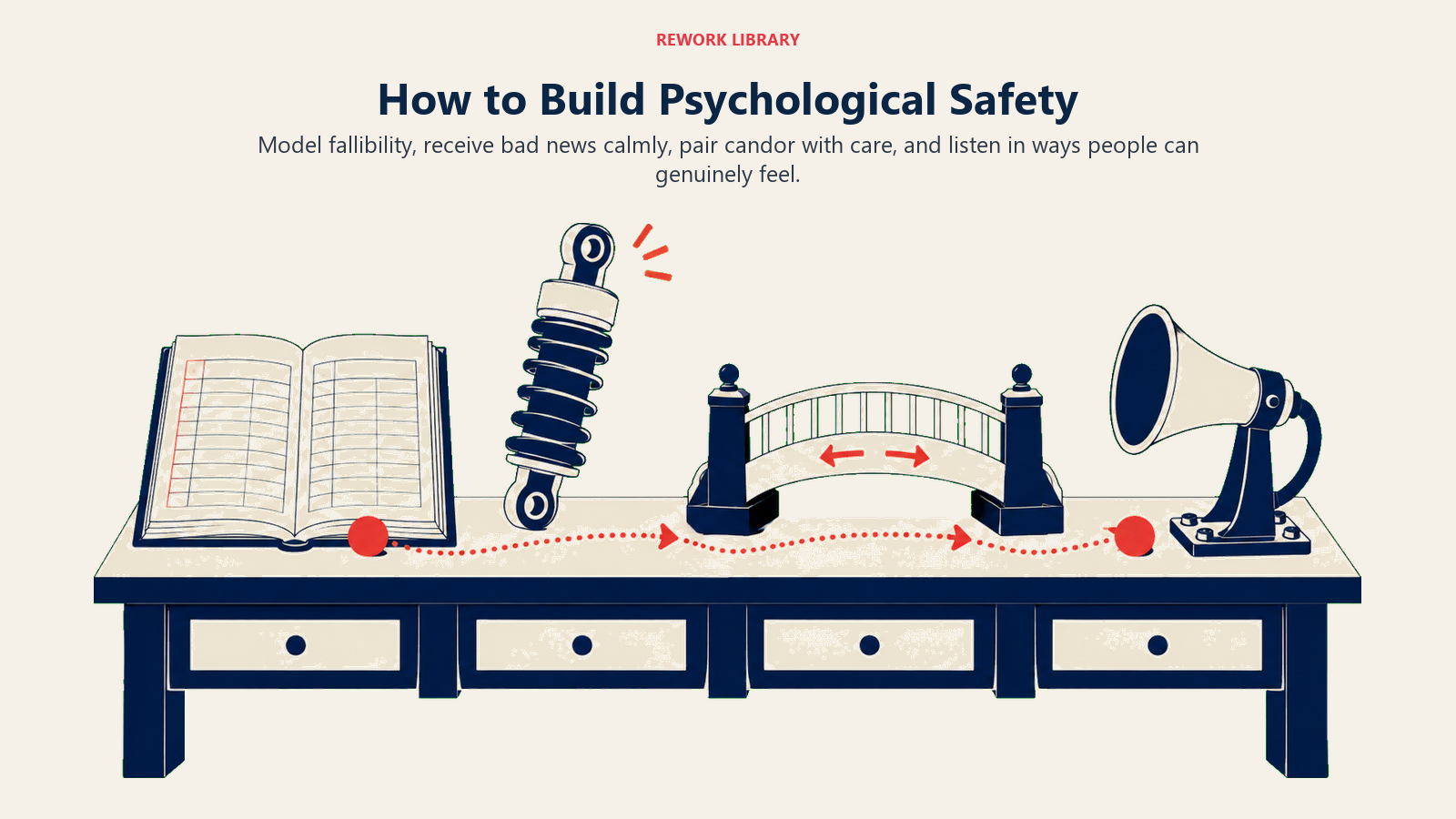
The leader-level behaviors that build psychological safety are well documented, and psychological safety: why it matters and how to build it walks through the full playbook, including how specific leadership styles like inclusive leadership and servant leadership make the work easier. The short version, focused on the behaviors that matter most at the culture-system level covered here:
Model Fallibility, on Purpose
A leader who says "I got that wrong last quarter, here's what I changed" does more for a team's stage-two learner safety than any workshop. It signals that admitting a mistake is a normal part of doing the job, not a career risk, and it gives everyone else explicit permission to do the same.
Respond to Bad News as Information, Not a Threat
The single highest-leverage moment for psychological safety is the ten seconds right after someone tells you something you did not want to hear. Thank them, engage with the substance, and resist the urge to look for who to blame. That reaction, repeated consistently, is what actually trains a team's ledger over time. One dismissive reaction can undo months of the opposite.
Build Radical Candor Into Feedback, Both Directions
Safety and candor reinforce each other rather than compete. Radical candor works precisely because it pairs direct feedback with genuine care for the person receiving it, which is the same combination Google's research found in its best teams: high challenge, high safety, at the same time.
Listen in a Way People Can Actually Feel
None of the above lands if people do not believe they were heard. Active listening is the foundational skill underneath every other item on this list; a team that feels genuinely heard when they raise a concern will keep raising them, and a team that feels tolerated rather than heard will quietly stop.
How to Measure Psychological Safety
Psychological safety is measurable, not just a vibe leaders guess at. Edmondson's original seven-item survey remains the standard instrument, asking people to rate statements like "if you make a mistake on this team, it is often held against you" (reverse-scored) and "it is safe to take a risk on this team." Run consistently, usually as part of a quarterly engagement pulse, the trend line matters more than any single score, since a team recovering from a bad incident should show measurable improvement over a few cycles, not an instant fix.
Beyond the survey, three behavioral signals are cheaper to track and harder to fake. How many questions get asked in meetings, and by whom (if it is always the same two or three people, stages three and four are not there yet). How early problems surface relative to when they actually happened (a lag between "we knew" and "we said something" is a direct measure of unsafe silence). And what a blameless retrospective actually produces: a genuine list of process fixes, or a room full of people carefully avoiding the word "why" because it might land on a name.
Common Myths About Psychological Safety
| Myth | Reality |
|---|---|
| It means being nice to everyone | It means people can disagree, challenge, and admit mistakes without penalty; harmony is not the goal |
| It lowers standards | The highest-performing teams in Edmondson's and Google's research pair safety with high standards, not low ones |
| One warm manager is enough | Reward systems, promotion criteria, and how bad news travels upward matter as much as any individual's style |
| It's built once and stays | One badly handled incident can undo months of trust; it requires ongoing, consistent behavior |
| Junior staff need it most | Everyone needs it, including senior people admitting they don't have the answer in front of their own team |
Psychological Safety in AI-Enabled Teams
Everything above gets harder, not easier, once AI is doing part of the work, and the stakes for getting it right go up at the same time. Three new interpersonal risks show up specifically because a teammate is now a model instead of a person.
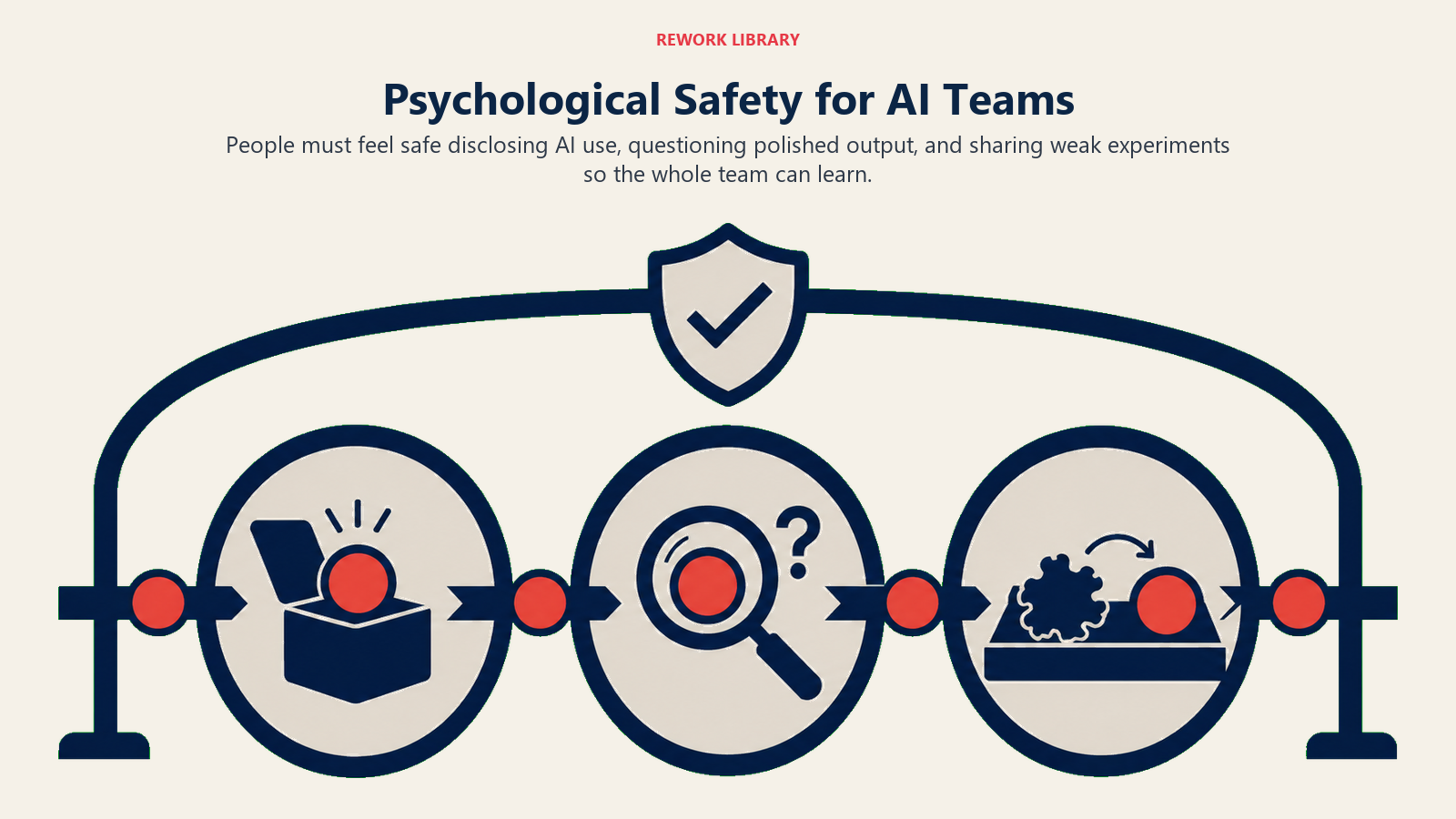
Admitting you used AI. The instinct to hide AI use is not a fringe behavior. Nearly half of employees say they conceal it, and the leading reason is not the job-security fear most employers assume; it is worry about being judged as having cut corners. A team where using AI on a draft feels like something to hide is a team that has quietly failed stage-two learner safety for a new kind of tool, and it means managers lose visibility into how work is actually getting produced.
Questioning AI output. Unlike a colleague's reasoning, a model's reasoning usually cannot be interrogated the same way: you cannot ask it why it made a specific tradeoff and get an answer you can fully trust. Psychology Today's 2026 review of this dynamic calls it "trust ambiguity," and argues it raises the bar for psychological safety rather than lowering it, because someone has to feel safe saying "I don't trust this output" about work that looks polished and came out fast. Teams without that safety default to either blind acceptance or silent, individual double-checking, both of which erode the trust AI cultural debt describes building up unmanaged.
Learning in the open. The BetterUp Labs and Stanford research on AI-generated "workslop" found that when a colleague's AI-assisted work turns out to be hollow, roughly half of recipients start viewing that person as less trustworthy and less capable, not less busy. That reaction punishes exactly the transparency you want: someone experimenting with a new AI workflow, getting a mediocre result, and being honest about it so the team learns faster. If the visible cost of an AI misstep is a quiet reputation hit, people stop disclosing their misses, and the team stops learning from them.
None of this is really new territory. It is the same challenger and learner safety Edmondson described in 1999, applied to a teammate that does not sleep, cannot be asked "why" in the way a person can, and is being adopted faster than most organizations have built norms for. Organizations working out what an AI-native culture actually looks like, including the new manager role Microsoft has called the agent boss, are running headfirst into this exact problem: intelligence got cheaper and faster, but the safety to be honest about using it, questioning it, and learning from it in public did not automatically scale with it.
Where This Leaves You
Psychological safety is not a values-deck line item, and it is not a personality a manager either has or doesn't. It is a structural condition, built by specific behaviors and reinforced or destroyed by the systems around them, that determines whether a team's real thinking, including its uncomfortable thinking, ever reaches the people who could act on it. The research is consistent across four decades of hospitals, 180 Google teams, and now a growing body of work on AI-enabled teams: safety and performance move together, not in opposition.
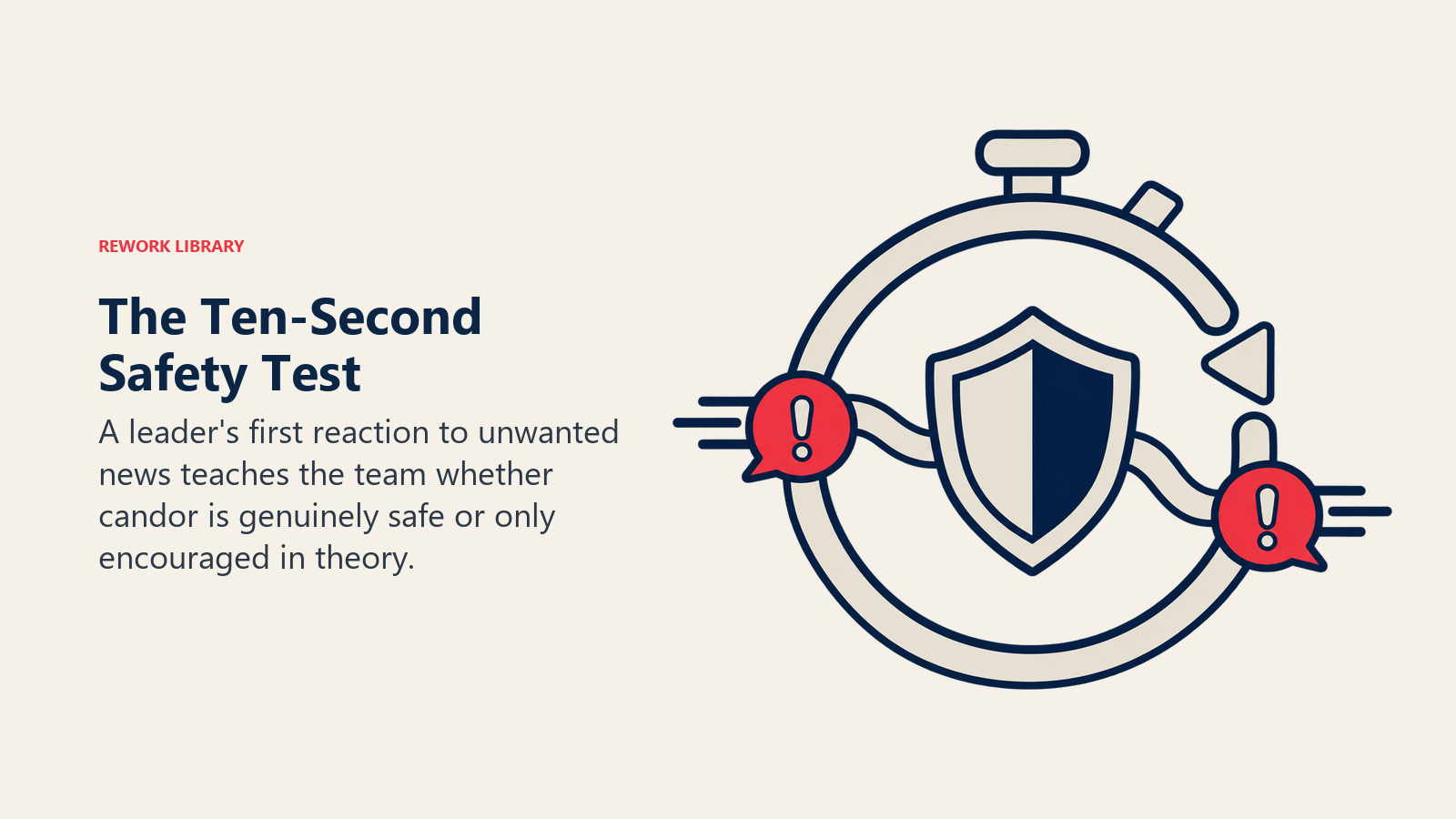
Start with the ten seconds after someone tells you something you did not want to hear. That single moment, repeated consistently, does more to build or break psychological safety than any workshop, survey, or values statement ever will.
Frequently Asked Questions about Psychological Safety at Work
What is psychological safety at work in simple terms?
Psychological safety at work is the shared belief that people on a team will not be embarrassed, rejected, or punished for speaking up: asking a question, admitting a mistake, raising a concern, or disagreeing with a decision. Harvard's Amy Edmondson coined the term in 1999, describing it as a team-level condition rather than an individual trait.
Is psychological safety the same as being nice or having a comfortable workplace?
No. Psychologically safe teams often have more direct disagreement, not less, because people trust that raising a hard truth will not cost them socially or professionally. A "nice" culture that avoids conflict usually means real problems go unspoken and resurface later as bigger, more expensive ones.
What are the four stages of psychological safety?
Timothy Clark's model describes inclusion safety (feeling accepted), learner safety (feeling safe to ask questions and make mistakes), contributor safety (feeling safe to offer ideas and use your skills), and challenger safety (feeling safe to question the plan or the person in charge). Most teams get stuck at the first two stages and never reach genuine challenger safety.
Why does psychological safety actually affect performance?
Google's two-year Project Aristotle study of over 180 teams found it was the single strongest predictor of team effectiveness, ahead of experience, skill mix, and team size. The mechanism is simple: a team can only act on what its members are willing to say out loud, and psychological safety is what determines how much of what people privately know actually gets said.
How do you measure psychological safety?
Amy Edmondson's original seven-item survey remains the standard tool, using statements like "it is safe to take a risk on this team" scored on agreement. Beyond the survey, track how many different people ask questions in meetings, how early problems get raised relative to when they happened, and what an honest blameless retrospective actually produces.
Can one manager build psychological safety without support from senior leadership?
A single manager can build real psychological safety within their own team through consistent behavior, even in an organization with a weaker overall culture. But it does not scale past that team unless the reward systems, promotion criteria, and how bad news travels upward are also fixed, since those systems shape behavior as much as any individual leader's style.
Why does psychological safety matter more now that teams use AI?
AI adds three new interpersonal risks: admitting you used it, questioning output you cannot fully interrogate the way you would a colleague's reasoning, and being honest when an AI-assisted attempt falls short. Research shows nearly half of employees already hide their AI use, mostly from fear of judgment, which is a direct measure of low psychological safety around a new kind of teammate.
Does psychological safety mean there are no consequences for poor performance?
No. Psychological safety covers interpersonal risk around ideas, questions, and honest mistakes. It does not remove accountability for results, quality, or professional conduct. The research consistently shows the best teams combine high psychological safety with high standards, not one instead of the other.

Co-Founder, Rework.com
On this page
- What Psychological Safety Is (and What It Isn't)
- Psychological Safety vs. Niceness
- Key Facts
- The Four Stages of Psychological Safety
- Why Psychological Safety Drives Performance: Google's Project Aristotle
- The System Behind Psychological Safety, Not Just the Manager's Style
- How to Build Psychological Safety
- Model Fallibility, on Purpose
- Respond to Bad News as Information, Not a Threat
- Build Radical Candor Into Feedback, Both Directions
- Listen in a Way People Can Actually Feel
- How to Measure Psychological Safety
- Common Myths About Psychological Safety
- Psychological Safety in AI-Enabled Teams
- Where This Leaves You