Why Teams Stay Silent in Meetings (and How to Fix It)
Turn this article into takeaways for your work.


Each assistant summarizes the article only for you and suggests best practices for your work.
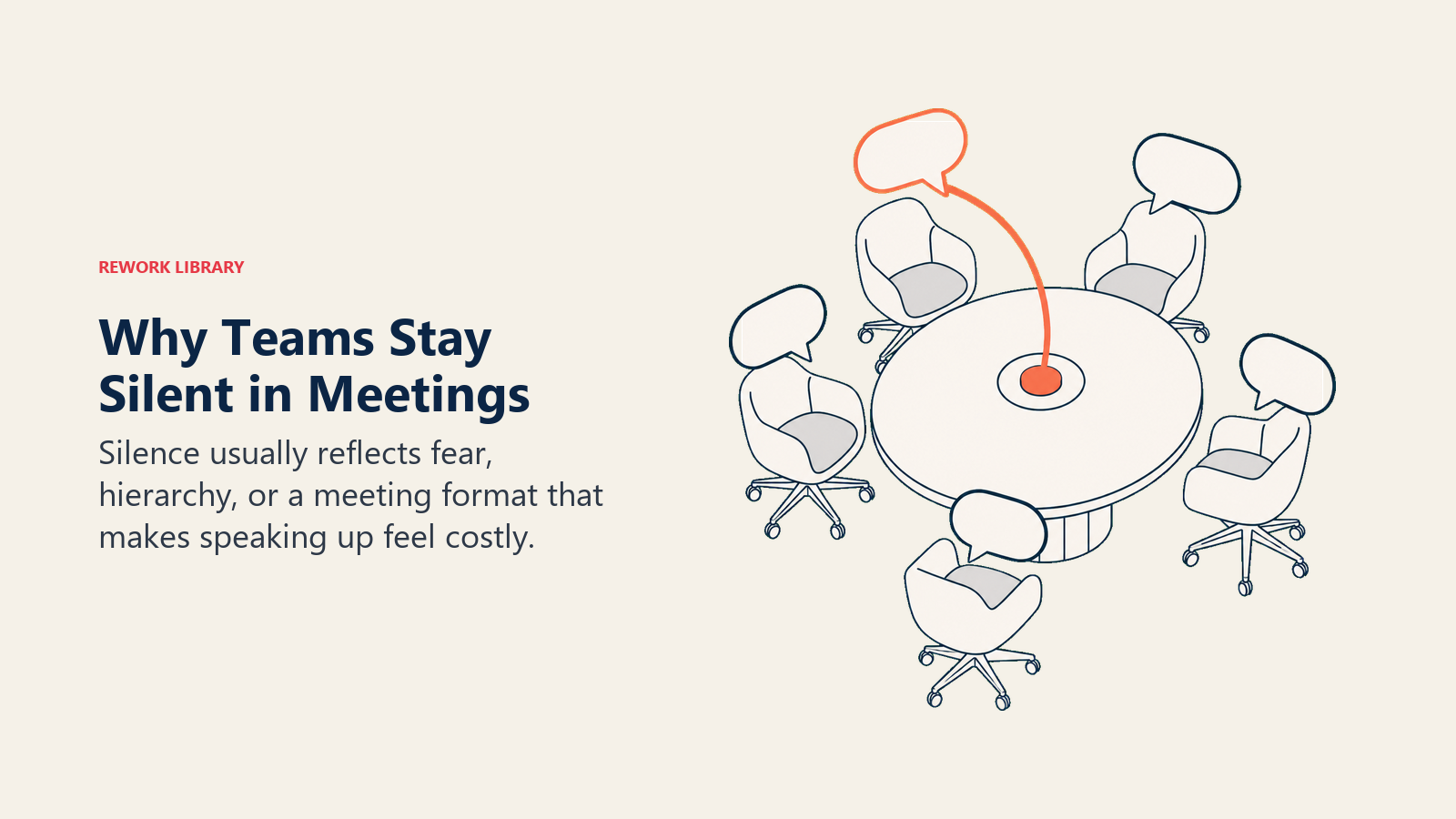
Team silence in meetings is when people who have real opinions, concerns, or better ideas don't say them out loud during the discussion, then share them privately afterward, in the hallway, on Slack, or not at all. It's rarely apathy. It's a signal that speaking up in that room, at that moment, costs more than staying quiet does.
The Real Reasons Your Team Goes Quiet
Silence looks the same from the front of the room no matter what's causing it, which is exactly why it's so easy to misread. Most leaders assume quiet means agreement or a lack of opinions. In practice, the causes cluster into a handful of patterns, and they usually stack on top of each other.
The Psychological Safety Gap
Harvard Business School professor Amy Edmondson's research on psychological safety found that teams need a shared belief that speaking up won't get them embarrassed, blamed, or punished before they'll actually do it. Without that belief, silence is the rational choice. Nobody gets fired for staying quiet. People get remembered for the wrong question at the wrong time.
High Power Distance and Hierarchical Culture
Some organizations, and some national cultures, run on a wider gap between the top and the bottom of the org chart. In high power-distance settings, challenging a senior person openly isn't just uncomfortable, it can read as disrespect. We break this axis down fully in hierarchical vs. egalitarian cultures, but the short version: the more a culture defers to title and seniority, the less likely a junior voice raises an objection in front of the group, regardless of how strongly they feel about it.
Collectivist Face-Saving
In collectivist cultures, the group's harmony often outweighs an individual's need to be right in the moment. Disagreeing with a plan in an open meeting can look like making the person who proposed it lose face in front of peers, which is a bigger social cost than staying quiet and raising the concern privately later, if at all. This isn't dishonesty. It's a different calculation about where the real conversation should happen.
Simple Fear
Sometimes it's not culture or safety science, it's a specific bad memory. Someone got shut down, mocked, or overruled the last time they spoke up, and they've generalized that lesson to every meeting since. One sharp reaction from a leader can silence a person for months, long after the leader has forgotten the moment happened.
Poor Facilitation
A lot of silence is just bad meeting design. "Any questions?" to a room of twelve people, asked once, with three seconds of silence before moving on, isn't really an invitation. It's a formality. If the loudest, most confident two or three people always answer first, everyone else learns their input isn't actually being solicited, it's just being allowed.
Dominant Voices
Even in a psychologically safe, low-hierarchy room, a handful of people can end up doing most of the talking simply because they think out loud, talk fast, or aren't uncomfortable with silence the way others are. Quieter processors, often more junior or newer team members, need a beat of silence to formulate a thought, and a fast-moving meeting rarely gives it to them.
Remote and Hybrid Dynamics
Video calls remove a lot of the small social cues, a leaning-forward posture, a half-raised hand, that experienced facilitators use to draw someone in. Unmuting to speak also carries a higher social cost than raising a hand in a room, and it's easy for one or two people to dominate a call while everyone else stays on mute, nodding at a black square. Distributed teams that already deal with power distance or face-saving dynamics get this effect twice.
Key Facts
- Google's Project Aristotle studied more than 180 teams and found psychological safety was the single strongest predictor of team effectiveness, ahead of skill, seniority, or team composition. Source: rework.withgoogle.com
- Amy Edmondson's landmark 1999 study of 51 work teams, published in Administrative Science Quarterly, found that psychological safety predicted team learning behavior: the willingness to ask questions, raise problems, and admit mistakes out loud. Source: journals.sagepub.com
- Gallup research found only 3 in 10 U.S. employees strongly agree their opinions count at work. Gallup estimates moving that ratio to 6 in 10 could cut turnover by 27%, reduce safety incidents by 40%, and lift productivity by 12%. Source: gallup.com
- On Hofstede's Power Distance Index, Malaysia scores 104 versus 40 for the United States, meaning employees in high-PDI cultures are far less likely to challenge a superior openly in a group setting. Source: hofstede-insights.com
- McKinsey's research on leadership development found that only 26% of leaders actively create psychological safety for their teams. Source: mckinsey.com
- In the same McKinsey study, only 43% of respondents reported a positive team climate, which the research identifies as the single biggest driver of psychological safety. Source: mckinsey.com
Is It Fear, Culture, or Format? A Quick Diagnostic
Before you redesign every meeting on your calendar, figure out which problem you're actually solving. The fixes are different for each one.
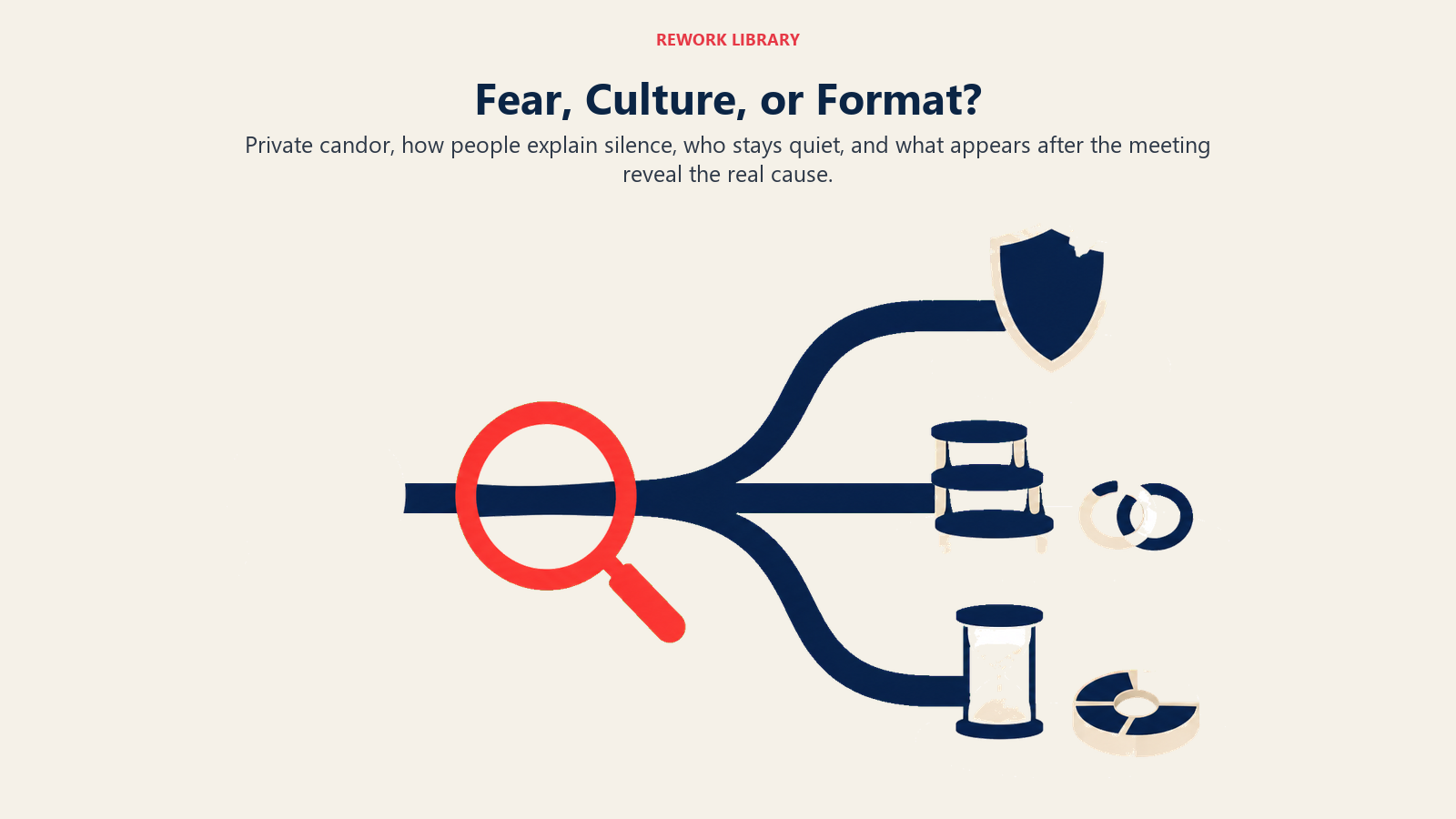
Test it with a 1:1. Ask the quiet person directly, in private, what they actually thought of the plan discussed in the meeting. If they give you a clear, confident opinion the moment the audience shrinks to one, the room itself is the problem, not their judgment or their willingness to think critically.
Listen for how they explain their silence. "I didn't want to put so-and-so on the spot" points to face-saving or hierarchy. "I wasn't sure it was my place to say" points to power distance or role clarity. "I got cut off last time" points to plain fear, tied to a specific bad experience. "I needed more time to think it through" points to format, a meeting that moves too fast for anyone who isn't a fast verbal processor.
Check whether it's one person or the whole room. If it's one or two people, you're likely dealing with an individual history or personality style. If it's most of the room, especially across a specific team, region, or seniority band, you're dealing with a structural pattern: culture, hierarchy, or a meeting format that consistently favors the same few voices.
Watch what happens after the meeting. If concerns or better ideas surface in Slack DMs, hallway conversations, or a 1:1 within a day of the meeting, that's strong evidence people had something real to say and simply didn't feel the room was the place to say it.
Once you know which one you're dealing with, fear, culture, or format, you can pick the right fix instead of running every team through the same generic "speak up more" pep talk that rarely works.
The Leader Playbook to Surface Real Opinions
None of these require a culture overhaul. They're meeting-level and relationship-level habits any manager can start using this week.
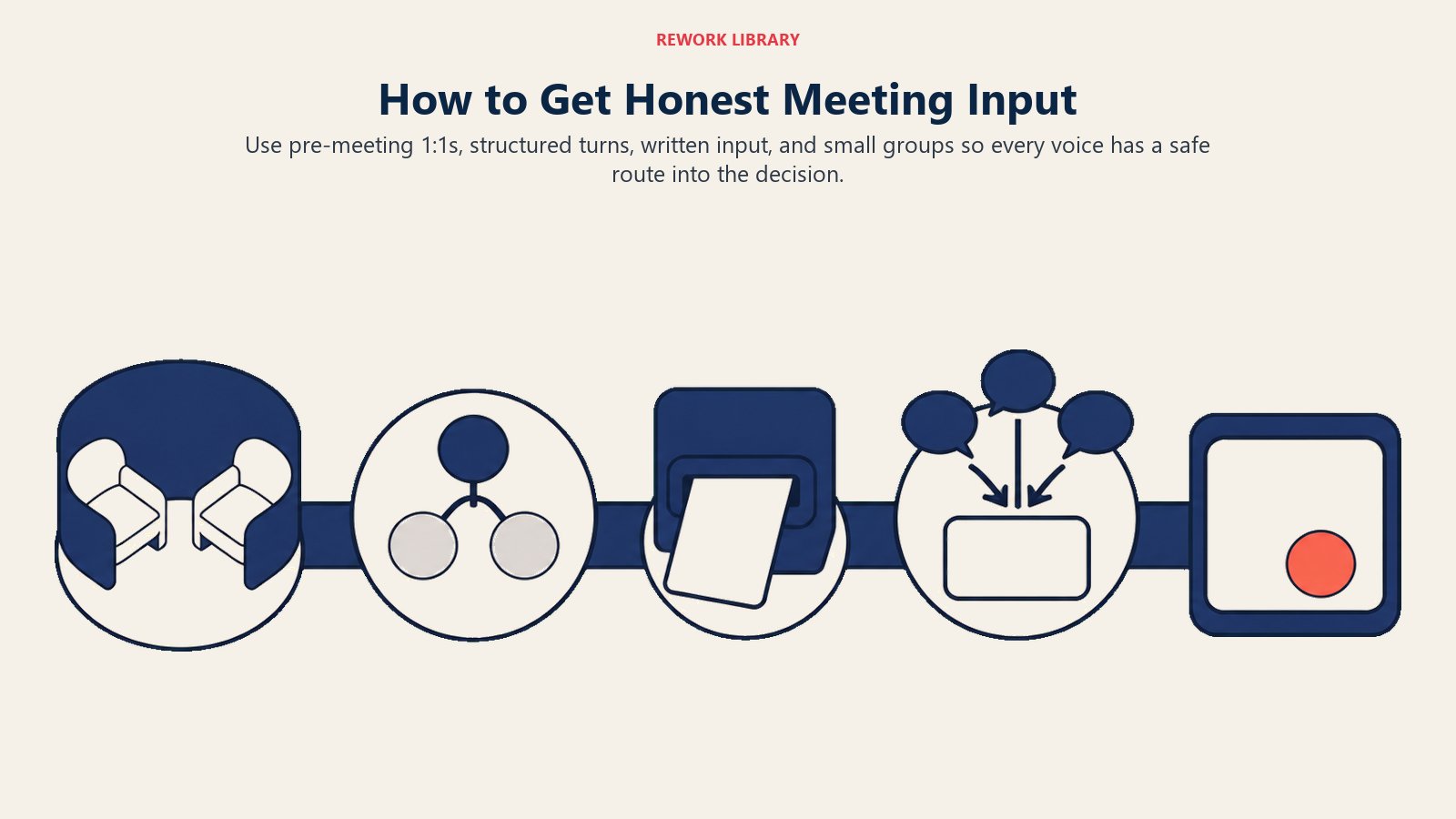
Run 1:1s before the meeting, not just after. If you already suspect a decision is contentious, walk the room privately first. Ask each key stakeholder what they think before the group ever convenes. You'll surface objections while they're still cheap to address, and people who won't contradict a peer in public will often tell you plainly in a 1:1.
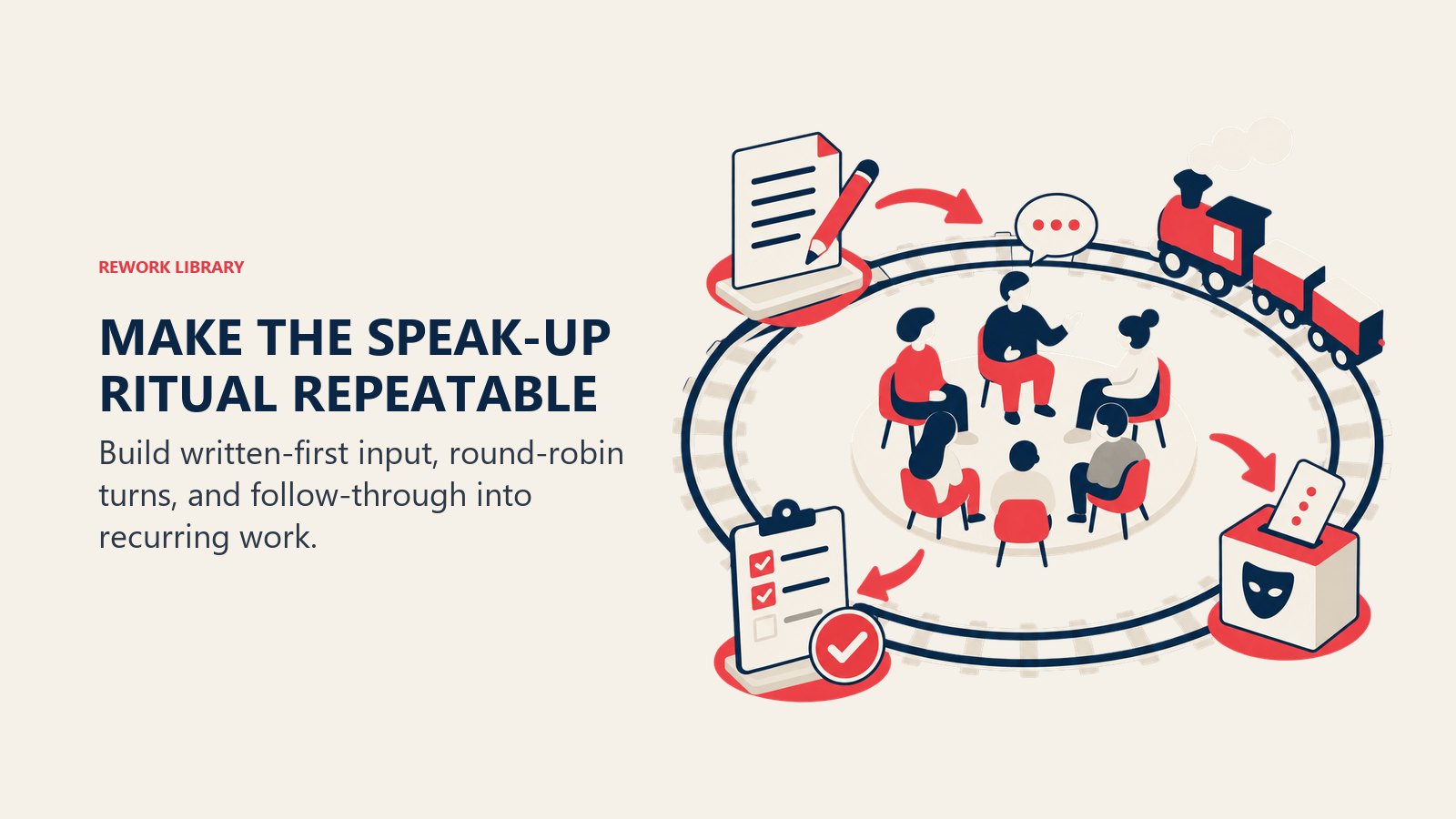
Use round-robin instead of open floor. Go person by person and ask each one directly: "What's your read on this?" A structured turn removes the need to fight for airtime, and it signals that everyone's input is expected, not just welcomed if they happen to jump in.
Add an anonymous input channel. A quick anonymous poll, form, or shared doc before a decision meeting lets people flag concerns without their name attached. It's not a permanent replacement for open discussion, but it's a fast way to find out if silence in the room is hiding real disagreement.
Ask, don't tell. Replace "any objections?" with specific, open questions: "What's the part of this you're least confident about?" or "What would make this fail?" Vague prompts get vague silence. Specific prompts get specific answers, even from people who'd never volunteer an unprompted objection.
Name the room as safe, out loud. Before a sensitive discussion, say directly: "I want to hear where this plan is weak. Nobody gets penalized for finding a hole in it here." This doesn't work as a one-time line. It works when you follow through the first three times someone tests it and you respond with genuine interest instead of defensiveness.
Break into small groups first. Two or three people talking for five minutes produces more honest input than fifteen people staring at one screen. Have small groups surface their top concern, then report it back. It's easier to voice a shared concern on behalf of a small group than to raise a solo objection in front of the whole room.
Go written-first for high-stakes decisions. For anything contentious, circulate a short written proposal before the meeting and ask for comments or questions in writing first. This gives people who need time to think, and people less comfortable speaking up live, a real chance to weigh in on equal footing with the fastest talker in the room.
Feedback that never gets built into a repeatable ritual quietly stops happening the moment the manager who championed it moves on. If your team wants the discipline behind this, building a feedback culture and giving feedback well are the next two pieces to read.
When Culture Is the Amplifier
Everything above works regardless of where your team sits culturally. But it's worth naming plainly: high power-distance and collectivist cultures amplify every one of these dynamics. Per Hofstede's research, countries across much of Southeast Asia and East Asia score far higher on power distance than the US, UK, or Northern Europe, which means the default distance between "junior" and "senior" in a meeting is wider before you've done anything at all.
That doesn't mean people in those cultures have less to say. It means the room, as designed by default Western meeting norms, wasn't built to make it easy for them to say it. A round-robin, a written-first process, and a private 1:1 before the big meeting close that gap without asking anyone to act against their own cultural instincts. For the country-level detail, the specific scores, and what it looks like day to day, see how business culture differs around the world and Hofstede's cultural dimensions explained, plus how hierarchy and egalitarian norms shape who talks first. We also cover the flip side of this problem, teams where nobody feels safe enough to challenge a plan even in private, in psychological safety at work.
Building talent density only pays off if the talent you hired actually says what it thinks. And inclusive leadership and radical candor both point to the same underlying skill: making it genuinely safe, structurally and not just verbally, for someone with less power in the room to disagree with someone who has more.
For teams that run into the same pointless meetings problem on top of silence, fixing the format usually fixes both at once: a shorter, better-facilitated meeting with a clear round-robin gives people less time to disengage and more reason to actually speak.
Where Rework Fits
None of this needs new software to start. But rituals that depend on one manager remembering to run them tend to fade within a quarter. If your team runs its work in Rework's Work Ops, you can build the round-robin prompt or the written-first step directly into a recurring meeting workflow, and route the anonymous input and feedback loop through a repeatable process instead of a one-off Slack poll, so the habit survives past the first few meetings where it feels new.
Frequently Asked Questions about Team Silence in Meetings
Why is my team silent in meetings even when I ask for feedback?
Asking "any objections?" once, to the whole room, rarely produces honest answers. Silence usually means the cost of speaking up (embarrassment, contradicting a senior person, or looking uncertain) outweighs the benefit in that moment, not that people agree or have nothing to say.
How do I know if my team's silence is about fear or about culture?
Ask the same question privately, in a 1:1, right after the meeting. A clear, confident answer in private but silence in public usually points to the room's dynamics, whether that's fear, hierarchy, or face-saving, rather than a lack of opinion.
Does psychological safety fix team silence on its own?
It's necessary but not sufficient. A psychologically safe team can still stay quiet if the meeting format favors fast talkers, or if cultural norms around hierarchy make open disagreement feel disrespectful regardless of how safe the team otherwise is. Safety and format both need fixing.
Are high power-distance or collectivist cultures more prone to meeting silence?
Yes, on average. Cultures with higher Hofstede Power Distance scores and stronger collectivist norms tend to see less open disagreement in group settings, because challenging someone senior in front of others carries a higher social cost than it does in low power-distance cultures. It doesn't mean less disagreement exists, just that it surfaces through different channels.
What's the fastest fix for silent meetings?
Switch from open-floor to round-robin for at least the key decision points. Going person by person removes the need to compete for airtime and signals that everyone's input is expected, not just welcomed if they happen to jump in.
Should I call people out by name if they're always quiet?
Generally no, not in the moment, and not publicly. Putting someone on the spot in front of the group often backfires, especially in hierarchical or collectivist cultures. A better move is a private 1:1 asking what would make it easier for them to weigh in, then adjusting the format based on what you learn.
Does remote work make silence worse?
Often yes. Video calls strip out the small physical cues that help facilitators draw quieter people in, and unmuting to speak carries a higher social cost than raising a hand in person. Written-first proposals and structured turn-taking matter even more on remote and hybrid calls.
How long does it take to fix a pattern of silent meetings?
There's no fixed timeline, but consistent use of round-robin, private pre-meeting 1:1s, and following through when someone does speak up (responding with genuine interest, not defensiveness) usually produces a visible shift within a few meetings. One dismissive reaction can undo weeks of progress, so consistency matters more than any single tactic.
Is staying silent ever the right call in a meeting?
Sometimes, yes. Not every half-formed thought needs airtime in a live meeting, and some cultures genuinely prefer to build consensus privately before a group discussion, which isn't dysfunction. The problem isn't silence itself, it's when silence hides a real objection or a better idea that never reaches the decision-maker at all.
Silence in a meeting is data, not a verdict. It tells you something about the room, the format, or the culture, and almost never about whether your team has anything worth saying. Run the diagnostic before you redesign anything: figure out if you're dealing with fear, hierarchy, or bad facilitation, then apply the fix that actually matches the cause. Teams that build the habit, round-robin turns, a 1:1 before the big call, a written proposal people can react to on their own time, don't just get quieter people talking. They catch the objection that would have killed the project two weeks later, while it's still cheap to fix.

Co-Founder, Rework.com
On this page
- The Real Reasons Your Team Goes Quiet
- The Psychological Safety Gap
- High Power Distance and Hierarchical Culture
- Collectivist Face-Saving
- Simple Fear
- Poor Facilitation
- Dominant Voices
- Remote and Hybrid Dynamics
- Key Facts
- Is It Fear, Culture, or Format? A Quick Diagnostic
- The Leader Playbook to Surface Real Opinions
- When Culture Is the Amplifier
- Where Rework Fits