How to Build a Culture of Accountability
Turn this article into takeaways for your work.


Each assistant summarizes the article only for you and suggests best practices for your work.
A culture of accountability is a workplace where people take ownership of outcomes, not just tasks, and follow through on commitments without needing to be chased, reminded, or supervised. It is not the same thing as a blame culture. Blame looks backward for someone to punish. Accountability looks forward, asks what happened and why, and expects the same person to fix it and report back. It is also one of the clearest gaps between the culture a company claims and the one it actually runs, the exact split covered in what is business culture.
That distinction sounds obvious on a slide. It is much harder to build in practice, because most leaders reach for the wrong lever. They add more oversight when what is missing is clarity. They punish a visible failure when the real problem was that nobody defined what success looked like in the first place. This guide covers what accountability actually means, the four ingredients that make it stick, why most attempts at it fail, and a concrete way to build it: commitments, scoreboards, and after-action reviews. It closes with a note on who owns the outcome when part of the work is done by an AI agent.
What Accountability Actually Means
Accountability is the willingness to own the result of your work, including the parts that went wrong, and to report on that result honestly without waiting to be asked. It has two halves that only work together. The first half is ownership: you did the thing, so the outcome is yours to explain. The second half is follow-through: when the outcome falls short, you are the one who closes the gap, not the one who disappears until it blows over.
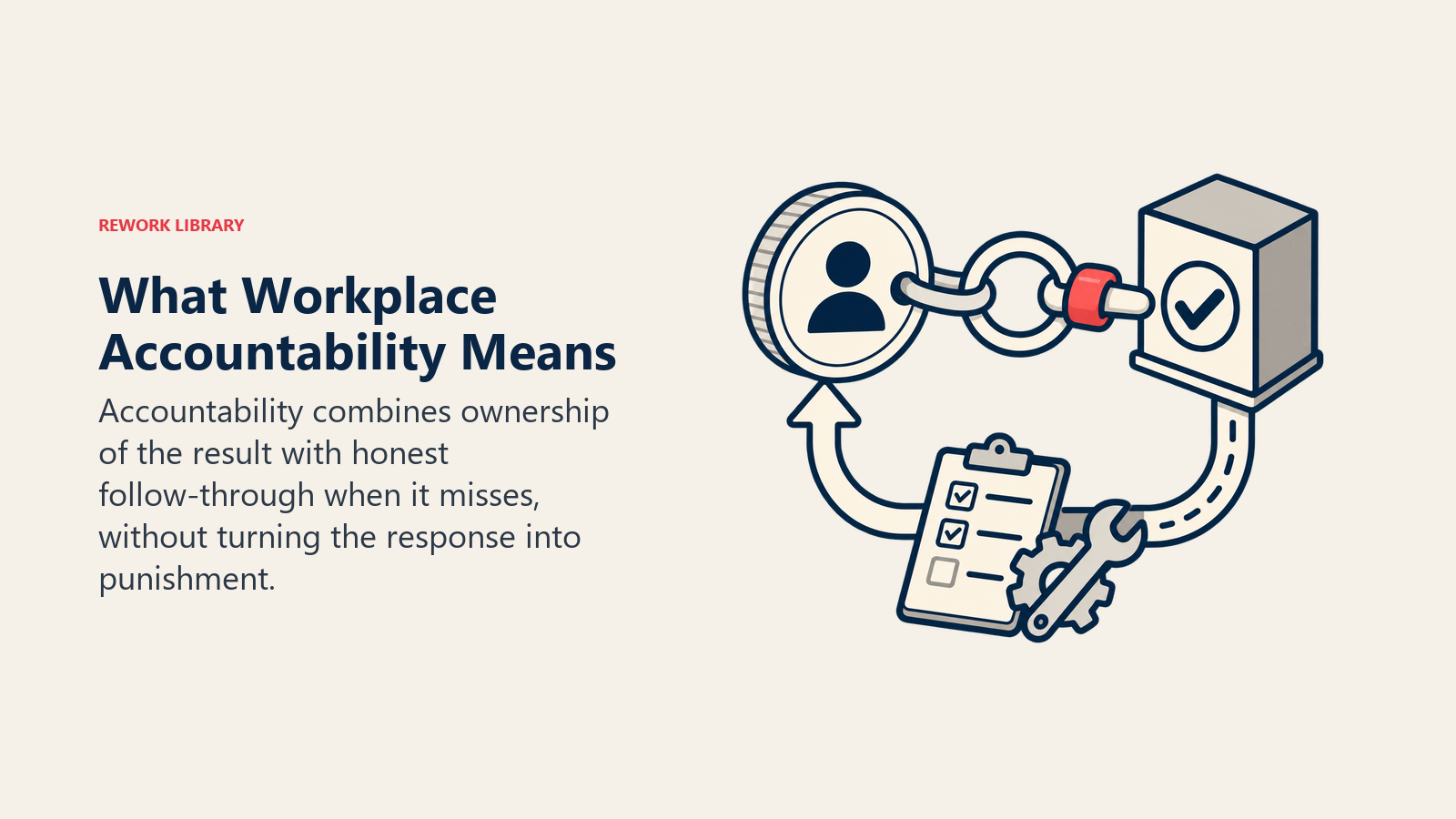
Notice what is missing from that definition: punishment. Accountability is not a euphemism for consequences, and it is not a synonym for "someone gets fired when this goes wrong." A team can hold each other accountable every week without a single person losing their job over it. The mechanism is transparency and follow-up, not fear.
Accountability vs. Blame
Blame culture and accountability culture produce opposite behavior from the same starting point: something went wrong. In a blame culture, the first question is "whose fault is this," and the goal of every person in the room becomes proving it was not them. People start covering their tracks before a mistake even happens, because the downside of being caught is so much worse than the downside of the mistake itself. Bad news gets filtered, delayed, or buried, which means leaders find out about problems only once they are too large to hide.
In an accountability culture, the first question is "what happened, and what do we do about it." The person closest to the mistake is still the one expected to explain it and fix it, so ownership does not disappear. But the tone of the conversation changes completely: it is diagnostic, not punitive. That difference determines whether people tell you about a problem in week one, when it is cheap to fix, or in week twelve, when it is not. A closer look at how blame culture and learning culture diverge, and why most organizations run more blame than they realize, deserves its own treatment; for now, the short version is that accountability without psychological safety collapses back into blame with better branding.
The Four Ingredients of an Accountability Culture
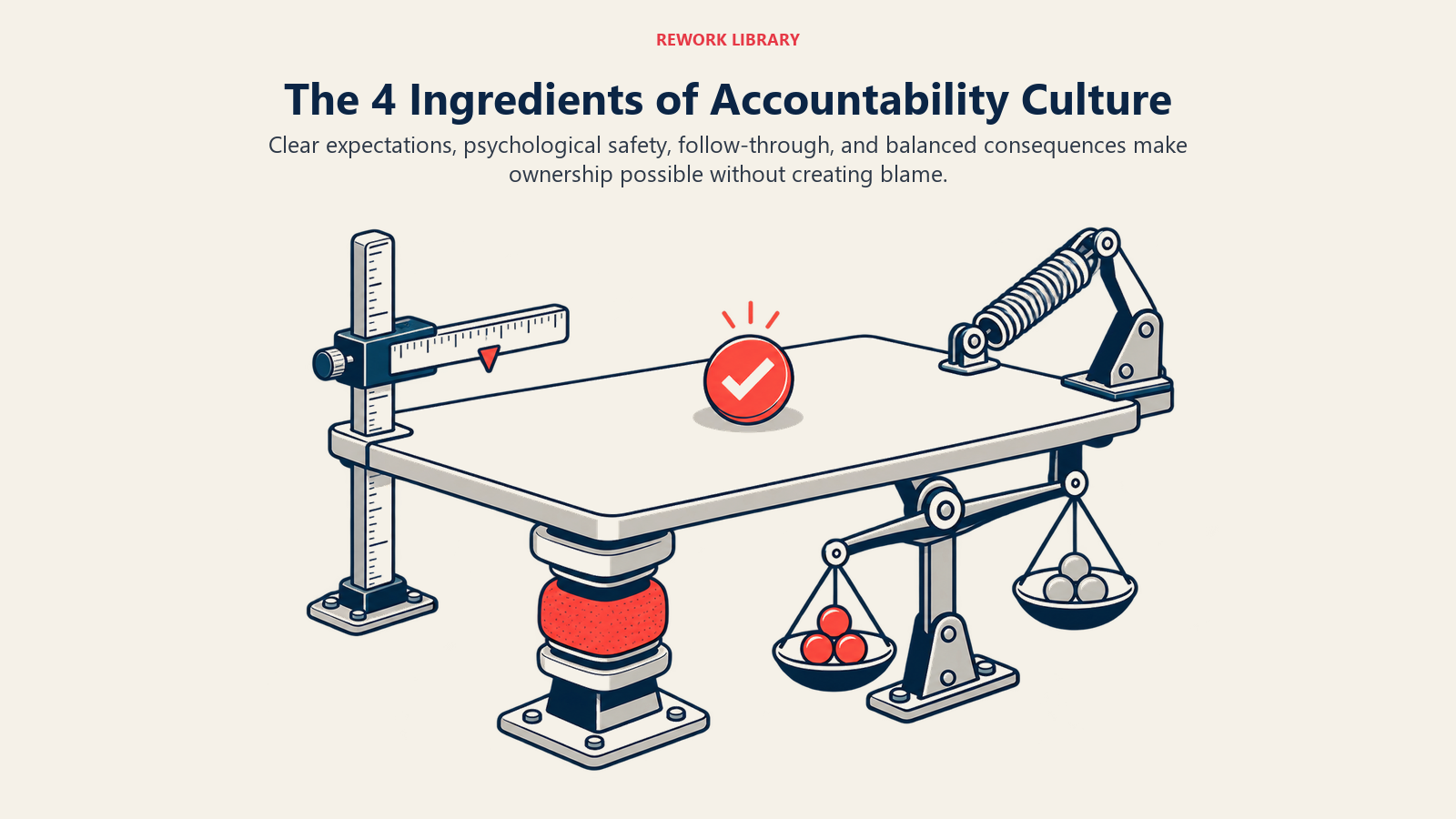
Accountability rarely fails because people are lazy or dishonest. It fails because one of four supporting conditions is missing, and no amount of exhortation ("just be more accountable") fixes a structural gap.
Clear Expectations
You cannot hold anyone accountable for a target that was never actually agreed on. This sounds too basic to mention, and it is also the single most common failure point. Gallup's long-running employee engagement research, built around its Q12 survey, has repeatedly found that roughly half of employees do not strongly agree that they know what is expected of them at work. That is not a training gap. It is a management gap, and it means half of most workforces are being judged against a standard nobody wrote down.
Clear expectations mean a specific outcome, a deadline, and an explicit definition of "done," agreed on before the work starts, not reconstructed afterward when something goes wrong. If a leader can only articulate what they wanted after the fact, the expectation was never actually clear, it was assumed. Getting the standard written down in the first place is the same discipline covered in how to define company values: put it in writing before you need to enforce it, not after.
Psychological Safety
Accountability requires people to report bad news early, and they will only do that if reporting bad news does not end their career. This is the connective tissue between accountability and psychological safety at work: teams that punish the messenger train people to stop sending messages. Google's internal Project Aristotle research on what separates high-performing teams named "dependability," teammates reliably following through and being straight about setbacks, as one of the top drivers of team effectiveness, right alongside psychological safety itself. The two conditions reinforce each other. Safety without any expectation of follow-through just produces a comfortable team that misses its numbers. Accountability without safety produces a team that hits its numbers on paper while hiding the real ones.
Follow-Through
A commitment that nobody checks on is not a commitment, it is a wish. Follow-through means someone actually looks at the result against what was promised, on a predictable cadence, and says so out loud, whether the news is good or bad. Most organizations are decent at setting goals in January and terrible at revisiting them in March. The gap between those two moments is where accountability quietly dies.
Consequences Both Ways
Accountability has to run in both directions or it is not a system, it is a stick. When someone delivers, that gets acknowledged specifically, not with a generic "great job, team." When someone misses, the consequence should fit the size of the miss: a conversation and a revised plan for a first-time shortfall, escalating structure for a repeated one. What kills accountability fastest is a culture where good work goes unnoticed but a single miss gets a leader's full attention. People learn quickly which behavior actually gets a response, and they calibrate their effort to match it. Getting that response specific and timely, instead of generic or delayed, is the same muscle behind building a feedback culture.
Why Accountability Cultures Fail
Most "we have an accountability problem" complaints are one of three simpler problems wearing a disguise.
No Clarity
If half the team cannot say, unprompted, what they are on the hook for this quarter, no amount of accountability language fixes that. The fix is upstream: define company values and specific expectations for a real target, not more pressure on the existing fuzzy one. A useful diagnostic: ask five people on the same team to describe their top priority in one sentence. If you get five different answers, the problem is clarity, not commitment.
Fear
When speaking up about a miss carries real risk, people stop speaking up, and leaders lose visibility into their own operation. This is one of the clearest signs of a toxic culture: problems get discovered late, from a customer or an auditor, instead of early, from the person doing the work. It is also the same dynamic behind why teams stay silent in meetings, where the risk of speaking up in front of the group outweighs the risk of staying quiet. Fear does not produce more accountability. It produces better hiding.
No Follow-Up
Plenty of teams set specific, well-communicated goals in a kickoff meeting and then never mention them again until the next kickoff. Without a recurring checkpoint, a commitment quietly becomes optional, and everyone learns that deadlines here are more like suggestions. This is the most fixable failure mode of the three, because it is a calendar problem, not a culture problem: put the checkpoint on the calendar and the behavior around it tends to follow.
Key Facts
- Gallup's long-running Q12 employee engagement survey research has repeatedly found that roughly half of employees do not strongly agree they know what is expected of them at work, one of the most consistent findings in its multi-decade dataset. (gallup.com)
- Google's Project Aristotle research on team effectiveness identified dependability, teammates reliably delivering quality work on time, as one of the five key dynamics of high-performing teams, alongside psychological safety, structure and clarity, meaning, and impact. (rework.withgoogle.com)
- Harvard Business School professor Amy Edmondson's research frames accountability and psychological safety as two independent axes: teams high on both land in what she calls the learning and high-performance zone, while teams high on accountability but low on safety land in an anxiety zone that suppresses the very reporting accountability depends on. (Amy Edmondson, "The Fearless Organization")
How to Build a Culture of Accountability
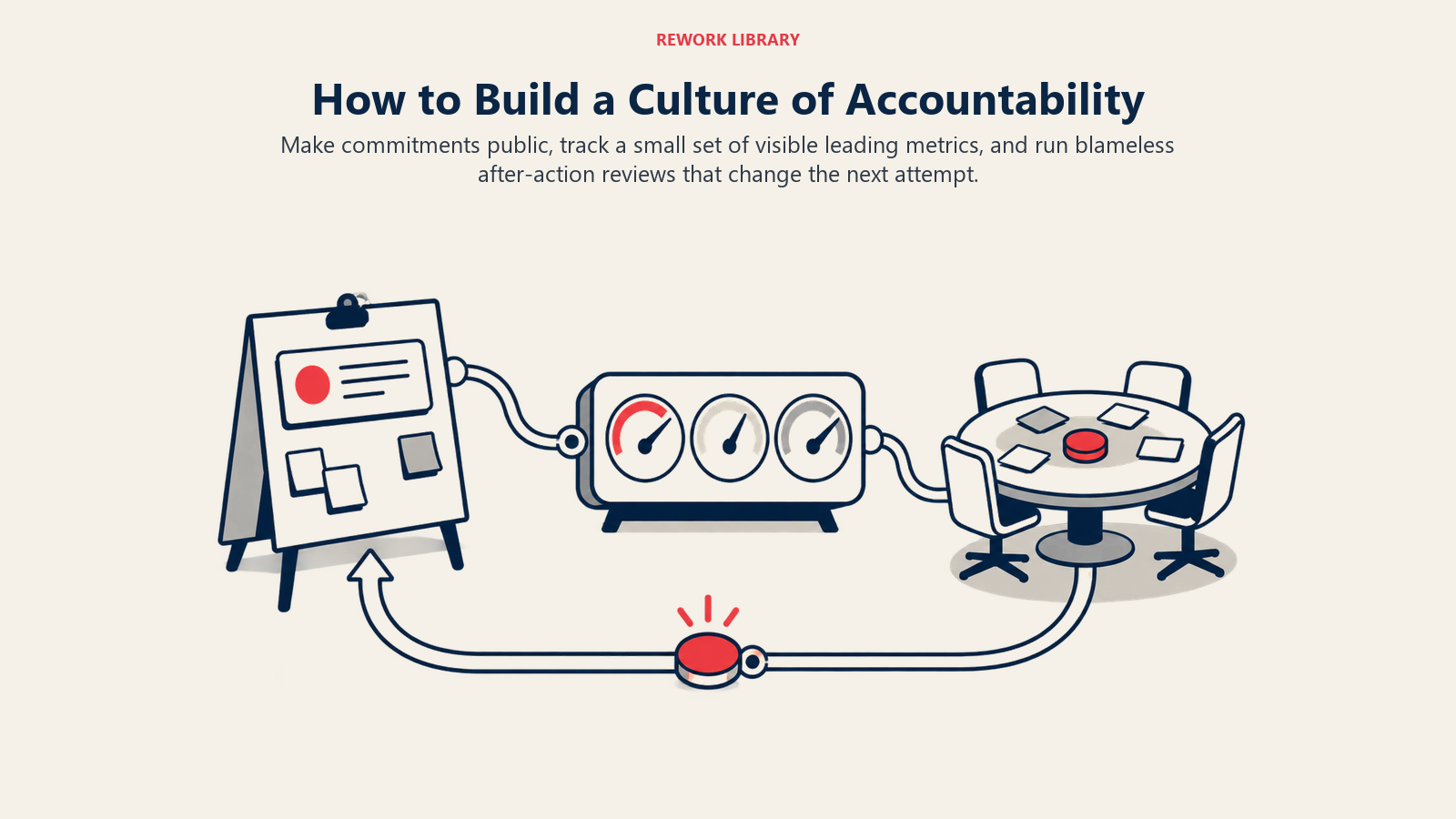
Once the four ingredients are in place, three concrete mechanisms turn accountability from a value statement into a habit.
Public Commitments
Move commitments out of private one-on-ones and into a shared, visible space, a team channel, a weekly written update, a shared document everyone can see. Visibility is doing the actual work here, not the format. When a commitment is only known to the person who made it and their manager, it is easy to quietly revise or forget. When a peer group can see it, the social pressure to follow through does most of the enforcement without a single difficult conversation.
Scoreboards and Visible Metrics
A scoreboard turns "how are we doing" from a subjective, arguable question into a shared fact everyone can see at the same time. It does not need to be elaborate: three to five numbers that map directly to what the team actually controls, updated on a fixed schedule, visible to the whole team rather than locked in a manager's spreadsheet. The scoreboard should track leading indicators the team can act on this week, not only lagging outcomes that show up a quarter later, when it is too late to adjust.
After-Action Reviews
Borrowed from military and emergency-response training, an after-action review is a short, structured conversation held right after a project, launch, or incident, built around four questions: what did we expect to happen, what actually happened, why was there a gap, and what do we do differently next time. The format only works if it stays blameless in tone and specific in content. The goal is a written answer to "what do we do differently," not a verdict on who was responsible. Teams that run this consistently build an institutional memory of what actually works, instead of relearning the same lesson every six months.
The Leader's Role
Accountability cultures are built top-down or they are not built at all, the same lesson at the center of how to change organizational culture, because a team calibrates its own honesty to what it watches leadership do, not to what leadership says. That calibration is not a soft cost either: it shows up directly in the link between culture and performance, since teams that trust leadership's response to bad news report problems earlier, when they are still cheap to fix. A leader who publicly owns a missed target, states plainly what they will do differently, and moves on without spiraling into self-punishment teaches the entire team that owning a miss is survivable. A leader who deflects, blames a vendor, or quietly reassigns the failure to someone junior teaches the opposite lesson in about thirty seconds, no matter what the culture deck says.
The leader's second job is proportionality: matching the response to the size of the miss instead of treating every shortfall as a five-alarm fire. Overreacting to small misses trains people to hide medium ones. The third job is protecting the messenger. The first time someone gets punished for surfacing a problem early, that channel of information closes for good, and it rarely reopens on its own. Rework's People app supports this operationally with shared goal tracking, timesheets, and a visible activity trail, so "did this happen" is a fact everyone can check rather than a dispute between two people's memories.
Accountability for AI and Agent Output
A newer wrinkle: as more work runs through AI agents doing first-draft research, drafting, and even parts of execution, "who owns this outcome" gets less obvious. An agent cannot be held accountable in any meaningful sense, no matter how confidently it writes. It has no stake in the outcome and nothing to lose. The person who deployed the agent, reviewed its output, and shipped it under their name still owns the result, exactly as if a human contractor had produced the first draft. This is the sharper edge of the ownership questions raised in human-agent teams and culture.
This is where a well-run team draws a hard line: automation can produce a draft, a summary, or a first pass, but a named human signs off before it goes out the door, and that person's name is the one attached to the outcome. Teams that skip this step tend to discover the gap only after something incorrect or embarrassing ships under the company's name, at which point "the AI wrote it" is not an explanation anyone outside the team finds satisfying. Left unmanaged, that gap is exactly how AI cultural debt accumulates: nobody quite owns the output, so nobody quite fixes the pattern. As human-agent teams become more common, the accountability conversation does not get more complicated so much as it gets more important: someone still has to own it, and that someone is never the agent.
Frequently Asked Questions about Building a Culture of Accountability
What is a culture of accountability?
A culture of accountability is a workplace where people own the outcomes of their work, not just the tasks assigned to them, and follow through on commitments without being chased or supervised. It combines two things: taking ownership of results, including failures, and reporting honestly on progress without waiting to be asked.
What is the difference between accountability and blame?
Blame looks backward to assign fault and punish it, which trains people to hide mistakes. Accountability looks forward, asking what happened, why, and what the same person will do to fix it, without the goal of punishment. Accountability without psychological safety tends to collapse back into blame.
Why do accountability initiatives usually fail?
Most fail because of one of three underlying gaps: unclear expectations that were never actually agreed on, fear that makes people hide problems instead of reporting them, or no recurring follow-up that lets commitments quietly become optional. Adding pressure without fixing the underlying gap rarely works.
How do you hold a team accountable without creating a blame culture?
Separate the diagnostic conversation from the consequence. Ask what happened and why in a blameless, specific way, then decide on a proportional next step, escalating structure for repeated misses, without punishing the person for surfacing the problem in the first place. Protecting the person who reports bad news early is what keeps the system honest.
What is an after-action review?
An after-action review is a short, structured conversation held after a project, launch, or incident, built around four questions: what did we expect to happen, what actually happened, why was there a gap, and what will we do differently next time. It stays focused on the lesson learned, not on assigning blame.
How does psychological safety relate to accountability?
They are independent conditions that only produce high performance together. High accountability with low psychological safety produces an anxious team that hides problems to avoid consequences. High safety with low accountability produces a comfortable team that misses its numbers. Teams need both.
Who is accountable when an AI agent produces the work?
The human who deployed the agent, reviewed its output, and approved it for release. An AI agent has no stake in the outcome and cannot meaningfully own a result, so accountability always lands on the person whose name goes on the final decision, regardless of how much of the draft was AI-generated.
What is a good first step to build accountability on a team?
Start with clarity, not consequences. Ask each person on the team to state their top priority and its deadline in one sentence. If answers vary widely or nobody can answer quickly, the underlying issue is unclear expectations, and no amount of accountability pressure will fix that until the target itself is defined and agreed on.

Co-Founder, Rework.com
On this page
- What Accountability Actually Means
- Accountability vs. Blame
- The Four Ingredients of an Accountability Culture
- Clear Expectations
- Psychological Safety
- Follow-Through
- Consequences Both Ways
- Why Accountability Cultures Fail
- No Clarity
- Fear
- No Follow-Up
- Key Facts
- How to Build a Culture of Accountability
- Public Commitments
- Scoreboards and Visible Metrics
- After-Action Reviews
- The Leader's Role
- Accountability for AI and Agent Output