Matriz TOWS: Cómo Convertir un SWOT en Estrategia
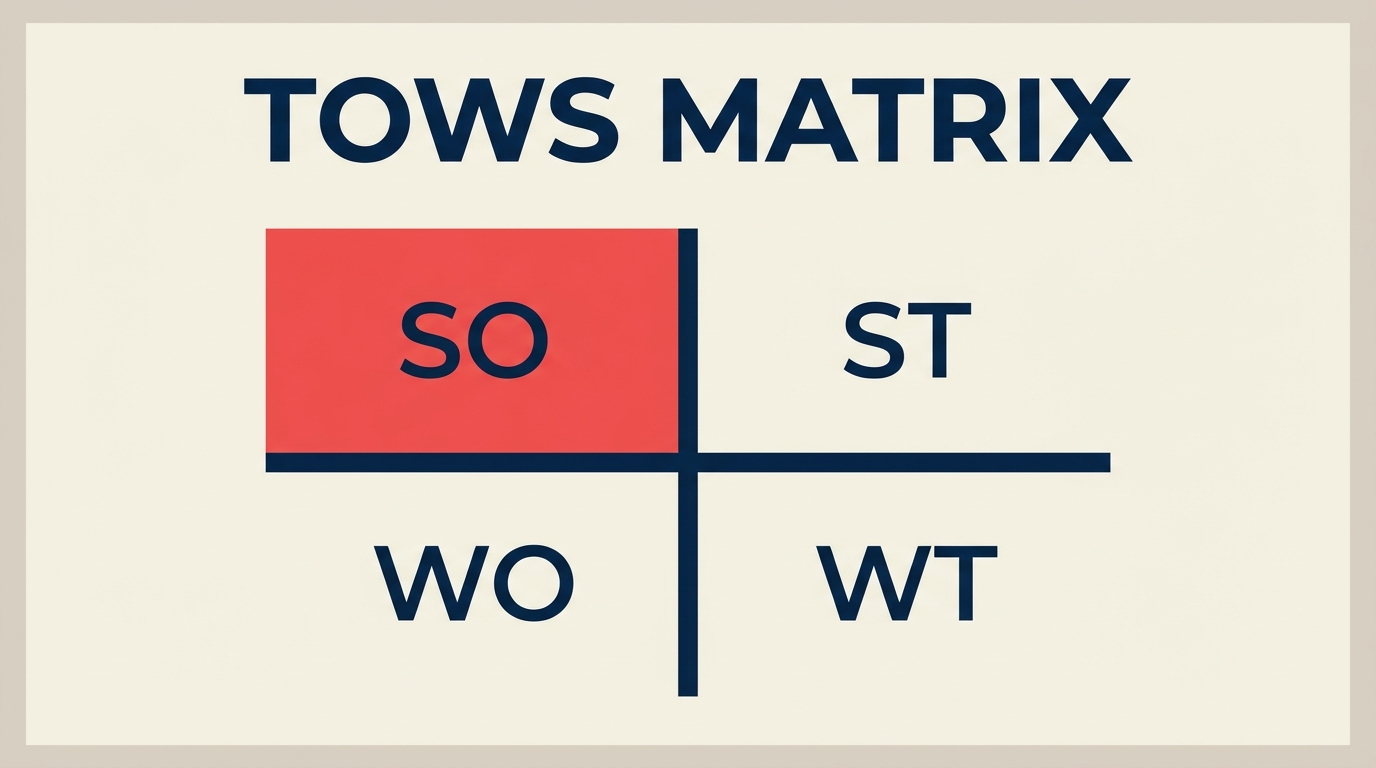
Turn this article into takeaways for your work.


Each assistant summarizes the article only for you and suggests best practices for your work.
La matriz TOWS toma el material en bruto de un análisis SWOT y lo convierte en algo sobre lo que se puede actuar realmente: cuatro direcciones estratégicas concretas, cada una construida a partir de una combinación específica de sus capacidades internas y las realidades externas. Es el puente que la mayoría de los equipos pasa por alto entre "analizamos la situación" y "esto es lo que vamos a hacer al respecto."
¿Qué es la Matriz TOWS?
La matriz TOWS es una herramienta de planificación estratégica desarrollada por el profesor de gestión Heinz Weihrich y publicada en la revista Long Range Planning en 1982. Toma los cuatro factores de un análisis SWOT (Fortalezas, Debilidades, Oportunidades, Amenazas) y los combina sistemáticamente en una matriz 2x2 para generar cuatro tipos de estrategias.
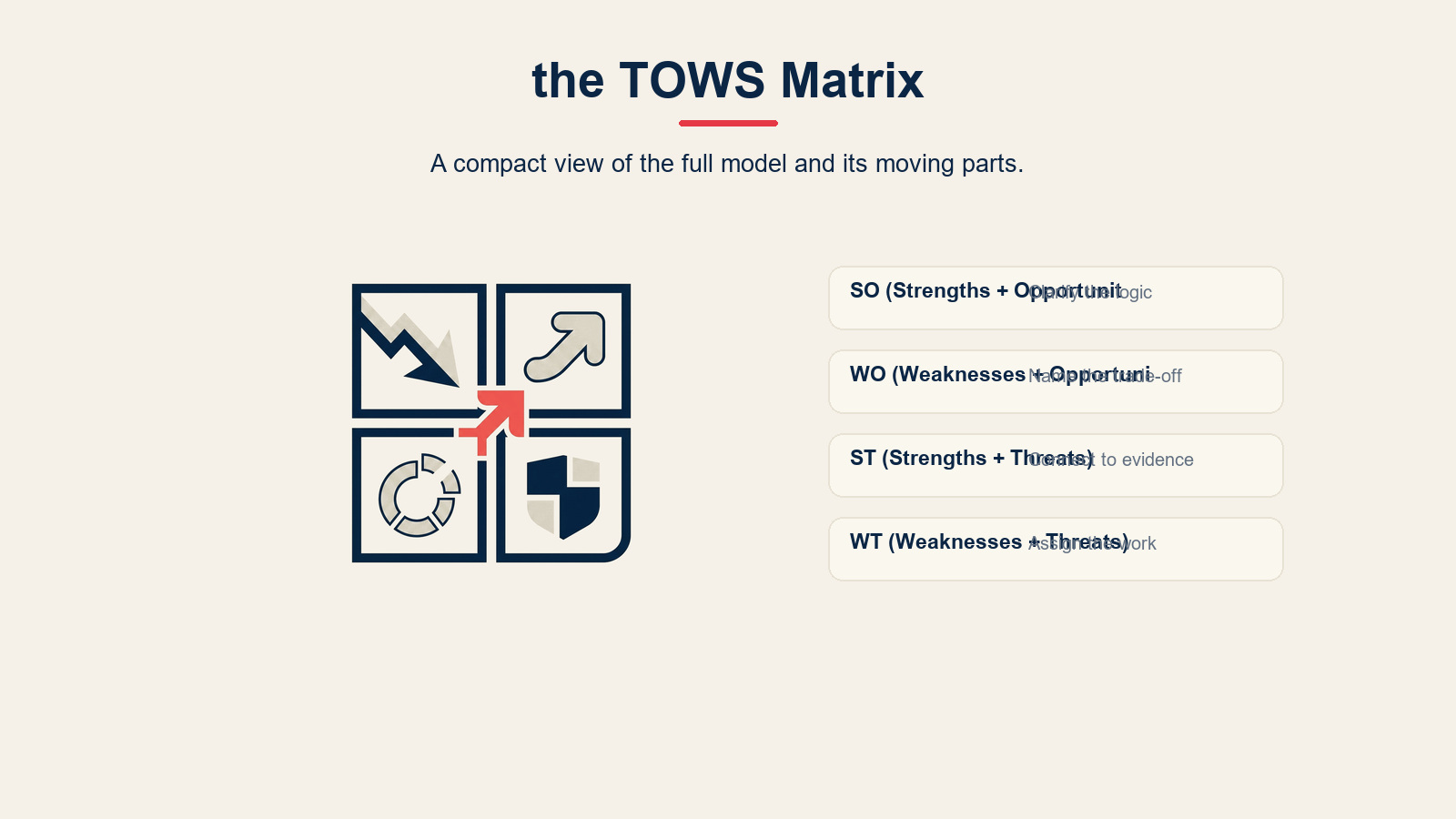
Donde el análisis SWOT ayuda a listar y comprender su situación, la matriz TOWS le dice qué hacer al respecto. Cada celda de la matriz combina dos factores del SWOT para responder una pregunta estratégica específica:
- SO (Fortalezas + Oportunidades): ¿Cómo usamos lo que hacemos bien para aprovechar esta oportunidad?
- WO (Debilidades + Oportunidades): ¿Cómo corregimos nuestras carencias para beneficiarnos de esta oportunidad?
- ST (Fortalezas + Amenazas): ¿Cómo usamos nuestras fortalezas para defendernos de esta amenaza?
- WT (Debilidades + Amenazas): ¿Cómo minimizamos la exposición cuando somos débiles y el entorno es hostil?
El nombre TOWS es simplemente SWOT al revés, una elección deliberada de Weihrich para indicar que el marco parte del entorno externo (Amenazas, Oportunidades) y trabaja hacia adentro, hacia los factores internos (Debilidades, Fortalezas).
Datos Clave
- Heinz Weihrich introdujo la matriz TOWS en su artículo de 1982 "The TOWS Matrix: A Tool for Situational Analysis" en la revista Long Range Planning.
- El propio marco SWOT se remonta a la investigación de Albert Humphrey en el Stanford Research Institute en los años sesenta y principios de los setenta, desarrollado originalmente en un proyecto de consultoría para empresas Fortune 500.
- Un estudio de Harvard Business Review encontró que aproximadamente el 67% de las estrategias bien formuladas fracasan durante la ejecución, a menudo porque omiten el paso de traducir el análisis de situación en acciones estratégicas específicas. La matriz TOWS está diseñada específicamente para cerrar esa brecha. (HBR, "Turning Great Strategy into Great Performance," 2005)
Matriz TOWS vs Análisis SWOT
Muchas personas tratan SWOT y TOWS como si fueran lo mismo. No lo son. SWOT es el insumo; TOWS es el resultado. Así es como difieren:
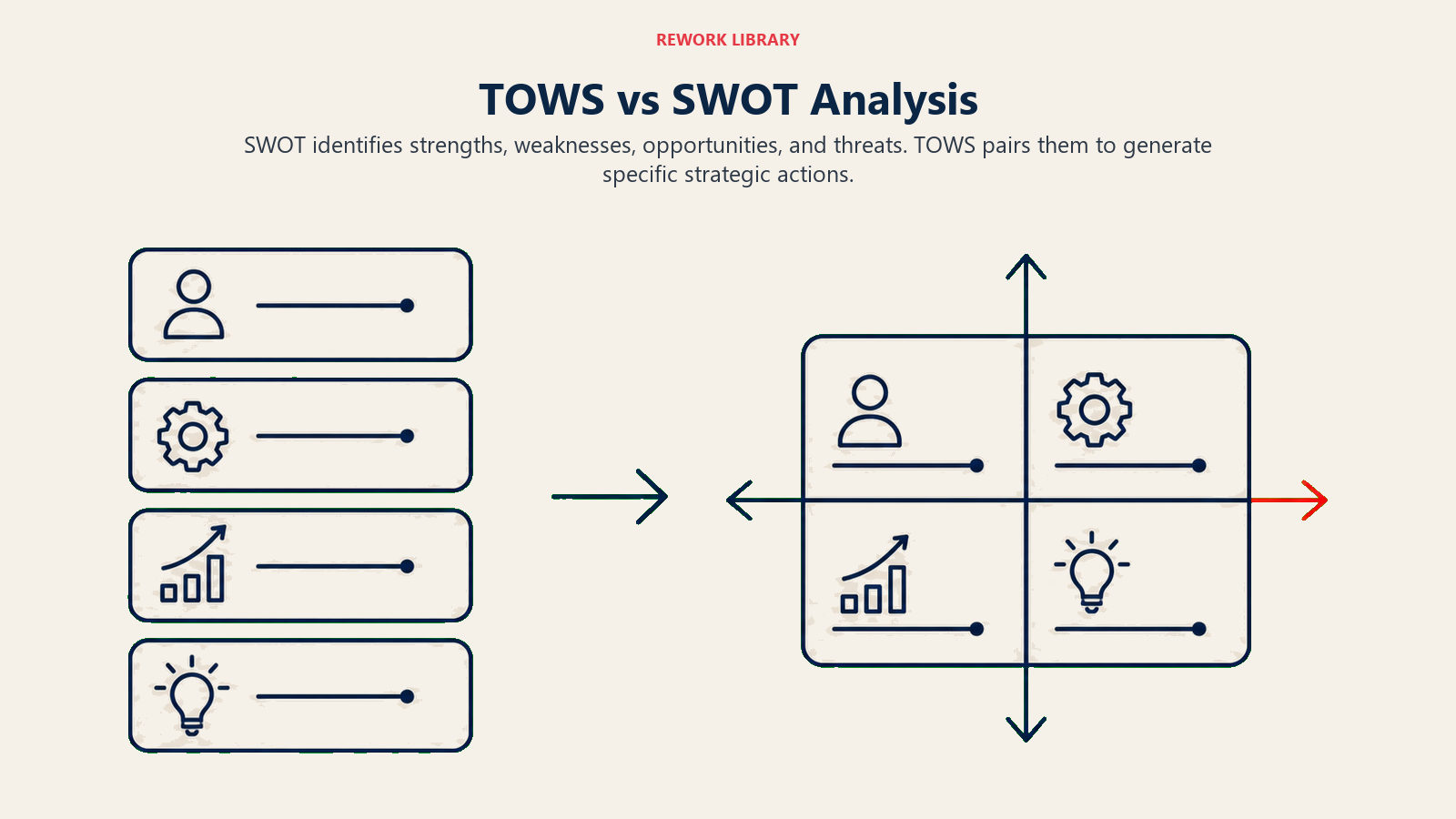
| Dimensión | Análisis SWOT | Matriz TOWS |
|---|---|---|
| Propósito | Identificar y listar factores internos/externos | Generar opciones estratégicas a partir de esos factores |
| Resultado | Cuatro listas (F, D, O, A) | Cuatro conjuntos de estrategias (SO, WO, ST, WT) |
| Orientación | Descriptiva: "Aquí es donde estamos" | Prescriptiva: "Esto es lo que hay que hacer" |
| Proceso | Lluvia de ideas y categorización | Combinación cruzada de factores y síntesis |
| Mejor uso | Al inicio de la planificación estratégica | Después del SWOT, para formular estrategia |
| Fallo habitual | Se detiene en la lista sin generar acción | Requiere disciplina para completar la combinación |
Piénselo así: un análisis SWOT es como un diagnóstico médico. La matriz TOWS es el plan de tratamiento. Necesita ambos, pero solo uno de ellos lo hace avanzar.
La matriz TOWS funciona mejor cuando ya se ha completado un SWOT exhaustivo. No salte directamente a TOWS sin hacer el trabajo previo, porque la calidad de sus estrategias depende enteramente de la calidad de los factores que le introduzca.
Las Cuatro Estrategias TOWS
El núcleo de la matriz TOWS son los cuatro cuadrantes estratégicos. Cada uno combina un conjunto de factores internos (Fortalezas o Debilidades) con un conjunto de factores externos (Oportunidades o Amenazas).
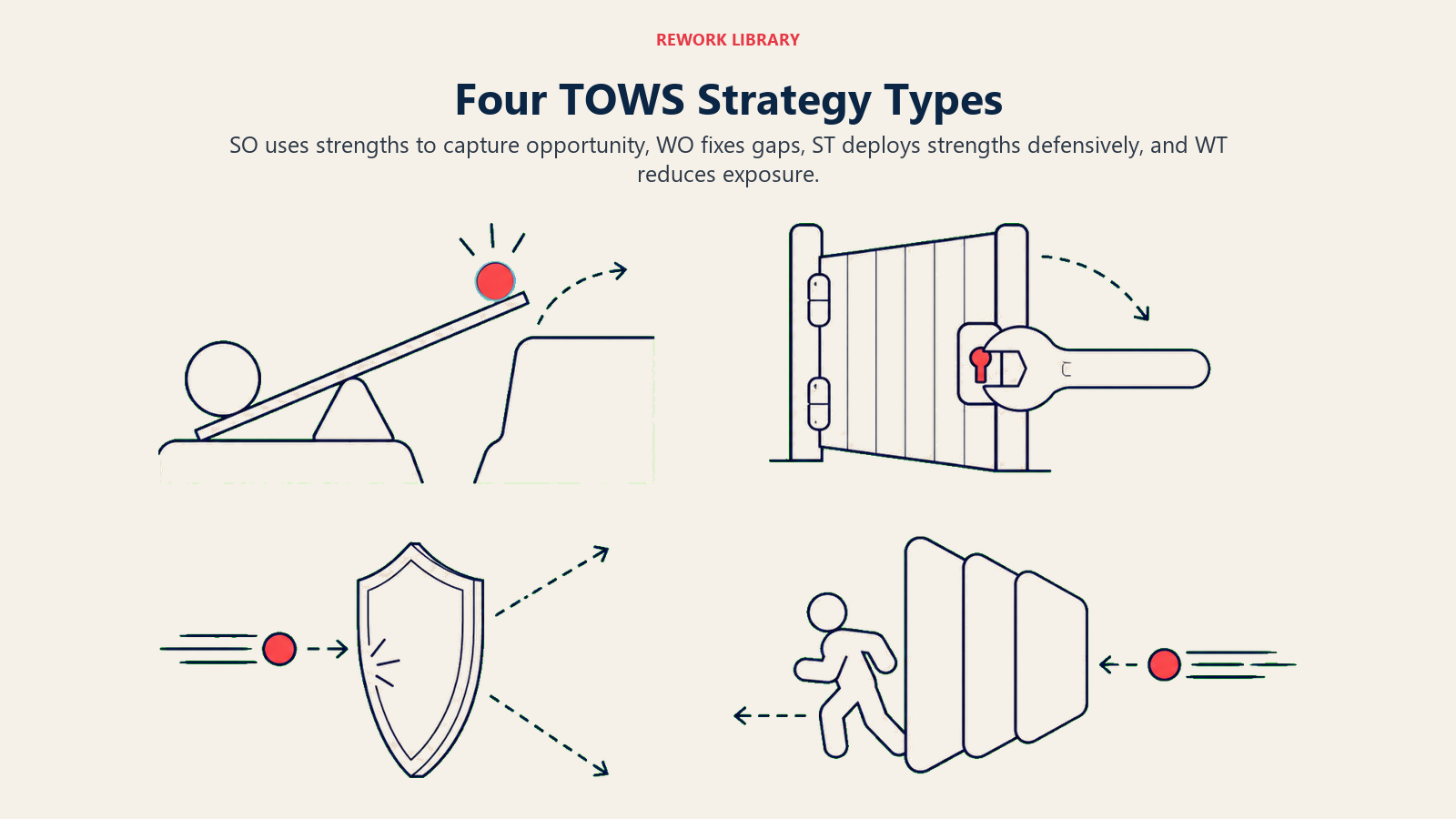
| Oportunidades (O) | Amenazas (A) | |
|---|---|---|
| Fortalezas (F) | Estrategias FO (maxi-maxi): Use las fortalezas para aprovechar oportunidades | Estrategias FA (maxi-mini): Use las fortalezas para minimizar amenazas |
| Debilidades (D) | Estrategias DO (mini-maxi): Mejore las debilidades para aprovechar oportunidades | Estrategias DA (mini-mini): Reduzca debilidades, evite amenazas |
Estrategias FO (Fortalezas + Oportunidades): La Jugada de Palanca
Las estrategias FO son el cuadrante más agresivo. Está en una posición sólida y el mercado ofrece algo que puede tomar. El objetivo es usar sus mejores capacidades para capturar las oportunidades más prometedoras.
Ejemplo: una empresa de software con una gran base de clientes empresariales (fortaleza) ve una demanda creciente de analítica potenciada por IA (oportunidad). Una estrategia FO sería incorporar funcionalidades de IA al producto existente y venderlas a los clientes actuales a través de las relaciones comerciales ya establecidas.
Esto se denomina a veces el enfoque "maxi-maxi" porque maximiza tanto las fortalezas como las oportunidades.
Estrategias DO (Debilidades + Oportunidades): La Jugada de Mejora
Las estrategias DO abordan una frustración habitual: se ve la oportunidad, pero algo interno está frenando el avance. Estas estrategias se centran en cerrar esa brecha para poder aprovechar realmente lo que está disponible.
Ejemplo: la misma empresa de software ve la oportunidad de analítica con IA pero carece de experiencia interna en machine learning (debilidad). Una estrategia DO sería adquirir una startup de IA o formar una alianza estratégica con una empresa de ML, abordando directamente la debilidad para acceder a la oportunidad.
Este es el enfoque "mini-maxi": minimizar las debilidades al tiempo que se maximiza el aprovechamiento de oportunidades.
Estrategias FA (Fortalezas + Amenazas): La Jugada Defensiva
Las estrategias FA consisten en usar lo que ya se hace bien para protegerse de las presiones externas. No se elimina la amenaza, pero se usan las fortalezas para absorberla o desviarla.
Ejemplo: un banco regional con sólida confianza de los clientes y una base de depósitos leal (fortaleza) enfrenta la amenaza de aplicaciones fintech que le arrebatan cuota de mercado entre los usuarios más jóvenes (amenaza). Una estrategia FA sería lanzar un producto digital que aproveche la confianza existente y la credibilidad regulatoria para competir directamente.
Este es el enfoque "maxi-mini": maximizar las fortalezas para minimizar el impacto de las amenazas.
Estrategias DA (Debilidades + Amenazas): La Jugada de Supervivencia
Las estrategias DA son defensivas y frecuentemente incómodas de discutir. Cuando se es internamente débil y externamente amenazado, hay que minimizar la exposición y evitar situaciones que multipliquen el daño.
Ejemplo: un minorista con sistemas de inventario obsoletos (debilidad) que opera en un mercado donde la disrupción de la cadena de suministro se acelera (amenaza). Una estrategia DA podría ser salir de las categorías de producto con bajo rendimiento y concentrar los recursos en una gama más reducida donde las carencias de inventario sean menos perjudiciales.
Este es el "mini-mini": minimizar las debilidades Y minimizar la exposición a las amenazas. No es derrotismo, es realismo, y frecuentemente libera recursos para los otros tres cuadrantes.
Cómo Construir una Matriz TOWS
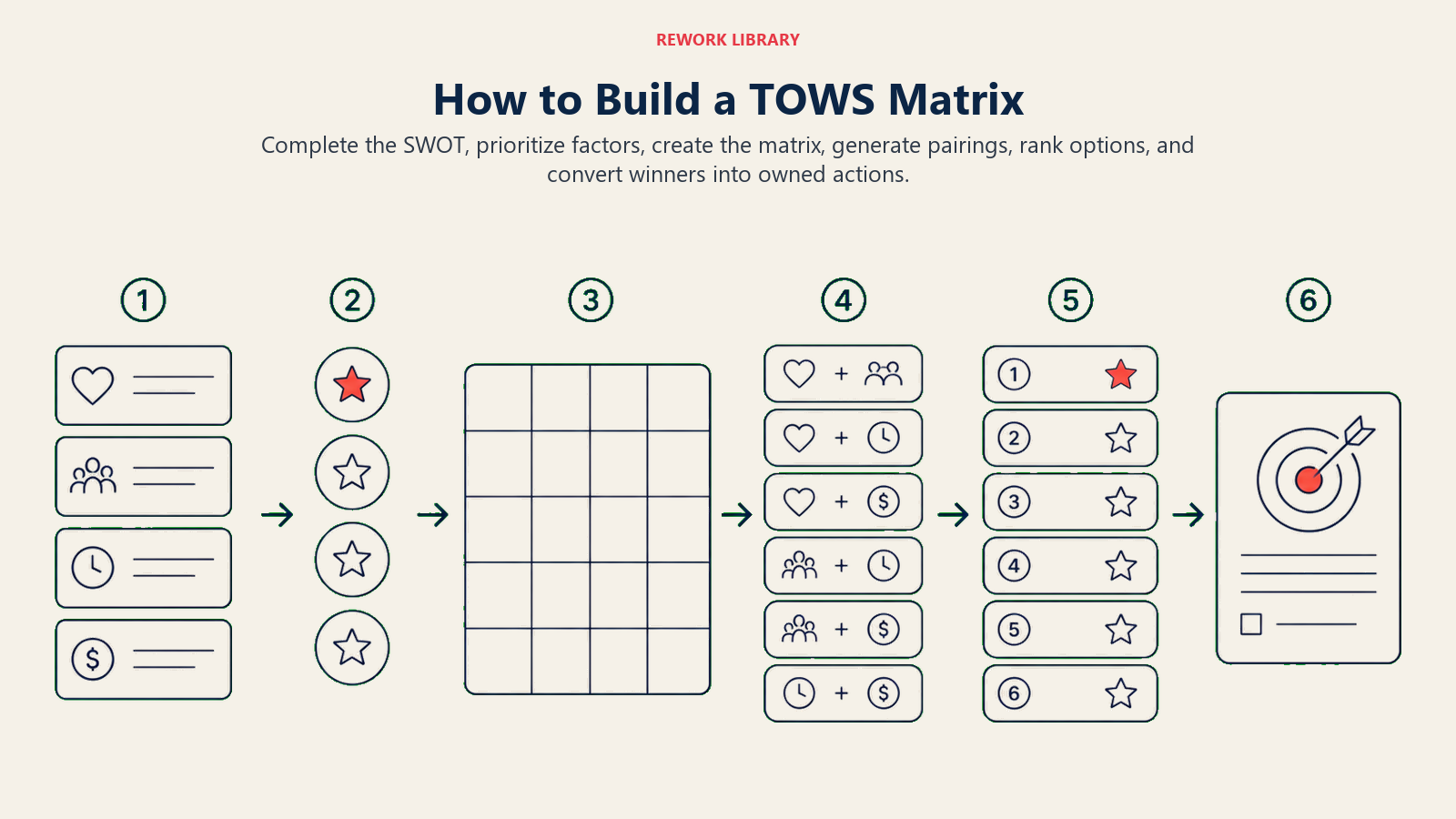
Construir una matriz TOWS es un proceso de cinco pasos. Es más riguroso que un SWOT básico, pero el esfuerzo adicional es lo que hace que el resultado sea accionable.
Paso 1: Complete Primero su Análisis SWOT
No lo omita. Realice un análisis SWOT exhaustivo antes de abordar la matriz TOWS. Necesita una lista bien curada y priorizada para cada uno de los cuatro cuadrantes. Mantenga las listas manejables: 3-5 elementos por cuadrante suelen ser suficientes. Demasiados factores hacen que el paso de combinación sea inmanejable.
Paso 2: Configure la Cuadrícula TOWS 2x2
Dibuje la matriz con Fortalezas/Debilidades en filas y Oportunidades/Amenazas en columnas. Etiquete cada una de las cuatro celdas: FO, DO, FA, DA. Este es su lienzo de trabajo.
Paso 3: Combine los Factores Sistemáticamente
Trabaje en cada celda una a la vez. Para FO, pregúntese: "¿Cuáles de nuestras fortalezas pueden aprovechar mejor cuáles oportunidades?" No combine cada fortaleza con cada oportunidad. Busque las combinaciones con mayor impacto estratégico.
Anote las combinaciones que produzcan ideas estratégicas significativas. Un formato útil es: "Podemos usar [Fortaleza X] para capturar [Oportunidad Y] haciendo [Acción Z]."
Paso 4: Redacte Enunciados Estratégicos para Cada Celda
Transforme cada combinación en un enunciado estratégico concreto. Las buenas estrategias TOWS son lo suficientemente específicas como para que alguien pueda comenzar a ejecutarlas. "Ampliar la presencia digital" es demasiado vago. "Lanzar una app móvil dirigida a clientes existentes de 25 a 40 años, usando la reputación de marca como gancho de adquisición" es una estrategia.
Apunte a 2-4 enunciados estratégicos por cuadrante. No los perseguirá todos, pero conviene tener opciones.
Paso 5: Priorice y Seleccione
Evalúe cada estrategia según dos criterios: impacto (¿cuánto mueve la aguja?) y viabilidad (¿realmente podemos hacerlo?). Seleccione las 2-3 estrategias principales de los cuatro cuadrantes para llevarlas a su plan estratégico.
Algunas organizaciones usan una cuadrícula de puntuación 3x3 en esta etapa. Otras simplemente ordenan por intuición después de la discusión. Cualquiera funciona, siempre que termine con una lista clara de prioridades, no una lista de todo lo que sonó bien.
Ejemplo de Matriz TOWS
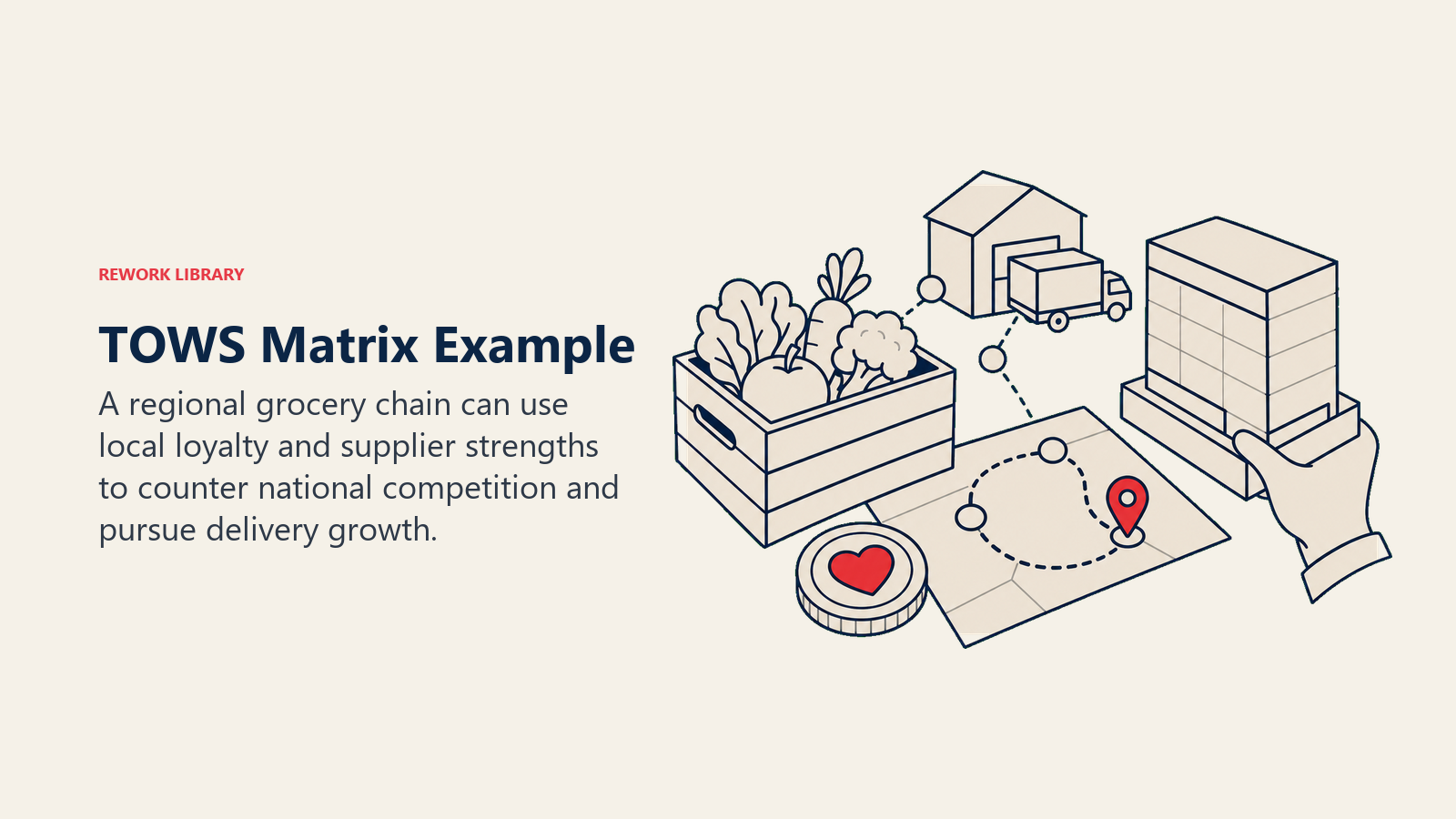
Veamos un ejemplo práctico. Imagine una empresa de software B2B de tamaño mediano, llamémosla Apex Systems, que vende herramientas de gestión de proyectos a firmas de servicios profesionales.
Insumos del SWOT:
Fortalezas: integraciones profundas con herramientas empresariales existentes; altas puntuaciones de satisfacción del cliente; sólido reconocimiento de marca en los sectores legal y de consultoría.
Debilidades: sin app móvil; equipo de marketing limitado; ciclo de lanzamiento de producto lento.
Oportunidades: el trabajo remoto impulsa la demanda de software de colaboración; los contratistas gubernamentales ahora deben usar herramientas de seguimiento de proyectos.
Amenazas: competidores con amplio financiamiento lanzando alternativas potenciadas por IA; clientes consolidando proveedores de software para reducir costos.
Resultado de la Matriz TOWS:
| Oportunidades | Amenazas | |
|---|---|---|
| Fortalezas | FO: Asociarse con asociaciones legales para posicionar Apex como la herramienta de proyectos preparada para el cumplimiento normativo del nuevo mandato para contratistas gubernamentales, aprovechando la credibilidad de marca existente en el sector | FA: Usar las altas puntuaciones de satisfacción del cliente para lanzar una oferta de "paquete de consolidación", posicionando Apex como la herramienta que reemplaza múltiples soluciones puntuales y justifica quedarse en lugar de cambiar a competidores con IA |
| Debilidades | DO: Priorizar el desarrollo de la app móvil para capturar la oportunidad del trabajo remoto; usar el consejo asesor de clientes para acelerar la hoja de ruta | DA: Salir del segmento de PYME donde los ciclos de lanzamiento lentos son una mayor desventaja; enfocar el soporte y los recursos de producto en cuentas empresariales donde los costos de cambio son altos |
Estas no son generalidades hipotéticas. Son lo suficientemente específicas como para asignar un responsable, establecer una fecha límite y medir el progreso.
Ventajas y Limitaciones
Ventajas
Convierte el análisis en acción. El principal modo de fallo del SWOT es que se detiene en la lista. TOWS obliga a ir más allá generando estrategias directamente a partir de la evaluación de la situación.
Saca a la luz estrategias no obvias. El proceso de combinación cruzada frecuentemente produce estrategias que los equipos no habrían alcanzado mediante una lluvia de ideas libre. Las estrategias DA en particular tienden a sacar a la luz verdades difíciles que necesitan abordarse.
Funciona junto a otros marcos. TOWS se combina de forma natural con Porter's Five Forces (para una visión más rica de Amenazas/Oportunidades), el análisis PESTEL (para insumos del macroentorno) y la Matriz de Ansoff (para opciones de estrategia de crecimiento). El Cuadro de Mando Integral es una buena herramienta para traducir los resultados del TOWS en objetivos medibles.
Estructurado pero flexible. La matriz funciona ya sea que esté planificando a nivel corporativo, de unidad de negocio o incluso para una línea de producto específica.
Limitaciones
La calidad depende de la calidad del SWOT. Entra basura, sale basura. Si sus listas de SWOT son vagas, subjetivas o mal priorizadas, sus estrategias TOWS también lo serán.
Puede generar demasiadas opciones. Con cuatro cuadrantes y 3-5 factores por cuadrante, se pueden generar docenas de estrategias potenciales. Sin un paso de priorización riguroso, los equipos terminan con una lista larga y sin foco.
Instantánea en un momento dado. Al igual que el SWOT, la matriz TOWS refleja las condiciones en un momento específico. Los mercados cambian, y una estrategia que parecía sólida en el primer trimestre puede no sostenerse en el tercero. Incorpore ciclos de revisión periódicos.
No tiene en cuenta las dinámicas. La matriz trata los factores del SWOT como estáticos. No modela cómo podría responder un competidor a su estrategia FO, o cómo capturar una oportunidad podría crear nuevas amenazas. Combine TOWS con la planificación de escenarios para entornos más dinámicos.
Mejores Prácticas
Mantenga las listas del SWOT cortas y curadas. Resista la tentación de listar todos los factores posibles. Las mejores matrices TOWS se construyen a partir de 3-5 elementos de alta prioridad por cuadrante del SWOT, no de inventarios exhaustivos.
Involucre a partes interesadas diversas. La estrategia formada en un grupo pequeño pierde perspectivas. Incluya personas de ventas, operaciones, finanzas y producto. El paso de combinación cruzada especialmente se beneficia de diferentes puntos de vista.
Escriba las estrategias en oraciones completas. Viñetas como "mejorar la presencia digital" son demasiado vagas para actuar sobre ellas. Una oración completa obliga a ser específico: quién hace qué, a quién, con qué propósito.
Revise trimestralmente. Desarrolle el hábito de verificar si sus estrategias seleccionadas siguen correspondiendo a su realidad SWOT actual. Los factores externos cambian rápidamente. El marco OKR se complementa bien aquí, dando a sus estrategias TOWS puntos de control trimestrales medibles.
Vincule a sus herramientas de ejecución. Una matriz TOWS que se queda en una presentación no se ejecuta sola. Conecte las estrategias resultantes con su sistema de gestión de proyectos, su revisión del McKinsey 7S Framework, o su Análisis de Cadena de Valor para identificar dónde deben ocurrir cambios operativos.
Preguntas Frecuentes sobre la Matriz TOWS
¿Qué significa TOWS?
TOWS significa Amenazas (Threats), Oportunidades (Opportunities), Debilidades (Weaknesses) y Fortalezas (Strengths). Son los mismos cuatro factores que SWOT, pero en un orden diferente para enfatizar que se parte del entorno externo (Amenazas y Oportunidades) antes de examinar los factores internos (Debilidades y Fortalezas).
¿Quién creó la matriz TOWS?
Heinz Weihrich, profesor de gestión en la Universidad de San Francisco, introdujo la matriz TOWS en 1982. La publicó en la revista Long Range Planning en un artículo titulado "The TOWS Matrix: A Tool for Situational Analysis." Su objetivo era dar a los profesionales una forma estructurada de generar estrategias a partir de los datos del SWOT, en lugar de detenerse en la etapa de análisis.
¿Cuál es la diferencia entre la matriz TOWS y el análisis SWOT?
El análisis SWOT identifica y categoriza factores internos (Fortalezas, Debilidades) y externos (Oportunidades, Amenazas). Es diagnóstico: le dice dónde está. La matriz TOWS toma esos mismos factores y los combina en una cuadrícula 2x2 para generar cuatro tipos de estrategias (FO, DO, FA, DA). Es prescriptiva: le dice qué hacer. Siempre se realiza el SWOT primero, luego se usa TOWS para construir estrategias a partir del resultado.
¿Cuándo se debe usar la matriz TOWS en lugar del SWOT?
Use el SWOT cuando necesite comprender su situación. Use TOWS cuando esté listo para construir estrategia a partir de esa comprensión. En la práctica, funcionan mejor como secuencia: SWOT para evaluar, TOWS para actuar. Si su equipo ha completado un SWOT pero tiene dificultades para acordar la dirección estratégica, la matriz TOWS es el siguiente paso adecuado. También es útil durante la planificación anual, antes de grandes decisiones de inversión o al ingresar a nuevos mercados.
¿Puede usarse la matriz TOWS para la planificación de carrera individual?
Sí, la misma lógica aplica. Liste sus Fortalezas personales, Debilidades, Oportunidades de carrera y Amenazas del mercado. Luego use la combinación TOWS para generar acciones específicas: estrategias FO para usar sus mejores habilidades y perseguir oportunidades, estrategias DO para cerrar brechas de habilidades y alcanzar oportunidades deseadas, estrategias FA para aprovechar sus fortalezas y mantenerse relevante ante la disrupción, y estrategias DA para reducir la vulnerabilidad en áreas donde está expuesto.
La matriz TOWS no reemplazará el juicio estratégico. Pero estructurará su pensamiento de una manera que convierte un buen SWOT en un plan que su equipo puede ejecutar realmente. Combínela con una revisión sólida de la BCG Matrix si trabaja a nivel de cartera, y tendrá tanto la imagen de la posición en el mercado como el mapa de acción en la misma sesión de planificación.

Co-Founder & COO
On this page
- ¿Qué es la Matriz TOWS?
- Matriz TOWS vs Análisis SWOT
- Las Cuatro Estrategias TOWS
- Estrategias FO (Fortalezas + Oportunidades): La Jugada de Palanca
- Estrategias DO (Debilidades + Oportunidades): La Jugada de Mejora
- Estrategias FA (Fortalezas + Amenazas): La Jugada Defensiva
- Estrategias DA (Debilidades + Amenazas): La Jugada de Supervivencia
- Cómo Construir una Matriz TOWS
- Paso 1: Complete Primero su Análisis SWOT
- Paso 2: Configure la Cuadrícula TOWS 2x2
- Paso 3: Combine los Factores Sistemáticamente
- Paso 4: Redacte Enunciados Estratégicos para Cada Celda
- Paso 5: Priorice y Seleccione
- Ejemplo de Matriz TOWS
- Ventajas y Limitaciones
- Ventajas
- Limitaciones
- Mejores Prácticas