Alianzas Estratégicas: Tipos, Beneficios y Ejemplos

Turn this article into takeaways for your work.


Each assistant summarizes the article only for you and suggests best practices for your work.
Las alianzas estratégicas son una de las formas más habituales que tienen las empresas para entrar en nuevos mercados, desarrollar nuevas capacidades y acelerar el crecimiento sin asumir el coste y el riesgo de una adquisición completa. Han dado forma a sectores que van desde la aviación hasta el software, y siguen apareciendo en las revisiones estratégicas de los consejos de administración porque funcionan.
Sin embargo, fracasan con una frecuencia sorprendentemente alta. Comprender los tipos, cómo estructurarlas y dónde se rompen marca la diferencia entre una asociación que crea valor y una que desperdicia dos años de atención directiva.
¿Qué es una alianza estratégica?
Una alianza estratégica es un acuerdo formal entre dos o más empresas independientes para perseguir un conjunto de objetivos acordados, manteniendo cada una su personalidad jurídica propia. Cada socio aporta recursos (tecnología, capital, distribución, experiencia) y comparte los beneficios, conservando su identidad y control fuera de la alianza.
La definición parece sencilla, pero el rango práctico es amplio. Una alianza estratégica puede ir desde un acuerdo de licencia de carácter informal hasta una operación conjunta profundamente integrada con personal compartido, propiedad intelectual compartida y beneficios compartidos. Lo que la distingue de un simple contrato con un proveedor es la intención estratégica: los socios tratan de lograr juntos algo que ninguno podría alcanzar con la misma eficiencia por separado.
Datos clave
- Entre el 50 y el 70 por ciento de las alianzas estratégicas no logran sus objetivos declarados, según investigaciones citadas por Harvard Business Review y McKinsey (varios estudios, 2015-2023). Las causas más frecuentes son las expectativas desalineadas, la gobernanza deficiente y la fricción cultural, no una estrategia incorrecta.
- Una encuesta de Deloitte de 2022 a directivos globales reveló que más del 60 por ciento de las empresas planeaba aumentar el número de asociaciones y alianzas durante los dos años siguientes, citando la velocidad de llegada al mercado y el acceso a capacidades como principales motores.
- Las empresas que gestionan activamente sus carteras de alianzas (con responsables dedicados, cuadros de mando compartidos y revisiones periódicas formales) obtienen mayores rendimientos de sus asociaciones que las que las tratan como operaciones puntuales, según la investigación de McKinsey sobre ecosistemas de asociación (2021).
Tipos de alianzas estratégicas
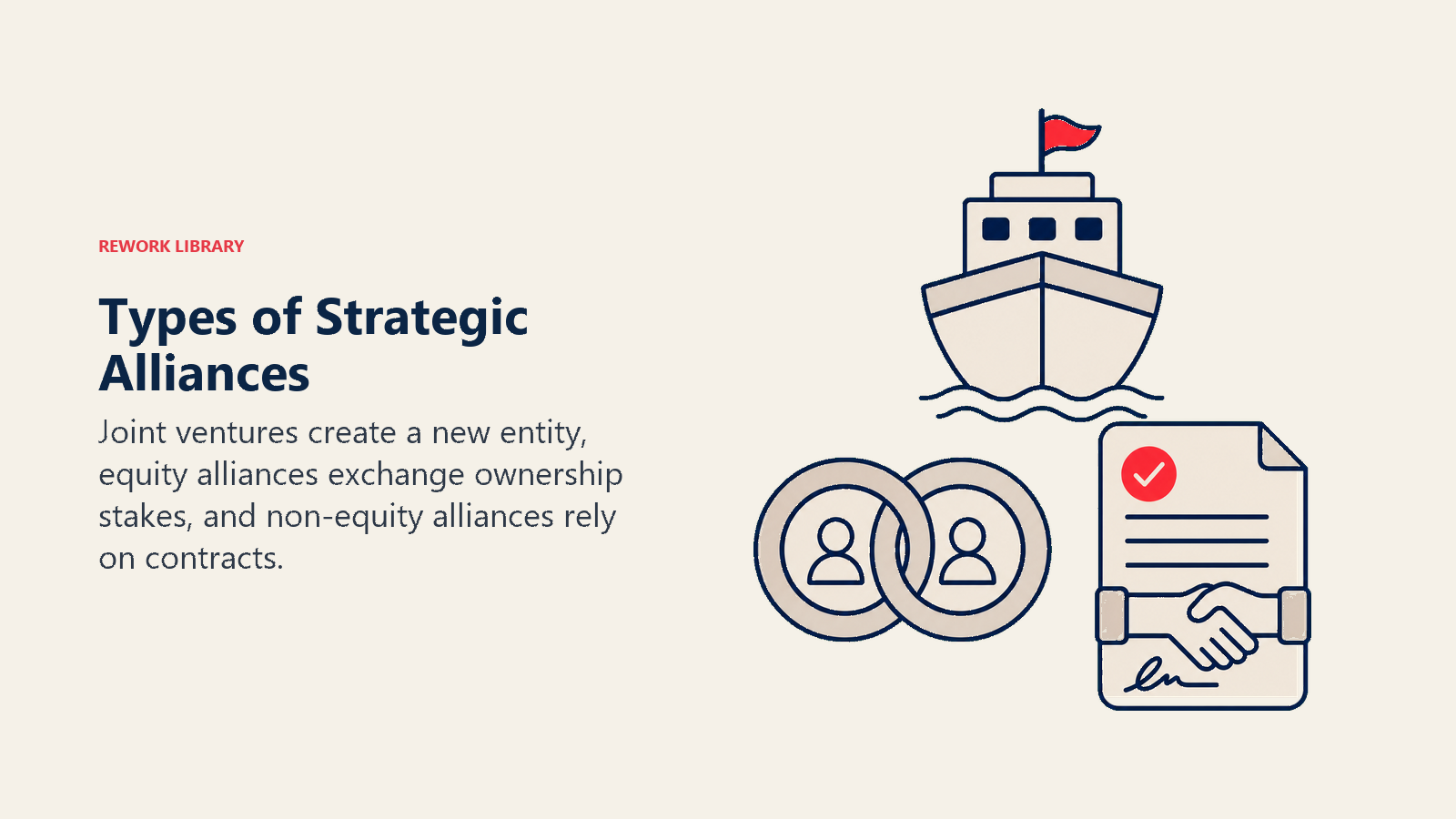
No todas las alianzas se construyen igual. Los tres tipos principales difieren en cuanto a propiedad, profundidad de compromiso y complejidad de gobernanza.
| Tipo | Propiedad | Nivel de compromiso | Ejemplo típico |
|---|---|---|---|
| empresa conjunta (JV) | Los socios crean una entidad jurídica separada; capital compartido | Muy alto: capital, personal y responsabilidad compartidos | Sony Ericsson (Sony + división de móviles de Ericsson, ya disuelta) |
| Alianza de capital | Un socio adquiere una participación minoritaria en el otro | Alto: vínculo financiero y estratégico, pero sin nueva entidad | La inversión de capital de Microsoft en OpenAI |
| Alianza sin participación de capital | Solo contractual; sin propiedad compartida | Bajo a medio: actividades compartidas, no activos compartidos | Starbucks y Spotify (integración de fidelización de marca compartida) |
La empresa conjunta (JV) es la estructura más formal. Los socios agrupan capital para crear una nueva empresa, comparten el control y se reparten los beneficios según sus aportaciones de capital. Las JV funcionan bien para proyectos grandes y bien definidos (infraestructura, recursos naturales, entrada en un mercado regulado) donde ambas partes necesitan tener algo en juego. El inconveniente es la complejidad: se gestionan dos negocios más la propia JV.
Una alianza de capital implica que una empresa adquiere una participación minoritaria en otra sin crear una nueva entidad. El inversor obtiene un asiento en la mesa (a veces literalmente, en el consejo) y un rendimiento financiero, mientras que la empresa objetivo recibe capital y un apoyo estratégico. Esta estructura es habitual en tecnología, farmacia y aeroespacial, donde una empresa consolidada quiere exponerse a la propiedad intelectual de un innovador sin una adquisición completa.
Una alianza sin participación de capital es la forma más común. Es un acuerdo contractual para codesarrollar, comercializar conjuntamente, distribuir conjuntamente o compartir tecnología. Ninguna de las partes adquiere una participación de propiedad en la otra. Son más rápidas de formalizar y más fáciles de disolver, pero también pueden deshacerse rápidamente si los incentivos dejan de estar alineados.
Cómo se comparan las alianzas con las fusiones y adquisiciones
Vale la pena separar las alianzas de la integración total. A continuación, una comparativa:
| Estructura | Independencia conservada | Profundidad de integración | Reversibilidad | Velocidad de cierre |
|---|---|---|---|---|
| Alianza sin participación de capital | Total | Baja | Fácil | Semanas |
| Alianza de capital | Parcial | Media | Moderada (venta de participación) | Meses |
| empresa conjunta | Parcial (nueva entidad) | Alta | Compleja | Meses |
| Adquisición (M&A) | Ninguna | Total | Muy difícil | Meses o años |
Las fusiones y adquisiciones (M&A) fusionan dos organizaciones en una sola. Eso otorga al adquirente el control total, pero también el coste total de integración, el riesgo cultural y el escrutinio regulatorio. Las alianzas son la alternativa cuando se quiere el beneficio estratégico sin el coste total ni la irreversibilidad.
Alianza estratégica vs empresa conjunta vs fusión
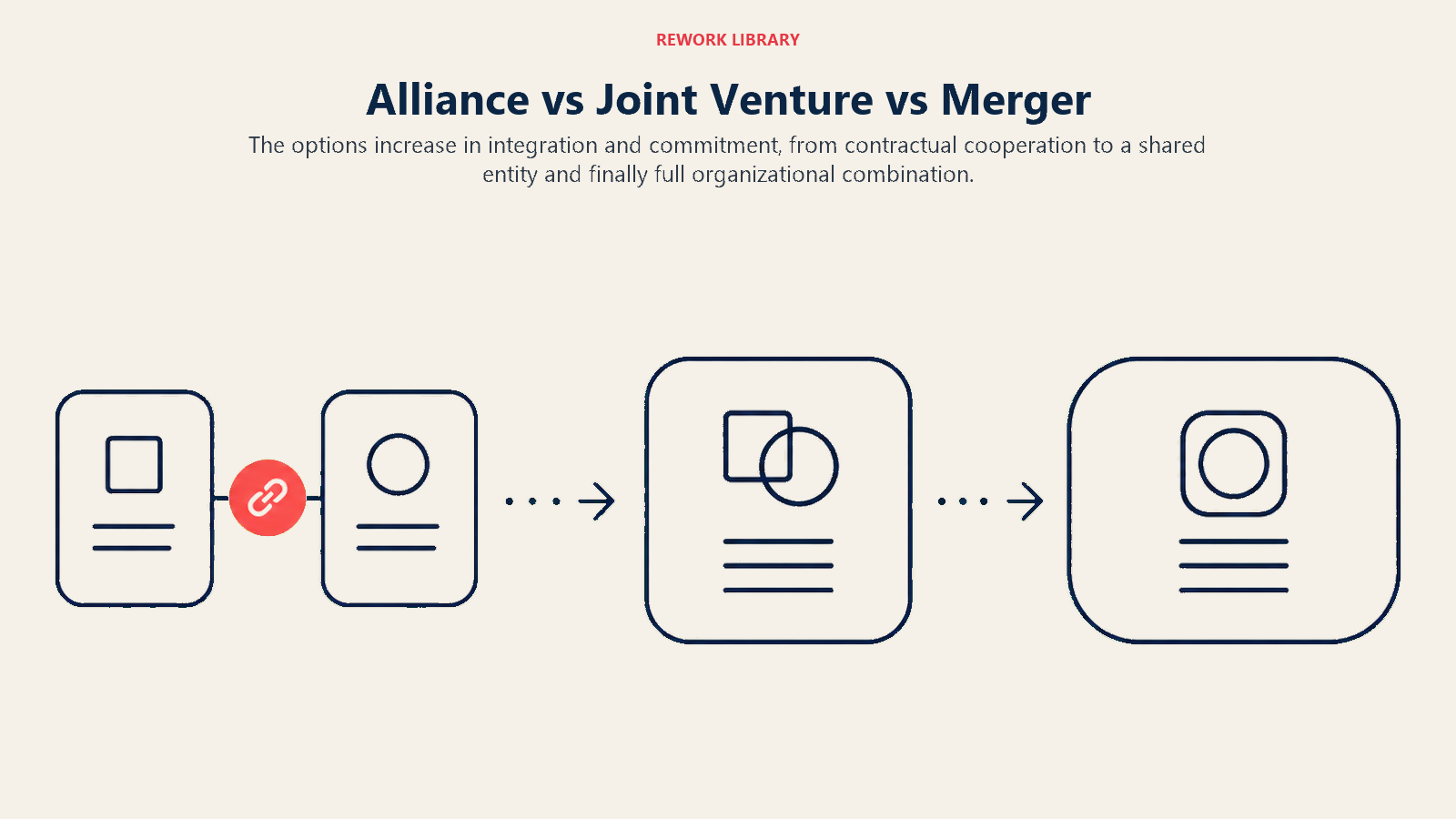
Esta distinción genera confusión en muchos debates estratégicos. A continuación, una comparativa más clara:
| Dimensión | Alianza estratégica (sin capital) | empresa conjunta | Fusión o adquisición |
|---|---|---|---|
| Estructura jurídica | Contrato | Nueva entidad jurídica | Entidad combinada única |
| Capital compartido | No | Sí (entidad JV) | Sí (absorbida) |
| Complejidad de salida | Baja | Media a alta | Muy alta |
| Carga de gestión | Baja a media | Alta | Muy alta (integración) |
| Reparto de riesgo | Limitado al ámbito del acuerdo | Proporcional al capital | Total |
| Más adecuado para | Velocidad, flexibilidad, pruebas | Gran inversión conjunta | Integración y control totales |
La línea entre una alianza sin participación de capital profunda y una empresa conjunta puede ser difusa en la práctica. Las empresas suelen comenzar con un acuerdo de licencia, profundizarlo con el tiempo y, finalmente, formalizarlo como JV cuando el alcance justifica la complejidad.
Beneficios de las alianzas estratégicas
El atractivo es evidente cuando se mapean los beneficios frente a la alternativa (hacerlo todo uno mismo o adquirir una empresa).
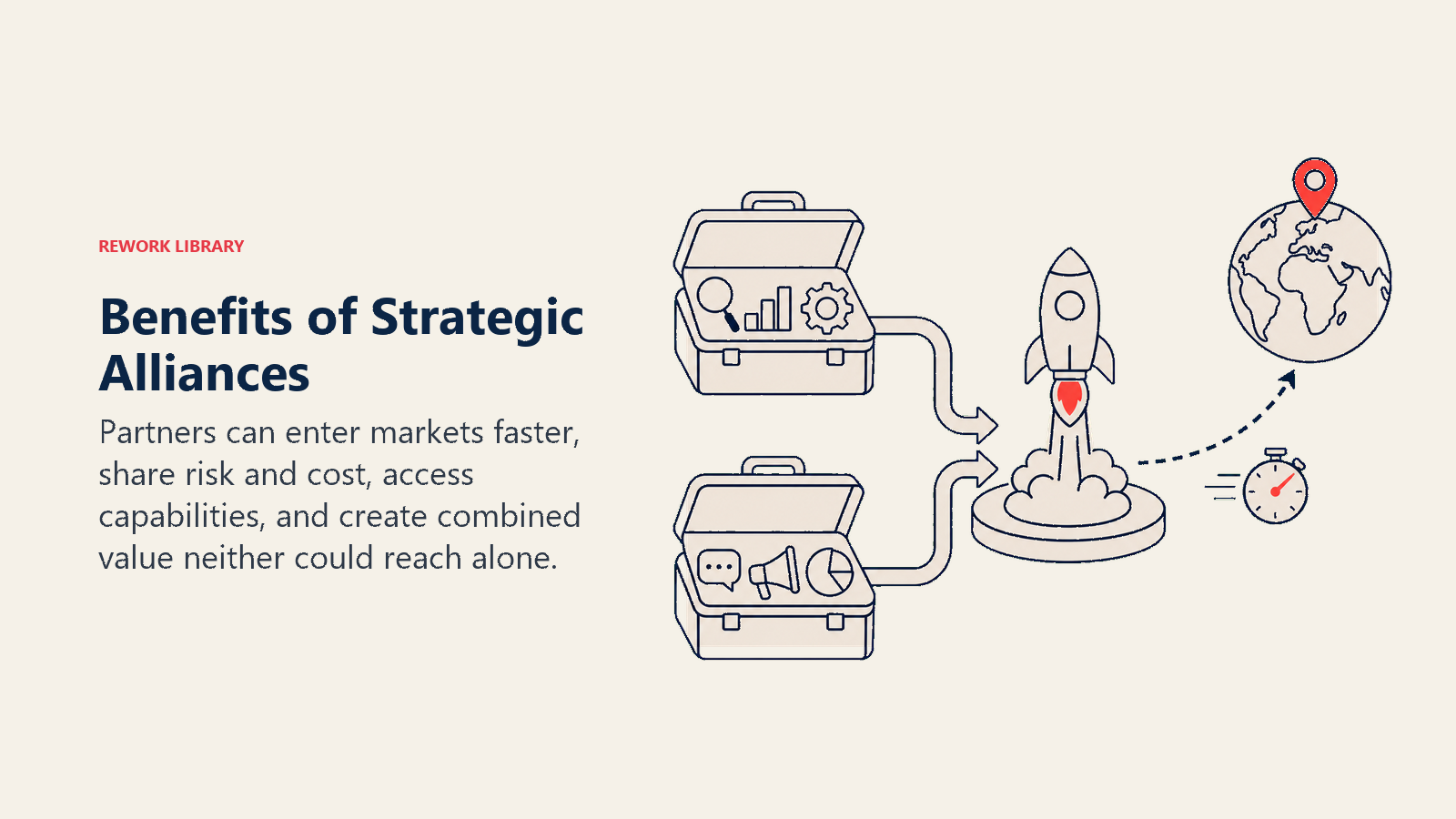
Acceso a nuevos mercados. Un socio local en un mercado extranjero ya cuenta con las relaciones de distribución, el conocimiento regulatorio y la confianza de marca que llevaría años construir de forma independiente. Muchas empresas utilizan las alianzas como estrategia principal de entrada al mercado, especialmente en la región Asia-Pacífico y Oriente Medio, donde las asociaciones locales son esperadas o legalmente obligatorias.
Costes de I+D compartidos. El desarrollo de fármacos, el diseño de semiconductores y la ingeniería aeroespacial conllevan costes de I+D muy elevados. Dividir esos costes entre dos o tres socios permite a cada empresa perseguir una innovación que no podría justificar por sí sola. Los acuerdos de codesarrollo farmacéutico son un ejemplo habitual: una empresa aporta el compuesto, otra financia los ensayos clínicos y se reparten los derechos de comercialización.
Velocidad de llegada al mercado. Desarrollar una capacidad desde cero requiere tiempo. Asociarse con una empresa que ya dispone de esa capacidad es más rápido. Por eso, las empresas de software forman alianzas de distribución con integradores de sistemas en lugar de crear sus propias fuerzas de ventas en cada mercado.
Reparto de riesgos. Entrar en un nuevo mercado o lanzar un nuevo producto conlleva un riesgo real a la baja. Una alianza permite a ambas empresas absorber ese riesgo de forma proporcional, lo que facilita la aprobación del caso de inversión.
Aprendizaje y transferencia de capacidades. Algunas alianzas tienen como objetivo explícito el aprendizaje organizativo. Un fabricante puede asociarse con una empresa tecnológica no solo para codesarrollar un producto, sino para comprender cómo esa empresa desarrolla software. Se trata de una justificación estratégica legítima, aunque también es el ámbito donde la protección de la propiedad intelectual resulta crítica.
Posicionamiento competitivo. Dos empresas de tamaño medio que forman una alianza pueden igualar la escala y el alcance de un competidor más grande. En sectores donde importan los efectos de red, las alianzas pueden reconfigurar el panorama competitivo con rapidez. Véase efectos de red para entender cómo se desarrolla esto estructuralmente.
Riesgos y errores frecuentes
La misma flexibilidad que hace atractivas a las alianzas también las hace frágiles.
Desalineación de objetivos. Los socios suelen entrar en una alianza con objetivos que se solapan pero no son idénticos. Uno quiere acceso al mercado; el otro quiere transferencia de tecnología. El acuerdo funciona hasta que los objetivos divergen. Sin una gobernanza explícita, no existe un proceso para resolver esa divergencia.
Contribución desigual. Un socio cumple sistemáticamente; el otro no. Eso genera resentimiento y, finalmente, un colapso. Acordar métricas de contribución claras en el momento de la formación es la medida preventiva.
Filtración de propiedad intelectual. En cualquier alianza que implique compartir tecnología o conocimiento especializado, existe el riesgo de que información propietaria migre hacia un competidor. Las alianzas sin participación de capital son especialmente vulnerables, porque las protecciones contractuales son más débiles que las protecciones estructurales de una JV.
Fricción cultural. Dos empresas con culturas de gestión, velocidades de toma de decisiones o tolerancias al riesgo diferentes se desgastarán mutuamente incluso cuando la estrategia sea sólida. La diligencia debida cultural está infravaluada en la formación de alianzas.
Ambigüedad en la salida. Muchas alianzas se rompen no por desacuerdos, sino porque ninguna de las partes clarificó las condiciones de salida desde el principio. Una cláusula de rescisión clara, un calendario de reversión de la propiedad intelectual y un plan de transición deben formar parte de todo acuerdo de alianza.
Dependencia excesiva. Si una empresa construye operaciones críticas sobre las capacidades de un socio de alianza, queda expuesta cuando ese socio cambia de dirección, es adquirido o se retira.
Cómo construir una alianza estratégica
La mayoría de los fracasos en alianzas son rastreables a errores en la formación, no en la ejecución. A continuación se presenta un proceso de seis pasos para establecer la base correctamente.
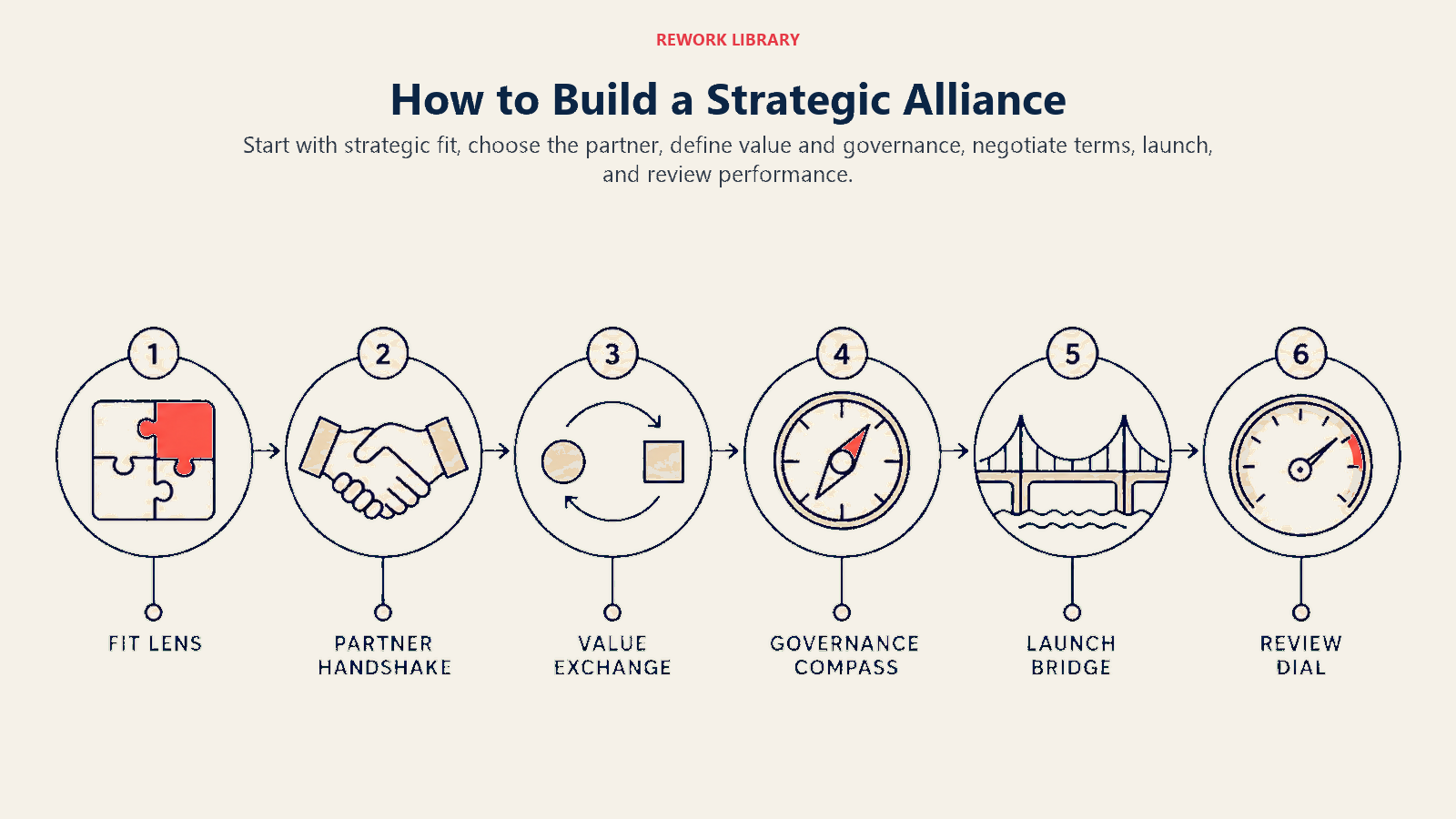
Paso 1: Defina su objetivo estratégico
Comience por el "por qué". ¿Qué resultado específico está tratando de lograr que no puede alcanzar solo? Sea preciso. "Expandirse internacionalmente" no es un objetivo. "Entrar en el sector manufacturero alemán con un socio local que tenga relaciones existentes con OEM de automoción de primer nivel" sí lo es. La precisión de su objetivo filtra la búsqueda de socios y le proporciona un punto de referencia para evaluar si la alianza está funcionando.
Vincule este objetivo a su estrategia corporativa más amplia y compruebe cómo encaja en sus niveles de estrategia.
Paso 2: Seleccione al socio adecuado
La selección del socio es la decisión de mayor apalancamiento en el proceso de alianza. Los criterios deben abarcar:
- Encaje estratégico: ¿Sus objetivos complementan los suyos o compiten con ellos?
- Encaje de capacidades: ¿Aportan lo que usted realmente necesita (no solo lo que suena impresionante)?
- Encaje cultural: ¿Podrán los equipos trabajar juntos a nivel operativo?
- Estabilidad financiera: ¿Pueden sostener sus compromisos durante el plazo de la alianza?
- Posición competitiva: ¿Son un competidor actual o potencial en su mercado principal?
Un marco útil aquí es el análisis construir, tomar prestado o comprar, que le obliga a evaluar la alianza (tomar prestado) frente a las alternativas antes de comprometerse.
Paso 3: Estructure el acuerdo
La estructura debe estar a la altura de la ambición. Un simple acuerdo de comarketing requiere un contrato de dos páginas. Una JV de codesarrollo requiere meses de estructuración jurídica y financiera. Elementos comunes que hay que resolver:
- Alcance de la alianza (qué está incluido y qué no)
- Contribuciones de recursos de cada parte
- Propiedad de la propiedad intelectual desarrollada conjuntamente
- Mecanismos de reparto de ingresos o costes
- Cláusulas de exclusividad (y sus límites geográficos o de producto)
Paso 4: Establezca la gobernanza
La gobernanza es lo que separa las alianzas que se adaptan de las que se estancan. Como mínimo, se necesita:
- Un comité de dirección conjunto con autoridad para tomar decisiones
- Vías de escalada definidas para los conflictos
- Revisiones periódicas del rendimiento (trimestral es lo habitual)
- Un proceso para modificar el acuerdo cuando las circunstancias cambien
La gobernanza de la alianza suele estar poco desarrollada porque ninguna de las partes quiere iniciar la relación con una larga conversación sobre escenarios de fracaso. Esa conversación vale la pena tenerla.
Paso 5: Alinee los incentivos
Los incentivos económicos de los socios deben mantenerse alineados durante toda la vigencia de la alianza. Si la contribución de un socio está concentrada al principio (aporta la tecnología desde el inicio) y la del otro es diferida (financia la comercialización durante tres años), la dinámica cambiará a medida que la alianza madure. Modele la estructura de incentivos a lo largo de todo el plazo, no solo en el lanzamiento.
Esto conecta directamente con la ventaja competitiva que cada parte trata de construir o proteger. Si la alianza crea valor para una parte a expensas de la posición a largo plazo de la otra, no durará.
Paso 6: Gestione y revise
La gestión activa de la alianza es una disciplina, no un trámite. Las empresas líderes asignan un responsable de alianza dedicado, establecen KPI compartidos y realizan revisiones estructuradas. Las empresas que tratan las alianzas como algo que se configura y se olvida obtienen sistemáticamente resultados inferiores. La Pirámide de Crecimiento de McKinsey señala la gestión de carteras de alianzas como una capacidad diferenciada en el nivel de crecimiento, no como un efecto secundario de la estrategia.
Ejemplos de alianzas estratégicas
| Empresas | Tipo de alianza | Lo que compartieron | Resultado |
|---|---|---|---|
| Renault y Nissan (1999-presente) | Alianza de capital cruzado | Plataformas de fabricación, compras, tecnología y talento directivo | La Alianza Renault-Nissan-Mitsubishi se convirtió en el mayor grupo de vehículos del mundo por volumen en su momento álgido (2017), demostrando cómo las alianzas de capital pueden ofrecer una escala comparable a una fusión sin la complejidad de una integración total |
| Starbucks y PepsiCo (1994-presente) | Alianza de distribución sin participación de capital | PepsiCo distribuye los productos listos para beber de Starbucks a través de su red de bebidas | Starbucks obtuvo distribución masiva sin construir su propia logística; PepsiCo amplió su cartera de productos. La alianza ha generado miles de millones en ingresos |
| Boeing y Lockheed Martin (United Launch Alliance, 2006) | empresa conjunta | Fabricación y operaciones de vehículos de lanzamiento | Creó un proveedor dominante de servicios de lanzamiento para seguridad nacional en EE. UU.; ambas empresas redujeron costes mediante infraestructura compartida y evitaron la competencia directa en un mercado con clientes limitados |
Estos ejemplos abarcan sectores y tipos de alianzas. El patrón es coherente: cada socio aporta algo que el otro necesita y no tiene, el acuerdo se estructura en torno a un resultado compartido claro y la gobernanza mantiene la relación funcional durante años o décadas.
Mejores prácticas
Haga:
- Elabore un documento de "justificación estratégica" antes de iniciar conversaciones con posibles socios. Si no puede articular en dos párrafos por qué esta alianza es mejor que las alternativas, deténgase.
- Trate la gobernanza de la alianza como un producto. Invierta en ella desde el principio.
- Modele la estructura de incentivos a lo largo de toda la vigencia de la alianza, no solo en el año uno.
- Realice la diligencia debida cultural junto con la diligencia debida financiera.
- Conecte los objetivos de la alianza con sus competencias centrales para saber qué está protegiendo y qué está compartiendo.
No haga:
- No asuma que los objetivos compartidos seguirán siéndolo sin mantenimiento activo.
- No descuide la protección de la propiedad intelectual en las estructuras sin participación de capital.
- No subestime los costes de integración cultural (incluso cuando no hay una fusión formal).
- No omita las condiciones de salida. Una cláusula de salida limpia no es pesimismo; es profesionalismo.
- No forme alianzas como sustituto de tener una estrategia clara. Las asociaciones son un vehículo de ejecución, no una estrategia. La Matriz de Ansoff y los marcos de estrategia de diversificación son mejores puntos de partida para la cuestión estratégica.
Las alianzas estratégicas no son un atajo. Mal gestionadas, absorben el ancho de banda directivo y entregan menos de lo que cualquiera de las dos empresas podría haber logrado por separado. Pero bien gestionadas, permiten a las empresas alcanzar escala, entrar en mercados y desarrollar capacidades años antes de lo que permitiría el crecimiento orgánico. Las empresas que triunfan en alianzas las tratan como una disciplina: formación estructurada, gobernanza activa y revisiones honestas. Esto es válido tanto para un contrato de licencia de dos páginas como para una empresa conjunta multimillonaria.
Para las empresas que deben decidir entre alianza, adquisición o inversión orgánica, el marco construir, tomar prestado o comprar es el punto de partida adecuado. Y para los equipos que necesitan entender cómo encajan las alianzas en la planificación del crecimiento global, Hoshin Kanri y el Modelo del Diamante de Porter ofrecen herramientas estructurales para alinear la estrategia de alianzas con la dirección empresarial.
Lectura relacionada

Co-Founder & COO
On this page
- ¿Qué es una alianza estratégica?
- Tipos de alianzas estratégicas
- Cómo se comparan las alianzas con las fusiones y adquisiciones
- Alianza estratégica vs empresa conjunta vs fusión
- Beneficios de las alianzas estratégicas
- Riesgos y errores frecuentes
- Cómo construir una alianza estratégica
- Paso 1: Defina su objetivo estratégico
- Paso 2: Seleccione al socio adecuado
- Paso 3: Estructure el acuerdo
- Paso 4: Establezca la gobernanza
- Paso 5: Alinee los incentivos
- Paso 6: Gestione y revise
- Ejemplos de alianzas estratégicas
- Mejores prácticas
- Lectura relacionada