Efectos de red: tipos y por qué importan
Turn this article into takeaways for your work.


Each assistant summarizes the article only for you and suggests best practices for your work.
Los efectos de red son la fuerza del lado de la demanda que hace que un producto o servicio sea más valioso a medida que más personas lo utilizan. Son también la razón por la que un puñado de plataformas domina sus categorías mientras decenas de rivales bien financiados no logran abrirse paso.
Comprender los efectos de red no es solo teoría interesante. Para los directivos que construyen negocios de plataforma, marca la diferencia entre desarrollar algo con poder de fijación de precios duradero y desarrollar algo que compite por funcionalidades hasta que aparece un rival más grande.
¿Qué son los efectos de red?
Un efecto de red existe cuando el valor que obtiene un usuario de un producto aumenta a medida que crece el número de otros usuarios. El producto en sí no cambia. La base de usuarios sí, y ese cambio hace el producto más valioso para todos los que ya lo usan.
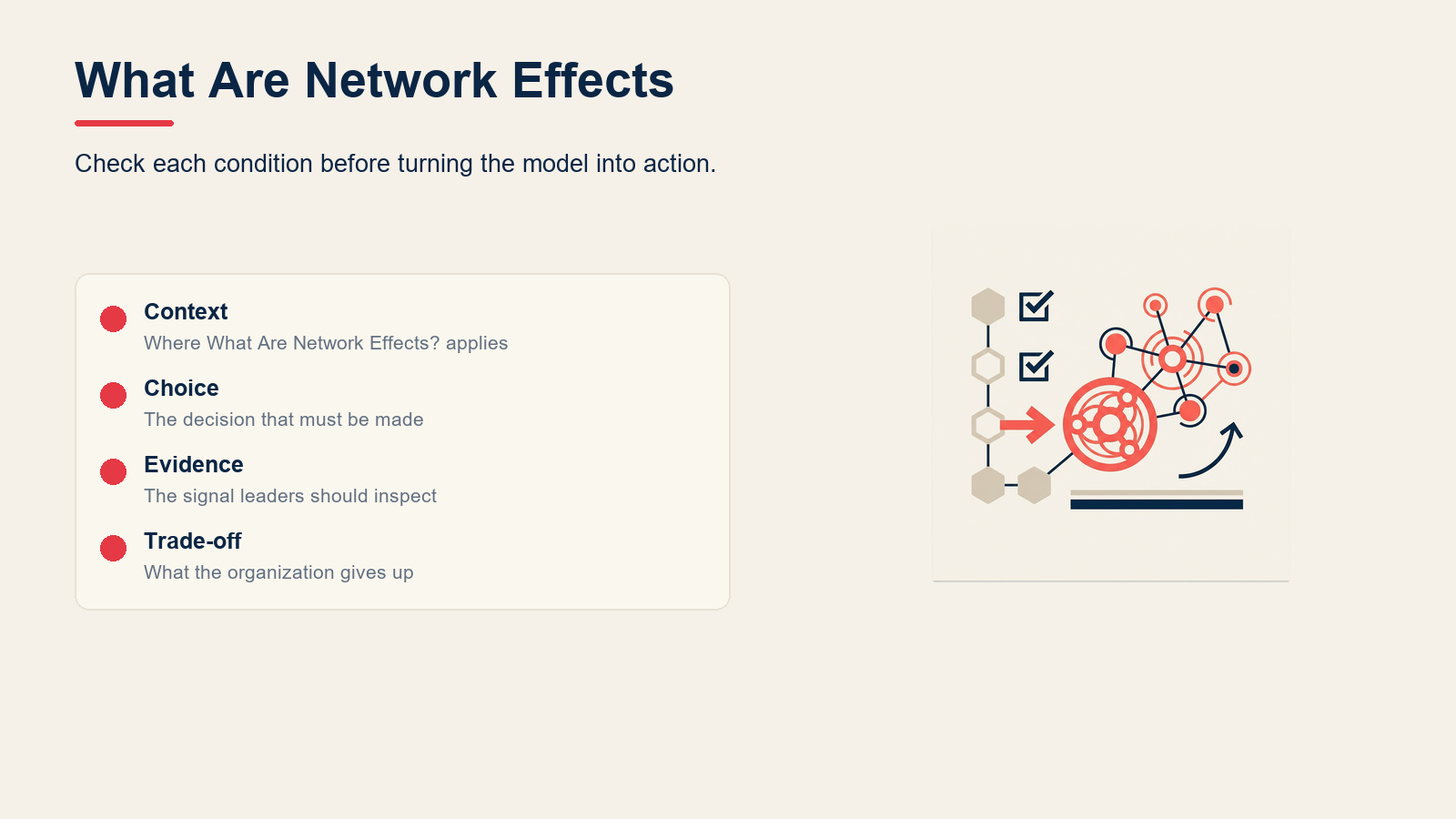
Contraste esto con un producto independiente como un martillo. Que una segunda persona compre un martillo no hace que su martillo sea más útil. Pero una segunda persona que se une a una aplicación de mensajería la hace más útil para todos los que ya están en ella, porque ahora hay una persona más a la que puede llegar.
Datos clave: Efectos de red
- Los efectos de red son el principal motor de creación de valor en las plataformas; una investigación de NFX encontró que representan aproximadamente el 70% del valor creado por las empresas tecnológicas desde 1994. (NFX, 2023)
- Las empresas con fuertes efectos de red sostienen el crecimiento de ingresos aproximadamente el doble de tiempo que las que no los tienen, según un estudio intersectorial de más de 100 negocios de plataforma. (Andreessen Horowitz, 2022)
- La Ley de Metcalfe predice que el valor de la red escala con el cuadrado del número de usuarios (n²), lo que significa que una red de 100 usuarios es aproximadamente 4 veces más valiosa que una de 50. (Robert Metcalfe, 1980; ampliamente citado en la literatura de estrategia de plataformas)
La característica definitoria de un efecto de red es que crea un bucle de autorrefuerzo: más usuarios atraen más usuarios. Ese bucle, una vez en marcha, se convierte en la ventaja competitiva.
Tipos de efectos de red
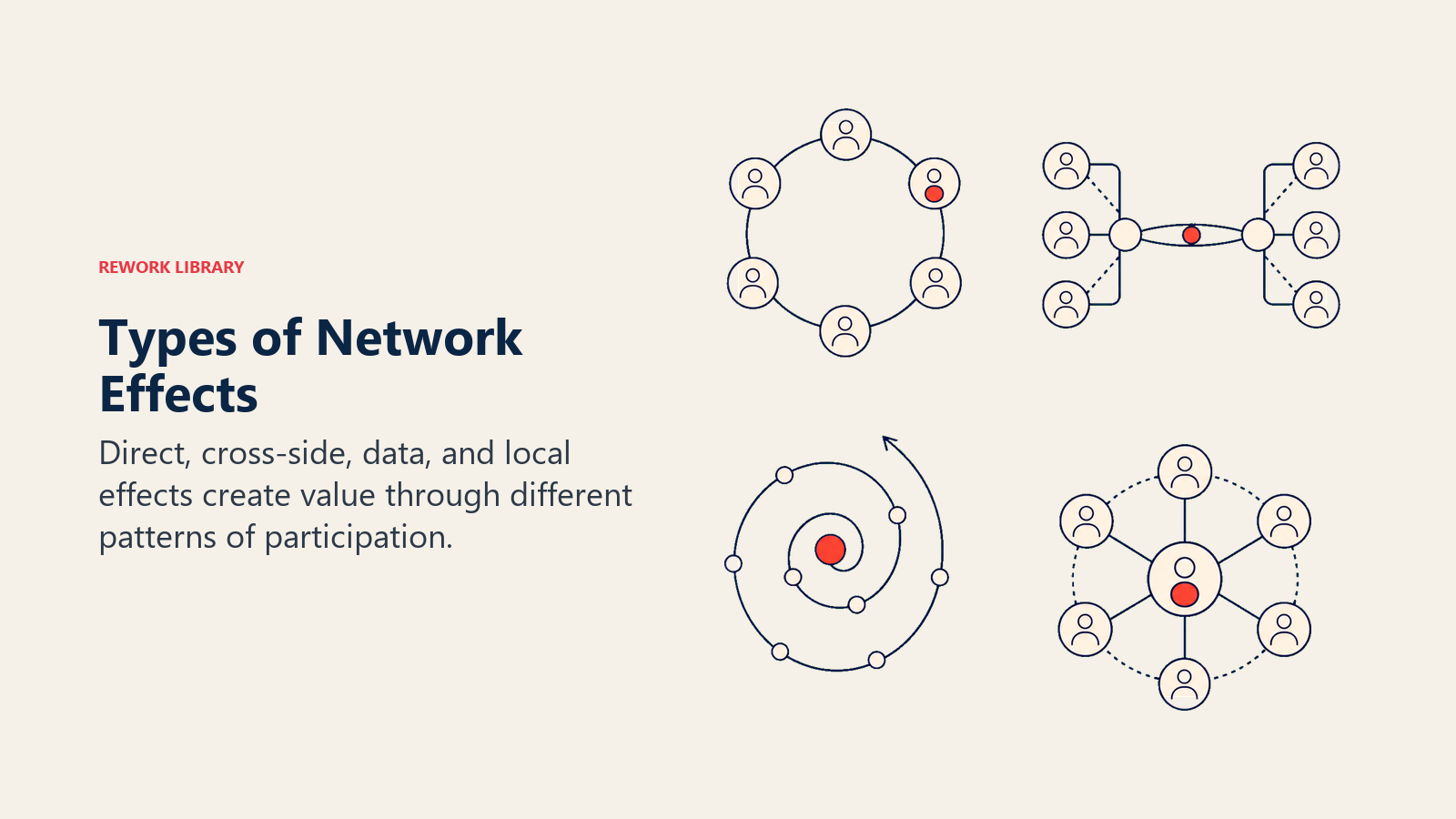
No todos los efectos de red funcionan de la misma manera. Los estrategas suelen distinguir cinco tipos principales, y cada uno tiene implicaciones distintas para cómo debe crecer un negocio.
Efectos de red directos (del mismo lado)
Los efectos de red directos ocurren cuando cada nuevo usuario del mismo tipo aumenta el valor para los usuarios existentes del mismo tipo. Son los más fáciles de entender.
WhatsApp es el ejemplo más claro. Cuando más contactos suyos están en WhatsApp, su cuenta se vuelve más útil. Todos en la plataforma se benefician de todos los demás porque son del mismo tipo de usuario.
Efectos de red indirectos (de lado cruzado)
Los efectos de red indirectos ocurren entre dos o más grupos de usuarios distintos. Más usuarios en un lado de la plataforma aumentan el valor para los usuarios del otro lado, pero no necesariamente para los usuarios del mismo lado.
Considere una consola de videojuegos. Más propietarios de PlayStation atraen a más desarrolladores de juegos, porque hay una audiencia mayor a la que vender. Más juegos atraen a más compradores de PlayStation. Desarrolladores y jugadores son lados diferentes, y cada uno hace la plataforma mejor para el otro.
Efectos de red de plataformas de dos lados
Las plataformas de dos lados son la arquitectura que hace posibles los efectos de lado cruzado a escala. Un mercado, una bolsa o un sistema operativo aloja dos grupos cuya interacción crea valor para ambos.
Uber conecta pasajeros y conductores. Airbnb conecta viajeros y anfitriones. Visa conecta tarjetahabientes y comerciantes. El trabajo de la plataforma es resolver un problema de coordinación entre partes que de otro modo no podrían encontrarse fácilmente.
Efectos de red de datos
Los efectos de red de datos son una categoría más reciente, distinta de las anteriores porque el valor no proviene de la interacción usuario a usuario, sino de los datos generados por los usuarios que mejoran el producto para todos.
Google Maps obtiene mejores recomendaciones de ruta a medida que más personas navegan, no porque los usuarios se hablen entre sí, sino porque sus patrones de conducción agregados entrenan el algoritmo. Waze hace lo mismo. Cuantos más viajes se realicen en Uber, mejor se vuelve su modelo de precios dinámicos para equilibrar oferta y demanda.
Efectos de red sociales
Los efectos de red sociales combinan elementos de los efectos directos con identidad y confianza. Su identidad profesional en LinkedIn se vuelve más valiosa a medida que más personas de su red profesional están presentes. A diferencia de WhatsApp (comunicación pura), el valor de LinkedIn incluye la señal de credibilidad de estar conectado con otros en su sector.
| Tipo | Valor proveniente de | ¿Mismo lado o cruzado? | Ejemplo |
|---|---|---|---|
| Directo | Más usuarios del mismo tipo | Mismo | WhatsApp, Zoom, máquinas de fax |
| Indirecto / Cruzado | Más usuarios del otro lado | Cruzado | PlayStation/desarrolladores, App Store/apps |
| Plataforma de dos lados | Crecimiento de ambos lados | Cruzado | Airbnb, Visa, Uber |
| Datos | Datos de uso que mejoran el producto | Ninguno (algorítmico) | Google Maps, recomendaciones de Netflix |
| Social | Identidad, confianza, señal profesional | Mismo (con identidad de red) | LinkedIn, Facebook |
Efectos de red vs. economías de escala
Estos dos conceptos se confunden frecuentemente porque ambos generan ventaja competitiva a través del crecimiento. Pero operan sobre principios completamente distintos.
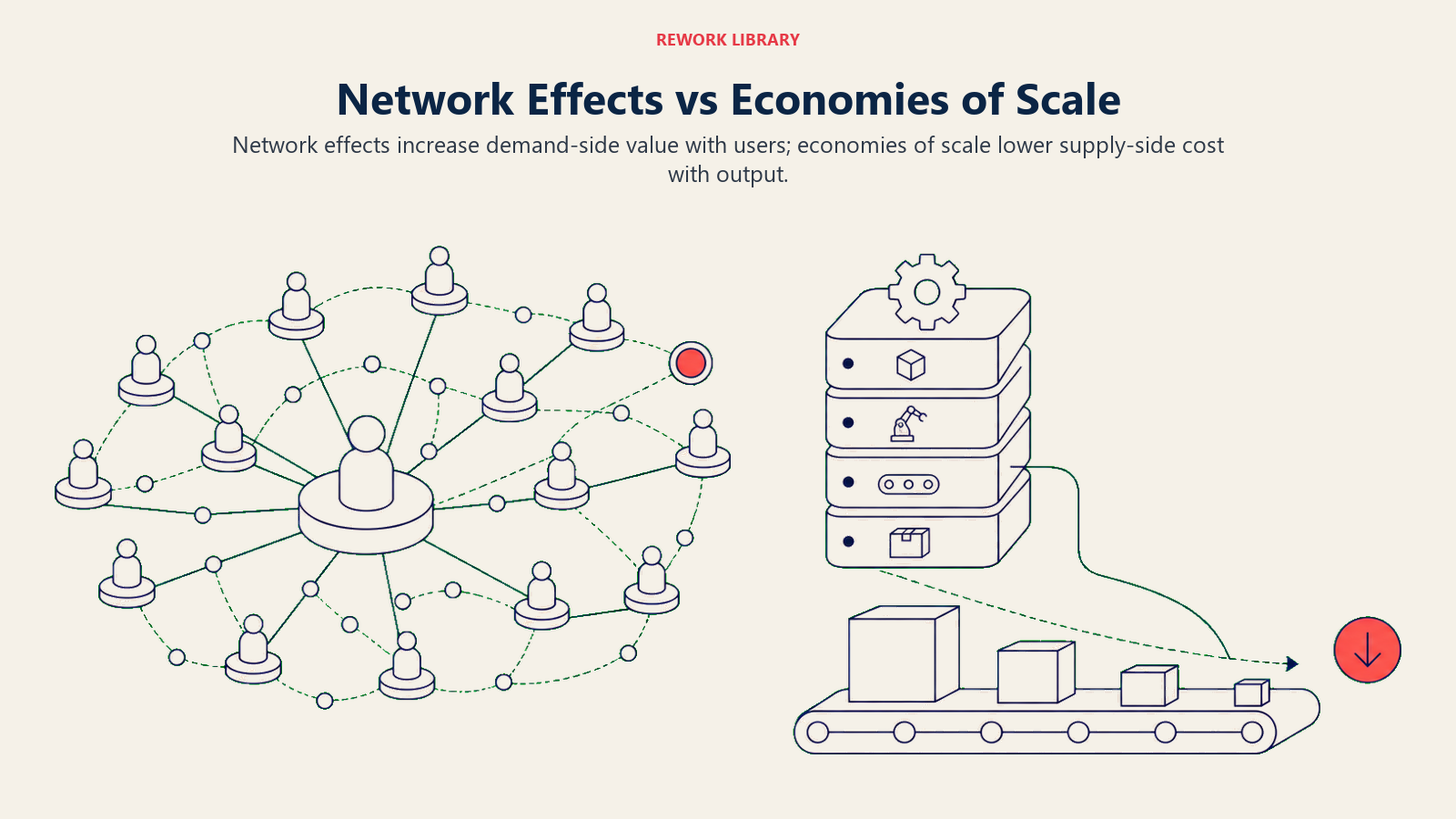
Las economías de escala son una ventaja del lado de la oferta. Cuanto más produce, menor es su costo unitario. Su curva de costos se dobla hacia abajo a medida que crece el volumen. La red de logística de Amazon tiene enormes economías de escala: cada unidad adicional enviada cuesta menos de manejar porque la infraestructura fija (almacenes, camiones, software) ya está pagada.
Los efectos de red son una ventaja del lado de la demanda. A medida que más personas usan el producto, cada usuario obtiene más valor. No hay ningún mecanismo de curva de costos aquí. El producto simplemente se vuelve más útil, lo que facilita retener a los usuarios existentes y atraer a nuevos.
| Dimensión | Economías de escala | Efectos de red |
|---|---|---|
| Fuente de ventaja | Lado de la oferta (costo) | Lado de la demanda (valor) |
| Mecanismo | Menor costo por unidad a medida que crece el volumen | Mayor valor por usuario a medida que crece la base de usuarios |
| Quién se beneficia | La empresa (menores costos, mayores márgenes) | El usuario (producto más valioso) |
| Analogía de escala | Fábrica funcionando a plena capacidad | Red telefónica que suma miembros |
| Ventaja competitiva principal | Posición de costo | Costo de cambio + bloqueo de la base de usuarios |
| Ejemplos clásicos | Walmart, Toyota, logística de Amazon | Facebook, Visa, WhatsApp |
Los negocios más defensibles combinan ambos. Amazon tiene economías de escala en logística y efectos de red en su marketplace (más vendedores atraen más compradores, y viceversa). Esa combinación es la razón por la que competir con Amazon en comercio electrónico es tan estructuralmente difícil.
La Ley de Metcalfe y la masa crítica
La matemática de los efectos de red fue formalizada por Robert Metcalfe, el coinventor de Ethernet, en lo que se conoció como la Ley de Metcalfe: el valor de una red escala con el cuadrado del número de usuarios conectados (n al cuadrado).
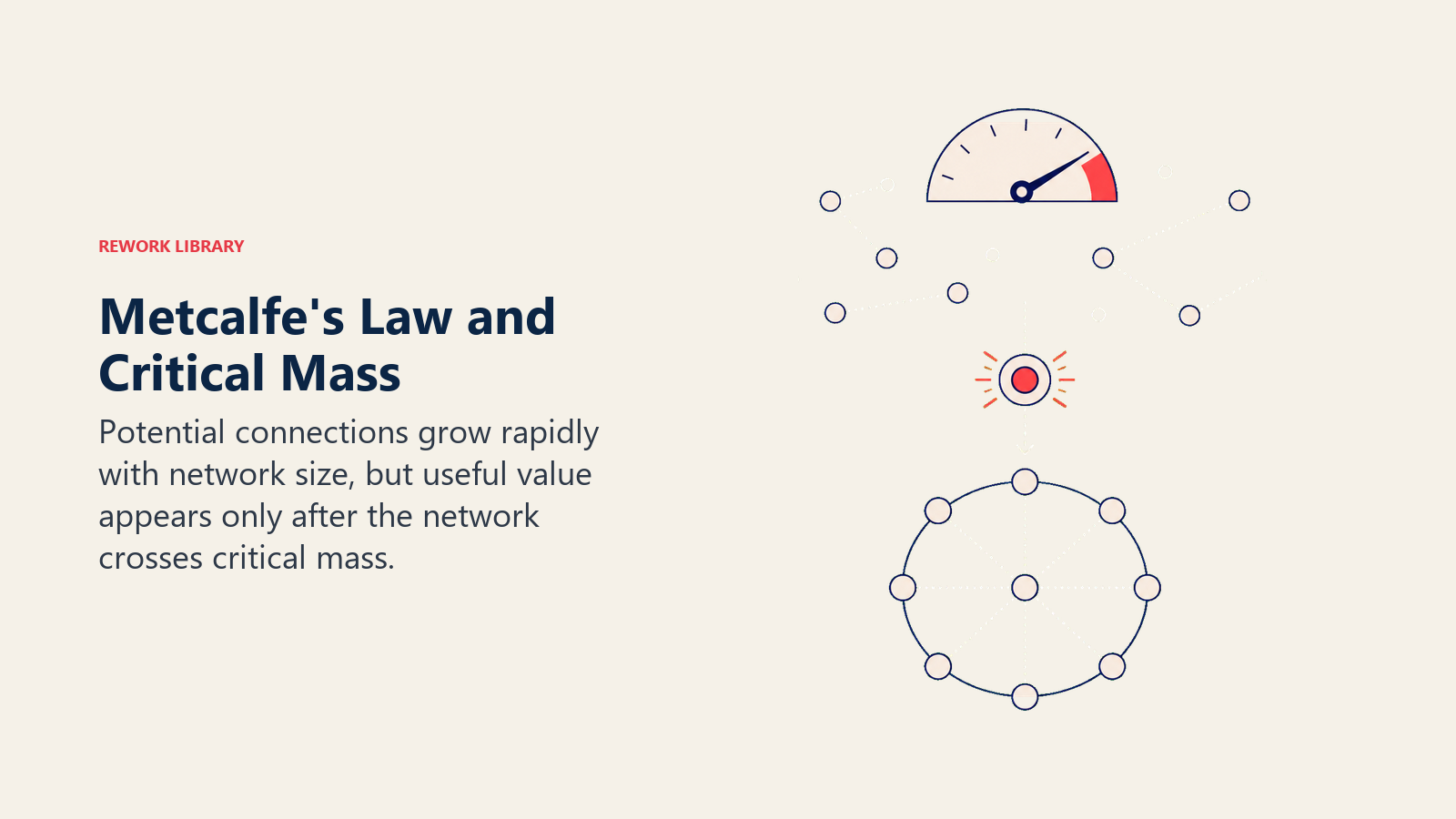
La intuición es sencilla. Con dos usuarios, hay una posible conexión. Con cinco, hay diez. Con 100 usuarios, hay 4.950. El valor no crece linealmente con los usuarios; crece de forma combinatoria.
La Ley de Metcalfe explica por qué las redes pequeñas tienen dificultades y las grandes dominan. Pero también apunta al problema más difícil en la estrategia de plataformas: la masa crítica.
La masa crítica es el umbral en el que una red se vuelve autosustentable. Por debajo de ella, el producto es demasiado delgado para ser útil. Los usuarios llegan, encuentran muy pocos otros usuarios y se van. Por encima de ella, el producto se vuelve lo suficientemente atractivo como para que los nuevos usuarios se unan sin gastos agresivos de adquisición.
Este es el problema del arranque en frío. Una nueva aplicación de mensajería tiene valor cero si ninguno de sus contactos la usa. Un nuevo marketplace no tiene nada que comprar si no hay vendedores, y no hay vendedores si no hay compradores. Superar el período de arranque en frío sin una masa crítica de usuarios es el mayor desafío operativo para cualquier negocio basado en efectos de red.
Las estrategias comunes de arranque en frío incluyen lanzar en una única geografía o comunidad (el lanzamiento ciudad por ciudad de Uber, el despliegue campus por campus de Facebook), sembrar un lado de un mercado de dos lados antes de abrir el otro, u ofrecer subsidios temporales que hagan viable el período de red delgada.
Ejemplos de efectos de red
En todas las categorías del sector, el patrón se mantiene: las plataformas que logran efectos de red se vuelven extraordinariamente difíciles de desplazar.
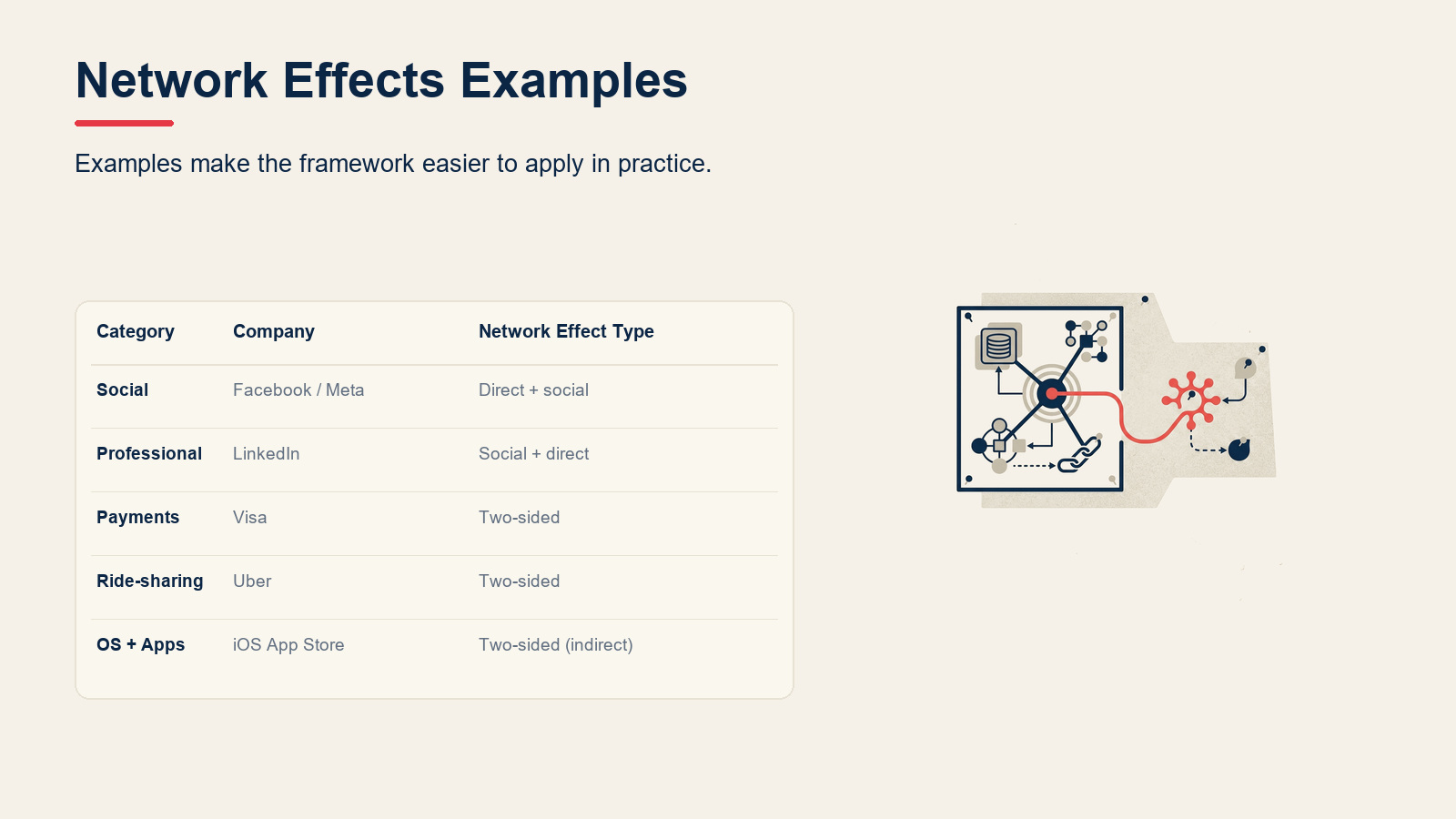
| Categoría | Empresa | Tipo de efecto de red | Por qué es difícil de desplazar |
|---|---|---|---|
| Social | Facebook / Meta | Directo + social | Más de 3.000 millones de usuarios, identidad social, historial de fotos |
| Profesional | Social + directo | Reputación profesional, relaciones con reclutadores | |
| Pagos | Visa | Dos lados | 4.000 millones de tarjetahabientes, más de 100 millones de comerciantes |
| Transporte compartido | Uber | Dos lados | La densidad de conductores reduce los tiempos de espera; el volumen de pasajeros financia los ingresos de los conductores |
| SO + Apps | iOS App Store | Dos lados (indirecto) | Más de 1.000 millones de usuarios de dispositivos atraen a desarrolladores; la amplitud de apps retiene usuarios |
| SaaS | Salesforce | Datos + indirecto | La calidad de los datos de CRM crece con el uso; ecosistema de más de 3.000 integraciones |
| Marketplaces | Amazon | Dos lados + datos | Más vendedores aumentan la selección; los datos mejoran las recomendaciones |
| Mensajería | Directo | Más de 2.000 millones de usuarios; sus contactos ya están ahí |
El patrón en cada caso: la ventaja competitiva no es la tecnología. Es la base de usuarios y el bucle de retroalimentación que la hace crecer.
Cómo desarrollar efectos de red
Desarrollar efectos de red no es accidental. Requiere una secuencia deliberada, especialmente en las etapas tempranas antes de alcanzar la masa crítica.
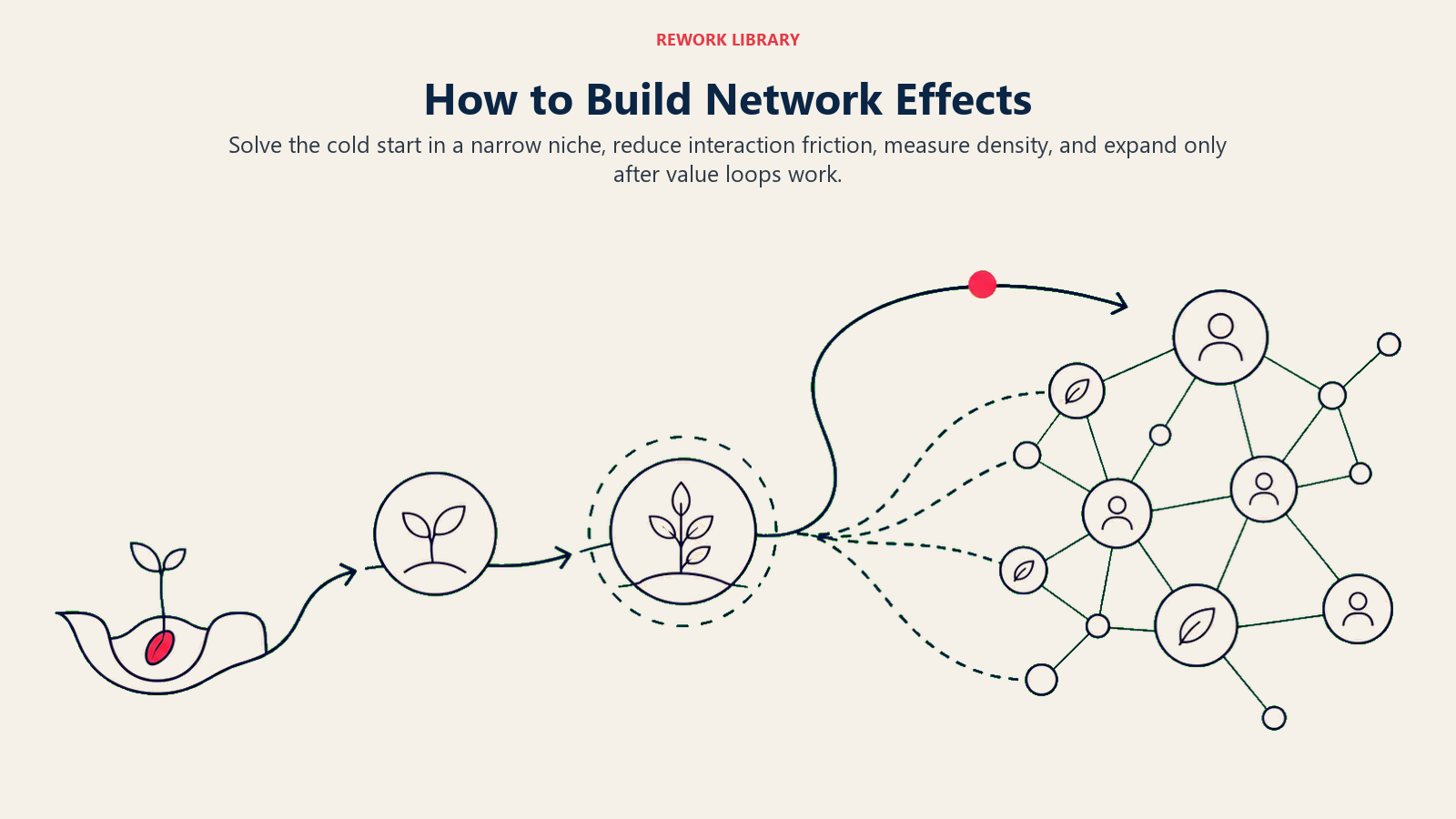
Paso 1: Resuelva primero un problema real de forma independiente
Antes de que un efecto de red pueda activarse, su producto necesita ser útil para al menos un usuario con cero otros presentes. Slack era una herramienta útil de comunicación interna para su propio equipo antes de ser un producto. Los filtros de fotos de Instagram lo hacían útil incluso cuando usted era el único usuario. Si su producto no tiene valor en aislamiento, no puede sembrar la red.
Paso 2: Identifique la topología de su red
Decida desde el principio si está construyendo una red de efectos directos (donde todos los usuarios son del mismo tipo) o una red de dos lados (donde necesita dos grupos distintos). La topología determina su estrategia de arranque en frío. Las redes de dos lados requieren sembrar primero un lado, generalmente el lado de la oferta.
Paso 3: Consolide primero una comunidad densa
No intente estar en todas partes. Siembre una comunidad, geografía o segmento compacto donde la densidad de red pueda crecer rápidamente. Facebook lanzó en Harvard. Uber lanzó en San Francisco. Airbnb se centró en eventos en Nueva York. La densidad en un lugar supera la cobertura delgada en todas partes.
Paso 4: Elimine la fricción en ambos lados
Cada paso entre "escuchar sobre su producto" y "obtener valor de él" es una fuga en su Funnel de adquisición. Para las redes de dos lados, la asimetría de fricción mata el crecimiento: si es difícil para los proveedores registrarse, nunca tendrá suficiente oferta para atraer compradores. Mapee el proceso de Onboarding de ambos lados y comprímalos.
Paso 5: Instrumente y proteja los costos de cambio
Una vez que los usuarios están activos, aumente el costo de irse. Esto no es manipulación; es diseño de producto. La portabilidad de datos debe ser razonable, pero las integraciones significativas, el historial y las relaciones deben vivir dentro de su plataforma. El historial de InMail de LinkedIn, los cinco años de datos de CRM de Salesforce, el archivo de mensajes buscable de Slack: estos son costos de cambio que refuerzan el efecto de red.
Paso 6: Defiéndase contra el multi-homing
El multi-homing ocurre cuando los usuarios utilizan múltiples redes competidoras de forma simultánea. Los conductores que trabajan tanto en Uber como en Lyft reducen la exclusividad de la oferta de conductores de cada plataforma. Esté atento a esto desde el principio y diseñe funcionalidades que recompensen la exclusividad donde sea posible, sin ser coercitivo.
Limitaciones y riesgos
Los efectos de red son poderosos pero no invulnerables. Varias fuerzas pueden erosionarlos.
Los efectos de red negativos (congestión) ocurren cuando demasiados usuarios degradan la calidad. Una carretera se vuelve más lenta a medida que más autos la usan. Un marketplace saturado se vuelve más ruidoso. La relación señal-ruido de Twitter declinó a medida que escalaba. Si la plataforma no puede gestionar la calidad a escala, el crecimiento se convierte en un pasivo.
El multi-homing reduce la dinámica de ganador total. Cuando los usuarios pueden estar fácilmente en múltiples plataformas de forma simultánea, ninguna red captura la ventaja completa. La entrega de comida es un ejemplo común: los restaurantes se registran en DoorDash, Uber Eats y Grubhub a la vez, diluyendo la exclusividad de cualquier plataforma individual.
La desintermediación de la plataforma es el riesgo de que, una vez que un marketplace conecta compradores y vendedores, estos realicen transacciones directamente. La plataforma pierde la relación que supuestamente debía poseer.
La regulación apunta cada vez más a los efectos de red como una preocupación antimonopolio. La Ley de Mercados Digitales de la UE, por ejemplo, exige que los grandes operadores de plataforma permitan la interoperabilidad, lo que debilita directamente ciertas ventajas basadas en efectos de red.
La sustitución tecnológica puede reiniciar las ventajas de red por completo. WhatsApp desplazó a los SMS porque el costo de cambio de mover sus contactos a un nuevo protocolo era manejable. Una nueva tecnología de comunicación significativamente mejor podría hacer lo mismo con WhatsApp.
Preguntas frecuentes
¿Cuál es la diferencia entre un efecto de red y la viralidad?
La viralidad describe la rapidez con que se propaga un producto. Los efectos de red describen qué tan valioso se vuelve un producto a medida que se propaga. Un producto puede volverse viral sin generar efectos de red (un video viral se propaga rápidamente pero no se vuelve más valioso a medida que más personas lo ven). Y una red puede desarrollar fuertes efectos sin ser convencionalmente viral (Visa creció a través de partnerships deliberados con comerciantes y bancos, no a través de redes sociales).
¿Puede un producto SaaS B2B tener efectos de red?
Sí, aunque a menudo son más sutiles. Los efectos de red de datos son comunes: cuantos más clientes usan el producto, mejores se vuelven sus recomendaciones, benchmarks o detección de anomalías. Los efectos de red sociales aparecen en herramientas como Slack o Notion donde el valor crece cuando su equipo o sector también usa el producto. Los efectos de marketplace aparecen en herramientas que conectan compradores y vendedores, como las plataformas de compras.
¿Cómo sabe cuándo ha alcanzado la masa crítica?
Una señal práctica: su tasa de adquisición orgánica supera su tasa de adquisición pagada y la brecha se amplía. Otra: el Churn de sus primeras cohortes está disminuyendo a pesar de una menor inversión en retención. Cuando la red está haciendo más del trabajo de adquisición y retención que su presupuesto de marketing, ha cruzado un umbral de masa crítica.
¿Son los efectos de red siempre de tipo ganador total?
No siempre. El resultado de ganador total es más fuerte cuando los costos de cambio son altos, los datos o relaciones de los usuarios no son portables, y la categoría del producto solo necesita una red para ser maximamente útil (como con las tecnologías de estándares como Ethernet o USB). En categorías donde los usuarios tienen fuertes preferencias por comunidades de nicho, los equilibrios de múltiples redes son estables. Instagram y LinkedIn pueden coexistir porque sirven a contextos sociales diferentes.
¿Se pueden desarrollar efectos de red sin un modelo de negocio de plataforma?
Sí. Las comunidades de software de código abierto, las asociaciones profesionales y los organismos de estándares del sector exhiben efectos de red sin un intermediario de plataforma. Pero la mayoría de los ejemplos bien estudiados involucran plataformas precisamente porque están diseñadas para intermediar conexiones a escala.
Lecturas relacionadas
Para una inmersión más profunda en conceptos de estrategia adyacentes, estos artículos se basan directamente en el marco de efectos de red:
- Ventaja competitiva: la categoría más amplia de posiciones estratégicas duraderas, incluyendo costo, diferenciación y enfoque.
- Economías de escala: el complemento del lado de la oferta a los efectos de red, explicado con comparación completa.
- Porter's Five Forces: cómo los efectos de red aparecen en las fuerzas de "amenaza de nuevos participantes" y "poder del comprador".
- Blue Ocean Strategy: crear mercados donde aún no se han formado efectos de red, y ser el primero en sembrarlos.
- Competencias centrales: las capacidades internas que permiten a una empresa desarrollar y sostener un negocio basado en efectos de red.
- Efecto Flywheel: el patrón de impulso más amplio detrás de por qué un ciclo que se refuerza a sí mismo se multiplica una vez que empieza a girar.
El aspecto estratégico más importante de los efectos de red no es el mecanismo técnico. Es lo que implican respecto al tiempo: la ventaja se acumula con el tiempo, lo que significa que el momento adecuado para desarrollar una red es antes de lo que resulta cómodo. Para cuando un efecto de red es visible y claramente vale la pena perseguir, un competidor generalmente ya ha superado la masa crítica.

Senior Operations & Growth Strategist
On this page
- ¿Qué son los efectos de red?
- Tipos de efectos de red
- Efectos de red directos (del mismo lado)
- Efectos de red indirectos (de lado cruzado)
- Efectos de red de plataformas de dos lados
- Efectos de red de datos
- Efectos de red sociales
- Efectos de red vs. economías de escala
- La Ley de Metcalfe y la masa crítica
- Ejemplos de efectos de red
- Cómo desarrollar efectos de red
- Paso 1: Resuelva primero un problema real de forma independiente
- Paso 2: Identifique la topología de su red
- Paso 3: Consolide primero una comunidad densa
- Paso 4: Elimine la fricción en ambos lados
- Paso 5: Instrumente y proteja los costos de cambio
- Paso 6: Defiéndase contra el multi-homing
- Limitaciones y riesgos
- Lecturas relacionadas