El Modelo del Diamante de Porter: La Ventaja Competitiva Nacional Explicada
Turn this article into takeaways for your work.


Each assistant summarizes the article only for you and suggests best practices for your work.
El Modelo del Diamante de Porter responde una pregunta que desconcierta a muchos estrategas: ¿por qué las empresas de un país específico dominan una industria global en particular? No es suerte, y rara vez se debe únicamente a la mano de obra barata.
Michael Porter presentó el marco en su libro de 1990 The Competitive Advantage of Nations, tras un proyecto de investigación de cuatro años que abarcó diez países. El modelo explica cómo las condiciones nacionales y regionales se combinan para dar a las empresas locales una ventaja duradera en los mercados mundiales.
¿Qué es el Modelo del Diamante de Porter?
El Modelo del Diamante de Porter es un marco que explica por qué las empresas de ciertos países o regiones logran una ventaja competitiva sostenida en industrias específicas. Identifica cuatro determinantes entrelazados de la competitividad nacional, modelados por dos factores externos, que juntos forman un sistema en forma de diamante.
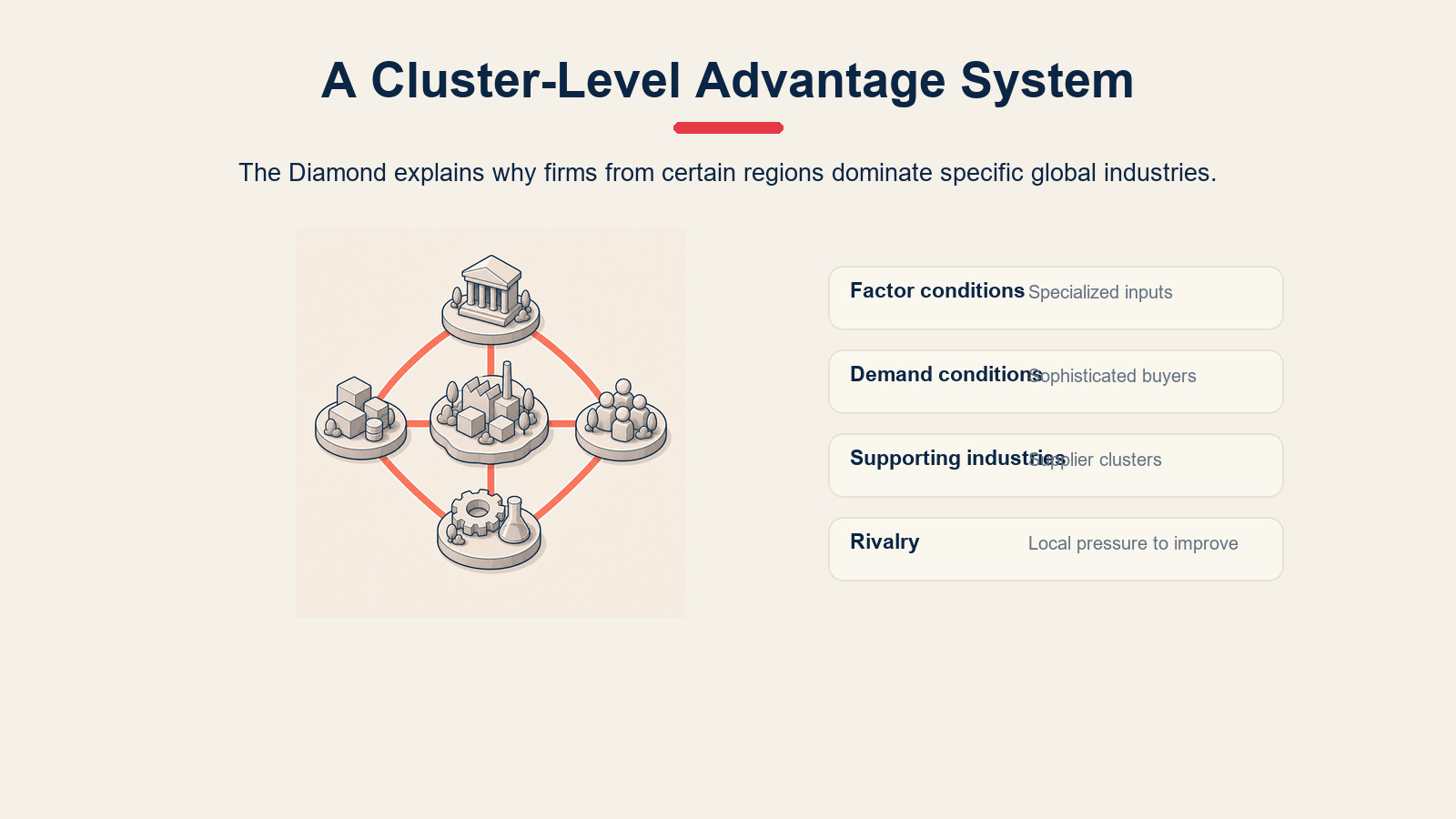
El modelo se sitúa en la intersección de la economía y la estrategia. A diferencia de los marcos que se centran en los recursos de una empresa individual o en la estructura de una industria, el Modelo del Diamante amplía el enfoque al nivel nacional y de clúster. Porter argumentó que el contexto local, no solo la estrategia corporativa, crea las condiciones para un desempeño de clase mundial.
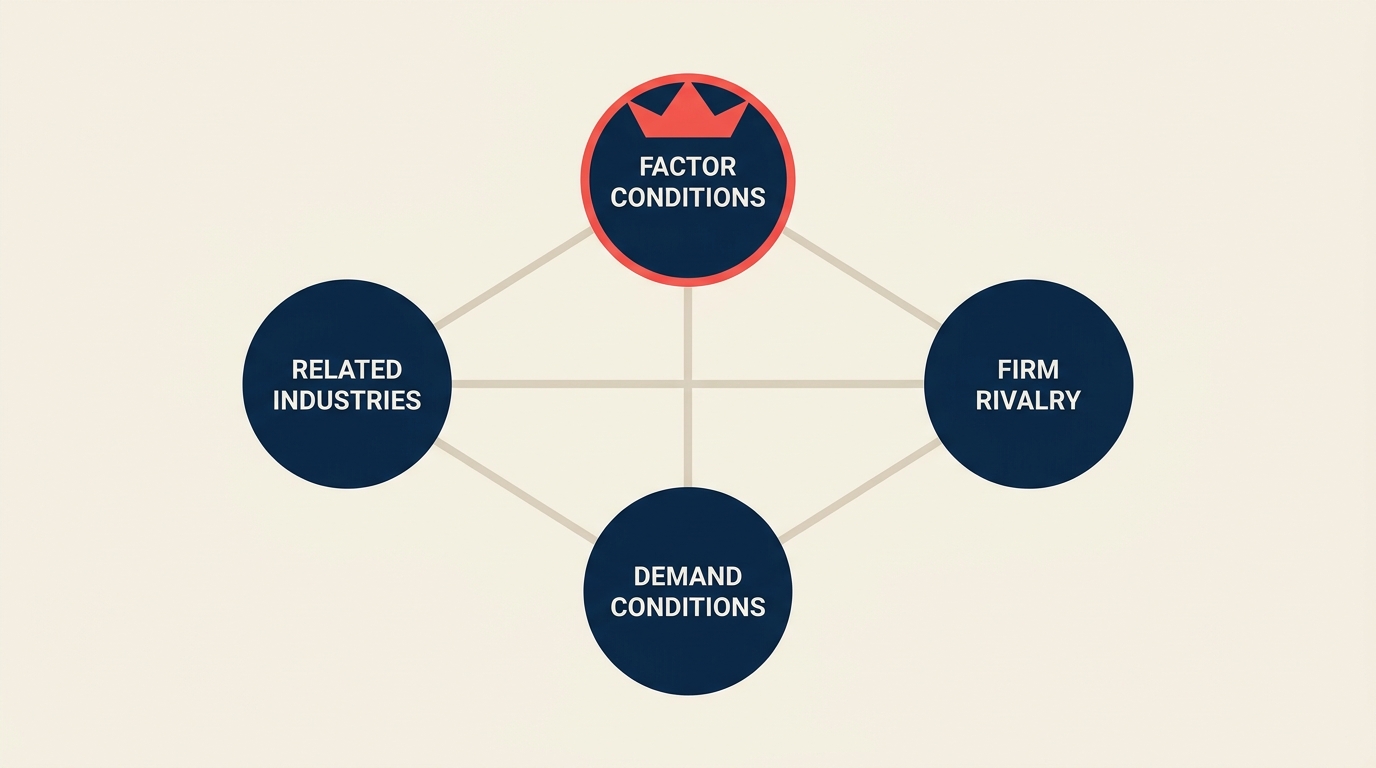
El nombre "diamante" proviene de la representación visual: cuatro nodos interiores conectados por líneas que forman un rombo. La clave está en que los nodos se refuerzan mutuamente. Unas condiciones de demanda sólidas, por ejemplo, impulsan a las empresas a innovar, lo que fortalece su posición frente a los rivales, lo que profundiza el grupo de industrias de apoyo, y así sucesivamente.
Este artículo se centra específicamente en el Modelo del Diamante de ventaja competitiva nacional. Es una herramienta diferente a las Cinco Fuerzas de Porter, que analiza la rentabilidad a nivel sectorial, y diferente también a las Estrategias Genéricas de Porter, que abordan cómo compite una empresa individual.
Datos Clave
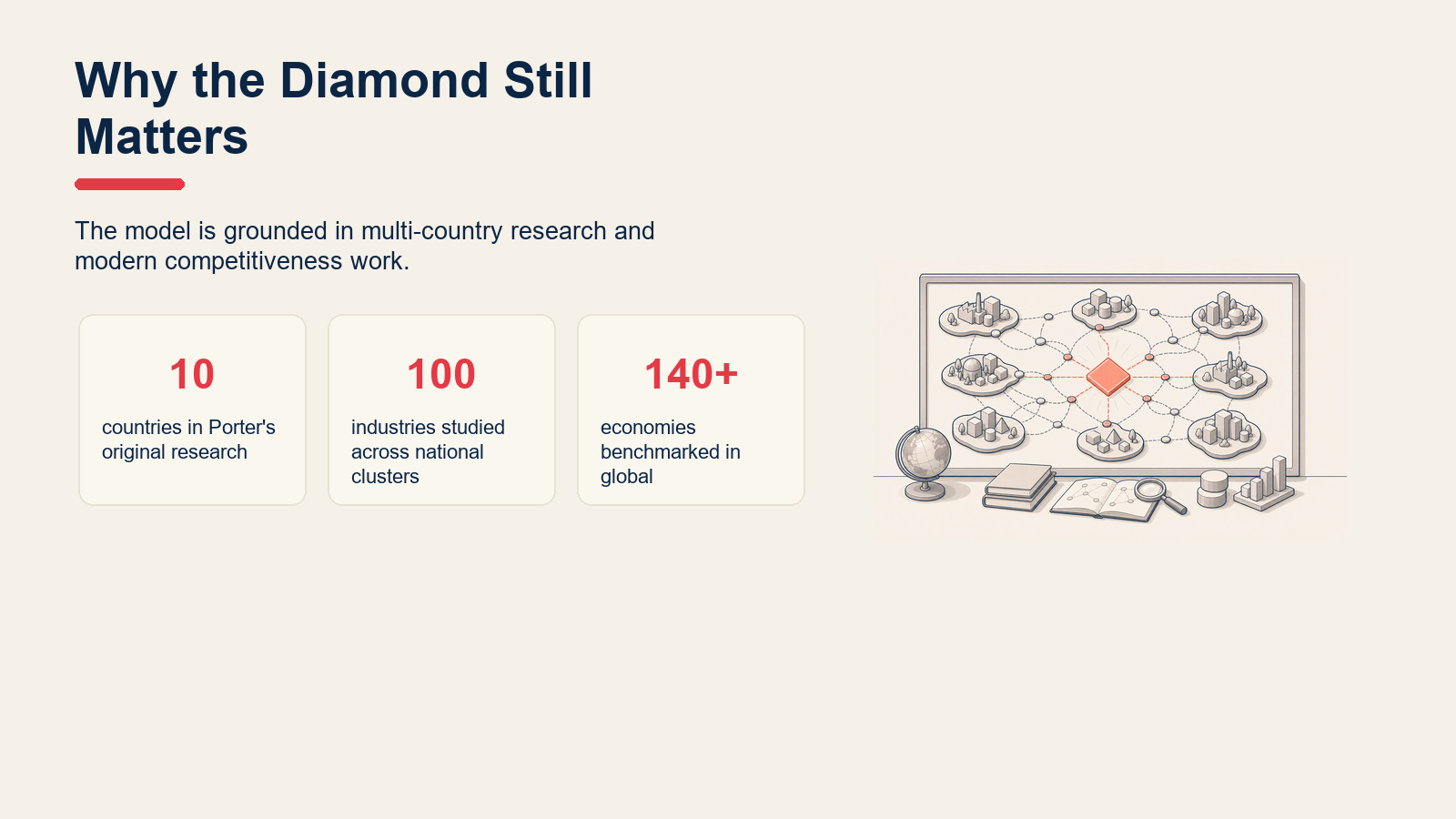
- El libro de Porter de 1990 The Competitive Advantage of Nations se basó en un estudio de cuatro años sobre 100 industrias en 10 países (Dinamarca, Alemania, Italia, Japón, Corea del Sur, Singapur, Suecia, Suiza, el Reino Unido y los Estados Unidos), convirtiéndolo en una de las obras más empíricamente fundamentadas en estrategia (Porter, 1990, Harvard Business School).
- El Informe de Competitividad Global del Foro Económico Mundial, que compara más de 140 economías anualmente, incorpora directamente la lógica de clúster y condiciones de factores de Porter en su metodología (WEF Global Competitiveness Report, 2023).
- Una investigación publicada en el Journal of International Business Studies encontró que la agrupación geográfica explica una proporción estadísticamente significativa del rendimiento exportador a nivel de empresa, incluso después de controlar el tamaño de la empresa y la industria (Alcacer & Chung, 2014, JIBS).
Cita destacada: "La ventaja competitiva se crea y sostiene a través de un proceso altamente localizado. Las diferencias en las estructuras económicas, los valores, las culturas, las instituciones y las historias nacionales contribuyen de manera profunda al éxito competitivo." (Michael Porter, The Competitive Advantage of Nations, 1990.)
Los Cuatro Determinantes del Diamante
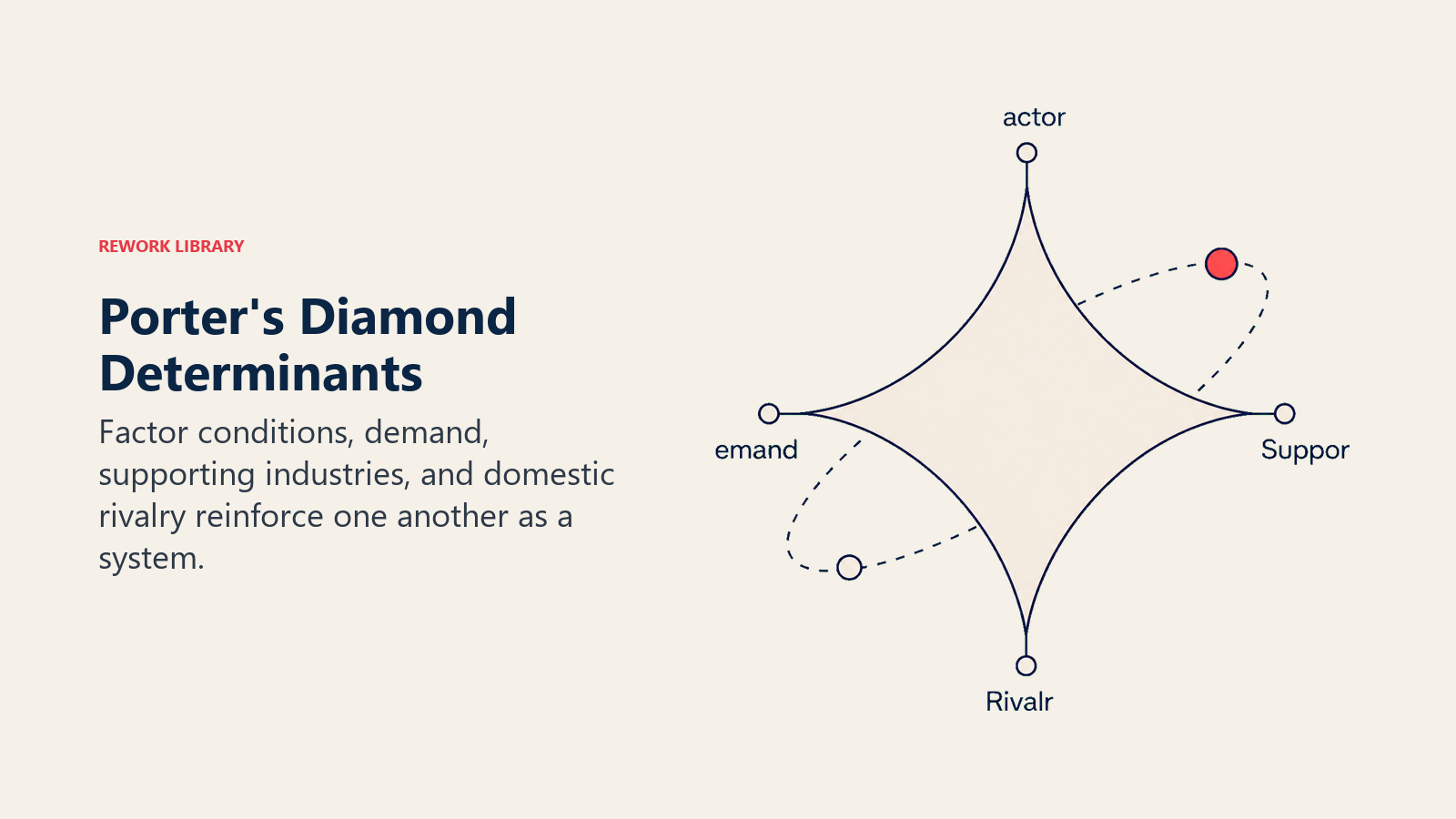
El Diamante de Porter tiene cuatro determinantes internos más dos factores externos: el Gobierno y la Casualidad.
| Determinante | Qué es | Por qué importa |
|---|---|---|
| Condiciones de los Factores | La dotación nacional de insumos productivos: mano de obra especializada, infraestructura, capital, recursos naturales y activos de conocimiento. Porter distingue los factores básicos (mano de obra no cualificada, materias primas) de los factores avanzados (ingenieros especializados, instituciones de investigación, infraestructura digital). | Los factores avanzados y especializados, que se crean y no simplemente se heredan, impulsan la ventaja sostenida. Los factores básicos son fácilmente copiables u obtenibles globalmente. |
| Condiciones de la Demanda | La naturaleza y sofisticación de la demanda del mercado interno para los productos o servicios de la industria. Los compradores domésticos exigentes y perspicaces presionan a las empresas para innovar y mejorar la calidad con más rapidez que sus competidores en otros lugares. | Un mercado interno amplio por sí solo no crea ventaja. Lo que importa es una base de clientes sofisticada y exigente que anticipa las tendencias globales. |
| Industrias Relacionadas y de Apoyo | La presencia de clústeres de proveedores e industrias relacionadas internacionalmente competitivos cerca de la empresa. Los proveedores de primer nivel entregan mejores insumos de manera más rápida y económica, y la proximidad genera transferencias de conocimiento. | Los clústeres crean ecosistemas. Una empresa con acceso a proveedores de componentes de vanguardia, laboratorios de investigación e industrias adyacentes innova más rápido que una empresa aislada. |
| Estrategia, Estructura y Rivalidad de las Empresas | Las condiciones que rigen cómo se crean, organizan y gestionan las empresas, incluida la naturaleza e intensidad de la rivalidad doméstica. La feroz competencia local obliga a las empresas a mejorar e innovar continuamente. | Los rivales domésticos que compiten duramente en el mercado interno se fortalecen mutuamente de forma involuntaria para la competencia global. |
| Gobierno (externo) | Los gobiernos actúan como conformadores, no como determinantes en sí mismos. Pueden fortalecer o debilitar cada uno de los cuatro determinantes mediante políticas, inversión en educación, aplicación de normas antimonopolio y gasto en infraestructura. | El papel del gobierno es catalizador y orientador, no intervencionista. Porter advirtió explícitamente contra el proteccionismo, que aísla a las empresas de la rivalidad que impulsa la mejora. |
| Casualidad (externo) | Eventos discontinuos fuera del control de cualquier empresa: guerras, avances en ciencia básica, cambios en la demanda extranjera, catástrofes naturales. La casualidad puede reconfigurar el diamante, creando ventanas para que nuevas naciones superen a las establecidas. | La casualidad crea oportunidades y disrupciones a partes iguales. Las empresas y los países que ya han construido diamantes sólidos están mejor posicionados para aprovechar los eventos fortuitos en lugar de ser destruidos por ellos. |
Los cuatro determinantes internos forman un sistema que se refuerza a sí mismo. La debilidad en cualquier nodo limita a los demás. Una nación puede tener abundantes recursos naturales y escasa rivalidad doméstica, y aun así fracasar en construir campeones globales.
Modelo del Diamante de Porter vs Cinco Fuerzas de Porter
Estos dos marcos se confunden con frecuencia porque ambos llevan el nombre de Porter y ambos implican análisis competitivo. Sin embargo, operan en niveles completamente diferentes.
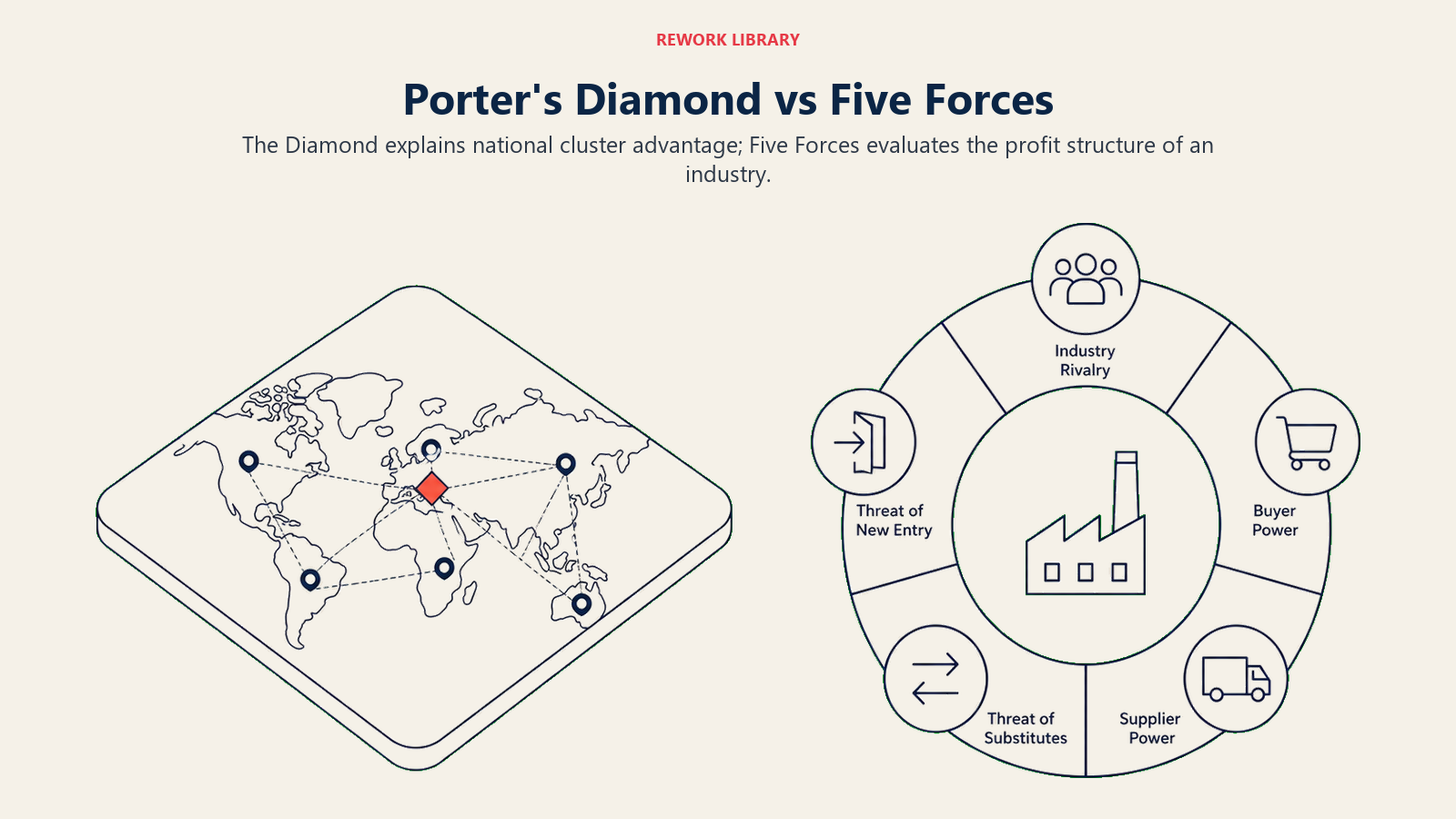
| Dimensión | Modelo del Diamante de Porter | Cinco Fuerzas de Porter |
|---|---|---|
| Unidad de análisis | Nación o clúster regional | Industria |
| Pregunta principal | ¿Por qué las empresas de este país dominan esta industria globalmente? | ¿Qué tan rentable es esta industria estructuralmente? |
| Factores clave | Condiciones de factores, demanda, industrias de apoyo, rivalidad, gobierno, casualidad | Poder de los proveedores, poder de los compradores, nuevos entrantes, sustitutos, rivalidad competitiva |
| Horizonte temporal | Décadas (condiciones nacionales estructurales) | Dinámicas competitivas a medio plazo |
| Uso estratégico | Decisiones de localización, política de clústeres, entrada en mercados, evaluación de IED | Selección de industria, posicionamiento, estrategia competitiva |
| Resultado | Mapa de fortalezas y brechas competitivas nacionales | Evaluación del potencial de rentabilidad de la industria |
Use el Modelo del Diamante cuando se pregunte "¿dónde deberíamos ubicar I+D?" o "¿por qué las empresas domésticas no pueden entrar en la automoción japonesa?" Use las Cinco Fuerzas cuando decida si entrar o salir de una industria. Las dos herramientas se complementan más que compiten.
Beneficios y Usos del Modelo
Decisiones de localización y expansión. Las empresas multinacionales utilizan el Modelo del Diamante para decidir dónde ubicar centros de I+D, plantas de fabricación o sedes regionales. Establecerse en un clúster sólido brinda acceso a talento especializado, proveedores y transferencias de conocimiento que no pueden replicarse en aislamiento.
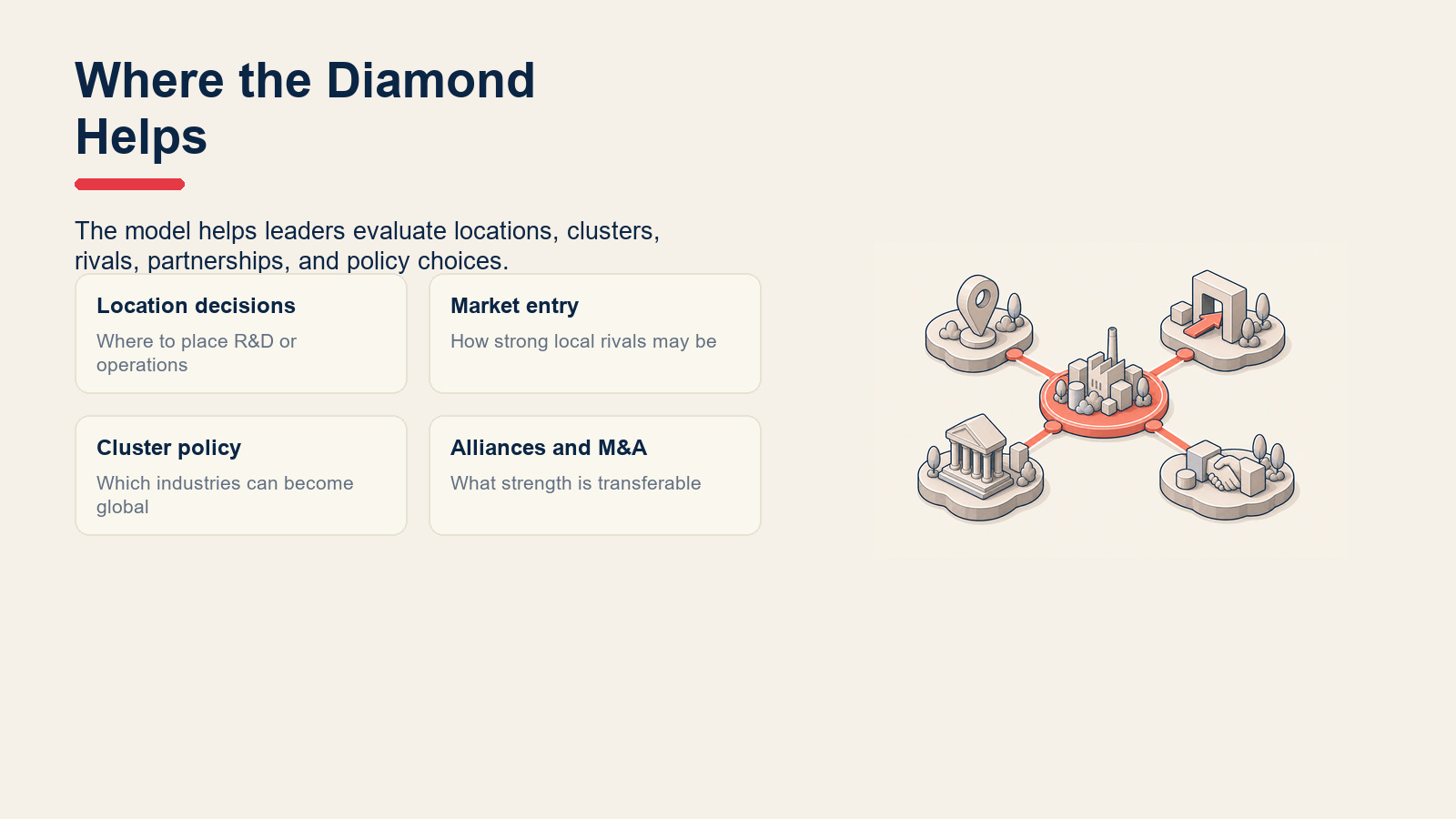
Análisis de entrada en nuevos mercados. Antes de entrar en un mercado extranjero, el marco ayuda a evaluar si los rivales locales serán contrincantes formidables. Los competidores automotrices alemanes se forjan gracias a compradores domésticos exigentes y ecosistemas de proveedores profundos. Es necesario saber eso antes de entrar en Alemania.
Política de clústeres para gobiernos. Los gobiernos usan el análisis del Diamante para identificar qué industrias pueden desarrollar de forma realista como líderes globales, en lugar de intentar competir en todo. El impulso de Singapur hacia la fabricación biomédica y la inversión de Israel en ciberseguridad son ejemplos de política industrial informada por el Diamante.
Comprensión de los orígenes de la ventaja competitiva. Para los ejecutivos de una empresa existente, el Modelo del Diamante revela cuánto de su posición competitiva es genuinamente propia frente a cuánto depende del clúster local. Una empresa que parece sólida en un análisis de la cadena de valor puede estar apoyándose en gran medida en recursos del clúster que perdería si se reubicara.
Marco para adquisiciones y alianzas. Cuando las empresas adquieren compañías extranjeras o forman alianzas, el Modelo del Diamante ayuda a evaluar si la fortaleza del objetivo proviene de capacidades transferibles o de un contexto de clúster irremplazable.
Limitaciones y Críticas
Sesgo hacia economías desarrolladas. Porter construyó el modelo principalmente con datos de economías avanzadas. Críticos como el académico Danny Dunning (quien extendió el modelo con su "paradigma ecléctico") argumentan que el marco se adapta mejor a industrias orientadas a la exportación de mercados desarrollados que a economías emergentes o industrias basadas en materias primas.
Las multinacionales y las cadenas de suministro globalizadas difuminan el diamante. Cuando los insumos de factores, los clientes, los rivales y los proveedores de una empresa están distribuidos por varios continentes, la noción de un único "diamante nacional" se debilita. Una empresa semiconductor coreana con I+D en California, fábricas en Taiwán y clientes en Europa no encaja perfectamente en un único diamante nacional.
El papel del gobierno está poco especificado. Porter trata al gobierno como un conformador externo en lugar de un determinante. En la práctica, la política industrial dirigida por el Estado (el sistema de chaebol de Corea del Sur, las empresas estatales chinas) puede crear campeones globales de formas que el modelo no contempla plenamente.
La definición de clúster es difusa. El modelo no ofrece un método preciso para delimitar los clústeres. Silicon Valley es claramente un clúster. Pero, ¿dónde termina y cómo se replica? El marco describe los clústeres exitosos mejor de lo que prescribe cómo construir otros nuevos.
Instantánea estática. El Diamante es útil para explicar una posición competitiva existente. Es menos útil para predecir con qué rapidez cambiarán los determinantes cuando la tecnología o la geopolítica disrumpan un clúster.
Cómo Aplicar el Modelo del Diamante de Porter
Paso 1: Defina el alcance
Elija la nación (o región) y la industria que va a analizar. Sea específico. "La industria manufacturera alemana" es demasiado amplia. "La industria automovilística premium alemana" es útil.
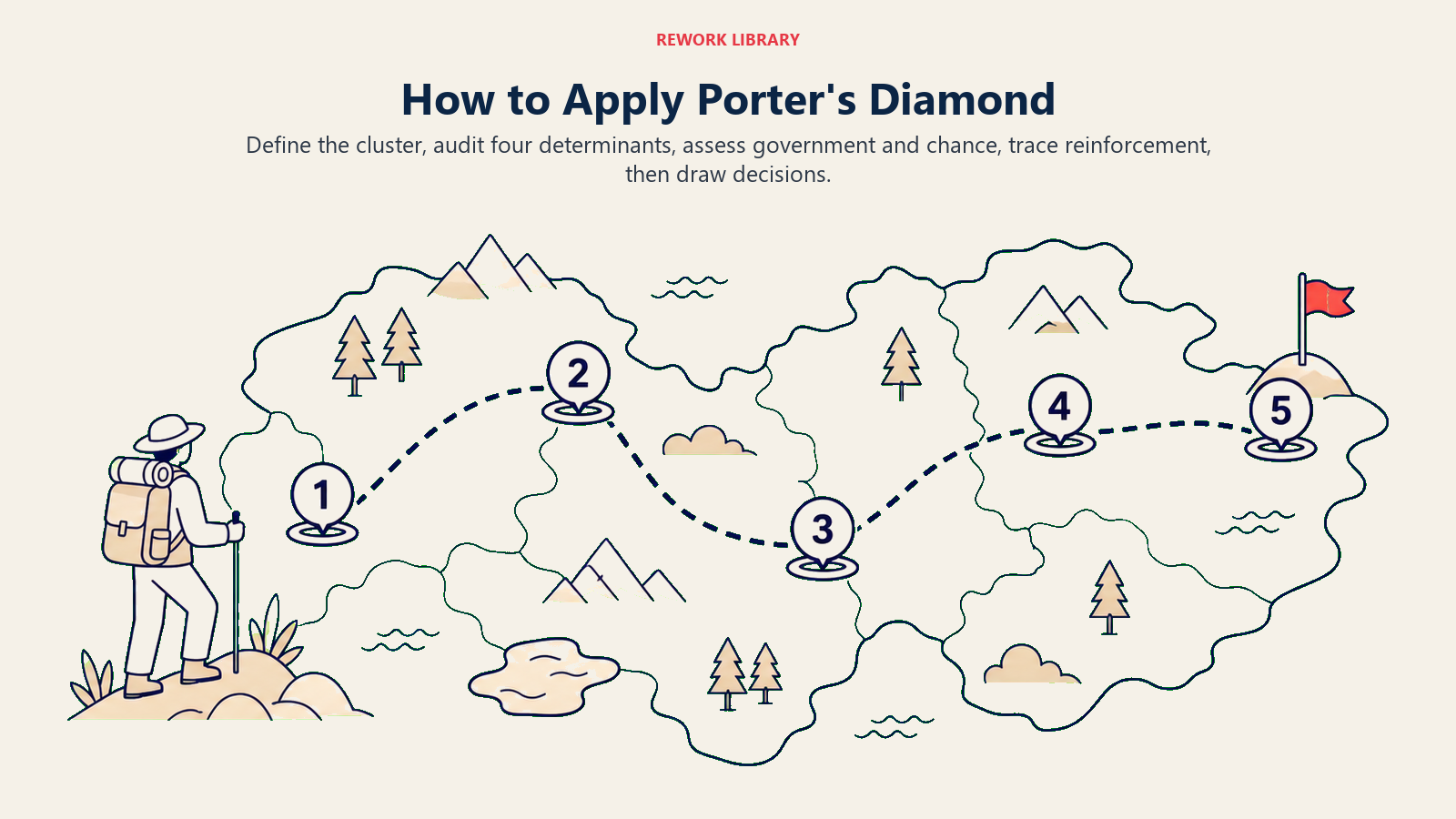
Paso 2: Audite los cuatro determinantes
Trabaje cada nodo interior de forma sistemática. Para las Condiciones de los Factores, haga un inventario de los insumos clave (ingenieros especializados, laboratorios de investigación, calidad de la infraestructura, acceso al capital). Para las Condiciones de la Demanda, evalúe cuán sofisticada y amplia es la base de clientes domésticos. Para las Industrias Relacionadas y de Apoyo, trace el ecosistema de proveedores e industrias adyacentes. Para la Estrategia, Estructura y Rivalidad de las Empresas, cuente los competidores domésticos de clase mundial y evalúe la intensidad competitiva.
Herramientas que agudizarán esta auditoría: el análisis PESTEL para los factores macroeconómicos; el análisis de posicionamiento competitivo para el nodo de rivalidad; y el mapeo de competencias centrales para distinguir lo que posee la empresa frente a lo que toma prestado del clúster.
Paso 3: Evalúe los factores de gobierno y casualidad
Documente las políticas relevantes que fortalecen o debilitan los cuatro determinantes: subsidios a I+D, política educativa, normas antimonopolio, acuerdos comerciales. Anote los eventos fortuitos importantes (cambios tecnológicos, disrupción geopolítica) que recientemente hayan abierto o cerrado ventanas de oportunidad.
Paso 4: Identifique las dinámicas del sistema
El valor del diamante reside en las interacciones, no solo en los nodos individuales. Pregúntese: ¿Qué nodos se refuerzan mutuamente con mayor fuerza? ¿Qué nodos son débiles y están limitando el sistema en su conjunto? Por ejemplo, unas condiciones de demanda sólidas con industrias de apoyo débiles podrían explicar por qué las empresas locales tienen dificultades para escalar aunque los compradores domésticos quieran sus productos.
Paso 5: Extraiga conclusiones estratégicas
Traduzca el análisis en decisiones. Decisiones de localización: "¿Dónde deberíamos establecer nuestro próximo centro de I+D para acceder al diamante más sólido?" Decisiones de entrada en mercados: "¿Los rivales locales se apoyan en ventajas de clúster que no podemos igualar?" Decisiones de política: "¿En qué determinantes deberíamos invertir para construir la fortaleza del clúster en diez años?" Compare con el mapeo de grupos estratégicos para ver dónde se agrupan los competidores dentro de la industria.
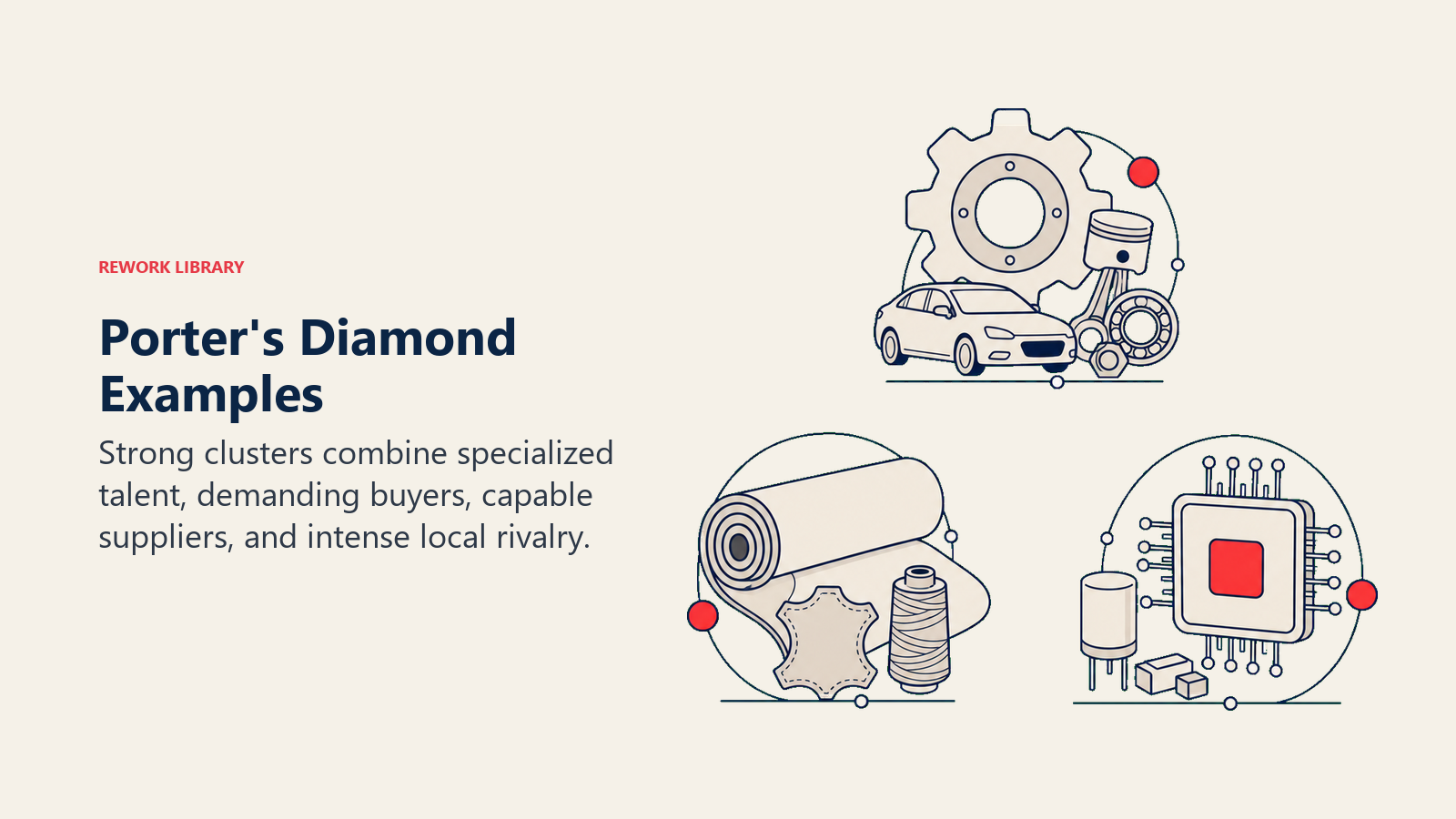
Ejemplos del Modelo del Diamante de Porter
Esta vista separa las partes principales de los ejemplos del Modelo del Diamante de Porter para que los detalles a continuación sean más fáciles de comparar.
| Nación / Clúster | Industria | Fortalezas del Diamante |
|---|---|---|
| Alemania: Automoción Premium | Automóviles (BMW, Mercedes-Benz, Volkswagen, Porsche) | Excepcional fuerza laboral de ingeniería (condiciones de factores); compradores domésticos técnicamente sofisticados que exigen rendimiento y calidad (condiciones de demanda); ecosistema de proveedores de clase mundial de fabricantes de componentes en Bavaria y Baden-Württemberg (industrias de apoyo); feroz rivalidad doméstica entre marcas premium (rivalidad de empresas). |
| Italia: Calzado y Moda de Lujo | Moda (Prada, Gucci, Ferragamo, Loro Piana) | Profunda tradición artesanal y habilidades de artesano, especialmente en las regiones de Emilia-Romaña y Toscana (condiciones de factores); consumidores domésticos con altos estándares estéticos y sensibilidad hacia las marcas (condiciones de demanda); densos clústeres de curtidores de cuero, molinos textiles y patronistas a pocas horas de las sedes de las marcas (industrias de apoyo). |
| Silicon Valley: Tecnología | Software empresarial, semiconductores, internet de consumo | Universidades de investigación de clase mundial (Stanford, UC Berkeley) que producen graduados en ingeniería e informática (condiciones de factores); compradores empresariales y de consumo pioneros dispuestos a pagar por tecnología no probada (condiciones de demanda); un ecosistema sin igual de capital de riesgo, bufetes de abogados y proveedores de componentes especializados en tecnología (industrias de apoyo); intensa rivalidad de startups que recicla continuamente talento e ideas (rivalidad de empresas). |
Mejores Prácticas
Haga
- Utilice el Diamante a nivel de clúster, no solo a nivel nacional. Los clústeres regionales suelen ofrecer señales más fuertes que los promedios nacionales amplios.
- Combínelo con otros marcos: el análisis PESTEL para el macroentorno, el análisis de la cadena de valor para las operaciones internas y el análisis de economías de escala cuando las condiciones de factores incluyen ventajas de escala.
- Actualice el análisis periódicamente. Los clústeres evolucionan en ciclos de 5 a 10 años, y el diamante cambia cuando los gobiernos modifican políticas o la tecnología disrumpe una industria de apoyo.
- Úselo para cuestionar sus suposiciones sobre su propia ventaja competitiva. Si su fortaleza depende de un clúster que no puede controlar plenamente, elabore planes para el escenario en que ese clúster se debilite.
No Haga
- Confundir el Diamante con las Cinco Fuerzas de Porter. Responden preguntas diferentes en diferentes niveles de análisis.
- Asumir que un diamante sólido es permanente. El clúster automotriz de Detroit y el clúster textil británico dominaron en su momento y luego declinaron.
- Ignorar las aplicaciones en mercados emergentes. El modelo necesita ajustes para las economías dirigidas por el Estado, pero la lógica básica de clústeres sigue siendo válida en lugares como Shenzhen (electrónica) o Hyderabad (farmacéutica y software).
- Usar el Diamante como argumento político a favor del proteccionismo. El propio Porter argumentó que las industrias domésticas protegidas pierden la presión competitiva que las hace fuertes a nivel global.
Preguntas Frecuentes
¿Cuáles son los cuatro determinantes del Modelo del Diamante de Porter?
Los cuatro determinantes internos son: Condiciones de los Factores (insumos especializados como mano de obra cualificada, infraestructura de investigación y capital); Condiciones de la Demanda (la sofisticación y el tamaño de la demanda del mercado interno); Industrias Relacionadas y de Apoyo (la competitividad de los clústeres locales de proveedores e industrias adyacentes); y Estrategia, Estructura y Rivalidad de las Empresas (la intensidad de la competencia doméstica y las prácticas de gestión que produce). El Gobierno y la Casualidad son dos factores externos que moldean pero no determinan el diamante.
¿En qué se diferencia el Diamante de Porter de las Cinco Fuerzas de Porter?
Las Cinco Fuerzas analizan la rentabilidad estructural de una industria desde la perspectiva de una empresa que compite dentro de ella. El Modelo del Diamante analiza por qué las empresas de una nación o región específica tienen éxito a nivel global en una industria particular. Las Cinco Fuerzas operan a nivel de empresa y están orientadas a la industria; el Diamante opera a nivel nacional/clúster y está orientado internacionalmente. Usaría las Cinco Fuerzas para decidir si entrar en una industria y el Diamante para decidir dónde ubicarse o cómo evaluar a la competencia extranjera.
¿Puede aplicarse el Modelo del Diamante de Porter a una empresa y no solo a una nación?
El modelo fue diseñado para el análisis a nivel nacional y de clúster. Dicho esto, las empresas lo usan indirectamente preguntándose: "¿Nuestro clúster local nos da ventajas de las que carecen los rivales extranjeros?" y "Cuando nos expandimos internacionalmente, ¿el diamante de qué país complementa mejor nuestras propias capacidades?" También se usa de forma inversa para evaluar si la fortaleza de un competidor extranjero depende del clúster y es, por tanto, difícil de transferir fuera de su país de origen.
¿Qué es un clúster en el marco del Diamante de Porter?
Un clúster es una concentración geográfica de empresas interconectadas, proveedores especializados, prestadores de servicios e instituciones asociadas en un campo particular. Ejemplos incluyen Silicon Valley (tecnología), Hollywood (entretenimiento), la City de Londres (servicios financieros) y la región de Emilia-Romaña en Italia (maquinaria de envasado, cerámica, textiles). Los clústeres se forman porque la proximidad facilita las transferencias de conocimiento, los mercados laborales especializados y la infraestructura compartida que beneficia a todos los participantes.
¿Cuáles son las principales críticas al Modelo del Diamante de Porter?
Las principales críticas son: (1) se adapta mejor a las economías avanzadas orientadas a la exportación que a los mercados emergentes o las industrias de materias primas; (2) las cadenas de suministro globalizadas y las empresas multinacionales implican que un único "diamante nacional" a menudo no captura dónde se origina realmente la ventaja competitiva; (3) el papel del gobierno está poco especificado, lo que dificulta dar cuenta de la política industrial dirigida por el Estado; y (4) el modelo describe los clústeres exitosos mejor de lo que prescribe cómo construir otros nuevos.
Lecturas Relacionadas
- Pirámide de Crecimiento de McKinsey: un marco para elegir dónde crecer una vez que se comprende la posición competitiva.
- Alianzas estratégicas: cómo las empresas toman prestadas las capacidades y el acceso a clústeres que no pueden construir por sí solas.
- Las Cinco Fuerzas de Porter: el complemento a nivel de empresa de la perspectiva nacional del Diamante.
Comprender el Modelo del Diamante de Porter es la base para cualquier análisis serio sobre por qué la ubicación geográfica sigue siendo relevante en una economía globalizada. Las naciones y los clústeres que invierten en sus propias condiciones del diamante, especialmente las condiciones avanzadas de factores y los compradores domésticos exigentes que no pueden importarse fácilmente, crean entornos competitivos que forjan empresas de clase mundial. Para los ejecutivos que piensan en dónde construir a continuación, qué competidores extranjeros tomar en serio o cómo fortalecer las condiciones a su alrededor, el Diamante sigue siendo uno de los marcos más sólidos en la gestión estratégica.

Co-Founder & COO
On this page
- ¿Qué es el Modelo del Diamante de Porter?
- Datos Clave
- Los Cuatro Determinantes del Diamante
- Modelo del Diamante de Porter vs Cinco Fuerzas de Porter
- Beneficios y Usos del Modelo
- Limitaciones y Críticas
- Cómo Aplicar el Modelo del Diamante de Porter
- Paso 1: Defina el alcance
- Paso 2: Audite los cuatro determinantes
- Paso 3: Evalúe los factores de gobierno y casualidad
- Paso 4: Identifique las dinámicas del sistema
- Paso 5: Extraiga conclusiones estratégicas
- Ejemplos del Modelo del Diamante de Porter
- Mejores Prácticas
- Lecturas Relacionadas