Ventaja Competitiva: Tipos y Cómo Construirla
Turn this article into takeaways for your work.


Each assistant summarizes the article only for you and suggests best practices for your work.
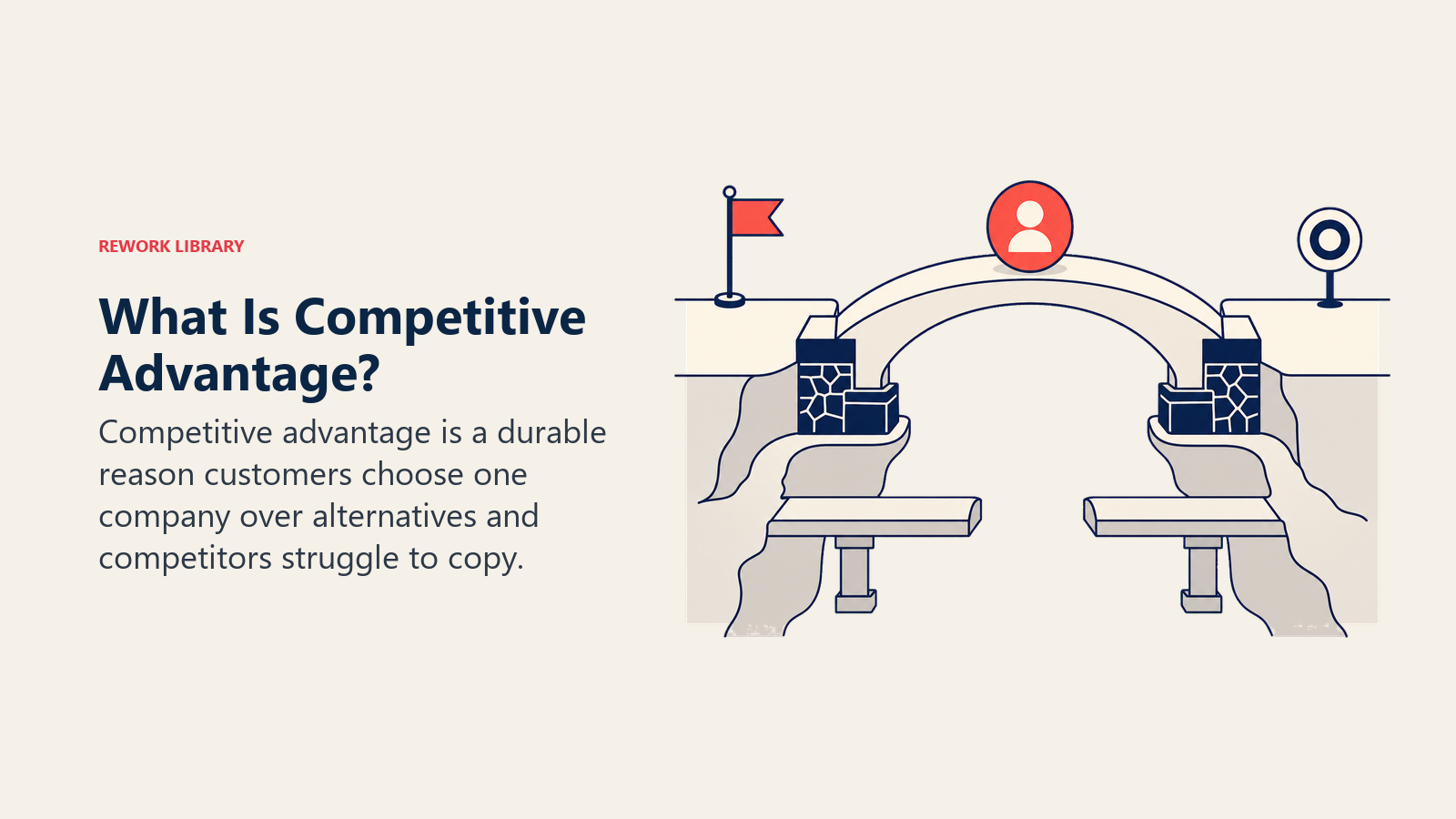
La ventaja competitiva es la razón por la que una empresa gana un mercado mientras un competidor prácticamente idéntico lucha por sobrevivir. Comprenderla no es un ejercicio académico. Es la base de cualquier estrategia duradera.
Michael Porter definió la ventaja competitiva en su libro de 1985 Competitive Advantage: Creating and Sustaining Superior Performance como la capacidad de crear más valor económico que los competidores, ya sea entregando el mismo beneficio a un costo inferior o entregando un beneficio claramente superior a un precio que los clientes estén dispuestos a pagar. Esa definición de dos oraciones sigue impulsando más decisiones estratégicas que cualquier marco publicado desde entonces.
Pero conocer la definición no es suficiente. Las preguntas más difíciles son: ¿qué tipo de ventaja debe perseguir su empresa, de dónde proviene realmente y cómo evitar que los rivales la copien? Esta guía aborda las tres.
¿Qué es la ventaja competitiva?
Datos clave: Ventaja Competitiva
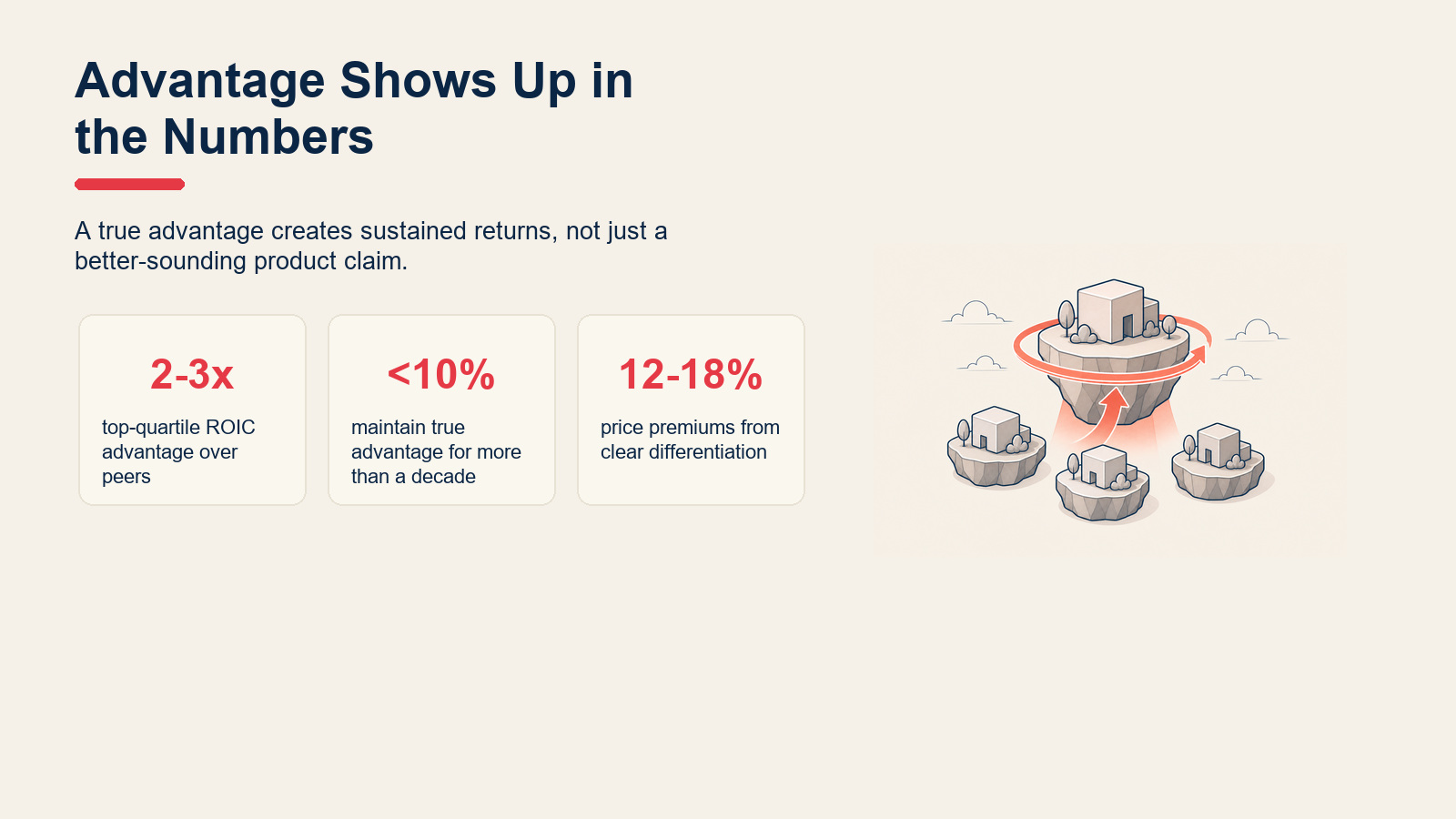
- Los factores estructurales del sector explican aproximadamente el 40% de la varianza en la rentabilidad empresarial, pero las empresas del cuartil superior superan a sus pares del sector entre 2 y 3 veces en ROIC, lo que apunta a una ventaja a nivel de empresa, no solo a la suerte del sector. (McKinsey Global Institute, 2023)
- Menos del 10% de las empresas mantuvieron una verdadera ventaja competitiva durante más de una década en un estudio de 30 años sobre 10.000 empresas. (HBS, "The Durability of Competitive Advantage", 2020)
- Las empresas con propuestas de valor claramente diferenciadas crecen sus ingresos entre un 4% y un 8% más rápido que la media de su categoría y obtienen primas de precio del 12 al 18%. (Bain & Company, 2022)
Una ventaja competitiva existe cuando una empresa obtiene de manera consistente retornos superiores a los de sus pares del sector a lo largo del tiempo. No "nuestro producto es mejor" o "nuestro equipo trabaja más duro". Esos son insumos. La ventaja competitiva se refleja en los números: márgenes más altos, mejor retención, mayor crecimiento a un menor costo de adquisición de clientes.
Porter argumentó que la ventaja siempre está arraigada en una de dos fuentes: o se hace lo que los competidores hacen a menor costo, o se hace algo lo suficientemente diferente como para que los clientes lo valoren y estén dispuestos a pagar más. Cualquier otra fuente de ventaja no es más que un mecanismo para lograr una de esas dos posiciones.
La palabra clave es sostenible. Una ventaja temporal derivada de un lanzamiento de producto no es una ventaja competitiva. Ventaja significa que los rivales no pueden copiar o neutralizar fácilmente la posición, aunque lo intenten.
Tipos de ventaja competitiva
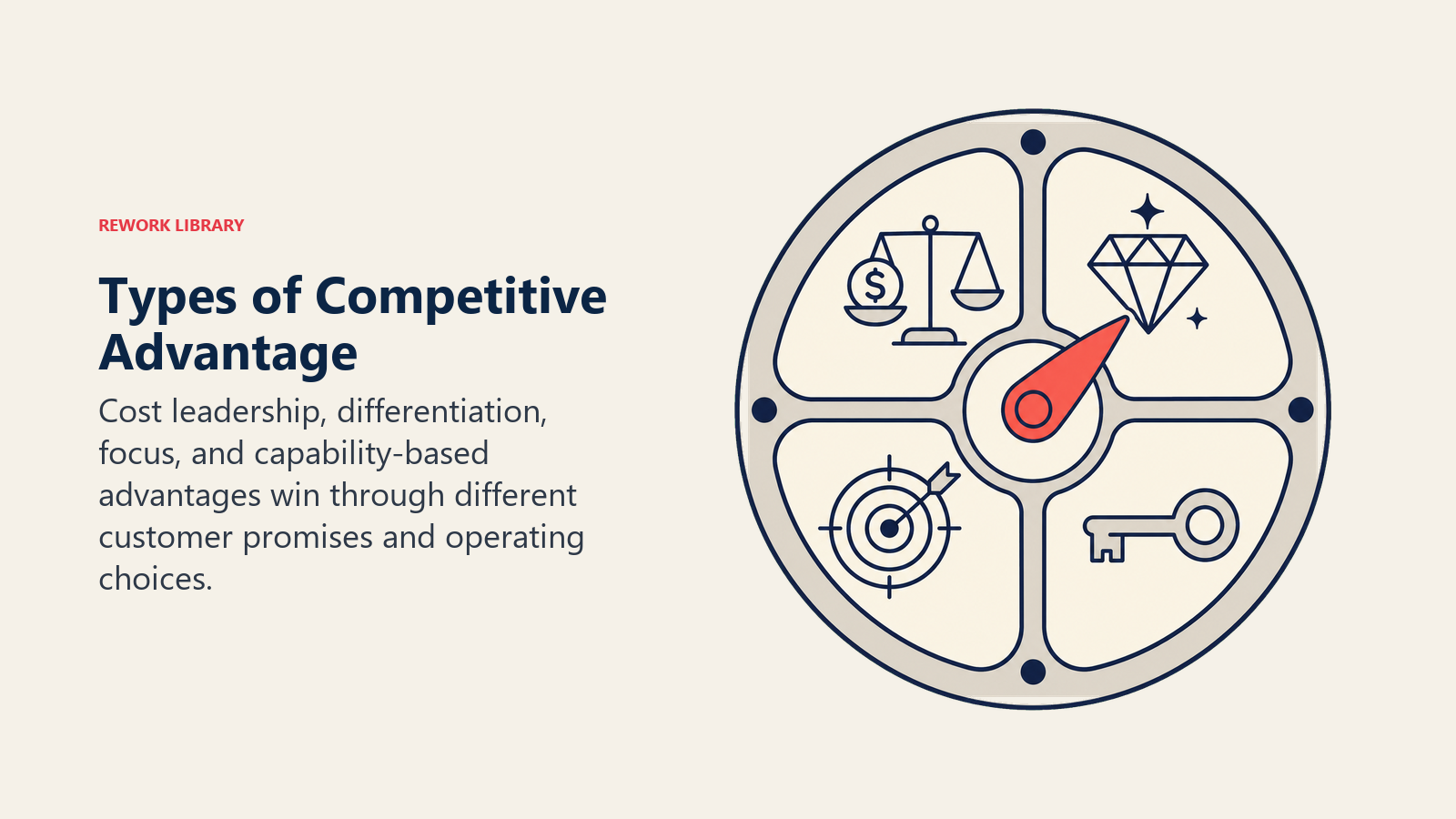
Existen tres tipos primarios, organizados por primera vez por Porter en Competitive Strategy (1980) y refinados con el concepto de enfoque en Competitive Advantage (1985).
| Tipo | Lógica central | Ejemplo | Impulsor del margen |
|---|---|---|---|
| Ventaja en costos | Producir o entregar a menor costo que los rivales manteniendo una calidad aceptable | La red de distribución de Amazon, la cadena de suministro de Walmart | Volumen, eficiencia, escala |
| Ventaja por diferenciación | Ofrecer algo que los rivales no pueden replicar fácilmente y que los clientes valoran lo suficiente como para pagar una prima | El ecosistema de diseño de Apple, la plataforma CRM de Salesforce | Singularidad, costos de cambio |
| Ventaja por enfoque (nicho) | Servir a un segmento estrecho tan bien que los competidores generalistas no pueden justificar el esfuerzo de igualarle | Rolls-Royce (ultra-lujo), Veeva Systems (CRM farmacéutico) | Ajuste profundo, menor intensidad competitiva |
Porter también distinguió dos formas subyacentes de ventaja:
La ventaja comparativa proviene de circunstancias externas: un país, región o empresa tiene acceso a recursos, mano de obra o insumos que otros no tienen. Un caficultor brasileño tiene ventaja comparativa en arábica no por estrategia sino por geografía y clima. Es real, pero no se construye, por lo que también puede desaparecer.
La ventaja diferencial es lo que los estrategas suelen entender cuando hablan de ventaja competitiva: una posición a nivel de empresa creada mediante elecciones deliberadas sobre qué hacer, qué no hacer y cómo configurar las actividades para que se refuercen mutuamente. Este es el tipo al que Porter dedicó su carrera.
Las posiciones más poderosas combinan tipos. IKEA tiene ventaja en costos gracias a la fabricación de muebles planos y el autoservicio, y diferenciación gracias a la estética de diseño y la experiencia en tienda. Esa combinación es lo que lo hace tan difícil de replicar.
Fuentes de ventaja competitiva sostenible
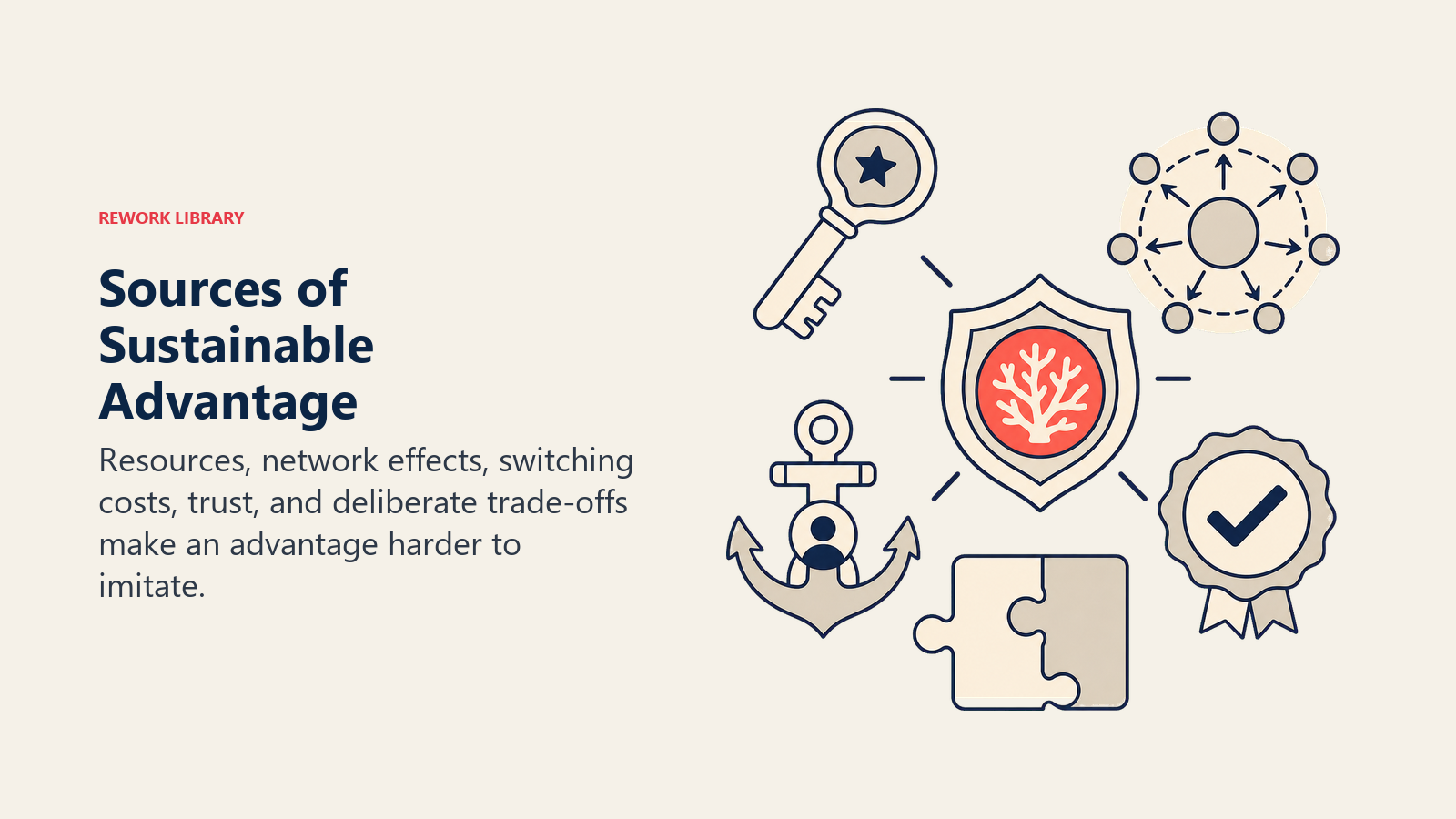
La ventaja no aparece por sí sola. Se construye a partir de fuentes específicas, y cuantas más fuentes se refuercen mutuamente, más difícil es atacar la posición.
Estrategias Genéricas de Porter
El marco de Porter derivado del análisis de las Cinco Fuerzas se extiende de manera natural hacia la estrategia a nivel de empresa. El liderazgo en costos, la diferenciación y el enfoque requieren configuraciones de actividades diferentes. Intentar perseguir las tres a la vez casi siempre produce mediocridad. Porter llamó a esto estar "atrapado en el medio".
La disciplina radica en la claridad: elegir un carril y configurar toda la cadena de valor para reforzarlo. Un líder en costos que añade características premium generalmente eleva los costos sin obtener una prima de precio. Un diferenciador que comienza a competir en precio erosiona la singularidad que justificaba la prima.
Recursos y capacidades VRIO
El marco VRIO le ofrece una forma estructurada de evaluar si un recurso o capacidad puede generar ventaja sostenida. El test de Jay Barney: ¿es Valioso, Raro, costoso de Imitar y está la Organización preparada para explotarlo?
La mayoría de los recursos fallan al menos una prueba. Las patentes vencen. La tecnología se convierte en commodity. Las personas se van. VRIO apunta a recursos estructuralmente difíciles de copiar porque emergen del aprendizaje acumulado, la cultura o el conocimiento de procesos integrado, en lugar de cualquier activo único.
VRIO es el complemento de la visión de posicionamiento de Porter. Porter dice: elija la posición adecuada en el sector. Barney dice: construya las capacidades internas para mantenerla. Las empresas que hacen ambas cosas superan de manera consistente a las que solo hacen una.
Efectos de red
Los efectos de red crean una ventaja que se acumula: cada usuario adicional hace que el producto sea más valioso para todos los usuarios existentes. LinkedIn se vuelve más valioso a medida que más profesionales se unen. Visa es más aceptada a medida que más comerciantes la aceptan.
Los efectos de red son especialmente poderosos de manera defensiva. Un competidor no solo necesita un mejor producto. Necesita convencer a una masa crítica de usuarios de moverse simultáneamente, un problema de coordinación que la calidad del producto por sí sola no puede resolver.
Costos de cambio
Los costos de cambio son la fricción, financiera y conductual, que hace que los clientes sean reacios a cambiar incluso cuando preferirían a un competidor en sus propios méritos. Aparecen como tiempo de implementación, migración de datos, reentrenamiento y dependencias de integración.
El software empresarial es el ejemplo clásico. Salesforce, SAP y Workday quedan embebidos en las operaciones y en la memoria institucional. Esa integración es la ventaja, no las características del software.
Los costos de cambio se profundizan cuando un producto se integra en las competencias centrales de un cliente: cuanto más central es la herramienta para cómo opera el cliente, más difícil es extraerla.
Marca y confianza
La ventaja de marca funciona mediante dos mecanismos: precio premium (los clientes pagan más para reducir la incertidumbre) y menor costo de adquisición de clientes con el tiempo (el reconocimiento de marca acorta la fase de consideración). Ambos mejoran el margen sin cambios operativos continuos.
Pero la marca es frágil. Un único fracaso de alto perfil puede erosionar décadas de confianza. La ventaja duradera no es la marca. Es la coherencia operativa que mantiene la promesa de la marca creíble.
Cómo construir una ventaja competitiva
Construir ventaja es una secuencia de decisiones estratégicas y operativas, no una iniciativa única. A continuación se describe cómo abordarlo de manera sistemática.
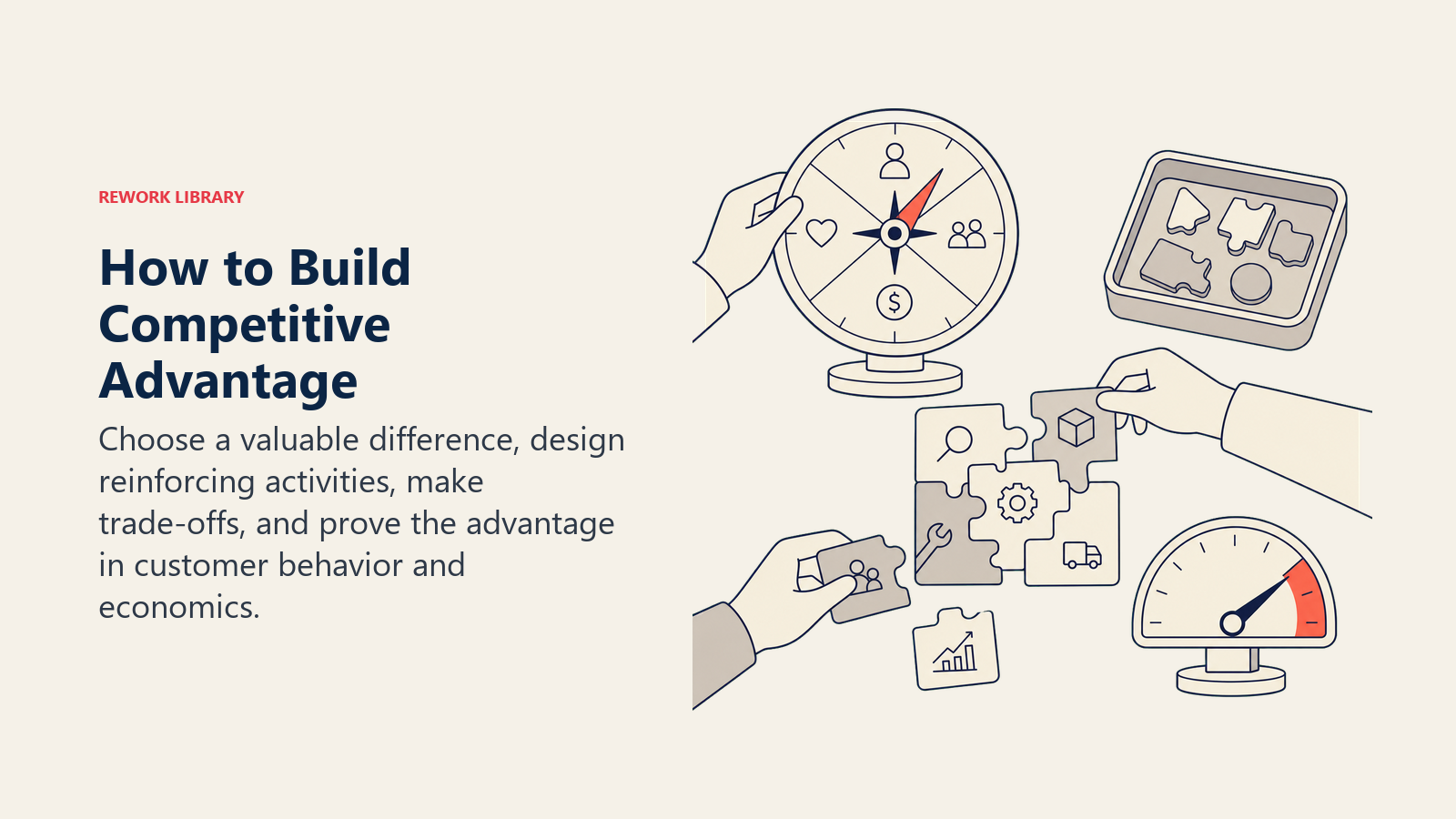
Paso 1: Diagnosticar el entorno externo. Use las Cinco Fuerzas de Porter para comprender dónde se sitúan los grupos de beneficio y qué posiciones vale la pena mantener. Use el análisis PESTEL para detectar tendencias macroeconómicas antes de que se conviertan en amenazas.
Paso 2: Auditar los recursos y capacidades internos. Aplique el marco VRIO a cada recurso o capacidad significativa. ¿Cuáles superan las cuatro pruebas? Esta auditoría suele revelar ventajas genuinas en las que la empresa no está invirtiendo activamente ni comunicando.
Paso 3: Elegir una posición estratégica. Decida entre liderazgo en costos, diferenciación y enfoque, con la especificidad suficiente para que tenga sentido operativamente. La Blue Ocean Strategy merece leerse aquí para los equipos que encuentran todas las posiciones actuales de un sector igualmente poco atractivas. A veces el mejor movimiento es redefinir el espacio competitivo en lugar de luchar con más intensidad en uno existente.
Paso 4: Mapear la cadena de valor. El análisis de cadena de valor descompone el negocio en actividades primarias y de apoyo y pregunta dónde contribuye cada una a la posición elegida. Los líderes en costos reducen el costo en cada actividad primaria. Los diferenciadores invierten de manera desproporcionada en las actividades que crean singularidad. Las actividades que no hacen ni una ni otra se externalizan o eliminan.
Paso 5: Identificar el segmento objetivo con precisión. La Matriz de Ansoff ayuda a clarificar dónde se compite. La BCG Matrix ayuda a asignar recursos entre una cartera. Pero ninguna reemplaza la disciplina de saber exactamente a qué clientes se sirve y por qué se les sirve mejor que nadie.
Paso 6: Ejecutar un análisis SWOT centrado en el ajuste. La pregunta no es "¿cuáles son nuestras fortalezas?" en abstracto. Es "¿cuáles son nuestras fortalezas en relación con la posición que hemos elegido?" Una fortaleza que no refuerza la posición competitiva es una distracción. Una debilidad que expone la posición es una prioridad a abordar.
Paso 7: Invertir en el refuerzo de actividades. Las ventajas duraderas provienen de sistemas de actividades mutuamente reforzantes, no de capacidades aisladas. Southwest Airlines no es de bajo costo porque vuela punto a punto. Es de bajo costo porque las rutas punto a punto, la rápida rotación en tierra, un único tipo de aeronave, sin asignación de asientos y una cultura laboral específica se refuerzan mutuamente. Copiar una pieza no da acceso al sistema.
Ejemplos de ventaja competitiva
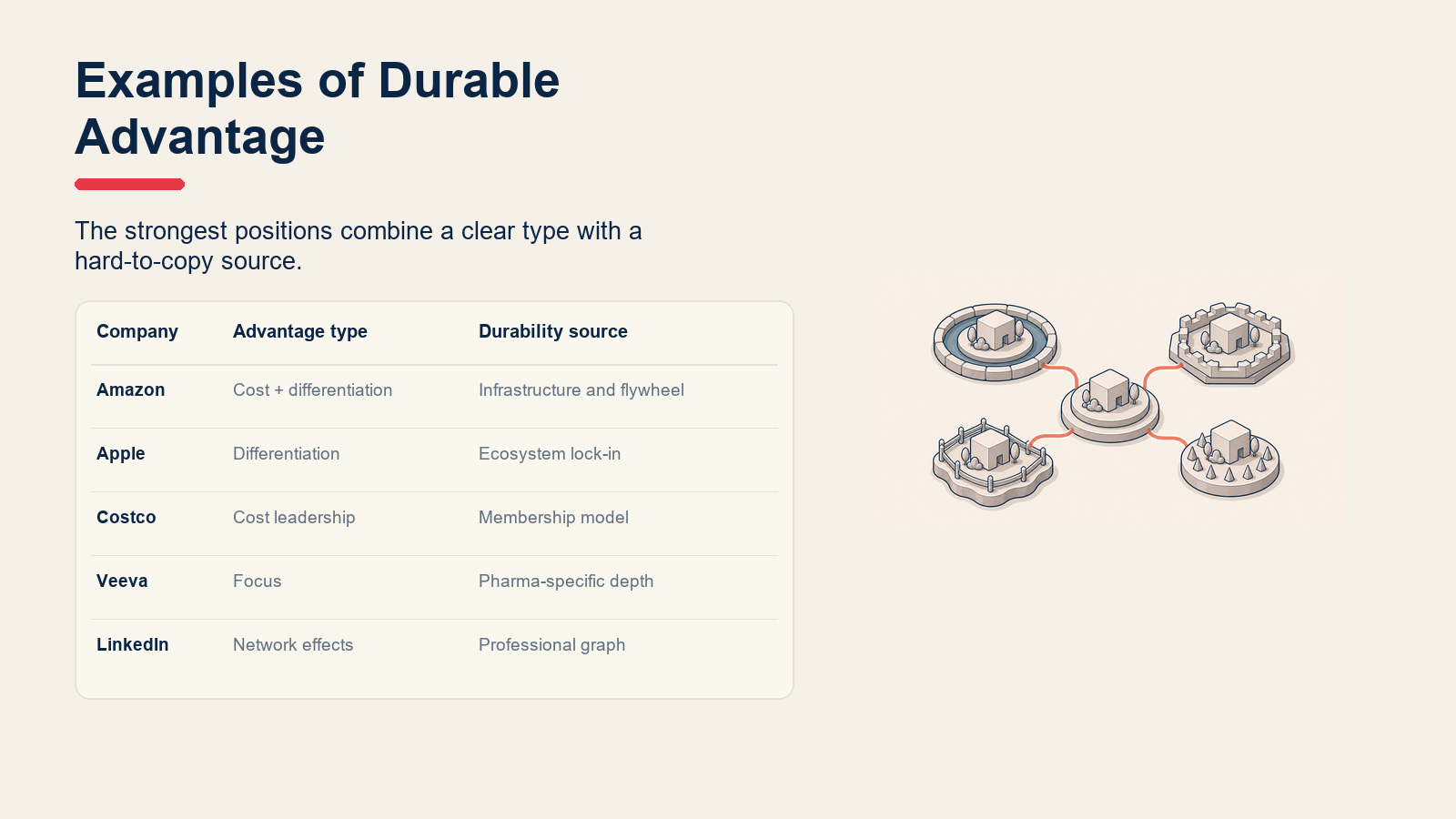
Las empresas reales ilustran cómo funcionan los tipos en la práctica.
| Empresa | Tipo de ventaja | Fuente principal | Por qué es duradera |
|---|---|---|---|
| Amazon | Costo + diferenciación | Infraestructura de distribución, ecosistema Prime, subsidio cruzado de AWS | Red física + ciclo de datos = ventaja masiva de reinversión |
| Apple | Diferenciación | Diseño, integración de silicio, ecosistema App Store | Bloqueo de los ecosistemas de dispositivos + servicios + desarrolladores reforzándose mutuamente |
| Costco | Liderazgo en costos | El modelo de membresía financia márgenes más bajos en productos | Lealtad del cliente integrada en la tarifa prepagada; el número de SKU reducido simplifica las operaciones |
| Veeva Systems | Enfoque (nicho) | CRM y gestión de contenido específicos del sector farmacéutico | Los requisitos de cumplimiento normativo en la industria farmacéutica hacen que el cambio sea catastrófico |
| Diferenciación + efectos de red | Datos de identidad profesional, red de dos caras | El grafo profesional es difícil de replicar; los costos de cambio son altos para los equipos de reclutamiento | |
| IKEA | Costo + diferenciación | Cadena de suministro de muebles planos, experiencia en tienda, estética de diseño | La integración de la cadena de suministro y el formato de tienda son ventajas acumuladas durante 50 años |
| Salesforce | Diferenciación + costos de cambio | Extensibilidad de la plataforma CRM, ecosistema AppExchange | Integración profunda en las operaciones de ventas; alto costo de cambio para clientes empresariales |
Ninguna construyó su posición de la noche a la mañana. La mayoría requirió entre 10 y 20 años antes de que las ventajas se volvieran estructuralmente duraderas. El hilo común: claridad sobre la posición combinada con una ejecución coherente alineada con ella, el mismo impulso acumulativo que describe el efecto flywheel cuando pequeños empujones repetidos en una misma dirección empiezan a construirse sobre sí mismos.
Cómo sostener una ventaja competitiva
Las ventajas se erosionan. Comprender por qué es igual de importante que comprender cómo construirlas.
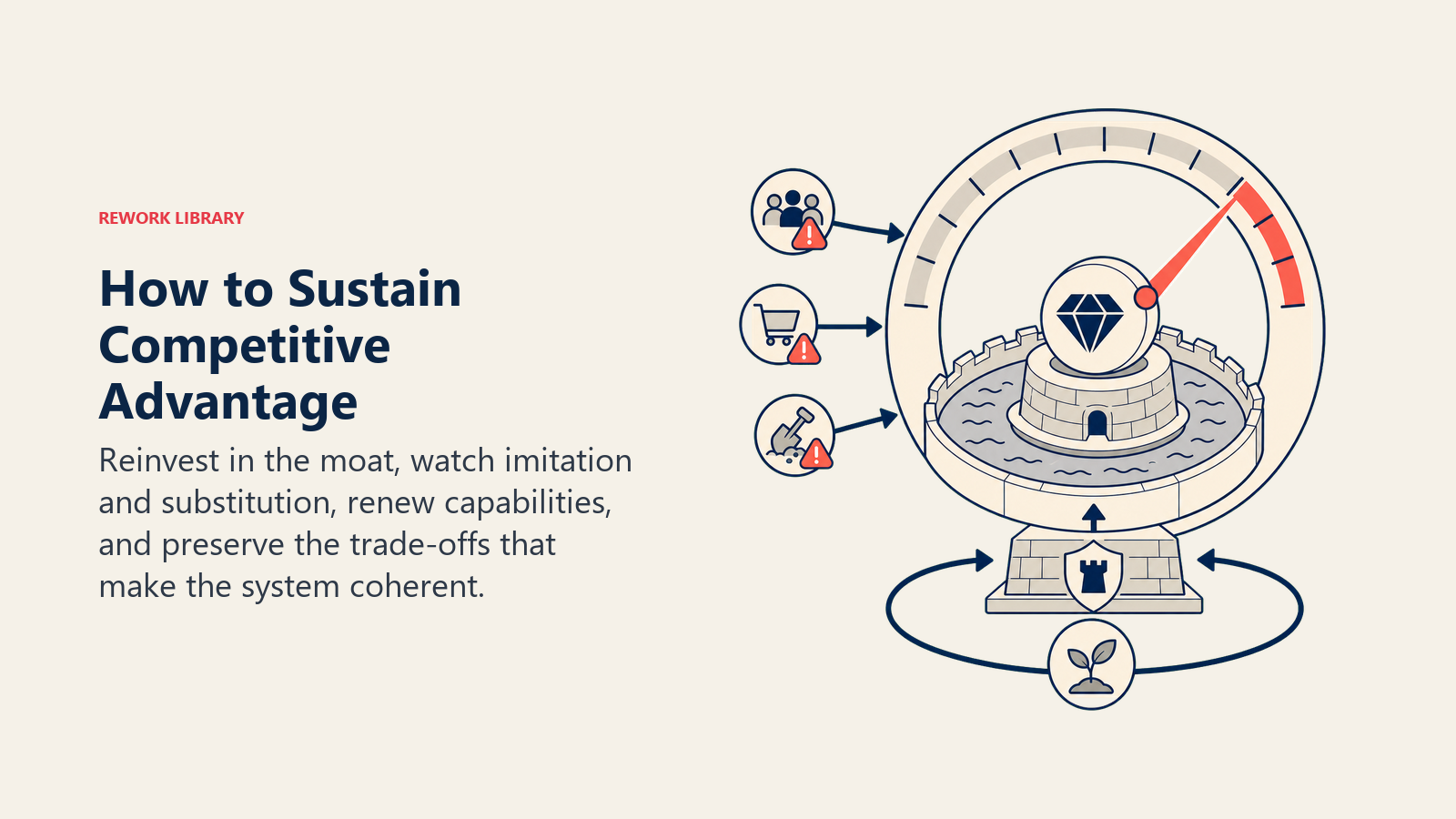
Imitación. Los rivales observan lo que funciona y lo copian. Esto es especialmente rápido en sectores con poca protección de patentes, alta movilidad de empleados y productos observables. La respuesta es seguir invirtiendo en las actividades que producen la ventaja, no solo en los resultados visibles. Proteja el sistema, no solo el producto.
Sustitución. Una tecnología o modelo de negocio alternativo superior puede hacer que toda la posición sea irrelevante. Kodak tenía ventaja en costos y diferenciación en película fotográfica. La fotografía digital no superó a Kodak en película. La hizo irrelevante. Haga seguimiento de las amenazas sustitutivas con el mismo rigor que aplica a los competidores directos. La planificación de escenarios está diseñada específicamente para esto.
Cambio en las preferencias del cliente. La ventaja se define por lo que los clientes valoran. Cuando las preferencias cambian, las ventajas construidas sobre impulsores de valor obsoletos se erosionan. Las empresas que sostienen la ventaja tratan la investigación de clientes como una función operativa continua, no como un ejercicio periódico de estrategia.
Complacencia. Este es el modo de fallo más común. Una ventaja duradera crea márgenes, y los márgenes crean comodidad organizacional. La comodidad ralentiza la reinversión, tolera la ineficiencia y retrasa las decisiones estratégicas difíciles. La investigación de Harvard mencionada anteriormente encontró que la causa principal de la erosión de la ventaja no fueron los ataques competitivos. Fue la desaceleración interna.
El modelo de los Tres Horizontes de Crecimiento es una herramienta práctica para gestionar la tensión entre proteger la ventaja actual y construir la del futuro. El Horizonte 1 defiende el núcleo. El Horizonte 2 construye posiciones adyacentes. El Horizonte 3 explora apuestas transformacionales. Sin inversión explícita en los Horizontes 2 y 3, la ventaja actual se convierte en nostalgia futura.
Errores habituales
Confundir tener recursos con tener ventaja. Los recursos son insumos. La ventaja requiere que esos recursos produzcan resultados que los rivales no puedan replicar. Aplique el test VRIO antes de afirmar que un recurso es una ventaja competitiva.
Perseguir varias estrategias genéricas simultáneamente. Estar "atrapado en el medio" produce retornos por debajo del promedio en casi todos los sectores que Porter estudió. Elegir una posición y mantenerla es más difícil de lo que parece bajo la presión de los resultados a corto plazo.
Definir la posición competitiva de manera demasiado amplia. "Servimos a todos" significa no servir a nadie especialmente bien. Las ventajas duraderas provienen de servir a un segmento específico tan bien que los competidores generalistas no pueden justificar la reconfiguración necesaria para igualarle.
Tratar la ventaja como algo estático. La ventaja requiere reinversión continua. Las empresas que la sostienen tratan el posicionamiento competitivo como un proceso de gestión continuo, no como un documento de estrategia trienal.
Ignorar el sistema de actividades. Un competidor puede contratar a sus mejores ingenieros. No puede replicar fácilmente las rutinas organizacionales y las normas culturales que hacen a esos ingenieros eficaces en su contexto. La ventaja reside en la coherencia del sistema, no en las partes individuales.
Mejores prácticas
Realice el análisis externo estructurado antes del trabajo de estrategia interna. Comience por la estructura del sector y la ubicación del grupo de beneficio, luego pase a los recursos internos. La mayoría de las empresas hacen esto al revés.
Audite su base de recursos con rigor VRIO al menos una vez al año. Las capacidades que eran raras y costosas de imitar hace cinco años pueden haberse convertido en elementos básicos hoy.
Alinee la asignación de capital con la posición estratégica elegida. La inconsistencia entre la estrategia declarada y las decisiones de inversión es la señal visible más temprana de deriva estratégica.
Mida los indicadores de ventaja, no solo el desempeño. Los ingresos y los márgenes son rezagados. Los indicadores adelantados son la tasa de retención de clientes, la realización de precio frente a los competidores y la cuota de cartera en el segmento objetivo.
Preguntas frecuentes
¿Qué es la ventaja competitiva en términos simples?
La ventaja competitiva es lo que permite a una empresa obtener retornos superiores a los de sus rivales de manera sostenida. Significa que puede hacer algo que los competidores no pueden, o no pueden hacer igual de bien, y ese algo es algo por lo que los clientes realmente pagan. La prueba no es lo que se cree hacer mejor. Es si esa diferencia se refleja en los márgenes, la retención o la cuota de mercado a lo largo de varios años.
¿Cuáles son los tres tipos principales de ventaja competitiva?
Porter identificó tres: ventaja en costos (producir lo mismo más barato), ventaja por diferenciación (producir algo que los clientes valoran más y por lo que pagarán una prima) y ventaja por enfoque (servir a un segmento estrecho tan bien que los competidores generalistas no pueden igualar rentablemente la especialización). La mayoría de las posiciones duraderas combinan al menos dos tipos, reforzados por un sistema coherente de actividades.
¿Cuál es la diferencia entre ventaja competitiva y ventaja comparativa?
La ventaja comparativa es en gran medida heredada: acceso geográfico a recursos, mano de obra más barata, regulación favorable. La ventaja competitiva se construye mediante elecciones estratégicas deliberadas. Los estrategas se centran en la ventaja competitiva porque está dentro del control de una empresa crearla y defenderla.
¿Pueden las empresas pequeñas tener ventajas competitivas sobre las grandes?
Sí, con frecuencia a través del enfoque. Un actor de nicho puede desarrollar experiencia y ajuste operativo con un segmento específico que hace que no sea rentable para un generalista grande desplazarle. El test VRIO se aplica igualmente a las empresas pequeñas: si tiene recursos que son valiosos, raros y difíciles de imitar en su mercado objetivo, tiene una ventaja real.
¿Cuánto dura una ventaja competitiva?
Depende de la fuente. Las ventajas por efectos de red y costos de cambio se acumulan con el tiempo y tienden a ser las más duraderas. Las ventajas tecnológicas en sectores de rápido movimiento pueden evaporarse en dos o tres años. La investigación de Harvard Business School encontró que menos del 10% de las empresas mantienen una ventaja genuina durante más de una década, razón por la cual la reinversión continua es esencial.
Construir ventaja es una disciplina, no una decisión
La ventaja competitiva no proviene de documentos de estrategia ni de retiros de planificación. Proviene de elecciones operativas consistentes, tomadas a lo largo de años, que alinean un sistema de actividades con una posición que vale la pena mantener.
Las empresas con ventajas duraderas comprendieron su posición antes y con mayor claridad que los competidores, tomaron decisiones difíciles sobre qué no hacer y siguieron reinvirtiendo en las fuentes de ventaja incluso cuando las presiones a corto plazo argumentaban en contra.
Esa disciplina es la ventaja real. Los marcos, las Cinco Fuerzas de Porter, VRIO, el análisis de cadena de valor, son herramientas para pensar con claridad sobre dónde dirigirla.

Co-Founder & COO
On this page
- ¿Qué es la ventaja competitiva?
- Tipos de ventaja competitiva
- Fuentes de ventaja competitiva sostenible
- Estrategias Genéricas de Porter
- Recursos y capacidades VRIO
- Efectos de red
- Costos de cambio
- Marca y confianza
- Cómo construir una ventaja competitiva
- Ejemplos de ventaja competitiva
- Cómo sostener una ventaja competitiva
- Errores habituales
- Mejores prácticas
- Construir ventaja es una disciplina, no una decisión