Plantilla de Descripción del Puesto de Warehouse Manager - Guía 2026
Turn this article into takeaways for your work.


Each assistant summarizes the article only for you and suggests best practices for your work.
Lo que obtendrá de esta guía
- Una descripción del puesto de Warehouse Manager lista para publicar, que puede copiar y personalizar
- La línea divisoria entre Warehouse Manager, Warehouse Supervisor, Distribution Center Manager y Logistics Manager, respaldada por códigos federales de ocupación
- Por qué no existe una cifra salarial federal exclusiva de almacén y en qué referencia apoyarse en su lugar
- Las dos cosas que una plantilla genérica de Manager siempre omite aquí: las obligaciones reales de seguridad OSHA y la rotación de la fuerza laboral por horas
- Requisitos específicos por industria para distribución de un solo sitio, multisitio o 3PL, fulfillment de ecommerce, almacenes de plantas de manufactura y cadena de frío
- Una matriz por nivel de experiencia que va desde el nivel inicial hasta VP of Distribution
- 18 preguntas de entrevista con un enfoque de evaluación para las rondas técnica, conductual y de encaje cultural
- Dos secciones de preguntas frecuentes, una para empleadores y otra para candidatos
Un Warehouse Manager es responsable de todo lo que ocurre dentro de cuatro paredes: recepción, almacenamiento, picking, empaque, envío, las personas que lo operan y el historial de seguridad que conlleva tener equipo pesado en movimiento a su alrededor todo el día. Es un trabajo distinto al del puesto contiguo de Logistics Manager, quien es responsable de los transportistas y de la carga que se mueve entre instalaciones, no del piso del almacén en sí. Nuestra guía de mejores prácticas para descripciones de puestos cubre los fundamentos que aplican a cualquier publicación.
Aspectos Clave
- No existe una línea salarial federal para "Warehouse Manager". El BLS incluye este título dentro de Transportation, Storage, and Distribution Managers, con una mediana de $107,230 a mayo de 2025, la misma ocupación a la que se ancla nuestra guía de Logistics Manager.
- Aquí la experiencia pesa más que las credenciales, más que en casi cualquier otro puesto de esta biblioteca. El BLS indica el diploma de bachillerato como la educación típica de ingreso para esta ocupación, junto con 5 años o más de experiencia laboral requerida.
- La seguridad es una obligación legal que recae en este puesto, no una declaración de valores. Según la norma de OSHA sobre camiones industriales motorizados, el empleador debe evaluar el desempeño de cada operador de montacargas al menos una vez cada tres años.
- Almacenamiento y depósito registra una de las tasas de lesiones más altas que rastrea el BLS: 4.8 casos registrables por cada 100 trabajadores de tiempo completo en 2024, más del doble de la tasa de 2.3 de toda la industria privada.
- El título se divide en dos códigos federales de ocupación distintos según el alcance. "Warehouse Manager" y "Warehouse Supervisor" aparecen ambos bajo el código de supervisor de primera línea de O*NET, mientras que el puesto que es dueño de la instalación, descrito en esta guía, se ubica en la ocupación gerencial que el BLS rastrea por separado.
- La estructura de turnos define la banda salarial más que cualquier dato de un currículum: un turno o una operación de 24 horas en tres, un solo sitio o una red multisitio, con o sin el lado de transporte y patio incluido.
Por Qué Este Puesto Importa
La semana de todo Warehouse Manager se complica en la misma dirección: más SKUs, más canales y menos paciencia ante un envío tardío. El e-commerce representó el 17.1% de las ventas minoristas totales de EE. UU. en el segundo trimestre de 2026 (FRED, E-Commerce Retail Sales as a Percent of Total Sales, con datos del Census), y cada punto de ese crecimiento añade densidad de picking y volumen de devoluciones a una instalación que antes enviaba pallets a un puñado de tiendas. El almacenamiento de terceros mantuvo el ritmo: Armstrong & Associates situó el Value-Added Warehousing and Distribution en $72.7 mil millones de ingresos brutos en 2025, dentro de un mercado 3PL estadounidense de $323.4 mil millones que creció 5.0% interanual (Armstrong & Associates, U.S. 3PL Market Size Estimates). Nada de eso aparece como una línea en una oferta de empleo. Aparece como un plan de plantilla y la llamada del domingo por la noche cuando un turno de la semana pico se queda corto.
El Ancla Salarial y una División Más Sutil Detrás del Título
El U.S. Bureau of Labor Statistics no publica una categoría llamada "Warehouse Manager". La coincidencia más cercana es Transportation, Storage, and Distribution Managers, con un salario anual mediano de $107,230 ($51.55 por hora) a mayo de 2025, en unos 228,100 empleos, con un crecimiento proyectado de 6% hasta 2035 y alrededor de 18,300 vacantes al año. Esa página no separa a los gerentes de almacenamiento y distribución de los gerentes de transporte, así que no hay una cifra exclusiva de almacén escondida dentro. Vale la pena decirlo con claridad, porque es inusual para un título gerencial en esta biblioteca: el BLS indica el diploma de bachillerato como la educación típica de ingreso aquí, junto con 5 años o más de experiencia requerida. La trayectoria pesa más que las credenciales.
Hay una división más sutil que conviene conocer antes de titular la publicación. O*NET clasifica "Warehouse Manager" y "Warehouse Supervisor" bajo First-Line Supervisors of Helpers, Laborers, and Material Movers, Hand (53-1042.00), una ocupación de primera línea, a nivel de turno. Un código relacionado, First-Line Supervisors of Material-Moving Machine and Vehicle Operators (53-1043.00), cubre a DC Supervisor y Dock Supervisor. El puesto que describe esta plantilla, responsable de la plantilla de personal, el presupuesto y los sistemas de una instalación en todos los turnos, es el trabajo más amplio que el BLS rastrea por separado bajo Transportation, Storage, and Distribution Managers. Si la publicación es en realidad el trabajo a nivel de turno, llámelo "Warehouse Supervisor" y fije su remuneración en consecuencia.
La Seguridad Es una Obligación Legal que Recae en Este Puesto, No una Declaración de Valores
La mayoría de las descripciones de puestos gerenciales de esta biblioteca tratan la seguridad como un punto más de la lista. Esta no puede: la exposición legal aquí es real y específica. Según la norma de OSHA sobre camiones industriales motorizados, 29 CFR 1910.178, el empleador debe capacitar y evaluar a cada operador de montacargas antes de que opere el equipo sin supervisión, y certificar esa capacitación con el nombre del operador, la fecha de capacitación, la fecha de evaluación y quién la realizó. Se requieren una capacitación de actualización y una nueva evaluación siempre que se observe a un operador trabajando de forma insegura, tenga un accidente o un casi accidente, pase a un tipo distinto de camión o cambien las condiciones lo suficiente como para afectar la operación segura. Incluso sin un detonante, la norma fija un mínimo: la evaluación del desempeño de cada operador debe realizarse al menos una vez cada tres años.
Las cifras de lesiones explican por qué la norma es estricta. Los datos más recientes reportados por empleadores del BLS sitúan la tasa total de casos registrables en almacenamiento y depósito en 4.8 por cada 100 trabajadores de tiempo completo en 2024, más del doble de la tasa de 2.3 de toda la industria privada, que a su vez es la más baja desde que el BLS inició la serie en 2003 (BLS, Table 1, Incidence Rates of Nonfatal Occupational Injuries and Illnesses by Industry, 2024). Transporte y almacenamiento en conjunto registró una tasa menor, de 4.4, así que almacenamiento y depósito se ubica incluso por encima de su propia categoría matriz. Un Warehouse Manager también es responsable de un deber de registro que la mayoría de los gerentes nunca toca: el resumen anual del Formulario 300A de OSHA debe exhibirse en un lugar visible a más tardar el 1 de febrero del año siguiente y permanecer publicado hasta el 30 de abril (29 CFR 1904.32).
La Rotación y el Personal en Temporada Pico Son la Realidad Operativa
Lo otro que omite una plantilla gerencial genérica: este trabajo se apoya en una fuerza laboral por horas que no permanece mucho tiempo y que no está igual de ocupada a lo largo del año. La Job Openings and Labor Turnover Survey del BLS situó la tasa promedio anual de renuncias de 2025 para transporte, almacenamiento y servicios públicos en 2.2%, igual que en 2024 y por debajo del 3.0% de 2022, frente a 2.0% del total de todas las industrias. Es un promedio de las tasas mensuales, no la proporción de la plantilla que se va en un año, así que debe leerse como una señal relativa y no como una cifra de rotación (BLS, JOLTS, Table 22, Annual Average Quits Rates by Industry). Esa categoría mezcla el almacenamiento con el transporte por carretera y los servicios públicos, por lo que probablemente subestima lo que ocurre específicamente en el piso de un almacén, donde la rotación por horas tiende a superar la mezcla de todo el sector. Lo que es seguro: el personal de temporada pico es un problema recurrente aquí, y un gerente que no pueda aumentar y reducir una fuerza laboral temporal sin arruinar la precisión del picking se enfrenta a un cuarto trimestre difícil cada año.
Dónde Termina el Warehouse Manager y Empiezan los Títulos Vecinos
| Rol | Es Responsable de | No Es Responsable de |
|---|---|---|
| Warehouse Manager (esta guía) | Una instalación completa en todos los turnos: recepción, almacenamiento, picking y empaque, envío, seguridad, la fuerza laboral por horas | Selección de transportistas, tarifas de flete, rutas a nivel de red |
| Warehouse Supervisor | Un turno o una función (O*NET 53-1042.00, el mismo código que el título de "Warehouse Manager" a nivel de turno) | Presupuesto y sistemas en toda la instalación |
| Distribution Center Manager | Con frecuencia varios edificios o una red regional; mayor responsabilidad sobre P&L y red | Cobertura de turnos en el día a día dentro de un solo edificio |
| Logistics Manager | El movimiento entre nodos: transportistas, flete, coordinación de entradas y salidas | Las operaciones diarias del piso de una instalación |
| Supply Chain Manager | La red de extremo a extremo: abastecimiento, proveedores, planificación de la demanda | Ejecución práctica dentro de un solo edificio |
| Operations Manager | Alcance operativo más amplio, a veces totalmente no físico | Responsabilidad sobre el WMS, slotting, conteo cíclico |
| Demand Planner | Pronosticar qué llega y cuándo | Ejecución física una vez que el inventario llega |
| Procurement Manager | Qué se compra y a quién | Qué ocurre con ello una vez dentro |
Plantilla Principal de Descripción del Puesto
Sobre el Puesto
Estamos contratando a un Warehouse Manager que se encargue de todo lo que ocurre dentro de nuestra instalación de [Company Name]: recepción y almacenamiento, precisión del inventario, picking y empaque, envíos salientes, cumplimiento de seguridad y el equipo que lo opera. Usted gestionará a [X] asociados por horas en [un turno / una operación de 24 horas en tres turnos], además de líderes o supervisores de turno que le reportan.
Usted reportará a [Director of Logistics / VP of Supply Chain / Distribution Center Manager] y trabajará de cerca con un Logistics Manager o Supply Chain Manager en el flujo de entradas y salidas, y con un coordinador de operaciones en el apoyo a la programación. En una empresa más grande, también preparará materiales para un director de operaciones que revise el desempeño multisitio.
El candidato ideal ya ha dirigido el piso de un almacén físico, comprende los requisitos de capacitación de montacargas de OSHA sin que se los expliquen y puede recorrer el piso durante una semana pico y tomar una decisión de personal sin necesidad de un comité.
Responsabilidades Clave
- Operaciones de la Instalación y Throughput: Responsabilizarse del desempeño en recepción, almacenamiento, picking, empaque y envío, alcanzando los objetivos de throughput sin sacrificar la precisión.
- Precisión del Inventario y Conteo Cíclico: Dirigir un programa de conteo cíclico que mantenga el inventario del sistema alineado con los conteos físicos, y encargarse de la conciliación cuando no coincidan.
- Responsabilidad sobre el Programa de Seguridad: Responsabilizarse del cumplimiento de OSHA, incluida la capacitación y certificación de operadores de montacargas, el ciclo obligatorio de reevaluación cada tres años y la publicación anual del Formulario 300A.
- Planificación de la Fuerza Laboral y Programación: Elaborar el calendario de turnos, responsabilizarse del presupuesto laboral y aumentar y reducir el personal temporal y de temporada sin afectar la precisión ni la seguridad.
- Responsabilidad sobre el WMS y Slotting: Responsabilizarse del sistema de gestión de almacenes y de las decisiones de slotting, coordinándose con un analista de cadena de suministro cuando los cambios de demanda afecten la distribución.
- Liderazgo y Desarrollo del Equipo: Contratar, guiar y desarrollar a supervisores de turno y líderes, incluyendo con frecuencia a un Junior Operations Manager de nivel inicial o a un coordinador junior de cadena de suministro.
- Mantenimiento de Equipo e Instalaciones: Responsabilizarse del mantenimiento preventivo del equipo de manejo de materiales, en coordinación con un Facilities Manager donde se crucen los alcances.
- Coordinación de Proveedores y Contratistas: Gestionar a las agencias de personal, los proveedores de equipo y los contratistas de mantenimiento del edificio.
- Coordinación Multifuncional: Colaborar con un Logistics Manager en la programación y con un Demand Planner en las implicaciones de personal de los cambios en el pronóstico.
- Métricas y Reportes: Dar seguimiento a la precisión del picking, la tasa de envíos a tiempo, el tiempo de muelle a almacén y el costo laboral por unidad, en coordinación con un analista de operaciones en los dashboards.
Requisitos
Cualificaciones Imprescindibles:
- Diploma de bachillerato o equivalente requerido, licenciatura como ventaja pero no obligatoria, con más de 5 años dirigiendo operaciones de almacén o distribución
- Experiencia demostrada a cargo de un programa de conteo cíclico y en la conciliación de discrepancias de inventario
- Conocimiento práctico de sistemas de gestión de almacenes (WMS) y de decisiones de slotting a partir de datos de velocidad de picking
- Comprensión práctica de la norma de OSHA sobre camiones industriales motorizados, incluidos la capacitación, la certificación y el ciclo de evaluación
- Experiencia elaborando y defendiendo un presupuesto laboral, incluido el aumento de personal de temporada para los periodos pico
- Comodidad para tomar decisiones de piso bajo presión de tiempo sin esperar aprobación
- Trayectoria gestionando supervisores de turno durante una temporada pico completa
Cualificaciones Deseables:
- Credencial IWLA Certified Warehouse Logistics Professional (CWLP) o Qualified Warehouse Logistics Professional (QWLP)
- Experiencia en un entorno regulado (cadena de frío, farmacéutico, alimentos y bebidas) con requisitos de cadena de custodia
- Experiencia previa en un 3PL, gestionando capacidad entre varias cuentas de clientes
- Condición de instructor autorizado por OSHA o experiencia dirigiendo la certificación interna de montacargas
Certificaciones y Capacitación en Seguridad
Las certificaciones aquí se dividen en dos categorías: credenciales de la industria y capacitación en seguridad que es un requisito legal, no una línea del currículum. La International Warehouse Logistics Association (IWLA) ofrece una escalera específica para almacenes, distinta de las credenciales más amplias que suele enumerar una publicación de Logistics Manager.
| Credencial | Entidad Emisora | Lo Que Exige la Entidad | Mejor Para |
|---|---|---|---|
| Qualified Warehouse Logistics Professional (QWLP) | International Warehouse Logistics Association (IWLA) | Tarifa de $250, currículum y patrocinio de una organización de almacén o logística; abierto a miembros y no miembros | Profesionales emergentes al inicio de una carrera en almacenes |
| Certified Warehouse Logistics Professional (CWLP) | IWLA | Tarifa de $500, experiencia profesional más amplia y formación profesional adicional | Un candidato con varios años de experiencia en el piso |
| Executive Warehouse Logistics Professional (EWLP) | IWLA | Tarifa de $1,000, logros a nivel de directivo, solo para miembros de IWLA | Liderazgo de centros de distribución o multisitio |
| Powered Industrial Truck Operator Training | Certificada por el empleador bajo 29 CFR 1910.178(l) | No es una credencial de terceros: el empleador capacita, evalúa y reevalúa a cada operador al menos cada tres años | Todo operador en el piso, no solo la gerencia |
Cada nivel de IWLA pasa por el Education Committee de la asociación, con aprobación típicamente en un plazo de 90 días. Ninguno de los tres sustituye la capacitación de montacargas exigida por OSHA, que sigue siendo obligación del empleador.
Lo Que Ofrecemos
- Compensación Competitiva: Salario base acorde con el alcance de la instalación y la estructura de turnos (consulte la Guía de Compensación más abajo), revisado anualmente
- Beneficios Integrales: Cobertura médica, dental y de visión, plan de jubilación con aportación del empleador y días libres pagados
- Cultura de Seguridad Primero: Inversión real en capacitación, EPP y mantenimiento de equipo, no un cartel en la sala de descanso
- Apoyo para Certificaciones: Cuotas de solicitud de IWLA y costos del curso de instructor OSHA cubiertos
- Trayectoria de Crecimiento: Un camino definido hacia Senior Warehouse Manager, Distribution Center Manager o Director of Distribution
- Responsabilidad Real: Autoridad presupuestaria sobre las decisiones de mano de obra, slotting y equipo, no solo la ejecución del plan de otra persona
Variaciones por Contexto
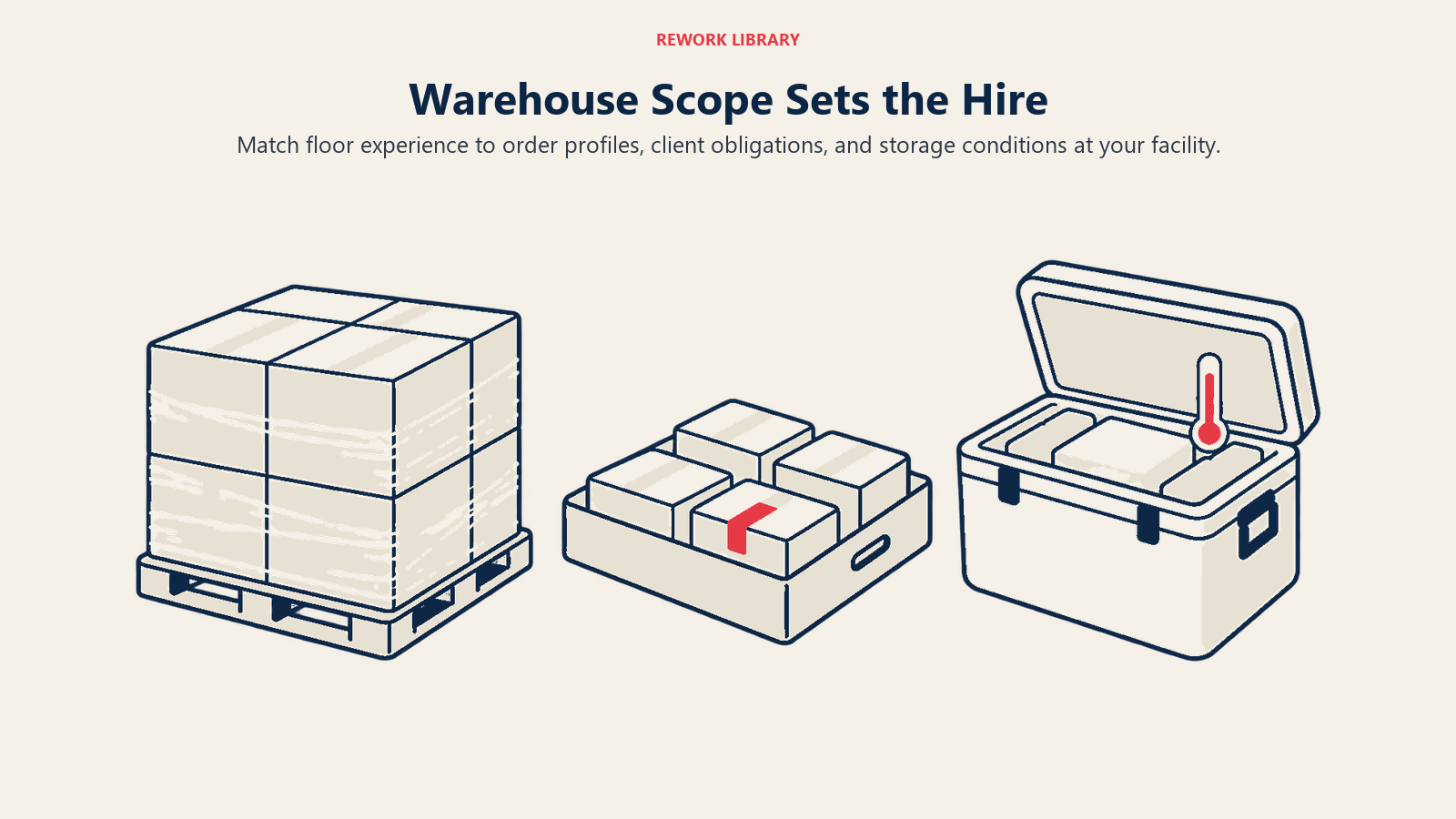
Distribución de un Solo Sitio
Un edificio, uno o dos turnos, moviendo producto a un conjunto fijo de destinos: tiendas, distribuidores o clientes regionales. El volumen es predecible fuera de los picos de temporada, y el gerente es responsable personalmente de todo el piso, sin una capa de gerente de sitio entre él y un líder de turno.
Multisitio o 3PL
Ya sea dirigiendo más de una instalación o dirigiendo una en nombre de un cliente externo dentro del segmento de Value-Added Warehousing and Distribution de $72.7 mil millones del mercado 3PL de EE. UU. (Armstrong & Associates, U.S. 3PL Market Size Estimates). Añada gestión de SLA, reportes a clientes y, para un verdadero multisitio, una capa de gerentes de sitio que le reportan.
Fulfillment de Ecommerce
Picking de unidades individuales en lugar de picking por pallet o caja, un alto número de SKUs, un procesamiento intenso de devoluciones y un problema de densidad de picking que supera con creces el de un centro de distribución mayorista. El ascenso del e-commerce al 17.1% de las ventas minoristas totales de EE. UU. en el segundo trimestre de 2026 (FRED, ECOMPCTSA) sigue haciendo crecer esta variante en relación con las demás.
Almacén de Planta de Manufactura
El almacén se ubica dentro o junto a una instalación de producción, alimentando materias primas de entrada y productos terminados de salida según un calendario que fija la línea, no los pedidos de los clientes. Espere una coordinación estrecha con un ingeniero de manufactura o un ingeniero industrial en el abastecimiento a pie de línea, y con un Facilities Manager donde se superpongan el espacio del almacén y los sistemas del edificio.
Cadena de Frío o Entorno Regulado
Almacenamiento y transporte con temperatura controlada que conllevan obligaciones de documentación que la mayoría de los Warehouse Managers nunca toca. Desde 2016, la norma de Sanitary Transportation de la FDA exige que los cargadores y transportistas que mueven alimentos sensibles a la temperatura especifiquen por escrito los requisitos de temperatura, mantengan equipo capaz de cumplirlos y conserven registros hasta por 12 meses (FDA, FSMA Final Rule on Sanitary Transportation of Human and Animal Food). Esta variante se apoya en un ingeniero de calidad para la trazabilidad de lotes, ya que un vacío de documentación aquí puede provocar una retención regulatoria, no solo un envío tardío.
Consideraciones por Industria
| Industria | Requisitos Clave | Consideraciones Únicas |
|---|---|---|
| Retail y E-commerce | Picking de unidades individuales y múltiples, procesamiento de devoluciones, planificación de capacidad para temporada pico | El perfil de pedidos pasa de pallet a paquete a medida que se multiplican los canales, lo que eleva el costo laboral por unidad aun cuando crece el volumen |
| Manufactura | Abastecimiento a pie de línea, kitting, programación de entradas just-in-time | Una entrega de abastecimiento omitida puede detener una línea de producción, elevando el costo de un fallo de almacén muy por encima de un retraso de envío típico |
| Alimentos y Bebidas / Cadena de Frío | Almacenamiento con temperatura controlada, cumplimiento de Sanitary Transportation de la FDA, trazabilidad de lotes | Un vacío de documentación puede provocar una retención regulatoria del inventario, no solo un retraso |
| Farmacéutica y Salud | Documentación de cadena de custodia, normas de almacenamiento de sustancias controladas, condiciones de almacenamiento validadas | Los incumplimientos conllevan consecuencias regulatorias que van mucho más allá de una entrega perdida |
| 3PL y Almacenamiento por Contrato | Segregación multicliente, cumplimiento de acuerdos de nivel de servicio, reportes específicos por cliente | El Warehouse Manager responde ante los objetivos de KPI de un cliente además de los de su propio empleador |
| Construcción y Suministro Industrial | Manejo de materiales sobredimensionados y pesados, abastecimiento de entregas en obra, gestión del patio de equipos | La planificación del espacio debe contemplar tipos de carga para los que un sistema estándar de estanterías nunca fue diseñado |
El trabajo central se parece en las seis filas. Lo que cambia es lo que ocurre cuando algo sale mal: un desabasto en retail, una línea detenida en manufactura, una retención regulatoria en alimentos y farmacéutica, un contrato incumplido en 3PL.
Guía de Compensación
Cómo Se Relacionan los Datos Federales con Este Título
No existe una categoría salarial federal llamada "Warehouse Manager". La coincidencia más cercana, Transportation, Storage, and Distribution Managers, es reportada por el BLS con un salario anual mediano de $107,230 ($51.55 por hora) a mayo de 2025, en unos 228,100 empleos, con un crecimiento proyectado de 6% hasta 2035, que añadiría unos 14,000 empleos con alrededor de 18,300 vacantes al año. El 10% más bajo ganó menos de $65,120; el 10% más alto ganó más de $194,900. La educación típica de ingreso es el diploma de bachillerato, con 5 años o más de experiencia requerida, una combinación poco común para un título gerencial en esta biblioteca.
El nivel de colaborador individual un escalón por debajo se ubica bajo otra ocupación del BLS. Los Logisticians reportan un salario anual mediano de $82,320 ($39.58 por hora) a mayo de 2025, en unos 255,100 empleos, con un crecimiento proyectado de 18% (BLS Occupational Outlook Handbook, Logisticians). Nuestra guía de Logistics Manager se ancla a ese mismo par de ocupaciones.
Bandas de Mercado por Alcance
Los rangos siguientes son bandas de planificación de mercado fijadas por empleadores, recopiladas de ofertas de empleo y de alcances típicos de Warehouse Manager a 2026. Son puntos de partida ilustrativos para presupuestar un puesto, no una cotización de ninguna base de datos salarial.
| Alcance | Rango de Salario Base | Rango de Compensación Total | Notas |
|---|---|---|---|
| Distribución de un solo sitio, menos de 50 asociados | $60,000 - $80,000 | $65,000 - $88,000 | Con frecuencia, el primer P&L completo del gerente |
| Distribución de un solo sitio, 50-150 asociados | $70,000 - $95,000 | $75,000 - $105,000 | Empieza a formarse una capa de supervisores de turno |
| Operación de 24 horas o multiturno | $80,000 - $110,000 | $85,000 - $120,000 | Prima por cobertura entre turnos y disponibilidad |
| Fulfillment de ecommerce | $75,000 - $105,000 | $80,000 - $115,000 | La densidad de picking y la complejidad de devoluciones impulsan la prima |
| Almacén de planta de manufactura | $75,000 - $105,000 | $80,000 - $115,000 | Prima vinculada a la responsabilidad del abastecimiento a pie de línea |
| Cadena de frío o regulado (alimentos, farmacéutica) | $80,000 - $112,000 | $85,000 - $122,000 | El alcance de documentación eleva el pago por encima del almacenamiento general |
| 3PL, instalación multicliente | $75,000 - $108,000 | $80,000 - $118,000 | La responsabilidad por el SLA del cliente añade una capa |
| Distribution Center Manager, multisitio | $100,000 - $140,000 | $108,000 - $150,000 | Se acerca o supera la mediana del BLS |
Guía de Ajuste por Área Metropolitana
A diferencia de los puestos centrados en la planificación, el pago de este trabajo sigue la ubicación de la instalación, no el mercado de residencia del empleado, ya que el trabajo se realiza en sitio.
| Nivel de Área Metropolitana | Mercados de Ejemplo | Ajuste vs. Base Nacional |
|---|---|---|
| Nivel 1 (Costo Más Alto) | Área de la Bahía de SF, NYC, Seattle, LA | +15% a +25% |
| Nivel 2 (Costo Alto) | Chicago, Boston, DC, San Diego | +8% a +15% |
| Nivel 3 (Costo Moderado) | Dallas, Atlanta, Denver, Phoenix | Aproximadamente la base nacional |
| Nivel 4 (Costo Menor) | Metrópolis más pequeñas y centros de distribución rurales | -5% a -12%, varía según el mercado laboral local |
Los factores que mueven a un candidato dentro de estas bandas: un historial de seguridad limpio, una certificación IWLA relevante, el tamaño del equipo gestionado y si ha dirigido la implementación de un WMS en lugar de solo haberlo usado. Fecha de referencia de las cifras del BLS anteriores: mayo de 2025. Nada de esto es asesoría de compensación; valide con datos actuales del mercado local antes de finalizar una oferta.
Matriz de Requisitos por Nivel de Experiencia
| Nivel | Años de Experiencia | Alcance Típico | Títulos Comunes |
|---|---|---|---|
| Inicial | 0-2 años | Apoya la programación, los conteos cíclicos y la cobertura de turnos bajo supervisión | Operations Coordinator, Warehouse Lead |
| Intermedio | 3-6 años | Es responsable de un turno o una función en recepción, picking o envío | Shift Supervisor, Warehouse Supervisor |
| Manager | 5-10 años | Es responsable de toda la operación de una instalación en un sitio: personal, seguridad, inventario, sistemas | Warehouse Manager |
| Senior | 8-12 años | Es responsable de una operación de 24 horas o multiturno, o de una instalación dentro de una red multisitio | Senior Warehouse Manager, Distribution Center Manager |
| Director | 10-15 años | Define estándares y estrategia de personal en una red multisitio | Director of Warehousing, Director of Distribution |
| Ejecutivo | 15+ años | Responsable de toda la función de almacenamiento y distribución | VP of Distribution, VP of Supply Chain |
Preguntas de Entrevista
Preguntas Técnicas/Funcionales
- Conteo Cíclico: "Explíqueme su proceso cuando un conteo cíclico no coincide con el sistema. ¿Por dónde empieza a buscar?"
- Cambio de WMS: "Cuénteme sobre una migración o cambio de sistema de gestión de almacenes que haya vivido. ¿Qué salió mal y cómo siguió enviando durante el proceso?"
- Temporada Pico: "Describa una temporada pico que se descarriló. ¿Qué fue lo primero que cambió?"
- Incidente de Seguridad: "Explíqueme el último caso registrable de OSHA durante su gestión. ¿Qué ocurrió en la primera hora y qué cambió después?"
- Falta de Personal: "Un turno se presenta con 30% menos de personal. ¿Cuál es su primera decisión?"
- Slotting: "¿Cómo decide qué va en una golden zone frente al almacenamiento profundo? Explíqueme una decisión real de slotting que haya tomado."
- Falla del Transportista: "Un transportista no llega en su ventana de recogida con un camión ya cargado en su muelle. ¿Qué hace?"
- Sistemas: "¿Cuál es su experiencia práctica con plataformas WMS y qué decisión tomó gracias a los datos que le dio el sistema?"
Preguntas Conductuales
- Bajo Presión: "Cuénteme sobre una ocasión en que su instalación estuvo en riesgo real de incumplir un plazo de envío. ¿Qué hizo?"
- Equipo en Crisis: "Describa cómo gestionó a un equipo durante un aumento repentino de volumen o un periodo inesperado de falta de personal."
- Conflicto Multifuncional: "Cuénteme sobre un desacuerdo con ventas o servicio al cliente por un compromiso que asumieron sin verificar antes su capacidad."
- Recuperación tras un Error: "Cuénteme sobre un envío o un incidente de seguridad que salió mal durante su gestión. ¿Qué aprendió y qué cambió después?"
- Relación con Proveedores: "Describa una relación con una agencia de personal o un proveedor de equipo que empezó mal y cómo la revirtió."
- Coaching: "Cuénteme sobre un supervisor de turno que convirtió en un líder más sólido. ¿Qué hizo en concreto?"
Preguntas de Encaje Cultural
- Estilo de Comunicación: "¿Cómo comunica una fecha de envío incumplida a un equipo interno que ya está frustrado?"
- Seguridad Frente a Velocidad: "¿Cuándo ha frenado un turno para resolver un problema de seguridad, aun cuando afectó los números del día?"
- Moral del Equipo: "¿Cómo mantiene motivado a un equipo de almacén durante un periodo de calma frente a uno de máxima demanda?"
- Mantenerse Actualizado: "¿Cómo se mantiene al día con los cambios en la tecnología de almacenes o en los requisitos de seguridad?"
Consejos de Evaluación: Busque candidatos que mencionen un turno específico, una cifra específica y un resultado específico, no una familiaridad general con las "operaciones de almacén". Las mejores respuestas describen una temporada pico o un incidente de seguridad reales, lo que cambiaron y cómo lo midieron. Desconfíe de quien solo pueda describir la ejecución del calendario de otra persona.
Consejos de Contratación
Guía Rápida de Sourcing
| Canal | Mejor Para | Notas |
|---|---|---|
| Promoción Interna | Un supervisor de turno listo para asumir toda la instalación | El más rápido en contexto del piso; verifique la experiencia en presupuesto y programas de seguridad que pueda faltarle |
| Búsqueda en LinkedIn | Sourcing directo | Apunte a "Warehouse Manager" o "Distribution Center Manager" en instalaciones de volumen similar |
| Red de Miembros de IWLA | Candidatos pasivos con credenciales específicas de almacén | Quienes tienen CWLP y EWLP ya fueron evaluados por un organismo externo |
| Agencias de Personal con Áreas de Almacén | Contrataciones de temporada pico y de nivel intermedio | Las agencias que colocan personal por horas suelen saber quién está listo para pasar a la gerencia |
| Equipos de Operaciones de 3PL | Candidatos cómodos con la presión de SLA multicliente | Una responsabilidad de cara al cliente que es más difícil de enseñar que lo contrario |
Señales de Alerta a Evitar
| Señal de Alerta | Por Qué Importa |
|---|---|
| Sin experiencia práctica en OSHA o programas de seguridad | Este puesto conlleva una exposición legal real; un candidato que nunca ha dirigido un programa de seguridad necesitará una curva de aprendizaje más larga de la que el puesto permite |
| No puede describir una temporada pico real | Si no puede nombrar una temporada concreta, qué falló y qué cambió, cuestione cuánto ha dirigido realmente |
| Trata el conteo cíclico como trabajo de otro | La precisión del inventario es central en este puesto; un candidato que nunca ha sido responsable de ella tendrá dificultades desde el primer día |
| Vago en sistemas | Quien no pueda describir experiencia práctica con WMS puede necesitar una curva de aprendizaje más larga de la que el puesto permite |
| Certificación sin tiempo en el piso | Las credenciales de IWLA son una buena señal, pero no sustituyen el tiempo dedicado a dirigir una operación física |
Preguntas Frecuentes para Empleadores
¿Cuál es la diferencia entre un Warehouse Manager y un Warehouse Supervisor?
Un Warehouse Supervisor es responsable de un turno o una función y le reporta al Warehouse Manager. O*NET clasifica ambos títulos bajo el mismo código de supervisor de primera línea, pero en la práctica el Warehouse Manager es responsable de toda la instalación en todos los turnos, no solo del resultado de un turno.
¿Un Warehouse Manager debe reportar a logística o a operaciones?
Cualquiera de las dos funciona. Con una función de logística dedicada, el Warehouse Manager suele reportar a ella junto a un Logistics Manager de su mismo nivel. Sin esa capa, lo más común es que la línea de reporte sea un director de operaciones o un Operations Manager.
¿Necesitamos un Warehouse Manager dedicado si tercerizamos con un 3PL?
Por lo general no para la instalación en sí, ya que el 3PL aporta su propia gestión en sitio. Aun así querrá a alguien, con frecuencia un Logistics Manager, que se encargue de la relación con el 3PL y le exija el cumplimiento de su acuerdo de nivel de servicio.
¿Con qué frecuencia exige OSHA reevaluar a los operadores de montacargas?
Al menos una vez cada tres años, según 29 CFR 1910.178(l), de forma independiente de la capacitación de actualización provocada por un accidente, una operación insegura o un cambio de equipo o de condiciones.
¿Cuál es un plazo realista para incorporar por completo a un nuevo Warehouse Manager?
Espere de 60 a 90 días hasta alcanzar plena productividad. Los primeros 30 días deben centrarse en el equipo actual, la distribución y los sistemas, y los cambios de proceso y slotting deben llegar después de que haya visto un ciclo completo, idealmente incluido un periodo pico.

Senior Customer Retention Strategist
On this page
- Aspectos Clave
- Por Qué Este Puesto Importa
- El Ancla Salarial y una División Más Sutil Detrás del Título
- La Seguridad Es una Obligación Legal que Recae en Este Puesto, No una Declaración de Valores
- La Rotación y el Personal en Temporada Pico Son la Realidad Operativa
- Dónde Termina el Warehouse Manager y Empiezan los Títulos Vecinos
- Plantilla Principal de Descripción del Puesto
- Sobre el Puesto
- Responsabilidades Clave
- Requisitos
- Certificaciones y Capacitación en Seguridad
- Lo Que Ofrecemos
- Variaciones por Contexto
- Distribución de un Solo Sitio
- Multisitio o 3PL
- Fulfillment de Ecommerce
- Almacén de Planta de Manufactura
- Cadena de Frío o Entorno Regulado
- Consideraciones por Industria
- Guía de Compensación
- Cómo Se Relacionan los Datos Federales con Este Título
- Bandas de Mercado por Alcance
- Guía de Ajuste por Área Metropolitana
- Matriz de Requisitos por Nivel de Experiencia
- Preguntas de Entrevista
- Preguntas Técnicas/Funcionales
- Preguntas Conductuales
- Preguntas de Encaje Cultural
- Consejos de Contratación
- Guía Rápida de Sourcing
- Señales de Alerta a Evitar