Best FigJam Alternatives in 2026: 11 Whiteboard Tools for Teams Outside Figma
Turn this article into takeaways for your work.


Each assistant summarizes the article only for you and suggests best practices for your work.
Miro is the best all-purpose FigJam alternative for teams that don't want to buy into Figma's seat structure, Mural leads for facilitated workshops and retros, Lucidspark for teams that need real diagramming depth alongside brainstorming, and Excalidraw or Apple Freeform for teams that want a genuinely free tool with no attached plan; every price below comes from each vendor's own pricing page. FigJam is a strong whiteboard when your company already lives in Figma, but Figma now sells FigJam through a Collab seat attached to a paid Figma plan ($3/month on Professional, $5/month on Organization or Enterprise, billed monthly), which means a sales team, an ops group, or an HR function that just wants a shared canvas ends up buying into Figma's plan and seat model to get one.
That's the problem this guide is built around. Some teams hit the Collab-seat tax directly: they don't design anything, but the whiteboard they want lives inside a product built for designers. Others outgrow FigJam on depth: a shallow diagramming ceiling next to tools built around flowcharts and ERDs, and a facilitation toolkit thinner than tools built specifically for running a workshop. The 11 tools below cover both problems, plus the teams that just want a whiteboard for zero dollars. For the wider category, see our best online whiteboard software roundup; for the direct head-to-head, Miro vs FigJam, and for the design-tool layer FigJam sits inside, best Figma alternatives.
Key Facts
- The collaborative whiteboard software market was worth USD 3.81 billion in 2026, up from USD 3.17 billion in 2025, and is forecast to reach USD 9.59 billion by 2031 at a 20.28% CAGR, per Mordor Intelligence.
- Real-time collaboration was the largest feature segment in 2025 at 30.0% of category revenue, and IT and telecom was the largest end-use segment at 32.0%, per Precedence Research.
- Miro reports more than 100 million users across 250,000 organizations on its own site, the largest self-reported user base among the general-purpose tools in this list (per Miro).
- Google retired Jamboard on 31 December 2024 and explicitly pointed its users to three partners, FigJam, Lucidspark, and Miro, according to Google's own transition announcement.
- Microsoft 365 Message Center notice MC1441775 cuts off whiteboard creation and editing for personal Microsoft accounts starting today, 22 August 2026, while Microsoft Whiteboard continues as a Microsoft 365 business and education service, per Merill's Message Center archive.
Why Teams Leave FigJam
FigJam's ceiling isn't a bug, it's a consequence of what the product is built to do: a design-team whiteboard first, with pricing and features that follow from that.
| Pain Point | Who Feels It Most | Better Fit |
|---|---|---|
| FigJam only ships inside a Figma Collab seat ($3-5/mo) attached to a paid Figma plan | Non-design teams (sales, ops, HR) who don't otherwise need Figma | Miro, Excalidraw, Apple Freeform |
| Facilitation toolkit is thin: no timers, voting, or breakout boards built for large sessions | Agile coaches, L&D teams, workshop facilitators | Mural, Klaxoon |
| Diagramming ceiling is shallow: no native flowchart, ERD, or org-chart depth | Ops, IT, and business-architecture teams | Lucidspark, Boardmix, Conceptboard |
| Free tier caps at 3 files and lives inside a Figma account, not a standalone whiteboard | Small teams testing before they buy anything | Excalidraw, Apple Freeform, Milanote |
| No home for moodboards, research clipping, or asynchronous campaign planning | Marketing, content, and creative research teams | Milanote |
| EU data residency or formal review and approval workflows required | Regulated European teams | Conceptboard |
| Team isn't in Figma's design ecosystem at all and wants a neutral, cross-platform tool | Cross-functional and non-technical teams | Whimsical, Boardmix |
The seat-model complaint surprises people most, since FigJam looks cheap next to Miro or Mural. It's cheap for a team already paying for Figma. For everyone else, the real comparison isn't $3/month against Miro's $8/member/mo Starter tier, it's $3/month plus whatever Figma plan the workspace already carries, against a standalone tool's own price.
Quick Comparison Table
| Tool | Best For | Starting Price | Key Strength | Key Limitation |
|---|---|---|---|---|
| Miro | Broadest general-purpose canvas, no ecosystem lock-in | Free / $8/member/mo billed yearly | Deepest feature set and integration ecosystem | Per-seat cost climbs fast past a few dozen editors |
| Mural | Facilitated workshops and structured retros | Free / $9.99/member/mo billed annually | Facilitator Superpowers plus a deep framework template library | Only 3 murals stay editable on the free tier |
| Lucidspark | Brainstorming wired to real diagramming depth | Free / $9/mo (Individual) | Native two-way integration with Lucidchart | Team seat price isn't vendor-published |
| Excalidraw | Free, open-source, self-hosted sketching | Free (open source) / $6/user/mo billed annually | Self-hostable, instant load, hand-drawn aesthetic | No structured facilitation tools or template library |
| Whimsical | Focused flowcharts, wireframes, and mind maps | Free (50 objects/mo) / $10/editor/mo | Four focused modes, near-zero learning curve | Not built for large freeform workshops |
| Conceptboard | EU-hosted teams needing formal review workflows | Free (3 boards) / EUR 5/user/mo | EU data residency and visual approval workflows | Longer contracts required past the Starter tier |
| Boardmix | Lowest per-seat price with AI-assisted diagrams | Free / $5/user/mo billed annually | Cheapest paid tier here, plus AI diagram generation | Smaller integration ecosystem than Miro or Mural |
| Klaxoon | Structured in-person and hybrid meeting facilitation | Free (1 activity) / $24.90/host/mo billed annually | Meeting-format toolkit built for live facilitation | Priced per host, not per editor |
| Milanote | Moodboards, research, and campaign planning | Free (100 items) / $9.99/mo billed annually | Purpose-built for creative research, not sprint diagrams | Not built for large-scale real-time facilitation |
| Microsoft Whiteboard | Microsoft 365 business and education teams | Included with M365 business/education licences | Zero incremental cost inside an existing M365 tenant | No longer available to personal Microsoft accounts |
| Apple Freeform | All-Apple teams wanting a free built-in whiteboard | Free (built into iOS/iPadOS/macOS) | Zero cost, up to 100 collaborators | Apple devices only, no web or Windows client |
1. Miro - The default canvas once nobody's tied to Figma
Miro is the tool most teams land on when they outgrow FigJam's design-only scope and want a single canvas that works for product, sales, ops, and leadership alike. It reports more than 100 million users across 250,000 organizations on its own about page, the widest self-reported footprint of any general-purpose tool here, and it covers sticky-note brainstorms, structured retros, roadmapping, and diagramming in one product, breadth FigJam doesn't try to match since it optimizes for design workflows specifically. See Miro vs FigJam for the direct head-to-head, and best Miro alternatives if Miro itself turns out too expensive at your seat count.
The tradeoff shows up at scale. Miro's paid tiers bill every editor, and teams that pull viewers and occasional commenters onto paid seats can watch the bill climb quickly past a few dozen people.
| What You Get | What You Don't |
|---|---|
| Broadest feature set: brainstorming, diagramming, roadmapping, retros | A cheap way to add many viewer-only seats |
| Huge integration and template ecosystem | The simplicity of a four-mode tool like Whimsical |
| Works for non-design teams as well as design teams | Editor-billed pricing that stays flat as headcount grows |
Pricing: Free (unlimited boards, only the 3 most recent stay editable). Starter $8/member/mo billed yearly ($10/member/mo billed monthly). Business $20/member/mo billed yearly ($25/member/mo billed monthly). Enterprise custom, from 30 members. See Miro's pricing page.
Best for: Any team that wants one canvas for brainstorming, diagramming, and structured sessions without being boxed into a design-tool ecosystem.
2. Mural - Best for workshops FigJam's template library can't run
Mural was built for facilitated sessions specifically, not general-purpose collaboration. Its "Facilitator Superpowers" let a session lead lock the canvas, guide participants stage by stage, and run voting and timers without losing control of the room, and its template library goes deep on structured frameworks: retrospectives, journey mapping, empathy mapping, and Design Sprints, each with facilitation notes attached. FigJam has templates too, but they're aimed at design rituals, not L&D or agile-coaching sessions, so teams running a recurring sprint retrospective cadence get controls here FigJam simply doesn't have. See best Mural alternatives for the wider field, and Miro vs Mural if you're weighing Miro's broader canvas against Mural's facilitation depth.
| What You Get | What You Don't |
|---|---|
| Best-in-class live facilitation controls | Competitive pricing for casual, unstructured use |
| Deep structured framework templates | A simple freeform canvas feel |
| Guest access for client and external workshops | Fast onboarding for people who've never facilitated |
Pricing: Free (unlimited murals, 3 editable at a time, unlimited members). Team+ $9.99/member/mo billed annually ($12.99/member/mo billed monthly). Business $17.99/member/mo billed annually. Enterprise contact sales. See Mural's pricing page.
Best for: Agile coaches, L&D teams, and consultancies where a facilitated workshop is a regular, repeatable activity.
3. Lucidspark - Best for diagramming depth FigJam doesn't have
Lucidspark is Lucid Software's brainstorming canvas, and its real differentiator is the native, two-way link to Lucidchart: a brainstorm can feed directly into a structured flowchart, ERD, or org chart, and diagram outputs can come back the other way, a meaningfully deeper diagramming story than FigJam, whose shapes and connectors are built for quick sketches, not maintained process documentation. Teams running structured visual documentation may also want best Lucidchart alternatives, and best Lucidspark alternatives for the wider field.
The Team price isn't published in a fetchable form; Lucid's pricing page quotes Individual clearly but renders Team client-side.
| What You Get | What You Don't |
|---|---|
| Genuine two-way Lucidchart integration | A vendor-published Team seat price |
| Voting, timers, and breakout boards | The onboarding speed of FigJam or Whimsical |
| Enterprise-grade admin controls at scale | A lightweight feel for quick, casual sessions |
Pricing: Free (3 editable boards). Individual $9/mo. Team runs around $10 per user per month with a three-user minimum (reported, not vendor-confirmed; verify on Lucid's pricing page). Enterprise is sales-quoted and bundles the Lucid Visual Collaboration Suite. See help.lucid.co for the confirmed Individual rate.
Best for: Teams already using Lucidchart for process documentation who want brainstorming connected to structured diagrams instead of living in a separate tool.
4. Excalidraw - Best free, self-hosted alternative for engineers
Excalidraw's hand-drawn aesthetic signals that a diagram is rough thinking, not a polished deliverable, lowering the social cost of sharing unfinished ideas, and it's genuinely fast: opening a board and sketching something takes seconds. The core editor is free and open source, with one infinite scene, unlimited collaborators, and local encryption in the browser, and security-conscious teams can self-host it entirely rather than send data to a third-party SaaS tool, something FigJam's cloud-only model doesn't offer at any price.
Structured brainstorming methods like an affinity diagram exercise work fine on Excalidraw's freeform canvas, but the tool has no built-in template or facilitation layer for running one at scale, so the structure has to come from the facilitator, not the software.
| What You Get | What You Don't |
|---|---|
| Open-source, genuinely self-hostable | Structured templates or facilitation controls |
| Local encryption and near-instant load | Enterprise admin and compliance features |
| Unlimited collaborators on the free core | A large template library |
Pricing: Free (open source, unlimited collaborators). Excalidraw+ $6/user/mo billed annually ($7/user/mo billed monthly). See Excalidraw+'s pricing page.
Best for: Engineering and technical teams who want a fast, trustworthy sketch tool without SaaS data concerns or a design-tool subscription underneath it.
5. Whimsical - Best focused tool for PMs who don't need a full canvas
Whimsical makes a deliberate bet: cover four modes well (flowcharts, wireframes, mind maps, and sticky-note boards) instead of trying to be a general-purpose canvas. If you already know which of those four you need, Whimsical gets you there in seconds, with none of FigJam's design-context assumptions or Miro's sprawling feature surface. PMs use it for specs, technical writers use the mind-map mode for content planning, and teams that pair it with a documentation tool like best Notion alternatives often use Whimsical as the visual layer and Notion (or its alternative) as the written one.
Where it falls short is anything genuinely freeform. Running a fifteen-person design sprint with embedded video and months of accumulated context isn't what Whimsical is built for.
| What You Get | What You Don't |
|---|---|
| Four focused, fast, opinionated modes | A freeform canvas for large workshops |
| Real-time collaboration with a clean interface | Deep facilitation or plugin ecosystem |
| A generous free tier for small teams | Company-wide platform scale |
Pricing: Free (unlimited boards, capped at 50 board objects and 50 doc blocks per month). Pro $10/editor/mo. Business $20/editor/mo. Annual billing saves 17% on both tiers. See Whimsical's pricing page.
Best for: PMs, individual contributors, and small product teams who want a clarity tool, not a collaboration platform. If Whimsical is the tool you're replacing rather than considering, see best Whimsical alternatives.
6. Conceptboard - Best for regulated European teams
Conceptboard's pitch is squarely European: EU-based hosting and data residency, plus a structured visual review and approval workflow that matters under GDPR or similar procurement rules. FigJam and most US-headquartered tools here don't lead with that positioning, making Conceptboard the practical default for a European enterprise or public-sector team that needs a data-residency answer before it can even pilot a tool.
The tradeoff is contract length. Past the free Starter tier, Conceptboard's plans require 12- or 24-month commitments with minimum seat counts, a heavier procurement lift than the month-to-month options elsewhere on this list.
| What You Get | What You Don't |
|---|---|
| EU data residency and GDPR-oriented positioning | Month-to-month flexibility past the Starter tier |
| Structured visual review and approval workflow | The largest template or integration library here |
| A workable free tier for small teams | US-based hosting, if that's what you actually need |
Pricing: Free (3 active boards, 100 objects/board, 250 MB storage, 10 MB per upload). Starter EUR 5/user/mo. Advanced from EUR 10/user/mo (12-month contract, 10+ users). Corporate and Government from EUR 14/user/mo (24-month contract, 100+ users). Prices exclude VAT. See Conceptboard's pricing page.
Best for: European teams and public-sector buyers who need EU data residency and a formal review and approval workflow, not just a canvas.
7. Boardmix - Best budget option with AI-assisted diagramming
Boardmix undercuts every other paid tool here on price while adding a feature FigJam doesn't have: AI-assisted diagram and mind-map generation, where a written prompt produces a starting flowchart the team then edits by hand. For a budget-conscious team that still wants diagramming depth, lowest per-seat cost plus generative structure is the differentiator worth noticing.
The catch is ecosystem maturity: Boardmix is newer than Miro or Mural, and its integration library and template marketplace are smaller, so teams that rely heavily on plugins elsewhere may feel the gap.
| What You Get | What You Don't |
|---|---|
| The lowest paid per-seat price on this list | The integration depth of Miro or Mural |
| AI-assisted diagram and mind-map generation | A large third-party template marketplace |
| A one-time lifetime plan option | The brand recognition of the bigger names here |
Pricing: Free (1 team workspace, 3 editable boards, 100 objects/board, 1 GB). Starter $5/user/mo billed annually ($12/user/mo billed monthly). AI Starter $10/mo annual ($15.90/mo monthly). AI Business $20/mo annual ($29.90/mo monthly). Lifetime one-off plans from $99. See Boardmix's pricing page.
Best for: Budget-conscious teams that want AI-assisted diagram generation without paying Miro- or Mural-level per-seat prices.
8. Klaxoon - Best for structured in-person and hybrid facilitation
Klaxoon is built around live meeting formats rather than an open canvas: structured activities, timed exercises, and a physical hybrid kit that syncs in-room participants with remote ones on the same board. For teams running recurring, defined-start-and-end sessions rather than open-ended brainstorming, that meeting-format toolkit does something FigJam's freeform canvas isn't designed for.
Plan around the pricing model: Klaxoon bills per host, not per editor or seat, an unusual unit to budget if you're used to per-user SaaS pricing.
| What You Get | What You Don't |
|---|---|
| A meeting-format toolkit for live, structured facilitation | Per-editor pricing (it's priced per host) |
| A physical hybrid kit for in-room plus remote sessions | A large freeform canvas for unstructured work |
| Clear activity limits on the free tier to test with | The lowest entry price in this category |
Pricing: Free (1 open activity, 5-participant editing limit, 500 MB). Starter $24.90 per host/mo billed annually (up to 4 Pros, 20-participant limit, 10 GB). Enterprise contact sales, starts at 5 Pros. See Klaxoon's pricing page.
Best for: Teams running structured, timed, in-person or hybrid meeting formats rather than open-ended brainstorming.
9. Milanote - Best for creative research and moodboard organization
Milanote isn't trying to compete with FigJam on sprint diagrams or user-flow mapping. It's built for the softer, earlier stage of creative work: clipping research, building moodboards, organizing campaign ideas into boards that read more like a corkboard than a whiteboard. Marketing and content teams that also lean on best Canva alternatives for finished creative assets often use Milanote for the messier planning stage before anything gets designed.
It's not built for large-scale live facilitation; organizing one person's or one small team's research and references is the job, not running a fifteen-person workshop.
| What You Get | What You Don't |
|---|---|
| Purpose-built moodboard and research organization | Real-time facilitation for large sessions |
| A genuinely useful free tier for individuals | Diagramming or flowchart depth |
| Clean, corkboard-style visual organization | A fit for sprint planning or process mapping |
Pricing: Free (100 notes/images/links, 10 file uploads, unlimited shared boards). Per person $9.99/mo billed annually ($12.50/mo billed monthly). Team $49/mo billed annually. See Milanote's plans page.
Best for: Marketing, content, and creative research teams organizing moodboards and campaign ideas, not running sprint ceremonies.
10. Microsoft Whiteboard - Best for Microsoft 365 business and education teams (with a caveat that matters today)
Microsoft Whiteboard's pitch has always been zero incremental cost: if your organization already pays for Microsoft 365, the whiteboard is already in your Teams sidebar. That's still true for business and education licences. What changed is the personal-account experience, and it changed today.
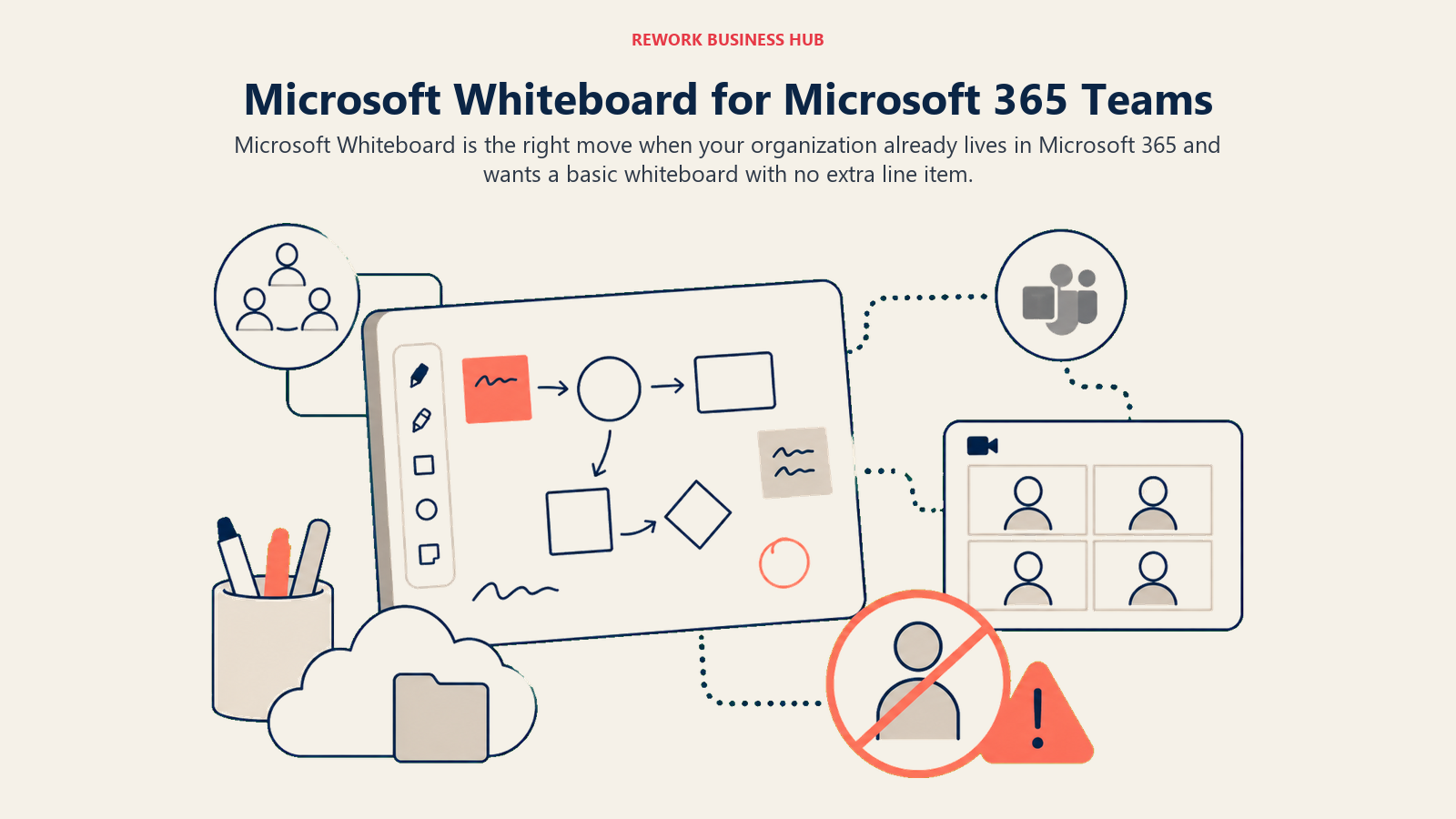
Microsoft 365 Message Center notice MC1441775, published 28 July 2026, retires legacy Microsoft Whiteboard and completes the move to OneDrive-backed whiteboards. As of today, 22 August 2026, migration tooling for legacy enterprise whiteboards is retired, and personal Microsoft accounts can no longer create or edit whiteboards, only view and export what already exists. On 5 September 2026, legacy whiteboards are permanently deleted with no recovery option. On 14 September 2026, the standalone Whiteboard app becomes unsupported, and enterprise users reach Whiteboard through Microsoft Teams instead. Microsoft Whiteboard isn't shutting down; it continues as a Microsoft 365 business and education service. What ends is the free personal-account experience, the legacy storage format, and the standalone app. Full details: Microsoft's Message Center notice MC1441775.
| What You Get (M365 business/education) | What You Don't |
|---|---|
| Zero incremental cost inside an existing M365 tenant | Access for personal Microsoft accounts, as of today |
| Native Teams meeting integration | The template depth of Mural or the flexibility of Miro |
| SharePoint-backed storage and permissions | A standalone app that will remain supported past mid-September |
Pricing: Included with Microsoft 365 business and education licences, no separate per-seat price. No longer available to personal Microsoft accounts as of 22 August 2026.
Best for: Organizations already standardized on Microsoft 365 business or education plans that need basic whiteboarding without a separate line item, not individuals on a personal Microsoft account.
11. Apple Freeform - Best free option for all-Apple teams
Apple Freeform is free on every iPhone, iPad, and Mac running iOS 16.2, iPadOS 16.2, or macOS Ventura 13.1 or later, with no paid tier at all. Boards support up to 100 collaborators, sync through iCloud, and open instantly with an Apple ID, no separate account, plan, or seat to provision, a genuinely zero-cost, zero-procurement option that FigJam, tied to a paid Figma plan, can't match.
The limitation is the platform lock-in itself: no web client and no Windows or Android app, so it only works if every collaborator is on an Apple device.
| What You Get | What You Don't |
|---|---|
| Completely free, no tier or seat to manage | A web client or Windows/Android app |
| Up to 100 collaborators per board | Facilitation tools, templates, or diagramming depth |
| Native iCloud sync across Apple devices | Any path forward for a mixed-device team |
Pricing: Free on every supported Apple device. No paid tier exists. See Apple's Freeform announcement.
Best for: All-Apple teams that want a genuinely free shared canvas with zero procurement and no ongoing bill.
Where FigJam Still Wins
None of this makes FigJam a bad tool, and it's worth being honest about where it still wins. For a design team already paying for a Figma Professional, Organization, or Enterprise plan, the marginal cost of adding FigJam is a $3-5/month Collab seat, cheaper than adding anything else on this list from scratch. The native link between a FigJam board and the actual Figma file removes a real friction point: linking frames directly to Figma components, running design critiques in context, and handing off annotated wireframes without re-importing anything, something none of the 11 tools above can replicate because none of them are Figma.
FigJam's template library is also genuinely strong for design-specific rituals: crit sessions, user-flow mapping, component brainstorming, and design retrospectives all have purpose-built templates that reflect how design teams actually work. The interface is already familiar to anyone who uses Figma daily, removing onboarding friction a brand-new tool always carries, and the free Starter plan includes FigJam, capped at 3 FigJam files of one page each, so a solo designer or a two-person team can get real work done at zero cost. The honest read: FigJam is the right call when design is the core function and Figma is already the platform of record. It stops being the right call the moment a non-design team needs the same whiteboard and has to buy a Figma seat to get it.
Stage Fit Matrix
| Tool | Startup (1-20) | Growth (20-100) | Mid-Market (100-500) | Enterprise (500+) |
|---|---|---|---|---|
| Miro | Good | Best fit | Good | Strong |
| Mural | Weak | Moderate | Best fit | Strong |
| Lucidspark | Weak | Moderate | Best fit | Strong |
| Excalidraw | Best fit | Good | Good | Works (self-hosted) |
| Whimsical | Best fit | Good | Moderate | Weak |
| Conceptboard | Weak | Moderate | Good | Best fit (regulated) |
| Boardmix | Best fit | Good | Moderate | Weak |
| Klaxoon | Weak | Moderate | Best fit | Strong |
| Milanote | Best fit | Good | Moderate | Weak |
| Microsoft Whiteboard | Weak | Weak | Moderate | Best fit (M365) |
| Apple Freeform | Best fit (Apple-only) | Good (Apple-only) | Moderate (Apple-only) | Weak |
Sizing and Persona Table
| Tool | Ideal Team Size | Primary Buyer | Secondary Users |
|---|---|---|---|
| Miro | 10-500 | Product or design manager | Sales, ops, leadership |
| Mural | 20-500 | L&D manager, agile coach | Facilitators, HR, strategy teams |
| Lucidspark | 50-500 | IT director, ops lead | Business analysts, architects |
| Excalidraw | 2-100 engineers | Engineering manager, CTO | DevOps, architects |
| Whimsical | 1-30 | PM, individual contributor | Founders, technical writers |
| Conceptboard | 20-500 (EU) | IT or compliance lead | Regulated project teams |
| Boardmix | 2-50 | Ops lead, small-team manager | Anyone budget-constrained |
| Klaxoon | 5-200 | Facilitator, trainer, ops lead | Meeting participants, in-room + remote |
| Milanote | 1-30 | Marketing or creative lead | Content strategists, brand designers |
| Microsoft Whiteboard | 500+ | IT admin | Any M365 business/education user |
| Apple Freeform | Any size, Apple-only | Team lead on Apple hardware | Anyone with an Apple ID |
How to Choose: Decision Framework
| If You Need... | Pick This |
|---|---|
| The single most broadly capable, ecosystem-neutral whiteboard | Miro |
| Deep facilitation controls for recurring workshops and retros | Mural |
| Brainstorming wired into real flowchart, ERD, and org-chart depth | Lucidspark |
| A free, open-source, self-hosted sketch tool for engineers | Excalidraw |
| Four focused modes (flowcharts, wireframes, mind maps, boards), nothing extra | Whimsical |
| EU data residency and formal visual-review and approval workflows | Conceptboard |
| The lowest per-seat price plus AI-assisted diagram generation | Boardmix |
| Zero incremental cost inside an existing Microsoft 365 or Apple device fleet | Microsoft Whiteboard or Apple Freeform |
Frequently Asked Questions about FigJam Alternatives
What does FigJam actually cost outside its free tier?
Figma sells FigJam through a Collab seat: $3/month on the Professional plan, $5/month on Organization or Enterprise, billed monthly, per figma.com/pricing. That seat sits on top of whatever Figma plan tier the workspace already carries, so a team with no other Figma need is paying for Figma's plan structure just to get a whiteboard.
Is Microsoft Whiteboard still free?
It's included at no separate cost with Microsoft 365 business and education licences, but as of today, 22 August 2026, personal Microsoft accounts can no longer create or edit whiteboards, only view and export existing ones, per Microsoft 365 Message Center notice MC1441775. Legacy whiteboards are permanently deleted on 5 September 2026.
What happened to Google Jamboard?
Google retired Jamboard on 31 December 2024, after going view-only on 1 October 2024 and being pulled from Google Meet on 1 September 2024. Google explicitly pointed Jamboard users to three partners: FigJam, Lucidspark, and Miro.
Which FigJam alternative is completely free with no paid tier at all?
Excalidraw's core editor is free and open source with unlimited collaborators, and Apple Freeform is free on every supported iPhone, iPad, and Mac with up to 100 collaborators per board. Neither requires a paid upgrade to use fully; Miro, Mural, Lucidspark, Whimsical, Conceptboard, Boardmix, Klaxoon, and Milanote all cap their free tiers at a small number of boards.
Which alternative has the deepest diagramming, beyond what FigJam offers?
Lucidspark, through its native two-way integration with Lucidchart, has the deepest flowchart, ERD, and org-chart depth here. Conceptboard and Boardmix also support structured diagrams, but neither matches Lucidspark's connection to a dedicated diagramming product.
Is there a FigJam alternative built specifically for facilitated workshops?
Mural is purpose-built for this, with Facilitator Superpowers (session locking, guided stages, voting, timers) and a deep library of retrospective and design-thinking templates. Klaxoon covers a related but distinct need: structured, timed, in-person or hybrid meeting formats rather than open-ended workshops.
What happened to InVision Freehand?
Miro acquired Freehand from InVision, announced 6 November 2023, and InVision shut down its design-collaboration services on 31 December 2024. Freehand and all InVision documents were deleted that night, so it's a past product, not a current alternative to evaluate.
How should I choose between these 11 FigJam alternatives?
Start from why FigJam doesn't fit your team, the Collab-seat cost, thin facilitation, a shallow diagramming ceiling, or wanting a free option, then match that to the decision framework above and run a real session in your top two picks before committing.
What to Do Next
Start from the specific reason FigJam doesn't fit, not a feature checklist. If it's the Collab-seat cost for a non-design team, pilot Miro or Excalidraw. If it's facilitation depth, pilot Mural. If it's diagramming depth, pilot Lucidspark. Pick a real upcoming session, a workshop, a retro, a process-mapping exercise, and run it in your top two picks with the same team rather than comparing feature lists in the abstract. The tool people reopen the next week without being reminded is the one worth paying for. If your team is also evaluating the broader design-tool layer FigJam sits inside, the best Figma alternatives guide covers that decision separately from the whiteboard question.

Principal Product Marketing Strategist
On this page
- Key Facts
- Why Teams Leave FigJam
- Quick Comparison Table
- 1. Miro - The default canvas once nobody's tied to Figma
- 2. Mural - Best for workshops FigJam's template library can't run
- 3. Lucidspark - Best for diagramming depth FigJam doesn't have
- 4. Excalidraw - Best free, self-hosted alternative for engineers
- 5. Whimsical - Best focused tool for PMs who don't need a full canvas
- 6. Conceptboard - Best for regulated European teams
- 7. Boardmix - Best budget option with AI-assisted diagramming
- 8. Klaxoon - Best for structured in-person and hybrid facilitation
- 9. Milanote - Best for creative research and moodboard organization
- 10. Microsoft Whiteboard - Best for Microsoft 365 business and education teams (with a caveat that matters today)
- 11. Apple Freeform - Best free option for all-Apple teams
- Where FigJam Still Wins
- Stage Fit Matrix
- Sizing and Persona Table
- How to Choose: Decision Framework
- What to Do Next