Best Mural Alternatives in 2026: 11 Whiteboards for Workshops and Facilitated Sessions
Turn this article into takeaways for your work.


Each assistant summarizes the article only for you and suggests best practices for your work.
Mural is still the best-built tool for facilitated sessions, so the teams worth reading this guide are the ones paying full per-member pricing for people who only open the board twice a quarter, not the facilitators who live in it every week. Miro is the broadest general-purpose swap, FigJam is the cheapest real paid seat for design-led teams, Klaxoon is the closest like-for-like on facilitation because it licenses by host instead of every participant, and Excalidraw or Apple Freeform take the seat cost to zero if you can live without the facilitation layer.
This guide is for ops leads, agile coaches, and L&D managers trying to figure out whether Mural's price tag matches how their team actually uses it. The eleven tools below cover the real range: tools that match Mural's facilitation depth, tools that cut per-seat cost to nearly nothing, and tools that solve a narrower job well.
Key Facts
- The collaborative whiteboard software market was worth an estimated USD 3.81 billion in 2026, up from USD 3.17 billion in 2025, and is forecast to reach USD 9.59 billion by 2031 (a 20.28% CAGR), per Mordor Intelligence.
- Real-time collaboration was the single largest feature segment in the category at 30.0% of 2025 revenue, with IT and telecom the largest end-use segment at 32.0%, per Precedence Research.
- The average organization puts only 54% of its purchased SaaS licenses to real use, wasting an average of $19.8 million a year on the rest, the exact pattern per-seat workshop tools create when occasional participants get billed the same as daily facilitators, per Zylo's 2026 SaaS Management Index.
- As of today, 22 August 2026, personal Microsoft accounts can no longer create or edit legacy Whiteboard boards, only view and export them; the boards are permanently deleted on 5 September 2026, per Microsoft 365 Message Center notice MC1441775.
- Google shut down Jamboard on 31 December 2024 and directed customers to FigJam, Lucidspark, and Miro; the same year, Miro acquired InVision's Freehand, and InVision closed its design-collaboration business, per Google Workspace Updates and Miro's newsroom.
Why Teams Leave Mural
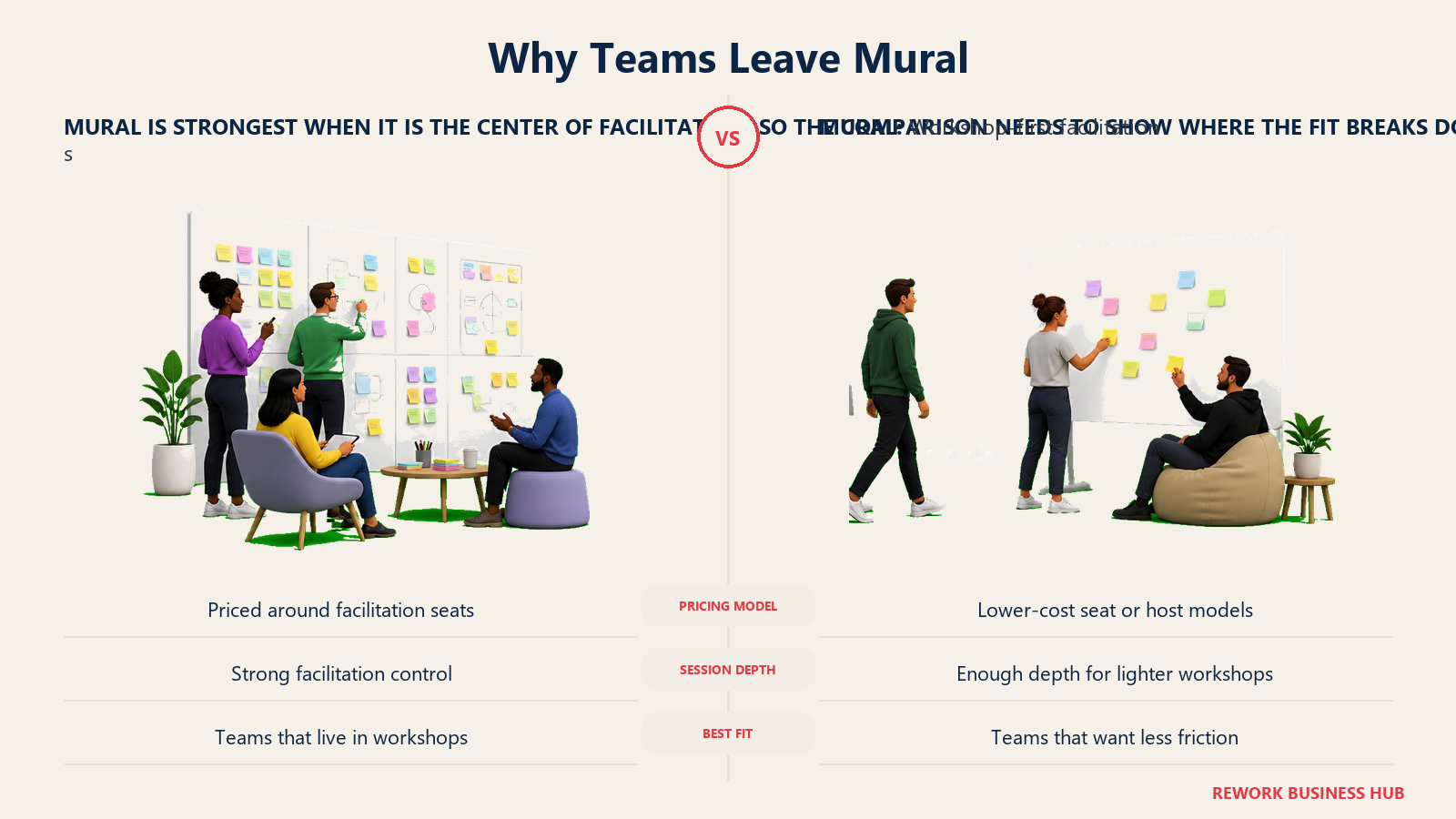
The complaint is rarely "Mural is too expensive" in the abstract. It's more specific: a handful of facilitators build and run the boards every week, and everyone else in the room shows up two to four times a year for an hour or two. Mural licenses by member: Team+ runs $9.99 per member per month billed annually ($12.99 billed monthly), and Business runs $17.99 per member per month billed annually. Every person who needs to add a sticky note, cast a vote, or use the timer is billed at that same rate, whether they open the tool fifty times a week or twice a quarter.
Run the math at three scales, on Team+ billed annually:
| Scenario | Weekly facilitators | Occasional participants (2-4 sessions/year) | Total paid seats | Annual bill |
|---|---|---|---|---|
| Small team | 3 | 7 | 10 | $1,198.80 |
| Mid-size department | 5 | 20 | 25 | $2,997.00 |
| Company-wide rollout | 6 | 44 | 50 | $5,994.00 |
In the last row, 44 of the 50 paid seats belong to people who collectively use Mural for a few hours a year. That's the actual problem, not the sticker price.
Klaxoon takes a structurally different approach: it licenses by host, not by participant. Starter runs $24.90 per host per month billed annually for up to four Pro hosts, sessions capped at 20 participants. Put the same 6 facilitators and 44 occasional participants on Klaxoon, and only the hosts need a paid seat:
| Mural (per member) | Klaxoon (per host) | |
|---|---|---|
| Facilitators needing a paid seat | 6 | 4 on Starter (a 5th or 6th host moves to Enterprise) |
| Occasional participants needing a paid seat | 44 | 0, they join inside the host's 20-person session cap |
| Annual cost for 4 hosts | 24 seats at $9.99/mo = $2,877.12 | 4 hosts at $24.90/mo = $1,195.20 |
That's not a claim that Klaxoon is cheaper in every scenario, a program past four active facilitators or 20-person sessions moves to Klaxoon's sales-quoted Enterprise tier. It's the actual shape of the decision: a small core of facilitators and a rotating cast of occasional attendees, or a room where everyone genuinely uses the tool weekly? The best online whiteboard software roundup covers the wider category if Mural was never quite the right starting point. For the direct head-to-head, see Miro vs Mural.
Quick Comparison Table
| Tool | Best For | Starting Price | Key Strength | Key Limitation |
|---|---|---|---|---|
| Miro | General-purpose whiteboarding at scale | Free / $8/member/mo annual | Broadest template and integration ecosystem | Same per-member billing pattern as Mural |
| FigJam | Design teams already on Figma | Free / $3/mo Collab seat (Professional) | Cheapest real paid seat, native Figma handoff | Weak outside a Figma-centric workflow |
| Lucidspark | Enterprise teams pairing brainstorms with diagrams | Free / $9/mo Individual | Connects directly into Lucidchart | Team pricing isn't vendor-published |
| Klaxoon | Closest facilitation match, priced by host | Free / $24.90/host/mo annual | Occasional participants don't need a seat | 20-participant cap on Starter sessions |
| Excalidraw | Engineering teams, self-hosted or free | Free (open source) / $6/user/mo annual | Zero cost, self-hostable, locally encrypted | No facilitation or template depth |
| Whimsical | Small teams wanting flowcharts and wireframes fast | Free / $10/editor/mo | Clean, focused, near-zero learning curve | Not built for large facilitated sessions |
| Conceptboard | European teams with data-residency needs | Free / EUR 5/user/mo | EU hosting, GDPR-first positioning | Higher tiers require 12-24 month contracts |
| Boardmix | Budget-conscious teams wanting AI extras | Free / $5/user/mo annual | Cheapest paid seat on this list | AI tiers add real cost quickly |
| Milanote | Creative and content planning, not live sessions | Free / $9.99/mo | Built for moodboards and content planning | No live facilitation controls at all |
| Microsoft Whiteboard | Microsoft 365 business and education orgs | Included with M365 | Zero incremental license cost | No personal-account access as of today |
| Apple Freeform | Apple-only teams wanting zero cost | Free | Genuinely free, no paid tier exists | Apple devices only, minimal facilitation |
1. Miro - The Broadest Swap, With the Same Seat-Cost Pattern
Miro is the default answer to "we need a whiteboard," and it solves everything Mural does except the facilitation-first positioning. Its free tier gives unlimited boards, though only the three most recently edited stay editable. Starter runs $8 per member per month billed yearly ($10 billed monthly), Business runs $20 per member per month billed yearly ($25 billed monthly), and Enterprise is custom-priced starting at 30 members.
Worth naming honestly: switching from Mural to Miro does not fix the occasional-participant math, it's still per-member, just at a lower Starter rate. Where Miro wins is breadth: a bigger integration catalog and a larger general template library. See best Miro alternatives if Miro itself is the tool you're replacing, and Miro vs FigJam if you're deciding between the two most common defaults.
| What You Get | What You Don't |
|---|---|
| Largest template and integration ecosystem here | A pricing model that solves occasional-seat cost |
| Facilitation tools: timer, voting, private mode, laser pointer | Mural's depth of facilitation-specific method library |
| Free tier for testing before buying | Business tier still runs $20-25/member/mo |
Best for: Teams that want Mural's general shape at a somewhat lower entry price and don't mind that the per-member cost problem doesn't go away.
2. FigJam - Cheapest Real Paid Seat, If Your Team Already Lives in Figma
FigJam ships inside every Figma plan. The free Starter plan includes it outright, no separate purchase needed. On paid plans, Figma prices FigJam access through a Collab seat, cheaper than a full design seat: $3/mo on Professional, $5/mo on Organization, $5/mo on Enterprise (compare Professional's Full seat at $16/mo, Organization's at $55/mo, Enterprise's at $90/mo, or the Dev seat at $12/$25/$35).
That $3 Collab seat fixes the occasional-participant math from the section above: 44 occasional attendees run about $132 a month combined, against roughly $440 on Mural Team+. The tradeoff is scope. FigJam is a design-workflow tool that happens to run good retrospectives, not a facilitation platform built around workshop methodology the way Mural is. Compare it against the field in best FigJam alternatives, and see best Figma alternatives if the whole design suite is up for review.
| What You Get | What You Don't |
|---|---|
| $3/mo Collab seat, cheapest paid tier in this list | A facilitation method library as deep as Mural's |
| Native linking into Figma design files | Strong fit outside a Figma-centric workflow |
| Timer, voting (stamp-based), cursor chat built in | A dedicated summon or take-control feature |
Best for: Design-led teams already paying for Figma who want workshop features without a second full software budget.
3. Lucidspark - Enterprise Diagram Pairing, Team Price Not Vendor-Published
Lucidspark is Lucid's whiteboard, built to pair with Lucidchart so a brainstorm connects into a structured process diagram without leaving the ecosystem. The free tier includes 3 editable boards, and Individual runs $9/month. Team pricing isn't published on Lucid's own site (the pricing table renders client-side); it's reported around $10/user/month with a three-user minimum, per RevPilots' Lucidspark pricing breakdown, not confirmed directly by Lucid. Enterprise is sales-quoted, bundled into the broader Lucid Visual Collaboration Suite.
Lucidspark's facilitator tools genuinely compete with Mural's: private mode that hides new stickies until the host reveals them, a countdown timer with quick-add presets, breakout boards that merge results back, and a "follow presenter" mode. The gap is template depth for structured facilitation methodology, Mural still leads there. For the diagramming half, see best Lucidchart alternatives; for the whiteboard half, see best Lucidspark alternatives.
| What You Get | What You Don't |
|---|---|
| Real facilitator tools: private mode, timer, breakout boards | A vendor-published Team price |
| Tight integration into Lucidchart for structured diagrams | Simple onboarding, the UI has real depth to learn |
| Enterprise-grade admin controls | Mural's depth of facilitation-specific templates |
Best for: Mid-market and enterprise teams already standardized on Lucidchart who want brainstorming connected to structured diagramming. For the direct head to head, see Mural vs Lucidspark.
4. Klaxoon - The Closest Like-for-Like on Facilitation, Priced by Host
Klaxoon is built around the same job as Mural: live, structured, facilitated sessions, not asynchronous canvases. The free tier allows one open activity with a five-participant editing limit and 500 MB of storage. Starter runs $24.90 per host per month billed annually, covering up to four Pro hosts, sessions capped at 20 participants, and 10 GB of storage. Enterprise is sales-quoted and starts at five Pro hosts.
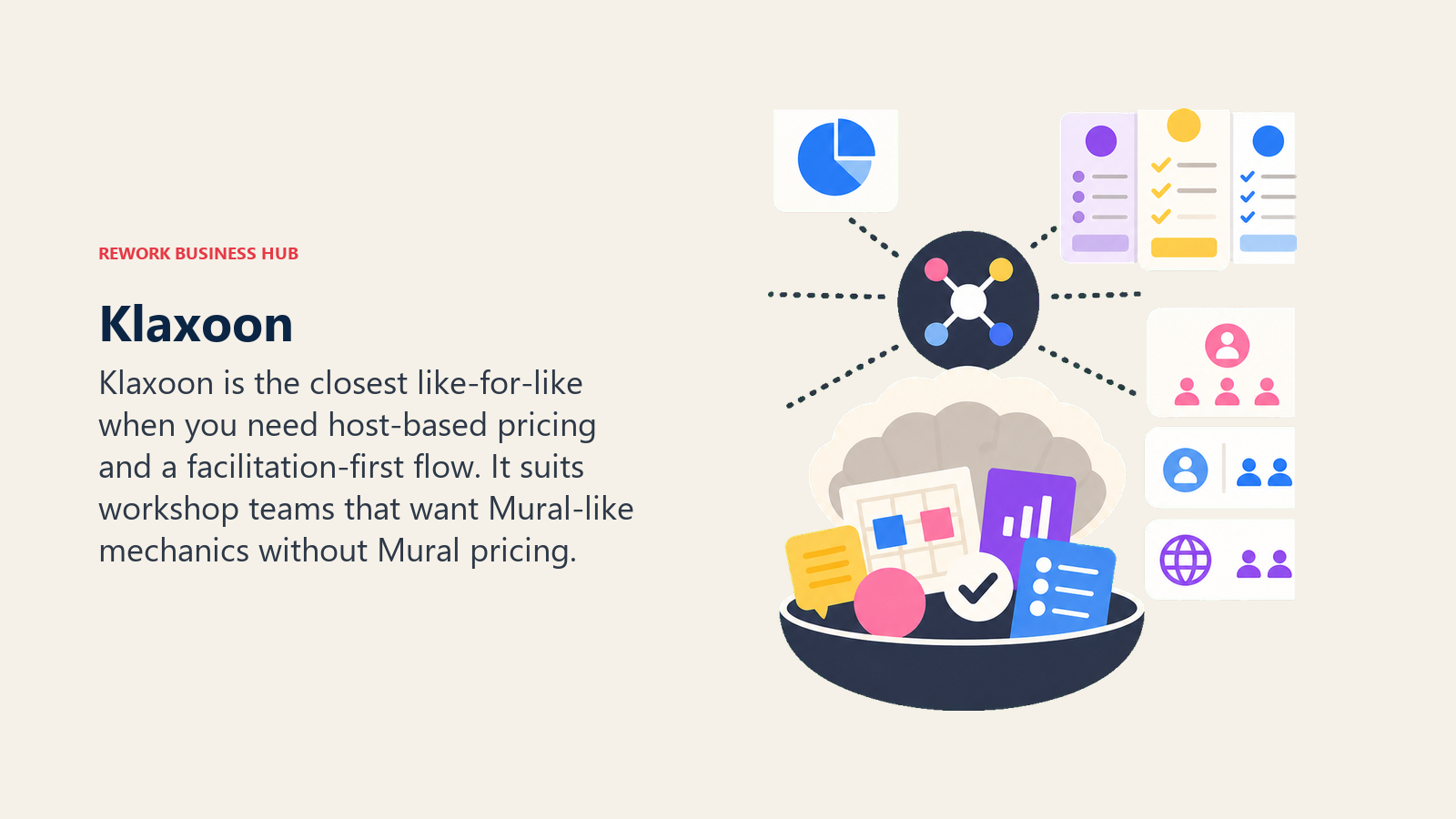
The structural difference from Mural is the one this guide is about: Klaxoon licenses hosts, not every attendee. A facilitator pays for their own seat; the 20 people joining that session don't need individual accounts. Klaxoon's activity set (Challenge, Vote, Storm, and Meeting apps) covers anonymous ideation, live polling, and structured agenda flows, a real overlap with Mural's toolkit, even if its template library is smaller.
| What You Get | What You Don't |
|---|---|
| Per-host pricing, occasional participants cost nothing extra | A template library as deep as Mural's LUMA-style method library |
| Live Vote, timer, and structured activity apps built in | Sessions above 20 participants without upgrading |
| Starter covers up to 4 hosts before Enterprise is required | A free tier usable for anything past a 5-person test |
Best for: Teams with a small, stable group of facilitators and a large rotating cast of occasional session participants, the exact profile Mural's per-member pricing penalizes.
5. Excalidraw - Free, Open Source, No Facilitation Layer
Excalidraw is the zero-cost end of this list. The open-source core is free: one infinite scene, unlimited collaborators, and local browser encryption, with no seat count to manage at all. Excalidraw+, the hosted commercial version, runs $6 per user per month billed annually ($7 billed monthly) and adds persistent collaboration and team management.
The honest tradeoff: Excalidraw solves the seat-cost problem completely, but it doesn't solve the facilitation need. There's no timer, no voting, no private mode, no summon control, and no structured method library. If your "workshop" problem is really just a shared, fast sketch canvas for a small technical team, Excalidraw is the answer. If you need a structured 30-person retrospective with voting and timers, it isn't.
| What You Get | What You Don't |
|---|---|
| Genuinely free core, no seat cost, self-hostable | Timer, voting, private mode, or any facilitation control |
| End-to-end encryption on Excalidraw+ | A template or method library |
| Instant load time, near-zero learning curve | Enterprise admin or compliance features |
Best for: Engineering-heavy teams that want a fast, free sketch canvas and don't need Mural's facilitation layer at all.
6. Whimsical - Small Teams, Fast, Not Built for Large Sessions
Whimsical covers four modes deliberately: flowcharts, wireframes, mind maps, and sticky-note boards, nothing more. The free tier includes unlimited boards, capped at 50 board objects and 50 doc blocks a month. Pro runs $10 per editor per month, Business runs $20 per editor per month, and annual billing saves 17% on either.
Whimsical's opinionated scope is the point: no plugin marketplace, no 200-option template library, so a small team gets to a usable board in seconds. That same constraint is why it's not a Mural replacement for a 30-person facilitated retrospective. There's no summon control, no breakout structure, and no method library built for facilitation.
| What You Get | What You Don't |
|---|---|
| Fast, clean interface, minimal learning curve | Facilitation controls for large group sessions |
| Strong flowchart and wireframe modes | A freeform canvas built for open-ended workshops |
| Generous free tier for small teams | Deep enterprise admin controls |
Best for: Small product teams and individual contributors who need a clarity tool, not a workshop facilitation platform.
7. Conceptboard - European Teams With Data-Residency Requirements
Conceptboard's pitch is EU hosting and GDPR-first positioning, which matters more to regulated European buyers than any feature gap with Mural. The free tier includes 3 active boards, 100 objects per board, 250 MB storage, and a 10 MB per-upload cap. Starter runs EUR 5/user/mo. Advanced runs from EUR 10/user/mo, on a 12-month contract with a 10-user minimum. Corporate and Government runs from EUR 14/user/mo on a 24-month contract with a 100-user minimum. All prices exclude VAT.
The contract terms are the real limitation, not the price: Advanced and above lock you in for a year or two, a real commitment next to Mural's month-to-month or annual member pricing. For a team that needs EU data residency for compliance reasons, that tradeoff is usually acceptable.
| What You Get | What You Don't |
|---|---|
| EU-hosted infrastructure, GDPR-first positioning | Month-to-month flexibility above the Starter tier |
| Straightforward per-user pricing in EUR | Mural's facilitation method-library depth |
| Reasonable free tier for evaluation | A large public template marketplace |
Best for: European teams whose compliance requirements make EU data hosting a hard requirement, not a nice-to-have.
8. Boardmix - Cheapest Paid Seat, AI Tiers Cost More
Boardmix undercuts nearly everyone here on entry price. The free tier includes one team workspace, 3 editable boards, 100 objects per board, and 1 GB of storage. Starter runs $5/user/mo billed annually ($12 monthly), the cheapest paid seat in this article. AI Starter runs $10 annually or $15.90 monthly, and AI Business runs $20 annually or $29.90 monthly. Lifetime one-off plans start at $99.
The catch: the AI-assisted tiers, where Boardmix differentiates with generative diagramming, cost roughly double to quadruple the Starter price. Budget for the tier you'll actually use, not the $5 headline.
| What You Get | What You Don't |
|---|---|
| Cheapest paid seat in this comparison ($5/user/mo annual) | AI features without a real price jump |
| Lifetime one-off pricing option, unusual in this category | Mural's facilitation-specific template depth |
| Straightforward per-user model | Deep enterprise compliance tooling |
Best for: Budget-conscious teams that want a low entry price and are willing to pay more only if they actually use the AI tiers.
9. Milanote - Not a Live Facilitation Tool, and That's Fine for Some Teams
Milanote solves a different job: visual planning for moodboards, content calendars, and creative research, not live facilitated sessions. The free tier includes 100 notes, images, or links, 10 file uploads, and unlimited shared boards. Per-person pricing runs $9.99/mo billed annually or $12.50/mo billed monthly. Team runs $49/mo billed annually.
Worth being direct: Milanote has no timer, no voting, no private mode, and no live facilitation controls at all. If a reader landed here expecting a Mural swap for a 20-person retrospective, Milanote isn't it. It belongs on this list for the reader whose actual "workshop" need is asynchronous creative planning. If brand and marketing planning is closer to the real need, best Canva alternatives covers the adjacent design-tool category.
| What You Get | What You Don't |
|---|---|
| Purpose-built for moodboards and content planning | Any live facilitation feature: timer, voting, summon |
| Clean, visual, unlimited shared boards | A fit for structured group retrospectives |
| Simple per-person or team pricing | Real-time facilitation controls of any kind |
Best for: Creative and content teams doing asynchronous visual planning, not teams running live facilitated workshops.
10. Microsoft Whiteboard - Free Today Only if You're Already on Microsoft 365
Microsoft Whiteboard is in the middle of a real transition, not a shutdown. As of today, 22 August 2026, migration tooling for legacy enterprise whiteboards has been retired and personal Microsoft accounts can no longer create or edit boards, only view and export them. Legacy whiteboards are permanently deleted on 5 September 2026, and the standalone app becomes unsupported on 14 September 2026, after which enterprise users reach Whiteboard through Microsoft Teams. None of this touches Microsoft 365 business and education licenses, where Whiteboard continues at no separate per-seat price, per Microsoft 365 Message Center notice MC1441775. If you were counting on it as a free personal tool outside that context, that option ended today.
| What You Get | What You Don't |
|---|---|
| Included at no extra cost inside Microsoft 365 business/education | Personal-account access, ended 22 August 2026 |
| Native integration inside Teams meetings | Facilitation depth close to Mural's |
| SharePoint storage and org permission model | A standalone app past 14 September 2026 |
Best for: Organizations already standardized on Microsoft 365 business or education licensing that need basic whiteboarding at zero incremental cost.
11. Apple Freeform - Genuinely Free, Apple Devices Only
Freeform is free on every iPhone, iPad, and Mac running iOS 16.2, iPadOS 16.2, or macOS Ventura 13.1 or later, with no paid tier at all, per Apple's newsroom announcement. Boards support up to 100 collaborators.
There's no facilitation layer either: no timer, no voting, no host controls, and it's locked to Apple hardware. But for a small, all-Apple team that just needs a shared canvas without paying anyone anything, Freeform genuinely costs zero, not a free tier with upgrade prompts, just a free app.
| What You Get | What You Don't |
|---|---|
| Completely free, no tier, no upsell | Any facilitation control: timer, voting, summon |
| Native iCloud sync across Apple devices | Availability outside iPhone, iPad, and Mac |
| Supports up to 100 collaborators on a board | A template or method library |
Best for: Small, all-Apple teams that want a genuinely free shared canvas and don't need facilitation controls.
Where Mural Still Wins
None of the above is a case against Mural in general, it's a case against paying Mural's per-member rate for people who barely open it. For the teams running frequent, high-stakes facilitated sessions with the same core group every week, Mural still has the deepest toolkit here.
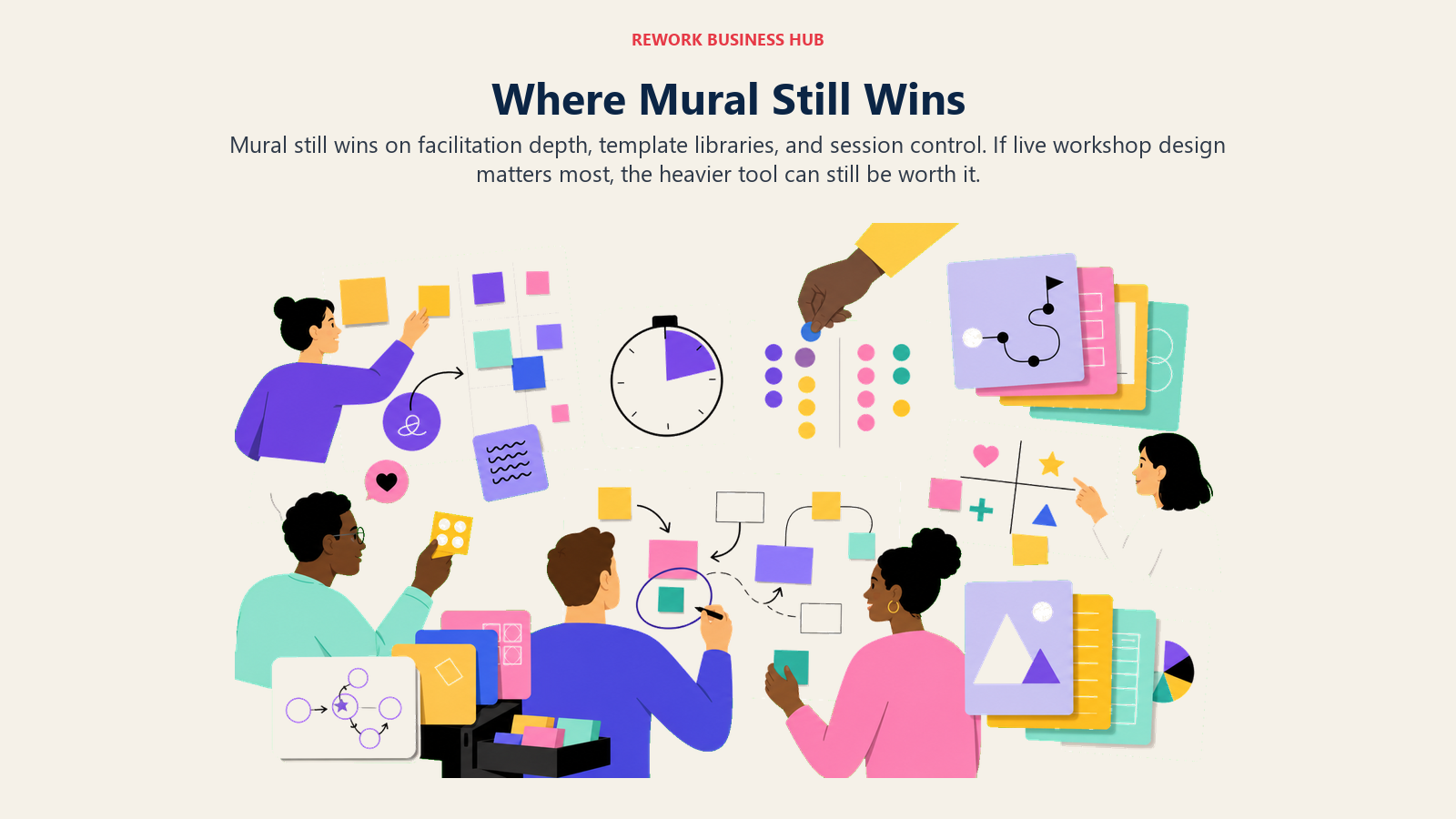
Mural's own Facilitation Superpowers feature set, confirmed on its features page, is more complete than any single alternative here: a timer, Private Mode to avoid groupthink, anonymous voting, Summon to pull the group back to the facilitator's spot on the canvas, Take Control, a laser pointer, hide-cursors for large groups, Facilitator Lock, custom visitor avatars, and publish-ready templates. Layer on Mural's method library, built with facilitation notes for retrospectives, journey mapping, empathy mapping, and Design Sprints, closer to a sprint retrospective or affinity diagram run by a professional facilitator than a blank canvas, and the case is clear: it's the deepest facilitation product in the category. Klaxoon comes closest on structure and live activity depth; nothing else here fully matches Mural's method-library breadth.
The honest recommendation: if your team's problem is that facilitation quality genuinely matters and everyone in the room uses the tool weekly, don't leave Mural over price. If your problem is that most of your paid seats belong to people who show up four times a year, that's what the alternatives above actually solve.
Facilitation Feature Parity Table
How Mural's closest four alternatives stack up on the controls facilitators actually rely on, not just feature-name checklists.
| Feature | Mural | Miro | FigJam | Lucidspark | Klaxoon |
|---|---|---|---|---|---|
| Timer | Yes, time-boxes any activity | Yes, board-wide countdown | Yes, with optional music cue | Yes, countdown with quick-add presets | Yes, on meeting/activity boards |
| Private or anonymous mode | Yes, Private Mode hides input until reveal | Yes, Private Mode | Partial, votes and cursors hide during a voting session only | Yes, Private Mode hides new stickies until host reveals | Partial, anonymous ideation rounds, no standalone private canvas mode |
| Voting | Yes, anonymous voting | Yes, up to 99 votes per person, anonymous | Yes, stamp-based voting | Yes, configurable vote limits | Yes, Live Vote: single-choice, rating, yes/no |
| Summon or follow participants | Yes, Summon plus Take Control | Yes, via attention management and laser pointer | No dedicated summon, cursor chat only | Yes, Follow Presenter and Take the Lead | Partial, facilitator-led activity flow, no named summon control |
| Templates and method library | Yes, deep facilitation-note method library | Yes, large general template library | Yes, workshop templates: retros, journey maps | Yes, template library paired with Lucidchart | Yes, activity-app based: Challenge, Vote, Storm |
Read the "Summon or follow participants" row and the gap is obvious: FigJam has no equivalent, the honest reason it's a cost fix, not a facilitation-parity fix.
Stage Fit Matrix
| Tool | Startup (1-20) | Growth (20-100) | Mid-Market (100-500) | Enterprise (500+) |
|---|---|---|---|---|
| Miro | Good | Best fit | Good | Works |
| FigJam | Best fit | Good | Moderate | Works |
| Lucidspark | Weak | Moderate | Best fit | Strong |
| Klaxoon | Moderate | Good | Best fit | Moderate |
| Excalidraw | Best fit | Good | Good | Works (self-hosted) |
| Whimsical | Best fit | Good | Moderate | Weak |
| Conceptboard | Weak | Moderate | Best fit | Good |
| Boardmix | Best fit | Good | Moderate | Weak |
| Milanote | Best fit | Good | Moderate | Weak |
| Microsoft Whiteboard | Weak | Weak | Moderate | Best fit |
| Apple Freeform | Best fit | Good | Weak | Weak |
Sizing and Persona Table
| Tool | Ideal Team Size | Primary Buyer | Secondary Users |
|---|---|---|---|
| Miro | 20-500 | Design or product manager | Cross-functional teams |
| FigJam | 5-50 designers | Design manager | PMs, engineers in reviews |
| Lucidspark | 50-500 | IT director, ops lead | Business analysts, architects |
| Klaxoon | 10-300 | L&D manager, agile coach | Facilitators, HR, strategy teams |
| Excalidraw | 2-100 engineers | Engineering manager, CTO | DevOps, architects |
| Whimsical | 1-30 | PM, individual contributor | Founders, content strategists |
| Conceptboard | 10-200 (EU) | Compliance or IT lead | Regulated project teams |
| Boardmix | 1-50 | Ops lead, founder | Small marketing or product teams |
| Milanote | 1-30 | Creative or content lead | Brand designers, writers |
| Microsoft Whiteboard | 500+ | IT admin | Any Microsoft 365 user |
| Apple Freeform | 1-20 | Founder, small team lead | Any all-Apple team |
How to Choose: Decision Framework
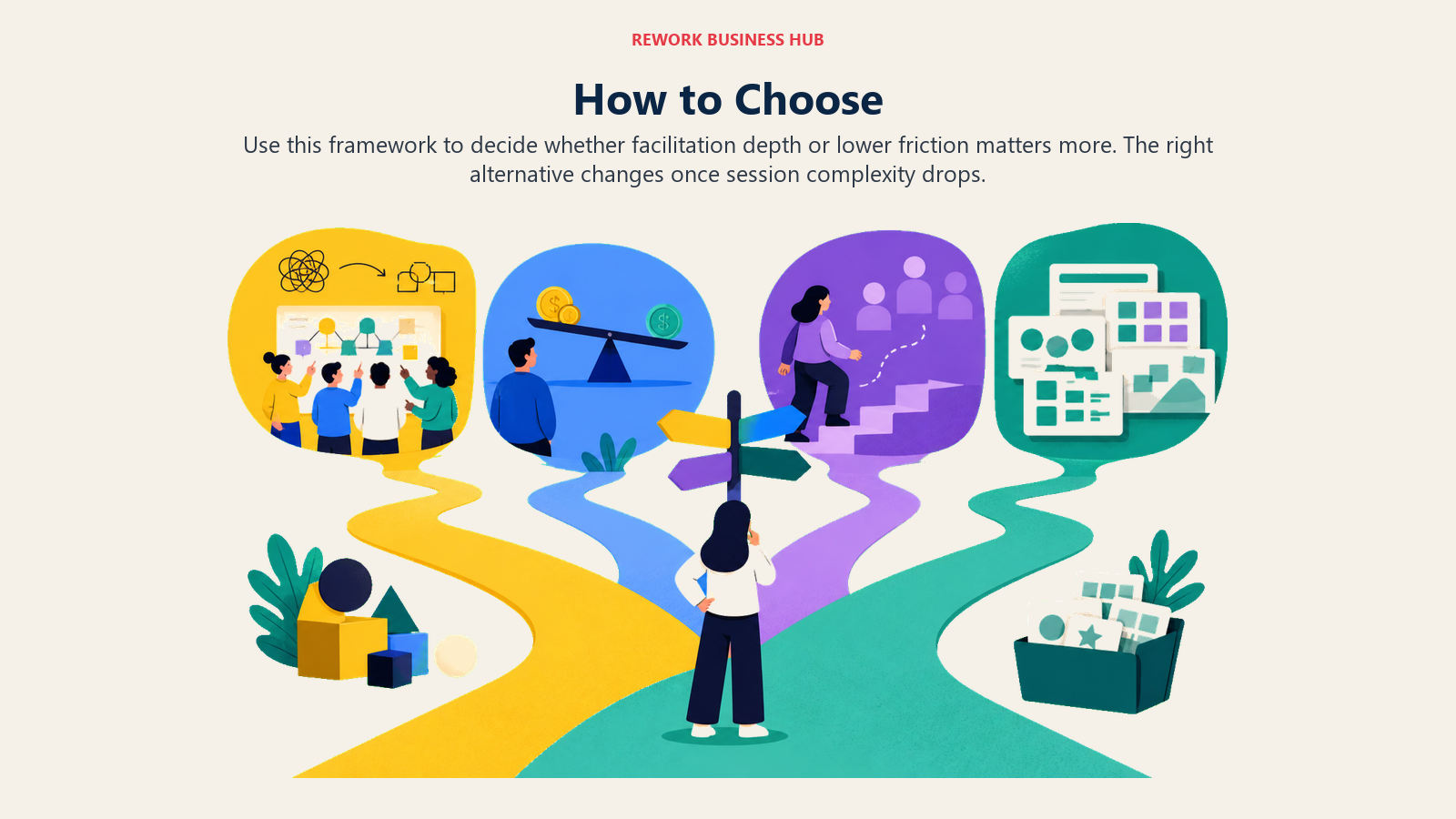
The choice comes down to whether your team needs facilitation depth or a lower-friction board tool. That makes the decision feel more like an operating model call than a feature count.
| If You Need... | Pick This |
|---|---|
| Mural's facilitation depth without paying for every occasional attendee | Klaxoon |
| Miro's broader ecosystem at a slightly lower entry price | Miro |
| The cheapest real paid seat, and you already run on Figma | FigJam |
| Brainstorming that connects directly into structured diagramming | Lucidspark |
| Zero seat cost and don't need any facilitation controls | Excalidraw or Apple Freeform |
| A fast, focused tool for a small team, not a large workshop | Whimsical |
| EU data residency for compliance reasons | Conceptboard |
| The lowest possible entry price with optional AI add-ons | Boardmix |
| Asynchronous creative and content planning, not live sessions | Milanote |
| Basic whiteboarding already covered by an existing Microsoft 365 license | Microsoft Whiteboard |
| The deepest facilitation toolkit and a team that uses it weekly | Stay on Mural |
Frequently Asked Questions about Mural Alternatives
What is the cheapest real alternative to Mural?
FigJam's Collab seat at $3/month is the cheapest paid tier here, and Excalidraw's open-source core and Apple Freeform are both free with no tier at all. The tradeoff is facilitation depth: none of the three match Mural's timer, voting, summon, and method-library combination.
Why do teams actually leave Mural?
Not the sticker price, usually, it's the per-member billing model applied to occasional participants. A team with 6 weekly facilitators and 44 people who join a session a few times a year pays for 50 full seats, even though most see only a few hours of use annually.
Is Klaxoon really comparable to Mural on facilitation?
Close, not identical. Klaxoon matches Mural on timers, voting, and structured session flows, and it prices by host instead of by every participant, which directly fixes the occasional-attendee cost problem. Mural still leads on template and method-library depth.
Is Microsoft Whiteboard still free?
Only for organizations on a Microsoft 365 business or education license, where it remains included at no extra cost. As of today, personal Microsoft accounts can no longer create or edit legacy Whiteboard boards, and those boards are permanently deleted starting 5 September 2026.
What happened to Google Jamboard and InVision Freehand?
Both are gone. Google retired Jamboard on 31 December 2024 and pointed customers to FigJam, Lucidspark, and Miro. Miro separately acquired InVision's Freehand before InVision shut down its design-collaboration business that same year. Neither belongs on a current alternatives list.
Which alternative is best for a large company with mostly occasional participants?
Klaxoon's per-host model is the structural fix, since occasional participants join sessions without their own paid seat. FigJam's $3 Collab seat is the next-best option if per-person billing is fine as long as it's cheap.
Should we just stay on Mural?
If most paid seats belong to people who genuinely use the tool every week, the per-member cost isn't actually a problem, and Mural's facilitation depth is still the strongest here. Switch only if the occasional-participant math above matches your actual seat list.
What to Do Next
Pull your actual Mural seat list and sort it by login frequency over the last twelve months. If most of the cost sits with people who logged in twice or fewer, pilot Klaxoon (or FigJam, if you're Figma-heavy) on your next real session, not a test board, and compare the bill against what Mural would have charged the same group. If your seat list is mostly weekly facilitators, Mural is priced correctly for how you use it, and the fix is elsewhere.

Principal Product Marketing Strategist
On this page
- Key Facts
- Why Teams Leave Mural
- Quick Comparison Table
- 1. Miro - The Broadest Swap, With the Same Seat-Cost Pattern
- 2. FigJam - Cheapest Real Paid Seat, If Your Team Already Lives in Figma
- 3. Lucidspark - Enterprise Diagram Pairing, Team Price Not Vendor-Published
- 4. Klaxoon - The Closest Like-for-Like on Facilitation, Priced by Host
- 5. Excalidraw - Free, Open Source, No Facilitation Layer
- 6. Whimsical - Small Teams, Fast, Not Built for Large Sessions
- 7. Conceptboard - European Teams With Data-Residency Requirements
- 8. Boardmix - Cheapest Paid Seat, AI Tiers Cost More
- 9. Milanote - Not a Live Facilitation Tool, and That's Fine for Some Teams
- 10. Microsoft Whiteboard - Free Today Only if You're Already on Microsoft 365
- 11. Apple Freeform - Genuinely Free, Apple Devices Only
- Where Mural Still Wins
- Facilitation Feature Parity Table
- Stage Fit Matrix
- Sizing and Persona Table
- How to Choose: Decision Framework
- What to Do Next