Miro vs FigJam: Which Whiteboard Fits Your Team in 2026?
Turn this article into takeaways for your work.


Each assistant summarizes the article only for you and suggests best practices for your work.
If you're a design lead, product lead, ops lead or founder putting a whiteboard tool in front of a team, Miro and FigJam are the two names that keep showing up on the same shortlist. But they are not priced on the same axis at all, and that fact should shape how you even run the evaluation. Miro sells you a whiteboard directly: every person gets a seat, priced per member, on a plan built around the whiteboard itself. FigJam does not have its own standalone plan. Figma sells it as a Collab seat bundled inside a Figma plan, priced at $3 to $5 a month depending on which Figma tier you're on.
That structural difference means the real question isn't "which whiteboard is cheaper per seat." It's "does your company already own Figma?" If it does, FigJam is close to the cheapest whiteboard you can add to the stack. If it doesn't, you're not buying a whiteboard, you're buying into Figma's entire seat model to get one. This guide walks through what each tool is built for, what they actually cost at real team sizes, and where the honest tradeoffs sit. If you're weighing more than these two names, our roundup of the best online whiteboard software in 2026 covers the wider field.
TL;DR
| Miro | FigJam | |
|---|---|---|
| What it is | Standalone digital whiteboard, sold as its own product and its own plan | Figma's whiteboard, sold as a Collab seat inside a Figma plan |
| How you buy it | Directly, per member, on Miro's own pricing page | Indirectly, as a $3 to $5/mo seat add-on to a Figma Professional, Organization or Enterprise plan |
| Entry price | Starter at $8/member/mo billed yearly ($10/mo billed monthly) | Collab seat at $3/mo on Professional (Figma's cheapest paid plan) |
| Free tier limit | Unlimited boards, but only the 3 most recent stay editable | Included in Figma's free Starter plan, capped at 3 FigJam files, one page each |
| Best for | Teams that want a whiteboard as a standalone, dedicated tool, independent of any other software purchase | Teams already paying for Figma seats who want whiteboarding folded into that spend |
| Biggest cost trap | Business tier at $20 to $25/mo per member adds up fast past 25 to 30 seats | The $3 to $5 Collab seat looks free until you count what it costs to stand up Figma from zero |
| AI included | Miro Assist, credit-based, scales from 10 credits/mo on Free to 50/member/mo on Business | Figma AI, credit-based, 500 AI credits/mo bundled into every Collab seat |
| Ecosystem | A dedicated visual collaboration product with its own integration marketplace | Lives inside the same file browser as Figma Design, Figma Slides and Figma Sites |
Key Facts
- Miro reported passing 100 million users worldwide and 250,000 companies at its Canvas 25 event on October 14, 2025, according to Miro's own newsroom.
- Figma's Q2 2026 revenue grew 48% year over year to $370.1 million, with 15,964 paid customers carrying more than $10,000 in annual recurring revenue, up 34% year over year, per Figma's official Q2 2026 financial results.
- Google retired Jamboard on December 31, 2024, after taking it view-only on October 1, 2024, and explicitly pointed customers to FigJam, Lucidspark and Miro as replacements, according to Google Workspace's own updates blog.
- The collaborative whiteboard software market was valued at USD 3.81 billion in 2026 and is forecast to reach USD 9.59 billion by 2031, a CAGR of 20.28%, per Mordor Intelligence.
- Both tools carry the same 4.6 out of 5 average rating on G2, though the sample sizes are wildly different: Miro has 13,189 reviews to FigJam's 462, per G2's Miro reviews page and G2's FigJam reviews page.
What Each One Is Actually Built For
Miro exists as its own product, with its own onboarding, its own admin console and its own reason for a company to sign a contract. It was built for the specific job of being a shared visual workspace: workshops, roadmapping, retros, diagramming, sticky-note brainstorms, all in one canvas that anyone in the company can be invited into without needing any other piece of software.
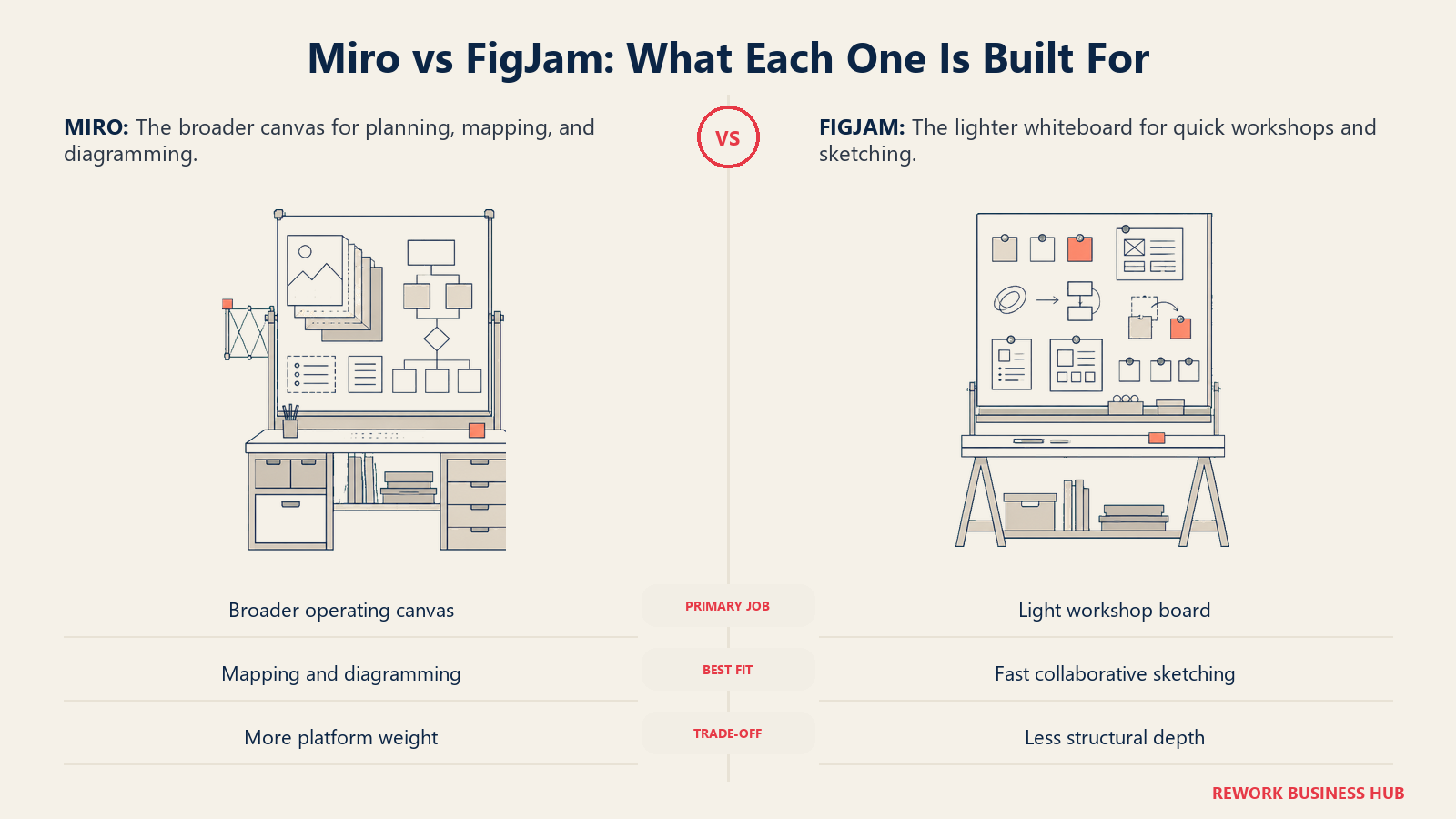
FigJam exists inside Figma. It was built as the whiteboard companion to a design tool, and it still carries that DNA. It's the natural place for a product team to sketch a flow next to the actual screens being designed, hand a rough wireframe straight into a Figma Design file, or run a workshop where the outputs need to land inside the same file browser as the product's UI. If your team already lives in Figma for product or brand work, FigJam removes the "switch tools to whiteboard" step entirely.
| Dimension | Miro | FigJam |
|---|---|---|
| Primary use case | General-purpose visual collaboration: workshops, planning, diagramming, brainstorming | Whiteboarding tied to a design and product workflow inside Figma |
| Who typically buys it | Ops leads, PMOs, agile coaches, IT or workplace teams rolling out a company-wide tool | Design and product teams already on a Figma plan, extending it to include planning |
| Where it lives in the stack | Standalone, its own login, its own admin panel | Inside Figma's file browser, next to Figma Design, Slides and Sites |
| Ideal team size to adopt | Any size, from a 10-person startup to a 10,000-seat enterprise | Any size that already has Figma seats; awkward to justify from zero |
| Non-designers on the team | Fully first-class; Miro was never designer-specific | Fully usable, since FigJam doesn't require design skill, but it still sits inside a design-first product |
The practical split: if your company doesn't touch Figma at all today, and whiteboarding is the whole ask, Miro is the more natural standalone purchase. If your design or product org already runs on Figma, adding FigJam is closer to flipping on a feature than buying a new tool. For teams evaluating the Figma side of that equation more broadly, our guide to Figma alternatives covers what else competes for that same design-tool budget.
Pricing at 10, 25 and 100 Seats
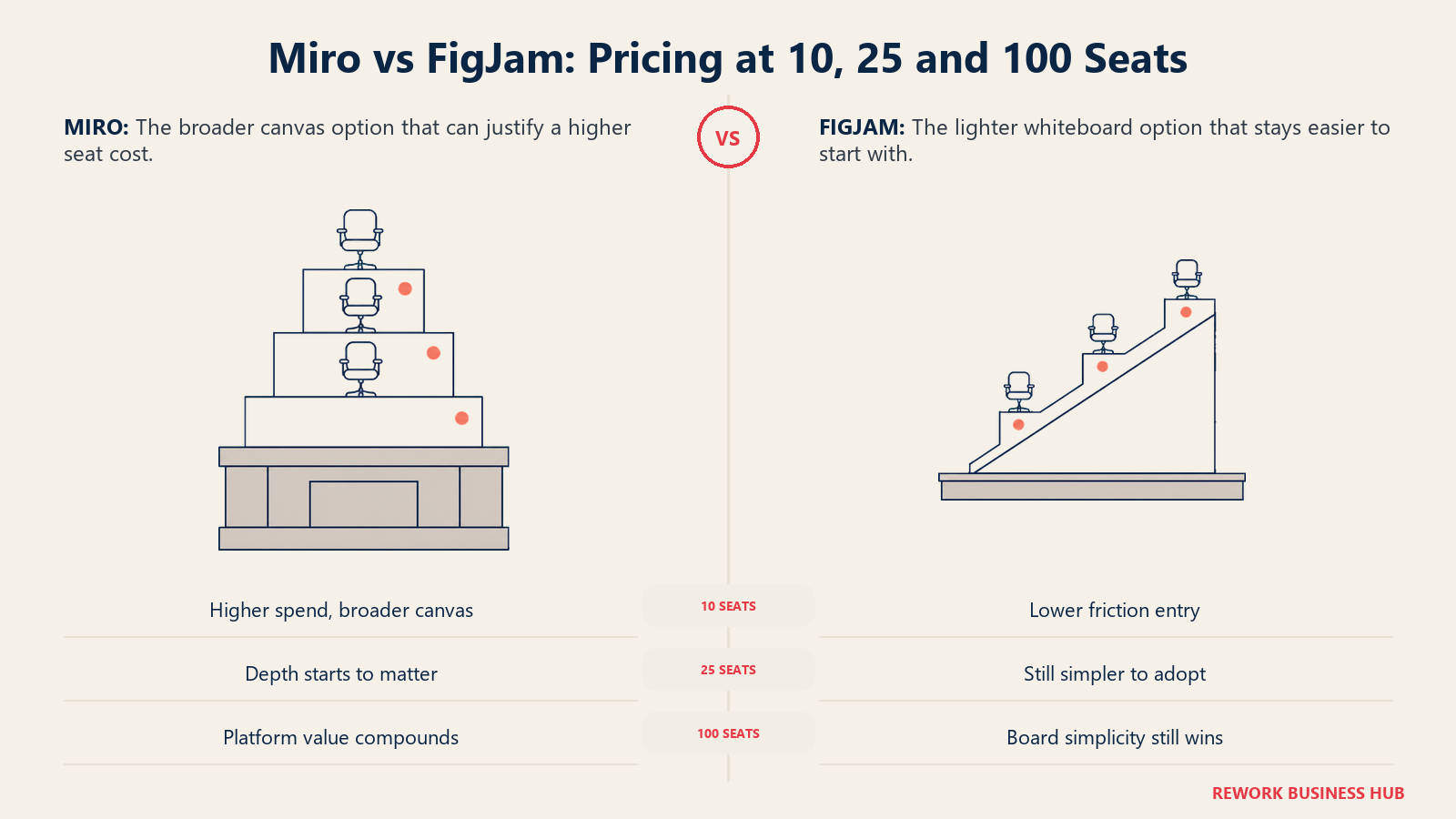
This is the section worth bookmarking, because the two vendors don't price the same thing. Miro prices a whiteboard. Figma prices a design platform, and FigJam rides along as one seat type inside it.
Miro's published tiers, per Miro's own pricing page:
| Tier | Price | Billing | AI credits included | What it unlocks |
|---|---|---|---|---|
| Free | $0 | N/A | 10 credits/mo, shared, limited trial | Unlimited boards, but only the 3 most recent stay editable |
| Starter | $8/member/mo | Billed yearly ($10/member/mo billed monthly) | 25 credits/member/mo | Unlimited editable boards, templates, core formats (Docs, Tables, Slides, Kanban) |
| Business | $20/member/mo | Billed yearly ($25/member/mo billed monthly) | 50 credits/member/mo | AI workflows and agents, interactive prototypes, Engage activities |
| Enterprise | Custom | Custom, from 30 members | Starts from 2,500 credits/mo, scales with seat count | Admin controls for AI, advanced governance, custom contract terms |
FigJam's published tiers, sold as a Collab seat inside Figma, per Figma's own pricing page:
| Figma plan | Collab seat price | Full (designer) seat | Dev seat | AI credits per Collab seat |
|---|---|---|---|---|
| Starter (free) | Included | Included, capped at 3 Figma Design files and 3 FigJam files | Included | Limited |
| Professional | $3/mo | $16/mo | $12/mo | 500 credits/mo |
| Organization | $5/mo | $55/mo | $25/mo | 500 credits/mo |
| Enterprise | $5/mo | $90/mo | $35/mo | 500 credits/mo |
Notice that Figma's page lists one flat rate per seat type and plan rather than splitting monthly versus annual billing the way Miro does. Treat $3, $5, $16, $55 and $90 as Figma's stated per-seat monthly rates. The free-tier file cap comes straight from Figma's own help center: 3 Figma Design files capped at 3 pages each, and 3 FigJam files capped at a single page each, with unlimited private drafts on top.
What that means at real seat counts, Miro side. Annual cost, both billing bases:
| Seats | Starter, billed yearly | Starter, billed monthly | Business, billed yearly | Business, billed monthly |
|---|---|---|---|---|
| 10 | $960/yr | $1,200/yr | $2,400/yr | $3,000/yr |
| 25 | $2,400/yr | $3,000/yr | $6,000/yr | $7,500/yr |
| 100 | $9,600/yr | $12,000/yr | $24,000/yr | $30,000/yr |
A 100-seat team sits right at Miro's Enterprise threshold of 30-plus members, so in practice a company that size is more likely to be routed into a custom Enterprise quote than to pay list Business pricing. Treat the 100-seat Business row as a reference ceiling, not a guaranteed number.
What that means at real seat counts, FigJam side. This assumes your company is already paying for a Figma plan and is only adding Collab seats for people who need FigJam and nothing else in Figma:
| Seats | Professional ($3/mo) | Organization ($5/mo) | Enterprise ($5/mo) |
|---|---|---|---|
| 10 | $360/yr | $600/yr | $600/yr |
| 25 | $900/yr | $1,500/yr | $1,500/yr |
| 100 | $3,600/yr | $6,000/yr | $6,000/yr |
At every seat count, the Collab-seat-only math is dramatically cheaper than Miro. That's the number every "FigJam is basically free" claim is built on, and it's accurate, with one enormous condition attached: it only holds if you're already on a paid Figma plan for other reasons.
The condition that changes everything: do you already own Figma? Here's the honest version of that math for a 25-person team with zero existing Figma footprint:
| Scenario | What you're actually paying for | Annual cost at 25 seats |
|---|---|---|
| Already on Figma Professional, adding FigJam to the design team's existing seats | Just the Collab seat add-on for people who don't already have a Full or Dev seat | $900/yr (25 Collab seats at $3/mo) |
| Starting from zero, standing up a new Figma Professional workspace to get FigJam | At least one paid Full or Dev seat to administer the workspace, plus Collab seats for everyone else | Roughly $192/yr (1 Full seat) + $864/yr (24 Collab seats) = about $1,056/yr |
| Miro Starter, standalone, no other software required | 25 members on Miro's own plan | $2,400/yr billed yearly |
Even the "starting from zero" FigJam number comes in under Miro Starter for this example, because Collab seats are genuinely cheap. But notice what changed: the "starting from zero" scenario isn't a pure whiteboard purchase anymore. It's standing up a Figma organization, appointing an admin, and living inside Figma's file and folder structure just to get a whiteboard. Figma doesn't publish a hard minimum seat requirement to activate a paid plan, so treat the one-Full-seat assumption above as a planning estimate, not a platform rule, and confirm the exact minimum with Figma before budgeting.
The upshot: for a team that already has Figma seats for design work, adding FigJam is nearly a rounding error. For a team with no Figma presence at all, Miro's pricing model, one product, one plan, one bill, is the simpler and more predictable purchase, even though the raw per-seat number is higher.
Canvas and Whiteboarding Features Compared
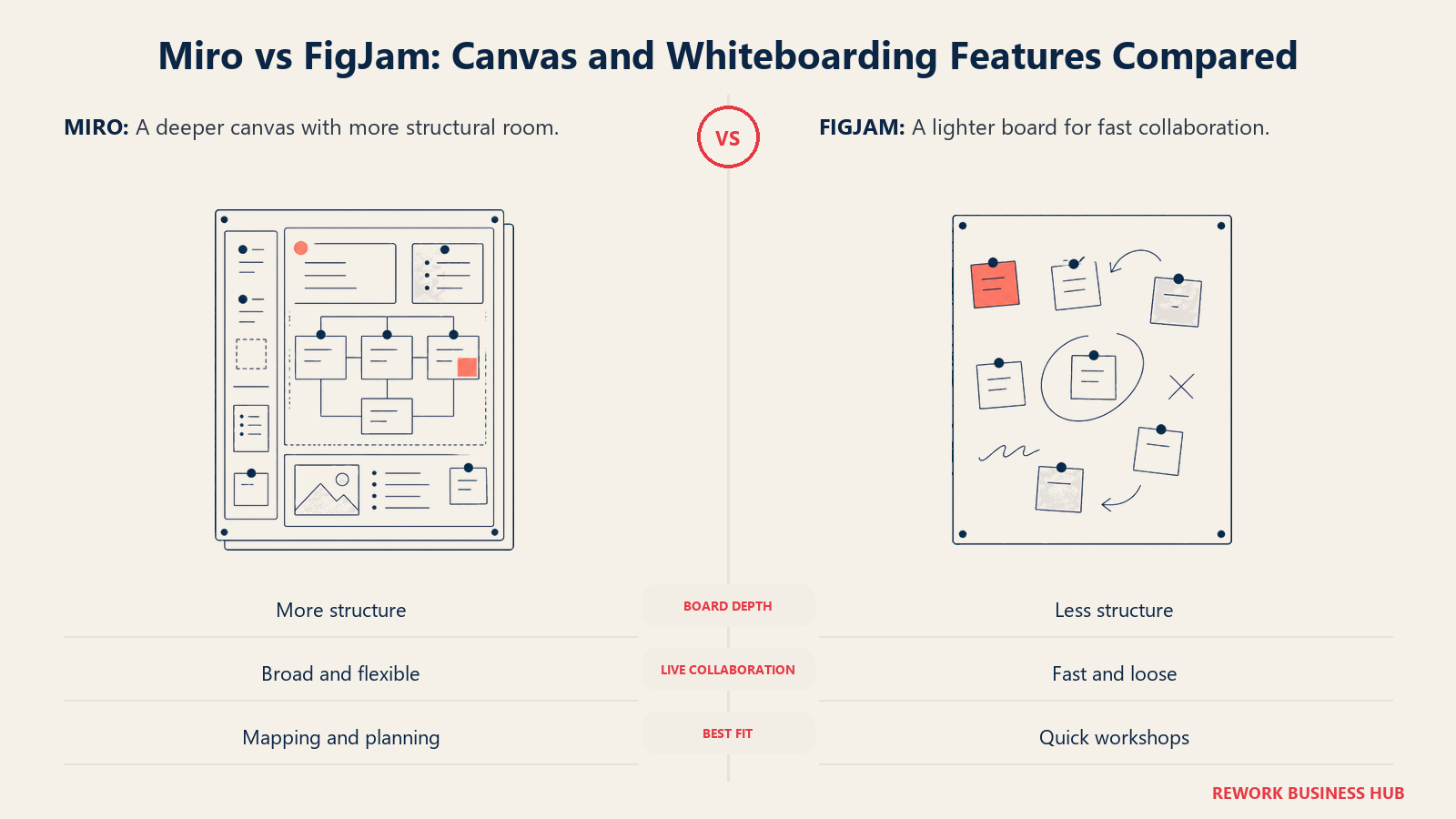
Both tools give you an infinite canvas, sticky notes, shapes, freehand drawing, real-time cursors and comments. Where they diverge is in canvas-native depth versus design-file proximity.
| Feature | Miro | FigJam |
|---|---|---|
| Infinite canvas | Yes | Yes |
| Sticky notes and clustering | Yes, with AI-assisted grouping on Business and above | Yes, with native stamps, reactions and voting |
| Freehand drawing | Yes | Yes |
| Shape and connector library | Extensive, purpose-built for diagramming | Present, lighter than Miro's dedicated shape libraries |
| Embed external content (docs, video, links) | Yes, broad embed support | Yes, plus direct drag-in from Figma Design files |
| Native format variety | Docs, Tables, Slides, Kanban boards, all inside the same product | FigJam files sit alongside Figma Design, Slides and Sites in one file browser |
| Cursor chat and live reactions | Yes | Yes |
| Sticky-to-structured-content conversion | AI-assisted, turns clusters into tables or docs on paid tiers | Manual grouping, with AI-assisted summarization on Figma AI-enabled plans |
The practical difference shows up when a workshop output needs to become something else. In Miro, a sticky-note cluster can turn into a Table or a Doc without leaving the product. In FigJam, the natural next step is dragging elements straight into a Figma Design file, because that's the tool sitting one tab over. Neither is objectively deeper, they're just optimized for different next steps.
Diagramming, Templates and Frameworks
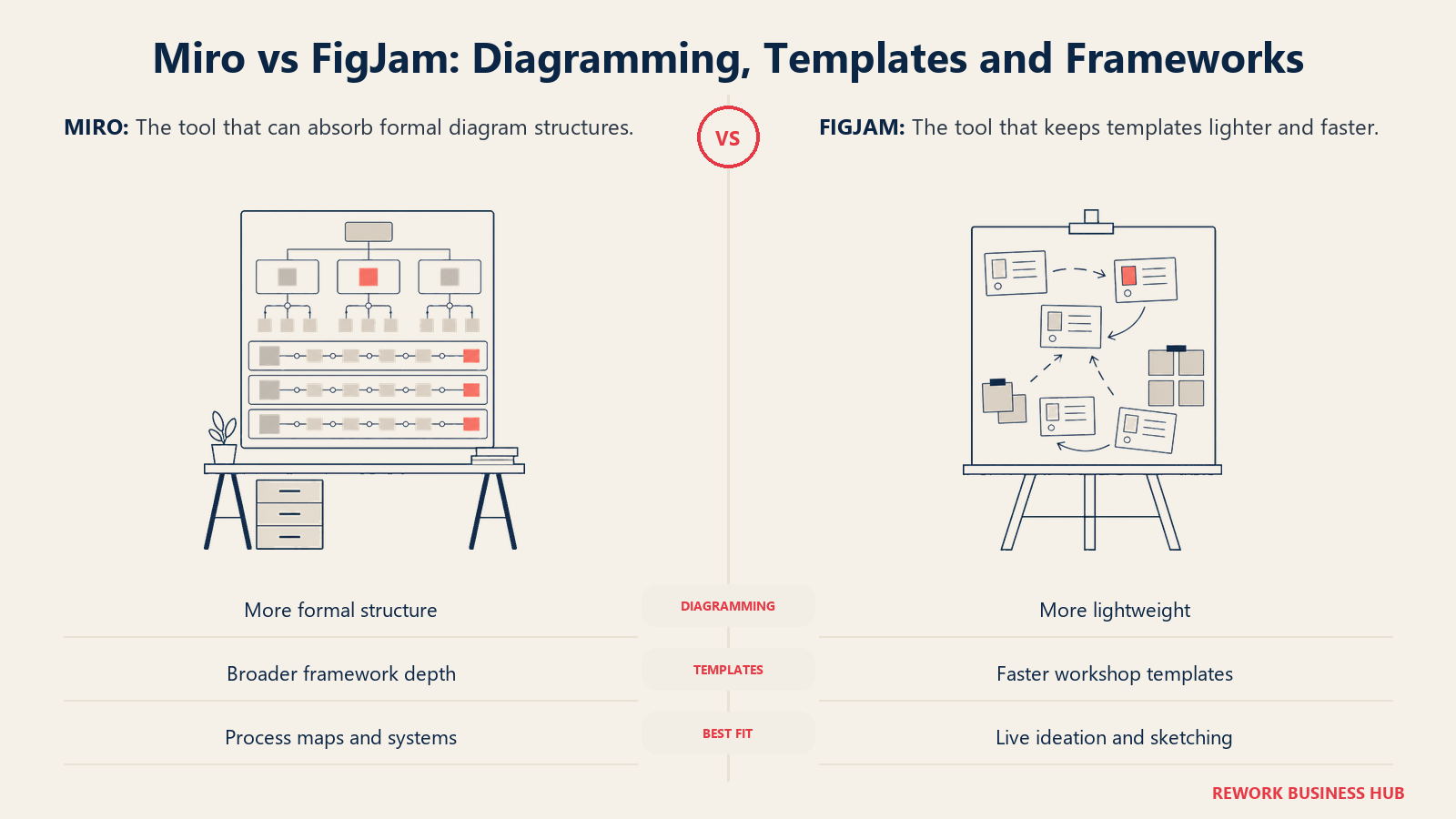
Miro ships with a large, general-purpose template library spanning strategy, product, engineering, HR and marketing use cases, plus a marketplace of community and partner templates. FigJam's template library leans toward product and design workflows, since it's built for teams already thinking in Figma's design-file mental model.
| Capability | Miro | FigJam |
|---|---|---|
| Built-in template count | Hundreds, spanning most business functions | Dozens, weighted toward product, design and facilitation use cases |
| Flowcharts and diagramming | Strong, purpose-built shape and connector tooling | Present, adequate for lightweight flows, not a dedicated diagramming tool |
| Mind mapping | Native mind map format | Supported through freeform shapes and connectors, no dedicated mind map format |
| Affinity mapping / clustering exercises | Native template plus AI-assisted grouping | Native template, manual grouping |
| Retrospective templates | Extensive, including timed retro formats | Present, commonly used for sprint reviews given the product-team audience |
| Framework templates (SWOT, business model canvas, etc.) | Deep library across strategy and product frameworks | Lighter, more design- and product-specific |
If your team runs frequent affinity-mapping exercises to cluster raw research or feedback into themes, our guide to running an affinity diagram covers the method regardless of which tool you run it in. And if flowcharting or precise diagramming is the main job, neither tool was built to be a dedicated diagram engine the way Lucidchart alternatives are, so it's worth checking that category too before committing.
Facilitation and Meeting Features
This is where "whiteboard" and "meeting tool" start to blur, and it's a real differentiator once a team runs regular live sessions on either platform.
| Facilitation feature | Miro | FigJam |
|---|---|---|
| Built-in timer | Yes | Yes |
| Voting and dot-voting | Yes | Yes |
| Private mode (participants work unseen until reveal) | Yes | Yes |
| Follow / spotlight mode (presenter drives everyone's view) | Yes | Yes |
| Breakout boards for sub-groups | Yes, on Business and above | Limited, no dedicated breakout-board feature |
| Video and audio built into the canvas | Yes, via Miro's Talktrack and Huddles | No native audio/video; FigJam relies on external call tools screen-shared alongside it |
| Facilitator-specific controls (lock objects, manage participants) | Yes, extensive facilitator toolkit | Present, lighter-weight than Miro's dedicated set |
Teams that run structured workshops, especially recurring ones like sprint retrospectives, tend to notice this gap first. If retros are a big part of why you're evaluating either tool, our guide to running a sprint retrospective is worth reading before you lock in a template, since the facilitation feature set matters as much as the canvas itself for that use case.
Integrations and Where Each One Sits in a Stack
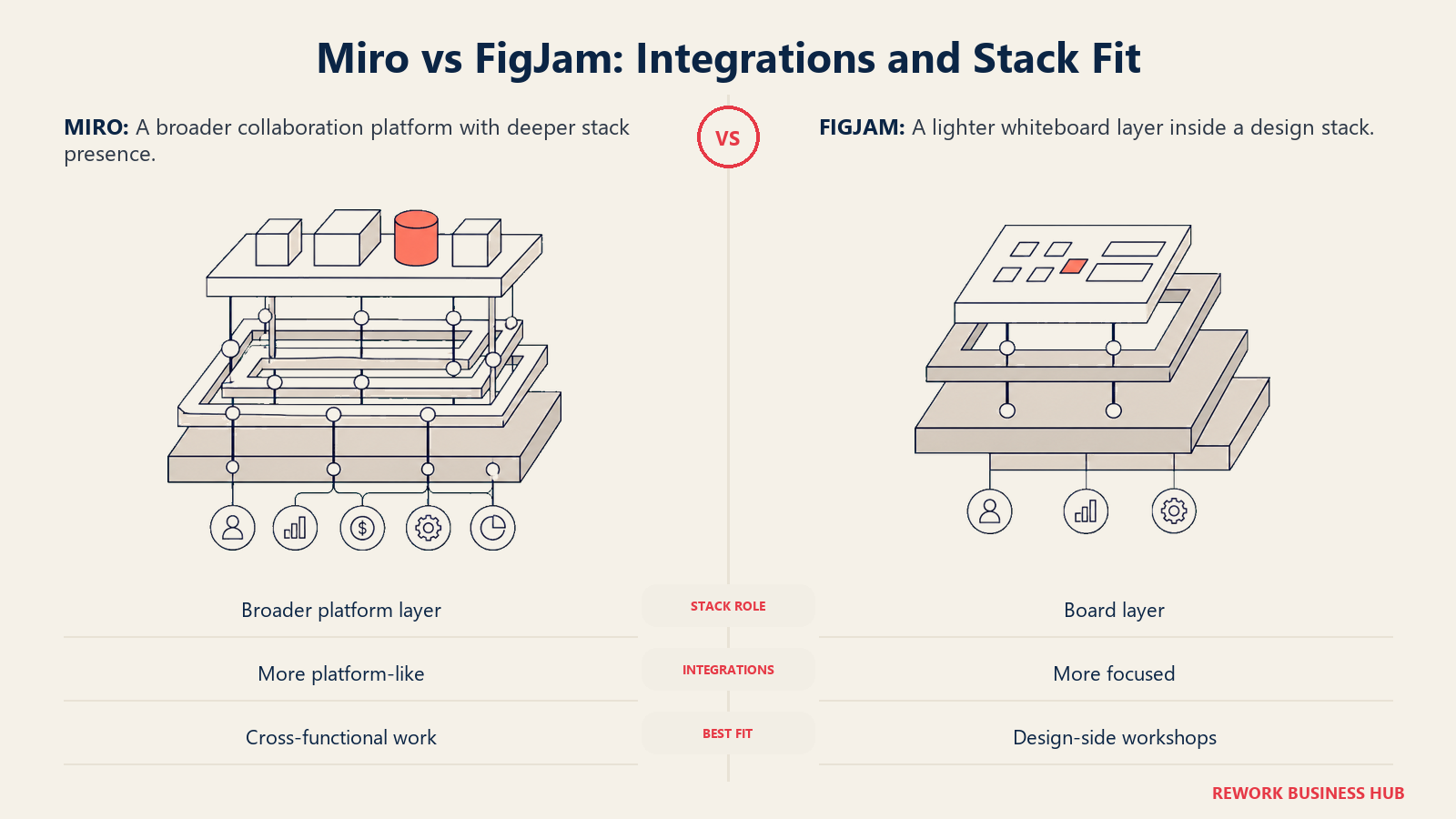
Miro sits outside any single vendor's ecosystem by design, so its integration marketplace spans project management, communication, and productivity tools broadly. FigJam's deepest integration is the one that matters most to its buyers: it's already inside Figma.
| Integration category | Miro | FigJam |
|---|---|---|
| Native tie-in to a design tool | None, Miro is vendor-neutral | Deep, shares a file browser with Figma Design, Slides and Sites |
| Project management tools (Jira, Asana, Monday, etc.) | Broad marketplace of native integrations | Supported through Figma's own integration set, generally lighter |
| Communication tools (Slack, Teams, Zoom) | Native integrations, plus Miro Huddles for built-in calls | Native Slack and similar integrations through Figma |
| Developer handoff | Possible through embeds and third-party connectors | Native, since FigJam boards and Figma Design files live in the same workspace |
| API and custom app development | Yes, Miro Developer Platform | Yes, Figma's plugin and widget API extends to FigJam |
| Single sign-on across the whiteboard and other company tools | Managed independently through Miro's own SSO | Inherits whatever SSO the company already has configured for Figma |
If your stack question is really "which design tool do we standardize on, and does its whiteboard come along for free," that's a broader decision than this article covers alone. Our Figma alternatives roundup is the place to weigh that question on its own terms.
Performance and Board Scale
Large boards are where whiteboard tools most often show their seams, and the two products handle scale differently because they were architected for different primary jobs.
| Scale factor | Miro | FigJam |
|---|---|---|
| Designed ceiling | Very large boards, built to hold dense, long-running strategic workspaces | Built primarily for session-sized boards tied to active design or planning work |
| Typical slowdown point | Boards with many thousands of objects and embedded media can lag without cleanup | Very large FigJam files can slow down similarly to large Figma Design files |
| Board organization tools | Frames, nested boards, and a dedicated board directory for managing many boards at once | Pages within a file, consistent with how Figma Design organizes large projects |
| Archiving and cleanup | Native archiving and board management tools | Standard Figma file and folder management |
Neither vendor publishes a hard object-count ceiling, so board performance in practice depends more on how disciplined a team is about archiving finished work than on a fixed technical limit either way.
AI Features in 2026
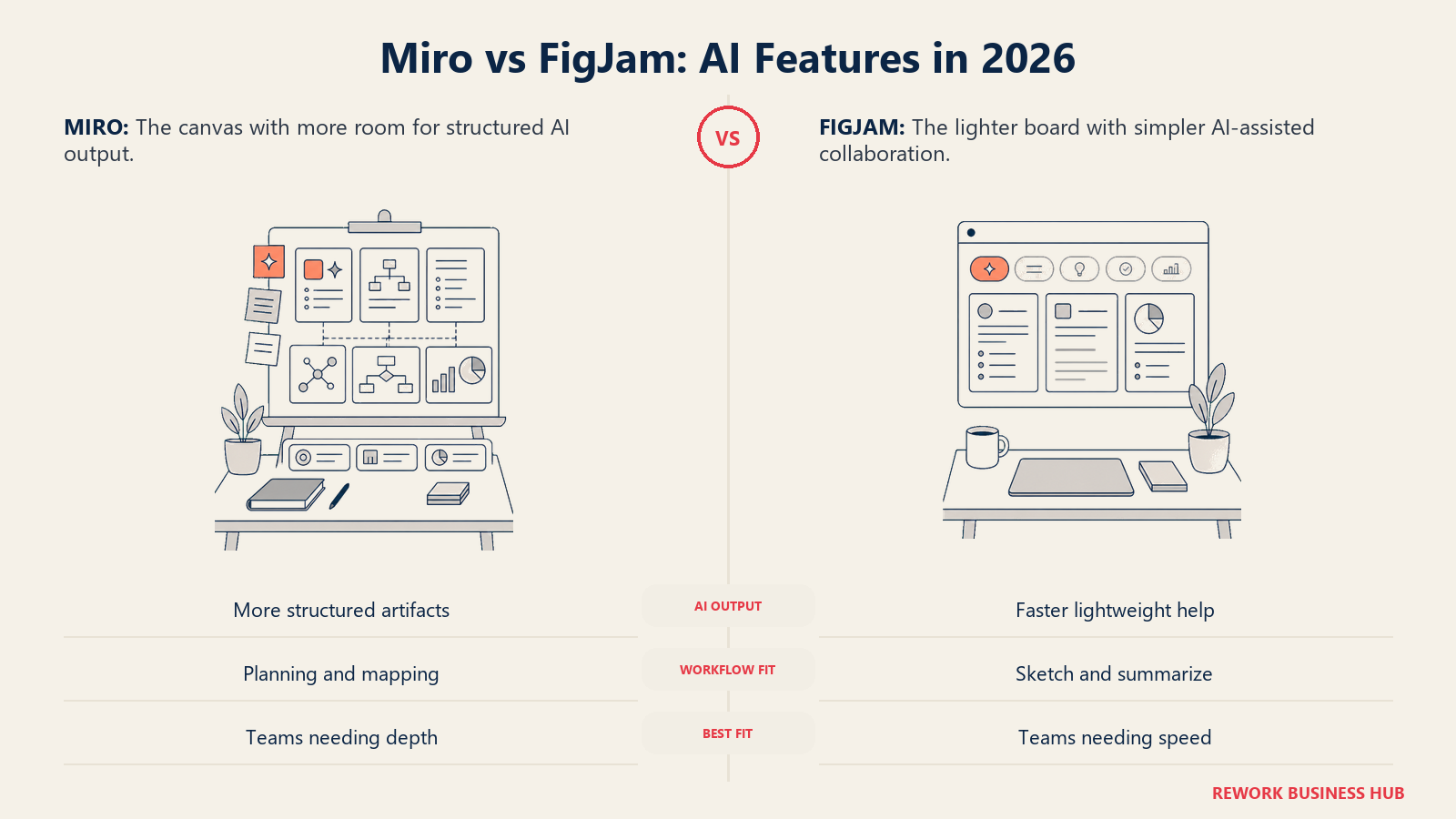
Both platforms now bundle AI into every paid seat, with a credit-based system rather than a flat "AI on or off" toggle.
| AI capability | Miro | FigJam (via Figma AI) |
|---|---|---|
| Credit model | Credits per member per month, scaling by tier | Credits bundled per seat, 500/mo on every Collab seat across Professional, Organization and Enterprise |
| Free tier AI access | 10 credits/mo, shared, limited trial | Limited access on the free Starter plan |
| Paid tier AI credits | 25/member/mo on Starter, 50/member/mo on Business, from 2,500/mo scaling with seats on Enterprise | 500 credits/mo per Collab seat across every paid Figma tier |
| What AI does on the canvas | Summarizes sticky-note clusters into themes, generates diagrams and mind maps from a prompt, cleans up rough sketches, chains multi-step AI workflows via Miro Assist and Flows | Summarizes board content, assists with content generation inside FigJam, and connects to the same AI credit pool used across Figma Design, Slides and Make |
| Admin controls for AI usage | Yes, on Enterprise | Managed at the organization level through Figma's admin console |
| Agent or automation features | AI workflows and agents on Business and above, plus MCP call allowances that scale from 500/day on Starter to 10,000/day on Enterprise | AI credits shared across the whole Figma seat, not FigJam-specific, since the credit pool spans Design, Slides, Make and FigJam together |
The practical difference: Miro's AI credits are metered specifically around whiteboard tasks like clustering and diagram generation. FigJam's AI credits come from the same shared pool a Figma seat uses for design and prototyping work, so a Collab seat's 500 monthly credits are really a slice of a bigger, shared Figma AI allowance rather than a whiteboard-specific budget.
Admin, Security and Governance
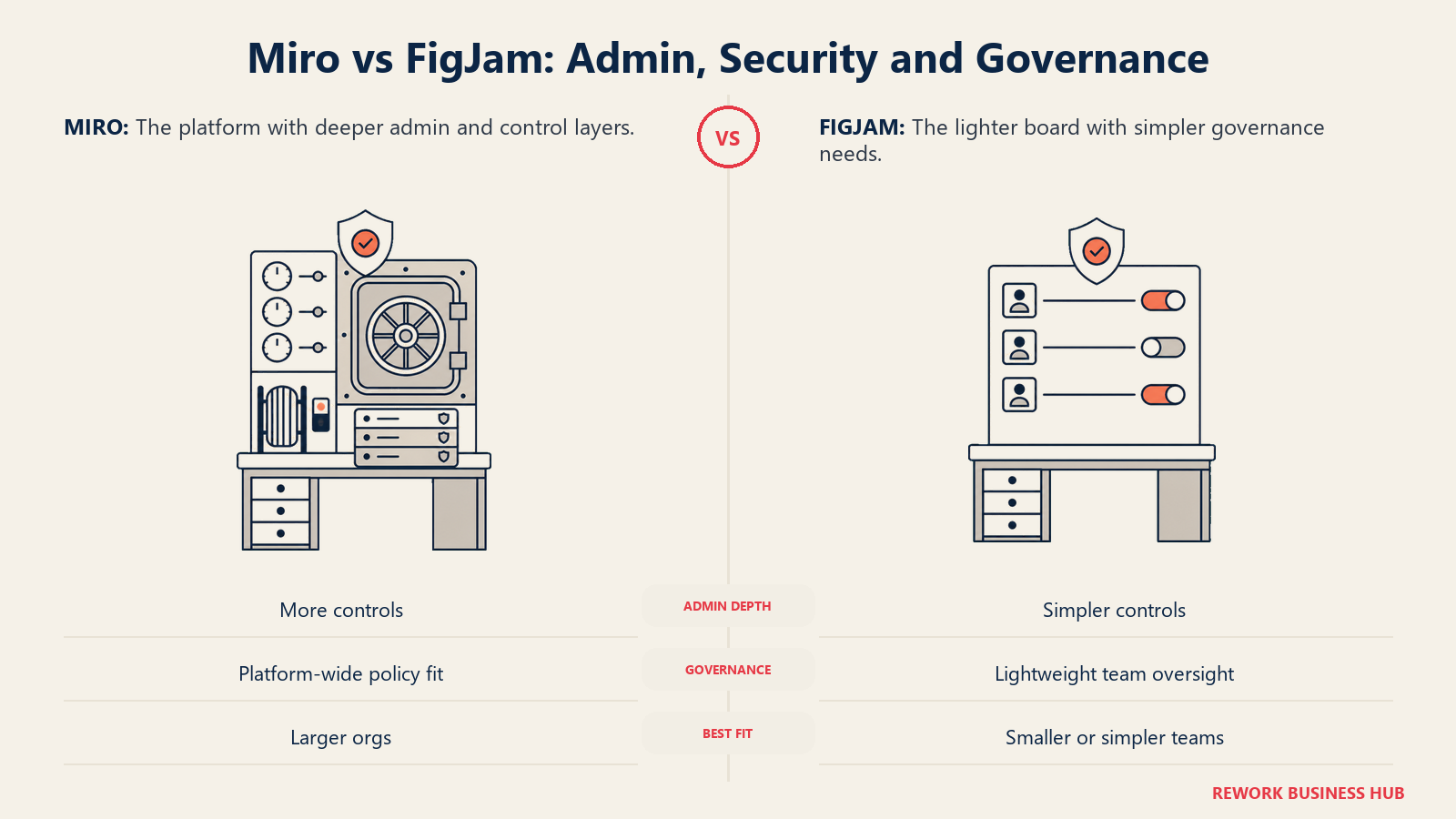
Governance needs usually surface later in a rollout, once IT or security gets involved, and this is one area where the two products' different origins show up clearly.
| Governance area | Miro | FigJam |
|---|---|---|
| SSO / SAML | Available on Business and Enterprise | Inherited from the Figma plan's SSO configuration |
| Admin console | Dedicated Miro admin console, board and content governance tools | Figma's admin console, covering all Figma products including FigJam |
| Data residency options | Available on Enterprise, region-specific hosting options | Governed by Figma's own enterprise data residency options |
| Content export and retention controls | Native board archiving, export, and retention policy tools | Standard Figma file retention and export tools |
| AI admin controls | Enterprise-tier controls for managing organizational AI usage | Managed at the Figma organization level, applies across all Figma products, not FigJam-specific |
| Compliance certifications | Published on Miro's trust and security pages, standard SaaS compliance set | Published on Figma's trust and security pages, applies to the whole platform including FigJam |
Because FigJam's governance model is inherited from Figma as a whole, a security review of FigJam is really a security review of Figma. That can be an advantage if your security team has already vetted Figma and doesn't want to run a second full review for a standalone whiteboard vendor. It can be a disadvantage if the security posture you actually want is scoped narrowly to whiteboarding rather than the entire design platform.
Implementation and Change Management
Rolling either tool out well is less about the software and more about who needs to change habits.
| Factor | Miro | FigJam |
|---|---|---|
| Learning curve for a new user | Low for basic use, moderate to get real value from templates and AI features | Low, especially for anyone already comfortable navigating Figma's interface |
| Training load if the team already uses the "other half" | Full training needed if the team has no whiteboard habit today | Minimal, since FigJam reuses navigation patterns from Figma Design |
| Change management effort | Standalone rollout: new login, new habit, new tool to justify in a budget review | Near-zero rollout for teams already living in Figma; the tool is already one click away |
| Where resistance usually shows up | "Why do we need another tool" from teams with no existing whiteboard habit | "Why are we planning inside our design tool" from teams who prefer a dedicated planning space |
The implementation story mirrors the pricing story almost exactly: Miro asks a team to adopt something new, FigJam asks a team to use more of something they already have. Neither is inherently easier, it depends entirely on which starting point describes your team today.
When Miro Is the Right Call
- Your company has no meaningful Figma footprint, and whiteboarding is the whole ask. Standing up a Figma org just to get a $3 Collab seat rarely makes sense if nobody on the team touches Figma otherwise.
- You run frequent, structured facilitation sessions, especially ones needing breakout boards, built-in video huddles, or a deep facilitator toolkit that goes beyond timers and voting.
- Non-design teams across the company need access, from sales kickoffs to HR onboarding boards to executive strategy sessions, and you want one tool that isn't tied to any single department's software.
- You want AI credits scoped specifically to whiteboard tasks, rather than drawn from a shared pool that also covers design and prototyping work elsewhere in the stack.
When FigJam Is the Right Call
- Your design or product org already pays for Figma seats. Adding FigJam is close to free at $3 to $5 per Collab seat, and it avoids standing up a second vendor relationship entirely.
- Whiteboard output needs to become a Figma Design file, or vice versa, without an export-import step breaking the workflow.
- Your team already lives in Figma's interface, so there's effectively zero training curve to pick up FigJam alongside it.
- You'd rather manage one vendor's security review, SSO configuration, and admin console than run governance separately for a whiteboard and a design tool.
If FigJam is close but not quite the fit, whether on price, feature depth, or the fact that your team doesn't use Figma for design work, our roundup of FigJam alternatives covers the standalone whiteboard options built for that exact gap. And if Miro feels closer but you want to see how it stacks up against another major standalone player, Miro vs Mural is the natural next comparison, alongside our Mural alternatives and Lucidspark alternatives roundups if enterprise diagramming depth is the deciding factor.
Decision Framework
Use this framework to choose the broader canvas when structure, mapping, and platform depth matter, or the lighter board when speed matters more.
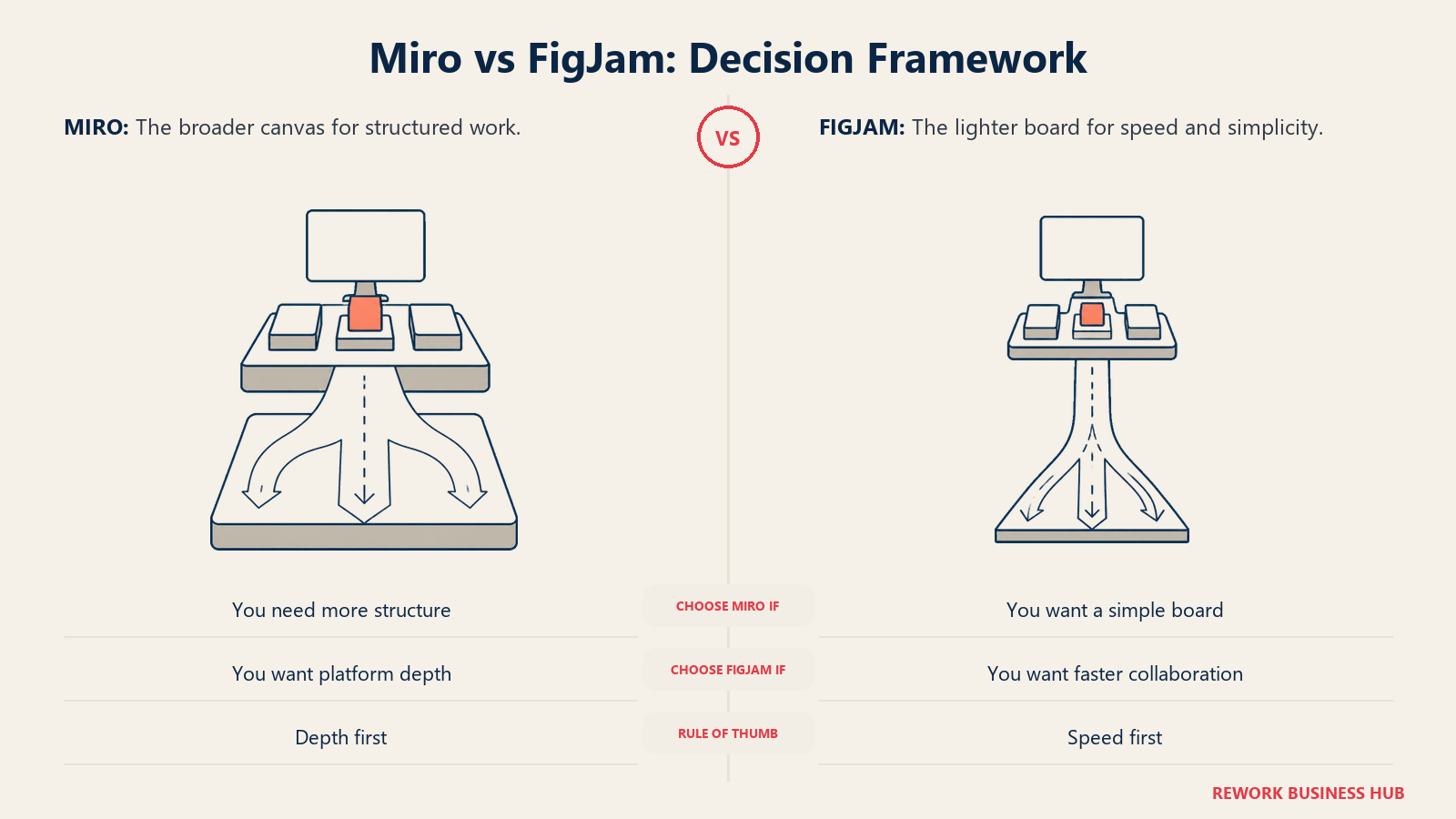
| If you are... | Pick |
|---|---|
| A team with zero Figma seats today, needing a whiteboard as a standalone purchase | Miro |
| A design or product org already paying for Figma Professional, Organization or Enterprise seats | FigJam |
| Running frequent facilitated workshops needing breakout boards and built-in video | Miro |
| Planning work that regularly hands off into Figma Design files | FigJam |
| Rolling a whiteboard out company-wide, across non-design departments | Miro |
| Trying to minimize the number of vendors your security team has to review | FigJam, if Figma is already approved |
| Budget-constrained and comparing raw per-seat cost with existing Figma seats in place | FigJam, the Collab seat math wins at every seat count shown above |
| Budget-constrained with no existing Figma spend to build on | Miro Starter, since it doesn't require standing up a second platform first |
The short version. Neither tool is cheaper in some absolute sense, they're priced on different axes entirely. Miro's price is the whole story: pay per member, get a whiteboard, done. FigJam's price is only part of the story: the $3 to $5 Collab seat is real, but it's a line item inside a Figma bill that may or may not already exist at your company. Answer the "do we already own Figma" question first, and the rest of this decision gets much easier.
What to Do Next
Before comparing another feature, pull your company's current Figma seat count, if any. If it's zero, price out Miro Starter or Business directly at your actual headcount using the tables above. If it's nonzero, ask your Figma admin what it would cost to add Collab seats for the people who need FigJam and nothing else, since that number is almost always smaller than either team expects going in.
Frequently Asked Questions about Miro vs FigJam
Is FigJam actually cheaper than Miro?
Per seat, yes, dramatically: a FigJam Collab seat runs $3 to $5 a month against Miro's $8 to $25 a month. But that comparison only holds if your company already pays for a Figma plan. If you don't, the honest cost of adopting FigJam includes standing up a Figma Professional workspace, which changes the math significantly.
Can you use FigJam without paying for Figma?
Yes, on Figma's free Starter plan, which includes FigJam capped at 3 FigJam files of one page each, alongside 3 Figma Design files. Beyond that limit, FigJam requires a paid Figma plan, since it's sold as a Collab seat rather than as its own standalone product.
What's the difference between Miro's free plan and FigJam's free access?
Miro's free plan allows unlimited boards, but only the 3 most recent stay editable, with older boards becoming view-only. FigJam's free access comes through Figma's Starter plan, which caps teams at 3 FigJam files total, each limited to a single page, rather than capping by recency.
Does Miro or FigJam have better AI features?
They're close in capability but different in structure. Miro's AI credits, from 10/mo on Free up to 50/member/mo on Business, are scoped specifically to whiteboard tasks like clustering sticky notes or generating diagrams. FigJam's 500 credits per Collab seat draw from the same shared pool Figma uses for AI across Design, Slides and Make, so it's a slice of a bigger allowance rather than a whiteboard-specific budget.
Why did Google Jamboard shut down, and does that affect this comparison?
Google retired Jamboard on December 31, 2024, after making it view-only on October 1, 2024, and explicitly pointed customers toward FigJam, Lucidspark and Miro as replacements. It's relevant context because a meaningful share of teams evaluating Miro or FigJam today are migrating off Jamboard specifically, not starting a whiteboard search from scratch.
Is Miro or FigJam better for a large enterprise rollout?
It depends on what's already in the stack. Miro's Enterprise tier, available from 30 members, is built as a standalone enterprise rollout with its own admin console, SSO and data residency options. FigJam's enterprise governance is inherited entirely from Figma's own Enterprise plan, so a large FigJam rollout is really a large Figma rollout, which suits a company that has already standardized on Figma for design work but not one that hasn't.
Can Miro and FigJam boards be moved between the two tools?
There's no native one-click migration between the two formats. Content typically moves through export and manual rebuild, image or PDF export, or third-party conversion tools, rather than a direct import path either vendor publishes.
Which tool is better for non-designers?
Miro was built for a general audience from the start and doesn't assume any design-tool familiarity. FigJam is fully usable by non-designers too, but it lives inside Figma's file browser and interface conventions, so a team with zero exposure to Figma faces a slightly steeper first-use curve than they would with Miro.

Principal Product Marketing Strategist
On this page
- TL;DR
- Key Facts
- What Each One Is Actually Built For
- Pricing at 10, 25 and 100 Seats
- Canvas and Whiteboarding Features Compared
- Diagramming, Templates and Frameworks
- Facilitation and Meeting Features
- Integrations and Where Each One Sits in a Stack
- Performance and Board Scale
- AI Features in 2026
- Admin, Security and Governance
- Implementation and Change Management
- When Miro Is the Right Call
- When FigJam Is the Right Call
- Decision Framework
- What to Do Next