Best Lucidspark Alternatives in 2026: 11 Whiteboards for Diagram-Heavy Teams
Turn this article into takeaways for your work.


Each assistant summarizes the article only for you and suggests best practices for your work.
The best Lucidspark alternatives in 2026 depend on what pulled you toward Lucidspark in the first place: Miro and Mural cover the same brainstorm-to-workshop ground without a second Lucid product, FigJam and Whimsical fit teams that want a fast, focused canvas, and Excalidraw or Apple Freeform work if you want the whiteboard to cost nothing.
Lucidspark's real pull is the Lucid Visual Collaboration Suite: a brainstorm that turns into a structured Lucidchart diagram without leaving the ecosystem, plus enterprise admin controls IT teams trust. The friction shows up the moment you price it out. The free plan caps at three editable boards, the Team plan carries a three-user minimum, and the value case genuinely depends on adopting Lucidchart alongside it, not just Lucidspark on its own. Teams that only wanted to run a retro or map a workflow end up evaluating a full diagramming platform instead. This guide covers eleven alternatives with real pricing, an honest look at where Lucidspark still wins, and the question buyers actually care about: which tools get you to a shareable, structured diagram, and which stop at sticky notes.
Key Facts
- The collaborative whiteboard software market was worth USD 3.17 billion in 2025, projected to reach USD 3.81 billion in 2026 and USD 9.59 billion by 2031, a 20.28% CAGR, per Mordor Intelligence.
- Real-time collaboration was the largest feature segment in the category at 30.0% of 2025 revenue, while IT and telecom was the largest end-use segment at 32.0%, per Precedence Research.
- When Google retired Jamboard on 31 December 2024, it named FigJam, Lucidspark and Miro as its official migration partners, per Google Workspace Updates.
- Microsoft's Message Center notice MC1441775 ends the free, personal-account Whiteboard experience on 25 September 2026, folding it into Microsoft 365 business and education licensing, per Merill's Message Center archive.
Why Teams Leave Lucidspark
Lucidspark rarely loses teams on features, it loses them on the shape of the purchase. Here's what pushes a team elsewhere, and roughly which tools solve each complaint.
| Pain Point | Who Feels It Most | Better Fit |
|---|---|---|
| Team plan requires a 3-user minimum | Two-person teams, solo consultants | Whimsical, Milanote, Boardmix |
| Free tier stops at 3 editable boards | Small teams testing before they buy | Excalidraw, Apple Freeform, Microsoft Whiteboard |
| Full value depends on buying Lucidchart too | Teams that only wanted a whiteboard | Miro, FigJam, Mural |
| Heavier UI and onboarding curve | Ad hoc or one-off meeting users | FigJam, Whimsical, Apple Freeform |
The three-user minimum surprises people most. A two-person ops team wanting Lucidspark for weekly planning still pays for three seats, whether or not a third person logs in. Lucidspark's Team tier is commonly quoted at around $10 per user per month, so check the current figure on Lucid's pricing page before budgeting against it. For comparison, Miro's Starter plan lists $8 per member per month billed yearly.
Quick Comparison Table
| Tool | Best For | Starting Price | Key Strength | Key Limitation |
|---|---|---|---|---|
| Miro | Whiteboarding plus light diagramming | Free / $8/member/mo (annual) | Broadest template and integration ecosystem | Weak for data-linked ERDs |
| FigJam | Teams already paying for Figma | Free / $3/mo (Collab seat, Pro) | Native Figma file linking | No swimlane, ERD or BPMN tooling |
| Mural | Facilitated workshops and training | Free / $9.99/member/mo (annual) | Deep facilitation and template library | Pricier, weak formal diagramming |
| Conceptboard | EU-hosted structured review | Free / EUR 5/user/mo | EU data residency, review workflows | Long contracts, small templates |
| Excalidraw | Free, self-hostable eng sketches | Free (open source) / $6/user/mo (annual) | Open source, local encryption | No enterprise admin controls |
| Whimsical | Fast flowcharts, no clutter | Free (50 objects/mo) / $10/editor/mo | A genuine flowchart mode | Not built for large workshops |
| Boardmix | AI-assisted diagrams, low price | Free / $5/user/mo (annual) | AI diagram generation | Smaller brand footprint |
| Klaxoon | Hybrid meeting facilitation | Free / $24.90/host/mo (annual) | Hybrid meeting activities | Host pricing, weak diagramming |
| Milanote | Organizing creative ideas | Free / $9.99/mo (annual) | Clean visual organization | No diagram or flowchart mode |
| Microsoft Whiteboard | Microsoft 365 business/edu teams | Included with M365 business/edu | Native Teams integration | Personal access ended 25 Sep 2026 |
| Apple Freeform | Free canvas, Apple-only teams | Free on iPhone, iPad, Mac | Zero cost, built into devices | Apple-only, no enterprise controls |
1. Miro - The Broadest Whiteboard-to-Diagram Bridge
Miro is the natural swap for teams that liked Lucidspark's ambition, a whiteboard that also holds structured diagrams, without a second Lucid product. Miro's Business tier adds flowchart shapes, mind maps, and diagramming templates, plus a deep integration library: Jira, Confluence, Slack, Teams, and Asana all connect natively.
The free plan keeps every board, but only the three most recently edited stay editable, older boards lock to view-only until you upgrade. Per Miro's pricing page: Starter runs $8/member/mo billed yearly ($10 monthly), Business runs $20/member/mo billed yearly ($25 monthly). Enterprise is custom-priced with a 30-member floor, well above Lucidspark's three-seat minimum.
| What You Get | What You Don't |
|---|---|
| Flowchart shapes and diagramming templates | Data-linked shapes like Lucidchart's live ERDs |
| Deep integration library (Jira, Confluence, Teams) | A generous free-tier board cap |
| No minimum seat count to start paying | Enterprise pricing under a 30-member floor |
| Strong facilitation tools (timers, voting, breakouts) | The lightest learning curve |
Best for: Teams that want brainstorming and lightweight process diagrams in one board without a second product. See best Miro alternatives if Miro itself is what you're replacing.
2. FigJam - The Whiteboard You Might Already Own
If your design team already pays for Figma, FigJam is close to free. Per Figma's pricing page, Figma bundles FigJam into every Collab seat: $3/mo on Professional, $5/mo on Organization, $5/mo on Enterprise. A full Figma seat (edit rights in both products) runs $16, $55, or $90 by tier, and a Dev seat runs $12, $25, or $35. Teams already carrying Figma licenses are often paying a few dollars a month for whiteboarding they didn't realize they had.
FigJam is genuinely good for design critiques, sprint retros, and user-flow mapping, linking a sticky note to a Figma frame is a real advantage Lucidspark can't match. But it's not a diagramming tool: no swimlane, ERD, or BPMN shapes.
| What You Get | What You Don't |
|---|---|
| Near-zero incremental cost if you already pay for Figma | Structured diagram types (ERD, swimlane, BPMN) |
| Direct linking between FigJam frames and Figma files | Relevance outside a Figma-centric team |
| Fast onboarding, familiar interface | Enterprise admin depth like Lucidspark's suite |
| Strong templates for design rituals and retros | Needs a Figma seat underneath it |
Best for: Design and product teams already paying for Figma who want whiteboarding folded into a bill they already pay. See best FigJam alternatives, Miro vs FigJam, or best Figma alternatives if you're evaluating those instead.
3. Mural - The Workshop Facilitator's Whiteboard
Mural solves a different complaint than pricing: teams that need genuine facilitation control, locking the canvas, guiding participants through stages, running structured retrospectives, rather than a general-purpose canvas. Its template library reflects that, built with L&D professionals and design-thinking consultants in mind.
The free plan gives unlimited murals with unlimited members, but only three stay editable at a time, similar to Lucidspark's cap but with no limit on who can view or comment. Per Mural's pricing page: Team+ runs $9.99/member/mo billed annually ($12 monthly), Business runs $17.99/member/mo billed annually. There's no published self-serve Enterprise price, that tier goes through sales.
Mural's shapes and connectors are built for flowcharts inside a workshop template, not for anything that would replace Lucidchart-level diagramming.
| What You Get | What You Don't |
|---|---|
| Best-in-class facilitation controls (locking, timers, voting) | Data-linked or smart diagramming |
| Deep structured framework template library | The cheapest option in this list |
| Unlimited members even on the free plan | A published Enterprise price |
| Enterprise SSO and compliance features on paid tiers | Fast onboarding for occasional users |
Best for: L&D teams, agile coaches, and consulting firms running recurring facilitated sessions who need room-management tools more than diagramming depth. See best Mural alternatives, Mural vs Lucidspark for these two head to head, and Miro vs Mural for more.
4. Conceptboard - The EU-Hosted Option for Structured Review
Conceptboard's real differentiator isn't a feature, it's where the data lives. The company is based in Germany and markets EU-hosted infrastructure hard, which matters for regulated industries or wherever GDPR data residency is a procurement requirement.
The free plan covers three active boards, 100 objects per board, 250 MB of storage, and a 10 MB per-upload limit, tighter than Miro's or Mural's free tiers. Paid pricing runs in euros, excludes VAT, per Conceptboard's pricing page: Starter EUR 5/user/mo, Advanced from EUR 10/user/mo (12-month contract, 10+ users), Corporate/Government from EUR 14/user/mo (24-month contract, 100+ users), stricter contract terms than anything else here.
Conceptboard is built around structured review workflows, annotated feedback, sign-off, version history, not freeform ideation or formal diagramming.
| What You Get | What You Don't |
|---|---|
| EU data residency and GDPR-first infrastructure | Flexible month-to-month billing |
| Structured review and annotation workflows | Formal diagram types (swimlane, ERD, BPMN) |
| Straightforward per-user euro pricing | A generous free tier |
| Version history built for compliance sign-off | Broad brand recognition outside Europe |
Best for: European or regulated-industry teams needing EU-hosted infrastructure and structured review workflows more than diagramming depth.
5. Excalidraw - The Free, Self-Hostable Sketch Tool
Excalidraw takes the opposite approach to Lucidspark's suite model: an open-source core editor that's free forever, with one infinite scene, unlimited collaborators, and encryption that happens locally in the browser. Security-conscious engineering teams that can't send whiteboard data to a third-party SaaS product can self-host it instead.
Excalidraw+, the hosted layer, adds persistent boards, team management, and cloud collaboration for $6 per user per month billed annually ($7 monthly), per Excalidraw's pricing page, a fraction of Lucidspark's reported Team price, with no three-user minimum.
The tradeoff is depth: no facilitation tools, no meaningful template library, no enterprise admin controls. The hand-drawn aesthetic signals "rough thinking" deliberately, but Excalidraw stays a sketch tool, even though community shape libraries can approximate basic ERDs.
| What You Get | What You Don't |
|---|---|
| Free, open-source core with no seat limits | Facilitation tools |
| Local encryption and a self-hosting option | A workshop template library |
| No minimum seat count on Excalidraw+ | Enterprise admin controls |
| Fast, near-instant startup for quick sketches | Native swimlane or BPMN types |
Best for: Engineering teams wanting a fast, private, zero-cost sketch tool who don't need Lucidspark's facilitation or enterprise features.
6. Whimsical - The Tool With an Actual Flowchart Mode
Whimsical is the one alternative here built around a real, dedicated flowchart mode rather than freeform shapes bolted onto a canvas. It covers four modes only: flowcharts, wireframes, mind maps, and sticky-note boards, so if you know which one you need, Whimsical gets you there in seconds without a template search.
For teams whose actual Lucidspark use case was "draw a quick flowchart in a meeting," Whimsical does that job with less overhead. Per Whimsical's pricing page: free plan covers unlimited boards with a monthly cap of 50 board objects and 50 doc blocks, Pro runs $10/editor/mo, Business runs $20/editor/mo, annual billing saves 17% on both. There's no team-size minimum, a two-person team pays for two editors, not three.
Whimsical isn't built for a fifteen-person facilitated workshop or a brainstorm running for months. It's a personal or small-team clarity tool, not a collaborative workspace at Lucidspark's scale.
| What You Get | What You Don't |
|---|---|
| A genuine, dedicated flowchart mode | Freeform depth for large workshops |
| No minimum seat count | Data-linked shapes or live updates |
| Clean, fast interface, minimal learning curve | Deep enterprise admin controls |
| Annual billing saves 17% | A large plugin ecosystem |
Best for: Product managers and small teams that need fast, real flowcharts and wireframes without Lucidspark's onboarding overhead or seat minimum.
7. Boardmix - The Budget AI-Assisted Diagram and Whiteboard Combo
Boardmix is the closest thing to Lucidspark's core pitch, whiteboarding plus real diagramming in one product, at a fraction of the price. It ships flowchart, org chart, mind map, and UML templates alongside its canvas, and its AI layer can generate a first-draft diagram from a text prompt, a capability Lucidspark doesn't offer natively.
Per Boardmix's pricing page, the free plan includes one workspace, three editable boards, 100 objects per board, and 1 GB of storage. Starter runs $5/user/mo billed annually ($12 monthly), cheaper than Lucidspark's reported Team rate with no seat minimum. Two AI tiers also exist, AI Starter ($10 annual/$15.90 monthly) and AI Business ($20 annual/$29.90 monthly), plus lifetime plans from $99.
The catch: Boardmix is a newer entrant with a smaller support footprint and less enterprise-procurement recognition than Miro, Mural, or Lucid.
| What You Get | What You Don't |
|---|---|
| Flowchart, org chart, UML, mind-map templates | Enterprise brand recognition |
| AI-generated diagrams from text prompts | Deep integrations (Jira, Confluence) |
| No minimum seat count, low entry price | Extensive facilitation tooling |
| One-off lifetime plans from $99 | A large community template library |
Best for: Budget-conscious teams that want whiteboarding and real diagram templates together without Lucidspark's price or seat minimum.
8. Klaxoon - Built for the Hybrid Meeting Room, Not the Async Board
Klaxoon's whole design center is the live meeting, in the room, on a call, or split across both, rather than a board that persists as an async workspace the way Lucidspark's does. Its "activities" model (Board, Quiz, Survey, Brainstorm) is built for structured facilitation inside a scheduled session, closer to Mural's focus than a general canvas.
Per Klaxoon's pricing page, the free plan allows one open activity with a five-participant editing limit and 500 MB storage, tight beyond a small test. Starter runs $24.90 per host per month billed annually, covering up to four Pro users with a 20-participant limit and 10 GB storage. Enterprise is sales-quoted with a five-Pro-seat minimum, steeper than Lucidspark's three-seat floor.
Klaxoon's diagramming stays basic: workshop flow templates, not structured swimlane or BPMN tooling.
| What You Get | What You Don't |
|---|---|
| Purpose-built hybrid meeting facilitation tools | Cheap per-seat economics at scale |
| Works across in-room and remote participants at once | Formal diagram types (ERD, swimlane, BPMN) |
| Multiple activity types beyond whiteboarding | A published, transparent price |
| 10 GB storage on the entry paid tier | A generous free tier |
Best for: Teams running frequent hybrid or in-room meetings who need structured facilitation more than an async diagramming canvas.
9. Milanote - For Organizing Ideas, Not Drawing Diagrams
Milanote isn't really competing with Lucidspark on the same job. It's a visual organization tool built for creative and content work, moodboards, campaign planning, research boards, not brainstorming sessions or process diagrams. If your use case was closer to "collect references and organize them visually" than "run a workshop," Milanote is a better and cheaper fit.
Per Milanote's pricing page, the free plan covers 100 notes, images, or links, 10 file uploads, and unlimited shared boards. The per-person plan runs $9.99/mo billed annually ($12.50 monthly), Team runs $49/mo billed annually, no seat minimum.
Milanote has no diagram shapes or flowchart mode. Cards connect with simple arrows for a loose idea map, well short of what a real diagramming tool produces.
| What You Get | What You Don't |
|---|---|
| Clean visual organization for creative and content work | Any structured diagram shapes or flowchart mode |
| Unlimited shared boards even on the free plan | Real-time facilitation tools |
| No seat minimum | Relevance for technical or process-mapping work |
| Affordable per-person and team pricing | Enterprise admin controls |
Best for: Marketing, content, and creative teams organizing ideas and references visually, not teams that need diagrams. See best Canva alternatives for the broader visual stack.
10. Microsoft Whiteboard - Free for Microsoft 365 Business and Education, Not Personal Accounts
Microsoft Whiteboard went through a licensing transition in 2026. Microsoft's Message Center notice MC1441775 retires the legacy Whiteboard experience: from 25 September 2026, personal Microsoft accounts can no longer create or edit whiteboards, only export existing ones. Legacy boards get permanently deleted on 16 October 2026, and the standalone app becomes unsupported on 30 November 2026, when enterprise users reach Whiteboard through Microsoft Teams instead.

Whiteboard itself isn't shutting down. It continues as a Microsoft 365 business and education service with no separate per-seat price, included in licensing your organization already carries. For IT teams standardized on Microsoft 365 who just need occasional meeting whiteboarding inside Teams, that's still zero incremental cost. It's the free-for-anyone framing that stopped being accurate on 25 September 2026.
Feature depth stays thin regardless of licensing: basic shapes, sticky notes, simple flow sketches, no swimlane, ERD, or BPMN tooling.
| What You Get | What You Don't |
|---|---|
| No incremental cost inside Microsoft 365 business/education | Free personal-account access (ended 25 September 2026) |
| Native Microsoft Teams meeting integration | Deep template library or facilitation tools |
| SharePoint storage and org permission model | Structured diagram types |
| Sufficient for ad-hoc meeting whiteboards | Any standalone consumer offering |
Best for: Organizations already licensed for Microsoft 365 business or education that need basic, no-extra-cost whiteboarding inside Teams.
11. Apple Freeform - Free on Every Apple Device, Nothing Beyond It
Apple Freeform is the simplest cost story here: free on every iPhone, iPad, and Mac running iOS 16.2, iPadOS 16.2, or macOS Ventura 13.1 or later, per Apple's Freeform launch announcement, with no paid tier at all. A board supports up to 100 collaborators, covering nearly any team size that would share one canvas.
The catch is the ecosystem lock: no web app, no Windows client, no Android access, a hard blocker for any mixed-device organization. There's also no enterprise admin layer, no SSO, no centralized board management, no usage analytics, the kind of controls Lucidspark's Team and Enterprise tiers are built to provide.
Freeform covers sticky notes, shapes, and sketches well enough for casual use, but has no dedicated flowchart mode or structured diagram templates.
| What You Get | What You Don't |
|---|---|
| Genuinely free, built into every supported Apple device | Cross-platform access (no web, Windows, Android) |
| Support for up to 100 collaborators per board | Enterprise admin, SSO, or usage controls |
| Zero procurement or billing overhead | A dedicated flowchart mode |
| Simple, familiar interface for Apple users | Facilitation tools for workshops |
Best for: Apple-only teams and small groups that want a genuinely free casual whiteboard with no procurement process.
From Whiteboard to Formal Diagram: What Each Tool Actually Produces
This is the question that separates Lucidspark buyers from generic whiteboard shoppers: once the sticky notes settle, can the tool produce something you'd hand to an engineer or auditor as a real flowchart, swimlane diagram, or ERD? Or does the output stay a photo of a brainstorm?
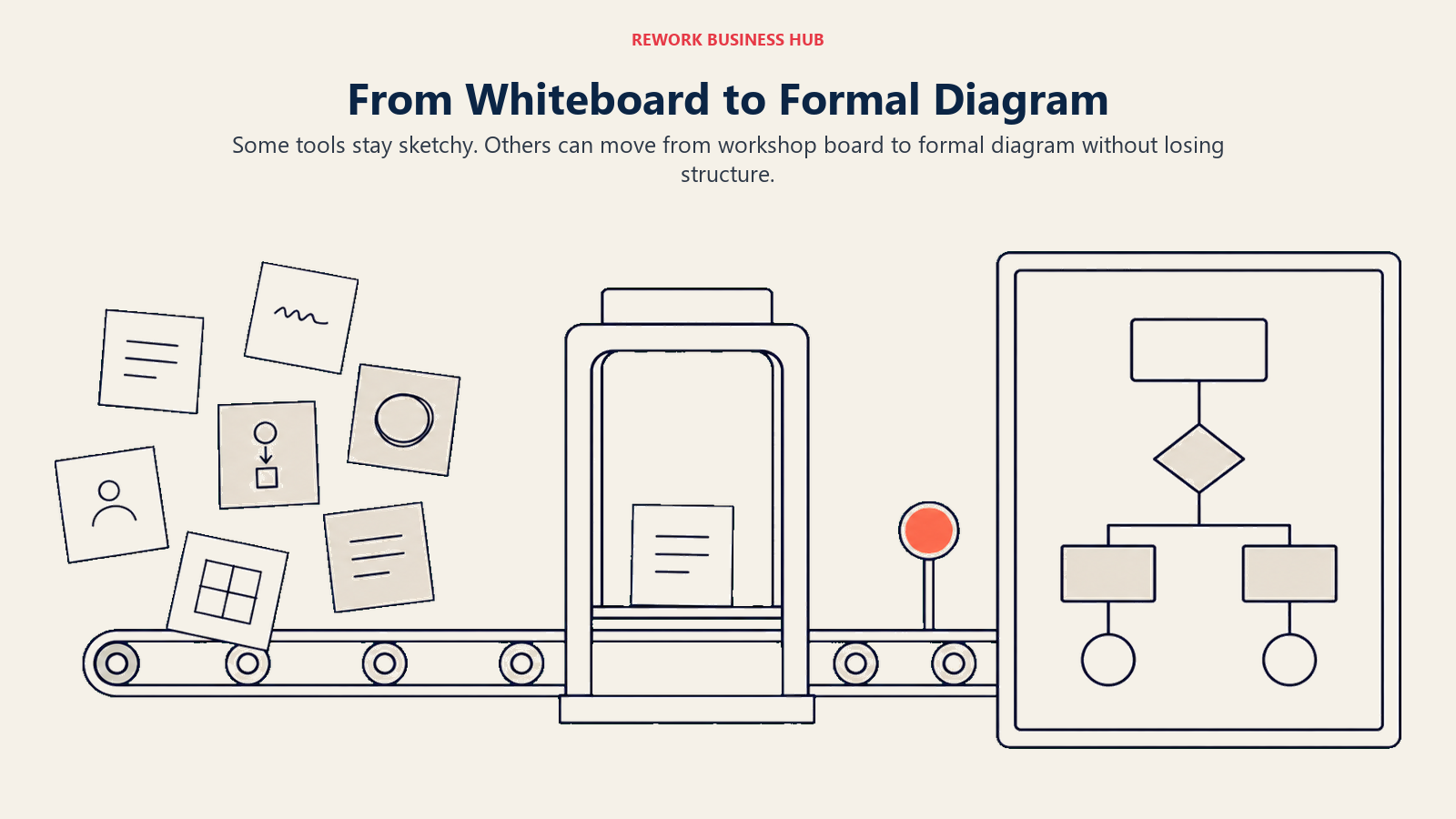
Lucidspark's own answer is: pair it with Lucidchart. That's the entire premise of the Suite. Most tools below lack that built-in handoff, and a few were never meant to have it.
| Tool | Diagram Capability | Handles | Stops Short Of |
|---|---|---|---|
| Miro | Partial | Flowchart shapes, mind maps, org charts | Data-linked ERDs, network diagrams, BPMN |
| FigJam | Partial | Basic flowcharts, user-flow diagrams | ERDs, network topology, BPMN |
| Mural | Partial | Template flowcharts for workshops | ERDs, network diagrams, data-linked shapes |
| Conceptboard | Basic shapes | Review annotations, flow sketches | Swimlane, ERD, BPMN tooling |
| Excalidraw | Partial | Hand-drawn flowcharts, simple ERDs via community libraries | Native swimlane or BPMN templates |
| Whimsical | Yes | Dedicated flowchart mode, wireframes, mind maps | Data-linked shapes, network diagrams |
| Boardmix | Yes | Flowchart, org chart, UML, mind-map templates, AI generation | Live data-linked shapes like Lucidchart's |
| Klaxoon | Basic shapes | Workshop flow templates | Swimlane, ERD, BPMN tooling |
| Milanote | Sticky notes only | Idea boards, loosely connected cards | Any structured diagram type |
| Microsoft Whiteboard | Basic shapes | Simple flow sketches, meeting notes | Swimlane, ERD, BPMN tooling |
| Apple Freeform | Basic shapes | Freeform sketches, simple diagrams | Swimlane, ERD, BPMN tooling |
Whimsical and Boardmix are the two tools here that ship a real, dedicated flowchart mode rather than freeform shapes standing in for one. Everyone else in the "partial" or "basic shapes" rows can sketch something flowchart-shaped, but none replaces a dedicated tool for business process mapping that stays accurate as the process changes. If your real requirement is structured, data-linked diagrams, read best Lucidchart alternatives instead, a different buying decision than this guide covers.
Where Lucidspark Still Wins
None of this makes Lucidspark a bad product, and a fair comparison has to say where it earns its price. Three things stand out.
The Lucidchart handoff is real. If your process maps, network diagrams, or ERDs already live in Lucidchart, Lucidspark is the only tool here that lets a brainstorm turn into a structured Lucidchart diagram without exporting, re-drawing, or switching products. Every alternative that claims "diagramming" is approximating that workflow with shapes; Lucidspark hands off directly into a dedicated tool from the same vendor.
Enterprise admin controls run deeper than most whiteboard-first competitors. SSO, provisioning, and governance on Lucidspark's Enterprise tier are built for IT teams managing access at scale, closer to Miro's Enterprise tier than to Whimsical or Boardmix, neither of which competes there.
The credibility signal from Google's Jamboard retirement is worth naming: when Google shut Jamboard down, it picked exactly three official migration partners, FigJam, Lucidspark, and Miro, a real, citable vote of confidence from a company with no commercial reason to name Lucidspark unless the product held up.
Where Lucidspark loses is the purchase shape, not the product: the three-user Team minimum, the free tier's three-board cap, and a value case that assumes you'll eventually want Lucidchart too. If none of that describes your team, one of the eleven tools above probably fits better and costs less.
Stage Fit Matrix
| Tool | Startup (1-20) | Growth (20-100) | Mid-Market (100-500) | Enterprise (500+) |
|---|---|---|---|---|
| Miro | Good | Best fit | Strong | Strong |
| FigJam | Best fit | Good | Good | Works (bundled) |
| Mural | Weak | Moderate | Best fit | Strong |
| Conceptboard | Moderate | Good | Best fit (regulated) | Good |
| Excalidraw | Best fit | Good | Good | Works (self-hosted) |
| Whimsical | Best fit | Good | Moderate | Weak |
| Boardmix | Best fit | Good | Moderate | Weak |
| Klaxoon | Moderate | Good | Best fit | Good |
| Milanote | Best fit | Good | Moderate | Weak |
| Microsoft Whiteboard | Weak | Weak | Moderate | Best fit (M365) |
| Apple Freeform | Best fit | Good | Weak | Weak (no admin layer) |
Sizing and Persona Table
| Tool | Ideal Team Size | Primary Buyer | Secondary Users |
|---|---|---|---|
| Miro | 10-500+ | Product or design manager | Ops, marketing, engineering |
| FigJam | 5-200 (Figma users) | Design manager | PMs, engineers in reviews |
| Mural | 20-500 | L&D manager, agile coach | Facilitators, HR, strategy teams |
| Conceptboard | 10-200 (EU/regulated) | Compliance or ops lead | Design reviewers, agencies |
| Excalidraw | 2-100 engineers | Engineering manager, CTO | DevOps, architects |
| Whimsical | 1-30 | PM, individual contributor | Founders, content strategists |
| Boardmix | 2-100 | Ops lead, small team manager | PMs, designers |
| Klaxoon | 5-200 | Meeting facilitator, trainer | Sales enablement, HR |
| Milanote | 1-50 (creative teams) | Content or brand lead | Marketers, writers |
| Microsoft Whiteboard | 500+ (M365 shops) | IT admin | Any M365 user |
| Apple Freeform | 1-50 (Apple-only) | Team lead, small business owner | Any Apple device user |
How to Choose: Decision Framework
| If You Need... | Pick This |
|---|---|
| Brainstorming and light diagramming without buying a second Lucid product | Miro |
| Whiteboarding you might already own inside a Figma seat | FigJam |
| Deep facilitation controls for recurring workshops | Mural |
| A free, self-hostable sketch tool with local encryption | Excalidraw |
| A genuine, dedicated flowchart mode without Lucidspark's UI overhead | Whimsical |
| AI-generated diagrams and real diagram templates at a low price | Boardmix |
| Zero incremental cost inside an existing Microsoft 365 license | Microsoft Whiteboard |
| Data-linked ERDs, network diagrams, and a real diagramming platform | Stay on Lucidspark (paired with Lucidchart) |
What to Do Next
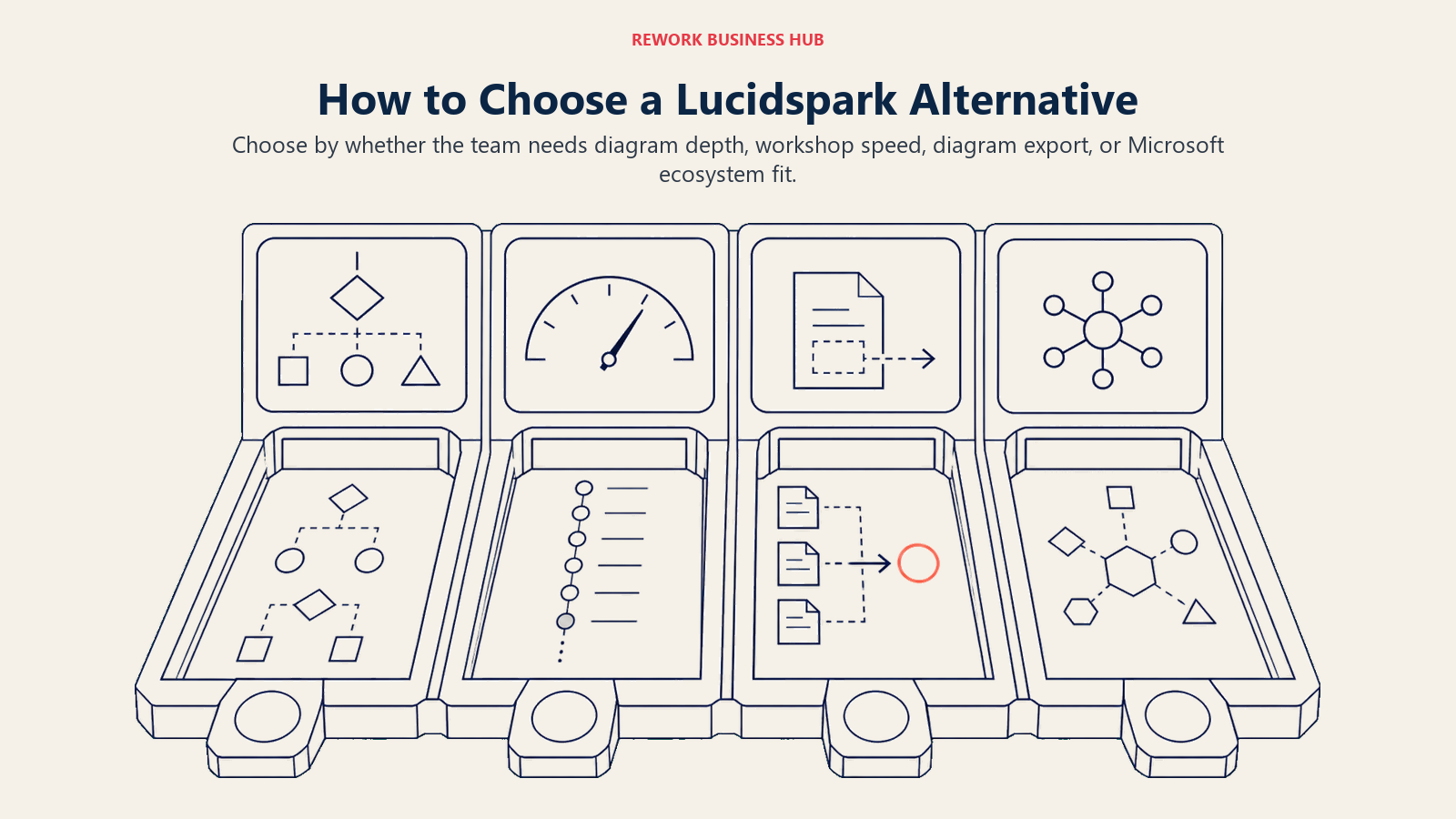
Start from the actual complaint, not a feature list. If it's the three-user minimum or the Team-tier price, price out Miro, FigJam, or Boardmix against your real headcount. If your team never touches Lucidchart and never will, Whimsical or Excalidraw solve the core job without the Suite dependency. And if you do need real structured diagrams, run one actual workflow, a retro, a sprint plan, a process map, through your top two picks before committing. The tool your team reopens without a reminder is the one worth paying for.
For the wider whiteboard and diagramming market, the best online whiteboard software roundup covers the category from the buyer's-market side rather than the Lucidspark-specific angle.

Principal Product Marketing Strategist
On this page
- Key Facts
- Why Teams Leave Lucidspark
- Quick Comparison Table
- 1. Miro - The Broadest Whiteboard-to-Diagram Bridge
- 2. FigJam - The Whiteboard You Might Already Own
- 3. Mural - The Workshop Facilitator's Whiteboard
- 4. Conceptboard - The EU-Hosted Option for Structured Review
- 5. Excalidraw - The Free, Self-Hostable Sketch Tool
- 6. Whimsical - The Tool With an Actual Flowchart Mode
- 7. Boardmix - The Budget AI-Assisted Diagram and Whiteboard Combo
- 8. Klaxoon - Built for the Hybrid Meeting Room, Not the Async Board
- 9. Milanote - For Organizing Ideas, Not Drawing Diagrams
- 10. Microsoft Whiteboard - Free for Microsoft 365 Business and Education, Not Personal Accounts
- 11. Apple Freeform - Free on Every Apple Device, Nothing Beyond It
- From Whiteboard to Formal Diagram: What Each Tool Actually Produces
- Where Lucidspark Still Wins
- Stage Fit Matrix
- Sizing and Persona Table
- How to Choose: Decision Framework
- What to Do Next