Best Planhat Alternatives in 2026: 12 Customer Success Platforms Compared
Turn this article into takeaways for your work.


Each assistant summarizes the article only for you and suggests best practices for your work.
For most teams shopping Planhat alternatives, the shortlist narrows fast: Vitally if you want comparable flexibility with less assembly required, Gainsight or ChurnZero if you want playbooks and health scores that arrive already built, Custify or ClientSuccess if a small CS team needs something that runs without a dedicated ops hire, and Akita or SmartKarrot if a published price matters more than depth.
Start with the honest part: Planhat is not a bad product, and plenty of teams should stay on it. Its whole thesis is that your customer data model should look like your business, not like a vendor's opinion of your business. You define the objects, the metrics, the health formulas and the customer-facing portals, and the platform bends to fit. For a company with an unusual product, a usage-based contract structure, or a CS Ops function that can actually build, that flexibility is leverage you cannot buy anywhere else on this list.
That same flexibility is what sends other teams here, because a blank canvas needs someone to configure it and keep it configured. This guide covers 12 alternatives for Heads of CS, CS Ops leads and RevOps leads at B2B SaaS companies between about 20 and 500 people. If you have not narrowed the category yet, start with the customer success software roundup, and if you are still deciding what a health score should measure, customer health monitoring covers the model before the tool.
Key Facts
- Across 913 verified disclosures from 105 public B2B SaaS companies sourced directly from SEC filings, median net revenue retention is 122% and the top decile reaches 155% (Cust, 2026 State of Customer Success).
- Private SaaS companies run far behind those public numbers: at $25,000 to $50,000 ACV the median NRR is 102%, with the top quartile at 111% and the bottom quartile at 97% (SaaS Capital, "What Is a Good Retention Rate for a Private SaaS Company?").
- Acquiring a new customer costs five to 25 times more than retaining an existing one, and Bain's Frederick Reichheld found that raising retention by 5% increases profits by 25% to 95% (Harvard Business Review, "The Value of Keeping the Right Customers").
- 95% of B2B tech companies now have an established CS function, but only 51% have a dedicated CS Ops team, which is the exact capability a configurable platform assumes you already own (vendor benchmark: Gainsight Customer Success Index 2025, 250-plus companies surveyed with Benchmarkit, July to September 2024).
- Gartner predicts that over 40% of agentic AI projects will be canceled by the end of 2027, which is worth remembering before you pay for any CS platform's AI add-on (Gartner press release, June 2025).
Quick Comparison Table
| Tool | Best For | Starting Price | Key Strength | Key Limitation |
|---|---|---|---|---|
| Vitally | The closest swap with less build effort | Quote only, three plans by CS motion | Unlimited automations and observer seats on every plan | No published price, so budgeting still needs a call |
| Gainsight | Teams that want the playbooks to arrive built | Quote only, Essentials and Enterprise | Deepest prebuilt CS methodology and adjacent product line | Heaviest platform here, enterprise sales motion |
| ChurnZero | Mid-market teams that need value in weeks | No published price; reported $18,681 to $131,560/yr | Opinionated health scores and journeys out of the box | Vendor publishes nothing, so you negotiate blind |
| Totango (incl. Catalyst) | Prebuilt CS programs you can switch on | Quote only, Enterprise and Premier tiers | SuccessBLOC-style prebuilt programs, account-count packaging | The free tier it was famous for is no longer listed |
| Custify | Mid-market SaaS that wants no setup bill | Quote only, no setup fees | Explicit no-setup-fee commitment, fast onboarding | No tiers or figures published at all |
| ClientSuccess | Small CS teams that want caps they can read | Quote only, priced per CSM seat | Publishes what each package actually includes | Customer caps by tier (10, 50, unlimited) constrain growth |
| Velaris | AI-first teams replacing manual CSM admin | Quote only, one license covering 5 users | One license, 5 users, unlimited viewers, add-ons available | Newer vendor with a shorter reference list |
| EverAfter | Customer-facing portals as the main job | Quote only, customized | Widget-built customer interfaces in the base product | Not a full internal CS command center on its own |
| Akita | Buyers who want a real rate card today | $49/month (Small Teams), 20% off annual | Only platform here publishing full self-serve pricing | 2 full users at entry, lighter analytics depth |
| SmartKarrot | Teams that want a published entry number | $15,000/year (Basic, 5 users) | Entry tier price stated openly on the site | Growth, Pro and Enterprise all revert to contact sales |
| ZapScale | Budget-conscious teams under 100 accounts | Reported around $500/month (Startup) | Lowest reported entry point for a dedicated CS tool | No public vendor pricing page |
| HubSpot Service Hub | Teams already standardized on HubSpot | $90/seat/month (Professional, annual commit) | CS workspace sits on the CRM you already run | Requires Professional plus a $1,500 onboarding fee |
Why Teams Leave Planhat (and Who Should Stay)
Planhat did not lose an argument. It built a customer platform on a flexible data model, and that model does things an opinionated tool cannot: custom objects that match your contract structure, metrics you define rather than pick from a dropdown, health formulas you can rebuild when your product changes, and portals shaped to your onboarding motion. If your business does not look like a textbook B2B SaaS company, that is worth a lot. Three specific things still push teams to evaluate alternatives.
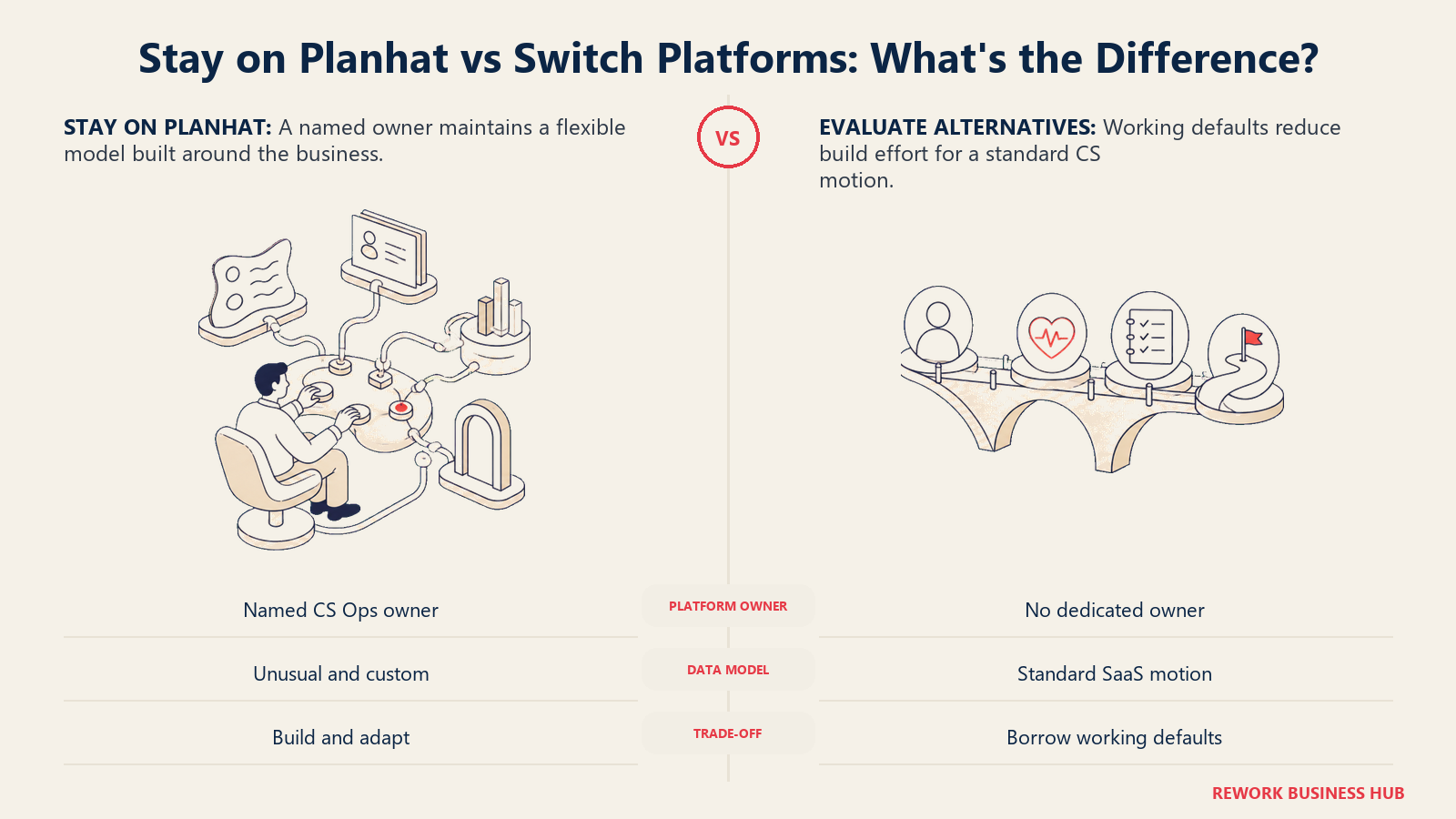
The build effort is a real line item, not a footnote. A blank canvas needs someone to configure it, then keep it configured every time you launch a product, change a plan structure or restructure the CS team. That is an ops job, not a CSM job. Gainsight's 2025 index found 95% of B2B tech companies have an established CS function but only 51% have a dedicated CS Ops team, which means roughly half the market is buying configurable software without the role that configures it. If your health scoring will be built by whoever has a free afternoon, an opinionated platform wins. Get the model right before you shop: churn prediction models and early warning systems are the thinking a blank canvas assumes you have already done.
The real total is hard to pin down at evaluation time. Planhat's pricing page says "quote-based pricing with add-ons for advanced needs" and names four: Upgraded AI Platform, Advanced Service, Email Marketing and Advanced Portals. No tiers, seat counts or minimums are published. That is normal here, as the table below shows, but it means the number in your business case and the number you sign can differ by four add-ons, and you often discover which ones you need after implementation starts. Ask for the add-on price list in writing on the first pricing call, not the third.
Some teams want the opinion, not the canvas. Gainsight, ChurnZero and Totango ship a point of view about what a health score should measure, what a renewal playbook looks like and when a CSM should be nudged. You can disagree with those defaults, but you get to disagree with something concrete in week two rather than staring at an empty schema. For a first CS platform, borrowed opinions beat a blank page.
Who should stay on Planhat. If you have a CS Ops or RevOps person who owns the platform, an unusual data model (usage-based pricing, multi-entity accounts, reseller hierarchies, services attached to subscriptions), or portals that must look like your product rather than a vendor's, Planhat's flexibility is the reason to keep paying for it. Switching to an opinionated tool there trades a build problem for a workaround problem, and workarounds compound. Same answer if your data already flows cleanly between CRM, product analytics and the CS platform, since that pipeline is the expensive part and an aligned stack is harder to rebuild than a health score.
What the category actually publishes. Almost no customer success platform publishes a price. That is the single most useful thing to know before you start, because it changes how you budget and when you negotiate.
| Vendor | Publishes a price? | What you can see before a sales call |
|---|---|---|
| Akita | Yes, full rate card | Tiers, seats, account caps, add-on rates, annual discount |
| SmartKarrot | Entry tier only | Basic at $15,000/year for 5 users; the rest is contact sales |
| HubSpot Service Hub | Yes | Per-seat rates plus one-time onboarding fees |
| Planhat | No | Quote-based pricing, four add-ons named, no figures |
| Gainsight | No | Two editions with included user and customer counts |
| Vitally | No | Three plans by CS motion and what each includes |
| Totango (incl. Catalyst) | No | Seat and account-count packaging per tier |
| ClientSuccess | No | Package caps plus a stated 15% to 20% annual discount |
| Custify | No | One commitment: no setup fees |
| Velaris | No | One license, 5 users, unlimited viewers, add-ons |
| EverAfter | No | Full feature list included at every tier |
| ChurnZero | No | Nothing; the pricing page is not publicly accessible |
| ZapScale | No | Nothing; no public pricing page |
Two consequences. Your leverage is your seat count and your account count, because that is what almost every quote is built from, so decide both before the first call. And with no public list to compare against, the only defensible comparison is your two finalists priced at your real numbers, not the example numbers in a proposal.
1. Vitally - The Closest Swap With Less Assembly
Vitally is where most Planhat evaluations land first, because it makes the same bet with lower activation energy. It is still data-first: pipe in product usage, CRM and support data, build health scores on your own logic, automate from there. What it does differently is package the CS motion rather than the schema, so defaults follow from how you actually serve customers instead of from a blank object model.
Vitally publishes three plans, Tech-Touch for one-to-many and product-led motions, Hybrid-Touch for any mix, and High-Touch for one-to-one coverage. All three include unlimited automations, unlimited observer seats, SSO, the full integration library and unlimited docs. One detail gets misquoted constantly: unlimited full seats belong to the High-Touch plan only, not to all three. If a comparison table told you Vitally has unlimited seats, check which plan that came from before you build a business case on it.
Target audience. B2B SaaS CS teams of roughly 3 to 40 CSMs that want configurable health scoring without owning a platform build.
Sizing fit. Strongest from 50 to 500 employees. Below 20 people the automation depth outruns what a one-person CS function will use.
Stage fit. Best at Series A through C, when the CS motion is defined enough to name but still changing every two quarters.
| Pros | Cons |
|---|---|
| Plans map to your CS motion, so defaults arrive already sensible | No published pricing, so budgeting still needs a sales call |
| Unlimited automations and observer seats on every plan | Unlimited full seats apply to High-Touch only |
| Modern interface CSMs adopt without a training program | Less schema flexibility than Planhat for unusual data models |
Pricing: Quote only. Three plans by CS motion (Tech-Touch, Hybrid-Touch, High-Touch), no published rates, seat counts or minimums.
Best for: Teams that liked Planhat's philosophy but ran out of the ops capacity to execute it.
2. Gainsight - When You Want the Playbooks to Arrive Built
Gainsight is the opposite end of the spectrum from Planhat, which is exactly why it belongs high on this list. Where Planhat hands you a canvas, Gainsight hands you a methodology: scorecards, success plans, playbooks, timeline logging and renewal forecasting, all arriving with a documented point of view about how CS is supposed to work. You spend implementation adapting your process to the software, a downgrade if your process is genuinely unusual and an upgrade if it is mostly aspirational.
Scope is the other differentiator. Gainsight's pricing page lists the CS product alongside Skilljar for customer education, Product Experience for in-app engagement, Customer Communities, Staircase AI and Atlas AI Agents. If your retention problem is really an onboarding or education problem, two modules from one vendor beats stitching two vendors together. It is also the fastest way to turn a $40,000 evaluation into a $150,000 one, so scope the modules before the demo.
Pricing is quote only. Two editions are published without prices: Essentials includes 10 full users and 100 customers per user, Enterprise includes 20 full users and 200 customers per user, both with unlimited viewer licenses. Those included counts are the real spec sheet, because they tell you how the quote will scale.
Target audience. CS organizations of 10-plus CSMs, usually at companies past $20M ARR with a formal renewal process.
Sizing fit. Built for 200 employees and up. Under 100 you are paying for governance depth you will not use.
Stage fit. Best once renewals are forecast in a board deck and someone owns the number.
| Pros | Cons |
|---|---|
| Prebuilt CS methodology means week-two output, not week-twelve | Heaviest configuration and change management on this list |
| Adjacent modules (education, communities, in-app) from one vendor | Module scope creep inflates quotes quickly |
| Unlimited viewer licenses on both editions | Enterprise sales motion with no published pricing |
Pricing: Quote only. Essentials (10 included full users, 100 customers per user) and Enterprise (20 included full users, 200 customers per user), both with unlimited viewer licenses.
Best for: Teams that want the opinion, the playbooks and the board-ready reporting without building any of it. If Gainsight itself becomes the incumbent you outgrow, the Gainsight alternatives guide covers that path.
3. ChurnZero - Opinionated Mid-Market CS With Fast Time to Value
ChurnZero sits between Gainsight's methodology weight and Planhat's blank canvas, and it is the usual answer when the complaint is "we spent four months configuring it." It assumes a mid-market CS team has one ops-capable person at most, so health scores, journeys, in-app messaging and renewal alerts ship with working defaults you tune rather than build. Teams routinely get a usable health model live in weeks, which matters more than feature parity when CSMs are running the book out of a spreadsheet.
The catch is transparency, and it is worse here than at Planhat. ChurnZero's pricing page is not publicly accessible, so there is nothing to model from. The most useful reference point comes from Vendr, which aggregates anonymized purchase contracts: deals ranged from $18,681 to $131,560 per year, with a median annual contract of $44,681 (reported by Vendr, not confirmed by the vendor). Treat that as a sanity check on a quote you already have, not a budget.
Target audience. B2B SaaS CS teams of 3 to 25 CSMs with a subscription renewal motion and no dedicated platform engineer.
Sizing fit. Sweet spot at 50 to 400 employees.
Stage fit. Best at Series A through C, especially on a first CS platform after outgrowing spreadsheets and CRM tasks.
| Pros | Cons |
|---|---|
| Working health scores and journeys in weeks, not months | Vendor publishes no pricing whatsoever |
| In-app messaging built in, so tech-touch does not need a second tool | Less schema flexibility for unusual account structures |
| Renewal and risk alerting designed for a small ops footprint | Reported deal range is wide enough to be nearly useless as a budget |
Pricing: No published price. Reported range of $18,681 to $131,560 per year across anonymized ChurnZero transactions, with a median annual contract of $44,681 (source: Vendr marketplace data, reported).
Best for: Mid-market teams that want to stop configuring and start running plays. Two adjacent guides go deeper if ChurnZero moves to the top of your list: ChurnZero alternatives and the head-to-head Gainsight vs ChurnZero comparison.
4. Totango (Including Catalyst) - Prebuilt Programs You Switch On
Totango's answer to the build-effort problem is prebuilt programs: instead of a schema you populate, you switch on a packaged motion for onboarding, adoption, risk or renewal and adjust it. For a team leaving Planhat because nobody had time to build, that is the most direct trade available. The platform also carries Unison, its customer intelligence engine, offered with standard or custom AI models.
Two structural facts matter more than any feature list. First, Catalyst is no longer an independent company. It is a Totango product line on Totango's own pricing page, with a Growth tier covering 2,500 customer accounts and up to 5 Salesforce custom objects. If a shortlist you inherited names both as separate vendors, that shortlist is out of date. Second, the free forever plan Totango was famous for is no longer listed on its pricing page. Every plan, Catalyst Growth included, now routes through "Talk to sales." Plenty of comparison pages still present that free tier in the present tense; do not build an evaluation on it.
Target audience. CS teams managing a large account count relative to headcount, including PLG and hybrid books.
Sizing fit. Strong from 100 to 2,000 employees, especially where account counts run into the thousands.
Stage fit. Best when the motion is known but under-resourced, and prebuilt programs beat a custom build.
| Pros | Cons |
|---|---|
| Prebuilt programs shorten time to a working motion | The free tier it was known for is no longer listed |
| Packaging is stated in accounts and seats, so quotes are predictable | Every tier routes through sales, including Catalyst Growth |
| Catalyst absorbed, so one vendor covers two former codebases | Product consolidation means roadmap uncertainty worth asking about |
Pricing: Quote only. Enterprise (10 practitioner seats, 2,000 customer accounts, 5 teams), Premier (20 practitioner seats, 3 viewer seats, 10,000 customer accounts, unlimited teams, 1 dev instance), Catalyst Growth (2,500 customer accounts, up to 5 Salesforce custom objects), plus Unison with standard or custom AI models.
Best for: High-account-count books that need programs running now. See Totango alternatives if you are evaluating in the other direction.
5. Custify - Mid-Market SaaS Without the Setup Bill
Custify built its product for mid-market B2B SaaS specifically, and the design shows: health scoring, lifecycle playbooks and CSM task automation aimed at a team with real accounts to manage and no platform engineer to assign. It is narrower than Planhat by design. Fewer ways to model an unusual business, in exchange for a shorter path from contract to a health score somebody trusts.
The one hard commitment on Custify's pricing page is worth more than it looks: the vendor states plainly that it does not charge setup fees. In a category where implementation fees routinely add five figures to year one, and where Planhat's quote can arrive with four add-ons attached, a stated zero on that line removes a whole negotiation. Nothing else is published, so the license itself is still a conversation.
Target audience. B2B SaaS CS teams of 2 to 15 CSMs managing recurring subscription accounts.
Sizing fit. Best from 30 to 300 employees. Above that, account-count packaging elsewhere usually prices better.
Stage fit. Best at Series A and B, on a first or second CS platform.
| Pros | Cons |
|---|---|
| Explicit no-setup-fee commitment on the vendor's own page | No tiers or price figures published at all |
| Purpose-built for mid-market SaaS, so defaults fit the segment | Narrower data modeling than Planhat by design |
| Shorter implementation than the enterprise platforms above | Thinner fit for non-SaaS or multi-entity account structures |
Pricing: Quote only. No tiers or figures published. The vendor commits publicly to charging no setup fees.
Best for: Mid-market SaaS teams that want year-one cost to be the license and nothing else.
6. ClientSuccess - Priced Per CSM, With Caps You Can Read
ClientSuccess does something rare here: it explains its own pricing logic in public. Pricing is based on the number of customer success managers using the platform and the modules you need, which tells you immediately that adding CSMs costs money and adding accounts mostly does not. That is the inverse of Totango's account-count model, and it changes which company shape gets a good deal. Four CSMs covering 900 accounts price very differently here than at a vendor packaging by account volume.
The three packages publish their limits even without prices, and the limits are the real decision. Startup caps you at 10 customers, 500 full licenses, one goal or KBO per customer, and onboarding-only support. Growth raises that to 50 customers, 5,000 full licenses, three goals or KBOs, and a dedicated CSM. Enterprise removes the caps and includes custom dashboards plus the customer portal. Annual contracts get 15% to 20% off, and there are no setup fees. Read those caps against your account list first, because account tiering tells you how many accounts genuinely need a managed relationship versus a digital one.
Target audience. Small to mid-size CS teams that want a clear, CSM-priced contract and a named support relationship.
Sizing fit. Strong from 20 to 250 employees. The Startup tier's 10-customer cap is genuinely small, so most teams start at Growth.
Stage fit. Best at seed through Series B, and at any stage where the CSM count is small relative to the book.
| Pros | Cons |
|---|---|
| Publishes what each package includes and where the caps sit | Prices themselves are still quote only |
| Priced per CSM, so a large account book does not inflate the bill | Customer caps of 10 and 50 force a tier jump earlier than expected |
| 15% to 20% annual discount and no setup fees, both stated | Customer portal and custom dashboards are Enterprise-only |
Pricing: Quote only, based on CSM count and modules. Startup (max 10 customers, max 500 full licenses, 1 goal/KBO per customer, onboarding support), Growth (max 50 customers, max 5,000 full licenses, 3 goals/KBOs, dedicated CSM), Enterprise (unlimited customers and licenses, custom dashboards, customer portal). Annual contracts 15% to 20% off; no setup fees.
Best for: Small CS teams carrying a big book, where per-CSM pricing beats per-account pricing.
7. Velaris - AI-First, One License, Five Users
Velaris is the newest platform here and takes the AI-first position seriously: a CSM's administrative load, meeting notes, account summaries, follow-up drafting, risk flagging, should be handled by the platform rather than by the CSM at 7pm. For a team leaving Planhat because the tool created work instead of removing it, that framing lands hard.
Packaging is simple even though the price is not published. The vendor states it as "all the tools you need in one license," covering 5 users with unlimited viewers, and add-ons available on top, with a custom estimate on request. A single license means you are not negotiating module by module, which shortens the evaluation, though the add-on line raises the same "what is actually included" question as the Planhat quote. Ask which capabilities sit outside the base license before you compare totals.
One honest caveat: Velaris is a younger vendor with a shorter public reference list than Gainsight or Totango. Ask for two customers of your size and shape. Apply the usual discipline to the AI claims too, since Gartner expects over 40% of agentic AI projects to be canceled by the end of 2027. Buy the AI layer for a workflow you can name today, not for a demo.
Target audience. CS teams of 3 to 15 CSMs drowning in manual account admin and note-taking.
Sizing fit. Best from 30 to 300 employees, where 5 licensed users covers the whole CS function.
Stage fit. Best at Series A through B, replacing a spreadsheet-plus-CRM stack rather than a mature platform.
| Pros | Cons |
|---|---|
| One license covering 5 users with unlimited viewers | No published price, and add-ons sit outside the base license |
| AI aimed at CSM admin load, the actual daily complaint | Younger vendor with a shorter public reference list |
| Simple packaging shortens the evaluation | Less proven at enterprise governance and audit requirements |
Pricing: Quote only. One license covering 5 users, unlimited viewers, add-ons available. Custom estimate on request.
Best for: Small CS teams where CSM time, not data modeling, is the binding constraint.
8. EverAfter - When the Customer-Facing Portal Is the Point
EverAfter solves a different half of the problem, and it belongs here for one reason: if you were paying for Planhat's Advanced Portals add-on, the customer-facing layer is EverAfter's entire product rather than an upsell. You build customer hubs out of widgets, onboarding plans, shared goals, resource libraries, task lists, QBR views, and control what each account sees through visibility and automation rules. The customer logs in to a workspace, not an email thread.
What you get at every tier is unusually well documented even without a price: the widget-based interface builder, automation and visibility rules, 100-plus integrations, engagement tracking, customer login with SSO, granular roles, task management and a dedicated CSM. Nothing meaningful is fenced behind a higher tier, the opposite of how portals are usually sold.
Be clear about what this is not. EverAfter is a customer-facing collaboration layer, not a full internal CS command center. Health scoring, renewal forecasting and internal risk workflows are thinner than on the platforms above, so many teams run it alongside a CS platform rather than instead of one. If the portal add-on price is what pushed you off Planhat, that pairing can still cost less.
Target audience. CS and onboarding teams whose main friction is customer-side visibility and accountability.
Sizing fit. Works from 20 employees up; scales well because it prices on the relationship, not the seat count.
Stage fit. Best where implementation or onboarding is long enough that customers lose track of where things stand.
| Pros | Cons |
|---|---|
| Customer-facing portal builder included at every tier | Not a complete internal CS platform on its own |
| Visibility and automation rules per account, no engineering needed | No published pricing or seat structure |
| 100-plus integrations, SSO and granular roles in the base product | Often a second tool alongside a CS platform, not a replacement |
Pricing: Quote only, described as customized. All tiers include the interface builder, automation and visibility rules, 100-plus integrations, engagement tracking, customer login and SSO, granular roles, task management and a dedicated CSM.
Best for: Teams whose Planhat spend was really about customer-facing portals.
9. Akita - The Only Published Rate Card in the Category
Akita is the only vendor in this entire comparison that publishes a full self-serve rate card, and after a Planhat evaluation that alone is worth an afternoon. You can price your team in 30 seconds without talking to anyone. Small Teams is $49 per month for 2 full users, 4 read-only users, 2 integrations and up to 10,000 accounts and contacts. Growing Teams is $99 per month for 4 full users, 8 read-only, 4 integrations and up to 100,000 accounts and contacts. Enterprise is custom with unlimited accounts. Annual prepayment takes 20% off, extra full users and extra integrations are $29 per month each, and there is a 14-day free trial with no setup or cancellation fees.
The product matches the price. Akita covers health scoring, segmentation, alerts, playbooks and task management competently, and does not attempt Gainsight's methodology depth or Planhat's data modeling. Two full users at entry is the real constraint: a five-CSM team buys Growing Teams plus extra seats, still under $200 per month before the annual discount. For a company under 50 people tracking health in a spreadsheet, this is the cheapest credible way to stop.
Target audience. Small CS, account management and support teams that want structured health tracking without a procurement cycle.
Sizing fit. Best from 10 to 100 employees. Above roughly 8 CSMs the per-seat additions start pushing you toward a quoted platform anyway.
Stage fit. Best pre-Series A through early Series B, or as a second-system stopgap while a bigger evaluation runs.
| Pros | Cons |
|---|---|
| Full published rate card, seats, caps, add-on rates and all | Analytics and playbook depth trail the enterprise platforms |
| $49 per month entry with a 14-day trial and no setup fees | 2 full users at entry, so most teams start at $99 |
| 20% annual prepayment discount stated openly | Integration count is capped and metered at $29 each |
Pricing: Small Teams $49/month (2 full users, 4 read-only, 2 integrations, up to 10,000 accounts and contacts). Growing Teams $99/month (4 full users, 8 read-only, 4 integrations, up to 100,000 accounts and contacts). Enterprise custom with unlimited accounts. 20% off annual prepayment. Extra full user $29/month, extra integration $29/month.
Best for: Small teams that want a real price today and a working health model this week.
10. SmartKarrot - A Published Entry Number and an Account-Level Model
SmartKarrot is the other vendor that puts a number on the page, and the number is instructive: Basic is $15,000 per year for 5 users, 2 third-party integrations and email support, flagged on the vendor's own page as a discounted price. Growth (10 users), Pro (25 users) and Enterprise (custom) all revert to contact sales. Seeing $15,000 stated for five seats does more for your budgeting than any quote-only vendor above, because it anchors what a mid-market CS platform costs before anyone negotiates.
The platform leans into automation and account intelligence: health scoring, playbooks, touchpoint automation, expansion signals and account-level analytics, with more emphasis on prescriptive next-best-action than the configurable platforms. That makes it a genuine philosophical swap from Planhat rather than a cheaper version of the same idea, with the usual trade-off of less room to model a business that does not fit the standard subscription shape.
Watch the integration count at entry. Two third-party integrations is thin for a stack that already has a CRM, product analytics, a support desk and billing, and integration limits are the most common reason an entry tier gets outgrown in month four.
Target audience. Mid-market B2B SaaS CS teams of 5 to 25 CSMs that want prescriptive automation over configuration.
Sizing fit. Best from 100 to 600 employees, where a reported median near $45,000 a year is a normal software line.
Stage fit. Best at Series B and beyond, once retention has a named owner and a target.
| Pros | Cons |
|---|---|
| Publishes a real entry number, rare in this category | Only the entry tier is published; everything else is contact sales |
| Prescriptive automation reduces the amount you must configure | Basic includes only 2 third-party integrations |
| Account intelligence and expansion signals in the core product | The published $15,000 is flagged as a discounted price, not a list rate |
Pricing: Basic $15,000/year (5 users, 2 third-party integrations, email support), flagged by the vendor as a discounted price. Growth (10 users), Pro (25 users) and Enterprise (custom) are all contact sales.
Best for: Mid-market teams that want an anchor number before they negotiate anything else.
11. ZapScale - The Low-Cost Option With No Rate Card
ZapScale targets the bottom of the market Planhat never priced for: small B2B SaaS teams that want health scores, usage-based risk signals and renewal alerts without a five-figure commitment. Connect product usage, CRM, support and billing, get a health score with the drivers visible, act on it.
Pricing needs a caveat before a number. ZapScale has no public pricing page. Third-party directories list a Startup plan at roughly $500 per month for up to 100 customers, Growth at roughly $2,000 per month for up to 500 customers, and a custom Enterprise tier (reported by GetApp and Software Advice vendor profiles, not confirmed by ZapScale). Treat those as directional only. A directory listing is the weakest evidence in this guide, and a vendor with no live pricing page may have repackaged since those listings were written. Ask for current tiers in writing on the first call.
Set expectations on depth too. This is a lean platform, not a discounted enterprise one. Reporting, permissions and integration breadth are all narrower than the platforms above, the right trade at this price and a bad one if you need governance.
Target audience. Early-stage B2B SaaS teams with 50 to 500 accounts and one or two people doing CS.
Sizing fit. Best from 10 to 80 employees.
Stage fit. Seed through Series A, on a first CS tool.
| Pros | Cons |
|---|---|
| Lowest reported entry point for a dedicated CS platform | No public vendor pricing page |
| Usage-driven health scoring with visible drivers | Pricing evidence comes from directories, not the vendor |
| Simple enough for a one-person CS function to run | Narrower reporting, permissions and integration coverage |
Pricing: No vendor rate card. Reported Startup around $500/month up to 100 customers and Growth around $2,000/month up to 500 customers, Enterprise custom (source: GetApp and Software Advice vendor profiles, reported).
Best for: Early-stage teams that need a health score now and cannot justify a five-figure contract.
12. HubSpot Service Hub - CS Inside the CRM You Already Run
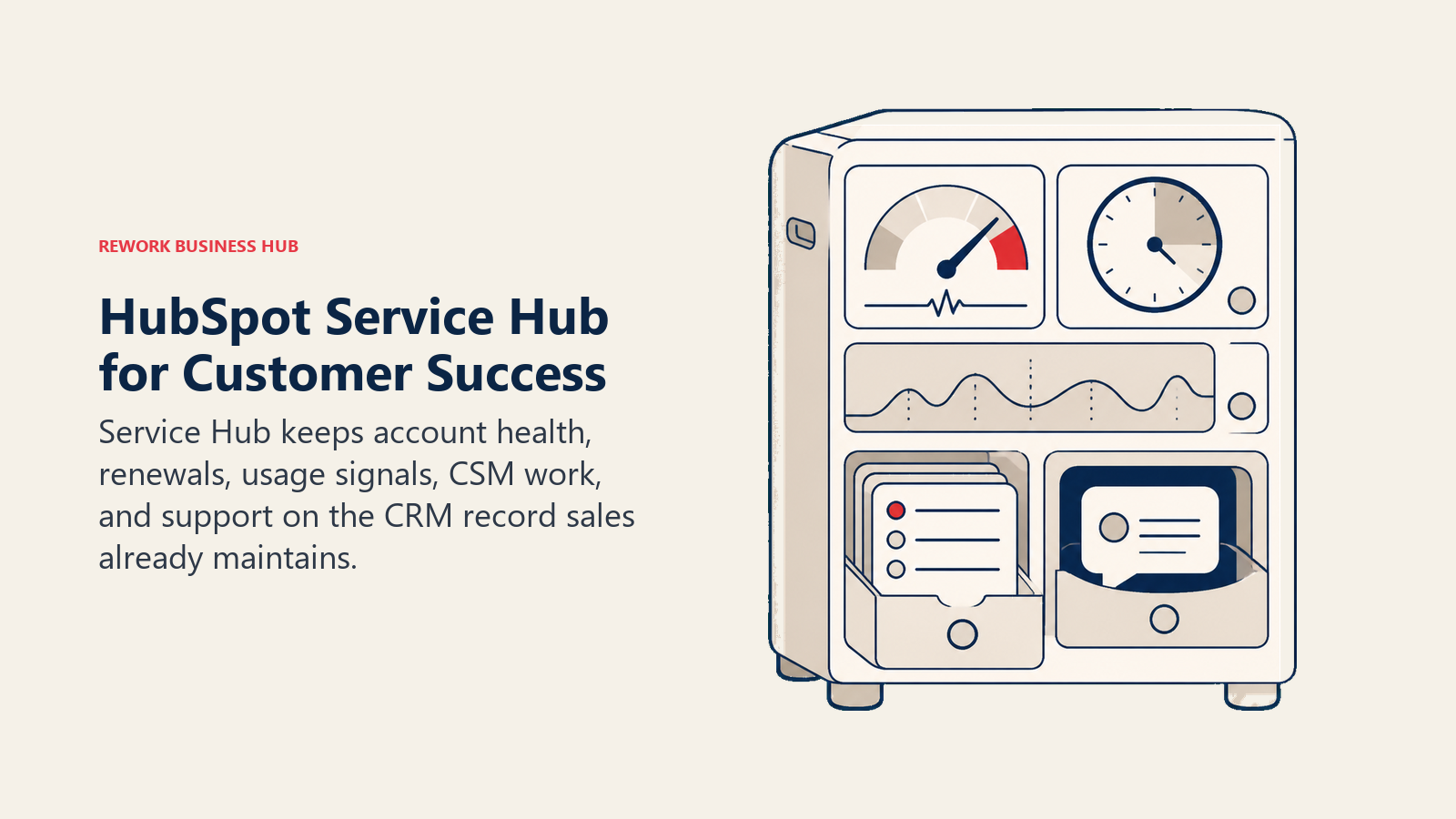
If your company already runs HubSpot, check this before anything else, because the cheapest integration is the one you do not have to build. Service Hub's Customer Success Workspace puts account health, renewal dates, usage signals and CSM tasks on top of the CRM records sales already maintains. The problem that eats weeks of a Planhat implementation, getting CRM and CS data to agree on what an account is, mostly disappears when both live in the same object model.
Pricing is published, which after eleven quote-only vendors is a relief, but read the requirement first: the Customer Success Workspace requires Professional or Enterprise. Professional is listed at $90 per seat per month on an annual commitment, with $100 per seat per month shown when billed monthly, plus a one-time $1,500 Professional onboarding fee. Enterprise starts at $150 per seat per month with a one-time $3,500 onboarding fee. A free tier exists for up to 2 users but does not include the workspace. The annual commitment is the cheaper of the two, so confirm your quote is written on the annual term.
The honest limitation is depth. Health scoring and lifecycle automation are lighter than on a dedicated CS platform, and if your model needs product-usage math Planhat handled natively, you will feel the gap. For a 10-seat team, Professional lands at $12,000 a year plus $1,500 onboarding, which compares reasonably against a mid-market CS quote while also covering support ticketing.
Target audience. Companies already standardized on HubSpot CRM where CS and support share a team.
Sizing fit. Strong from 20 to 400 employees. Per-seat pricing gets expensive past roughly 30 CS seats.
Stage fit. Best when CS is a defined function but not yet a separate org with its own systems budget.
| Pros | Cons |
|---|---|
| Sits on the CRM you already run, so no data integration project | Requires Professional or Enterprise, not the free or entry tier |
| Published per-seat pricing you can model before any call | One-time onboarding fees of $1,500 or $3,500 on top |
| Support ticketing and CS in one license | Health scoring depth trails dedicated CS platforms |
Pricing: Customer Success Workspace requires Professional or Enterprise. Professional $100 per seat per month on annual commit ($90 per seat per month billed monthly) plus a one-time $1,500 onboarding fee. Enterprise from $150 per seat per month plus a one-time $3,500 onboarding fee. Free tier for up to 2 users.
Best for: HubSpot-native companies where the CRM already holds the truth. If the CRM itself is also up for review, the CRM software roundup covers that decision separately.
Configurable vs Opinionated: What Each Choice Costs You
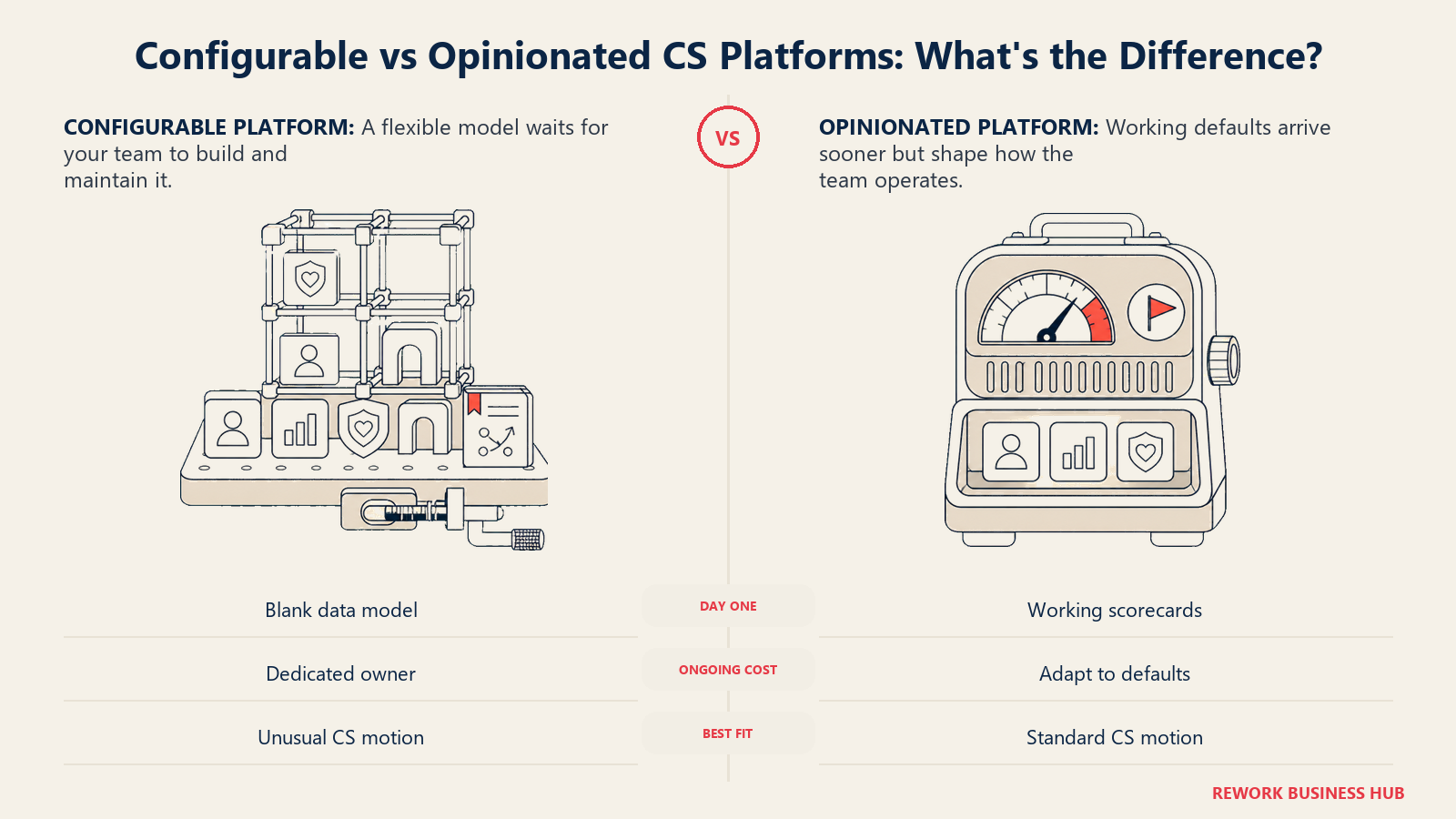
This is the axis the whole decision turns on, and most comparison tables skip it because it does not fit in a feature checkbox. A configurable platform gives you a data model and expects you to express your business in it. An opinionated platform gives you someone else's business already expressed, and expects you to bend. Neither is better; what matters is whether you have the person and the hours for the first option. Be honest about the second column below, because "what you have to build" is not a one-time project. Every product launch, pricing change, segmentation change and CS reorg reopens it.
| Platform | What ships working on day one | What you have to build | Setup effort |
|---|---|---|---|
| Planhat | Data model, integrations, portal framework | Objects, metrics, health formulas, portals, playbooks | High, needs a dedicated owner |
| Vitally | Motion-based defaults, automations, integrations | Health score logic, segment rules, playbooks | Medium |
| Gainsight | Scorecards, success plans, playbooks, forecasting | Mapping your process onto the vendor's model | High, change management not schema |
| ChurnZero | Health scores, journeys, alerts, in-app messaging | Threshold tuning and journey content | Low to medium |
| Totango (incl. Catalyst) | Prebuilt onboarding, adoption, risk and renewal programs | Program tailoring and segmentation | Low to medium |
| Custify | Lifecycle playbooks, health scoring, CSM tasks | Threshold tuning and integration mapping | Low to medium |
| ClientSuccess | Goal and KBO framework, dashboards, engagement tracking | Goal definitions and reporting views | Low |
| Velaris | AI summarization, note capture, risk flagging | Which signals you want flagged | Low |
| EverAfter | Widget-based interface builder, visibility rules | Portal content and per-segment layouts | Low to medium, content-heavy |
| Akita | Health scoring, segments, alerts, playbooks | Segment rules and score weights | Low, live in days |
| SmartKarrot | Prescriptive playbooks, account intelligence, expansion signals | Integration mapping inside the 2-integration cap | Low to medium |
| ZapScale | Usage-driven health scoring with visible drivers | Score weighting and account grouping | Low |
| HubSpot Service Hub | CS workspace on existing CRM records, ticketing | Health properties and workflow automation | Low, if HubSpot is your CRM |
One test cuts through this quickly. Name the person who will own the platform's configuration next quarter, by name, not by role. If you cannot, pick from the low-effort rows. A half-configured flexible platform produces health scores nobody believes, and those are worse than no health score at all because they get quoted in QBRs anyway. The second test is data: whatever you pick is only as good as the product-usage and CRM feeds behind it, and if those pipes do not exist yet, that is your real project no matter which vendor wins.
Sizing and Persona Fit
Two numbers drive every quote here: practitioner seats and customer accounts. They pull in opposite directions. A four-person team covering 3,000 accounts wants per-CSM pricing; a twenty-person team covering 200 enterprise accounts wants per-account packaging. Work out which shape you are before the first call, because vendors will size you on whichever number is larger.
| Headcount | Best fit | Why | Watch out for |
|---|---|---|---|
| Under 50 | Akita, ZapScale, Velaris | Published or low reported entry points, fast setup | Akita's 2 full users at entry; ZapScale's pricing is reported only |
| 50 to 150 | Custify, ChurnZero, Vitally, ClientSuccess | Real CS platform depth without an enterprise contract | ClientSuccess Startup caps at 10 customers, so most start at Growth |
| 150 to 300 | Vitally, ChurnZero, Custify, SmartKarrot | Automation depth starts paying back the license | SmartKarrot's 2-integration entry cap bites at this scale |
| 300 to 500 | Vitally, Totango, Gainsight, SmartKarrot | Account-count packaging and governance start to matter | Quotes climb fast once viewer and practitioner seats separate |
| 500 to 1,500 | Gainsight, Totango, Planhat | Enterprise governance, forecasting and multi-team structures | Add-on scope, not license rate, is what inflates these deals |
| Already on HubSpot, any size | HubSpot Service Hub | No integration project, one seat covers CS and support | Requires Professional or Enterprise plus a one-time onboarding fee |
| Persona | What they optimize for | Strongest picks |
|---|---|---|
| Head of CS with no ops support | Working defaults, short setup, low admin | ChurnZero, Custify, Akita |
| CS Ops lead who can build | Data model control and automation depth | Planhat, Vitally, Gainsight |
| RevOps lead owning the whole stack | Clean CRM and product-data alignment | HubSpot Service Hub, Vitally, Gainsight |
| Founder or COO covering CS personally | Cheapest credible health signal | Akita, ZapScale |
| Head of Onboarding or Implementation | Customer-facing visibility and accountability | EverAfter, Totango |
| CFO signing the renewal | A number you can forecast before the call | Akita, SmartKarrot, HubSpot Service Hub |
| CS leader reporting NRR to a board | Forecasting, segmentation and defensible reporting | Gainsight, Totango, Vitally |
Stage Fit
Match the platform to the decisions your customer-success motion must survive at its current stage.
| Company stage | What usually breaks | Best fit |
|---|---|---|
| Seed, under 30 | No health signal at all, churn is a surprise | Akita, ZapScale |
| Series A, 30 to 100 | Spreadsheet health scores nobody updates | Custify, ChurnZero, Akita |
| Series B, 100 to 250 | CS and sales disagree about which accounts are at risk | Vitally, ChurnZero, ClientSuccess |
| Series C, 250 to 600 | Account count outruns CSM capacity, tech-touch needed | Vitally, Totango, SmartKarrot |
| Late stage, 600 to 1,500 | Forecasting and segmentation must survive board scrutiny | Gainsight, Totango, Planhat |
| Any stage, HubSpot-native | Two systems of record disagreeing about the same account | HubSpot Service Hub |
Stage matters more than headcount because the question is not how many people you have, it is how many decisions the platform has to survive. A 200-person company with one motion and one product needs far less flexibility than a 90-person company selling three products on two pricing models.
Migrating Off Planhat: What Travels and What Does Not
Leaving a configurable platform is harder than leaving an opinionated one, and for a reason that surprises people: the valuable thing you built is not the data, it is the definitions. Your health formula, your custom objects, your metric logic and your portal structures are institutional knowledge that happens to live in a vendor's schema. Rows export cleanly. Definitions do not.
Three things do not travel. Your custom object model is the first: whatever you defined to represent your business, contract lines, deployments, sites, learners, seats, has no equivalent waiting in the next platform, and an opinionated tool may not let you recreate it at all. Document it on paper before you cancel, because reading it back out of an expired account is not an option.
Health-score logic is the second. Export the scores and you get numbers with no explanation; export the formula and you get something you can rebuild. Screenshot every scorecard configuration, weight and threshold, and write down why each weight is what it is, since that reasoning usually lives in one person's head. Your customer-facing portals are the third. If you use Planhat's Advanced Portals, the layouts, visibility rules and content do not port anywhere, which is a real argument for EverAfter if portals are the main thing you are replacing.
| Export before you cancel | Why it matters | Format to insist on |
|---|---|---|
| Account and contact records with all custom fields | The base of every future health model | CSV with field names intact, not display labels |
| Custom object definitions and relationships | The part no vendor can rebuild for you | Written schema doc plus CSV per object |
| Health score formulas, weights and thresholds | Numbers without logic are unusable | Screenshots plus a written definition per scorecard |
| Historic health score values by account and date | Your only trend line across the switch | Row-level CSV with a date column |
| Playbook and automation definitions | Sharply shortens rebuild on the next platform | Export or screenshots of each workflow |
| Customer timeline, notes and activity history | Continuity for CSMs mid-relationship | CSV or per-account export |
| Portal layouts, content and visibility rules | Does not port anywhere, must be rebuilt | Screenshots plus a content inventory |
| Renewal dates, contract values and expansion history | Feeds forecasting from day one | CSV joined to account IDs |
One sequencing tip. Run the last full quarter on Planhat, export at quarter close, and start the new platform on a clean period boundary. A mid-quarter switch leaves two half-quarters of health data nobody can compare, and that gap shows up in exactly the QBR where somebody asks whether risk is trending up or down.
How to Choose: Decision Framework
Choose by the customer-success motion your team can operate now, not the longest feature list.
| If you need... | Choose |
|---|---|
| Planhat's flexibility with less build effort | Vitally |
| Playbooks, scorecards and forecasting that arrive already built | Gainsight, or Totango if account counts are high |
| A working health model in weeks, with one part-time ops person | ChurnZero or Custify |
| A published price you can budget against today | Akita for small teams, SmartKarrot for mid-market |
| Per-CSM pricing because your account book is large | ClientSuccess |
| Customer-facing portals as the main deliverable | EverAfter |
| The cheapest credible health signal for an early-stage team | Akita, or ZapScale if reported pricing is acceptable |
| CS to sit on the CRM you already run | HubSpot Service Hub, with Velaris if CSM admin load is the real problem |
If two rows point at different tools, the tiebreaker is the setup-effort column in the table above, not the feature list. Feature gaps get closed in a roadmap conversation. Missing ops capacity does not.
Frequently Asked Questions about Planhat Alternatives
How much does Planhat cost?
Planhat does not publish a price. Its pricing page describes "quote-based pricing with add-ons for advanced needs" and names four add-ons: Upgraded AI Platform, Advanced Service, Email Marketing and Advanced Portals. No tiers, seat counts or minimums are listed, so the only route to a number is a quote. Ask for the add-on price list in writing on that first call, because the add-ons are where the total moves.
Should I actually leave Planhat?
Not if you have a CS Ops or RevOps person who owns the platform and a data model that does not fit a standard subscription shape. Planhat's flexibility is real leverage there, and switching to an opinionated tool trades a build problem for a permanent workaround problem. Teams that benefit from leaving are the ones with no named owner for configuration, or the ones that want playbooks and health scores shipped rather than built.
Does Totango still have a free forever plan?
No. Totango was widely known for a free tier, but its own pricing page as of August 2026 lists no free plan. Every option, including the Catalyst Growth product line, routes through "Talk to sales." Comparison pages that still describe a Totango free plan in the present tense are out of date.
Is Catalyst a separate alternative to Planhat?
No. Catalyst is no longer an independent company; it is a Totango product line and appears on Totango's own pricing page, with a Growth tier covering 2,500 customer accounts and up to 5 Salesforce custom objects. Evaluate it as part of a Totango conversation, not as a second vendor.
Which Planhat alternative publishes real pricing?
Akita publishes a full self-serve rate card: Small Teams at $49 per month, Growing Teams at $99 per month, Enterprise custom, with 20% off annual prepayment and extra full users or integrations at $29 per month each. SmartKarrot publishes one tier, Basic at $15,000 per year for 5 users, and routes the rest to sales. HubSpot Service Hub publishes per-seat rates, though the Customer Success Workspace requires Professional at $90 per seat per month on annual commit plus a one-time $1,500 onboarding fee.
Does Vitally include unlimited seats?
Unlimited full seats belong to Vitally's High-Touch plan only, not to all three plans. All plans do include unlimited observer seats, unlimited automations, SSO, the full integration library and unlimited docs. If a comparison table told you Vitally has unlimited seats across the board, check which plan the claim came from before you build a budget on it.
What is the cheapest Planhat alternative for a small team?
Akita at $49 per month for 2 full users, or $99 per month for 4 full users, with 20% off annual prepayment and a 14-day free trial. ZapScale is reported at around $500 per month for up to 100 customers, though the vendor publishes no rate card and that figure comes from third-party directory listings rather than the vendor. Neither matches Planhat's data modeling, which is the trade-off for the price.
What is the hardest thing to migrate off Planhat?
The definitions, not the data. Custom object models, health score formulas with their weights and thresholds, and portal layouts have no direct equivalent elsewhere, and an opinionated tool may not let you recreate the object model at all. Export records as CSV, but also document the schema and every scorecard configuration on paper before your account expires.
What to Do Next
Do the cheap diagnostic first. Write down the name of the person who will own platform configuration next quarter, then count your practitioner seats and your customer accounts. Those three facts decide more than any feature comparison, because they determine whether you belong in the configurable rows or the opinionated ones, and which pricing model quotes in your favor.
Then get both finalist quotes at your real seat and account numbers, with the add-on list in writing. In a category where most vendors publish nothing, the quote is the only comparable artifact you will get, and the add-ons are where the surprise lives. Price the same scenario with each vendor, same seats, same accounts, same integrations, and make them state what falls outside the base license.
Finish with a bounded pilot rather than a rollout. Pick one segment, load real accounts, build one health score you would defend in a QBR, and watch whether CSMs open the tool without being asked. Pair that with a hard look at your current at-risk list, since at-risk customer management is the workflow the new platform has to improve to be worth the switch. If a four-week pilot cannot produce a health score you trust, the problem is your data, and no vendor here fixes that for you.
Camellia writes about customer success and revenue operations tooling for B2B teams.

Principal Product Marketing Strategist
On this page
- Key Facts
- Quick Comparison Table
- Why Teams Leave Planhat (and Who Should Stay)
- 1. Vitally - The Closest Swap With Less Assembly
- 2. Gainsight - When You Want the Playbooks to Arrive Built
- 3. ChurnZero - Opinionated Mid-Market CS With Fast Time to Value
- 4. Totango (Including Catalyst) - Prebuilt Programs You Switch On
- 5. Custify - Mid-Market SaaS Without the Setup Bill
- 6. ClientSuccess - Priced Per CSM, With Caps You Can Read
- 7. Velaris - AI-First, One License, Five Users
- 8. EverAfter - When the Customer-Facing Portal Is the Point
- 9. Akita - The Only Published Rate Card in the Category
- 10. SmartKarrot - A Published Entry Number and an Account-Level Model
- 11. ZapScale - The Low-Cost Option With No Rate Card
- 12. HubSpot Service Hub - CS Inside the CRM You Already Run
- Configurable vs Opinionated: What Each Choice Costs You
- Sizing and Persona Fit
- Stage Fit
- Migrating Off Planhat: What Travels and What Does Not
- How to Choose: Decision Framework
- What to Do Next