Gainsight vs ChurnZero: Which Customer Success Platform Fits Your Team in 2026?
Turn this article into takeaways for your work.


Each assistant summarizes the article only for you and suggests best practices for your work.
If Gainsight and ChurnZero are the last two names on your shortlist, you've already won the hard argument internally. Somebody agreed that spreadsheets and a CRM field called "Health" aren't a customer success system. What's left is a close call between the category's enterprise standard and its most credible mid-market challenger, and a CFO who will ask two questions you can't answer yet: what does it cost, and how do we know anyone will use it.
This is for a VP or Head of Customer Success, a CS Ops lead, or a COO at a B2B SaaS company between 20 and 500 people, with three to thirty CSMs and a renewal number you own. You don't need another feature checklist. You need to know which platform your team will still be logging into in month nine, what each really costs once seats and accounts are counted, and how to evaluate when neither vendor puts a number on a public page. That last part isn't a detail. It shapes the entire process.
Key Facts
- Median net revenue retention across 105 public B2B SaaS companies was 122% in 2026, top decile 155%, from 913 verified disclosures in SEC filings and earnings transcripts (Cust, 2026 State of Customer Success).
- Private companies live elsewhere: median NRR 103% and median gross revenue retention 91% for bootstrapped B2B SaaS between $3M and $20M ARR, across more than 1,000 private companies (SaaS Capital, 2026).
- Neither vendor publishes a price. Gainsight publishes edition shapes only, behind "Request Pricing": Essentials includes 10 full users at 100 customers per user, Enterprise 20 at 200, both with unlimited viewer licenses (Gainsight pricing).
- ChurnZero publishes nothing at all. The only public figures are third-party contract data: $18,681 to $131,560 per year across anonymized ChurnZero transactions, with a median annual contract of $44,681 (reported, Vendr). Directional, not a quote.
- 52% of surveyed companies run AI inside CS workflows and 94% put cross-functional collaboration at the core of their customer strategy, per Gainsight's own Customer Success Index, a vendor benchmark of more than 400 CS professionals (Gainsight).
TL;DR
| Gainsight | ChurnZero | |
|---|---|---|
| Ideal customer | Enterprise or complex mid-market, 20+ CSMs | Mid-market SaaS, 3 to 30 CSMs, one or two products |
| Core strength | Breadth and governance across CS, analytics, education, community | Speed to a working motion, built around the CSM's day |
| Pricing model | Quote only, edition shapes published | Quote only, nothing published |
| What drives the number | Seats, customers per user, edition, attached products | Practitioner seats and account volume |
| Implementation load | Heavy, assumes a CS Ops owner | Moderate, works without a dedicated admin |
| Best for | Standardizing one motion across regions and products | Getting proactive on health and renewals this quarter |
| Weakest point | Admin burden and contract size for a lean team | Depth ceiling on governance and multi-product scope |
| Risk of choosing wrong | Paying enterprise money for config nobody does | Outgrowing it in two years and migrating again |
Who Each Platform Is Really Built For
The honest split runs along org shape rather than headcount. A 400-person company with one product and eight CSMs behaves like a mid-market buyer. A 180-person company with four products, a partner channel, and regional CS behaves like an enterprise one.
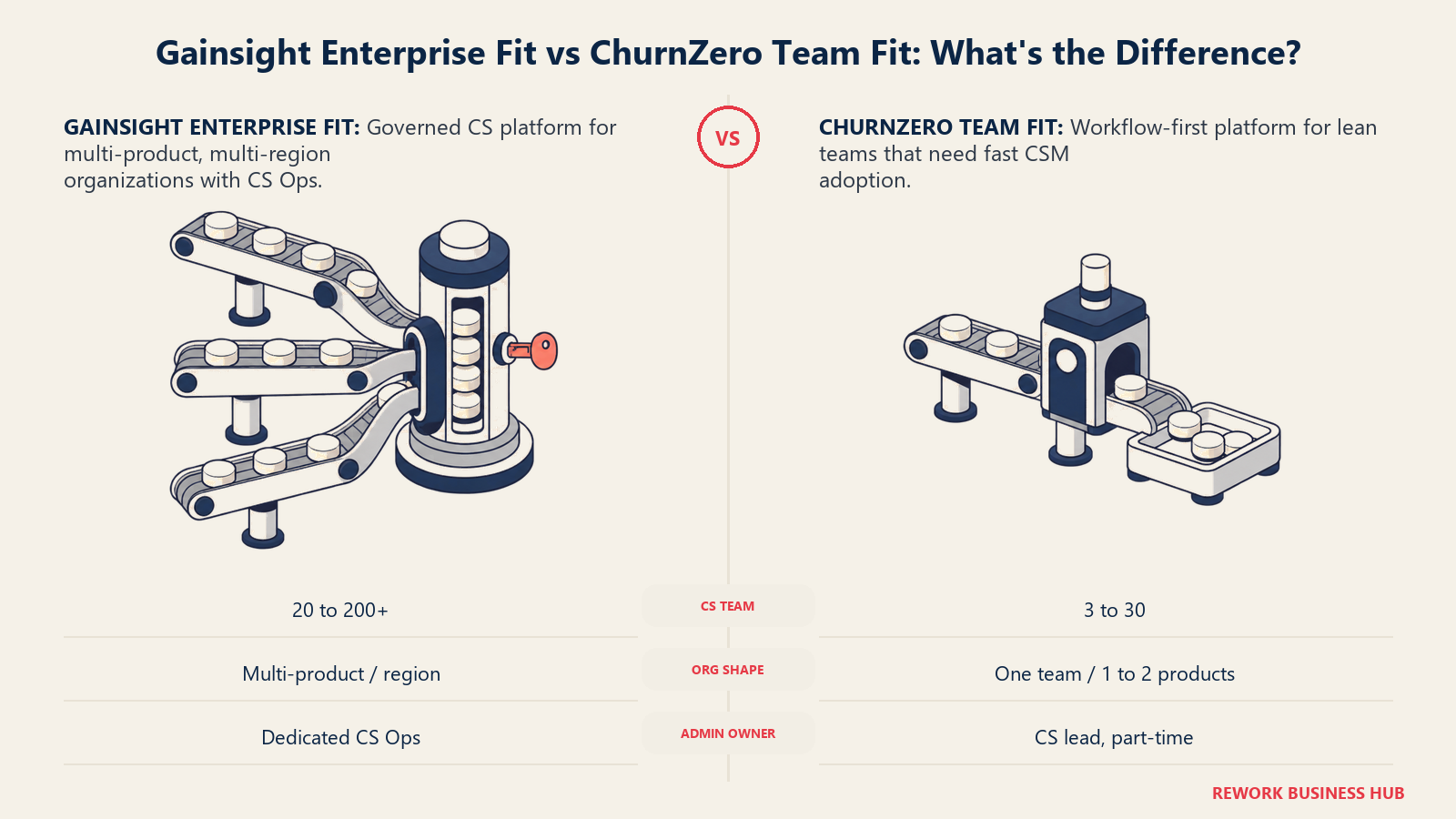
Gainsight is built for the second shape. Its design assumes somebody's job includes owning the platform: a CS Ops manager, a systems admin, a RevOps person with real capacity. In exchange you get configurability that holds up when three regional teams want three different scorecards on one data model, plus a product family reaching past customer success into analytics, education, and community. Staircase AI, Atlas AI Agents, Skilljar, Customer Communities, and Product Experience all sit on the same pricing page.
ChurnZero is built for the first shape. A CSM opens it, sees what needs attention, and works from there, rather than opening a configuration surface. That focus is the product's thesis, visible in surfaces like the Command Center and Success Centers that front-load the daily workflow. The tradeoff arrives when governance gets complicated.
| Gainsight | ChurnZero | |
|---|---|---|
| Company size sweet spot | 500+ employees, or complex mid-market | 50 to 500 employees |
| CS team size | 20 to 200+ CSMs across segments and regions | 3 to 30 CSMs, usually one team |
| Maturity assumed | Segmentation, documented playbooks, a platform owner | Motion exists informally, needs systematizing |
| Primary use case | Standardize and govern CS across products and regions | Get proactive on health, adoption, renewals fast |
| Ideal buyer | Chief Customer Officer, VP CS with a CS Ops function | VP of CS who is also the de facto ops owner |
| Portfolio breadth | CS plus analytics, education, community, conversation AI | Customer success, focused |
| Question it answers | "How do we run one motion everywhere and prove it?" | "How do we stop learning about churn in the renewal call?" |
If neither profile fits because you're still deciding what a CS platform should do at all, start with the category view in our best customer success software for 2026 roundup.
Team fit matrix
Teams outside CS matter more than most evaluations account for. A platform Product and Finance never touch quietly becomes a CS-only tool, which caps its value.
| Team | Gainsight | ChurnZero |
|---|---|---|
| CSMs (daily users) | Powerful once configured, heavier interface | Strong, the daily workflow is the design center |
| CS Ops / admin | Excellent, the role is assumed | Good, the role isn't required |
| Renewals and AM | Forecasting on the Enterprise edition | Renewal and Forecast Hub is a core surface |
| Product management | Strong via Product Experience | Usage flows in, analytics depth is narrower |
| Support / services | Skilljar and Communities extend into education | Help desk integrations, no owned education product |
| Finance / FP&A | Portfolio-level NRR reporting | Forecast data available, less depth |
| Executives | Deep dashboards, board-ready rollups | Clean dashboards, less slicing |
Either way, the platform is only as good as the account structure feeding it. Settling how you tier and segment accounts before implementation saves more wasted effort than any feature on either roadmap.
Core Capability Comparison
At the level of "does it have the thing," these platforms look nearly identical. Both do health scoring, playbooks, lifecycle automation, surveys, renewal forecasting, in-app messaging. Feature-parity tables here are mostly noise, which is why the column that matters below isn't the checkmark but the note beside it.
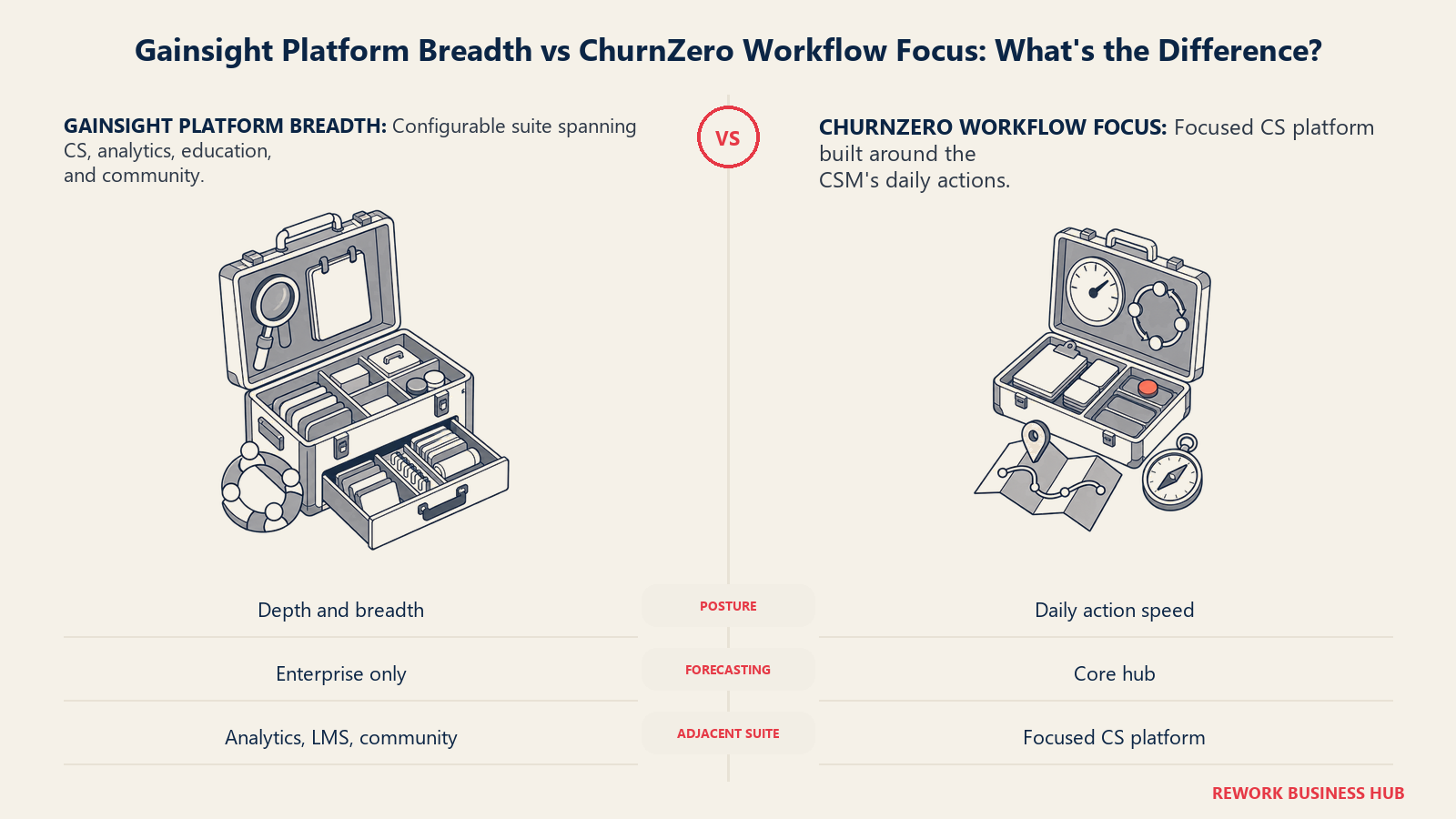
The real split is depth versus reach. Gainsight goes deeper on configuration and wider on adjacent products. ChurnZero goes further on getting a CSM to do the right thing today without an admin behind them.
| Capability | Gainsight | ChurnZero | What differs |
|---|---|---|---|
| Health scorecards | ✓ | ✓ | More segment variants vs faster to stand up |
| Customer 360 | ✓ | ✓ | More configurable vs more opinionated |
| Playbooks / plays | ✓ | ✓ | Success Plans and CTAs vs Plays on Journeys |
| Lifecycle automation | ✓ | ✓ | More branching vs quicker to build |
| In-app messaging | ✓ | ✓ | Via Product Experience vs native |
| Surveys and NPS | ✓ | ✓ | Comparable |
| Renewal and expansion forecasting | Partial | ✓ | Gainsight Enterprise-only, not Essentials |
| Org mapping and sponsor tracking | Partial | ✗ | Gainsight Enterprise-only, no ChurnZero equivalent |
| Conversation and sentiment AI | ✓ | ✓ | Staircase AI vs Engagement AI |
| Customer-facing portals | ✓ | ✓ | Communities vs Success Centers |
| Customer education / LMS | ✓ | ✗ | Skilljar is owned, ChurnZero integrates |
| Product analytics | ✓ | Partial | A real suite vs usage ingestion only |
| AI agents | ✓ | ✓ | Both ship agents, Atlas is broader |
| Unlimited viewer access | ✓ | Unclear | Published by Gainsight, unpublished by ChurnZero |
That last row matters more than it looks. Unlimited viewer licenses are the difference between "CS uses the platform" and "the company uses the platform." Gainsight puts it in writing on both editions. ChurnZero may match it in a quote, but you have to ask, and get it in the contract rather than an email from an AE.
Health Scoring and Early Warning Depth
Every vendor demos a green, yellow, and red dot. The question is what happens the day the dot turns yellow, and whether anyone believes it.
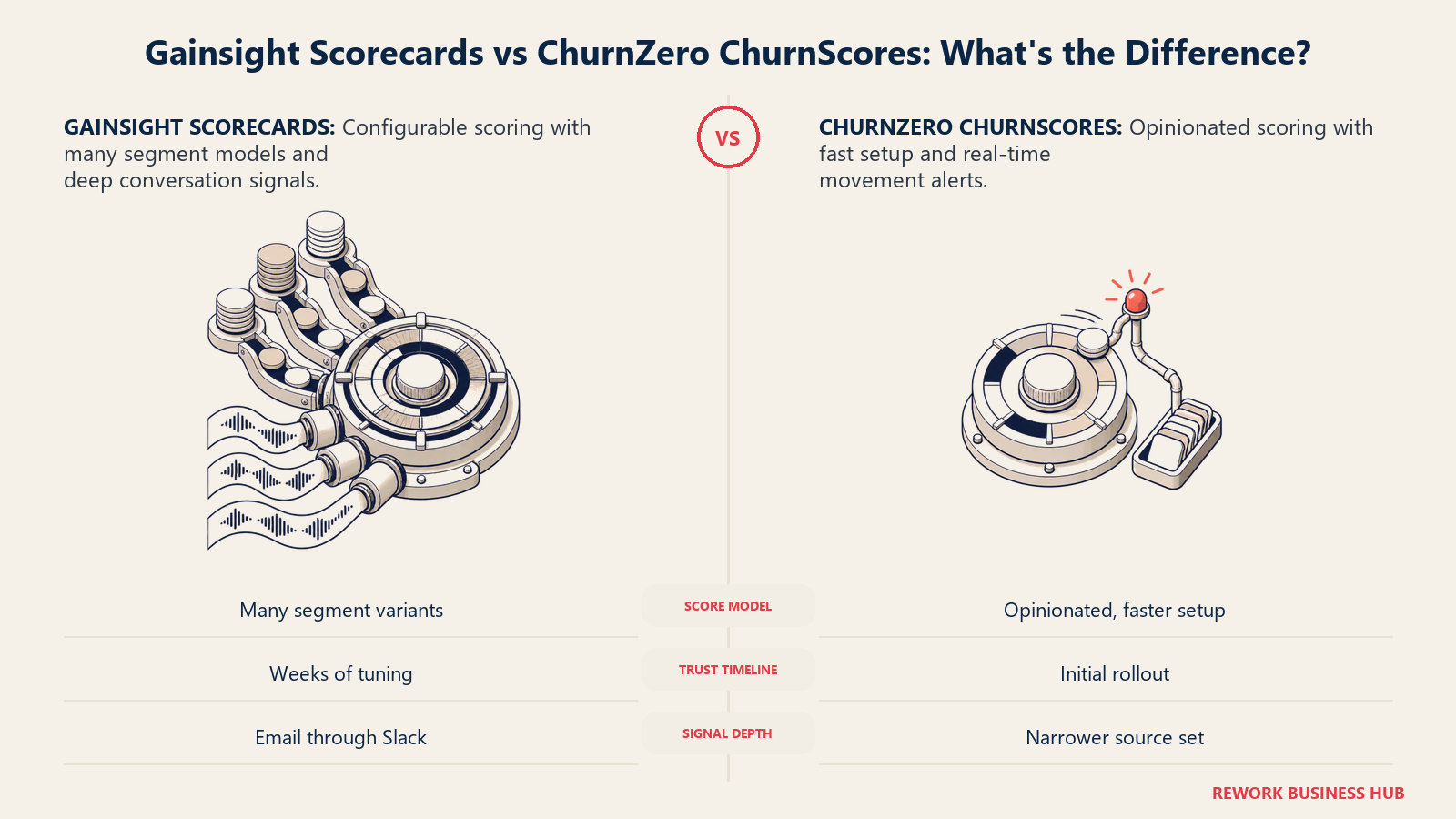
Gainsight builds around configurable scorecards with weighted measures, and its strength is running different scoring logic for different segments without forking the data model. An enterprise segment scored on sponsor engagement, ticket severity, and multi-product adoption can coexist with an SMB segment scored almost entirely on usage. If you have three or more segments with different definitions of healthy, that's the capability you're buying.
ChurnZero's ChurnScores are more opinionated. You define factors, weight them, and the score updates against live product and engagement data, with alerts firing on change rather than only on threshold breach. For eight CSMs covering one product, that reaches usefulness much faster.
The trap is identical in both. A health score built on the data you happen to have, rather than the behaviors that predict renewal, is a colored dot with a spreadsheet behind it. Decide what belongs in the model before configuring either platform, using customer health monitoring and the more statistically serious version in churn prediction models.
| Health and risk factor | Gainsight | ChurnZero |
|---|---|---|
| Multiple scorecards by segment | Strong, a core design assumption | Supported, less depth at high segment counts |
| Weighted configurable measures | Extensive | Simpler to configure |
| Time to a score the team trusts | Weeks of tuning, with an owner | Often live in the initial rollout |
| Alerting model | CTAs and rules routed into workflows | Real-time alerts on score movement |
| Conversation signal | Staircase AI: email, tickets, chat, meetings, CRM, Slack | Engagement AI: relationship scores, sentiment, topics |
| Sponsor and stakeholder risk | Org mapping and sponsor tracking, Enterprise | Contact-level engagement, no equivalent |
| Explaining the score to execs | Deep, needs curation | Presentable unedited |
| Who has to own it | Realistically a CS Ops or admin role | A CS lead, part-time |
Gainsight's conversation layer is the clearest capability gap. Staircase AI ingests email, support tickets, chat, meeting recordings, CRM records, and Slack, producing risk and expansion signals plus stakeholder relationship mapping, with PII redaction and ISO 27001 and ISO 42001 certifications listed on its product page. ChurnZero's Engagement AI covers similar ground across fewer source systems. Whether that gap matters depends on whether your conversations live in those systems or in a WhatsApp thread nobody will ever connect.
Alerts are only useful if somebody decided in advance what happens when one fires. That routing logic is the substance of an early warning system, and it's what teams skip and then blame the platform for.
Playbooks, Plays, and Automation
Both let you codify a motion and trigger it automatically. They optimize for different things.
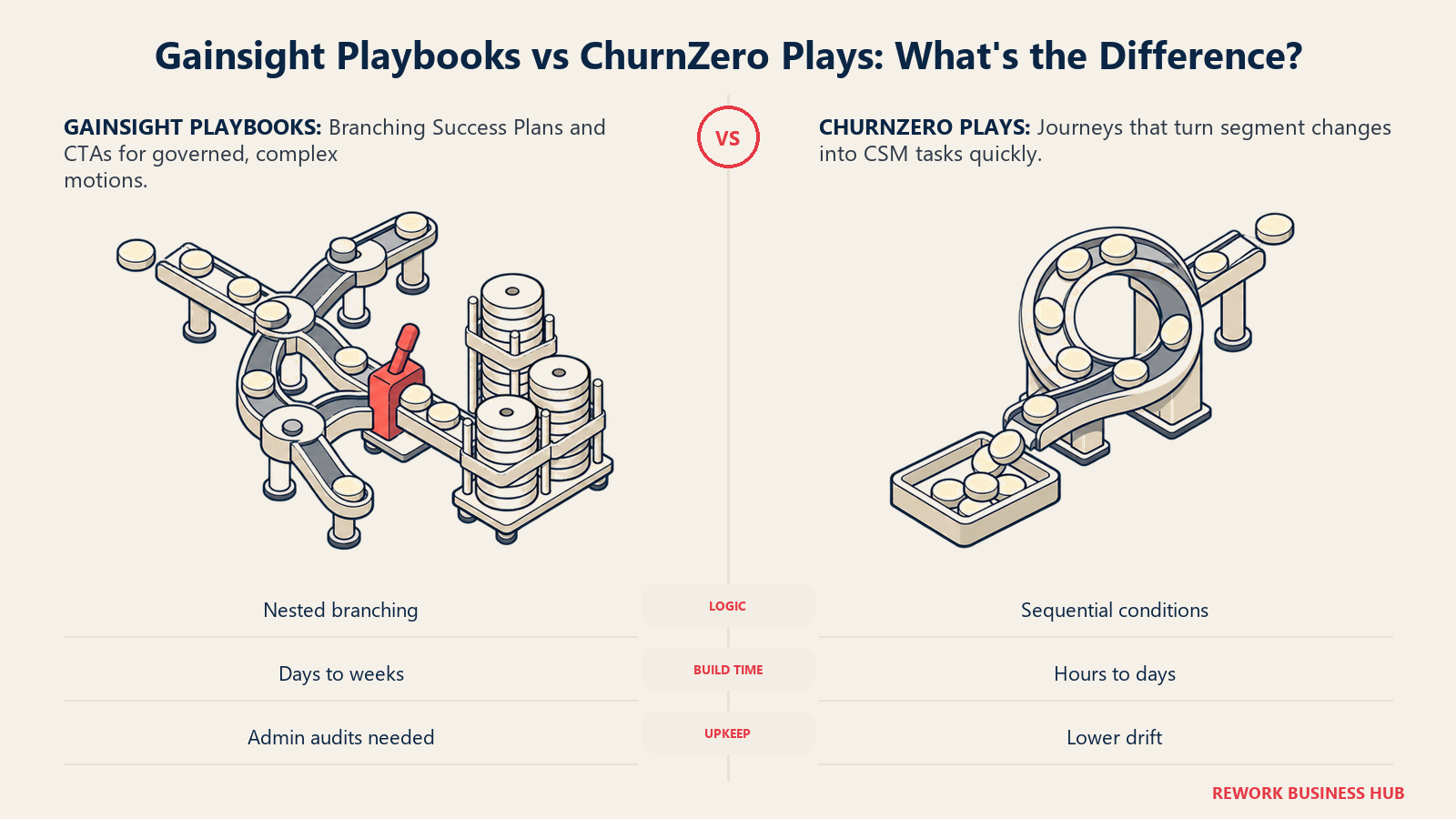
Gainsight runs through Success Plans, playbooks, and Calls to Action, with a deep automation engine: multi-step, multi-condition, branching, able to gate steps on approvals and data conditions. If you have compliance requirements, regional variations, or a QBR process that must look identical in three languages, that's what you want. The cost is real. Deep engines need maintenance, and orphaned automations nobody remembers building are a genuine operational risk in Gainsight deployments.
ChurnZero's Plays attach to Journeys and segments. A customer enters a segment, a Journey fires, Plays execute, tasks land on a CSM's list. Less expressive, faster to build, and for a team needing four or five reliable motions (onboarding, adoption stall, executive change, renewal runway, expansion signal) the gap is theoretical rather than practical.
| Automation dimension | Gainsight | ChurnZero |
|---|---|---|
| Trigger sources | Health, usage, survey, CRM field, conversation, date | Health, usage, segment entry or exit, survey, date |
| Branching depth | High, multi-condition with nested logic | Moderate, sequential with segment conditions |
| Approvals and gating | Supported | Limited |
| Time to build a working motion | Days to weeks, with an owner | Hours to days |
| Digital / one-to-many CS | Digital Journeys, Communities, Skilljar | Journeys, in-app comms, Success Centers |
| AI agents on workflows | Atlas: risk, expansion, handoff analysts | Agents surfacing next steps, drafting follow-ups |
| Maintenance burden | Real, needs periodic audit | Lower, less to drift |
Gainsight's agentic layer is moving fastest. Its own May 2026 announcement describes Agent Studio for building workflows in plain language, plus named agents including a Staircase Handoff Analyst and Risk and Expansion Analysts, and reports customers running more than 175,000 tool calls against Gainsight data (Gainsight press release). Those are vendor-reported numbers about the vendor's own platform, so read them as evidence of investment, not outcome. ChurnZero ships agents too. Neither has published independently verified retention lift from them.
What you automate matters more than the engine you automate it in. If you haven't written down which signals trigger which intervention, that's the work to do before either tool earns its money.
Product Usage Data and Analytics
Here the two genuinely diverge, and buyers decide it wrong by conflating two needs.
Need one: health scores and playbooks require product usage as an input. Both do this. Events come in, become measures, feed scores, trigger plays. It's core to how ChurnScores work.
Need two: somebody wants to analyze product behavior itself. Funnels, retention curves, adoption cohorts, path analysis. That's product analytics, not customer success, and Gainsight owns a real product there in Product Experience while ChurnZero doesn't. If Product is already happy on a dedicated analytics tool, this is a non-issue. If Product has nothing and you're quietly hoping the CS platform covers both, only Gainsight plausibly does.
| Usage data dimension | Gainsight | ChurnZero |
|---|---|---|
| Ingest events for health scoring | ✓ | ✓ |
| Feature-level adoption tracking | ✓ | ✓ |
| Funnels, paths, retention curves | ✓ via Product Experience | ✗ |
| In-app guides driven by usage | ✓ via Product Experience | ✓ native in-app comms |
| Separate license for full analytics | Yes, Product Experience is priced separately | Not applicable |
| Product team likely to adopt it | Yes, if PX is licensed | Rarely, it's a CS tool |
The failure mode worth naming: buying the broader platform assuming Product will use it, then discovering Product never got a license because it was a separate line item cut in negotiation. Ask which SKU the analytics live in before building a business case on cross-team adoption.
Either way, the useful artifact is one view where usage and health sit side by side instead of two tools nobody reconciles, a pattern worked through in product usage meets customer health dashboard.
Reporting, Forecasting, and NRR Visibility
This is where the CFO conversation gets settled, and where Gainsight's edition structure matters more than anything else on its pricing page.
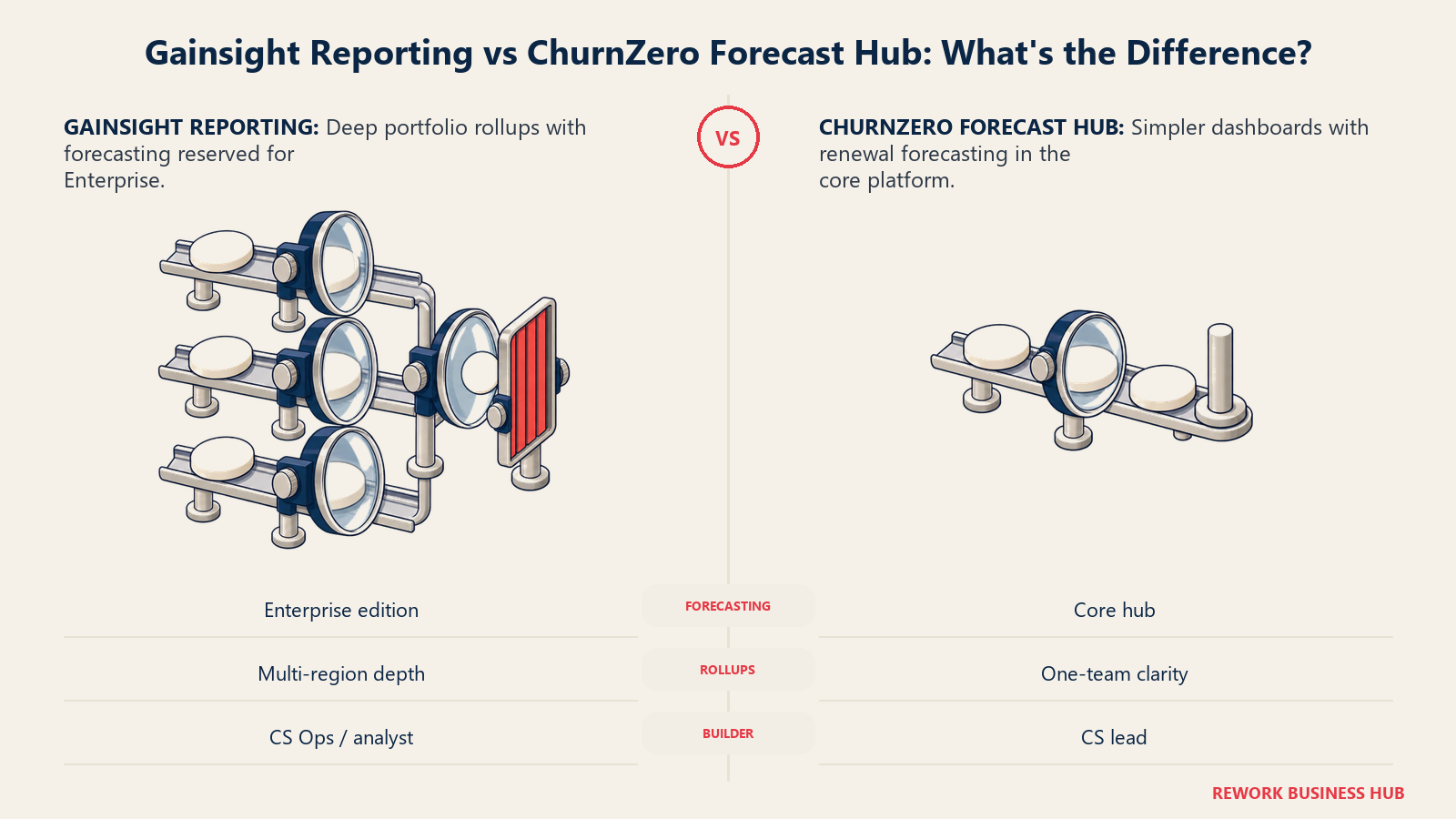
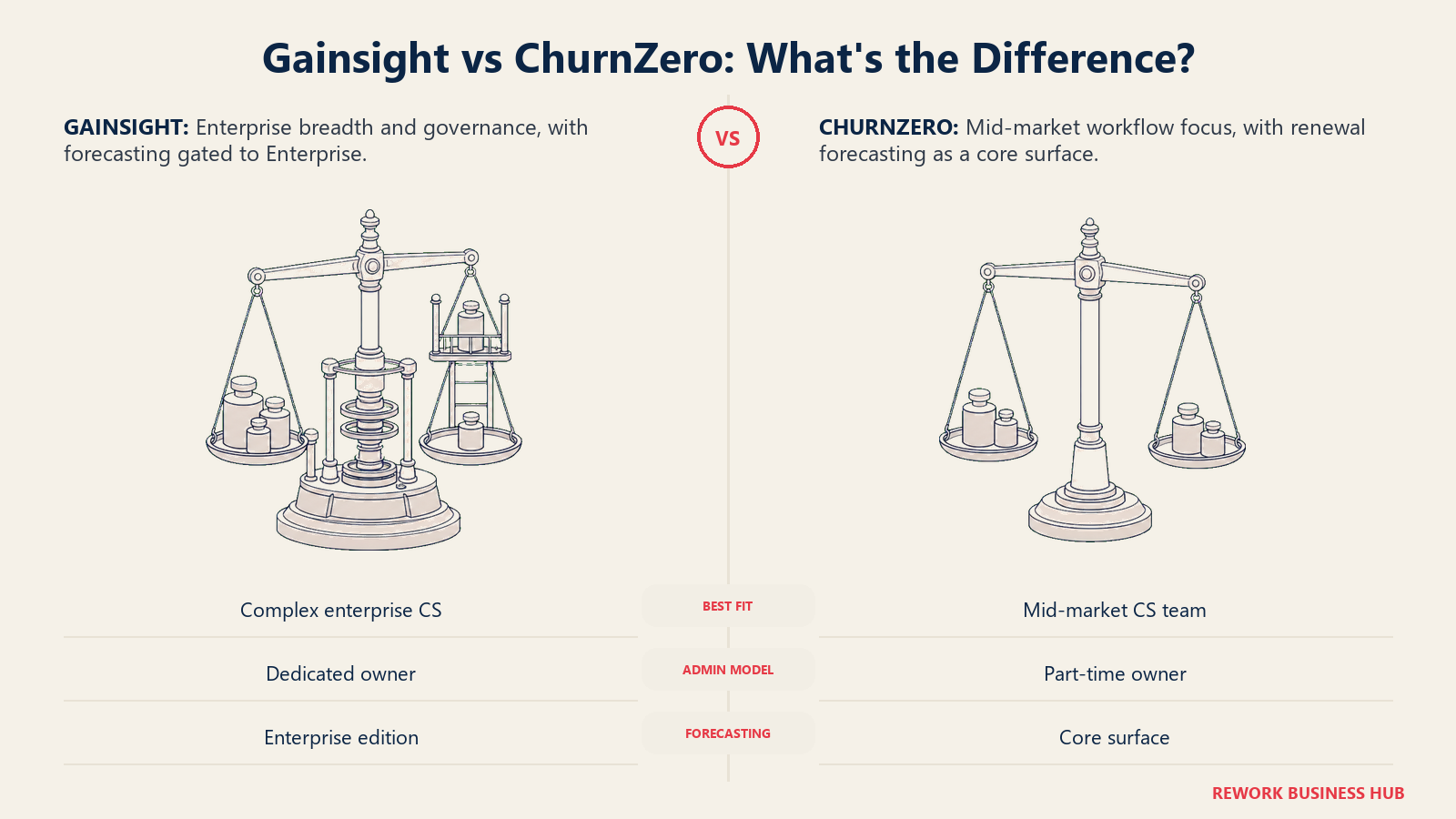
Renewal and expansion forecasting is an Enterprise-edition feature in Gainsight. It is not in Essentials. Gainsight's pricing page draws that line explicitly, alongside Company News and Organizational Mapping and Sponsor Tracking. So if you're pricing Essentials against ChurnZero and assuming forecasting is in the box, you're comparing the wrong things. ChurnZero's Renewal and Forecast Hub is a core surface, not a tier upgrade.
That's material, because forecasting is often why the purchase gets approved at all. Nobody signs a six-figure contract to make CSMs feel organized. They sign because a board slide has to become defensible.
| Reporting dimension | Gainsight | ChurnZero |
|---|---|---|
| Standard CS dashboards | ✓ | ✓ |
| Custom report building | Deep, requires familiarity | Straightforward |
| Renewal forecasting | Enterprise edition only | Core product surface |
| Expansion forecasting | Enterprise edition only | In the Renewal and Forecast Hub |
| Multi-segment, multi-region rollups | Strong | Adequate for one team |
| Board-ready NRR view | Yes, with configuration effort | Faster, less configurable |
| Read-only exec access | Unlimited viewers, published | Not published, ask |
| Who builds the reports | CS Ops or an analyst | Usually the CS lead |
Two caveats apply regardless of vendor. First, a CS forecast that disagrees with the sales forecast creates a meeting, not clarity. Getting one number out of two systems is an operating decision, not a software feature, and the mechanics are in forecasting NRR jointly. Second, benchmark against the right population. That 122% median NRR is a public company median. SaaS Capital's private-company data shows companies selling at $25,000 to $50,000 ACV running a 102% median NRR, top quartile 111% (SaaS Capital). If your board deck compares private mid-market NRR to a public benchmark, no platform fixes that conversation.
Integrations and the Data Model
Both integrate with what you'd expect: Salesforce, HubSpot, Zendesk, Intercom, Jira, Slack, Snowflake, Segment, and the usual billing and support suspects. Counting integrations is close to meaningless. What matters is how the CRM relationship is structured and where the system of record lives.
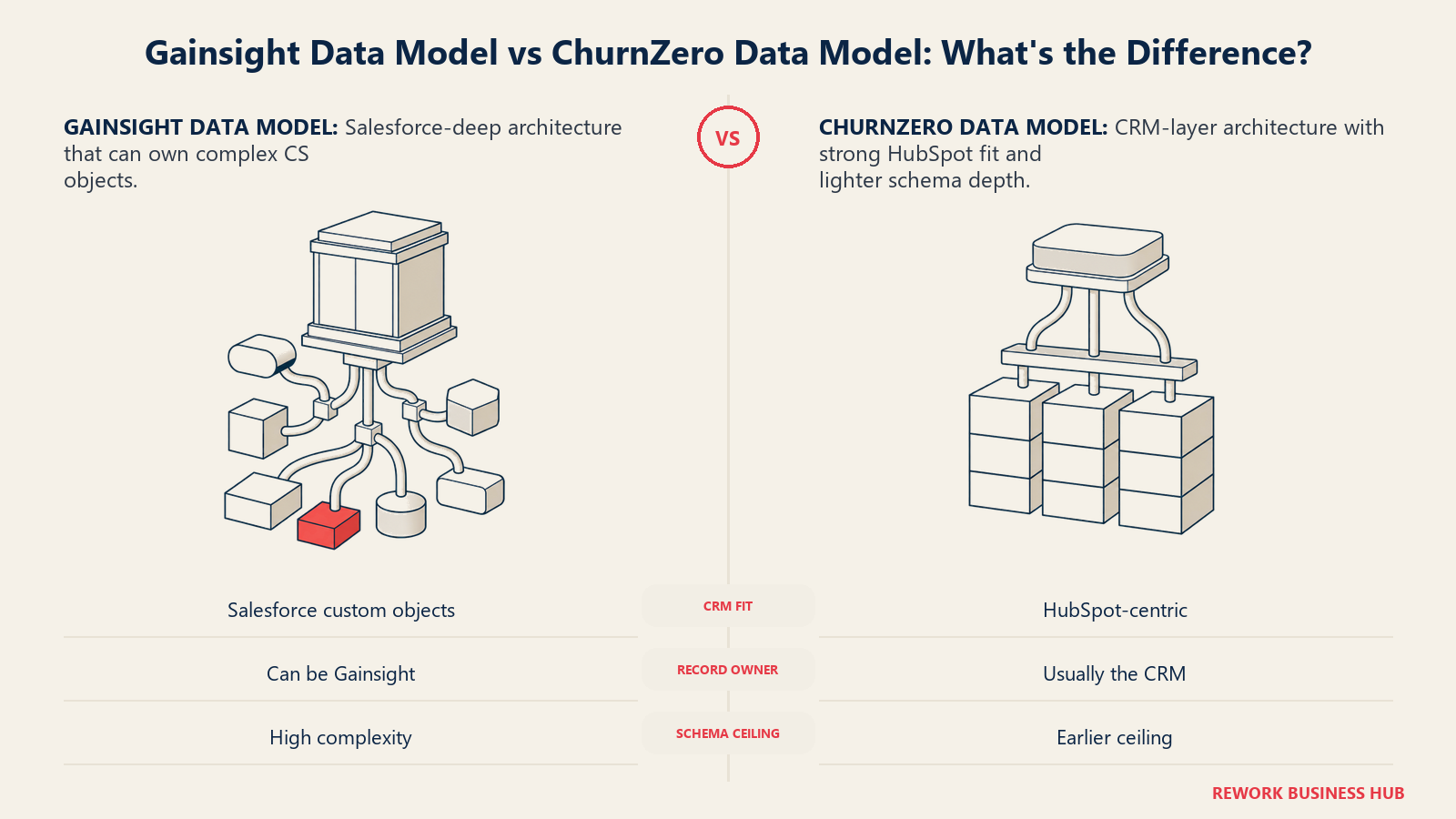
Gainsight's history is deeply Salesforce-native and it shows. If you run on Salesforce with custom objects, its data model feels like an extension of what you have. ChurnZero works well with both and is noticeably more comfortable in a HubSpot-centric mid-market stack, which is what most companies in the 50-to-500 range actually run.
| Integration dimension | Gainsight | ChurnZero |
|---|---|---|
| Salesforce depth | Deepest of the two, custom objects included | Solid, bidirectional |
| HubSpot depth | Supported | Strong, a common deployment |
| Support desk (Zendesk, Intercom, Freshdesk) | ✓ | ✓ |
| Product event ingestion | ✓ SDK, API, Segment | ✓ SDK, API, Segment |
| Data warehouse sync | ✓ | ✓ |
| Custom objects and complex schemas | Strong | Adequate, ceiling appears sooner |
| System of record | Can be Gainsight for CS objects | Usually stays in the CRM |
| API and programmatic access | Extensive, plus MCP and CLI | Available, narrower |
The system-of-record question decides whether year three hurts. If CS objects live in Gainsight and your CRM lives in Salesforce, you need an explicit decision about which wins on conflict. If the CS platform is a layer on top of the CRM and defers to it, that decision is already made. Neither is wrong. Not deciding is. The options are in the aligned stack: CRM, CS platform, and revenue intelligence.
What Each One Actually Costs, and How to Run the Evaluation
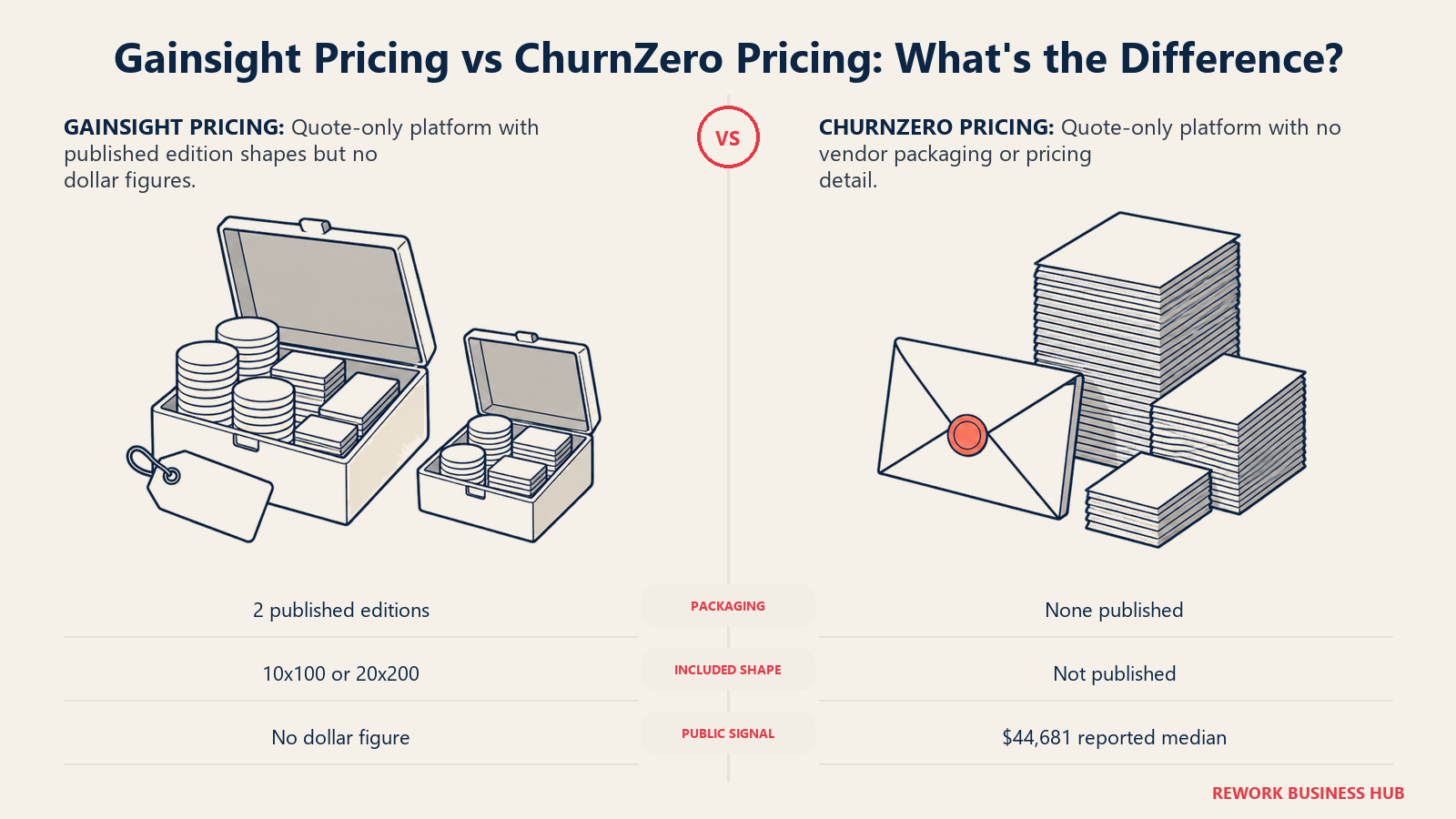
Neither vendor publishes a price, and that isn't unique to these two. Almost nothing in this category has a public rate card, so the usual process (open two pricing pages, build a spreadsheet, pick) doesn't run here. You have to replace it, and most teams don't, which is why so many CS purchases feel like they happened to the buyer. Here is what is public today, and nothing more.
| Gainsight | ChurnZero | |
|---|---|---|
| Published price | None, "Request Pricing" on both editions | None, no pricing page at all |
| Published packaging | Yes, Essentials and Enterprise | No |
| Included full users | 10 (Essentials) / 20 (Enterprise) | Not published |
| Included customers per user | 100 (Essentials) / 200 (Enterprise) | Not published |
| Viewer licenses | Unlimited on both editions | Not published |
| Feature gating by tier | Yes, forecasting and org mapping are Enterprise-only | Not published |
| Adjacent products priced separately | Skilljar, Product Experience, Communities, Staircase AI, Atlas | Not applicable |
| Third-party contract data | Not used here | (reported) Vendr: $18,681 to $131,560/year, $44,681 median |
Read Gainsight's edition shapes carefully, because they encode the pricing logic even without a number. Essentials at 10 full users and 100 customers per user implies roughly 1,000 accounts before you buy more. Enterprise at 20 and 200 implies roughly 4,000. If you have 2,500 accounts and six CSMs, you're an Enterprise-shaped buyer on account volume and an Essentials-shaped buyer on headcount, and that mismatch is where the quote gets interesting. Work out which dimension you blow through first, because that's what the AE prices against.
For ChurnZero, the Vendr data is the only public signal and it needs a health warning. It's reported third-party data from closed contracts, not a rate card and not a quote. The spread is wide enough that quoting the low end in a business case would be reckless. Use the $44,681 median to get budget approved in principle, then replace it with a real quote before anyone signs.
What to actually ask for in a quote
Send both vendors the same written request: identical inputs, identical format, same deadline. Let each propose its own shape and you'll get two documents that can't be compared.
| Ask for this | Why it decides the number |
|---|---|
| Your exact CSM headcount, plus one hire | Seat pricing punishes growth you already know is coming |
| Your exact account count, plus a 12-month projection | The second pricing axis, and the one buyers forget |
| Which features sit behind which tier, in writing | Forecasting is Enterprise-only in Gainsight. Assume other gates exist |
| Viewer and read-only license terms and count | Decides whether execs ever see the platform |
| Every adjacent module as a separate line | Analytics, education, community, and agents are often separate SKUs |
| Implementation fees itemized, plus year 2 and 3 uplift caps | Both are where an unmanaged contract gets expensive late |
| Multi-year discount, the annual alternative, and ramp terms | You can't judge a commit without the annual number beside it |
| Exit terms: export format and notice period | Migration cost is the real switching cost here |
| Two references at your size and account count | Not the flagship logo. Your shape |
One discipline that costs nothing: get both quotes before either vendor knows who else is in the process. It moves the first number more than any tactic applied later.
Implementation Effort and Time to Value
This is where the two differ most in practice and least in the demo, because a demo shows a configured system and hides the eleven weeks that configured it.
Gainsight implementations are substantial projects: discovery, data model design, scorecard configuration, playbook build, integration work. The downside is this category's best-documented failure mode, where a consultant configures the platform, the internal owner leaves, and eighteen months later nobody can explain why an automation fires.
ChurnZero implementations are lighter by design and reach a working state faster, which is the entire argument for choosing it. That doesn't make it zero effort. Data still has to be clean, score factors still have to be chosen and defended, and integrations take calendar time.
| Implementation factor | Gainsight | ChurnZero |
|---|---|---|
| Typical scope | Discovery, data model, scorecards, playbooks, integrations | Integrations, ChurnScores, segments, first Journeys |
| Internal owner required | Effectively yes, CS Ops or an admin | Helpful, not required |
| Partner or professional services | Common | Less common |
| Time to first useful health score | Weeks, after tuning | Often within the initial rollout |
| Time to a full configured motion | A quarter or more | Weeks to a quarter |
| Ongoing admin load | Meaningful and continuous | Light to moderate |
| Risk if the owner leaves | High, undocumented config becomes debt | Lower, less to lose |
| Training load on CSMs | Higher, more surface to learn | Lower, workflow-first |
The number that matters isn't time to go-live. It's time until a CSM changes what they do because of something the platform told them. Make that your success criterion and ask both vendors how their references hit it.
When Gainsight Is the Right Call
Multiple products, segments, or regions need different motions on one data model. Running three scorecards, three playbook sets, and three reporting rollups without forking your architecture is what Gainsight's configurability buys, and it's the first thing ChurnZero makes you compromise on.
You have a CS Ops function, or you're funding one. With a named owner who has real capacity, Gainsight's depth is an asset. Without one, the same depth is why adoption stalls.
You need governance you can show an auditor or an acquirer. Approval gating, org mapping, sponsor tracking, standardized process across regions, portfolio rollups. Gainsight is built to produce that evidence.
Your customer conversations live in connected systems. Staircase AI's value depends on real signal from email, tickets, meetings, CRM, and Slack. If your relationships run through those channels, the conversation layer is a genuine advantage. If they run through one quarterly call, it isn't.
When ChurnZero Is the Right Call
Three to thirty CSMs who need to be proactive this quarter, not next year. Time to a trusted health score and a working alert routine is the whole game at this size, and ChurnZero gets there faster with less internal machinery.
Nobody is going to own a platform full time. If the VP of CS will administer the tool between customer calls, pick the tool designed for that reality. A cheaper platform your team uses beats a more capable one nobody maintains.
Renewal forecasting has to be in the box from day one. ChurnZero's Renewal and Forecast Hub is a core surface. In Gainsight it is Enterprise-edition functionality, so an Essentials-priced comparison isn't like for like.
You're on HubSpot, not Salesforce. ChurnZero sits comfortably in a HubSpot-centric stack. Gainsight's Salesforce heritage is a real advantage in a Salesforce shop and neutral at best outside one.
When Neither Is Right
Both are real platforms with real contract values, and a meaningful share of teams reading this shouldn't buy either yet.
| If this is you | What to do instead |
|---|---|
| Under about 100 customers, or fewer than 3 CSMs | Track health in your CRM, revisit in two quarters |
| Your churn is really a product or onboarding problem | Diagnose the cause before buying a platform for it |
| Your customer data is a mess | Fix it. Both will faithfully automate garbage |
| You need something cheaper or lighter | See best Gainsight alternatives and best ChurnZero alternatives |
| You want to weigh the rest of the field | Start with best Totango alternatives |
| Your real gap is ticket volume, not retention | You need help desk software |
| Your CRM can't support either implementation | Sort the foundation with best CRM software for 2026 |
A note on the wider field, because stale comparisons are everywhere here. Catalyst is now sold as a Totango product line rather than an independent vendor, and the free tier Totango was widely known for is no longer listed on its pricing page. If an article tells you to sign up for Totango's free plan, it's out of date, and assume its pricing is too.
Neither answer is wrong for everyone. The wrong move is buying the more capable platform and staffing it like the simpler one.
Decision Framework
The choice comes down to operating shape: Gainsight rewards teams that can fund governance and administration, while ChurnZero rewards teams that need fast adoption with a lighter owner model.
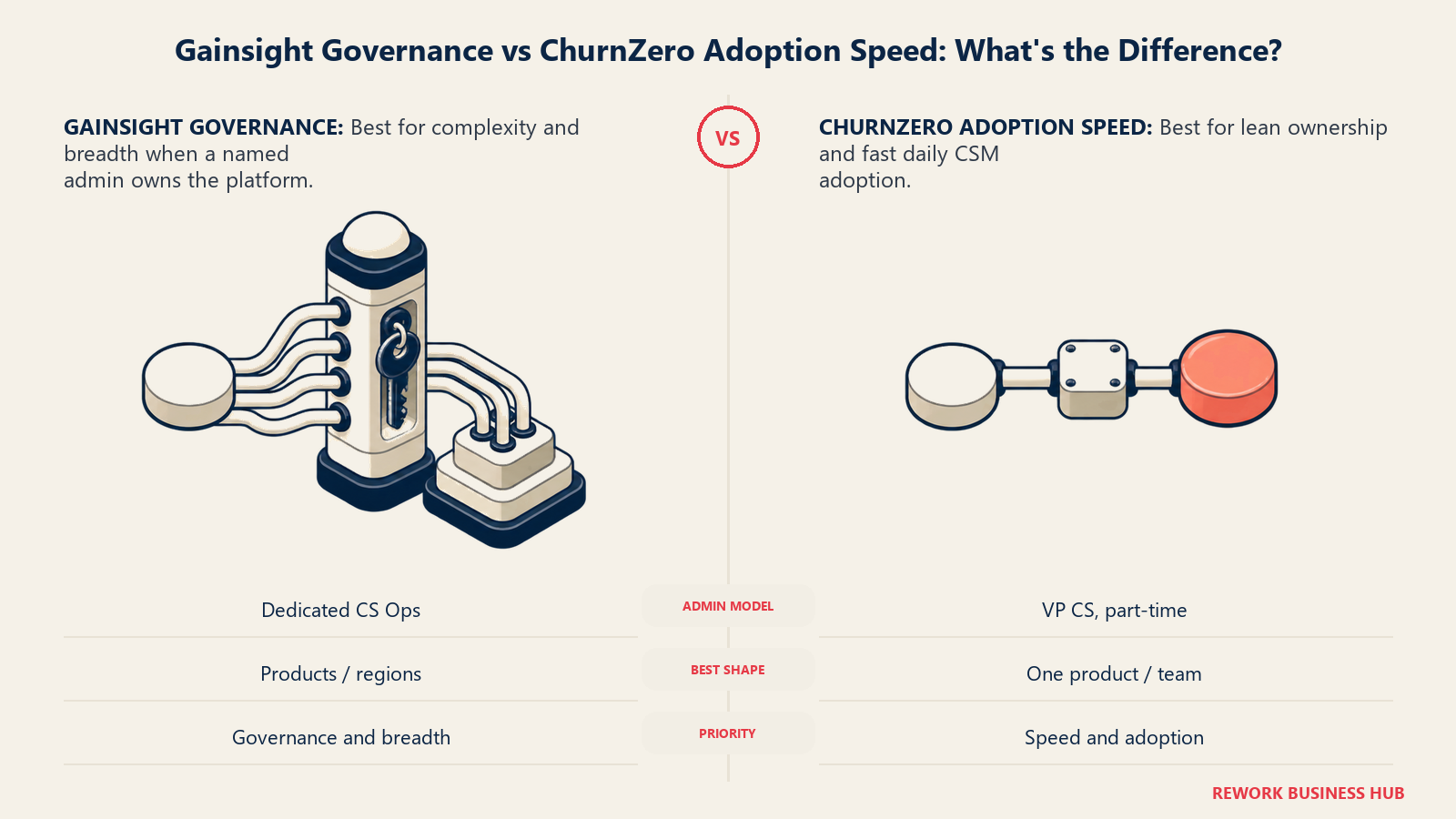
| If this is true for you | Pick |
|---|---|
| You have a CS Ops owner, or you're hiring one | Gainsight |
| The VP of CS will administer it between customer calls | ChurnZero |
| Multiple products or regions need different motions | Gainsight |
| One product, one CS team, one motion to systematize | ChurnZero |
| Forecasting must be included, not tier-gated | ChurnZero, or budget Gainsight Enterprise |
| You want analytics, education, or community from one vendor | Gainsight |
| Your stack is HubSpot-centric | ChurnZero |
| Your stack is Salesforce with custom objects | Gainsight |
| Adoption risk worries you more than capability ceilings | ChurnZero |
| Governance evidence for audit or diligence is required | Gainsight |
What to Do Next
- Decide which pricing axis you blow through first, seats or accounts. Gainsight's published edition shapes let you work that out before the first sales call, and it changes which edition you're really being quoted.
- Send both vendors the same written quote request, using the table above. Same headcount, same account count, same projection, same deadline.
- Name your implementation owner before you sign. If you can't name a person and the hours they'll have, that's your answer about which platform to buy, and it isn't the enterprise one.
- Define your health score model on paper first. Both platforms will implement whatever you tell them, including a bad model.
- Agree with Sales who owns the renewal number before the platform arrives, because the answer determines who the platform is really for.
- Ask each vendor for a reference at your account count, not their flagship logo, and ask it one question: how long until a CSM changed what they did because of the tool?
Frequently Asked Questions about Gainsight vs ChurnZero
How much does Gainsight cost?
Gainsight does not publish a price. Its pricing page shows "Request Pricing" on both editions. It does publish the shape of each: Essentials includes 10 full users at 100 customers per user, Enterprise 20 at 200, both with unlimited viewer licenses. Your quote is driven by which limit you exceed first, plus any adjacent products you attach.
How much does ChurnZero cost?
ChurnZero publishes no pricing information at all. The only public data is third-party: Vendr reports $18,681 to $131,560 per year across anonymized ChurnZero transactions, with a median annual contract of $44,681. That is reported contract data, not a vendor rate card, so treat it as a planning assumption and replace it with a written quote before committing.
Does Gainsight include renewal forecasting?
Only on the Enterprise edition. Gainsight's pricing page lists Renewal and Expansion Forecasting, Organizational Mapping and Sponsor Tracking, and Company News as Enterprise-only, so Essentials does not include them. ChurnZero's Renewal and Forecast Hub is a core surface rather than a tier upgrade, so an Essentials-versus-ChurnZero comparison is not comparing the same capability set.
Which one is easier to implement?
ChurnZero, by design. It reaches a working health scoring and alerting motion without a dedicated platform administrator, which is the main reason mid-market teams choose it. Gainsight implementations are larger projects involving data model design, scorecard configuration, and integration work, and realistically assume a CS Ops owner or a partner.
What about Totango, Planhat, and the rest of the category?
They are legitimate alternatives, and the field has consolidated. Catalyst is no longer independent and is sold as a Totango product line, and the free tier Totango was known for is no longer listed on its pricing page as of August 2026. Almost every platform here is quote-only, so this evaluation discipline applies whichever names end up on your shortlist.
Why does no customer success platform publish pricing?
Because price depends on two variables that differ wildly between buyers: how many practitioner seats you need and how many customer accounts you manage. A 10-CSM team with 300 enterprise accounts and one with 12,000 SMB accounts are completely different deals. So budget approval has to happen on a range rather than a number. Get a written quote early in the cycle, not at the end.

Principal Product Marketing Strategist
On this page
- Key Facts
- TL;DR
- Who Each Platform Is Really Built For
- Team fit matrix
- Core Capability Comparison
- Health Scoring and Early Warning Depth
- Playbooks, Plays, and Automation
- Product Usage Data and Analytics
- Reporting, Forecasting, and NRR Visibility
- Integrations and the Data Model
- What Each One Actually Costs, and How to Run the Evaluation
- What to actually ask for in a quote
- Implementation Effort and Time to Value
- When Gainsight Is the Right Call
- When ChurnZero Is the Right Call
- When Neither Is Right
- Decision Framework
- What to Do Next