Best Softr Alternatives in 2026: 13 No-Code Portal and App Builders Compared
Turn this article into takeaways for your work.


Each assistant summarizes the article only for you and suggests best practices for your work.
Noloco and Pory are the best Softr alternatives if a shrinking app-user allowance is the reason you're looking, since both charge for a portal in a way that doesn't punish you for growth. Knack and Caspio are the best fit if you want a flat bill and unlimited logins with nobody on the team who writes SQL, and Bubble or Budibase are worth a serious look the moment your "client portal" quietly turns into a real product. We evaluated 13 tools on app-user allowance, billing shape (flat, per-seat, or credit-metered), and total annual cost at a realistic team-plus-client scenario.
This is written for founders, agency owners, and ops leads at organizations of 2 to 200 people running a client-facing portal, membership site, or internal tool on top of data they already keep somewhere else. One thing worth knowing before you compare a single price: Softr repriced its entire plan lineup on 5 August 2026, and the number that actually decides your bill isn't the sticker price on the tier, it's how many app users that tier now includes. If you're still deciding whether a no-code app builder is even the right category, best no-code app builders in 2026 is the wider map this list sits inside.
Key Facts
- Gartner forecasts the low-code development technologies market to grow 19% to reach $44.5 billion by 2026, per Gartner as reported by InfoWorld.
- By 2026, low-code tools will account for 75% of new application development, up from 40% in 2021, per Gartner as reported by InfoWorld.
- Developers outside formal IT departments will make up at least 80% of the low-code user base by 2026, up from 60% in 2021, per Gartner as reported by InfoWorld.
- 35% of enterprises have already replaced at least one SaaS tool with custom-built software, and 78% expect to build more of their own tools in 2026, per Retool's 2026 Build vs. Buy report, based on a survey of 817 builders.
- 60% of builders across seniority levels have shipped something outside formal IT oversight in the past year, per the same Retool 2026 Build vs. Buy report.
That's the same demand pulling client portals and internal tools out of engineering backlogs and onto an ops person's desktop, which is exactly the shift Softr, Noloco, and the rest of this list are built to serve.
Quick Comparison Table
| Tool | Best For | Starting Price | Key Strength | Key Limitation |
|---|---|---|---|---|
| Noloco | Cheapest flat-rate client portal swap | Free; Build $79/mo, $65/mo annual | 10 internal users and 1,000 active clients on one flat fee | Enterprise quote needed past that ceiling |
| Stacker | Credit-metered agents and portals | Free trial credits; Standard $50/mo | No per-seat charge at any headcount | Cost tracks usage, not people, so budgeting is harder |
| Pory | Unlimited members, zero per-user math | Free; Pro $99/mo annual | States plainly it doesn't charge per user, applicant, or seat | One portal per plan below Enterprise |
| Glide | Mobile-first field and frontline apps | Free; Solo $25/mo | Best native-feeling mobile output here | Credit metering makes cost hard to predict |
| WeWeb | No per-app-user charge at all | Free; Essential $20/mo | Only builder seats and hosting bandwidth are billed | You still need a separate backend like Xano or Supabase |
| Jetadmin | Dedicated customer-portal plans | Free; Pro $16/mo annual | States "unlimited users" as a common feature across tiers | Customer Portal track lists 1 app below Enterprise |
| Airtable Interfaces | Teams whose data already lives in Airtable | Free; Team $20/seat/mo annual | Read-only portal viewers via a share link cost nothing | No workflow logic beyond what Airtable itself offers |
| Knack | Flat pricing with unlimited logins | $49/mo annual, Starter | Unlimited users on every plan | Builder feels dated; record ceilings arrive early |
| Bubble | A full product, not just a portal | Free; Starter $29/mo annual, web only | Genuine full-stack app builder | Workload-based billing is hard to predict |
| Budibase | Self-hosting the whole platform for free | Free unlimited self-hosted; Pro $19/mo | True open-source core, no user ceiling | Cloud end users cost $5 each and add up fast |
| Google AppSheet | Teams already paying for Google Workspace | $5/user/mo, Starter | Often bundled into Workspace already paid for | No cheap tier for individually authenticated external users |
| Zoho Creator | A full app platform with real workflow logic | Free; Standard $8/user/mo annual | Unlimited apps from Professional up | Per-user pricing punishes a large external audience |
| Caspio | Enterprise portals, including HIPAA builds | Team $300/mo, $270/mo annual | Unlimited users on every plan, no per-user cost | No permanent free plan; priciest entry point here |
Softr Bills by App User. That Number Just Moved.
Every Softr plan is built around one number: how many app users it includes. Since the August repricing, that number splits into Team users (your own staff) and Client users (everyone outside your company), and the math underneath both changed. Free covers up to 3 builders and 5 app users combined. Basic runs $19 a month for 1 builder with 5 team plus 5 client users. Pro is $99 a month for 2 builders with 10 team users and additional client users priced from $1 a month each. Business is $329 a month for 3 builders with 30 team users and additional client users priced from $2 a month each, per Softr's own pricing and plans documentation.
The old lineup, Basic $49, Professional $139, Business $269, with roughly 20, 100, and 500 app users respectively, is gone, and a lot of the internet still describes it as current. On Softr's own community forum, the difference isn't subtle. In the thread announcing the change, community members did the math themselves: one described the Business plan's old allowance as roughly 2,500 users for just over $300 a month, now down to a small fraction of that for a similar or higher price, per the pricing update announcement thread. A separate, earlier thread has existing customers running the same numbers for their own builds, with one calculating that holding onto 2,500 users would now cost several times the old $269 rate, per that Business plan user limits thread. Existing paying customers keep legacy pricing for now, which is why this hits new signups and upcoming renewals hardest.
If that's the reason you're here, the alternatives below split cleanly into two camps: tools that also band or per-seat their users the way Softr now does, and tools that charge flat or don't meter per person at all. Retool vs Softr vs Budibase is a deeper look at how Softr's billing shape stacks up against two specific alternatives if you want the three-way version of this comparison.
| Why you're leaving Softr | What broke in Softr's model | Alternatives built for it |
|---|---|---|
| The Business plan lost most of its user headroom | Roughly 2,500 users became a small fraction of that for a similar or higher price | Pory, Jetadmin, Knack, Caspio (flat or unlimited-user pricing) |
| You don't want a second database bill on top of the portal | Softr is a front end only, so Airtable's or Sheets' own caps and cost stack on top | Knack, Zoho Creator, Caspio (each ships its own database) |
| Your build needs more workflow logic than a portal skin | Softr's automation is comparatively thin | Zoho Creator, Budibase, Bubble |
1. Noloco - the flat-rate client portal Softr used to be
Noloco builds client portals, internal tools, and member directories on top of Airtable, Google Sheets, HubSpot, or its own database, which is nearly the same pitch as Softr. The real difference shows up in the bill. Where Softr now meters both team and client users by app-user count, Noloco's Build plan is a single flat fee that already includes 10 internal users and up to 1,000 active clients, with extra internal seats added at $6 each rather than a new pricing band. For a portal that's mostly external, low-touch client logins, that's dramatically cheaper than Softr's per-client math above the included allowance.
The trade-off is where the ceiling sits. Once a build genuinely needs more than 1,000 active clients or heavier record volume, Noloco moves to an Enterprise quote, the same move Softr's own Enterprise tier makes, so the flat-rate advantage caps out rather than scaling forever. Its builder is also narrower than Bubble's or Budibase's: Noloco is a portal and workflow tool, not a general application platform, so custom logic beyond conditional visibility and record automations will hit a wall faster than in a code-capable tool.
| What you get | What you don't |
|---|---|
| A flat fee covering 10 internal users and 1,000 active clients | A cheap path past that ceiling; Enterprise is a quote |
| No separate per-client billing band to track | Deep custom logic beyond conditional visibility and automations |
| Unlimited team seats on the free plan | A large third-party template or plugin ecosystem |
| Its own hosted database option, not just Airtable | Bubble's or Budibase's general-purpose app depth |
Pricing: Free is $0 with unlimited team seats and up to 50 active clients. Build is $79 a month, $65 a month billed yearly, with 10 internal users included, extra internal seats at $6 a month each, and up to 1,000 active clients. Enterprise is custom, per Noloco's pricing page.
Best for: Agencies and ops teams of 2 to 50 replacing a Softr portal with hundreds of client logins and a fixed monthly bill.
2. Stacker - credit-metered instead of user-metered, on purpose
Stacker isn't the same product it was even a year ago. stackerhq.com now redirects straight to stacker.ai, and the pricing page underneath it dropped the old per-seat portal-builder plans entirely in favor of one credit-metered model: Standard at $50 a month for 250 credits, scaling up through 500, 1,000, 2,500, 5,000, and 10,000-credit tiers as usage grows. There's no line item for team users or client users anywhere on the page, per Stacker's pricing page.
That's the appeal for a Softr refugee specifically annoyed by the August repricing: Stacker's page advertises unlimited agents and unlimited customer portals on every paid tier, so growing your client count doesn't trigger a new billing band the way it now does on Softr. The catch is that credits meter what the platform actually does, updating records, running automations, generating reports, rather than how many people log in, so a portal with heavy per-client automation can burn through credits faster than one with the same headcount and lighter usage. Budget by watching actual credit consumption in a pilot, not by counting users.
| What you get | What you don't |
|---|---|
| No per-seat or per-client charge on any paid tier | A cost you can compute from headcount alone |
| $100 in free credits to start, no card required | A long production track record under the new model |
| Unlimited agents and customer portals advertised | Transparent unit economics for what one credit costs you |
| A credit ladder that scales smoothly to 10,000/mo | The old per-user Stacker pricing, which no longer exists |
Pricing: Standard is $50 a month for 250 credits. Higher tiers run 500 credits at $100, 1,000 at $200, 2,500 at $500, 5,000 at $1,000, and 10,000 at $2,000 a month. $100 in credits is included free to start, no credit card required, per Stacker's pricing page.
Best for: Teams comfortable estimating usage rather than headcount, who want zero per-client billing bands as their portal grows.
3. Pory - "we don't charge per user, applicant, or seat"
Pory builds directories, marketplaces, and community or applicant portals from a template library rather than a blank canvas, and it leads with the same complaint a lot of Softr refugees have right now: per-user pricing that punishes success. Pory's own pricing page states plainly that unlike competitors where "the better your program does, the more you pay," it doesn't charge per user, applicant, or seat at any tier.
Free covers 1 portal for up to 5 team members on core templates, and Pro removes the member cap entirely for $119 a month, $99 billed annually, while still capping you to 1 portal. That's the honest trade: Pro is genuinely unlimited on people, but it's metered on how many separate portals you're running, which matters if your business needs several distinct client-facing sites rather than one. Enterprise, at $549 a month, removes the portal cap too.
| What you get | What you don't |
|---|---|
| Unlimited members on Pro with no per-user math | Multiple portals without moving to Enterprise |
| AI features included in every paid plan, not metered separately | Softr's breadth of integrations and templates |
| A directory and marketplace-specific template library | A general-purpose app builder for non-portal use cases |
| Custom branding and domain on the entry paid tier | A free plan that scales past 5 members |
Pricing: Free is $0 for 1 portal and up to 5 members on core templates. Pro is $119 a month, $99 a month billed annually, for 1 portal with unlimited members, custom branding, and a custom domain. Enterprise is $549 a month for unlimited portals plus priority support and migration assistance, per Pory's pricing page.
Best for: Directories, communities, and applicant portals of any size that need exactly one portal and zero per-user billing.
4. Glide - mobile-first, credit-metered like Stacker
Glide solves a job Softr doesn't reach for: a genuinely good phone experience for field staff, drivers, or members who will only ever open your app from their pocket. It builds from a table rather than a design canvas, and the output behaves like a real app instead of a scaled-down web page.
Glide is mid-rebuild the same way Stacker is. Its live pricing page shows a credit-based GlideOS set: Free with 1 project and limited credits, Solo at $25 a month with 5 projects and 100 credits, Team at $125 a month, starting at 5 members with 500 pooled credits plus 50 more per additional member, and custom Enterprise, per Glide's pricing page. That credit model makes cost track usage rather than a flat per-client number the way Softr's plans do, so confirm what a realistic month of activity actually consumes before committing. Best Glide alternatives is the deeper cut if mobile output is the top priority and Glide itself doesn't fit.
| What you get | What you don't |
|---|---|
| The best native mobile output in this comparison | A flat per-client number to budget against |
| A fast build cycle starting from an existing table | Predictable cost under unpredictable usage |
| A real database included on paid plans | Softr's design-forward web portal layouts |
| Team plan credits pooled across members | A large enterprise production track record |
Pricing: Free covers 1 project with limited credits. Solo is $25 a month with 5 projects and 100 credits. Team is $125 a month, starting at 5 members with 500 pooled credits plus 50 more per additional member. Enterprise is custom, per Glide's pricing page.
Best for: Field, frontline, and membership apps of 2 to 50 people that live primarily on a phone.
5. WeWeb - the only tool here that doesn't bill per app user at all
WeWeb takes a different structural approach than every other tool on this list: it's a headless visual frontend that connects to a backend you choose, Supabase, Xano, or your own API, rather than a bundled portal-plus-database product like Softr. That separation is exactly why its billing looks nothing like Softr's app-user bands.
WeWeb charges for two things only: builder seats and hosting bandwidth. Free is $0 with 1 million AI tokens and 1,000 sessions. Essential is $20 a month per seat with 10 million tokens, code export, and unlimited sessions. Pro is $50 a month per developer with 25 million tokens and collaboration features, per WeWeb's pricing page. Separately, WeBook Cloud Hosting runs from Free at $0 up to Scale+ at $66 a month as bandwidth and database needs grow. Nowhere on the page is there a charge tied to how many people log into the finished app, the single biggest structural difference from Softr's model. The trade is that you're paying for, and managing, a backend separately, which is real extra setup Softr and Noloco bundle away.
| What you get | What you don't |
|---|---|
| Zero charge tied to app-user or client headcount | A bundled database; you bring your own backend |
| A real code-export option if you outgrow the visual builder | Softr's all-in-one simplicity for a non-technical team |
| Hosting priced separately by bandwidth, not by user | A flat price that covers everything in one line |
| AI-assisted building on every paid seat | A large template marketplace built for portals specifically |
Pricing: Free is $0 with 1 million AI tokens and 1,000 sessions. Essential is $20 a month per seat with 10 million tokens and code export. Pro is $50 a month per developer with 25 million tokens and collaboration seats. WeBook Cloud Hosting runs separately, from Free at $0 to Scale+ at $66 a month for 200GB bandwidth, per WeWeb's pricing page.
Best for: Technical teams who already have, or want, a real backend and never want a per-app-user line item again.
6. Jetadmin - dedicated customer-portal plans, "unlimited users" on the label
Jetadmin runs two pricing tracks off the same platform: Internal Tools plans for admin panels your own staff uses, and Customer Portal plans built specifically for the client-facing use case Softr competes in. Both tracks share the same price points, Free, Pro at $20 a month ($16 billed annually), Business at $100 a month ($80 annually), and a custom Enterprise tier, per Jetadmin's pricing page.
The headline claim worth checking carefully: Jetadmin's own page states plans include "unlimited apps, unlimited users and unlimited workflows" as a common feature across every tier, which would make it one of the few tools here with no app-user math at all. Read the fine print on the Customer Portal track specifically, though, since Pro and Business are both listed there as covering 1 app, with unlimited apps arriving only at Enterprise, so confirm which reading applies to your account before relying on it as your unlimited-user answer.
| What you get | What you don't |
|---|---|
| "Unlimited users" stated as a common feature across tiers | Unlimited apps below Enterprise on the Customer Portal track |
| A dedicated Customer Portal product, not a general-purpose repurpose | Softr's design polish or template breadth |
| A cheap Pro entry point at $16/mo annually | A long, widely documented production track record |
| Both internal-tool and customer-portal tracks in one product | Full clarity on how "unlimited" and "1 app" reconcile |
Pricing: Free is $0. Pro is $20 a month, $16 a month billed annually, with 10GB storage on the internal-tools track (or 1 app on the Customer Portal track). Business is $100 a month, $80 a month annually, with 20GB storage (or 1 app on the Customer Portal track). Enterprise is custom with unlimited apps confirmed, per Jetadmin's pricing page.
Best for: Teams who want internal tools and a customer portal from the same vendor and will confirm the per-app fine print before relying on "unlimited."
7. Airtable Interfaces - free for everyone who's just viewing
If your Softr portal is really just a nicer front end over data your team already keeps in Airtable, Interfaces removes an entire vendor from the stack. It's a native feature of Airtable itself, not a separate product, so there's no second bill for a database underneath it the way there is when Softr sits on top of Airtable.
The billing detail worth knowing: Airtable only charges for collaborators with edit rights. On both Team and Business plans, read-only viewers, form submitters, and anyone opening an Interface through a share link cost nothing, confirmed on Airtable's own collaborator billing documentation. Commenters are billable on Team but free on Business. That means a client-facing Interface shared as a read-only link can carry hundreds of external viewers at zero incremental cost, a structurally different offer than Softr's per-client-user bands. What you give up is any workflow logic beyond what Airtable's automations already do, and no concept of a client submitting data back through anything richer than a form.
| What you get | What you don't |
|---|---|
| Free read-only viewers, form submitters, and share-link recipients | Any charge-free way for clients to edit their own records |
| One less vendor and one less bill than Softr-on-Airtable | Softr's client-account login and membership features |
| The largest ecosystem and template library in this category | Workflow logic beyond Airtable's own automations |
| Interfaces included on every plan, including Free | A dedicated client-portal product; it's a database feature |
Pricing: Free covers Interfaces with no separate charge. Team is $20 per seat per month billed annually, $24 monthly. Business is $45 per seat per month billed annually, $54 monthly. Enterprise Scale is custom. Read-only collaborators, commenters (Business only), form submitters, and share-link recipients aren't billed, per Airtable's pricing page and its collaborator billing documentation.
Best for: Teams whose Softr portal never had any client-side data entry, just a branded view onto data your own team already owns.
8. Knack - flat pricing with unlimited logins, no engineer required
Knack closes the same gap for Softr refugees that it closes for Retool refugees: flat, account-based pricing with unlimited users on every plan, no query language required to build with it. You define objects and fields, then build pages with roles and record-level rules, the same portal job Softr does, just with pricing that doesn't move when your client count does.
The trade-off carries over too. Knack's builder is noticeably less polished than Softr's design-forward layouts, and there's no code escape hatch when the visual tools run out. Record ceilings on entry plans also arrive sooner than a growing portal expects, 20,000 records on Starter. For a Softr refugee whose real complaint is the app-user bill rather than the design, that trade is usually worth it. Knack vs Zoho Creator is the deeper look if Zoho Creator, also on this list, is the other finalist.
| What you get | What you don't |
|---|---|
| Unlimited users on every plan, priced by account | A design layer as polished as Softr's |
| Real roles and record-level visibility rules | A SQL or JavaScript escape hatch when needed |
| A short path from idea to a working portal | Generous record allowances on entry plans |
| No engineer required anywhere in the build | Softr's template and integration breadth |
Pricing: Starter is $59 a month, $49 billed annually (a $19/mo introductory rate applies for the first 3 months), with 20,000 records and 3 apps. Pro is $130 a month, $110 annually, with 50,000 records and unlimited apps. Corporate starts at $300 a month, $250 annually, with 125,000 to 2.5 million records. Enterprise is a quote. Unlimited users on every plan, per Knack's pricing page.
Best for: Teams of 2 to 50 running an external-facing portal who want unlimited logins without hiring an engineer.
9. Bubble - when "portal" was underselling what you're actually building
Some Softr builds quietly outgrow being a portal. A client dashboard turns into the actual product, and suddenly the requirement is real UX, custom logic, and a mobile app, not a branded skin over a spreadsheet. Bubble is a genuine full-stack, no-code application builder for web and mobile, built for exactly that outgrowing.
Its billing has nothing in common with Softr's app-user bands. Every paid Bubble app includes a pool of monthly workload units, and cost scales with what the app actually does, not a headcount set at signup. The Web-only Starter plan runs $29 a month billed annually, $32 monthly, with 175,000 workload units; Web and Mobile Starter is $59 a month annually. Overage beyond your tier's workload is billed per unit, per Bubble's pricing page. If your client logins each perform a handful of actions a day, that's a knowable estimate; if usage is unpredictable, budget for overage rather than assuming a flat number. Bubble vs Softr is the direct head-to-head if this is genuinely a two-tool decision, and best Bubble alternatives covers the wider field if Bubble itself isn't quite right.
| What you get | What you don't |
|---|---|
| A genuine product builder, not just a portal skin | Per-user pricing you can budget with a headcount |
| Real, usable web and mobile output from one build | Predictable cost under unpredictable usage |
| A real free plan for development | Softr's speed for a simple branded portal |
| Workload that scales with actual app activity | A flat number to compare against Softr's bands |
Pricing: Starter (Web only) is $29 a month billed annually, $32 monthly; Web and Mobile is $59 monthly annually. Growth is $119 monthly annually web only, $209 for Web and Mobile. Team is $349 monthly annually web only, $549 for Web and Mobile. Enterprise is custom. All paid tiers include a monthly workload allowance for production; overage is billed per unit past it, per Bubble's pricing page.
Best for: Teams of 2 to 50 whose portal needs to become a real product, not just look like one.
10. Budibase - free and unlimited, if you're willing to self-host
Budibase answers the "we don't want a per-client bill at all" version of the Softr complaint more completely than anything else here. The self-hosted open-source edition is free with unlimited actions, apps, and users on one workspace, no license fee at any headcount, the kind of move some of the 35% of enterprises already building rather than buying make specifically to avoid recurring per-user math.
It's a real app platform: a screen designer, role-based access, and automations, not a database with forms attached. The trap is assuming cloud pricing behaves like self-hosted pricing. On Budibase Cloud, extra creators cost $50 a month each and end users cost $5 a month each, so a build with 300 external users lands in five figures a year on the cloud tier while the same build self-hosted costs infrastructure and a maintainer's time, per Budibase's pricing page. Decide the deployment model before you price anything.
| What you get | What you don't |
|---|---|
| Free, unlimited self-hosted open-source edition | Cheap external users on the cloud plans |
| Full control of where client data physically sits | Softr's managed hosting and design polish |
| A real screen designer with role-based access | A managed service unless you pay for one |
| No license ceiling on users when self-hosted | Someone else to page when the server misbehaves |
Pricing: Self-hosted open source is free with unlimited actions, apps, automations, and users. Pro is $19 a month billed yearly, $22.80 monthly, for 1 creator with 5,000 actions yearly. Premium is $49 a month yearly, $58.80 monthly, with additional creators at $50 each and end users at $5 each. Business is $299 a month billed yearly for 3 creators. Enterprise is custom, per Budibase's pricing page. If a full internal-tool builder with SQL and JavaScript is more what you're after than a portal, best Retool alternatives covers that side of the category, Budibase included.
Best for: Organizations of 10 to 500 who'd rather host the platform than pay a per-client-user bill that grows every year.
11. Google AppSheet - the cheapest seat if Workspace is already paid for
AppSheet's appeal is arithmetic before it's features: Core is $10 a user a month and is bundled into many Google Workspace Business and Enterprise plans your organization may already be paying for, which can make the marginal cost of a build effectively zero. It connects natively to Google Sheets and the rest of Workspace, a real alternative to the Airtable-plus-Softr stack for teams already living in Google's ecosystem.
For external client users specifically, the nuance matters: Publisher Pro is $50 a month per app and covers unlimited access for a public app with no individual login, genuinely cheap for the right kind of external traffic. The moment those clients need their own login and row-level permissions on their own records rather than anonymous access, that pushes them onto licensed Core or Enterprise Plus seats instead, at $10 or $20 a user, and the arithmetic advantage disappears fast at real client volume, per AppSheet's pricing page. Appsmith vs Glide vs Google AppSheet is a deeper three-way look if AppSheet is one of your finalists.
| What you get | What you don't |
|---|---|
| Often bundled into Workspace plans already paid for | Cheap authenticated logins for hundreds of clients |
| A flat $50/mo option for genuinely public apps | Softr's client-account and membership features |
| Native Sheets and Workspace integration | A design layer as polished as Softr or Bubble |
| The lowest published per-seat entry price here | Row-level security on the free public-app tier |
Pricing: Starter is $5 a user a month. Core is $10 a user a month, included in most paid Google Workspace plans. Enterprise Plus is $20 a user a month. Publisher Pro is $50 a month per app for public apps with no individual sign-in. A no-cost tier lets you explore with up to 10 users, per AppSheet's pricing page.
Best for: Google Workspace shops of 10 to 500 building internal tools for staff, with a genuinely public app for outside visitors.
12. Zoho Creator - a full app platform, if per-user pricing fits your audience
Zoho Creator plays a different game than Softr: it's a complete low-code application platform with real workflow logic, not a portal-focused front end, and it now publishes its pricing directly rather than routing every quote through sales. Standard is $8 a user a month billed annually for 1 application; Professional is $20 a user a month for unlimited applications; Enterprise is $25 a user a month with deeper workflow-action allowances, per Zoho's own pricing page.
The catch for a client-portal use case specifically: Zoho Creator's pricing is per user across the board, with no dedicated cheap tier for hundreds of external logins the way AppSheet's Publisher Pro or Airtable's free share-link viewers offer. It does support genuinely public, unauthenticated forms and pages, so a build that doesn't need per-client personalization can route external access through those at no per-seat cost, but that sacrifices the individual client accounts a real portal usually needs. Best Zoho Creator alternatives covers the wider field if Zoho itself isn't quite the fit, and Knack vs Zoho Creator is the direct comparison against the other flat-pricing option on this list.
| What you get | What you don't |
|---|---|
| Real workflow logic beyond a portal skin | A cheap per-client-login tier for a large external audience |
| Unlimited applications from Professional up | Softr's design-forward portal templates |
| Genuinely public, unauthenticated forms and pages | Individual client accounts without a per-seat cost |
| Vendor-published pricing, no sales call required | Flat or unlimited-user pricing like Knack or Caspio |
Pricing: Free edition is $0 for 1 custom app. Standard is $8 a user a month billed annually, 1 application, 90 workflow actions per user monthly. Professional is $20 a user a month annually, unlimited applications, 300 actions per user monthly. Enterprise is $25 a user a month annually, 600 actions per user monthly. Flex is custom, per Zoho's pricing page.
Best for: Teams of 5 to 200 who need real workflow logic more than a client-facing headcount that stays small and mostly internal.
13. Caspio - unlimited users on every plan, built for compliance-heavy portals
Caspio closes this list the way Knack does, unlimited users on every plan, but aimed one tier up: at teams that need a dedicated HIPAA or compliance-ready edition, not just a flat bill. No plan charges per user, from the entry Team tier through Enterprise, per Caspio's pricing page.
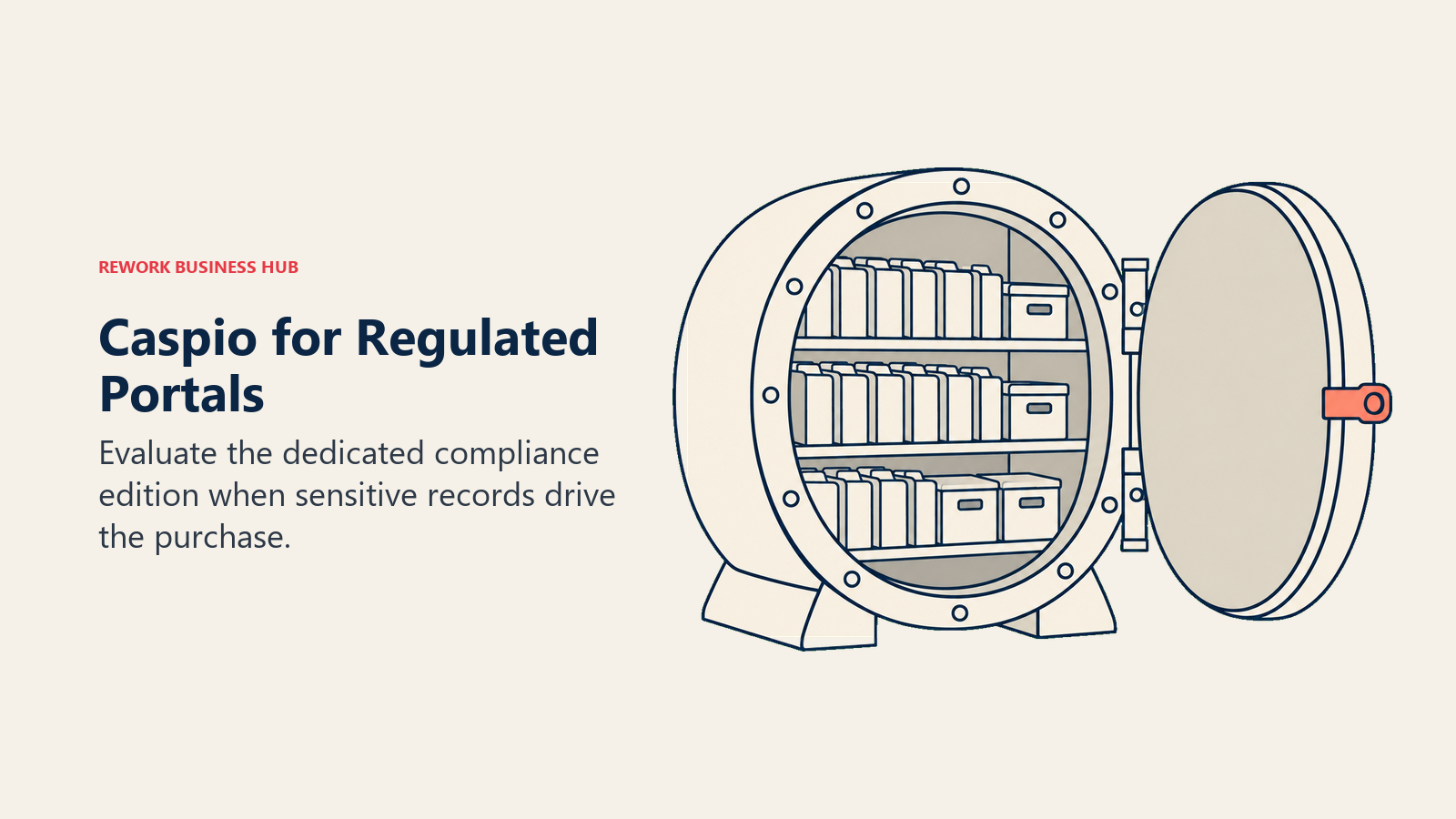
That positions Caspio for the Softr builds that outgrew a design tool's compliance posture entirely: healthcare intake portals, regulated client data, or audit-heavy internal tools. Team is $270 a month billed annually with 5 app authors, 100 DataPages, and 250,000 records; Business is $540 a month annually with unlimited authors and 1 million records; a dedicated HIPAA/Compliance edition runs $500 a month on a 1-year term. There's no permanent free plan, only a trial, and the entry price alone is well above anything else on this list, so it only makes sense once compliance or scale actually demands it. For enterprise-grade low-code platforms with a steeper price and deeper governance than anything on this list, best OutSystems alternatives covers that tier.
| What you get | What you don't |
|---|---|
| Unlimited users on every plan, no per-user cost | A free plan; trial only |
| A dedicated HIPAA/Compliance edition | Softr's price point for a small or early-stage portal |
| Unlimited app authors on Business | A modern, fast-feeling builder interface |
| Up to 1 million records without a database add-on | The lowest entry price in this comparison |
Pricing: Team is $300 a month, $270 billed annually, with 5 app authors, 100 DataPages, and 250,000 records. Business is $600 a month, $540 annually, with unlimited authors, 200 DataPages, and 1 million records. A HIPAA/Compliance edition is $500 a month on a 1-year term. Enterprise is a custom quote, per Caspio's pricing page.
Best for: Regulated or enterprise-scale portals of 20 to 500-plus users where unlimited logins and compliance matter more than entry price.
Total Annual Cost: 2 Builders, 10 Team Users, 300 Client Users
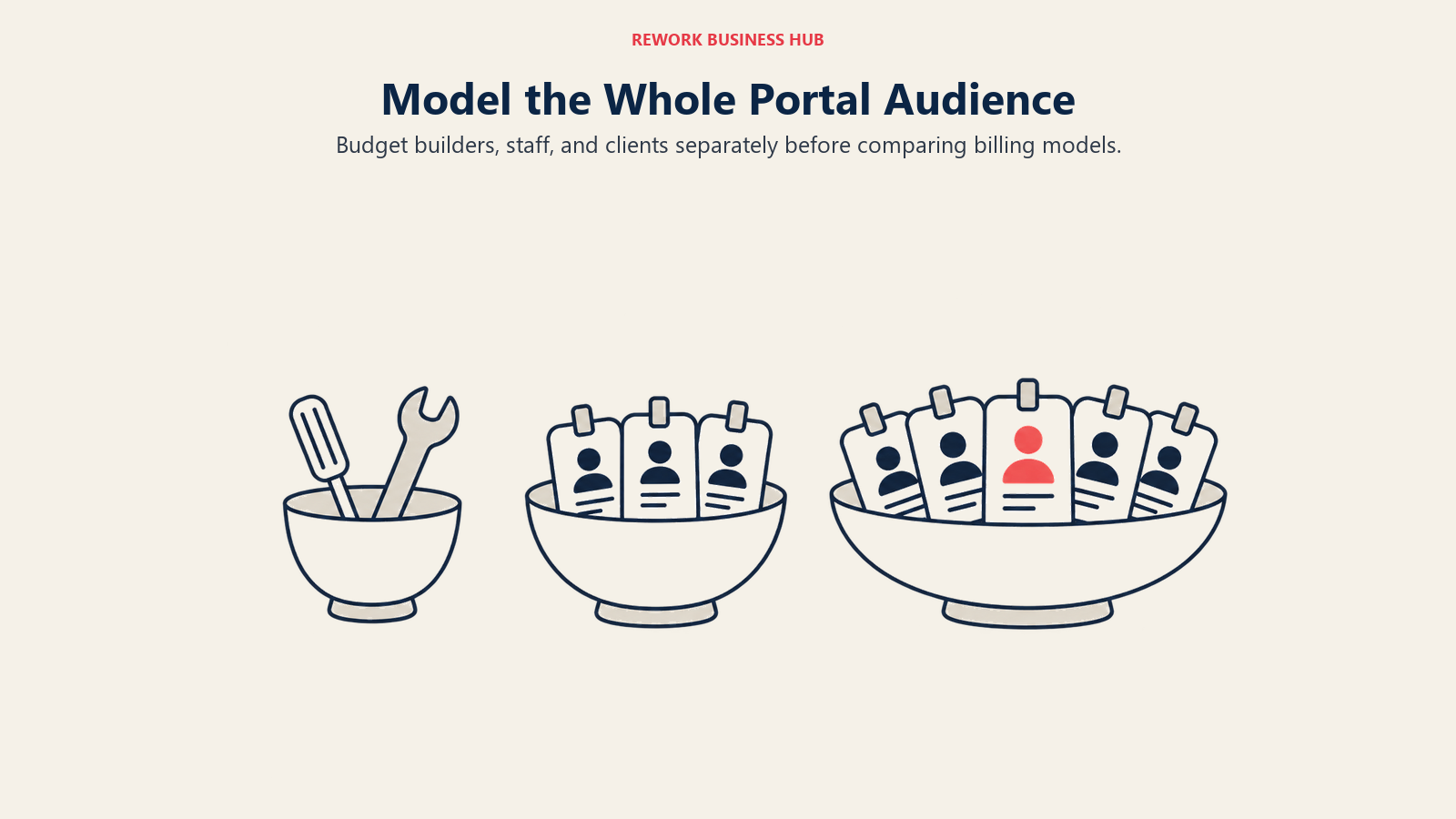
This is the comparison that actually decides the question for most Softr refugees, and it's where the August repricing shows its teeth. One realistic build: 2 people who build and maintain the portal, 10 employees who use it internally, and 300 outside clients who log in to view or submit their own records. Annual billing where the vendor offers it, first year, before any separate database a front-end-only tool doesn't include.
| Tool and tier | Estimated annual cost | How the number is built |
|---|---|---|
| Noloco Build | $780 | $65/mo annual, flat, already covers 10 internal users and up to 1,000 active clients |
| WeWeb Essential x2 + Grow+ hosting | $720 | 2 seats at $20/mo plus $20/mo hosting; no charge tied to the 300 client logins |
| Stacker Standard | $600, usage-dependent | $50/mo covers unlimited agents and portals; actual cost depends on credit usage, not headcount |
| Jetadmin Business (Customer Portal) | $960 | $80/mo annual, "unlimited users" per its common-features page, 1 app |
| Pory Pro | $1,188 | $99/mo annual, unlimited members, 1 portal |
| Glide Team | $1,500, usage-dependent | $125/mo starting at 5 members; the 300 client logins draw down pooled credits, not a fixed per-user fee |
| Knack Pro | $1,320 | $110/mo annual, unlimited users on every plan |
| Airtable Team | $2,880 | 12 paid editor seats (2 builders plus 10 internal) at $20/mo annual; the 300 clients view via a free read-only share link |
| Zoho Creator Professional, public access | $2,880, limited fit | 12 seats at $20/mo annual; the 300 clients would need a fully public, unauthenticated page, not individual accounts |
| Google AppSheet, public app | $2,040 | 12 Core seats at $10/mo ($120) plus Publisher Pro at $50/mo for one public app covering the 300 clients |
| Caspio Team | $3,240 | $270/mo annual, unlimited users on every plan, 5 app authors covers both builders |
| Bubble Team, web only | $4,188, usage-dependent | $349/mo annually including a monthly workload allowance; actual cost depends on how much the 300 clients do |
| Softr Business | $8,748 | $329/mo annual covers 3 builders, 30 team users, and 100 client users; the remaining 200 clients add roughly $2/mo each |
| Budibase self-hosted | $0 in license | Open source, unlimited users, cost is infrastructure plus a maintainer |
| Budibase Premium (cloud) | $19,188 | $49/mo plus 1 extra creator at $50 plus 300 end users at $5, all monthly rates |
| Google AppSheet, per-row security | $37,440 | If the 300 clients need individually authenticated access instead of a public app, all 312 people need $10/mo Core seats |
| Zoho Creator Professional, individual logins | $74,880 | If all 312 people need their own seat rather than a public page, at $20/mo each annually |
A few things fall out of that table. Noloco and WeWeb both land under $800 a year for the same headcount that costs Softr nearly $8,750, and they get there two different ways: Noloco by bundling the client allowance into a flat fee, WeWeb by not charging for app users at all. Airtable, Knack, Jetadmin, and Pory all land in a tight band between roughly $960 and $2,900, each trading away something (workflow depth, design polish, or a database of its own) for that flat or near-flat price. The self-hosted Budibase row is the strongest argument in the whole comparison, genuinely free at any headcount, with the cost moved entirely to infrastructure and a named owner. And the last three rows are there on purpose: they show what happens when a per-user tool meets a real external audience, which is precisely the trap Softr's own August repricing pulled its existing customers into.
Sizing and Persona Table
| Tool | Team size sweet spot | Who buys it | Typical buyer title |
|---|---|---|---|
| Noloco | 2-50 | Agencies and ops teams wanting a flat client-portal bill | Founder, Ops Lead |
| Stacker | 2-50 | Teams comfortable budgeting by usage, not headcount | Founder, Product Manager |
| Pory | 2-100 | Directories, communities, applicant portals | Founder, Program Manager |
| Glide | 2-50 | Field, frontline, and membership apps | Operations Manager, Field Lead |
| WeWeb | 5-100 | Technical teams with their own backend | Engineering Lead, CTO |
| Jetadmin | 2-100 | Teams wanting internal tools and a portal from one vendor | IT Manager, Founder |
| Airtable Interfaces | 5-100 | Teams whose data already lives in Airtable | Ops Manager, Marketing Ops Lead |
| Knack | 2-50 | Small teams shipping an external portal without an engineer | Founder, Program Manager |
| Bubble | 2-50 | Teams building a real product, not just a portal | Founder, Product Manager |
| Budibase | 10-500 | Teams that must host inside their own boundary | IT Manager, Head of Infrastructure |
| Google AppSheet | 10-500 | Existing Google Workspace customers | IT Director, Business Systems Manager |
| Zoho Creator | 5-200 | Teams needing real workflow logic, mostly internal audience | Ops Director, IT Manager |
| Caspio | 20-500+ | Regulated or enterprise-scale compliance-heavy portals | IT Director, Compliance Manager |
When Softr Is Still the Right Answer
Most alternatives articles are quietly built to talk you out of the incumbent. This one shouldn't be, because Softr still does one thing better than almost anything above it: shipping a modern, branded, genuinely good-looking portal in an afternoon, with zero SQL and zero JavaScript.
The first reason to stay is design. Nothing in this list, save maybe Bubble at a much steeper learning curve, matches Softr's out-of-the-box visual polish for a client-facing site. The second is speed: connecting an existing Airtable base or Google Sheet and having a working, branded portal live the same day is still Softr's core promise, and it holds up. The third is that the category itself keeps growing regardless of who wins any one deal, per the 75% of new application development Gartner expects to run through low-code tools by 2026, so the pressure to ship something fast isn't going away even though Softr's bill just did.
| Stay on Softr if | Leave Softr if |
|---|---|
| Your client count comfortably fits inside a Pro or Business tier's included allowance | Client growth keeps pushing you into the next per-user band |
| Design polish and speed to launch matter more than the lowest possible bill | A flat or unlimited-user competitor would do the same job for less |
| Your data already lives in Airtable, Sheets, or HubSpot and stays there | You want a builder that doesn't depend on a second database bill |
| You need zero SQL and zero JavaScript, full stop | Your build needs workflow logic Softr's automation doesn't reach |
How to Choose: Decision Framework
Use this once you've narrowed to two or three candidates, not as a substitute for narrowing.
| If you need this... | Choose this | Why |
|---|---|---|
| The cheapest flat-rate portal swap for Softr | Noloco | One flat fee covers 10 internal users and 1,000 active clients |
| Zero per-user or per-client billing, on any headcount | WeWeb | Only builder seats and hosting bandwidth are billed |
| Unlimited members with no per-user math | Pory | States it doesn't charge per user, applicant, or seat |
| Flat, unlimited-user pricing with no engineer required | Knack | Priced by account and records, not per person |
| Your data already lives in Airtable | Airtable Interfaces | Read-only viewers via share link cost nothing |
| The best native mobile experience | Glide | Strongest phone-first output in this comparison |
| A real product, not just a portal | Bubble | Full web and mobile app builder |
| To self-host for free at any headcount | Budibase open source | Free, unlimited users, cost moves to infrastructure |
| Cheap seats you may already be paying for | Google AppSheet | Often bundled into existing Google Workspace plans |
| Compliance-heavy or regulated client data | Caspio | Dedicated HIPAA/Compliance edition, unlimited users |
If Microsoft 365 is already the standard at your company rather than Airtable or Sheets, best Power Apps alternatives covers that side of the category instead. And if your team wants a fully open-source, developer-first internal-tool builder rather than a portal, best Appsmith alternatives is the deeper cut.
Frequently Asked Questions about Softr Alternatives
What changed in Softr's pricing in August 2026?
Softr replaced its old Basic/Professional/Business lineup (roughly $49/$139/$269 with 20/100/500 app users) with a new Free/Basic $19/Pro $99/Business $329 structure (effective per-month rates when paying yearly; $25/$119/$395 billed monthly) that splits app users into Team and Client categories with much smaller included allowances, per Softr's own pricing and plans documentation. Existing paying customers keep legacy pricing for now; new signups and renewals see the new plans.
What's the cheapest Softr alternative for a client portal with hundreds of users?
Noloco, if your build fits inside its 1,000 active client ceiling, since its Build plan is a single flat $65-a-month fee (billed yearly) rather than a per-client band. WeWeb is close behind and charges nothing tied to app-user count at all, though you'll need to pair it with a separate backend.
Is there a truly free, unlimited-user alternative to Softr?
Yes, if you're willing to self-host. Budibase's open-source edition is free with unlimited actions, apps, and users at any headcount, per Budibase's own pricing page. The trade is that you own the infrastructure and maintenance instead of paying a subscription.
Can Airtable Interfaces replace Softr?
Only if your portal is view-only or form-based. Interfaces is a native Airtable feature with no separate bill, and read-only viewers, form submitters, and share-link recipients cost nothing on Team or Business plans, confirmed on Airtable's own collaborator billing documentation. What it can't do is give clients their own login with the ability to edit their own records the way Softr's client accounts can.
What's the real difference between Noloco and Softr?
Both build portals on top of Airtable, Google Sheets, or their own database, and both target non-technical builders. The difference is billing shape: Softr now bands both team and client users by plan tier, while Noloco's Build plan is a flat fee that already includes 10 internal users and 1,000 active clients before any per-user math kicks in.
Does any Softr alternative ship its own database, instead of needing Airtable or Sheets underneath?
Yes. Knack, Zoho Creator, and Caspio all include their own database, so you're not paying for, or capped by, a separate Airtable or Sheets plan on top. Noloco also offers its own hosted database as an option alongside its Airtable and Sheets connections.
Is Bubble a good Softr alternative?
Only if "portal" was underselling what you're actually building. Bubble is a full web and mobile application builder with workload-based billing, not a portal-focused front end, so it fits a team whose Softr build has quietly grown into a real product rather than a client-facing view onto existing data.
Should a team with no engineers ever consider Stacker or WeWeb over Softr?
Usually not as the first choice. Stacker's credit metering and WeWeb's headless, bring-your-own-backend model both assume more technical comfort than Softr, Noloco, or Knack require. A non-technical team chasing Softr's ease of use with a better bill is generally better served by Noloco, Pory, or Knack.
What to Do Next
Before comparing another pricing page, count two numbers: how many client logins your portal will realistically carry a year from now, and whether that number grows in bursts or stays roughly flat. A flat count under a few hundred keeps Softr, Pory, or Jetadmin's included allowances in the running. Steady growth past a few hundred client logins points to Noloco's flat fee, WeWeb's zero-per-user model, or Knack's unlimited-user pricing, depending on how much design polish and workflow depth you're willing to trade away.
Then run one real test instead of five demos. Take the single screen in your current Softr portal that clients actually use the most, the dashboard or the record detail page, and rebuild only that screen in your top two candidates. A day is enough. Whatever breaks, whether it's a missing integration, a workflow Softr's automation handled that your candidate can't, or a design gap you didn't expect, tells you more than a month of vendor calls will.
Related Resources:
- Best No-Code App Builders in 2026
- Best Retool Alternatives
- Best Bubble Alternatives
- Best Glide Alternatives
- Best Zoho Creator Alternatives
- Best Appsmith Alternatives
- Best Power Apps Alternatives
- Best OutSystems Alternatives
- Bubble vs Softr
- Retool vs Softr vs Budibase
- Knack vs Zoho Creator
- Appsmith vs Glide vs Google AppSheet

Principal Product Marketing Strategist
On this page
- Key Facts
- Quick Comparison Table
- Softr Bills by App User. That Number Just Moved.
- 1. Noloco - the flat-rate client portal Softr used to be
- 2. Stacker - credit-metered instead of user-metered, on purpose
- 3. Pory - "we don't charge per user, applicant, or seat"
- 4. Glide - mobile-first, credit-metered like Stacker
- 5. WeWeb - the only tool here that doesn't bill per app user at all
- 6. Jetadmin - dedicated customer-portal plans, "unlimited users" on the label
- 7. Airtable Interfaces - free for everyone who's just viewing
- 8. Knack - flat pricing with unlimited logins, no engineer required
- 9. Bubble - when "portal" was underselling what you're actually building
- 10. Budibase - free and unlimited, if you're willing to self-host
- 11. Google AppSheet - the cheapest seat if Workspace is already paid for
- 12. Zoho Creator - a full app platform, if per-user pricing fits your audience
- 13. Caspio - unlimited users on every plan, built for compliance-heavy portals
- Total Annual Cost: 2 Builders, 10 Team Users, 300 Client Users
- Sizing and Persona Table
- When Softr Is Still the Right Answer
- How to Choose: Decision Framework
- What to Do Next