Best OutSystems Alternatives in 2026: 14 Enterprise Low-Code Platforms Compared
Turn this article into takeaways for your work.


Each assistant summarizes the article only for you and suggests best practices for your work.
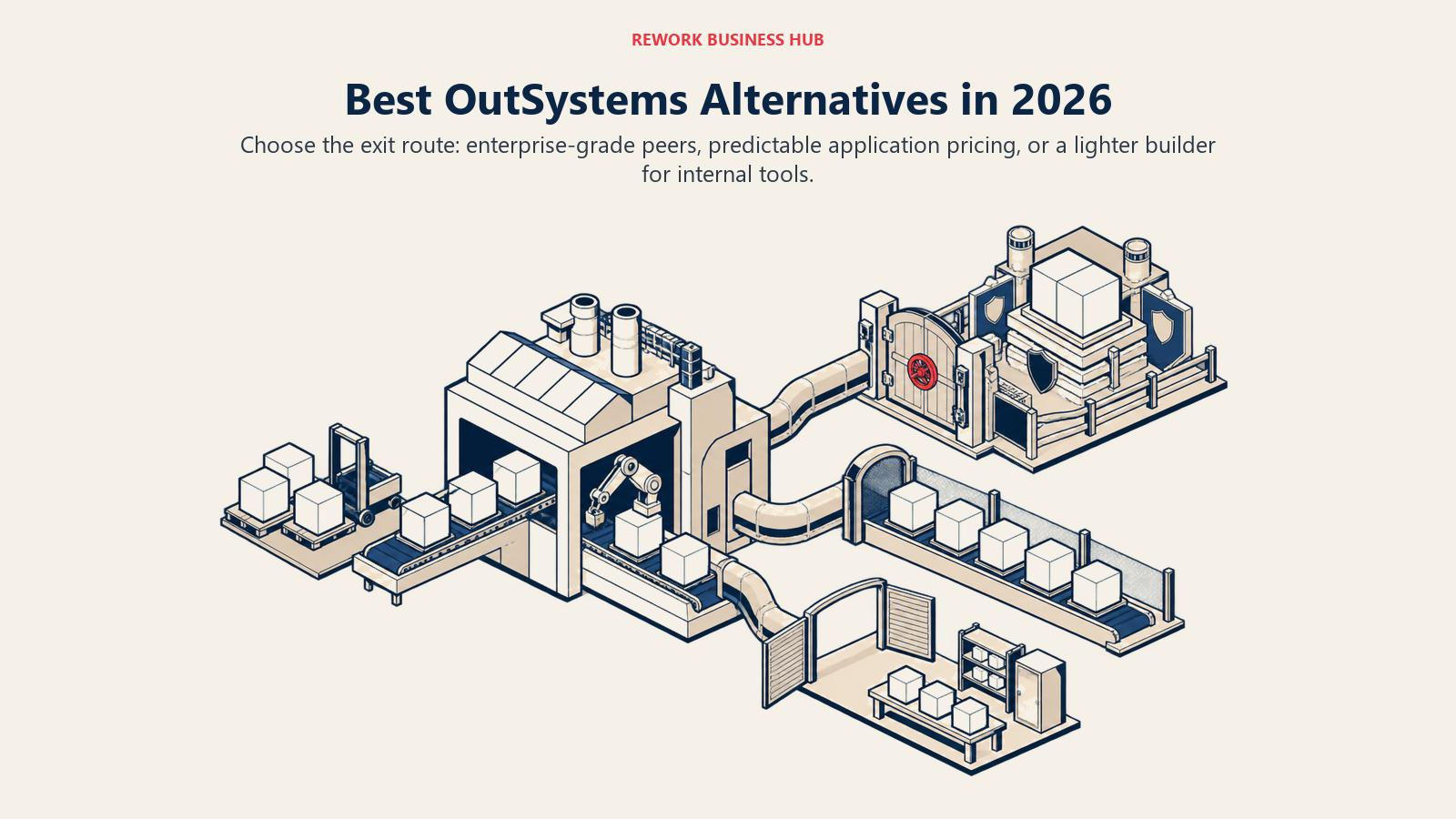
If you're leaving OutSystems because you can't predict what the renewal will cost, Mendix and Appian are the closest honest peers: enterprise-grade, also quote-based, but Mendix at least publishes a starting euro figure to anchor a negotiation against. If you're leaving because you never actually needed a platform built for hundred-developer teams and ISO 27001 audits, Retool, Budibase, or Bubble will do the job your team is really doing for a fraction of the bill. And if what you resent is the metering unit itself, Application Objects instead of users or dollars, Zoho Creator, Caspio, and Microsoft Power Apps price by something you can actually forecast.
This is written for IT directors, enterprise architects, and operations leaders managing an OutSystems renewal or evaluating it before signing one, at organizations from roughly 50 to several thousand employees. OutSystems is, by design, the hardest platform in this category to shop for: it does not publish a price, its sales team quotes per application, per user, and per add-on, and the metric that actually drives the number, Application Objects, isn't something you can look up before the first call. That's not a flaw unique to OutSystems, either. Read the section below before assuming any "enterprise" alternative on this list will hand you a number without a conversation.
Key Facts
- A Forrester Total Economic Impact study of OutSystems, commissioned by OutSystems and published in November 2025, found a composite enterprise ($50 billion revenue, 100,000 employees) achieved a 363% three-year ROI with a $4.6 million net present value and payback in under six months, per Forrester's TEI study.
- In that same study, the composite organization cut new-developer ramp time from 24 weeks to 3 to 4 weeks (an 80% reduction) while scaling from 15 applications to 120 over three years, per Forrester.
- Gartner forecasts the worldwide low-code development technologies market will reach $44.5 billion in 2026, growing at roughly 19% a year, as reported by InfoWorld.
- By 2026, Gartner predicts developers outside formal IT departments will make up at least 80% of the low-code user base, up from 60% in 2021, per Gartner's newsroom.
- Gartner's Magic Quadrant for Enterprise Low-Code Application Platforms projected that 70% of new applications built by enterprises would use low-code or no-code technologies by 2025, up from less than 25% in 2020, as reported by RevGen Partners.
Why Nobody Can Quote You a Price: The Application Object Problem
OutSystems doesn't sell seats. It sells Application Objects, OutSystems Developer Cloud's own unit for screens, database tables, and API methods, and the base ODC package starts at 100 internal users and exactly one medium-sized production application, which OutSystems itself sizes at roughly 150 Application Objects. Add a second app, add external users, add a compliance tier like SOC 2 Type II or PCI DSS, add a faster support SLA or a second environment, and each of those is a separate line an account executive prices after learning what you're building, per OutSystems' own pricing page. The base tier includes development, non-production, and production runtimes, 99.5% uptime, 8x5 support, and ISO 27001 as a baseline; 24x7 support, a 99.95% uptime SLA, and SOC 2 Type II or PCI DSS all sit on the add-on side of the same quote. A free Personal Edition exists, but it's a development-only sandbox capped at 100 internal users, explicitly not licensed for production.
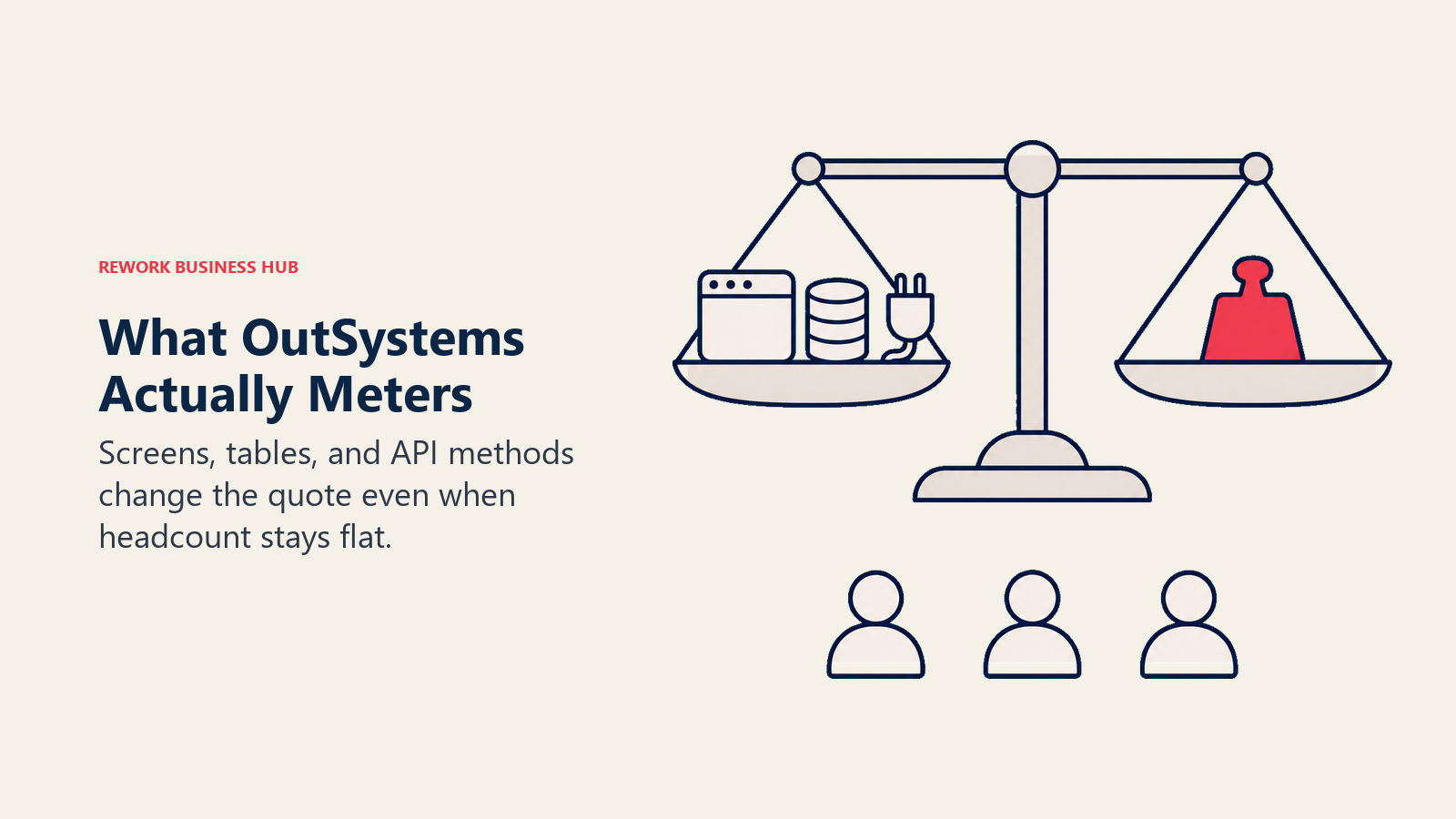
That's genuinely different from a per-user SaaS bill, and it's why the number you get in March can look nothing like the number at renewal even if headcount never moved: the thing being metered isn't people, it's the shape and size of what you built. A team that added one integration-heavy module, three admin screens, and a reporting API between quotes has changed its AO count without changing its user count at all.
Three groups of people end up reading an article like this one, and they need different tools.
| If your reason for leaving is... | What you're actually solving for | Alternatives that fit |
|---|---|---|
| An unpredictable renewal quote | A different vendor relationship, still enterprise-grade | Mendix, Appian, ServiceNow App Engine, Unqork, Quickbase |
| The Application Object model itself | A metering unit you can actually forecast (per-user, flat, or free) | Zoho Creator, Caspio, Microsoft Power Apps, Oracle APEX |
| Enterprise governance you never needed | A simpler tool sized to what your team is really building | Retool, Budibase, Appsmith, Bubble, Kissflow |
Read that table honestly before the comparison below: the first group isn't cheaper than OutSystems, it's differently unpredictable, and every genuine enterprise peer, Mendix, Appian, Pega, ServiceNow, Unqork, is also quote-based. Anyone telling you a specific enterprise-grade competitor "starts at $X" without a source is guessing. The second and third groups are where a switch usually saves real money, because most builds never needed the first group's depth to begin with.
Quick Comparison Table
| Tool | Best For | Starting Price | Key Strength | Key Limitation |
|---|---|---|---|---|
| Mendix | Enterprise peer with an actual entry number | €918/month (Standard, one app); Premium is quote-only | Real starting figure to anchor negotiation, strong model-driven tooling | Still requires a sales conversation past the entry tier |
| Appian | Process-heavy enterprise automation | Quote only | Deep BPM and case management pedigree | No published price at any tier |
| ServiceNow App Engine | Shops already running the Now Platform | Quote only | Native extension of an existing ServiceNow investment | Meaningless without an existing ServiceNow contract |
| Unqork | Regulated, no-code-only enterprise builds | Quote only | Codeless architecture, no technical debt from custom code | The most opaque pricing page on this entire list |
| Quickbase | Governed operations without OutSystems' depth | From $35/user/mo annually, plus an undisclosed platform minimum | Published per-user floor, strong audit trail | The floor is not the real price |
| Zoho Creator | Teams consolidating into Zoho's suite | $8/user/mo annually (Standard) | Fully published tiered pricing | Only makes sense if you're already on Zoho |
| Caspio | Unlimited users on a flat bill | Team $300/mo, $270/mo annual | No per-user cost at any headcount | Database-forward, not a canvas-style app designer |
| Microsoft Power Apps | Microsoft 365 shops wanting per-user math | $20/user/mo annually (Premium) | Native Microsoft 365 and Dataverse integration | Every named user pays, however lightly they use the app |
| Oracle APEX | Existing Oracle Database customers | Free with a supported Oracle Database license | Zero incremental licensing cost, no user or app caps | Only "free" if you already pay for Oracle Database |
| Retool | Engineering-led internal tools | Free up to 5 users; Team builders $10/mo, Business $50/mo (annual) | No ceiling on data source or logic | Real cost lands in per-user pricing past the free tier |
| Budibase | Self-hosted governance on your own terms | Free, self-hosted, unlimited; Pro $19/mo yearly on cloud | Free unlimited self-hosted edition | Cloud pricing behaves nothing like self-hosted |
| Appsmith | Open source with a legible upgrade path | Free up to 5 users; Business $15/user/mo | Airgapped enterprise edition, real open-source fallback | Steep cliff to $2,500/mo at 100 users |
| Bubble | Building a real product, not an internal form | Free to build; Starter $29/mo annual (web only) | Workload billing, not per-named-user | Workload units are hard to estimate up front |
| Kissflow | Workflow-first apps without full-platform complexity | Quote only | Purpose-built for process and approval apps | No published price, and it caps at what a workflow tool can do |
1. Mendix - the one enterprise peer that publishes a real number
Mendix answers the "I still need enterprise depth but I want some anchor point" problem better than any other true peer on this list. It's a model-driven low-code platform built for the same audience as OutSystems: multi-team development, complex integrations, and applications that genuinely need enterprise architecture underneath them, not a form with a workflow attached. Where it earns its place at the top of this list is honesty. Mendix's own pricing page lists a real starting figure instead of hiding behind "contact sales" from the first click.
That figure is in euros, and it stays in euros; don't let anyone convert it to a round dollar number and hand it to you as the price. Standard is listed "starting at €918 per month" for one application, or "starting at €2,295 per month" for unlimited applications, both before any conversation with sales about your actual scale. Premium, the tier built for the kind of scale OutSystems customers usually operate at, is quote-only, same as OutSystems itself. So the honest read is: Mendix doesn't solve the "no published price" problem at enterprise scale, but it gives you a real floor to negotiate from at mid-scale, which OutSystems doesn't offer at all.
| What you get | What you don't |
|---|---|
| A real starting figure to anchor a negotiation | A published number at the scale OutSystems customers usually need |
| Model-driven tooling built for multi-team development | Freedom from a sales conversation past Standard |
| A migration path many system integrators already know | Pricing quoted in a currency your finance team may need to convert |
| Genuine enterprise architecture depth | Any discount on complexity versus what you're leaving |
Pricing: Free is listed as starting at €0/month. Standard starts at €918/month for one application, or €2,295/month for unlimited applications. Premium is quote-only, per Mendix's pricing page. All figures are published in euros; convert at your own exchange rate rather than treating a converted number as Mendix's price.
Best for: Enterprises that want a genuine OutSystems peer but need at least one real number to start a budget conversation with, rather than walking into the first sales call blind.
2. Appian - the process-and-case-management peer
Appian competes for the same buyer as OutSystems, but it starts from a different center of gravity: business process management and case management first, general application development second. Where OutSystems markets itself broadly as a full application development platform, Appian leans hardest into the workflows that touch compliance, claims, and case tracking, which makes it a strong fit for enterprises whose OutSystems portfolio skews heavily toward process apps rather than customer-facing products.
Pricing follows the enterprise pattern common across this whole category. Standard, Advanced, and Premium are all priced per user, per month, per app, with no figure published at any tier, and every evaluation starts with a sales conversation, not a rate card. The one real exception is Appian Community Edition, free, but scoped to a personal development instance rather than anything you could run in production. If your complaint about OutSystems is specifically the absence of a number, Appian will not fix that; it will simply be a different unpriced conversation with a different vendor.
| What you get | What you don't |
|---|---|
| Deep BPM and case-management pedigree | Any published price at Standard, Advanced, or Premium |
| A platform built for compliance-heavy process work | Relief from an enterprise sales cycle |
| A free Community Edition for personal development | A production-ready free tier |
| Strong integration depth for case-driven applications | A general-purpose app builder emphasis the way OutSystems has |
Pricing: Quote-only across Standard, Advanced, and Premium, all priced per user, per month, per app, per Appian's pricing page. Appian Community Edition is free for a personal, non-production development instance.
Best for: Enterprises whose application portfolio is heavily process- and case-driven, and who are comparing OutSystems against another quote-based BPM-rooted platform rather than looking to escape the enterprise sales cycle entirely.
3. ServiceNow App Engine - the peer that only makes sense if you're already there
ServiceNow App Engine isn't really a platform you shop for independently; it's an app-development layer built to extend a Now Platform investment you already have. If your organization runs ServiceNow for ITSM, HR service delivery, or customer service already, App Engine lets the same platform, the same data model, and the same admins build custom applications instead of standing up a second vendor relationship purely for internal apps.
That's also the whole case against it for anyone not already a ServiceNow customer. It isn't sold as a standalone low-code platform the way Mendix or OutSystems is, and ServiceNow's own product pages don't publish a price for it. Every deal is quoted, typically bundled into or added onto an existing Now Platform agreement, and confirmed through direct checks of ServiceNow's own site in August 2026. Third-party licensing analyses describe it as sold per user per year, but nothing on ServiceNow's own pages confirms a rate, so it would be dishonest to print one here.
| What you get | What you don't |
|---|---|
| One platform and one admin team instead of two | Any reason to adopt it if you're not already a ServiceNow customer |
| App Engine Studio's AI-assisted, low-code builder | A published price anywhere on the vendor's site |
| Native access to existing ServiceNow data and workflows | A standalone evaluation path separate from a Now Platform deal |
| Enterprise-grade governance inherited from the core platform | A quick, self-serve way to test it before committing |
Pricing: Quote-only. ServiceNow does not publish a rate for App Engine on its product page; pricing is negotiated as part of a Now Platform agreement, typically through a partner.
Best for: Organizations that already run ServiceNow and want custom applications on the same platform instead of a second low-code vendor relationship purely for internal tools.
4. Unqork - the codeless answer for regulated, no-code-only builds
Unqork takes a stricter position than every other tool on this list: no code, not "low code," for any part of the build. That's a deliberate bet aimed at large regulated enterprises, insurance carriers, banks, and government agencies among its best-known customer segments, where technical debt from custom code is itself treated as risk, and a codeless architecture makes an application easier to audit, document, and hand off between teams over a decade of maintenance.
The pricing model mirrors OutSystems' opacity almost exactly. Unqork's own pricing page carries no dollar figures at all; the entire page exists to route you into a sales conversation. The actual language on the page reads: "Fill out the form, and after a quick chat, we'll craft pricing tailored to your organization's needs." If your complaint about OutSystems is specifically that you can't get a number without a call, Unqork won't solve that complaint. It'll just be a different call.
| What you get | What you don't |
|---|---|
| A genuinely codeless architecture built for audit and compliance | Any published price, tier, or starting figure |
| Deep positioning in regulated, high-stakes industries | A self-serve trial or sandbox to test before a sales call |
| No custom-code technical debt by design | A quick evaluation path for a small or mid-size team |
| Enterprise-grade governance built in from the start | Relief from the exact pricing opacity you're leaving OutSystems for |
Pricing: Quote-only, with no figures published anywhere on Unqork's pricing page.
Best for: Large regulated enterprises, especially in insurance, banking, and government, that want a strictly no-code architecture and already expect an enterprise sales cycle.
5. Quickbase - governance without the Application Object math
Quickbase is where people land when the real complaint wasn't OutSystems' price, it was the AO metering unit itself. Quickbase still charges enterprise-level money and still has an unpublished piece of its bill, but that unpublished piece is a platform minimum sitting on top of a real, published per-user rate, not a formula tied to how many screens and database tables your app happens to contain. For a buyer who wants governance and a number they can at least partially model, that's a meaningfully different negotiating position.
The platform itself has been in this market longer than almost anything else on this list, and the maturity shows exactly where auditors look: sandbox and production separation, full audit logging, and hundreds of interconnected apps running inside one organization without turning into shadow IT. Quickbase publishes SOC 1, SOC 2, and SOC 3 attestations along with a HIPAA attestation with BAAs for business and enterprise subscribers, a compliance posture built for the same buyer OutSystems competes for.
| What you get | What you don't |
|---|---|
| A published per-user floor to start budgeting from | Full price transparency; the platform minimum stays hidden |
| Mature governance, audit logging, environment separation | A fast, self-serve evaluation path |
| SOC attestations and a HIPAA BAA option | A modern interface by 2026 standards |
| Proven at hundreds of apps inside one organization | Freedom from a real enterprise sales process |
Pricing: Team starts at $35 per user per month, priced annually. Business starts at $55 per user per month, priced annually. Enterprise is quote-only. Both published tiers carry a platform minimum fee Quickbase does not disclose, so the per-user rate understates the real bill, per Quickbase's plans and pricing page.
Best for: Operations organizations of 100 to 5,000 people who want governance and audit depth close to OutSystems' level, but priced by users instead of Application Objects.
6. Zoho Creator - the fully published option, if you're willing to consolidate
Zoho Creator is the cleanest answer on this entire list to "just tell me the price." Every tier, Standard, Professional, and Enterprise, is published with a real per-user monthly figure, no sales call required to see it, no AO count to estimate first. That alone makes it worth a look for anyone exhausted by OutSystems' opacity.
The honest catch is what you're actually buying. Zoho Creator is a real low-code application platform with genuine workflow logic written in Deluge, Zoho's scripting language, but the strongest case for choosing it almost never comes from the builder itself. It's that if your CRM, help desk, books, and HR records already live inside Zoho, Creator reads them natively instead of through an integration you have to build and maintain. Leave OutSystems for Zoho Creator without an existing Zoho footprint, and you've swapped one vendor's ecosystem for a different one, not escaped ecosystem lock-in at all.
| What you get | What you don't |
|---|---|
| A fully published price at every tier | A reason to pick it if you're not already on Zoho |
| Native access to Zoho CRM, Books, Desk, and People | OutSystems' depth for complex, multi-team applications |
| Real workflow scripting depth via Deluge | Freedom from vendor ecosystem lock-in generally |
| A predictable per-user bill you can model today | Enterprise governance certifications at OutSystems' level |
Pricing: Standard is $8 per user per month billed annually. Professional is $20 per user per month billed annually. Enterprise is $25 per user per month billed annually. A custom Flex plan and a free single-app edition are also available, per Zoho Creator's pricing page.
Best for: Companies of 10 to 500 already running on Zoho's suite who want a fully transparent price and are willing to consolidate into that ecosystem instead of escaping vendor lock-in entirely. If Zoho Creator itself turns out to be the wrong fit, best Zoho Creator alternatives covers where teams go from there.
7. Caspio - unlimited users, a flat bill, and a database-first build
Caspio takes the opposite approach from every per-user tool on this list: nobody pays per seat, ever, at any headcount. Every plan, from Team through the HIPAA-focused Compliance edition, is one flat monthly number regardless of how many people log in. For an OutSystems refugee whose real complaint was watching the bill grow every time someone new touched the app, that's the most direct fix in this entire comparison.
What you're buying is closer to a managed database application platform than a full enterprise app builder. Caspio builds real applications with DataPages, its page and form component system, role-based access, and workflow automation, but the center of gravity is the data model, not a canvas-style visual designer. Teams whose OutSystems build was fundamentally about managing and displaying structured data, rather than a complex multi-screen product experience, tend to find Caspio does the same job for a fraction of the cost and none of the AO accounting.
| What you get | What you don't |
|---|---|
| A flat bill with unlimited users on every plan | A visual, canvas-style app designer |
| A dedicated HIPAA/Compliance edition | The same breadth of custom logic OutSystems supports |
| Fast development for database-centric applications | A free tier; only a trial is offered |
| Predictable cost that never grows with headcount | A brand most business stakeholders have heard of |
Pricing: Team is $300 per month, or $270 per month billed annually. Business is $600 per month, or $540 per month billed annually. A HIPAA/Compliance edition is $500 per month on a one-year term. Enterprise is quote-only. All plans include unlimited users, per Caspio's pricing page.
Best for: Teams whose OutSystems build was really a structured database application with forms and reporting on top, and who want a flat bill that never grows with headcount.
8. Microsoft Power Apps - the per-user math, if you're already a Microsoft shop
Microsoft Power Apps solves a specific version of the OutSystems complaint: not "I want a number I can't get," but "I want a number that's a straightforward per-user calculation instead of an Application Object count." Power Apps Premium is priced simply, one figure, one unit, with no separate metering for screens or database tables layered on top.
The trade is real, though. Every named user pays that $20 a month regardless of how lightly they touch the app, which is exactly the model Caspio and the flat-fee tools on this list exist to undercut. And Power Apps' own ceiling sits lower than OutSystems' for genuinely complex, mission-critical, multi-team builds; it's a strong option for the mid-tier of internal applications, not necessarily a like-for-like replacement for what pushed you to OutSystems in the first place. If Power Apps and Retool are both on your shortlist, Power Apps vs. Retool is a direct comparison worth reading before you commit either way, and best Power Apps alternatives covers the wider field if Power Apps itself doesn't end up being the answer.
| What you get | What you don't |
|---|---|
| A single, published per-user price | A ceiling for applications as complex as OutSystems handles |
| Native Microsoft 365 and Dataverse integration | A charge that stays flat as more people touch the app |
| A large existing partner and consultant ecosystem | Freedom from Microsoft's licensing model generally |
| A predictable, if not cheap, per-user number | Application Object-style granularity, if that's actually what you needed |
Pricing: Power Apps Premium is $20.00 per user per month, paid yearly. A 2,000-plus seat volume tier is $12.00 per user per month, paid yearly. A free Developer Plan exists for build and test, not production. A Dataverse database capacity add-on runs $40.00 per GB per month, paid yearly, per Microsoft's Power Apps pricing page.
Best for: Microsoft 365 shops that want predictable per-user math over Application Object accounting, for applications that don't need OutSystems-level complexity.
9. Oracle APEX - free, if you already pay for the database underneath
Oracle APEX is the strangest entry on this list, and the most useful one for a specific reader: it costs nothing at all, with no per-user, per-application, or per-Application-Object charge of any kind, as long as your organization already licenses a supported Oracle Database. APEX ships bundled inside that license. There's no separate SKU, no seat count, and no ceiling on the number of applications, developers, or end users you build for.
The honest framing matters here. "Free" is doing a lot of work in that sentence. If you're not already an Oracle Database customer, standing up the infrastructure APEX needs is its own cost, whether that's Oracle Cloud Infrastructure's Always Free tier for small workloads, an Autonomous Database subscription, or an on-premises Oracle installation your organization already runs. For a company that already has Oracle underneath its data layer, though, APEX is the single largest cost reduction in this entire comparison, because the AO-style billing OutSystems charges for simply doesn't exist here at all.
| What you get | What you don't |
|---|---|
| Zero additional licensing cost on top of Oracle Database | A reason to adopt it if you're not already an Oracle shop |
| No caps on applications, developers, or end users | A modern, drag-and-drop visual builder on par with newer tools |
| Enterprise-grade database performance underneath every app | A vendor-published single number for the infrastructure it runs on |
| Decades of Oracle's own production hardening | A large ecosystem of low-code-specific consultants |
Pricing: Free, included at no additional cost with all supported editions of Oracle Database. No user, application, or developer limits. Underlying infrastructure (Oracle Cloud Infrastructure, Autonomous Database, or an on-premises Oracle installation) carries its own cost, which Oracle doesn't publish a single figure for, per Oracle APEX's pricing page.
Best for: Organizations already licensing Oracle Database that want to build real applications on top of data they already own, without a separate AO-metered platform bill.
10. Retool - when the build genuinely needed an engineer
Retool is where OutSystems refugees land when the honest answer is "we over-bought for what's really an engineering team's internal-tools problem." It's low-code by design in the literal sense: drag components onto a canvas, then write real SQL and JavaScript against whatever the data actually lives in, Postgres, a REST API, three systems at once. Teams with at least one developer hit a wall with OutSystems' visual abstractions far less often than teams without one, which is itself a signal about who actually needs the platform they're leaving.
The billing model rewards exactly this kind of buyer. Retool prices builders, internal users, and external users separately, and the first 50 external users are free on every paid tier, the opposite of a model where every touch adds to an Application Object count or a per-seat charge. If Retool later becomes the platform you've outgrown, best Retool alternatives covers that next step, and if your shortlist also includes Softr and Budibase specifically, Retool vs. Softr vs. Budibase is a direct three-way comparison worth reading.
| What you get | What you don't |
|---|---|
| No ceiling on data source, API, or logic complexity | A tool a non-technical buyer can own entirely alone |
| The first 50 external users at no charge on paid tiers | Affordable pricing at hundreds of external users |
| Cloud or self-hosted at the same tiers | OutSystems' AO-based governance model, for better or worse |
| A real exit from any proprietary object-counting bill | A build path that avoids engineering time |
Pricing: Free covers up to 5 users and 500 workflow runs a month. Team bills builders at $10 per month annually ($12 monthly) and internal users at $5 ($7 monthly). Business bills builders at $50 per month annually ($65 monthly) and internal users at $15 ($18 monthly); external users run free from 0 to 50, then $8 per month annually for 51 to 250, $6 for 251 to 500, and $4 above 500. Enterprise is quote-only, per Retool's pricing page. Self-hosted mirrors cloud pricing, capped at 100 users on Team and Business.
Best for: Teams with at least one developer building internal tools connected to messy, multi-source data, who never needed OutSystems' governance layer for what is fundamentally an engineering-owned build.
11. Budibase - self-hosted governance on your own infrastructure
Budibase makes a different argument than every enterprise peer on this list: instead of paying anyone, OutSystems or otherwise, for governance and data residency, host the platform yourself, inside infrastructure your organization already controls, for free. The self-hosted open source edition has no license ceiling on actions, apps, or users, and it's a genuine application platform, not a spreadsheet with forms bolted on, complete with a real screen designer, role-based access, and automations.
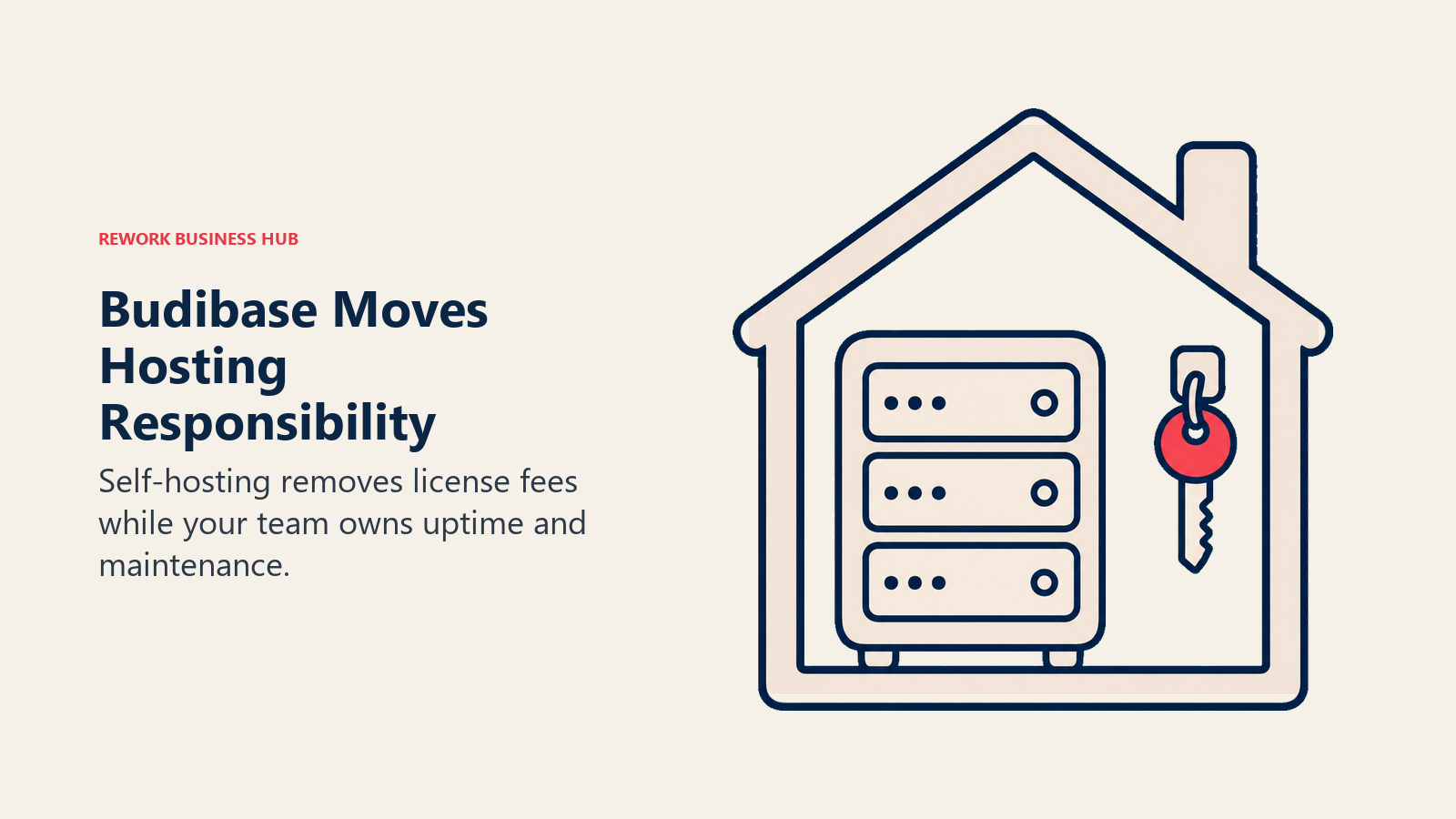
The trap is assuming cloud pricing behaves like the self-hosted edition; it doesn't. Extra creators cost $50 each per month on cloud and end users run $5 each, so a build with real headcount on Budibase's cloud tiers can land in five figures annually while the identical self-hosted build costs infrastructure and a maintainer's time instead. Choose the deployment model on purpose, not by default.
| What you get | What you don't |
|---|---|
| A free, unlimited self-hosted open source edition | Cheap external users on the cloud plans |
| Full control over where the data physically sits | Vendor compliance certificates to hand an auditor |
| A real screen designer with role-based access | A managed service unless you pay for one |
| No AO-style or per-seat ceiling when self-hosted | Someone else to page when the server misbehaves |
Pricing: Self-hosted open source is free with unlimited actions, apps, automations, agents, and users on one workspace. Pro is $19 per month billed yearly, 1 creator included. Premium is $49 per month yearly, 1 creator included, extra creators at $50 per creator per month, end users at $5 per user per month. Business is $299 per month billed yearly, 3 creators. Monthly billing runs 20% above the yearly rate, per Budibase's pricing page.
Best for: Organizations with an infrastructure owner who would rather host the platform themselves than pay any vendor, OutSystems included, for governance and data residency.
12. Appsmith - open source with the clearest upgrade path
Appsmith answers the OutSystems lock-in complaint about as directly as a tool on this list can. The Community edition is Apache-licensed open source, self-hosted, and free with unlimited users, so the question of where your data physically lives moves back under your own control instead of any vendor's. On the cloud side, the building experience is close to Retool's: drag components onto a canvas, write SQL and JavaScript behind them.
Pricing is unusually legible for the category, and that legibility is most of the appeal for someone exhausted by AO math. Free covers up to 5 users; Business is a flat $15 per user per month up to 99 users, with no separate builder premium. The one place it gets murky is the jump to Enterprise: crossing 100 users moves to a $2,500 per month floor, and Appsmith's own pricing page doesn't state whether cost keeps climbing above that headcount, so confirm the shape of that tier with sales before planning around it. If Appsmith itself becomes the platform your team eventually outgrows, best Appsmith alternatives covers that next move.
| What you get | What you don't |
|---|---|
| A free, unlimited self-hosted open source edition | A cheap route past 100 users |
| Flat per-user pricing with no builder premium | Clarity on how Enterprise scales past 100 users |
| An airgapped edition available on Enterprise | Prebuilt compliance editions below Enterprise |
| Any data source, with SQL and JavaScript escape hatches | OutSystems' depth for large multi-team builds |
Pricing: Free cloud covers up to 5 users, 5 workspaces, 3 Git repos. Business cloud is $15 per user per month for up to 99 users. Enterprise cloud is $2,500 per month for 100 users, with SAML/OIDC SSO, SCIM, CI/CD, and the airgapped edition; the vendor page doesn't state whether the price scales further above 100, per Appsmith's pricing page. Community edition, self-hosted, is free and Apache 2.0 licensed with unlimited users.
Best for: Technical teams under 100 total users who want a genuine open source exit from any proprietary object- or seat-metered platform, with a free unlimited self-hosted fallback if headcount grows.
13. Bubble - when the app was always a product, not an internal tool
Bubble is the tool that reveals a specific kind of over-buying: teams that put a customer-facing product on OutSystems because it was the enterprise platform already in the building, not because the build needed OutSystems' governance model at all. Bubble is a true no-code web app builder, full design and logic control, closer to "build your own SaaS product" than to an internal form with a workflow attached.
The billing model is the clearest signal this was never really an enterprise-internal-tools problem: Bubble meters workload, not named users or Application Objects. Every paid tier includes 100,000 monthly workload units, and usage above a subscribed tier costs $0.30 per 1,000 units, which means a public-facing app with thousands of light visitors can cost far less than the same headcount would under any per-user or per-AO model. If Bubble's own learning curve turns out to be the wrong fit, best Bubble alternatives covers that direction, and Retool vs. Bubble is worth reading if you're genuinely torn between an internal-tools build and a product build.
| What you get | What you don't |
|---|---|
| A genuinely free plan to build and test on | Predictable cost from headcount alone |
| Full design and logic control, not a template | Any AO-style governance model at all |
| Workload billing that rewards light, public usage | A gentle learning curve |
| No enterprise sales process required to start | An internal-tools focus; this is a product builder |
Pricing: Figures below are Web only, then Web and Mobile, per Bubble's pricing page. Free is $0. Starter is $29 per month billed annually (web only) or $59 per month billed annually (web and mobile). Growth is $119 per month annually (web only) or $209 per month annually (web and mobile). Team is $349 per month annually (web only) or $549 per month annually (web and mobile). Enterprise is quote-only. Every paid tier includes 100,000 monthly workload units, with unsubscribed overage at $0.30 per 1,000 units.
Best for: Teams that realize partway through an OutSystems build that what they actually needed was a real external product, not an internal enterprise tool.
14. Kissflow - workflow-first apps without the enterprise sales cycle's complexity
Kissflow narrows the job on purpose. Instead of a full application development platform capable of anything OutSystems can build, Kissflow focuses on workflow and process apps specifically: approvals, requests, case tracking, the kind of structured business process work that made up a real share of most OutSystems portfolios without needing OutSystems' full depth to build.
Pricing follows the same enterprise pattern as OutSystems itself, though: nothing published. Kissflow's own pricing page describes "fixed annual agreements" and value-based pricing rather than a rate card, and routes every visitor to a sales conversation. If your specific frustration with OutSystems was the absence of a number, Kissflow won't fix that. What it offers instead is a narrower, faster-to-deploy tool for the workflow-shaped slice of your app portfolio, which for many OutSystems customers turns out to be most of what they actually built.
| What you get | What you don't |
|---|---|
| A tool purpose-built for workflow and process apps | Any published price or rate card |
| A narrower learning curve than a full app platform | The breadth to replace every kind of OutSystems build |
| Faster deployment for approval- and request-style apps | Relief from an enterprise sales cycle |
| Value-based pricing tied to your actual usage | A number you can get without a conversation |
Pricing: Quote-only. Kissflow's own pricing page describes "fixed annual agreements" and value-based pricing, directing every buyer to a sales conversation rather than publishing a rate.
Best for: Teams whose OutSystems portfolio was mostly workflow and approval apps, who want a purpose-built, faster tool for that specific slice of work rather than a full application development platform.
True Enterprise Peers vs. the Tools You Buy When You Were Over-Sold
Not every tool on this list is actually competing with OutSystems. Roughly half of them are the honest answer to "we bought more platform than we needed."
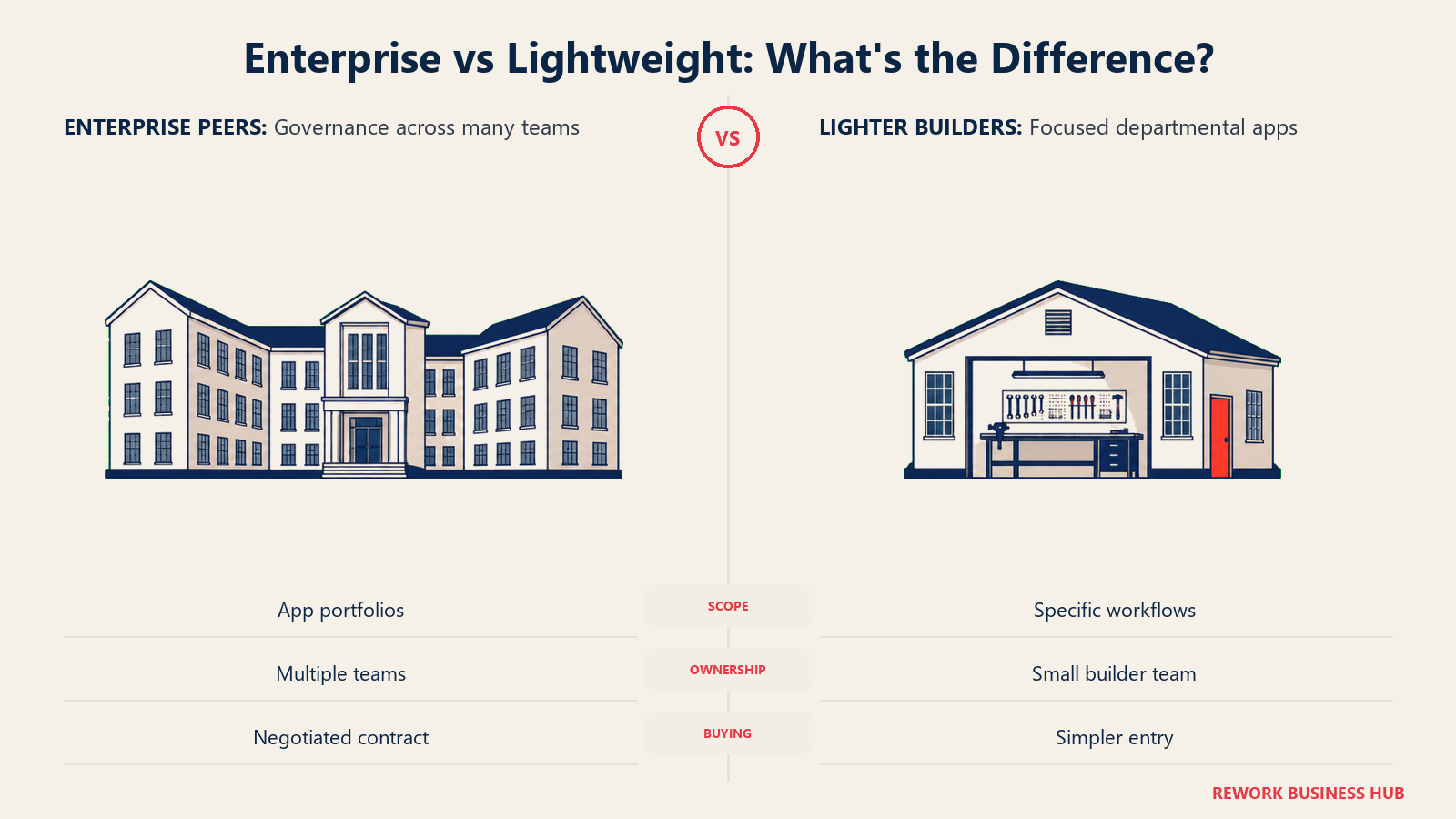
| True enterprise peers (also quote-based or partially so) | The tools you buy when you were over-sold |
|---|---|
| Mendix (published floor; Premium is quote-only) | Retool |
| Appian | Budibase |
| ServiceNow App Engine | Appsmith |
| Unqork | Bubble |
| Quickbase (published floor, undisclosed platform minimum) | Kissflow |
| Zoho Creator (if not already on Zoho) | |
| Caspio | |
| Microsoft Power Apps | |
| Oracle APEX (if not already on Oracle) |
If your build genuinely needs the left column's depth, hundreds of interconnected applications, multi-team DevOps pipelines, formal compliance certifications, cross-department governance, comparison shopping among these five won't get you a published number, but it will get you a real negotiation. If it doesn't, the right column will very likely do the same job for a fraction of the cost, and most OutSystems renewals that trigger a search like this one belong in that second column.
Sizing and Persona Table
| Tool | Team size sweet spot | Who buys it | Typical buyer title |
|---|---|---|---|
| Mendix | 50-5,000 | Enterprises wanting a real anchor price | VP Engineering, Enterprise Architect |
| Appian | 200+ | Process-heavy regulated enterprises | VP Operations, Head of BPM |
| ServiceNow App Engine | 500+ | Existing ServiceNow customers | IT Director, ServiceNow Platform Owner |
| Unqork | 500+ | Insurance, banking, government | Chief Digital Officer, VP Engineering |
| Quickbase | 100-5,000 | Regulated and field-heavy operations | VP Operations, IT Director |
| Zoho Creator | 10-500 | Existing Zoho customers | IT Director, Business Systems Manager |
| Caspio | 5-200 | Database-centric application builds | Ops Manager, IT Manager |
| Microsoft Power Apps | 10-2,000 | Microsoft 365 shops | IT Director, Power Platform Admin |
| Oracle APEX | 10-5,000+ | Existing Oracle Database customers | DBA, Enterprise Architect |
| Retool | 20-1,000 | Engineering-supported internal tools | Engineering Manager, CTO |
| Budibase | 10-500 | Teams that must host inside their own boundary | IT Manager, Head of Infrastructure |
| Appsmith | 20-100 | Technical teams wanting open source | Engineering Manager, IT Director |
| Bubble | 1-100 | Teams building an external product | Founder, Product Lead |
| Kissflow | 20-1,000 | Workflow and approval-heavy teams | Ops Manager, Business Process Lead |
Stage-Fit Matrix
| Tool | Prototype / pilot | Departmental rollout | Company-wide, mission-critical |
|---|---|---|---|
| Mendix | Strong | Strong | Strong |
| Appian | Weak, sales-cycle heavy | Moderate | Strong |
| ServiceNow App Engine | Weak without an existing contract | Moderate | Strong (inside ServiceNow shops) |
| Unqork | Weak, enterprise sales cycle | Moderate | Strong (regulated industries) |
| Quickbase | Moderate | Strong | Strong |
| Zoho Creator | Strong | Strong | Moderate (ecosystem-dependent) |
| Caspio | Strong | Strong | Moderate |
| Microsoft Power Apps | Strong | Strong | Moderate |
| Oracle APEX | Strong (if already on Oracle) | Strong | Strong (within Oracle shops) |
| Retool | Strong | Strong | Moderate |
| Budibase | Strong | Strong | Moderate |
| Appsmith | Strong | Strong | Weak past 100 users |
| Bubble | Strong | Moderate | Weak (not internal-tools shaped) |
| Kissflow | Strong | Strong | Moderate |
When OutSystems Is Still the Right Answer
None of this means OutSystems is a bad platform, and this isn't only defensible for people who haven't shopped yet. It's still the right call when a handful of things are all true at once: the application portfolio genuinely spans hundreds of interconnected apps across multiple development teams, the build requires enterprise-grade DevOps pipelines and multi-environment governance that a lighter tool simply can't express, compliance requirements (SOC 2 Type II, PCI DSS, ISO 27001) are non-negotiable and need to be built into the platform rather than bolted on, and the organization has the budget authority and procurement patience to negotiate an enterprise contract rather than self-serve.
It's also, honestly, still the right call for an organization already deep into an OutSystems investment: hundreds of AOs built, developers trained, a system integrator on retainer, where the migration cost of leaving exceeds the cost of negotiating a better renewal. Application Object metering is annoying to budget around, but it isn't, by itself, a reason to rebuild a mature multi-year platform from scratch. Read the "true enterprise peers" table above with that in mind. It exists to give you real leverage in that renewal conversation, not necessarily to talk you out of staying.
How to Choose: Decision Framework
Use this once you've narrowed to two or three candidates, not as a substitute for narrowing.
| If you need this... | Choose this | Why |
|---|---|---|
| A genuine enterprise peer with at least one real number to anchor on | Mendix | The only true peer that publishes a starting figure at all |
| Deep BPM and case-management pedigree | Appian | Built around process and case work at enterprise scale |
| To extend a platform you already own | ServiceNow App Engine | Native to an existing Now Platform investment |
| Strictly no-code architecture for a regulated industry | Unqork | Codeless by design, positioned for insurance, banking, government |
| Governance and audit depth priced by user, not by AO | Quickbase | A published floor plus a real compliance posture |
| A fully transparent price and an existing Zoho footprint | Zoho Creator | Every tier published, no sales call required to see it |
| A flat bill that never grows with headcount | Caspio | Unlimited users on every plan |
| Predictable per-user math inside a Microsoft 365 shop | Microsoft Power Apps | Native Dataverse and Microsoft 365 integration |
| Zero incremental licensing cost on an existing Oracle investment | Oracle APEX | Bundled free with supported Oracle Database editions |
| An engineering team ready to own internal tools directly | Retool | No ceiling on data source or logic, first 50 external users free |
| Full control over where the data physically lives | Budibase or Appsmith | Both ship free, unlimited self-hosted editions |
| A real external product, not an internal tool | Bubble | Full design control with workload-based, not per-user, billing |
| A narrower tool for workflow and approval apps specifically | Kissflow | Purpose-built for process work without full-platform complexity |
For the wider category beyond these 14, best no-code app builders in 2026 covers the broader field.
Frequently Asked Questions about OutSystems Alternatives
Why doesn't OutSystems publish a price like most SaaS vendors?
OutSystems bills by Application Objects, its own unit for screens, database tables, and API methods, not by seats or a flat fee. Because AO count depends entirely on what you build, not how many people use it, OutSystems can't publish one number the way a per-user tool can. The base OutSystems Developer Cloud package starts at 100 internal users and one medium-sized application (roughly 150 Application Objects), and everything past that, more apps, more users, more environments, a faster support tier, added compliance, is priced as a separate add-on after a sales conversation.
Is there any true OutSystems peer that publishes a real price?
Mendix comes closest. Its Standard tier lists a real starting figure, "starting at €918 per month" for one application or "starting at €2,295 per month" for unlimited applications, in euros, on its own pricing page. Mendix's Premium tier, the one built for OutSystems-scale deployments, is quote-only just like OutSystems. Appian, ServiceNow App Engine, and Unqork are all fully quote-based with no published figures at any tier.
What's the cheapest realistic OutSystems alternative for a small team?
It depends what your build actually needed. If it was really an internal engineering tool, Retool's and Appsmith's free tiers cover up to 5 users at zero cost. If it was a database-driven app for unlimited internal users, Caspio starts at $270 a month billed annually with no per-user charge at all. If you're already an Oracle Database customer, Oracle APEX costs nothing incremental beyond the database license you already pay for.
Which alternatives actually compete with OutSystems at true enterprise scale?
Mendix, Appian, ServiceNow App Engine, Unqork, and Quickbase are the closest genuine peers for hundreds of interconnected applications, multi-team development, and enterprise compliance requirements. All five are quote-based or carry an undisclosed component in their pricing (Mendix's Premium tier, Quickbase's platform minimum), which is the honest state of enterprise low-code pricing generally, not a flaw specific to any one vendor.
How do I know if I actually need enterprise-grade governance, or if I was over-sold?
Count what you actually built. If your OutSystems portfolio is mostly workflow and approval apps, structured database applications, or a handful of internal tools maintained by one or two engineers, you likely don't need OutSystems' multi-team DevOps pipelines or its compliance depth, and Retool, Budibase, Appsmith, Caspio, or Kissflow will do the same job for a fraction of the cost. If your portfolio spans hundreds of interconnected applications across multiple development teams with hard compliance requirements, you're in the group that genuinely needs an enterprise peer.
What is an Application Object, exactly?
OutSystems defines an Application Object as a screen, a database table, or an API method inside an application built on OutSystems Developer Cloud. A simple internal tool might use a few dozen; OutSystems itself sizes a "medium-sized production application" at roughly 150 Application Objects, which is the benchmark the base ODC package is built around. Every AO past what your package includes adds to the bill, which is why two applications with the same user count can carry very different prices.
Can I get OutSystems-style governance without OutSystems-style pricing?
Partially. Quickbase gets closest, publishing a real per-user floor while still offering SOC attestations and a HIPAA BAA option, though a platform minimum sits on top of that floor unstated. Budibase and Appsmith's self-hosted open source editions let you build your own governance model on infrastructure you control, for free, but you take on the operational responsibility that a vendor like OutSystems otherwise carries for you.
Does switching away from OutSystems mean rebuilding everything from scratch?
Usually not entirely, but plan for real migration work regardless of which alternative you pick. Document your current application's screens, data model, and integrations first, then rebuild the single most complex screen, the one with the deepest integration or the most conditional logic, in your top two candidates before committing to a full migration timeline. What breaks in that test is what will break at scale.
What to Do Next
Before comparing another feature grid, answer one question honestly: does your OutSystems portfolio actually need hundreds of interconnected applications, multi-team DevOps pipelines, and formal compliance certifications, or is most of what you built a handful of workflow apps, internal tools, and database-driven forms that never needed that depth? The first answer sends you to Mendix, Appian, ServiceNow App Engine, Unqork, or Quickbase for a real negotiation, not necessarily a cheaper one. The second answer, which is where most OutSystems renewals that trigger a search like this one actually land, sends you to Retool, Budibase, Appsmith, Caspio, Zoho Creator, Bubble, or Kissflow, where the same build costs a fraction as much and comes with a published price you can see before the first call.
Then run one real test instead of five demos. Take your single most complex screen, the one with the deepest integration, the most conditional logic, or the highest Application Object count, and rebuild only that screen in your top two candidates. Give it a few days. Whatever breaks in that window is what will break during the real migration, and it will tell you more than a month of sales calls.
Related Resources:

Principal Product Marketing Strategist
On this page
- Key Facts
- Why Nobody Can Quote You a Price: The Application Object Problem
- Quick Comparison Table
- 1. Mendix - the one enterprise peer that publishes a real number
- 2. Appian - the process-and-case-management peer
- 3. ServiceNow App Engine - the peer that only makes sense if you're already there
- 4. Unqork - the codeless answer for regulated, no-code-only builds
- 5. Quickbase - governance without the Application Object math
- 6. Zoho Creator - the fully published option, if you're willing to consolidate
- 7. Caspio - unlimited users, a flat bill, and a database-first build
- 8. Microsoft Power Apps - the per-user math, if you're already a Microsoft shop
- 9. Oracle APEX - free, if you already pay for the database underneath
- 10. Retool - when the build genuinely needed an engineer
- 11. Budibase - self-hosted governance on your own infrastructure
- 12. Appsmith - open source with the clearest upgrade path
- 13. Bubble - when the app was always a product, not an internal tool
- 14. Kissflow - workflow-first apps without the enterprise sales cycle's complexity
- True Enterprise Peers vs. the Tools You Buy When You Were Over-Sold
- Sizing and Persona Table
- Stage-Fit Matrix
- When OutSystems Is Still the Right Answer
- How to Choose: Decision Framework
- What to Do Next