Bubble vs Softr: Build the App, or Put a Front End on Data You Already Have?
Turn this article into takeaways for your work.


Each assistant summarizes the article only for you and suggests best practices for your work.
These two names land on the same shortlist for a reason that has nothing to do with feature overlap. You're an ops lead, IT director, or founder who typed "no-code app builder" into a search bar, and both showed up, because both let a non-engineer ship something real without a dev backlog. That's where the similarity ends. One of them hands you a database, a visual logic engine, and a real application you could charge strangers to use, and asks you to accept that building software takes weeks. The other assumes your data already lives somewhere, Airtable, Google Sheets, a Softr Database, HubSpot, Postgres, and gets you a branded, permissioned portal on top of it in hours.
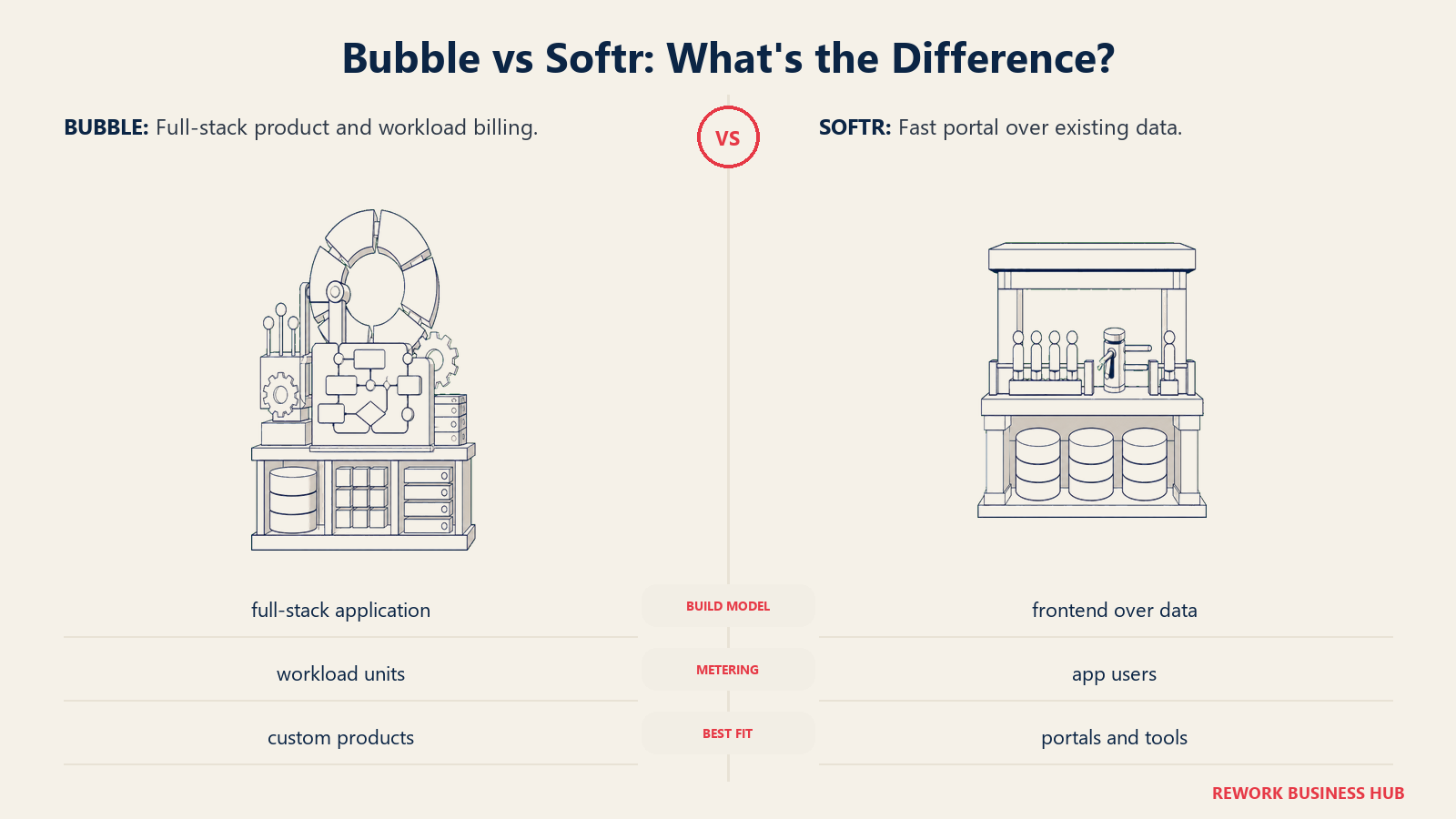
Here's the distinction that decides this comparison before any feature row does. Bubble is a full-stack builder: you're building a product, data model and all. Softr is a front end: you're shipping an interface to data you already own. If you're not sure which camp you're in, the rest of this article won't help much until you decide, because every table below assumes you already know the answer.
TL;DR
| Bubble | Softr | |
|---|---|---|
| Built for | A real application, your own database and logic, that you could launch as a product and charge users for | A branded, permissioned front end on data that already lives somewhere else (Airtable, Google Sheets, Softr Database, HubSpot, Postgres) |
| Pricing model | Flat plan price plus workload units, so the bill moves with what the app does | Flat plan price plus app users, split into team and client seats, so the bill moves with who logs in |
| Entry price | $29/month billed annually, web only (Starter); $59/month billed annually for web and mobile, per Bubble's own pricing page | $19/month billed annually, $25 billed monthly (Basic), per Softr's pricing page, following the plan lineup Softr rolled out on 5 August 2026 |
| Free plan | Yes, but development-version only: no live app, no custom domain | Yes, live from day one, capped at 5 app users and 5,000 database records |
| What actually moves the bill | Workload units: page loads, searches, workflow runs, API calls | Named app users: team seats and client seats, counted and billed separately |
| Strongest fit | A real multi-user product built from scratch, with logic and a data model that don't exist yet | Data that already lives in Airtable, Sheets, or another suite and just needs a portal in front of it |
| Weakest fit | A quick internal tool over data you already have elsewhere, which is paying for a database you don't need | A genuinely new product whose data model and logic don't exist anywhere yet |
| When you outgrow it | Records export; Bubble's own visual workflow logic does not hand off as portable code | The portal layer is replaceable; the underlying data source was never locked to Softr in the first place |
What Each Tool Is Actually Built For
Bubble is full-stack, and it wants you to know that up front: a database, a visual workflow engine that functions as real backend logic, and a hosted, responsive application, all in one product. You define data types, build workflows, design pages, and Bubble hosts the whole thing including the database. Nothing needs to exist before you start. That independence is also exactly why a real Bubble build takes weeks rather than hours, and why the community it's built has scaled the way it has: 6 million builders have shipped more than 7 million apps across 220-plus countries and territories, with marketplaces built on the platform processing over $1 billion a year, per Bubble's own blog.
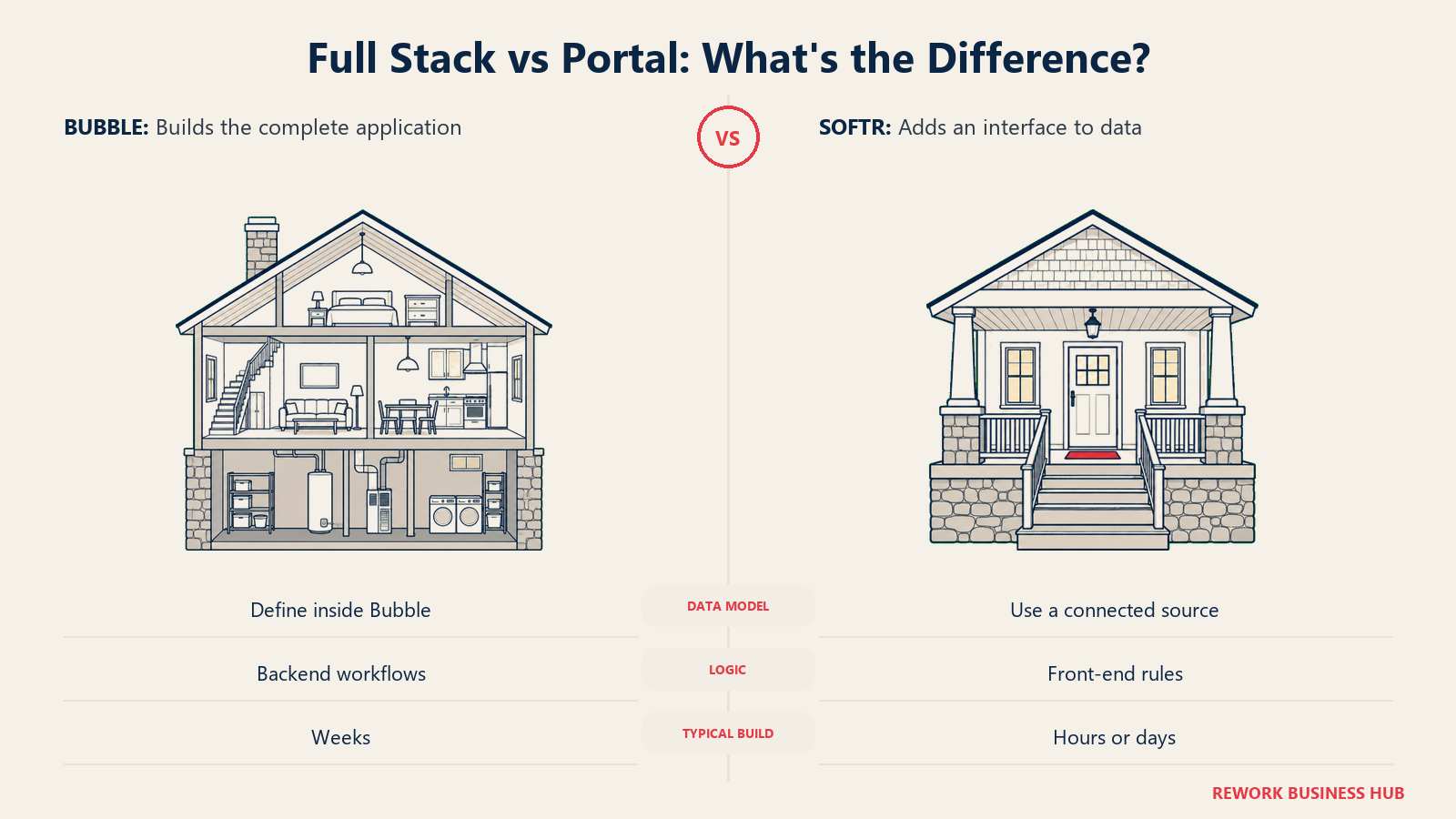
Softr starts from the opposite assumption: that the data model already exists somewhere, and your job is putting a real interface on it, not inventing one. Point it at an Airtable base, a Google Sheet, a HubSpot CRM, a Postgres database, or its own lightweight Softr Database if you genuinely have nothing yet, and it builds pages, logins, roles, and record-level permissions on top without you touching backend logic. It doesn't run its own workflow engine the way Bubble does; it reads and writes wherever your data already lives. That's the whole reason it ships in hours instead of weeks: there's no data model to invent, only a front end to design. It's also why Airtable specifically matters to this comparison. Airtable alone counts 500,000 organizations building on it, including 90% of the Fortune 100 and 10 million active users, per Airtable's own about page, which is a very large pool of unstyled spreadsheets waiting for exactly the kind of portal Softr exists to build.
| Bubble | Softr | |
|---|---|---|
| Org fit | A team building a genuinely new product or internal tool from a blank data model | A team whose operational data already lives in Airtable, Sheets, a Softr Database, HubSpot, or Postgres |
| Buying trigger | Need a real application with custom logic and no engineer to build it | Need a client or team portal on data you already maintain, without building a backend |
| Data model | Bubble's own database, defined inside the builder | Reads and writes an external source; Softr's own Database is the fallback if you don't have one |
| Logic engine | Bubble's visual workflow engine, full backend logic | None of its own; logic largely lives in the connected data source or simple front-end rules |
| Typical build time | Weeks, for a real multi-user application | Hours to a few days, for a working portal on existing data |
Key Facts
- Airtable, one of Softr's most common data sources, counts 500,000 organizations building on it, including 90% of the Fortune 100 and 10 million active users, per Airtable's own about page.
- Bubble's community has grown to 6 million builders who have shipped more than 7 million apps across 220-plus countries and territories, with marketplaces built on Bubble processing over $1 billion annually, per Bubble's own blog.
- Softr repriced its entire plan lineup on 5 August 2026, and grandfathers every existing paying customer into their legacy plan indefinitely, with no action required, per Softr's own community announcement.
- Sales for low-code development technologies, the category both tools sit inside, are projected by Gartner to grow 19% over four years to reach $44.5 billion by 2026, per Gartner as reported by InfoWorld.
- Companies that empower citizen developers score 33% higher on innovation than bottom-quartile companies, per McKinsey's Developer Velocity research, the underlying case for handing either tool to a non-engineer instead of waiting on a dev backlog.
What Changed in August 2026
Softr's plan lineup changed on 5 August 2026, and it's the single most decision-relevant fact in this comparison. The old structure, still described across most of the internet's Softr write-ups, was Basic $49, Professional $139, and Business $269, with 20, 100, and 500 app users respectively. That lineup is gone.
The page today shows Free, Basic at $19/month, Pro at $99/month, and Business at $329/month, with far tighter app-user allowances than before. Basic now includes Team: 5 plus Client: 5, ten named logins total, down from 20 on the old Basic tier. Pro includes 10 team users plus client users from $1/month; Business includes 30 team users plus client users from $2/month. Apps, databases, workflows, and forms stay unlimited on every tier including Free, and builders can be added as app users at no extra cost. The entry price dropped. The included audience did not, and for anyone whose portal serves more than a handful of outside logins, that's the number that actually decides the bill.
The good news for anyone already paying: Softr grandfathers you. Per the company's own community announcement, "as an existing paying customer (or on a 14-day free trial), you can keep your current plan exactly as it is, no action is required," and Softr says it has restructured pricing twice before, in 2024 and 2025, grandfathering existing customers both times. Pricing Softr fresh today means pricing the new, tighter lineup. An account opened before 5 August 2026 may still run on the old math, worth confirming directly rather than assuming.
Decision by Business Goal
| Your goal | Pick this | Why |
|---|---|---|
| "I want to launch a real product I could charge strangers to use" | Bubble | It has its own database and logic engine; nothing needs to pre-exist |
| "I want a client-facing portal on data my team already maintains in Airtable or Sheets" | Softr | Reads and writes your existing source natively, no backend to build |
| "I want the cheapest way to get a large login base into a working portal fast" | Softr, if headcount stays inside a plan's included user counts | Per-seat billing kicks in past the included Team and Client allowances |
| "I want a bill that doesn't move no matter how much the app computes" | Softr | Workflow-action caps aside, Softr's core price is set by named users, not usage |
| "I want a bill that doesn't move no matter how many people log in" | Bubble | Workload units meter actions, not headcount, so a large but light-usage login base stays cheap |
| "I want to avoid learning a visual workflow or logic engine" | Softr | No backend logic to build; Bubble's workflow engine has a genuine learning curve |
Team and Role Fit
| Role | Bubble | Softr |
|---|---|---|
| Non-technical builder | A real ceiling exists once workflow logic gets specific | Comfortable throughout; there's no backend logic engine to run into |
| Technical/developer builder | Real headroom: workflow engine, API connector, 6,000-plus plugins | Lower ceiling; extensibility is limited to Softr's own block library and connected data sources |
| End user / app user | Not billed per person directly, but a live app requires a paid plan and consumes workload units per action | Costs a named seat, split into cheaper client seats and pricier team seats |
| IT or business systems admin | Owns and hosts the entire application and its database, one vendor, one bill | Owns the portal layer only; the connected data source keeps its own separate admin and access controls |
Core Capability and Builder Model
Both let a non-engineer assemble a working app with logins and roles, no query language required for a basic build. The gap opens over what each one is actually building.
| Capability | Bubble | Softr |
|---|---|---|
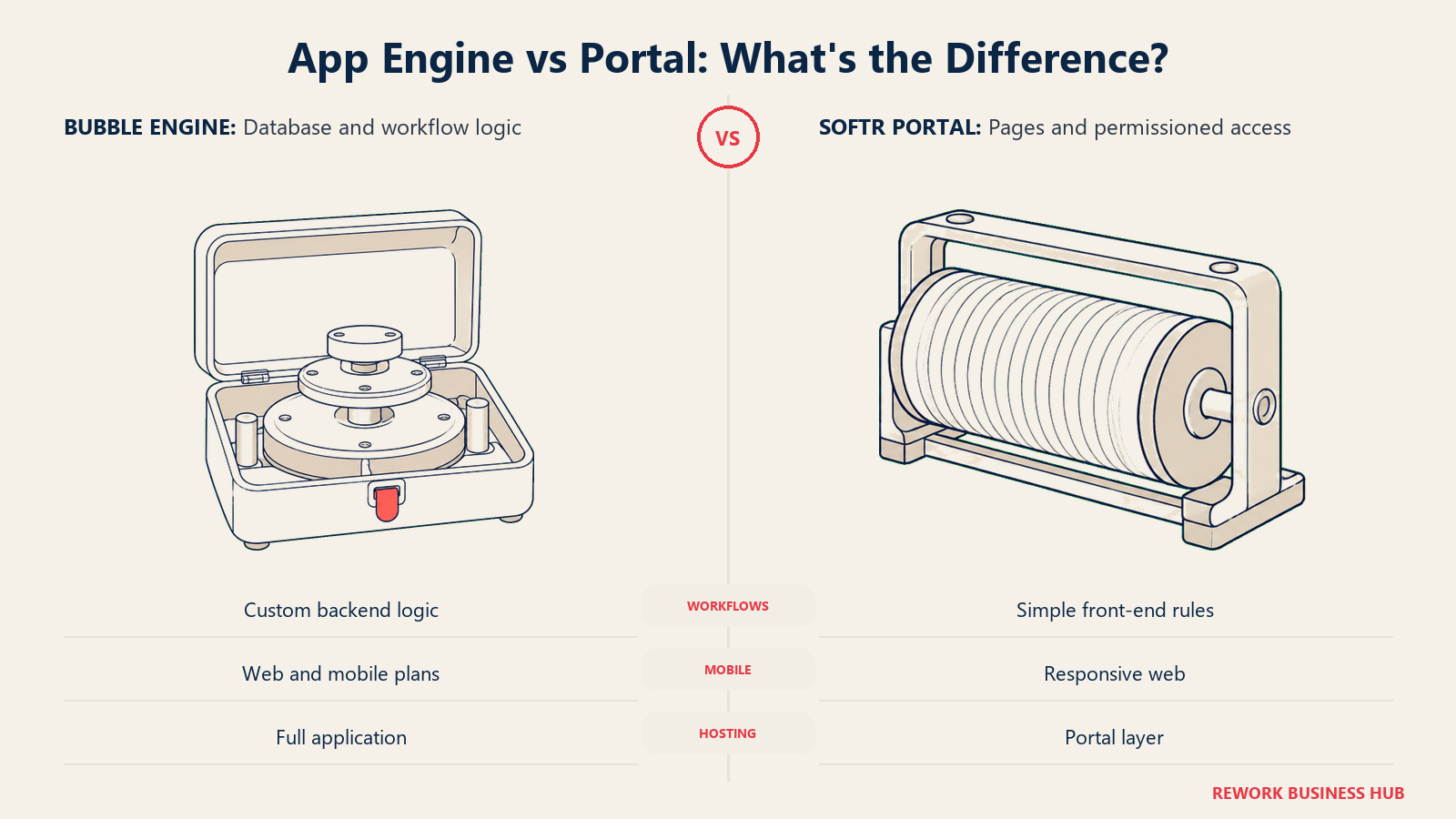
| Data modeling | Own database, defined inside the builder | None of its own by default; reads and writes an external source, or its lightweight Softr Database |
| Logic and workflow | Full visual workflow engine, real backend logic | Simple front-end rules and automations; no backend workflow engine |
| Roles and record-level visibility | Native, configured inside Bubble's own database | Native, and this is the actual product: branded, permissioned access to someone else's data |
| Native mobile app generation | Web & Mobile plans generate real app-store builds | No native mobile app generation; output is a responsive web app |
| API access | Full API connector, build APIs to consume or expose | Reads and writes connected sources' own APIs; no general-purpose backend API of its own |
| Extensibility | 6,000-plus marketplace plugins | Limited to Softr's own block library and data-source integrations |
| Hosting | Bubble hosts the full application and database | Softr hosts the front end; your data source hosts your data |
Neither tool is the right shortlist if the build genuinely needs to move data between multiple business systems with real query logic in between, and our Retool alternatives guide covers that heavier-duty category instead, alongside a direct look at Retool vs Bubble for teams weighing a database-first builder against a full-stack one. And if the honest need is a data front end but Softr specifically isn't the right shape of it, our best Softr alternatives roundup covers that narrower search.
Two Different Meters: Workload Units Versus App Users
This is the axis that produces genuinely different bills, and it's not about which tool is "more expensive." Bubble and Softr meter completely different things.
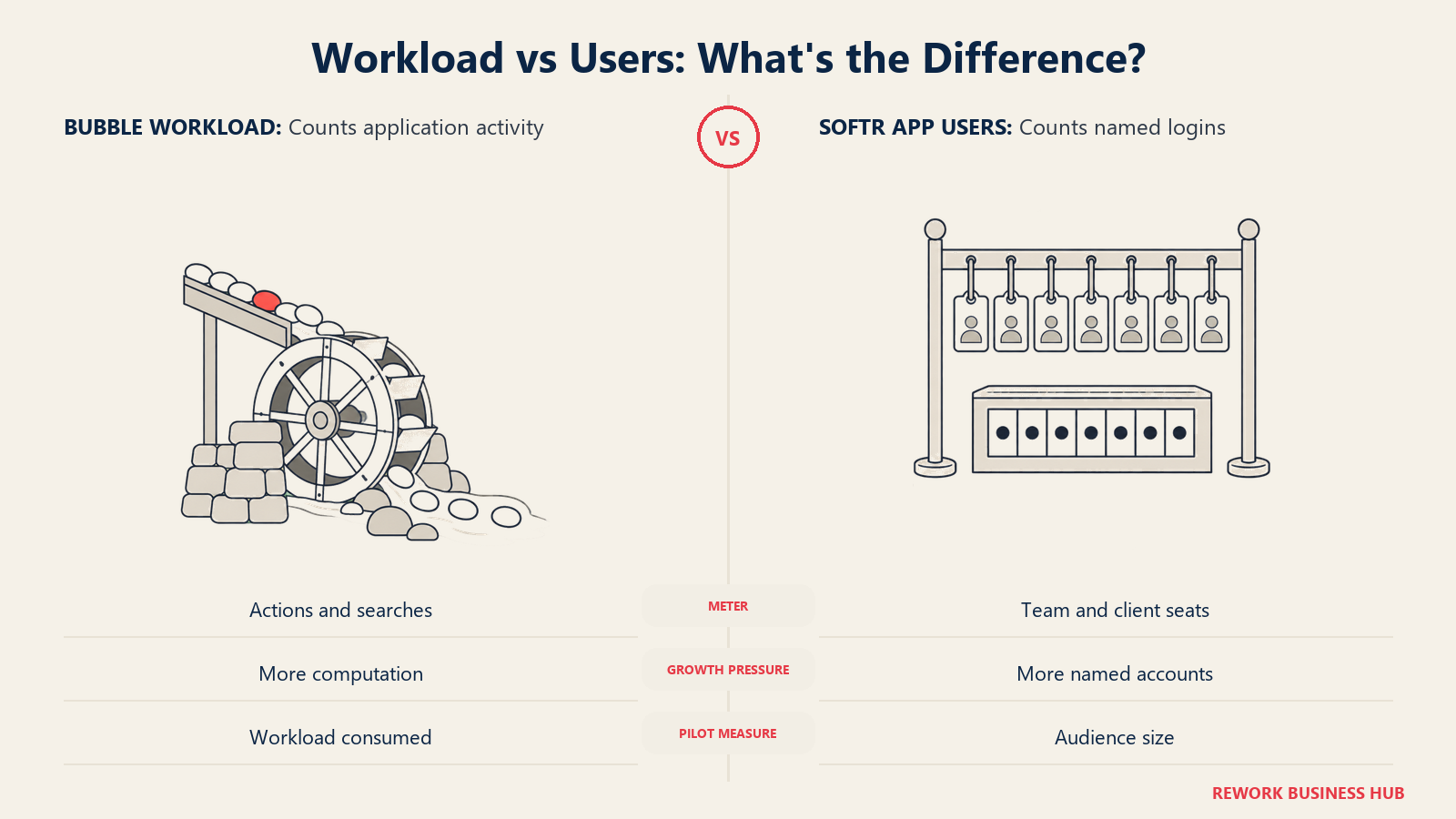
| Bubble: Workload Units | Softr: App Users | |
|---|---|---|
| What it meters | Every action the app performs: page loads, database searches, workflow runs, API calls | Every person who logs in, split into team seats (builders and staff) and client seats (outside users) |
| What barely moves the bill | The number of people using the app, within reason | How much the app computes, up to the plan's workflow-action cap |
| Who benefits from this model | A high-traffic product with a small login base: heavy usage, few named accounts | A low-traffic internal tool with a large login base: many named accounts, light usage each |
| Who gets squeezed by this model | A computation-heavy app with few users can still burn through workload units fast | A portal with thousands of named logins costs more even if each one barely opens the app |
| Overage handling | Extra workload units billed incrementally past the plan's monthly allotment | Extra app users billed per seat above the included Team and Client counts, from $1 to $2/month depending on tier |
A 30-person internal tool and a 5,000-person public product sit at opposite ends of this table, and the cheaper vendor flips depending on which one you're building. Know your shape before you price either one.
Pricing at Real Team Sizes
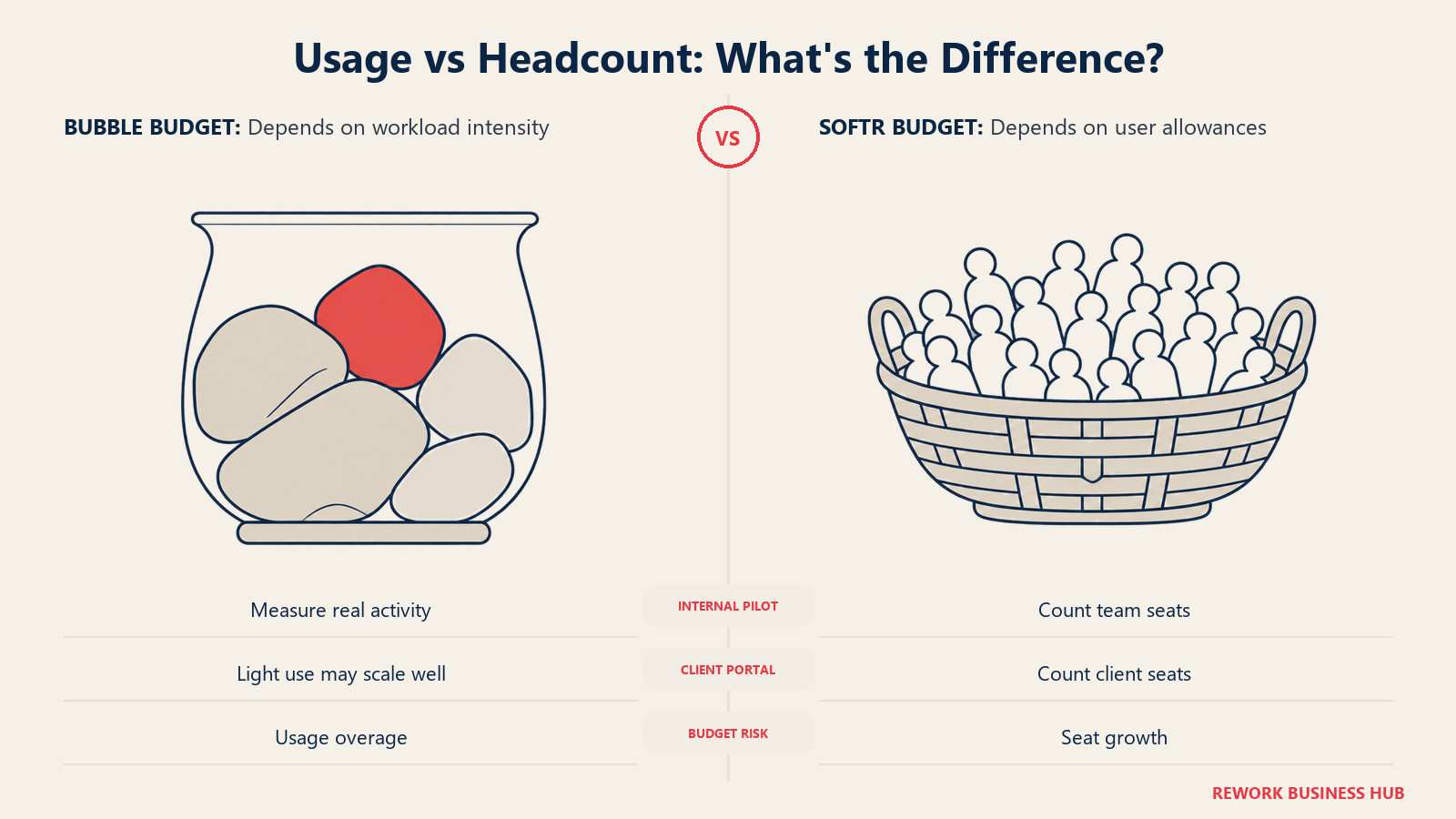
Compare both a realistic workload and the number of people who need access. These two inputs drive different bills on Bubble and Softr.
Bubble's published tiers, per Bubble's own pricing page. The page has a Web-only versus Web & Mobile toggle; every price below is labeled.
| Plan | Web only | Web & Mobile | Workload units | App editors |
|---|---|---|---|---|
| Free | $0 | $0 | 50,000 WU/month | 1 |
| Starter | $29/month billed annually ($32/month billed monthly) | $59/month billed annually | 175,000 WU/month | 1 |
| Growth | $119/month billed annually | $209/month billed annually | 250,000 WU/month | 2 |
| Team | $349/month billed annually | $549/month billed annually | 500,000 WU/month | 5 |
| Enterprise | Contact for pricing | Contact for pricing | Custom | Custom |
Bubble's Free plan is development-version only: no live app, no custom domain, so it cannot host anything a real user would ever see. The page advertises "save up to 20% annually," and file storage is a separate add-on at $3 per 100 GB each month.
Softr's published tiers, per Softr's pricing page, following the 5 August 2026 repricing:
| Plan | Price | Builders | App users | Database records | Workflow actions |
|---|---|---|---|---|---|
| Free | $0 | Up to 3 | 5 | 5,000 | 500/month |
| Basic | $19/month | 1 included, additional $5/month | Team: 5 + Client: 5 | 50,000 | 2,500/month |
| Pro | $99/month | 2 included, additional $10/month | Team: 10, plus client users from $1/month | 500,000 | Per plan |
| Business | $329/month | 3 included, additional $20/month | Team: 30, plus client users from $2/month | 1,000,000 | 25,000/month |
| Enterprise | Contact for pricing | Custom | Custom | Custom | Custom |
Softr's page shows a Monthly and Yearly toggle labeled "2 months off," but renders only one dollar figure per tier, so the numbers above are what the page actually displays, not a separately computed annual rate. Apps, databases, workflows, and forms are unlimited on every tier including Free. Builders can be added as app users at no extra cost. Extra custom domains run $15/month, or $13/month billed annually. Non-profits and education get a 50% discount, raised from 30% in the August change.
What a 25-user internal portal and a 500-user client portal actually cost
Run two contrasting scenarios and the "per user versus per usage" framing stops being a footnote.
Scenario one: a 25-person internal portal, all staff, moderate daily usage (a handful of page loads, searches, and form submissions per person per day).
- Bubble: assume this lands within Growth's 250,000 workload-unit monthly allotment, a reasonable estimate for 25 staff at light-to-moderate daily use. Web only, billed annually: $119/month, $1,428/year. Web & Mobile, billed annually: $209/month, $2,508/year. Twenty-five internal users cost the same as five, because Bubble doesn't bill per login.
- Softr: 25 people who all need team-level (staff) access don't fit Basic's 5 included team seats or Pro's 10. Business's 30 included team seats are the first tier that covers 25 staff outright, with no per-seat overage needed: $329/month, $3,948/year flat. Softr's own tiers publish an overage rate for additional client users ($1 to $2/month) but not for additional team users beyond each tier's included count, so scaling internal headcount past that count means moving up a tier, not paying incrementally.
For this scenario, Bubble is the cheaper option on either billing basis, because Bubble never counted the 25 logins against the price in the first place.
Scenario two: a 500-person client portal, external users viewing and submitting records a few times a month each, light workflow load per session.
- Bubble: assume moderate usage across 500 light-touch users lands in Team's 500,000 workload-unit allotment for most real-world portals of this shape; a much more compute-heavy version could push into Enterprise. Web only, billed annually: $349/month, $4,188/year. Web & Mobile, billed annually: $549/month, $6,588/year.
- Softr: 500 client users on Business, assuming all 500 seats are billed at the stated $2/month client-user rate (Softr's own tiers don't publish a free client-seat allotment on Pro or Business, only that additional client users start from that per-tier rate): 500 x $2 = $1,000/month in client-user overage, plus the $329 base plan, for $1,329/month, $15,948/year.
For this scenario, Bubble is dramatically cheaper, because Softr's per-client-seat billing scales linearly with a login base that Bubble's workload-unit model barely notices, assuming usage per person stays light. The crossover point is usage intensity, not headcount alone: a 500-user Softr portal where every user is heavily interactive could still land under a Bubble build with genuinely complex logic. Model your own usage pattern before trusting either number as final.
Time to First Working App
| Bubble | Softr | |
|---|---|---|
| Time to a working first page | Days to weeks, depending on data model and logic complexity | Hours to a couple of days, once the source data is already organized |
| What slows it down | Designing the data model and workflow logic from nothing | Messy or unstructured source data, a spreadsheet that was never meant to be a database |
| Learning curve | Real: workflow engine, database design, responsive layout | Shallow: connect a source, drop in pages and blocks |
| Who can build the first version | A builder investing real hours per week over several weeks | Almost anyone who already knows the underlying spreadsheet or CRM |
Data Ownership and What Happens If You Leave
Leaving Bubble means rebuilding application logic; leaving Softr usually means replacing the portal while keeping externally stored records in place.
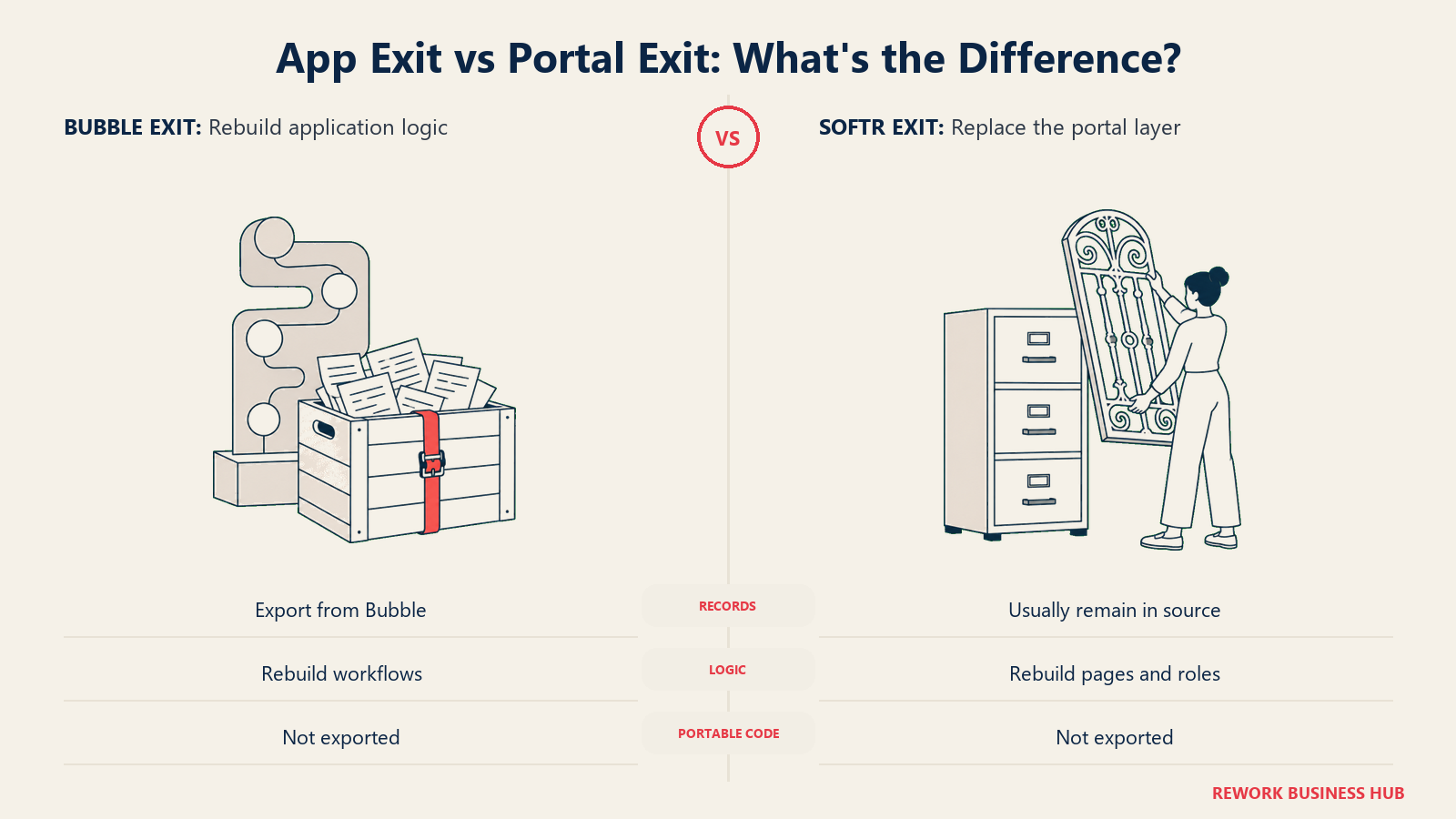
| Bubble | Softr | |
|---|---|---|
| Where the data lives | Inside Bubble's own hosted database | Wherever you pointed it: Airtable, Sheets, Postgres, HubSpot, or Softr's own Database if you had nothing yet |
| Export | Records export; the application's workflow logic does not export as portable code | Nothing meaningful to export from Softr itself in most cases, since the data was already living outside it |
| Walking away from the vendor | Rebuild the whole application, database and logic included, somewhere else | Point a different front end, or nothing at all, at the same data source; the data was never Softr's to begin with |
| Real lock-in | The application itself: logic, workflows, and hosting are all Bubble-specific | The portal layer only: pages, roles, and branding are Softr-specific; the underlying records usually are not |
Neither hands you the kind of exit a code-exporting builder gives you, real, downloadable source an engineer could pick up. What differs is how much is actually trapped. Bubble's lock-in covers the whole application, because the whole application lives inside Bubble. Softr's lock-in is bounded to the portal you built, because the records it displays were designed to live somewhere else from the start. If genuine data portability across systems matters more to your build than either of these tools' current shape, our best no-code app builders roundup widens the search.
Implementation and Change Management
Neither tool has a mandatory multi-week rollout phase, but they ask different things of the team that owns them afterward.
| Bubble | Softr | |
|---|---|---|
| Rollout effort | A real project: data model, workflow logic, QA, then launch | A configuration exercise: connect the source, design pages, set roles |
| Training load | Meaningful, for whoever maintains workflow logic after launch | Light, for whoever maintains pages and permissions after launch |
| Ongoing maintenance | Your team owns the entire application, database included, indefinitely | Your team owns a front end; the connected data source keeps its own separate admin |
| Realistic owner | A dedicated no-code builder or product-minded operator | Whoever already owns the spreadsheet, base, or CRM being exposed |
Risk and Governance
Neither tool is a heavyweight enterprise platform, and the governance conversation differs for each.
- Vendor lock-in runs deeper on Bubble: application, data, and logic all live inside one vendor. Softr's lock-in is shallower by design; the portal is Softr's, but the records behind it typically aren't.
- Access control is native on both, but Softr's permission model is implicitly bound by whatever the connected source (Airtable, HubSpot, Postgres) already allows. A misconfigured role can expose live business data one layer removed from Softr's own settings screen.
- Pricing transparency is a genuine strength for both: Bubble and Softr each publish full tier pricing on their own pages, unlike some names in this category that route every quote through a sales call, the way our Knack vs Zoho Creator comparison covers on the low-code side.
- Governance for citizen developers matters either way. Someone still needs to own what gets exposed to which role, especially on Softr, where the underlying system of record sits a click away from the portal a non-technical builder just shipped.
When Bubble Is the Right Call
- You're building a genuinely new product, with a data model and logic that doesn't exist anywhere else yet
- You want to eventually charge users or run a real marketplace, and need to own the whole application stack
- The build needs meaningfully custom logic, not just a filtered, styled view of records that already exist
- You need native mobile app-store builds, not a responsive web page resized for a phone
- You'd rather own the entire stack, database included, than depend on a separate data source staying available and well-organized
When Softr Is the Right Call
- Your operational data already lives in Airtable, Sheets, HubSpot, Postgres, or a similar source and just needs a real front end
- You need a client or partner portal live in hours or days, not weeks
- Nobody on the team wants to learn a visual workflow engine or maintain application logic long-term
- Your login base is large but usage per person is light, exactly the shape Bubble's workload-unit model would price efficiently for Bubble, and Softr's per-seat model would not
- You want the underlying data to stay independently portable, even if the portal on top of it changes later
Decision Framework
| If you are... | Pick |
|---|---|
| Building a real product from a data model that doesn't exist yet | Bubble |
| Putting a portal in front of data you already maintain in Airtable, Sheets, or another suite | Softr |
| Planning to charge strangers to use the finished application | Bubble |
| Serving hundreds of light-usage logins on a fixed budget | Softr, within its included user counts; priced per seat past that |
| Needing native mobile app-store builds | Bubble (Web & Mobile plans) |
| Wanting the underlying data to stay independently portable if you switch tools later | Softr |
| Planning to hand the app to a developer with real portable source code eventually | Neither. See our best no-code app builders roundup for that category |
| Ruling out Bubble specifically first | See our best Bubble alternatives guide |
| Ruling out Softr specifically first | See our best Softr alternatives guide |
| Comparing a third, database-first builder against both of these | See Retool vs Softr vs Budibase |
What to Do Next
- Decide which world you're in first. If the data your app needs doesn't exist yet, you're building a product, Bubble's category. If it already lives in Airtable, Sheets, or another suite, you're shipping a front end, Softr's category.
- Estimate your usage shape, not just your headcount. A large, light-touch login base favors Softr up to its included user counts, and Bubble past that. A small but computation-heavy build favors Bubble's workload-unit model regardless of headcount.
- Confirm Softr's current tier pricing directly before budgeting, since the lineup changed on 5 August 2026 and an existing account may still be on the older, grandfathered structure.
- Rebuild your single most demanding screen in both tools before committing. For Bubble, that's the screen with the most conditional logic. For Softr, it's the screen touching the messiest part of your existing data source.
- Still not sure either is the right shape? Our best Retool alternatives, best Glide alternatives, and best Power Apps alternatives guides widen the search, and Retool vs Bubble covers the database-first alternative directly.
Frequently Asked Questions about Bubble vs Softr
Is Bubble or Softr cheaper?
It depends on what you're building and who logs in. Entry tiers run close, $29/month web-only billed annually for Bubble Starter versus $19/month billed annually for Softr Basic. At real scale the two diverge on different axes: a large but light-usage login base stays cheap on Bubble because it doesn't bill per person, while it gets expensive on Softr past the included Team and Client seat counts. A computation-heavy app with few users can flip that the other way, since Bubble's workload units meter what the app does, not who's logged in.
What changed with Softr's pricing in August 2026?
Softr replaced its old Basic $49, Professional $139, Business $269 lineup (with 20, 100, and 500 app users respectively) with a new Free, Basic $19, Pro $99, Business $329 structure on 5 August 2026 (those are the effective per-month rates when paying yearly; billed monthly they are $25, $119, and $395). The new lineup's included app-user counts are tighter: Basic now includes 5 team plus 5 client users, down from 20 total. Existing paying customers were grandfathered into their old plan and can stay on it indefinitely with no action required, per Softr's own community announcement.
Can Softr build a real standalone product, or does it need Bubble underneath it?
Softr doesn't need Bubble specifically, but it does need a data source, whether that's Airtable, Google Sheets, Postgres, HubSpot, or Softr's own lightweight Database. Softr has no backend logic engine of its own, so a build with real custom logic, calculations, or a data model invented from scratch is not what it's built for. That's Bubble's job.
What's the practical difference between Bubble's workload units and Softr's app users?
Workload units meter what the app does: page loads, searches, workflow runs, and API calls, so a large but lightly-used login base barely moves Bubble's bill. App users meter who logs in, split into team and client seats, so a heavily-used app with few named accounts barely moves Softr's bill. Pick based on whether your bottleneck is headcount or activity.
Can I build a native mobile app with either tool?
Bubble can, on its Web & Mobile plans, which generate real app-store builds. Softr cannot; its output is a responsive web app that works in a phone's browser but isn't a native, store-published app.
What data sources does Softr actually connect to?
Airtable, Google Sheets, HubSpot, and Postgres are the most common, plus Softr's own built-in Database for teams that don't already have a structured data source. It reads and writes those sources natively rather than running its own separate backend.
What happens if I outgrow Bubble or Softr?
Neither hands you portable source code the way a code-exporting builder does. With Bubble, your data exports but the application's logic and workflows stay inside Bubble's own format, so leaving means rebuilding the whole application elsewhere. With Softr, there's usually less to migrate from Softr itself, since your actual data lived outside it the whole time; you'd mainly be rebuilding the portal layer, roles, and branding against a new front end.
Related Resources:

Principal Product Marketing Strategist
On this page
- TL;DR
- What Each Tool Is Actually Built For
- Key Facts
- What Changed in August 2026
- Decision by Business Goal
- Team and Role Fit
- Core Capability and Builder Model
- Two Different Meters: Workload Units Versus App Users
- Pricing at Real Team Sizes
- What a 25-user internal portal and a 500-user client portal actually cost
- Time to First Working App
- Data Ownership and What Happens If You Leave
- Implementation and Change Management
- Risk and Governance
- When Bubble Is the Right Call
- When Softr Is the Right Call
- Decision Framework
- What to Do Next