Best Glide Alternatives in 2026: 12 No-Code App Builders Compared
Turn this article into takeaways for your work.


Each assistant summarizes the article only for you and suggests best practices for your work.
Google AppSheet and Adalo are the closest doppelgangers if you just want another spreadsheet-to-app builder, Bubble and FlutterFlow are where you go once Glide's ceiling gets in the way of what you're trying to build, and Airtable or Knack are the honest answer if you never actually needed a deployed mobile app, only a shared database with a decent front end on it. Every tool below was evaluated on billing model, output type (native app versus web app versus internal tool), customization ceiling, and total cost at a realistic team size, with pricing clearly labeled wherever a vendor doesn't publish one.
This is written for operations and product leaders who came to Glide to turn a spreadsheet or database into a mobile-friendly app without writing code, and who are now leaving for one of four reasons: the pricing changed under them, the new credit-based billing feels unpredictable, they hit a wall on customization, or the project outgrew a spreadsheet-backed app and needs a real native build or a proper internal tool instead. One thing before the list. Glide itself is genuinely hard to price right now, because Glide's own pricing page and its own help center currently disagree with each other, and that disagreement gets its own section below because it's the most useful thing you can know before comparing anything else.
Key Facts
- Gartner forecasts the low-code development technologies market to reach $44.5 billion by 2026, growing 19% over four years, and expects 75% of new application development to run on low-code technologies by 2026, up from 40% in 2021, per Gartner as reported by InfoWorld.
- By 2026, developers outside formal IT departments will make up at least 80% of the user base for low-code development tools, up from 60% in 2021, per Gartner as reported by InfoWorld.
- 78% of director-level-or-higher developers say their organization already empowers people outside IT through a citizen developer strategy, or plans to within 12 months, per Forrester's Developer Survey, cited in a Forrester report Airtable distributes to prospective customers.
- Companies that empower citizen developers score 33% higher on innovation than bottom-quartile companies, per McKinsey's Developer Velocity research.
- Glide's own pricing pages currently disagree with each other: glideapps.com/pricing shows a credit-metered GlideOS rate card while help.glideapps.com still documents the older flat-monthly Explorer, Maker, and Business plans as current, both confirmed by us on 22 August 2026.
Quick Comparison Table
| Tool | Best For | Starting Price | Key Strength | Key Limitation |
|---|---|---|---|---|
| Google AppSheet | Spreadsheet-to-app teams already on Google Workspace | $5/user/mo | Often bundled free inside paid Workspace plans | Per-user billing adds up fast with many external users |
| Adalo | A native mobile app with a real app-store listing | $36/mo annual, $45 monthly | True native builds, flat unlimited app actions | Free plan publishes 0 apps |
| Softr | A branded client or member portal on data you already run | $19/mo annual, $25 monthly | Fast, modern portals on top of Airtable or Sheets | Front end only, you still pay for the database underneath |
| FlutterFlow | Real, ejectable Flutter source code | $39/mo | Genuine native output a developer can take over | Credit-metered AI features, annual basis not clearly shown |
| Bubble | Web app logic too complex for a drag-and-drop database tool | $29/mo annual, $32 monthly | Full application logic without writing code | Workload-unit billing is hard to predict at scale |
| Airtable | Teams that only needed a shared database, not a deployed app | Free (1,000 records/base) | Largest ecosystem of templates and integrations | No real external user portal |
| Knack | Caspio-style unlimited logins at a smaller-team price | $49/mo annual, $59 monthly | Unlimited users on every plan | No permanent free plan, only a trial |
| Zoho Creator | Companies already standardized on Zoho | Around $8/user/mo (reported) | Native access to Zoho CRM, Books, Desk, People | Public price table does not render |
| Retool | Engineering-supported internal tools on messy, multi-source data | Free up to 5 users; Team builders $10/mo, Business $50/mo (annual) | No ceiling on data source, API, or logic | External users get expensive past a few hundred |
| Appsmith | Open source internal tools with a clear commercial tier | Free up to 5 users (cloud) | Unlimited users on the self-hosted Community edition | $2,500/mo cliff at 100 cloud users |
| Budibase | Self-hosting the whole platform inside your own boundary | Free (self-hosted) | Unlimited users at zero licence cost when self-hosted | Cloud end users cost $5 each and add up fast |
| Xano | A real backend and API layer behind any no-code frontend | Free (100,000 records) | Genuine Postgres backend that scales past what Glide holds | No frontend at all, you pair it with another builder |
Why Glide Itself Is the Hardest Tool on This Page to Price
Before comparing Glide to anything else, know this: Glide is currently quoting two different prices to two different audiences, and neither of its own pages calls the other one wrong.
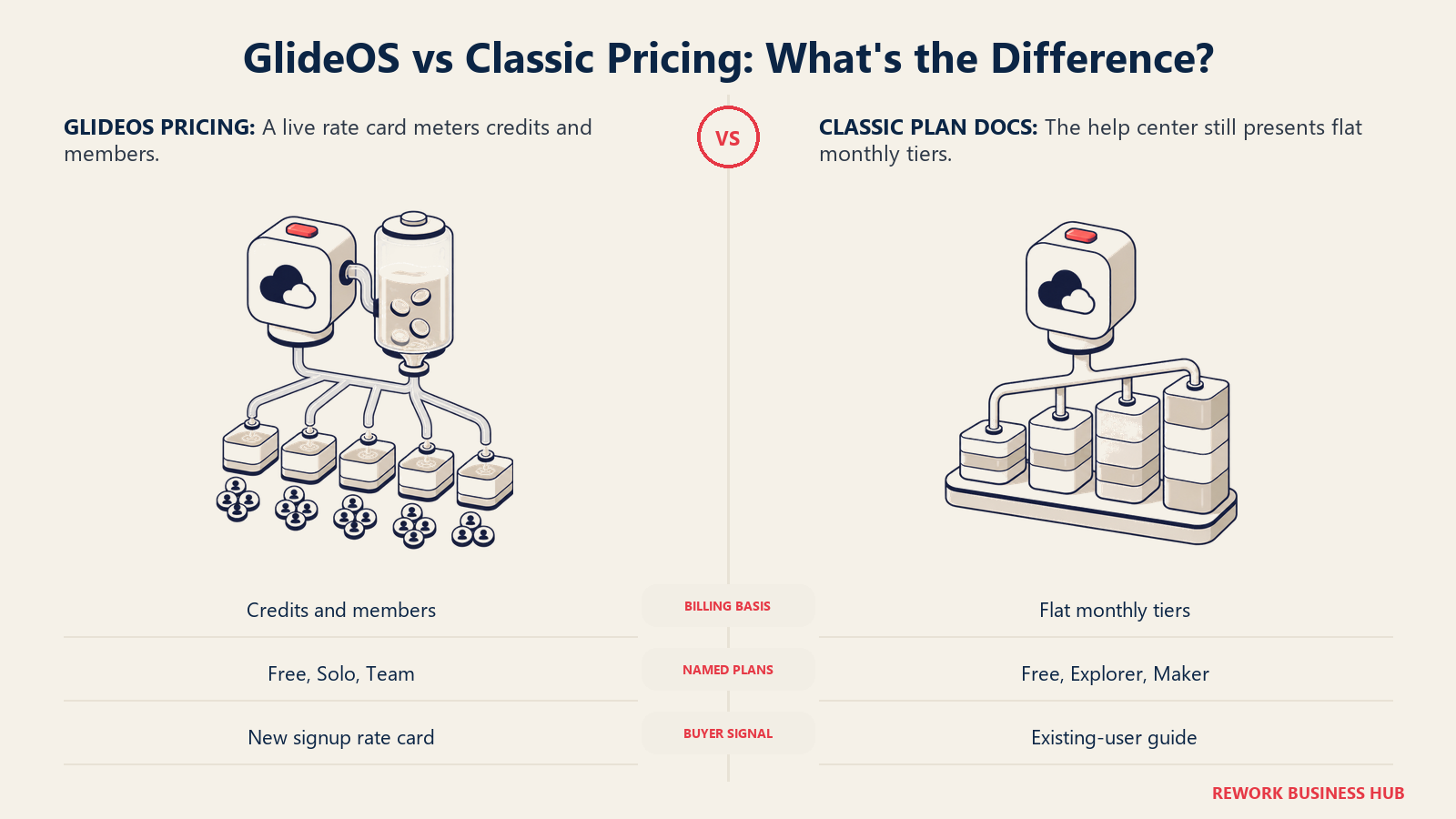
Open glideapps.com/pricing today and you get the GlideOS rate card: Free at $0 for one project with limited credits, Solo at $25 a month for five projects with a database included and 100 credits, Team at $125 a month starting at five members with 50 credits per member, and Enterprise on quote. Every number on that page is monthly. No annual rate appears anywhere on it.
Open help.glideapps.com instead and you land on an article titled "Pricing Plans (as of November 1, 2025)" that documents a completely different set of tiers: Free at $0, Explorer at $19 a month billed annually or $25 monthly, Maker at $49 a month annually or $60 monthly, Business at $199 a month annually or $249 monthly, and Enterprise on quote. That article never says these plans are legacy or superseded. Glide's own documentation elsewhere still states plainly that "Glide offers five plans: Free, Explorer, Maker, Business, and Enterprise," and separately describes a Legacy tier reserved for accounts that predate 17 January 2024.
That's not a stale page someone forgot to update. It's a company mid-migration to usage-based billing, with its marketing page pointing new signups at credits while its help center still walks existing customers through flat monthly plans. Before you budget a renewal or a switch away from Glide, open your own account's billing page and confirm which of these two rate cards you're actually on. What you find may not match either page exactly.
The credit-based shift is the substantive change here, more than any single price on either page. A flat Maker or Business plan tells you your bill in advance. A credit pool tells you your bill only after usage has already landed, and heavy publishing, high traffic, or AI-assisted building can burn through credits faster than a monthly plan ever would have. That loss of predictability, more than the sticker price, is the real reason this comparison has an audience in 2026, and it's worth weighing against every alternative below, several of which, Knack and Adalo among them, still sell flat pricing precisely because buyers value knowing the number ahead of time.
How Billing Actually Works Across These 12 Tools
Glide's credit metering is not unique to Glide. Once you start shopping alternatives, you'll find the same four billing shapes repeat across the category, and the shape matters more than the sticker price because it decides whether your bill is predictable or not.
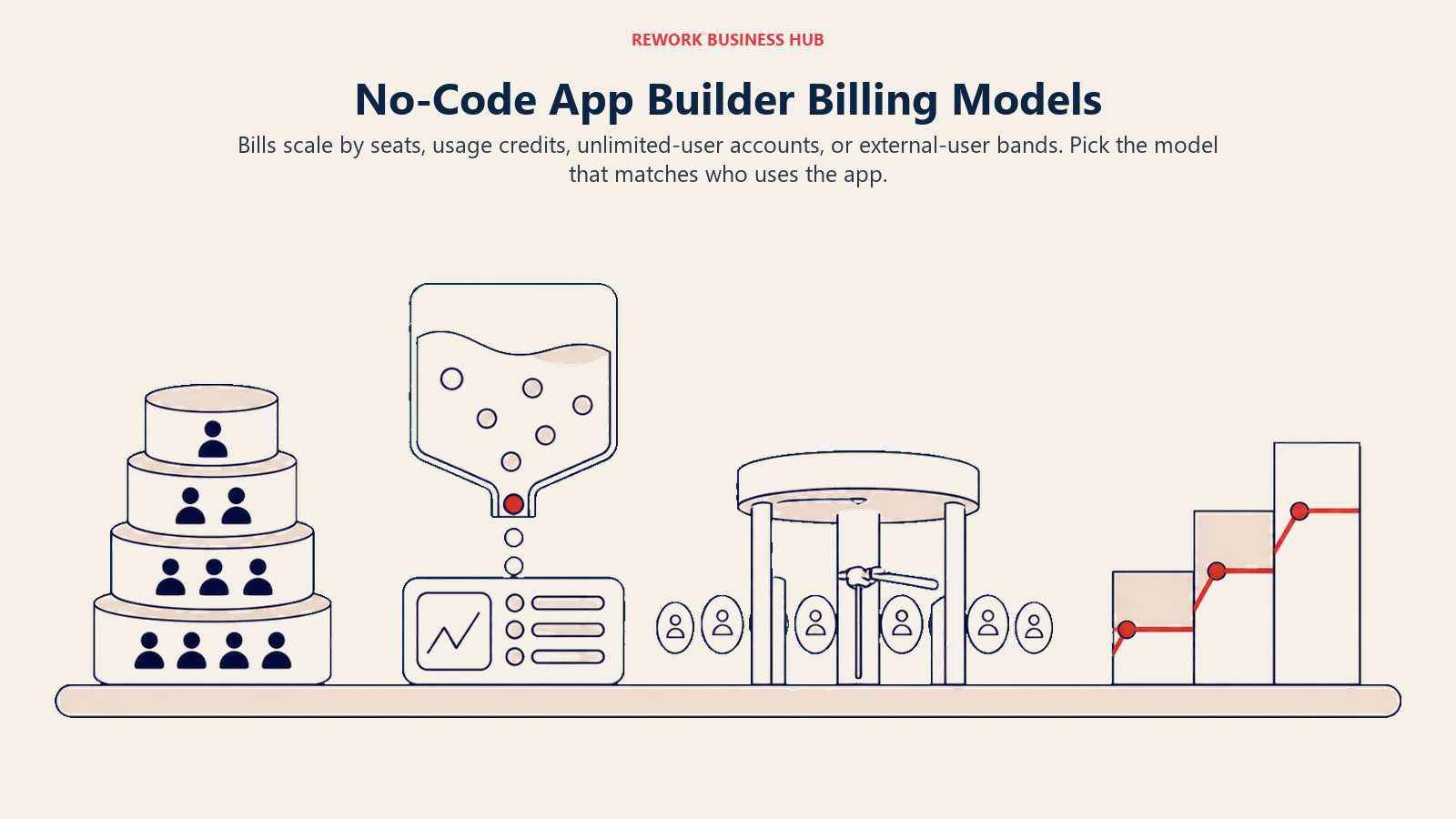
| Billing model | How the bill grows | Tools that use it here | Best when |
|---|---|---|---|
| Flat per seat or user | One price times headcount, the same every month | Airtable, Zoho Creator, Appsmith, Retool (builders and internal users), Budibase (creators) | Headcount is stable and you can name it in advance |
| Credits or workload units | A pool of usage-based currency that drains with app activity | Bubble (workload units), FlutterFlow (AI credits), and Glide itself | Usage is light and predictable, riskier when traffic or AI use spikes |
| Unlimited-user flat account | One price per account no matter how many people log in | Knack, Adalo, Google AppSheet's Publisher Pro tier | You have hundreds of outside users and per-seat pricing would be ruinous |
| Banded external users | Price steps up at defined headcount thresholds | Softr (app-user bands), Retool (external users banded 0-50, 51-250, 251-500, 500+) | You know roughly how many outside people will actually use the app |
The Free Tier Reality Check
Half the reason people leave Glide is a pricing surprise, so read the free tier of whatever comes next before you commit, not after.
| Tool | Free tier | The catch |
|---|---|---|
| Google AppSheet | Up to 10 test users, full editor and process designer | Prototyping only, no path to a published app without a paid seat |
| Adalo | $0 | Publishes 0 apps, so nothing you build actually ships |
| Softr | Up to 3 builders, 5 app users combined | Too small for a real client portal |
| FlutterFlow | 2 projects, 10 lite credits | No code download or APK export until you pay |
| Bubble | Development environment only | Enough workload to build, but paid and Agency plans are the only ones that can buy workload for a live app |
| Airtable | 1,000 records per base | No external user portal at any price |
| Knack | Trial only | No permanent free plan exists |
| Zoho Creator | 1 app | Portal and workflow features are gated to paid tiers |
| Retool | Up to 5 users, full feature set | Generous, but 500 workflow runs a month caps real usage |
| Appsmith | Up to 5 users (cloud) | Self-hosted Community edition is the one with no user ceiling |
| Budibase | Unlimited, self-hosted only | Cloud has no free tier once you need a hosted workspace |
| Xano | Up to 100,000 records, 1 workspace | Rate-limited to 10 requests per 20 seconds, fine for testing, not production traffic |
1. Google AppSheet - the other spreadsheet-to-app giant
AppSheet answers to almost the same pitch as Glide: point it at a Google Sheet, Excel file, or Cloud SQL table, and it generates a working mobile and web app with forms, views, and offline sync. The difference is who owns it. Google bought AppSheet in 2020 and has spent the years since wiring it directly into Workspace, so a Gmail-and-Sheets shop gets an app builder that already understands its data without an export step.
The audience is teams of 5 to 500 who are already inside Google's ecosystem and want field forms, inspection checklists, or simple internal apps without touching Glide's newer credit system. Pricing is refreshingly boring: flat per-user monthly tiers, no workload meter, no credits. The trade-off shows up at the high end. Publisher Pro, the tier built for public apps with no login required, is a flat $50 a month per app with unlimited users, which is the AppSheet answer to Glide's old unlimited-user promise, but every other tier bills per named user, so a big external audience with individual logins gets expensive fast.
| What you get | What you don't |
|---|---|
| Native Google Sheets, Excel, and Cloud SQL data sources | A credit meter or usage surprise |
| Often free inside a paid Google Workspace plan already | A cheap way to serve hundreds of individually logged-in users |
| A flat, unlimited-user public-app tier at $50/mo | The polish of a purpose-built consumer app builder |
| Offline sync that has been in production for years | Fast iteration cycles for a solo non-technical builder |
Pricing: Starter is $5 per user per month. Core is $10 per user per month and is included in most paid Google Workspace plans already. Enterprise Plus is $20 per user per month and requires a Google Workspace administrator account or a free Cloud Identity account to purchase. Publisher Pro is a flat $50 per month per app for public apps that require no sign-in and support unlimited users. The free tier covers up to 10 test users during prototyping, per AppSheet's pricing page. Prices are billed monthly with no annual discount shown on the page. Teams evaluating this alongside a Microsoft-centric option should also see best Power Apps alternatives.
Best for: Teams of 5 to 500 already on Google Workspace who want a spreadsheet-to-app builder without Glide's credit system.
2. Adalo - the closest thing to a native app-store app
Adalo is the pick when "mobile-friendly web app" isn't good enough and you actually need something in the App Store and Google Play with your name on it. It builds true native apps rather than a responsive web wrapper, with a drag-and-drop screen editor, a built-in database, and enough component depth to handle marketplaces, social features, and booking flows that push past what a table-driven tool like Glide was ever built for.
Read the free plan carefully before you get excited about it. Adalo's Free tier is $0, but it publishes 0 apps, meaning you can build and preview but never actually ship without moving to a paid plan. Once you do, the pricing is unusually simple for the category: flat monthly fees with unlimited app actions and no usage-based fees layered on top, which is the opposite of the credit anxiety driving people off Glide right now.
| What you get | What you don't |
|---|---|
| Real native App Store and Google Play builds | A free plan that can publish anything |
| Flat pricing, no usage or credit metering | Glide's speed for a simple table-to-app build |
| Component depth for marketplaces and social apps | A large enterprise or compliance track record |
| A visually driven builder non-developers can run | Backend flexibility beyond Adalo's own database |
Pricing: Free is $0 but publishes 0 apps. Starter is $36 per month billed annually or $45 monthly, for 1 published app. Professional is $52 per month annually or $65 monthly, for 2 apps. Team is $160 per month annually or $200 monthly, for 5 apps. Every paid tier includes unlimited app actions with no separate usage fee, per Adalo's pricing page.
Best for: Teams of 1 to 20 who need a real native mobile app rather than a web app, and want flat pricing with no usage meter.
3. Softr - the modern portal builder for data you already have
Softr solves the interface half of the problem, not the database half. Point it at Airtable, Google Sheets, HubSpot, or its own included store, and it turns that data into a branded client portal, member site, or internal directory in an afternoon, with the kind of current design that makes Glide's default look dated by comparison.
The billing shape is closer to Glide's old flat-plan world than to a per-seat tool: Softr bands its plans by builder count and app-user count rather than charging per individual login, so a portal serving a few hundred clients is a plan tier decision, not a line-item explosion. Softr repriced on 5 August 2026, so treat any Softr number you see elsewhere on the internet as stale until you check the vendor page directly. The one thing to budget separately is the data layer. Softr is a front end, so if your records live in Airtable, you're paying for Airtable's plan underneath the Softr subscription.
| What you get | What you don't |
|---|---|
| A genuinely modern, brandable portal built fast | A database of its own worth relying on long term |
| App-user banding instead of per-seat licensing | Native mobile app output, this stays a web app |
| Solid client portal and membership building blocks | Deep workflow logic or scripting |
| Freshly repriced, current tiers as of August 2026 | A single bill, since you still pay for the data source |
Pricing: Free is $0 for up to 3 builders and 5 app users combined. Basic is $19 per month billed annually or $25 monthly, for 1 builder plus 5 team and 5 client users. Pro is $99 per month annually or $119 monthly, for 2 builders and up to 50 team, 50 client users. Business is $329 per month annually or $395 monthly, for 3 builders and up to 100 team, 500 client users. Extra app users run $1 to $5 a month and extra builders $5 to $24 a month depending on tier, per Softr's pricing documentation.
Best for: Teams of 2 to 50 who need a good-looking client or member portal this month and already have somewhere to keep the data.
4. FlutterFlow - when you need code you can actually own
FlutterFlow is the graduate-school option for a Glide user who has started to feel boxed in. It builds real Flutter apps, the same framework professional mobile teams use, and it lets you download the actual source code or an APK rather than locking your app inside a proprietary runtime. That single feature, ownership of the underlying code, is the whole pitch for teams that suspect they'll eventually need a developer to take over.
It's a heavier tool than Glide in every sense. You're working with Flutter widgets and app architecture concepts, not a spreadsheet turned into screens, and the learning curve reflects that. Pricing runs on a seat-and-credit hybrid: a flat monthly fee per plan, then AI-assisted building features metered through "lite credits" that top up with each paid tier. The page shows a monthly-versus-annual toggle claiming roughly 25% savings on the annual basis, but it does not clearly display the resulting annual figures next to the monthly ones, so verify the exact annual number before you commit to a yearly contract.
| What you get | What you don't |
|---|---|
| Real Flutter source code and APK export | Glide's simplicity for a first-time no-code builder |
| A path to hand the app to a professional developer | Fully transparent annual pricing on the page itself |
| Genuine native performance across iOS and Android | A workload-free flat bill, AI features run on credits |
| Real-time collaboration on Growth and Business tiers | A free tier that ships a production app |
Pricing: Free is $0 for up to 2 projects with 10 lite credits. Basic is $39 a month for unlimited projects, code download, APK download, and 100 lite credits a month. Growth is $80 a month for the first seat and $55 for a second, with 200 lite credits per seat. Business is $150 a month for the first seat and $85 for seats two through five, with 400 lite credits per seat. Enterprise pricing is not published, per FlutterFlow's pricing page.
Best for: Teams of 1 to 5 who have outgrown a spreadsheet-backed app and want real, exportable native code.
5. Bubble - when the logic is the hard part, not the interface
Bubble is what to reach for when the problem was never the interface, it was the logic. Conditional workflows, multi-step processes, marketplaces with two-sided payments, anything with branching rules that a table-driven tool like Glide simply cannot express, Bubble handles through a full visual programming layer sitting on top of a real database.
The free plan is genuinely real, and Bubble's own pricing FAQ says it "comes with more than enough workload to build any kind of app." The nuance is that Free and Agency plans are designed for development and cannot purchase workload tiers or overage capacity, which in practice means a live, public-facing app needs a paid plan. Every paid tier includes 100,000 monthly workload units for its Development environment, and workload consumed beyond a tier's allowance without a subscription costs $0.30 per 1,000 units. That metered structure is the same credit-anxiety problem Glide users are trying to escape, just measured in workload units instead of credits, so budget a buffer rather than sizing exactly to your current traffic.
| What you get | What you don't |
|---|---|
| A true visual programming layer, not just a form builder | Predictable billing if traffic spikes unexpectedly |
| A genuinely usable free plan for development | A simple flat monthly number like Adalo or Knack |
| Deep marketplace, payment, and workflow logic | Native mobile app output, Bubble builds web apps |
| A large plugin and template ecosystem | A short learning curve for a first-time builder |
Pricing: Free covers development only, with no purchasable workload. Starter is $29 per month billed annually or $32 monthly for web only, rising to $59 annually or $69 monthly for web plus mobile. Growth is $119 annually or $134 monthly for web only, up to $209 annually or $249 monthly for web plus mobile. Team is $349 annually or $399 monthly for web only, up to $549 annually or $649 monthly for web plus mobile. Enterprise is custom. All paid apps include 100,000 monthly workload units in Development, with overage billed at $0.30 per 1,000 units, per Bubble's pricing plans documentation. If Bubble's own workload meter is the new problem rather than the solution, best Bubble alternatives picks up exactly where this leaves off.
Best for: Teams of 2 to 50 building complex web apps with real business logic that a spreadsheet-backed tool cannot express.
6. Airtable - the database, if that's all you actually needed
Everything from here down replaces the database half of what Glide does, not the deployed-app half, and for a meaningful share of Glide users, that's the honest answer. If your Glide app was really just a way for your own team to view and edit a shared spreadsheet on their phones, you never needed an app platform at all.
Airtable is the category default for that job: a familiar grid, real relational links between tables, and alternate views (kanban, calendar, gallery, Gantt) on top of the same records, backed by the largest ecosystem of templates, extensions, and integrations in this list. What disappears when you move here is any concept of an external user with a login and record-level permissions. Interfaces can give internal staff a simplified view, but there's no portal for customers, patients, or contractors the way Glide, AppSheet, or Adalo provide one.
| What you get | What you don't |
|---|---|
| The largest ecosystem of any tool on this page | Any real external user portal or app-store presence |
| Genuinely strong relational data modeling | Generous record limits at the entry tier |
| Simple internal-facing app views through Interfaces | Native mobile output, this is a responsive web app |
| Read-only collaborators and form submitters at no charge | Predictable cost as your editing headcount grows |
Pricing: Free covers 1,000 records per base. Team is $20 per seat per month billed annually, $24 monthly, with 50,000 records per base. Business is $45 per seat per month billed annually, $54 monthly, with 125,000 records per base. Enterprise Scale is custom, per Airtable's pricing page. If Airtable's own seat pricing or record caps become the next problem, best Airtable alternatives and the wider best no-code database software guide map where teams go from there.
Best for: Internal teams of 5 to 100 whose Glide app never actually had an outside user logging into it.
7. Knack - unlimited logins at a smaller-team price
Knack belongs on this list for the same reason it tops our Caspio alternatives roundup: it's one of the only mainstream platforms left that bills per account rather than per user, so an app with hundreds of outside logins doesn't multiply your bill the way a per-seat tool would. If the part of Glide you actually valued was that end users didn't cost you anything extra, Knack is the nearest thing to that model outside Glide's own old Classic plans.
It builds real application platforms with roles, record-level visibility rules, and page-level structure, closer to Caspio's DataPage model than to Glide's table-first approach. The trade-off is a builder that feels a generation older than Glide's or Softr's, and no permanent free plan, only a time-limited trial, which matters if you were relying on Glide's free tier to prototype before committing.
| What you get | What you don't |
|---|---|
| Unlimited logins per account on every paid plan | A permanent free plan to prototype on |
| Real roles and record-level visibility rules | A modern, fast builder interface |
| A separate HIPAA product line with a signed BAA | Native mobile app output |
| Predictable flat pricing with no credit meter | Generous record allowances on entry tiers |
Pricing: Starter is $49 per month billed annually, $59 monthly, with a $19 monthly intro rate for the first 3 months, covering 20,000 records. Pro is $110 per month annually, $130 monthly, with a $49 monthly intro rate for 3 months, covering 50,000 records. Corporate starts at $250 per month with 125,000 to 2.5 million records. Enterprise is custom, per Knack's pricing page. For the fuller comparison this billing model comes from, see best Caspio alternatives.
Best for: Teams of 2 to 50 running an external-facing app who want flat, unlimited-user pricing without Glide's credit meter.
8. Zoho Creator - the right call only if you're already on Zoho
Zoho Creator is a genuine application platform, not a database with forms bolted on. You model data, then build web and mobile apps with real workflow logic written in Deluge, Zoho's scripting language, and it handles mobile output better than most database-first tools on this list.
The reason to pick it is almost never the builder itself. It's that your CRM, books, help desk, and HR records may already live in Zoho, so Creator reads them natively instead of through an integration you have to maintain and monitor. If your organization already holds a Zoho One license, Creator may already be included at no extra marginal cost, which would make it the cheapest option on this entire page, so check that before pricing anything else. If you're not a Zoho customer already, Deluge is one more language to learn and the vendor still won't quote a firm price without a sales conversation.
| What you get | What you don't |
|---|---|
| Native access to Zoho CRM, Books, Desk, and People | A published, self-serve price table |
| Real mobile app generation, closer to Glide's output | A large independent consultant community |
| Genuine workflow scripting depth via Deluge | A reason to choose it if you're not on Zoho already |
| Possibly zero marginal cost on an existing Zoho One plan | A modern building experience by 2026 standards |
Pricing: Zoho Creator's public pricing page lists Standard, Professional, Enterprise, and a custom Flex plan, plus a free edition limited to one app. Third-party listings (reported) put Standard around $8 per user per month, Professional around $20, and Enterprise around $25, all billed annually, per Capterra's Zoho Creator pricing listing. Confirm everything directly with Zoho before budgeting.
Best for: Companies of 10 to 500 already standardized on Zoho who want apps sitting directly on existing Zoho records.
9. Retool - when a query does what the no-code builder cannot
Retool is the endpoint for teams that hit a wall inside a table-driven builder and realized the wall was a few lines of SQL wide. It's low-code by design: drag components onto a canvas, then write real queries and JavaScript against any API or database to make them do genuine work. Operations teams end up here when the logic got too specific for a visual builder, or when the data lives across several systems that no single-source tool like Glide can reach. That fragmentation is common rather than rare: IT teams spend 39% of their time building custom integrations, and 80% of organizations name data silos as the single biggest barrier to their automation and AI goals, per the 2025 MuleSoft Connectivity Benchmark Report, which surveyed 1,050 IT leaders.
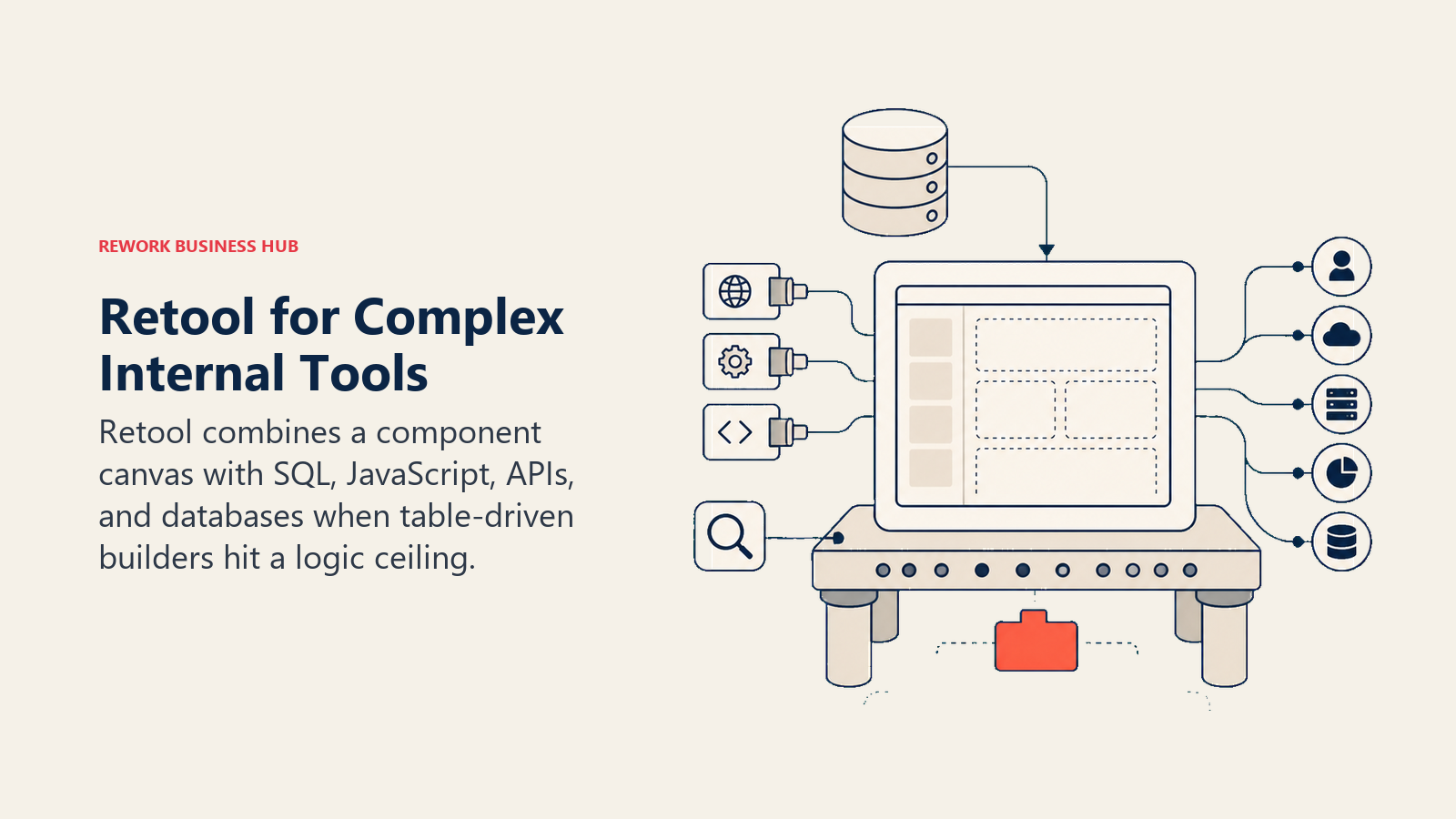
Understand the billing before you fall for the demo. Retool prices builders, internal users, and external users separately, and external users are where the shape diverges hardest from a Glide-style flat plan. Business builders run $50 a month billed annually, internal users $15, and external users are banded: free up to 50, then $8 for 51 to 250, $6 for 251 to 500, and $4 above 500. The first 50 external users are genuinely generous. The 500th is not, so if you're serving a large public audience, Retool is one of the more expensive replacements on this page.
| What you get | What you don't |
|---|---|
| No ceiling on data source, API, or business logic | A tool a non-technical buyer can run alone |
| The first 50 external users at no charge | Cheap pricing at hundreds of external users |
| Cloud or self-hosted at the same tier pricing | Glide's speed for a simple, single-source app |
| Strong developer ergonomics and Git workflows | A build path that avoids engineering time entirely |
Pricing: Free covers up to 5 users, 5GB database plus 5GB file storage, and 500 workflow runs a month. Team bills builders at $10 a month annually ($12 monthly) and internal users at $5 ($7 monthly), with 5,000 workflow runs a month. Business bills builders at $50 a month annually ($65 monthly) and internal users at $15 ($18 monthly). External users on Business run free from 0 to 50, then $8 monthly annually for 51 to 250, $6 for 251 to 500, and $4 above 500. Enterprise is quote-only, per Retool's pricing page. If Retool's external-user cost is the dealbreaker, best Retool alternatives is the more direct comparison.
Best for: Engineering-supported teams of 20 to 1,000 building internal tools on messy, multi-source data, with fewer than about 50 external users.
10. Appsmith - open source with an honest upgrade path
Appsmith sits in the same conversation as Retool and Budibase but earns its own slot for pricing that's unusually easy to read. It leans toward internal tools built on data already spread across several systems, and suits teams comfortable writing some SQL and JavaScript behind a drag-and-drop canvas. Nothing about the data source is off limits.
Pricing is legible in a way few tools on this page manage: free up to 5 users on the cloud plan, then a flat $15 per user per month on Business up to 99 users, with builders billed as ordinary users rather than at a premium. The real draw for teams leaving a proprietary tool like Glide is the fully open-source, self-hosted Community edition, which is genuinely free with unlimited users under the Apache 2.0 license. Just don't confuse the two free things. The cloud free plan stops at 5 users; only self-hosting removes the ceiling entirely. The other thing to plan around is the enterprise jump: crossing 100 users moves you to a $2,500-a-month floor, a cliff rather than a slope.
| What you get | What you don't |
|---|---|
| Open source core with a genuine self-hosted path | A cheap route past 100 cloud users |
| Flat per-user pricing with no builder premium | A no-code experience for non-technical staff |
| Unlimited users at zero cost on self-hosted Community | Prebuilt compliance editions below Enterprise |
| Any data source, with SQL and JavaScript escape hatches | Native mobile app output |
Pricing: Free covers up to 5 users on cloud, with 5 workspaces and 3 Git repos. Business is $15 per user per month for up to 99 users, with builders billed as standard users, and no annual discount published. Enterprise is $2,500 a month starting at 100 users, with SAML and OIDC SSO, SCIM, and CI/CD included. The self-hosted Community edition is free and open source with unlimited users, per Appsmith's pricing page. See best Appsmith alternatives if the cloud ceiling itself is the problem.
Best for: Technical teams of 5 to 100 who want an open-source internal tool builder with a clear, predictable paid tier.
11. Budibase - self-host the whole platform inside your own boundary
Budibase reframes the compliance and control question rather than paying a vendor to answer it. Instead of trusting a third party's security review, you self-host the platform inside infrastructure your organization already controls, and the self-hosted open-source edition is free with unlimited apps, actions, and users on one workspace. For teams whose real objection to Glide was never the price but the idea of their data living on someone else's servers, that's a materially different answer than any hosted tool on this page can give.
It's a real app builder rather than a database with forms on top: internal tables or an external source, a screen designer, role-based access, and automation. The trap is treating the cloud pricing like the self-hosted pricing, because they behave like different products. Extra creators cost $50 each per month and end users $5 each on cloud, so a modestly sized external app adds up in cloud dollars fast, while the identical build costs only infrastructure and a maintainer when self-hosted.
| What you get | What you don't |
|---|---|
| Free, unlimited self-hosted open-source edition | Cheap external users on the cloud plans |
| Full control over where the data physically lives | Vendor compliance certificates to hand an auditor |
| A real screen designer with role-based access | A managed service unless you pay for one |
| No licence ceiling on users when self-hosted | Someone to page when the server misbehaves |
Pricing: Self-hosted open source is free with unlimited actions, apps, automations, and users on one workspace. Cloud Pro is $19 a month billed yearly, $22.80 monthly, for 1 creator. Cloud Premium is $49 a month yearly, $58.80 monthly, with extra creators at $50 each per month and end users at $5 each per month. Cloud Business is $299 a month billed yearly for 3 creators. Enterprise is custom, per Budibase's pricing page. Teams weighing this against a full automation platform rather than just an app builder should also see best workflow automation software.
Best for: Organizations of 10 to 500 with an infrastructure owner who would rather host the platform than trust someone else's security review.
12. Xano - the backend Glide never gave you
Xano is the odd one out here on purpose. It doesn't build screens at all. It's a genuine backend and API layer, a real Postgres database with visual API-building on top, meant to be paired with a frontend builder rather than replacing one. For a Glide user who's hit the ceiling on record volume, data relationships, or backend logic that a table-driven tool simply can't express, Xano is what sits underneath a new frontend, whether that's FlutterFlow, Bubble, Softr, or a hand-built app.
That single-purpose focus is the whole value proposition. Where Glide's database is a convenience baked into the app builder, Xano's is a production-grade backend you can scale independently, version, and query through a real API that other tools can call. The trade-off is exactly what you'd expect: no visual screens, no app builder, nothing to show a stakeholder without connecting a frontend tool first.
| What you get | What you don't |
|---|---|
| A genuine Postgres backend, not a proprietary store | Any screens, views, or app builder at all |
| Scale well past what a spreadsheet-backed tool can hold | A single bill, you still need a frontend tool |
| A real, versioned API other tools can call | No-code simplicity, backend concepts still apply |
| Generous free tier for prototyping the backend alone | Native mobile output on its own |
Pricing: Free covers a Postgres database up to 100,000 records, 1 workspace, 1GB of watermarked image storage, and a 10-requests-per-20-seconds rate limit. Essential is $85 a month billed annually. Pro is $224 a month billed annually. Larger volumes are custom on quote, per Xano's pricing page. For pairing a backend like this with automation across other tools, best Zapier alternatives and best Make alternatives cover the connective layer.
Best for: Technical teams of 2 to 50 who've outgrown a spreadsheet-backed database and want a real backend behind a separate frontend builder.
How to Choose: Decision Framework
Choose the app output and operating model first, then compare the builders that fit that route.
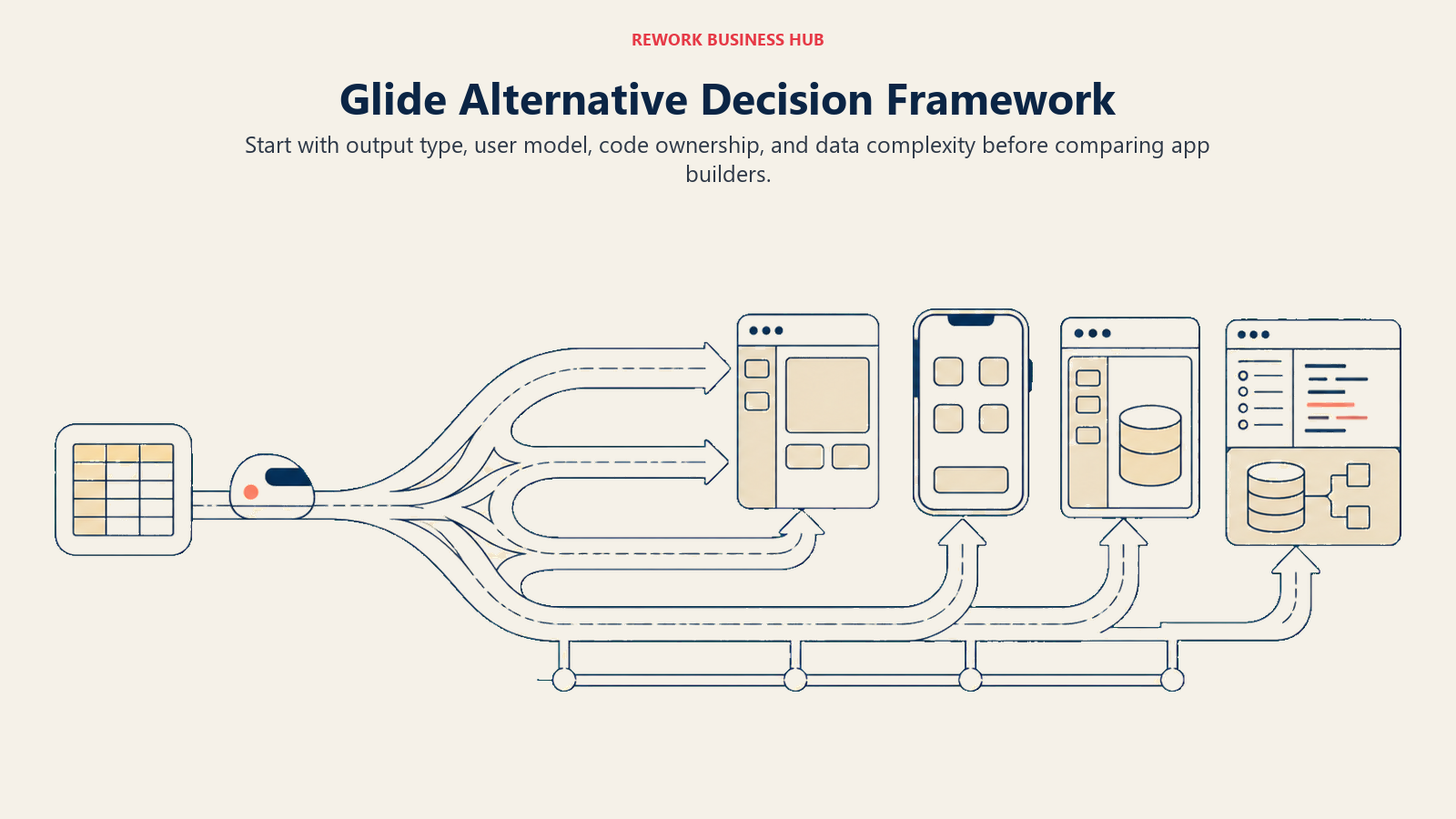
| If you need this... | Choose this | Why |
|---|---|---|
| The same spreadsheet-to-app pitch as Glide, without credits | Google AppSheet | Flat per-user billing, deep Google Workspace integration |
| A real app in the App Store and Google Play | Adalo | True native builds with flat, unlimited-action pricing |
| A modern client or member portal, fast | Softr | App-user banding on top of data you already have |
| Code you can hand to a developer and own outright | FlutterFlow | Real Flutter source and APK export |
| Business logic too complex for a table-driven tool | Bubble | Full visual programming layer on a real database |
| Just a shared internal database, no outside users | Airtable | Cheaper, better, and honest about what it is |
| Caspio-style unlimited logins at a lower floor | Knack | Flat account pricing, no per-user cost for end users |
| Apps sitting on records already in Zoho | Zoho Creator | Native access, no integration to build or maintain |
| Logic a visual builder cannot express | Retool | SQL and JavaScript against any source |
| Open source with a predictable, flat paid tier | Appsmith | $15 flat per user, unlimited on self-hosted |
| To host the whole platform inside your own boundary | Budibase | Free self-hosted edition with no user ceiling |
| A real backend behind a different frontend tool | Xano | Genuine Postgres database with a versioned API |
If it turns out your team needed process and workflow structure more than a raw database, best SmartSuite alternatives is worth a look before you commit to any of the twelve above.
Frequently Asked Questions about Glide Alternatives
What is the cheapest Glide alternative?
Airtable's free plan costs nothing for up to 1,000 records per base, but it only replaces the database half of Glide, not the deployed app. Among tools that ship a real app, Google AppSheet starts at $5 per user per month and Adalo's paid tier starts at $36 per month billed annually, both cheaper than Glide's Team plan at $125 a month.
Why is Glide moving to credit-based billing, and should that worry me?
Glide's live pricing page now shows GlideOS plans metered in credits rather than the flat Explorer, Maker, and Business plans still documented on its help center. Credit metering means your bill depends on usage rather than a fixed monthly number, so it's worth checking which rate card your account is actually on before you renew, and worth weighing against flat-priced alternatives like Knack or Adalo if predictability matters more to you than flexibility.
Which Glide alternative builds a real native mobile app instead of a web app?
Adalo and FlutterFlow both build genuine native apps you can publish to the App Store and Google Play, rather than a responsive web page. Adalo is the faster, more visual route with flat pricing. FlutterFlow builds on real Flutter code you can download and hand to a developer, which suits a team expecting to eventually need custom engineering work.
Is there a genuinely free, permanent alternative to Glide?
Airtable's free plan is permanent up to 1,000 records per base, though it has no deployed app or external login. For a real self-hosted app platform at no licence cost, Budibase and Appsmith both ship free, open-source, self-hosted editions with no user ceiling, the closest free equivalent to what Glide offered before its credit shift.
What's the difference between Google AppSheet and Glide if they solve the same problem?
Both turn a spreadsheet or database into a working app without code, but AppSheet bills flat per user with no credit meter and integrates natively with Google Workspace, while Glide has shifted its live pricing page to credit-based billing. If predictable, flat per-user cost matters more than Glide's design polish, AppSheet is the more direct swap.
Can I self-host a Glide alternative instead of paying a monthly subscription?
Budibase and Appsmith both offer free, open-source, self-hosted editions with unlimited users, and Xano can run as a backend behind a self-hosted or hand-built frontend. None of them match Glide's ease of use out of the box, but they remove the recurring subscription entirely in exchange for owning the infrastructure.
How do I migrate an app from Glide to another platform?
Export your underlying Google Sheet, Airtable base, or Excel file first, since the data moves cleanly to almost any tool on this list. Then rebuild your single most complex screen, the one with conditional logic or role-based views, in your top two candidates before touching anything else. Logic and permissions are where a migration stalls, not the raw data.
Which Glide alternative is best once a team has outgrown a simple spreadsheet-backed app?
Bubble and FlutterFlow are the two graduate-level options. Bubble adds a full visual programming layer for complex logic and multi-step workflows that a table-driven tool cannot express. FlutterFlow adds genuine native performance and exportable code for a team expecting to hand the app to an engineer eventually.
What to Do Next
Before comparing another feature grid, answer two questions honestly. First, does anyone outside your own team log into this app, and does it need to feel like a real native app on their phone? That single question sends you toward Adalo or FlutterFlow if yes on both, AppSheet or Knack if the users are external but a web app is fine, and Airtable if the answer to the first half is no at all.
Second, check your own Glide account's billing page before you decide anything. Confirm whether you're on the credit-metered GlideOS plans or the older flat-monthly Classic plans, because that single fact changes what "leaving for cheaper" actually means in your case. Then take the single most complex screen in your current Glide app, the one with the most conditional logic, and rebuild only that screen in your top two candidates. Give it a day. Whatever breaks in that day is what will break during the real migration.
Related Resources:

Principal Product Marketing Strategist
On this page
- Key Facts
- Quick Comparison Table
- Why Glide Itself Is the Hardest Tool on This Page to Price
- How Billing Actually Works Across These 12 Tools
- The Free Tier Reality Check
- 1. Google AppSheet - the other spreadsheet-to-app giant
- 2. Adalo - the closest thing to a native app-store app
- 3. Softr - the modern portal builder for data you already have
- 4. FlutterFlow - when you need code you can actually own
- 5. Bubble - when the logic is the hard part, not the interface
- 6. Airtable - the database, if that's all you actually needed
- 7. Knack - unlimited logins at a smaller-team price
- 8. Zoho Creator - the right call only if you're already on Zoho
- 9. Retool - when a query does what the no-code builder cannot
- 10. Appsmith - open source with an honest upgrade path
- 11. Budibase - self-host the whole platform inside your own boundary
- 12. Xano - the backend Glide never gave you
- How to Choose: Decision Framework
- What to Do Next