Best Appsmith Alternatives in 2026: 12 Internal Tool Builders Compared
Turn this article into takeaways for your work.


Each assistant summarizes the article only for you and suggests best practices for your work.
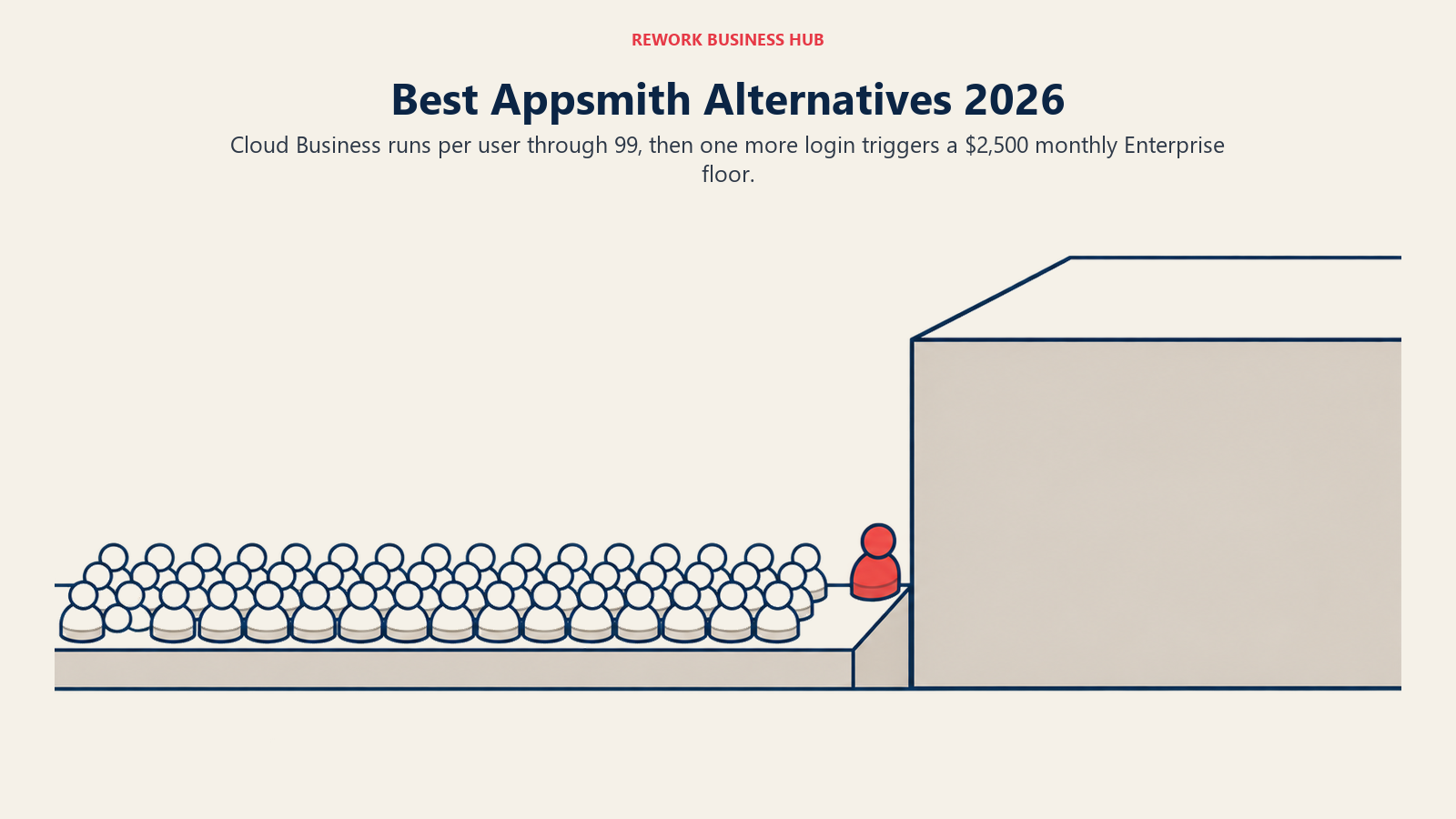
If you are leaving Appsmith because the jump from Business to Enterprise at 100 users just blew up your budget, Budibase and ToolJet are the closest open-source, self-hosted swaps, UI Bakery is the closest thing to a genuinely free self-hosted builder with a nicer interface, and Knack is the tool to pick if you realize your team never actually needed the SQL and JavaScript canvas. Retool is where you land if the opposite is true and you want more of that canvas, not less. Every tool below was evaluated on licensing model, self-hosting reality, user-cap structure, and total cost at scale, with prices clearly labelled where a vendor publishes none.
It is written for engineering managers, IT directors, and operations leads at organizations of 10 to 500 people who are either renewing an Appsmith Business contract or shopping before signing one. The comparison that actually matters here is not feature-for-feature. It is the licensing question, because Appsmith's own pricing page hides two completely different products behind one brand, and almost every article about it collapses them into one misleading sentence.
Key Facts
- Gartner forecasts spending on low-code development technologies to grow 19% to reach $44.5 billion by 2026, as reported by InfoWorld.
- By 2026, developers outside formal IT departments will make up at least 80% of the user base for low-code development tools, up from 60% in 2021, per Gartner, as reported by InfoWorld.
- Low-code development tools will account for 75% of new application development by 2026, up from 40% in 2021, per Gartner, as reported by InfoWorld.
- A composite organization modelled in Forrester's Total Economic Impact study of Microsoft Power Apps saw a 206% three-year ROI with payback in under six months, per the Forrester TEI study commissioned by Microsoft.
- IT teams spend 39% of their time building custom integrations, and 80% of organizations name data silos their biggest barrier to automation and AI goals, per the 2025 MuleSoft Connectivity Benchmark Report, which surveyed 1,050 IT leaders.
- Companies that empower citizen developers, exactly the audience most of these self-hosted and open-source builders target, score 33% higher on innovation than bottom-quartile companies, per McKinsey's Developer Velocity research.
Quick Comparison Table
| Tool | Best For | Starting Price | Key Strength | Key Limitation |
|---|---|---|---|---|
| Budibase | Open-source, self-hosted swap for Appsmith | Free self-hosted (unlimited); Cloud Pro $19/mo yearly | Genuinely free and unlimited when self-hosted | Cloud end-user pricing climbs fast |
| ToolJet | AGPL open source with AI app generation | Free (2 builders, 50 end users); Pro $79/builder/mo | Auditable AGPL source, generous free tier | Charges per builder even when you host it yourself |
| Retool | Developer-led internal tools on messy, multi-source data | Free up to 5 users; Team builders $10/mo, Business $50/mo (annual) | First 50 external users free, deep SQL and JS control | External users banded and add up fast past 50 |
| UI Bakery | A nicer builder with a real free self-host tier | Free (cloud or self-hosted); Builder $20/dev/mo annually, Team $35 | Unlimited public users at $0, even self-hosted | Proprietary code, nothing to audit or fork |
| Microsoft Power Apps | Microsoft-shop enterprises building on Dataverse | Premium $20/user/mo annually | Deep Microsoft 365 and Azure integration | No self-host, no cheap per-app entry point left |
| Xano | A scalable backend without an app-builder canvas | Free (100K records); Essential $85/mo annually | Real Postgres API layer built to scale | Still need a separate frontend tool |
| Knack | Non-technical builders who never needed SQL | Starter $49/mo annually | Unlimited users on every plan, no seat cliff | Dated builder, record ceilings on entry tiers |
| Zoho Creator | Companies already standardized on Zoho | Around $8/user/mo annually (reported) | Native access to the whole Zoho suite | Public pricing page won't render its own prices |
| Bubble | Customer-facing web apps, not internal tools | Free; Starter from $29/mo annually | Full web app builder with real logic depth | The wrong tool if your audience is internal staff |
| Glide | Mobile-first field and frontline apps | Free (1 project); Solo $25/mo | The best native-feeling mobile output here | Two live pricing pages currently disagree |
| Softr | Branded client portals on data you already have | Free; Basic $19/mo annually | Fast, modern portal on an existing data source | Front end only, you still pay for the database |
| Airtable | An internal database, if that is all you needed | Free; Team $20/seat/mo annually | Biggest ecosystem, best relational modeling | No real external logins or portal layer |
Two Different "Free" Ideas Hide Behind Every Comparison
Almost every unhappy Appsmith evaluation traces back to the same confusion, and it is worth stating plainly before anything else. Appsmith advertises itself as free and open source, and that claim is true, but it describes two completely different offers depending on where you read it.
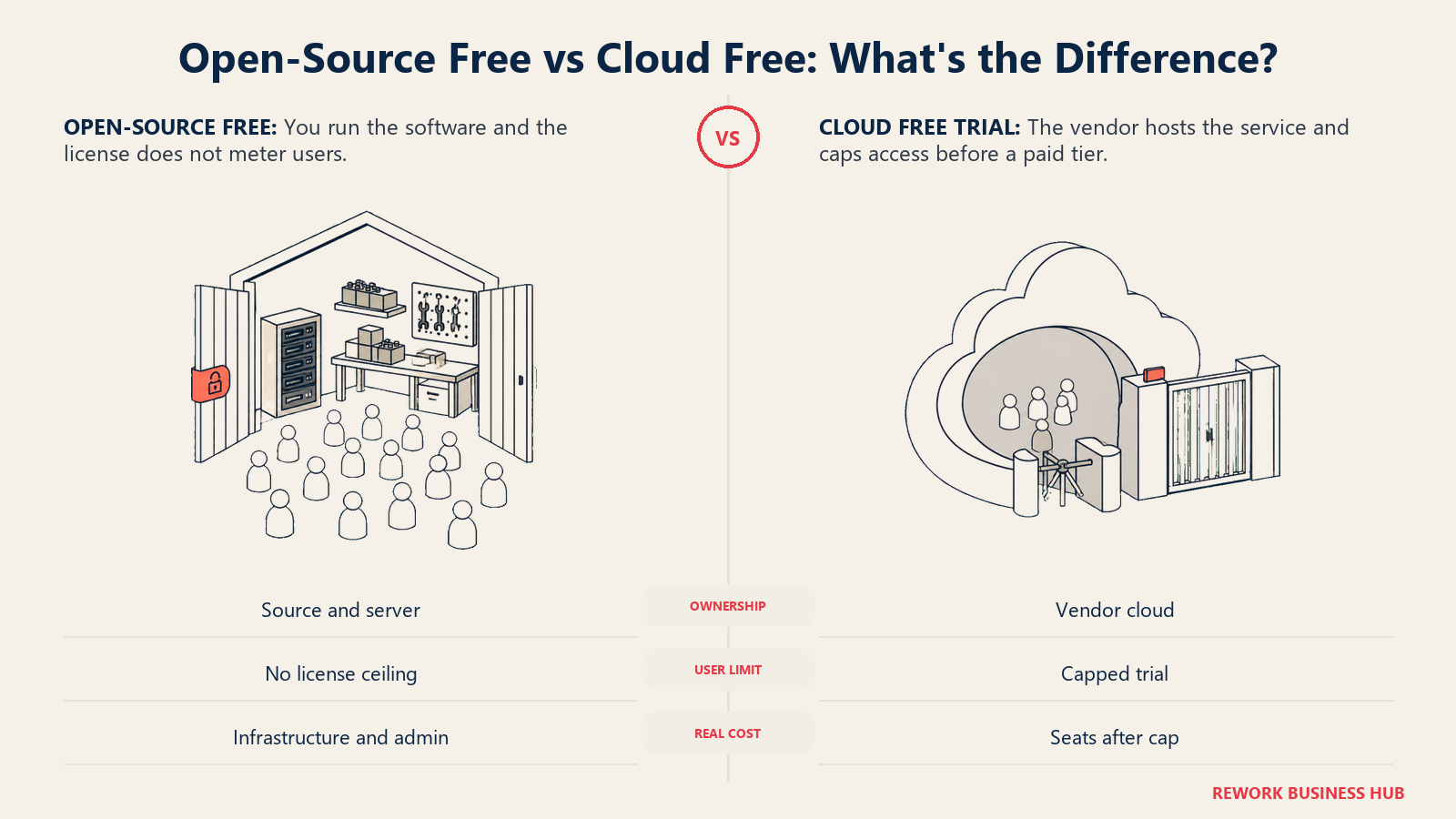
Appsmith Cloud's Free plan is $0 and caps out at 5 users, 5 workspaces, and 3 Git repositories, with community support only. That is a trial, not a real deployment for any team past a handful of people. Appsmith Community edition, on the other hand, is genuinely free, genuinely open source under the Apache 2.0 licence, and genuinely unlimited on users, because you are running it on your own servers and Appsmith is not metering logins at all. "Appsmith is free for unlimited users" is true only of that second thing. Paste it into a comparison of the cloud product and you have written something false.
That same split runs through the entire category, and it is the real axis this article is organized around, not feature checklists. Some alternatives ship an open-source licence you can read, fork, and run yourself with no ceiling on who logs in. Others only offer a capped free trial on their own cloud, dressed up in the same "free" language, with no self-hosted path at any price. Confusing the two is how a team ends up budgeting for infrastructure they never needed, or budgeting for a per-seat bill they thought they had escaped.
| Genuinely open source, self-hostable free | Free cloud trial only, no self-host at any price | |
|---|---|---|
| Tools here | Appsmith Community, Budibase, ToolJet | Power Apps, Bubble, Glide, Softr, Airtable, Xano, Knack, Zoho Creator |
| What "free" means | No licence fee, no user ceiling, ever, on infrastructure you run | A capped trial meant to convert to a paid seat or plan |
| What you're actually paying for | Your own infrastructure and the person who maintains it | The vendor's hosting, once you outgrow the free cap |
| Where the code lives | Public repository, licence lets you fork it | Proprietary, nothing to read or audit |
| Retool and UI Bakery | Self-hosted deployment available, but the code itself is proprietary, not open source. You get the "run it yourself" benefit without the "read the code" benefit. |
The test takes thirty seconds. Ask whether the vendor will let you download the source and run it with zero users capped, forever, for $0. If yes, you are looking at Budibase, ToolJet, or Appsmith's own Community edition. If the answer is "yes, but only our binary, not the source," that is Retool or UI Bakery, still a real cost saver at scale, just not an open-source one. Everyone else on this list is a cloud product with a free trial, full stop, and no amount of reading the pricing page differently changes that.
1. Budibase - the closest open-source swap, self-hosted and genuinely unlimited
Budibase is the tool most technical Appsmith refugees land on first, because it makes the same promise Appsmith's Community edition makes and keeps it the same way. Self-host the open-source core and you get unlimited creators, unlimited end users, and unlimited apps and automations, for a licence cost of zero. Where it diverges from Appsmith is the building experience: Budibase leans more design-first, with autogenerated screens and a component library that feels closer to a polished no-code tool than Appsmith's heavier SQL-and-JavaScript canvas.
The trap to watch is the same one Appsmith cloud sets, wearing different numbers. Budibase's cloud pricing bears no resemblance to its self-hosted economics. Extra creators cost $50 each per month and end users $5, so a cloud deployment with a real headcount can land in five figures a year while the identical self-hosted build costs infrastructure and a maintainer's time. Decide the deployment model on purpose, the same way you should have with Appsmith, rather than discovering the difference on an invoice.
| What you get | What you don't |
|---|---|
| Free, unlimited self-hosted open source edition | Cheap end users on the cloud plans |
| A friendlier, more design-first builder than Appsmith's canvas | The lightest possible learning curve either way |
| Full control over where the data physically lives | Vendor compliance certificates on the free tier |
| No licence ceiling on users when self-hosted | A managed service unless you pay for one |
Pricing: Self-hosted open source is free with unlimited actions, apps, automations, and users on one workspace. Cloud Pro is $19 per month billed yearly ($22.80 monthly) with 5,000 actions yearly (10,000 monthly) and 1 creator. Premium is $49 per month yearly ($58.80 monthly) with 20,000 to 50,000 actions and 10 workspaces, plus additional creators at $50 per creator per month and end users at $5 per user per month. Business is $299 per month billed yearly with 250,000 actions and 3 creators, per Budibase's pricing page.
Best for: Teams of 10 to 500 who want Appsmith's self-hosted, free-forever model with a friendlier, more design-first builder.
2. ToolJet - open-source and auditable, but paid even when you host it
ToolJet is the other open-source name that comes up in the same breath as Appsmith, licensed under AGPL v3 with an active public repository you can read line by line. It has repositioned around AI-assisted app generation in 2026, but the core is the same drag-and-drop internal tool builder with a query panel underneath, close enough to Appsmith's shape that migrating a simple internal dashboard is a weekend project, not a rebuild.
The distinction that actually matters for an Appsmith switcher is easy to miss and worth stating directly: ToolJet's free tier is real but small, capped at 2 builders and 50 end users, and once you cross it, self-hosting stops being free. ToolJet's own pricing mirrors cloud pricing on a self-hosted deployment, so unlike Budibase or Appsmith's Community edition, running the AGPL source on your own servers does not remove the per-builder bill past the free tier. You get the auditability of open source without the "host it yourself and stop paying" outcome most people assume comes with that licence.
| What you get | What you don't |
|---|---|
| AGPL-licensed source you can read and audit | A free tier past 2 builders and 50 end users |
| AI-assisted app generation on top of a familiar canvas | Free self-hosting once you outgrow the free tier |
| A 20% discount for committing to annual billing | Pricing that behaves differently self-hosted vs cloud |
| Deployment flexibility (Docker, Kubernetes, your own cloud) | Appsmith Community's unlimited-forever promise |
Pricing: Free is $0 per builder, up to 2 builders, 2 apps, 50 end users, and 100 AI credits a month. Pro is $79 per builder per month with up to 50 end users. Team is $199 per builder per month with up to 100 end users. Enterprise starts from $3,000 a month with unlimited end users. Annual billing saves 20%, and self-hosted deployments carry the same per-builder pricing as cloud, per ToolJet's pricing page.
Best for: Small technical teams who can stay inside the free 2-builder, 50-user tier, or teams willing to pay per builder specifically for ToolJet's AI generation features even while self-hosting.
3. Retool - more developer polish, priced by role instead of a flat user cap
Retool is where Appsmith switchers land when the frustration runs the opposite direction: not that the platform costs too much, but that the no-code layer got in the way and five minutes of SQL would have solved it faster. It is low-code by design, drag components onto a canvas, then write real queries and JavaScript against any API or database, and ops and engineering teams end up here when the data lives in four systems and nothing else can see across all of them cleanly.
The pricing shape is genuinely different from Appsmith's, and that matters for the migration math. Appsmith counts every login, builder or viewer, toward the same user cap. Retool splits builders, internal users, and external users into three separate rates, with the first 50 external users free on Business. If your Appsmith app was mostly internal staff with a handful of builders, that split usually comes out cheaper than Appsmith's flat per-user Business rate. If it served hundreds of outside users, Retool's banding turns expensive fast, and Appsmith's flat $15 per user reads better by comparison right up until the Enterprise cliff.
| What you get | What you don't |
|---|---|
| No ceiling on data source, API, or logic | A tool a non-technical buyer can run alone |
| The first 50 external users at no charge on Business | Cheap pricing past hundreds of external users |
| Self-hosted deployment at the same price as cloud | Open-source code, despite the self-host option |
| Excellent developer ergonomics and Git-based workflows | A build path that avoids engineering time entirely |
Pricing: Free covers up to 5 users and 500 workflow runs a month. Team bills builders at $10 per month annually ($12 monthly) and internal users at $5 ($7 monthly). Business bills builders at $50 per month annually ($65 monthly) and internal users at $15 ($18 monthly). External users on Business are free from 0 to 50, then $8 per month annually for 51 to 250, $6 for 251 to 500, and $4 above 500, per Retool's pricing page.
Best for: Engineering-supported teams of 20 to 1,000 who hit a wall inside Appsmith's canvas and want more control, plus fewer than about 50 external users.
4. UI Bakery - a nicer builder with a real free self-host tier, minus the open code
UI Bakery is the answer for teams who liked exactly one thing about Appsmith's self-hosting story and wanted the rest of the product to feel newer. Its free plan, on cloud or self-hosted, includes unlimited apps, unlimited data sources, and unlimited public users at $0, which is a closer echo of Appsmith Community's "genuinely free, genuinely unlimited" promise than anything else paid competitors offer. The builder itself is more polished, with a component library and layout system that reads as more finished than Appsmith's utilitarian canvas.
The honest trade is the one the licence table above makes explicit. UI Bakery is not open source. You can self-host the platform for free, but you cannot read, audit, or fork the code the way you can with Budibase, ToolJet, or Appsmith itself. For teams whose actual requirement was data residency or infrastructure control rather than licence philosophy, that distinction rarely matters. For teams that specifically wanted an auditable open-source stack, it is the whole point, and UI Bakery does not clear that bar.
| What you get | What you don't |
|---|---|
| Unlimited public users at $0, on cloud or self-hosted | Source code you can read, audit, or fork |
| A more modern, design-forward builder than Appsmith's | A large public community or plugin ecosystem |
| Paid tiers priced per developer, not per public user | A pricing model as generous once you need RBAC |
| The same free economics whether hosted by them or you | AI credits beyond the modest amount each tier includes |
Pricing: Free is $0 per month on cloud or self-hosted, with unlimited apps and data sources and unlimited public users, community support only. Builder is $25 per developer monthly ($20 annually), adding environments, app export, and up to 50 workspace viewer seats. Team is $40 per developer monthly ($35 annually), adding role-based access control, audit logs, and premium support. Enterprise is custom, with 50-plus workspace viewer seats, dedicated infrastructure, and custom SSO, per UI Bakery's pricing page.
Best for: Teams who want Appsmith's free self-hosted economics with a more modern interface, and do not need the code itself to be open source.
5. Microsoft Power Apps - the enterprise graduation, on Microsoft's terms
Power Apps is where an Appsmith migration goes if the real driver is consolidating onto Microsoft 365 and Azure rather than saving money. It builds real business apps on Dataverse, with native ties into Teams, SharePoint, and the rest of the Power Platform, which matters enormously if those systems already hold your data and your identity provider is Entra ID.
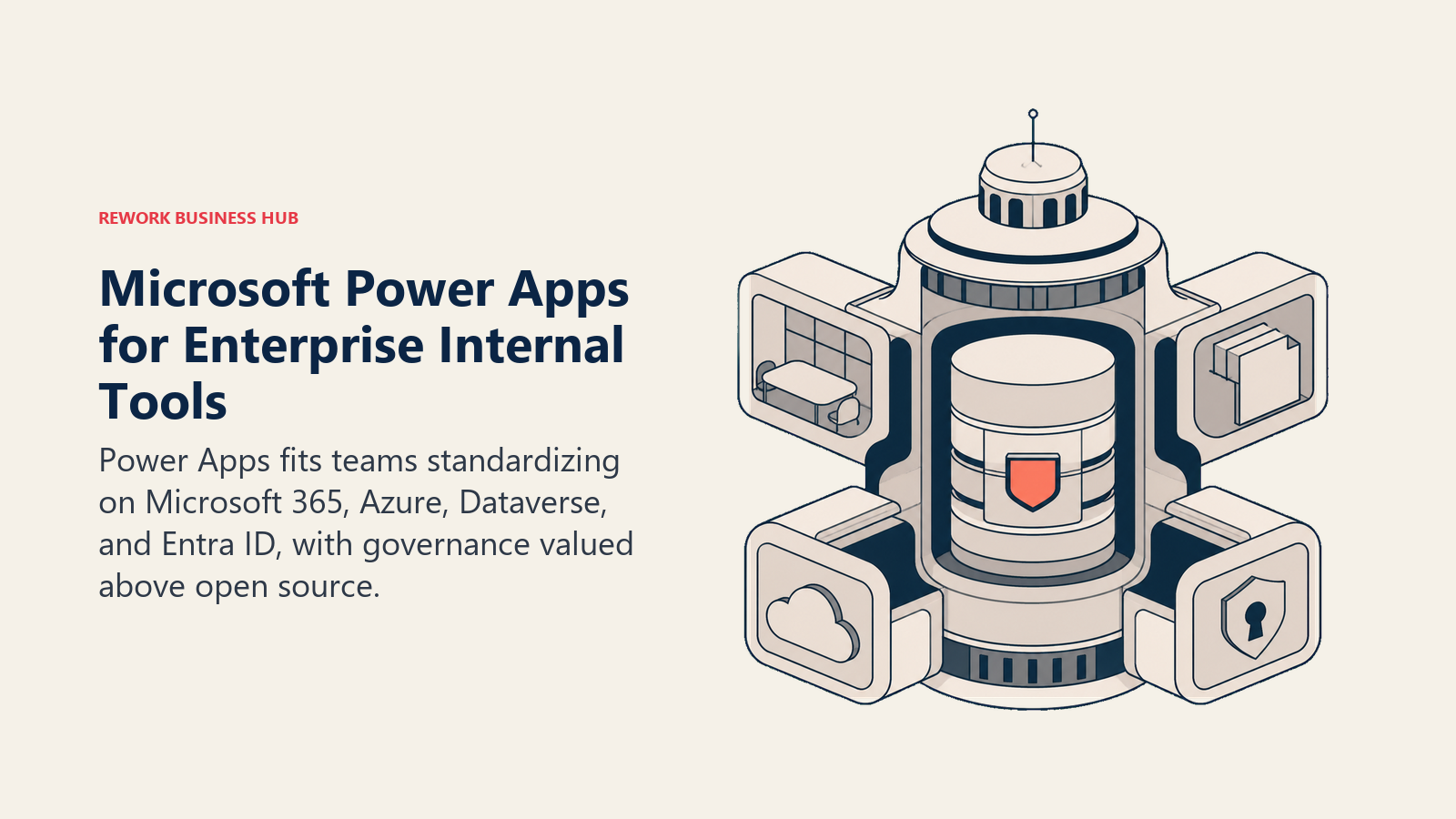
Be careful with the number most comparisons still quote. The cheap "$5 per user per app" plan that used to headline every Power Apps pricing summary was pulled from Microsoft's own pricing page and from the January 2026 Power Platform licensing guide, with end of sale for new customers beginning 2 January 2026. Reporting suggests it survives for some customers depending on purchasing channel (EA and CSP retained access, MPSA did not), which is a channel question for your Microsoft reseller, not something to budget from a third-party listicle. What the vendor page actually shows today is Power Apps Premium at $20 per user per month on annual billing, or $12 for 2,000-plus seat deployments, plus a free Developer plan explicitly marked not for production and a pay-as-you-go Azure metered option with no published per-app rate.
| What you get | What you don't |
|---|---|
| Deep native integration with Microsoft 365 and Azure | Self-hosting or open-source code of any kind |
| Enterprise governance, compliance, and identity via Entra ID | The cheap per-app entry price most articles still quote |
| A published Forrester TEI study showing strong ROI | A clean, simple pricing page in 2026 |
| Unlimited apps per user on the Premium plan | A fast, self-serve path for a 5-person team |
Pricing: Power Apps Developer Plan is free, for building and testing, explicitly not for production. Power Apps Premium is $20 per user per month on annual billing, with unlimited apps plus Dataverse; a 2,000-plus seat rate brings that to $12 per user per month. Dataverse database capacity beyond what's included is $40 per GB per month. Pay-as-you-go through an Azure subscription is referenced but its per-app meter rate is not published on the pricing page, per Microsoft's Power Apps pricing page.
Best for: Enterprises of 200-plus already licensing Microsoft 365 or Azure who want internal tools built directly on Dataverse.
6. Xano - the backend Appsmith's own database layer can't scale to
Xano solves a different half of the Appsmith complaint than the other tools on this list. Some teams never had a problem with Appsmith's builder; they had a problem with the database underneath straining once real traffic and real record volumes showed up. Xano is a no-code backend, a scalable Postgres API layer with authentication, background tasks, and instant REST or GraphQL endpoints, meant to be paired with whatever frontend you like, no-code or hand-coded.
That pairing is also the catch. Xano does not give you a visual app builder at all, so choosing it means picking a second tool for the interface, which is a bigger architectural decision than swapping one app builder for another. It also does not offer a self-hosted or open-source path; Xano is cloud-only, and pricing is workspace- and usage-based rather than tied to how many people log in, which is unusual in this list and worth knowing before you try to map it onto the other tools' per-user math.
| What you get | What you don't |
|---|---|
| A real Postgres database built to scale past Appsmith's | A visual app builder of any kind |
| Instant, documented REST and GraphQL APIs | A self-hosted or open-source option |
| Pricing tied to usage, not headcount | A single tool that does both backend and frontend |
| A serious answer to "the database is the bottleneck" | Anything resembling Appsmith's low-code canvas |
Pricing: Free is $0, with a Postgres database up to 100,000 records, 1 workspace, 1GB of watermarked image storage, and a 10-request-per-20-second rate limit. Essential is $85 per month billed annually. Pro is $224 per month billed annually. Enterprise pricing is by quote, per Xano's pricing page.
Best for: Technical teams of 5 to 200 whose real bottleneck was the database, paired with a separate frontend or no-code builder.
7. Knack - true no-code for teams who never needed the SQL canvas
Knack is worth a serious look for a specific kind of Appsmith refugee: the team that adopted Appsmith because it was open source and free-sounding, then discovered every meaningful screen still required someone comfortable writing SQL or JavaScript. Knack skips that requirement entirely. You define objects and fields, then build pages, forms, and portals with logins, roles, and record-level rules, no query panel required.
The pricing shape is also the cleanest answer to Appsmith's Enterprise cliff on this whole list: Knack charges per account, not per user, and every plan includes unlimited logins. There is no moment at 100 users where the bill jumps 68% overnight the way Appsmith's does. What you give up for that simplicity is Appsmith's flexibility. Knack cannot reach into an arbitrary API or write a custom SQL query the way Appsmith, Retool, or Budibase can, and its builder feels a full generation behind Appsmith's canvas visually.
| What you get | What you don't |
|---|---|
| Unlimited users on every plan, no seat cliff | Appsmith's SQL and JavaScript flexibility |
| Real record-level access rules for external users | A modern, fast builder interface |
| A separate HIPAA product line with a signed BAA | Any self-hosted or open-source option |
| A short path from idea to a working portal | Generous record allowances on entry plans |
Pricing: Starter is $49 per month billed annually, $59 billed monthly (a $19 monthly intro rate applies for the first 3 months), with 20,000 records. Pro is $110 per month billed annually, $130 billed monthly ($49 intro for 3 months), with 50,000 records. Corporate starts at $250 per month billed annually, spanning 125,000 to 2.5 million records. All plans include unlimited users, per Knack's pricing page.
Best for: Non-technical teams of 2 to 50 building an external-facing portal who want Appsmith's licence simplicity without the SQL or the seat cliff.
8. Zoho Creator - the ecosystem play for existing Zoho customers
Zoho Creator is a genuine low-code application platform, models data and generates web and mobile apps with workflow logic written in Deluge, Zoho's own scripting language. It builds real customer-facing apps and handles mobile more natively than Appsmith does out of the box.
The reason to pick it over Appsmith is almost never the builder itself. It is that your CRM, help desk, books, and HR records already live inside Zoho, and Creator reads them natively rather than through an integration you have to maintain and monitor, which is exactly the kind of custom-integration tax the MuleSoft benchmark above puts a number on. If you already hold a Zoho One licence, Creator's marginal cost may be close to zero, worth checking before pricing anything else on this page. If you are not a Zoho customer today, the calculus flips hard: Deluge is one more language to learn on top of whatever you already know from Appsmith, and Zoho will not publish a price you can budget against without a sales conversation.
| What you get | What you don't |
|---|---|
| Native access to Zoho CRM, Books, Desk, and People | A reason to buy it if you're not already on Zoho |
| Real mobile app generation, not just responsive pages | A published price you can budget against directly |
| Workflow scripting with genuine logic depth | Appsmith's open-source, self-hostable option |
| Possibly near-zero marginal cost on Zoho One | A large independent consultant community |
Pricing: Zoho Creator's public pricing page lists Standard, Professional, Enterprise, and a custom Flex plan, plus a free edition limited to one app and a 15-day trial. Third-party listings (reported) put Standard at around $8 per user per month, Professional at around $20, and Enterprise at around $25, all billed annually, per Capterra's Zoho Creator pricing listing. Confirm everything with Zoho before budgeting.
Best for: Companies of 10 to 500 already standardized on Zoho who want apps sitting directly on existing records.
9. Bubble - when the real need was a customer-facing product, not an internal tool
Bubble belongs on this list for a different reason than the other eleven: plenty of people searching "Appsmith alternatives" are not actually looking for another internal-tools platform, they are trying to build a public-facing product and picked the wrong category of tool the first time. Bubble is a full web app builder, authentication, payments, marketplaces, complex conditional logic, the kind of thing Appsmith was never designed to ship to paying customers.
Its free plan is real and, per Bubble's own pricing FAQ, comes with more than enough workload to build almost anything during development, though free and Agency plans cannot buy workload tiers or enable overages, since they're designed for building rather than running production traffic. Every paid plan includes 100,000 monthly workload units for its development environment, and overage without a tier subscription runs $0.30 per 1,000 workload units. If your actual problem was internal dashboards, Bubble is the wrong tool entirely; it solves a genuinely different job.
| What you get | What you don't |
|---|---|
| A real customer-facing web app builder, not internal tools | Any relevance if your audience is internal staff |
| Free plan with real development workload included | Per-seat or per-user pricing at all |
| Complex logic, auth, and payment flows out of the box | An open-source or self-hosted option |
| A large existing no-code app-builder community | Appsmith's SQL-and-database-first approach |
Pricing (web-only / mobile-only / web plus mobile): Starter is $32 / $49 / $69 monthly, $29 / $42 / $59 annually. Growth is $134 / $199 / $249 monthly, $119 / $169 / $209 annually. Team is $399 / $529 / $649 monthly, $349 / $449 / $549 annually. Enterprise is custom. Workload overage beyond the included allowance runs $0.30 per 1,000 units, per Bubble's pricing manual.
Best for: Founders and product teams building a customer-facing web app or SaaS product, where an internal-tools builder was never the right category to begin with.
10. Glide - mobile-first, when the users carry a phone instead of a laptop
Glide solves the one job Appsmith has never been particularly graceful at: a genuinely good mobile experience for people who are not sitting at a desk. Technicians, inspectors, drivers, and site supervisors get something that behaves like a native app rather than a responsive web page shrunk down, built from a table instead of a mobile framework.
Glide is mid-migration to GlideOS right now, and its own properties currently disagree with each other, which is worth flagging plainly rather than picking a side. The live pricing page shows a credit-based set: Free (1 project, limited credits), Solo at $25 a month (5 projects, 100 credits, database included), Team at $125 a month starting at 5 members, and custom Enterprise, with only monthly figures shown, no published annual rate. Glide's help centre, meanwhile, still documents a separate Classic set (Explorer, Maker, Business) without labelling it superseded. Confirm which rate card your account is actually on before budgeting anything.
| What you get | What you don't |
|---|---|
| The best native-feeling mobile output in this comparison | Predictable cost under unpredictable usage |
| A real database included on paid plans | A single, unambiguous pricing page right now |
| Very fast build cycles from an existing table | Published annual billing rates |
| Flat project pricing since the GlideOS rebuild | Any self-hosted or open-source option |
Pricing: Free covers 1 project with limited credits. Solo is $25 per month with 5 projects, 25GB storage, and a database included. Team is $125 per month starting at 5 members with 50 credits per member, 100GB storage, and unlimited apps. Enterprise is custom. Only monthly rates are shown, per Glide's pricing page; Glide's help centre separately documents an older Classic plan set that has not been labelled retired.
Best for: Teams of 2 to 50 building mobile-first internal or field apps where a known, countable group of users needs something that feels native on a phone.
11. Softr - a modern client portal on data you already have
Softr exists for teams that have the data problem solved and the interface problem wide open. It sits on top of a source you already run, usually Airtable, Google Sheets, HubSpot, or its own included store, and turns it into a branded, permissioned client portal or membership site in an afternoon. If your complaint about Appsmith was that even a finished app still looked utilitarian, this is the most direct answer here.
Softr repriced on 5 August 2026, so treat any third-party figure older than that as stale, including most of what still circulates in other listicles. The billing model bands by builder and app-user count per plan rather than a flat per-seat charge, which makes a portal serving a few hundred people a plan tier rather than a line-item explosion the way per-seat pricing would. The trap to avoid is treating Softr as a system of record. It is a front end. If the data still lives in Airtable underneath it, you inherit Airtable's record caps and bill on top of Softr's own subscription.
| What you get | What you don't |
|---|---|
| A genuinely modern, brandable portal in hours | A database of its own worth relying on |
| Builder-and-app-user banding instead of per-seat pricing | Deep workflow logic or scripting like Appsmith's |
| Good client portal and membership primitives | A single bill; you still pay for the data layer too |
| Fast iteration without engineering time | Any self-hosted or open-source option |
Pricing: Free is $0, up to 3 builders and 5 combined app users. Basic is $25 monthly, $19 annually, with 1 builder and 5 team plus 5 client users. Pro is $119 monthly, $99 annually, with 2 builders and up to 50 team plus 250 client users. Business is $395 monthly, $329 annually, with 3 builders and up to 100 team plus 500 client users. Enterprise is custom. Extra app users run $1 to $5 a month, extra builders $5 to $24, depending on tier, per Softr's pricing documentation.
Best for: Teams of 2 to 50 who need a good-looking client portal this month and already have somewhere to keep the underlying data.
12. Airtable - when you never needed an app at all, only a shared database
Airtable earns the last slot for the mirror-image reason Bubble earns an early one: some Appsmith apps were never really apps. They were a database with a form bolted on, built by a team that reached for a low-code platform because that was the tool they knew, when a shared grid with good views would have done the entire job for less money and less maintenance.
Airtable is the category default for internal structured data, a familiar grid, real relational links, and alternate views (kanban, calendar, gallery, Gantt) over the same records, with more templates and integrations built around it than the rest of this list combined. What disappears if you move an Appsmith build here is anything resembling a real external-facing portal. There are no logins with record-level rules for outside users, and record caps arrive by tier, 1,000 on Free, 50,000 per base on Team, 125,000 on Business. If any part of the app you're replacing serves people outside your organization, Airtable cannot take that part of the job.
| What you get | What you don't |
|---|---|
| The largest ecosystem of any tool in this comparison | Any real external-user portal or record-level rules |
| Genuinely good relational modeling out of the box | Appsmith's SQL, JavaScript, or arbitrary API access |
| A far lower bill for a team that was always internal-only | Generous record limits at any pricing tier |
| Read-only collaborators and form submitters at no charge | An open-source or self-hosted option |
Pricing: Free covers 1,000 records per base. Team is $20 per seat per month billed annually, $24 monthly, with 50,000 records per base. Business is $45 per seat per month billed annually, $54 monthly, with 125,000 records per base. Enterprise Scale is custom. Read-only collaborators, form submissions, and share links are not charged, per Airtable's pricing page.
Best for: Internal teams of 5 to 100 whose Appsmith build never actually had an external user logging into it.
When Appsmith Is Still the Right Call
This category rewards staying put more often than most alternatives articles admit, and Appsmith earns that in a specific way. Its self-hosted Community edition is real Apache 2.0 code, permissively licensed, with no user ceiling and no vendor lock-in beyond your own willingness to maintain a server. Very few tools on this page match that combination of a genuinely permissive licence and a genuinely unlimited free tier at the same time; Budibase comes closest, ToolJet asks you to keep paying past its free tier even when self-hosted, and every proprietary alternative here, UI Bakery included, only gives you the "run it yourself" half of the deal.
Below the 99-user line, Appsmith's Business plan is also simply competitive: $15 flat per user with no premium for builders is easy to model and easy to explain to finance. The problem is specifically the jump at 100, not the product underneath it, and if your headcount growth is slow or your team is happy self-hosting, that jump may never actually arrive.
| Stay on Appsmith if | Leave Appsmith if |
|---|---|
| You are comfortable self-hosting the Community edition | You need managed hosting you don't have to operate |
| Your paid user count sits comfortably under 99 | You are about to cross 100 users on Business |
| You value permissive, auditable open-source code | Proprietary code with self-hosting is an acceptable trade |
| Your team is technical enough for SQL and JavaScript | Non-technical builders need to ship without a query panel |
Licence and Hosting at a Glance
| Tool | Open-source licence | Self-host option | Free tier user cap |
|---|---|---|---|
| Appsmith | Apache 2.0 (Community edition) | Yes, free and unlimited on Community | Cloud Free capped at 5 users |
| Budibase | GPL v3 server, AGPL v3 builder, MPL client | Yes, free and unlimited self-hosted | No permanent free cloud tier; free only self-hosted |
| ToolJet | AGPL v3 | Yes, but priced the same as cloud past the free tier | Free: 2 builders, 50 end users, both cloud and self-hosted |
| Retool | Proprietary, source not open | Yes, at the same price as cloud | Free: up to 5 users |
| UI Bakery | Proprietary, source not open | Yes, a free self-hosted tier with unlimited public users | Free: unlimited public users, cloud or self-hosted |
| Microsoft Power Apps | Proprietary | No | Developer plan free, explicitly not for production |
| Bubble | Proprietary | No | Free plan real but workload-capped |
| Glide | Proprietary | No | Free: 1 project, limited credits |
| Softr | Proprietary | No | Free: 3 builders, 5 combined app users |
| Airtable | Proprietary | No | Free: 1,000 records per base |
| Xano | Proprietary | No (cloud-hosted; Enterprise offers dedicated infrastructure by quote) | Free: 100,000 records, 1 workspace |
| Knack | Proprietary | No | No permanent free plan, trial only |
| Zoho Creator | Proprietary | No | Free edition limited to 1 app |
Total Annual Cost: Where Appsmith's 100-User Cliff Actually Bites
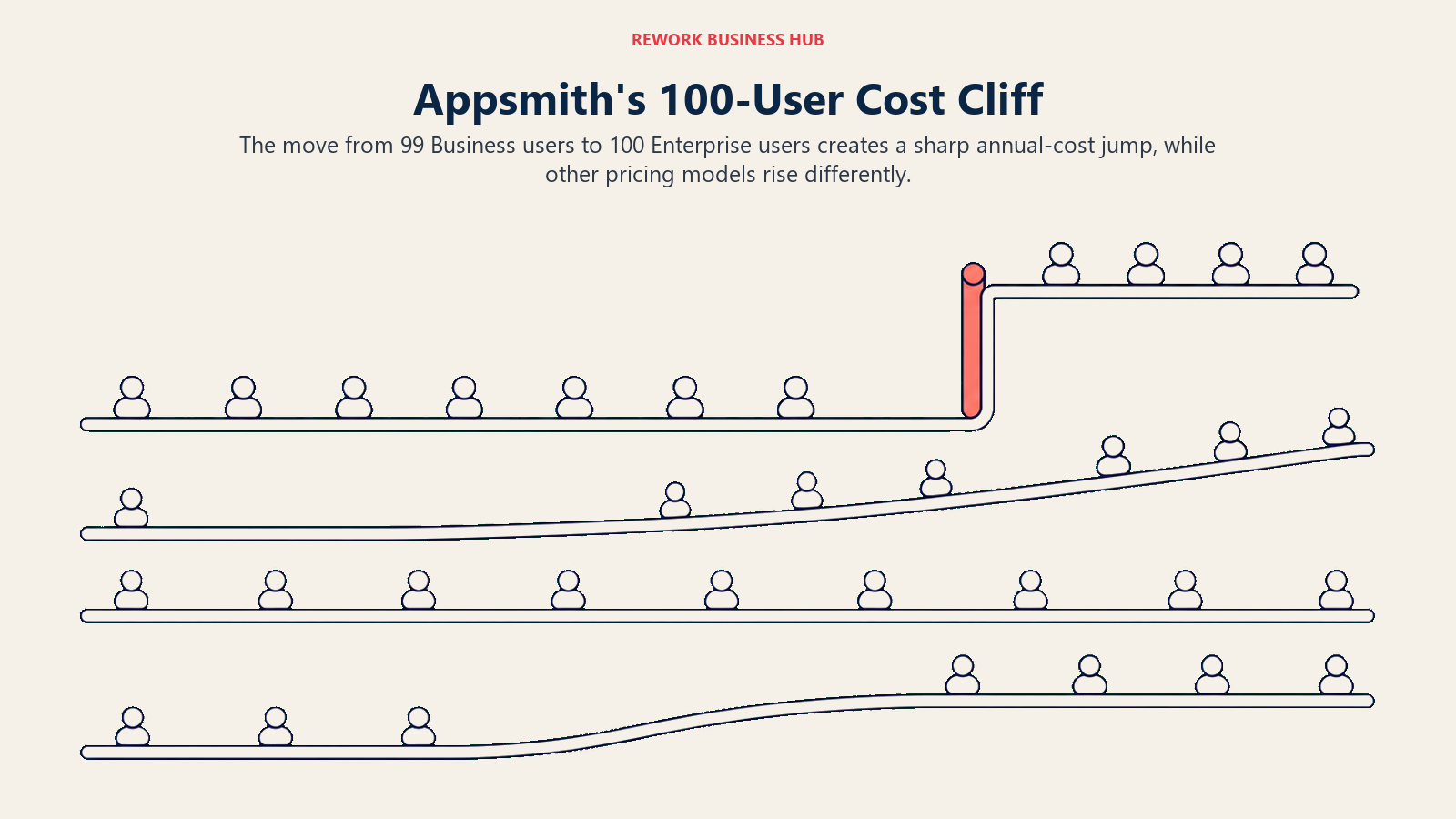
This is the comparison that decides the migration question, and it is exactly the point where Appsmith's pricing stops being a slope and becomes a step. One scenario: 10 people who build and maintain your internal tools, plus 90 more who only need to view or use them, 100 people total. Annual billing where a vendor offers it, first year, before any underlying database a front-end-only tool does not include.
| Tool and tier | Estimated annual cost | How the number is built |
|---|---|---|
| Appsmith Business at 99 users | $17,820 | $15/user/mo flat, just under the Business cap |
| Appsmith Enterprise at 100 users | $30,000 | $2,500/mo floor starting at 100 users, a 68% jump for one more login |
| Appsmith self-hosted Community | $0 in licence fees | Apache 2.0, unlimited users, cost is infrastructure plus a maintainer |
| Budibase self-hosted Open Source | $0 in licence fees | Same open-source, unlimited-user model as Appsmith Community |
| Budibase Cloud Business | Around $13,188 | $299/mo base plus 7 extra creators at $50 plus 90 end users at $5 |
| ToolJet Team, annual | Around $19,104 | $199/builder/mo for 10 builders (100 end users included), 20% annual discount |
| ToolJet self-hosted Team | Around $19,104, plus your own infrastructure | Mirrors cloud pricing; not free at this scale even self-hosted |
| Retool Business | $22,200 | 10 builders at $50/mo annually plus 90 internal users at $15/mo |
| Microsoft Power Apps Premium | $24,000 | $20/user/mo annually across all 100 users, under the 2,000-seat rate |
| Zoho Creator Professional (reported) | Around $24,000 | Roughly $20/user/mo annually across 100 users, unverified vendor price |
| Airtable Team | $24,000 | 5 seats at $20/mo would suffice if only builders need edit access; shown here at 100 full seats for comparability |
| UI Bakery Team | From $4,200, likely more | $35/dev/mo for 10 developers; the free tier's 50 included viewers cover half of the 90 viewers, the rest push into custom Enterprise pricing |
| Bubble Team (Web plus Mobile) | $6,588 | $549/mo annual flat rate; Bubble prices workload, not headcount, so this holds regardless of exact user count |
| Softr Business | $3,948 | $329/mo annually, covers up to 100 team users plus 500 client users in one tier |
| Knack Pro | $1,320 | $110/mo annually, unlimited users on every plan, unaffected by headcount |
| Xano Pro | $2,688 | $224/mo annually; Xano prices the workspace and API usage, not seats, so this also holds regardless of headcount |
| Glide Team | $1,500, likely far more at this scale | $125/mo baseline for 5 members; scaling to 100 users needs many more members and credits than the base plan covers |
Three things fall out of that table. Appsmith's self-hosted Community edition and Budibase's self-hosted open source are the only two genuinely free options at any headcount, which is the strongest argument for either if your team can operate a server. The Enterprise cliff is real and severe: crossing from 99 to 100 users on Appsmith Business costs more than the jump from Knack's cheapest plan to Retool's Business tier. And the tools priced by workload or workspace rather than headcount (Bubble, Knack, Xano) are the cheapest options on this table precisely because they never asked how many people log in.
Sizing and Persona Table
| Tool | Team size sweet spot | Who buys it | Typical buyer title |
|---|---|---|---|
| Budibase | 10-500 | Teams that need free, self-hosted, and unlimited | IT Manager, Head of Infrastructure |
| ToolJet | 2-100 (free tier) or willing to pay per builder | Technical teams wanting auditable AGPL source | Engineering Manager, CTO |
| Retool | 20-1,000 | Engineering-supported internal tools | Engineering Manager, CTO |
| UI Bakery | 5-200 | Teams wanting a nicer builder and a free self-host tier | IT Manager, Product Ops Lead |
| Microsoft Power Apps | 200-plus | Microsoft-standardized enterprises | IT Director, VP Engineering |
| Xano | 5-200 | Technical teams needing a scalable backend | Backend Lead, CTO |
| Knack | 2-50 | Non-technical teams shipping an external portal | Founder, Program Manager |
| Zoho Creator | 10-500 | Existing Zoho customers | IT Director, Business Systems Manager |
| Bubble | 1-50 | Founders building a customer-facing product | Founder, Product Lead |
| Glide | 2-50 | Field, frontline, and inspection teams | Operations Manager, Field Lead |
| Softr | 2-50 | Client services and membership businesses | Founder, Client Services Lead |
| Airtable | 5-100 | Internal ops, marketing, and content teams | Ops Manager, Marketing Ops Lead |
How to Choose: Decision Framework
Choose by deployment model first, then by the job: open-source self-hosting, developer control, ecosystem fit, mobile delivery, portals, or a simpler shared database.
| If you need this... | Choose this | Why |
|---|---|---|
| Appsmith's self-hosted promise, kept, with a nicer builder | Budibase | Free, unlimited self-hosted open source with a more design-first canvas |
| Auditable open-source code and can pay if you cross the free tier | ToolJet | AGPL v3 source, generous but capped free tier |
| More SQL and JavaScript control, not less | Retool | Deep query and API access, first 50 external users free |
| A free self-host tier without needing open code | UI Bakery | Unlimited public users at $0, cloud or self-hosted |
| Deep Microsoft 365 and Azure integration | Microsoft Power Apps | Native Dataverse, Teams, and SharePoint access |
| A scalable backend, decoupled from any builder | Xano | Real Postgres API layer, priced on usage not headcount |
| No SQL, no JavaScript, and no seat cliff at all | Knack | Flat account pricing, unlimited logins on every plan |
| Apps sitting directly on records already in Zoho | Zoho Creator | Native access, no integration to maintain |
| A customer-facing product, not an internal dashboard | Bubble | A full web app builder with real logic and payments |
| A real mobile app for field or frontline staff | Glide | The strongest native mobile output in this comparison |
| An internal database, because nobody outside logs in | Airtable | Cheaper, simpler, and honest about what it is |
If your actual need turns out to be workflow automation glued to Appsmith rather than the app builder itself, best n8n alternatives, best Zapier alternatives, and the best workflow automation software guide cover that adjacent category directly. For the other Caspio-style application platforms and no-code databases this cluster overlaps with, best Caspio alternatives, best no-code database software, best Airtable alternatives, and best Baserow alternatives are the closest neighboring shortlists. And for the wider app-builder category this article sits inside, the best no-code app builders hub is the place to start, alongside dedicated comparisons for Retool alternatives, Power Apps alternatives, Bubble alternatives, and Glide alternatives.
Frequently Asked Questions about Appsmith Alternatives
Is Appsmith actually free for unlimited users?
Only the self-hosted Community edition, which is genuinely free, Apache 2.0 licensed, and unlimited on users because you run it yourself. Appsmith Cloud's Free plan is a different product entirely, capped at 5 users, 5 workspaces, and 3 Git repositories. Confusing the two is the single most common error in this category.
What's the cheapest genuinely open-source alternative to Appsmith?
Budibase, by a clear margin, if you can self-host it. The self-hosted open-source edition is free with no user ceiling, the same shape as Appsmith Community. ToolJet is also open source under AGPL v3, but unlike Budibase and Appsmith, it charges the same per-builder rate whether you self-host it or use its cloud, so self-hosting ToolJet does not remove the bill past its free tier.
What actually happens at Appsmith's 100-user mark?
Business tops out at 99 users for $15 each, about $1,485 a month. At 100 users, you move to Enterprise at a $2,500 monthly floor, a jump of roughly 68% to add one more login. That cliff, not the per-user rate itself, is the main reason teams start shopping for alternatives.
Can I self-host Retool or UI Bakery the way I self-host Appsmith?
You can run both on your own infrastructure, at the same price as their cloud plans, but neither ships open-source code the way Appsmith, Budibase, or ToolJet does. Self-hosting Retool or UI Bakery buys you infrastructure control and data residency, not the ability to read, audit, or fork the underlying software.
Which Appsmith alternative is best for customer-facing apps rather than internal tools?
Bubble, if the product needs real authentication, payments, and complex logic aimed at paying customers. Softr and Glide also serve outward-facing use cases, portals and mobile field apps respectively, but neither replaces a full application the way Bubble can. None of the three were built for the internal-dashboard job Appsmith was.
Is there a no-code alternative that avoids SQL and JavaScript entirely?
Knack is the closest fit here. It uses objects, fields, and visual rules instead of a query panel, and it charges per account with unlimited users rather than per seat, so it also sidesteps Appsmith's Enterprise cliff entirely. The trade is less flexibility than Appsmith's SQL-and-API access allows.
How do I migrate an Appsmith app to another platform?
Export or document the data model first, then rebuild the single most complex screen, the one with conditional logic, custom queries, or role-based visibility, in your top two candidates before touching anything else. The data usually moves cleanly. Custom SQL, JavaScript transforms, and access rules are where a migration stalls, so prove those work before committing to a timeline.
What to Do Next
Before comparing another feature table, answer two questions. Can your team operate a self-hosted deployment, and are you willing to trade proprietary polish (Retool, UI Bakery) for open, auditable code (Budibase, ToolJet, Appsmith itself)? Those two answers alone eliminate most of this list. If the answer to the first is no, you are choosing among cloud-only proprietary tools regardless of what licence badge any of them carry.
Then run one real test instead of three demos. Take the single most complex screen in your current Appsmith app, the one with custom SQL, a JavaScript transform, or a role-based visibility rule, and rebuild only that screen in your top two candidates. Give it a day. Whatever breaks in that day is what will break during the real migration, and it will tell you more than a month of vendor calls.
Related Resources:

Principal Product Marketing Strategist
On this page
- Key Facts
- Quick Comparison Table
- Two Different "Free" Ideas Hide Behind Every Comparison
- 1. Budibase - the closest open-source swap, self-hosted and genuinely unlimited
- 2. ToolJet - open-source and auditable, but paid even when you host it
- 3. Retool - more developer polish, priced by role instead of a flat user cap
- 4. UI Bakery - a nicer builder with a real free self-host tier, minus the open code
- 5. Microsoft Power Apps - the enterprise graduation, on Microsoft's terms
- 6. Xano - the backend Appsmith's own database layer can't scale to
- 7. Knack - true no-code for teams who never needed the SQL canvas
- 8. Zoho Creator - the ecosystem play for existing Zoho customers
- 9. Bubble - when the real need was a customer-facing product, not an internal tool
- 10. Glide - mobile-first, when the users carry a phone instead of a laptop
- 11. Softr - a modern client portal on data you already have
- 12. Airtable - when you never needed an app at all, only a shared database
- When Appsmith Is Still the Right Call
- Licence and Hosting at a Glance
- Total Annual Cost: Where Appsmith's 100-User Cliff Actually Bites
- Sizing and Persona Table
- How to Choose: Decision Framework
- What to Do Next