Retool vs Softr vs Budibase: Which Internal Tool Builder Fits Your Team in 2026
Turn this article into takeaways for your work.


Each assistant summarizes the article only for you and suggests best practices for your work.
You're not really choosing a UI kit. You're choosing who gets to touch this app once it's live, and by extension, who has to fix it when it breaks on a Tuesday afternoon. That part gets skipped in most comparisons, because ranking features is easier than asking who's still going to be at the company in twelve months.
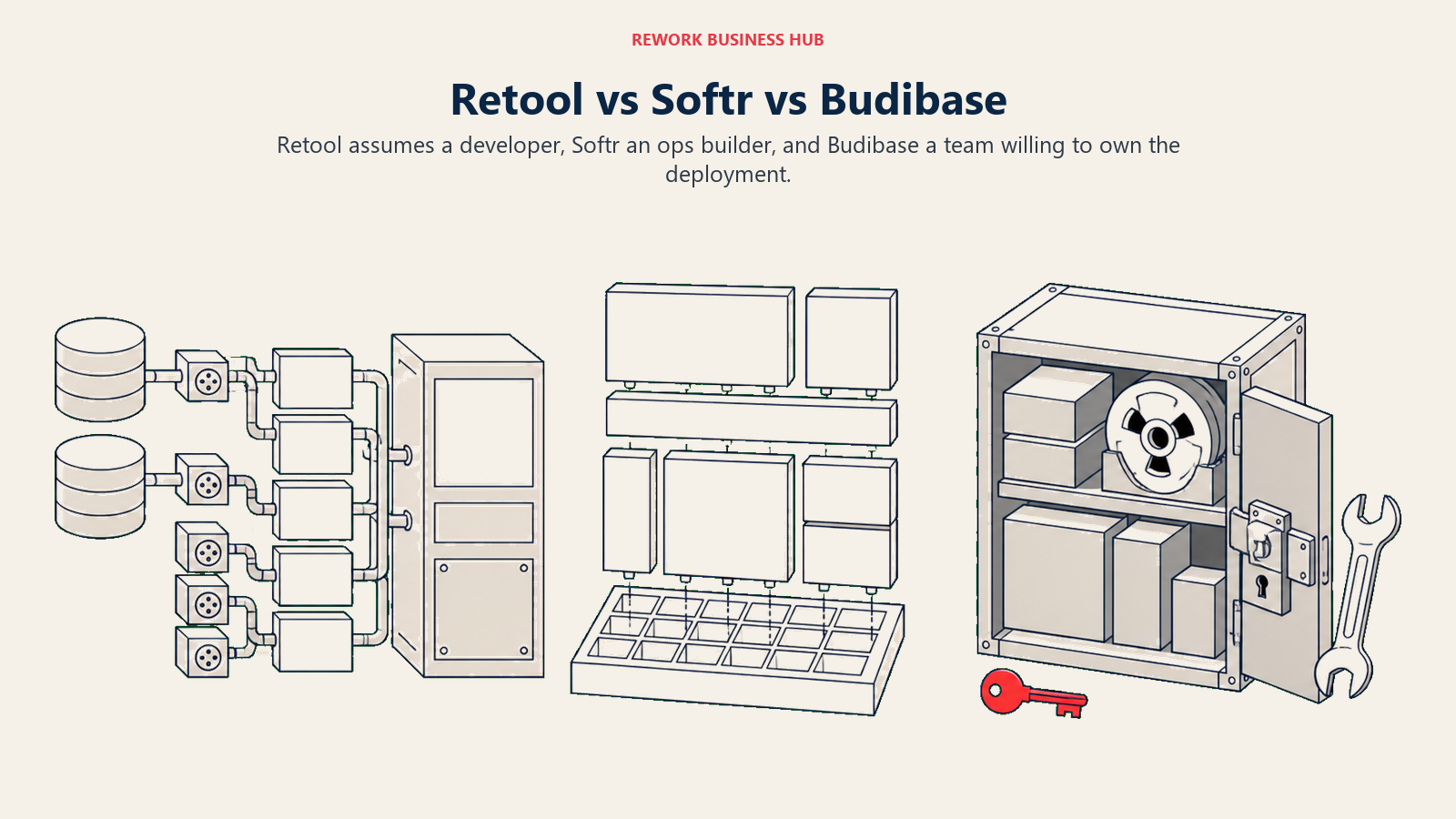
Retool, Softr, and Budibase all get pitched for the same job: replace a spreadsheet, a stack of Slack messages, or a contractor's one-off script with a real internal tool. But each one assumes a different person is going to build it, then keep it running. Retool assumes a developer comfortable writing SQL and JavaScript who wants real code as a fallback. Softr assumes an ops person with no interest in code who already has data in Airtable or Google Sheets and just needs a front end on it. Budibase assumes someone, technical or not, willing to trade a recurring bill for owning a server, in exchange for a license that doesn't expire the day a credit card does. Pick the wrong one and you don't get a bad app. You get an app that works fine until the one person who understands it takes another job.
TL;DR
| Retool | Softr | Budibase | |
|---|---|---|---|
| Assumes a | Developer comfortable with SQL and JavaScript | Non-technical operator with data already in Airtable or Sheets | Anyone willing to own a server, technical or not |
| Built for | Internal admin panels and ops dashboards wired to any database or API | Client portals, directories, and internal tools skinned on data you already have | Self-hosted internal tools with no seat ceiling |
| Pricing shape | Separate rates for builders, internal viewers, and (Business tier only) external users | Flat plan tiers by builder and user count, with per-user add-ons | Cloud: base plan plus creator and end-user add-ons. Self-hosted: free |
| Self-hosting | Costs the same as cloud; only Enterprise unlocks the self-host extras | Not offered; Softr is cloud-only | Free and genuinely unlimited on the Open Source edition |
| Core license | Proprietary cloud SaaS | Proprietary cloud SaaS | GPLv3 overall, Business Source License on paid features, MPL 2.0 in the apps you build |
| Strongest at | A real code escape hatch when the visual builder hits a wall | Speed to a branded front end with zero engineering time | Cost control at scale, and owning your own deployment |
| Weakest at | The bill grows with every internal viewer, not just every builder | Complex logic hits a ceiling fast, and you're renting the UI, not the data underneath | "Free" only covers the license, not the server someone has to run |
| 100-person annual cost, realistic mix | $20,100 (Business tier) | $8,328 (Business tier plus add-ons) | $8,328 on Cloud, or $0 in license fees self-hosted |
For the wider field these three sit inside, best no-code app builders in 2026 maps all thirteen options by the job they're built for, not by whose demo looks best.
What Each Tool Is Actually Built For
Retool: a developer's internal tools, wired to anything
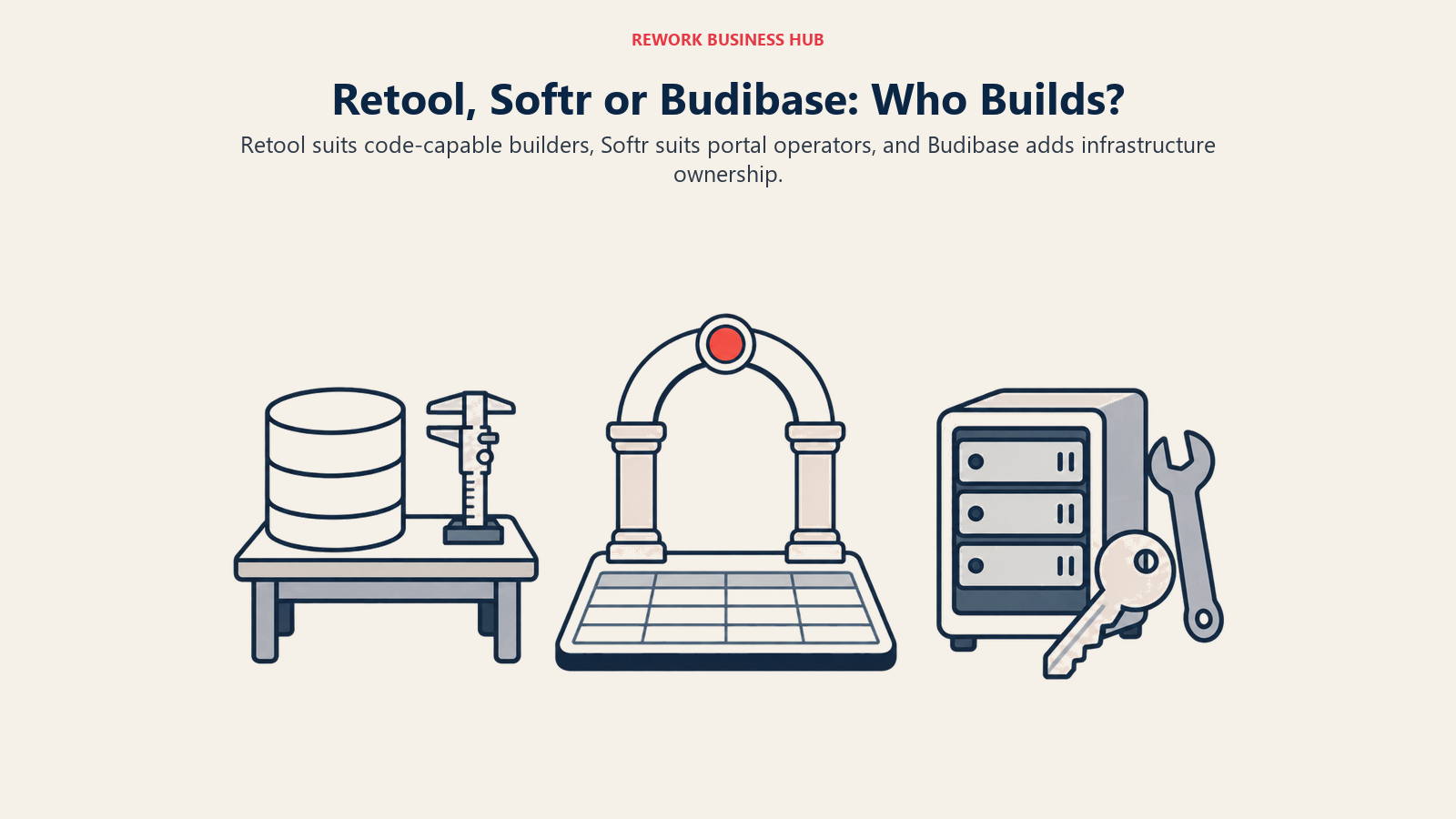
Retool hands a developer prebuilt UI components (tables, forms, buttons, charts) and wires them to a SQL query, a REST call, a GraphQL endpoint, or nearly any data source through its connector library. The building block is a query, not a record. When the visual builder runs out of room, you drop into real JavaScript or Python through Retool Workflows instead of hitting a wall. That's the entire pitch: assemble a working screen in hours, and never be blocked by the platform's own ceiling, because you can write your way around it.
In practical terms, that shows up in:
- Admin panels and ops dashboards that read and write production databases directly
- Approval workflows and internal CRUD tools that need real business logic, not just a form
- Anything combining two or three backend systems into a single screen
- Teams that already have engineering capacity and want to stop burning sprint time on internal-only screens
If Retool's own pricing shape below doesn't fit once you've read the numbers, best Retool alternatives covers twelve other builders sorted by the actual reason teams leave, not a generic feature list.
Softr: a fast front end on data you already have
Softr doesn't want to be your database. It wants to be the fastest way to put a branded, permissioned front end on data you already keep in Airtable, Google Sheets, HubSpot, or Softr's own tables, turning that into a client portal, a member directory, or an internal wiki without a developer. The tradeoff is a lower ceiling: complex logic and heavy computation get harder to express in a block-based builder than in a query, and eventually you'll hit something Softr genuinely can't do.
In practical terms:
- Client-facing portals where customers log in to see their own records
- Internal directories, wikis, and simple intake or approval forms
- A customer-facing MVP built on an Airtable base before anyone commits engineering time
- Ops teams that need a working screen now and don't have, or don't want to wait for, a developer
Softr is explicit that it's a front end, not a database, so if your underlying data has outgrown a single Airtable base, best no-code database software in 2026 and best Airtable alternatives are the more relevant shortlists to work through first.
Budibase: open source, and actually self-hostable
Budibase starts from the same low-code idea (drag components onto a canvas, connect to a SQL or NoSQL data source, add automations), but its real differentiator is the license underneath it, not the builder. The core is open source, and the self-hosted Open Source edition is genuinely free with no ceiling: unlimited creators, end users, apps, and automations, for as long as you're willing to run the server. A Cloud edition also exists, and it behaves like ordinary SaaS: a base plan plus per-creator and per-end-user add-ons, metered by a monthly action allowance rather than a hard headcount cap.
Appsmith runs the same open-core play (a free, self-hosted community edition plus a paid cloud tier) and comes up constantly as the other option in this exact conversation. If open source itself is the deciding factor rather than Budibase specifically, best Appsmith alternatives is worth a look too.
| Capability | Retool | Softr | Budibase |
|---|---|---|---|
| Data source connections | SQL, REST, GraphQL, and most APIs directly | Airtable, Google Sheets, HubSpot, or Softr's own tables | SQL and NoSQL databases, REST APIs |
| Code escape hatch | Full JavaScript and Python, via Workflows | None; visual blocks and conditional logic only | JavaScript bindings and automations, less depth than Retool |
| Client-facing, branded portals | Possible, not the focus | The core use case | Possible, not the focus |
| Self-hosting | Yes, same price as cloud | Not offered | Yes, free on the Open Source edition |
| Best-fit builder | A developer | An ops person with existing data | Someone willing to own infrastructure, technical or not |
Decision by Business Goal
| Business goal | Best fit | Why |
|---|---|---|
| I need this to still work if the person who built it leaves | Retool Business or Budibase self-hosted | Both give you permissions and either an audit trail or a codebase anyone can inherit without a vendor relationship |
| I have zero developers and need something live this week | Softr | No code, and it sits directly on data your team already understands |
| I need real business logic, not just a form on a table | Retool | JavaScript and Python escape hatches handle what a visual builder can't |
| I want to stop paying a recurring per-seat bill as headcount grows | Budibase self-hosted | License cost is zero at any headcount; only your own infrastructure scales |
| I need a portal my customers log into, not just my own team | Softr | Client-facing permissioned access is the entire use case, not an add-on |
| I need audit logs and granular permissions today, not eventually | Retool Business | Audit logging and rich permission controls ship on Business, not on Team |
| I want to avoid a vendor repricing my tool overnight | Budibase self-hosted | Nothing to reprice once it's running on infrastructure you control |
| I need this to survive a data platform migration without a rebuild | Retool or Budibase | Both connect to your data rather than owning it; Softr's UI sits closer to the base underneath it |
Team and Role Fit
Who ends up maintaining this matters more than who builds the first version, so match the tool to the role that will still own it in a year, not just the one demoing it this week.
| Role | Best fit | Why |
|---|---|---|
| CTO or Engineering Manager | Retool | Real code, real data sources, and a builder your engineers already understand |
| IT Director | Budibase self-hosted, or Retool Enterprise | Self-hosting or Enterprise-tier controls satisfy data residency and audit requirements directly |
| Operations Director or Ops Lead | Softr | Ships a working portal without opening an engineering ticket |
| Founder or non-technical operator | Softr | The fastest path from an Airtable base to something a customer can log into |
| Compliance or Legal reviewer | Budibase | A GPLv3 core is auditable line by line; Retool Enterprise adds SSO and a signed DPA instead |
| Citizen developer inside an ops or RevOps team | Budibase Cloud or Retool Team | Low enough cost per builder to hand a non-engineer a real building environment |
Pricing at Real Team Sizes
Every number below comes from each vendor's own pricing page, priced at annual billing unless stated otherwise. To keep the comparison fair, we're holding the team shape constant across all three tools: a small group of builders who design and maintain the app, and everyone else who just opens the finished tool to do their job. At 10 people that's 2 builders and 8 viewers, at 25 it's 3 builders and 22 viewers, and at 100 it's 5 builders and 95 viewers. None of these scenarios include outside, customer-facing logins. That's a real cost driver specifically for Retool, and it's covered on its own below.
Retool bills three different prices, not one
Retool's pricing has a shape most competitors don't share: a builder (someone who edits the app) costs more than an internal user (someone who just opens the finished app), and an external user (someone outside your company) is a third, banded rate that only exists once you're on the Business tier.
| User type | Team (annual) | Business (annual) |
|---|---|---|
| Builder | $10/month | $50/month |
| Internal user (viewer) | $5/month | $15/month |
| External user, 0-50 | Not offered on Team | Free |
| External user, 51-250 | Not offered on Team | $8/month |
| External user, 251-500 | Not offered on Team | $6/month |
| External user, 500+ | Not offered on Team | $4/month |
Monthly billing, with no annual commitment, runs higher across every line: builders at $12 and $65, internal users at $7 and $18, external bands at $10, $7, and $5. The moment you need even one outside login, you're on Business regardless of how small your team is, since Team doesn't offer external users at any price.
| Tier | 10 people (2 builders, 8 viewers) | 25 people (3 builders, 22 viewers) | 100 people (5 builders, 95 viewers) |
|---|---|---|---|
| Team | $720/year | $1,680/year | $6,300/year |
| Business | $2,640/year | $5,760/year | $20,100/year |
Self-hosting doesn't change this math. Per Retool's pricing page, self-hosted deployments cost the same as cloud on Free, Team, and Business; only Enterprise unlocks unlimited users, SSO, and the deeper self-host controls. Unlike Budibase, running your own server buys you data residency, not a cheaper bill.
Softr charges by plan tier, not by person
Softr repriced its entire plan structure on August 5, 2026, so treat any third-party number you find elsewhere as stale. Per Softr's own pricing documentation, Basic is $19/month annual ($25 monthly) with 1 builder and 5 team users. Pro is $99/month annual ($119 monthly) with 2 builders and 10 team users included, extendable to 50 team users at $3/month each and up to 250 client users at $1/month each. Business is $329/month annual ($395 monthly) with 3 builders and 30 team users included, extendable to 100 team users at $5/month each and up to 500 client users at $2/month each. Extra builders run $10/month annual on Pro and $20/month annual on Business.
| People (builders plus team users) | Plan | Monthly (annual billing) | Annual cost |
|---|---|---|---|
| 10 (2 builders, 8 team users) | Pro, no add-ons needed | $99 | $1,188 |
| 25 (3 builders, 22 team users) | Pro, plus 1 extra builder and 12 extra team users | $145 | $1,740 |
| 100 (5 builders, 95 team users) | Business, plus 2 extra builders and 65 extra team users | $694 | $8,328 |
Notice what's cheaper here than you'd expect: a client (external) user costs less than a team (internal) user on every Softr plan, the opposite of how Retool's external band behaves. That's Softr's whole pitch in one line item; a portal with hundreds of outside logins is priced for exactly that job, and internal headcount is the expensive part instead.
Budibase: a base plan plus a usage meter, or free if you host it yourself
Per Budibase's own pricing page, Cloud Pro is $19/month annual ($22.80/month billed monthly) with 1 creator included. Premium is $49/month annual ($58.80/month monthly) with more workspaces and a larger action allowance. Business is $299/month annual, with a monthly-billing rate not shown directly on the page; applying Budibase's own stated 20 percent monthly markup puts it around $359/month. Extra creators cost $50/month on any cloud tier, and end users cost $5/month each, with no published headcount ceiling the way Softr and Retool both have.
| People (creators plus end users) | Cloud Pro (annual, monthly-equivalent) | Annual cost | Self-hosted Open Source |
|---|---|---|---|
| 10 (2 creators, 8 end users) | $109/month | $1,308 | $0 license, your own infrastructure |
| 25 (3 creators, 22 end users) | $229/month | $2,748 | $0 license, your own infrastructure |
| 100 (5 creators, 95 end users) | $694/month | $8,328 | $0 license, your own infrastructure |
That $694 a month at 100 people isn't a typo next to Softr's number above; both tools land on the exact same total by two different routes, one from a flat plan plus add-ons, the other from a base fee plus per-seat charges. Useful coincidence: at that headcount, the two SaaS options already cost almost the same, and the real argument for Budibase over Softr becomes the self-hosting option Softr doesn't offer.
What it actually costs at each size
| Team size | Retool Business | Softr | Budibase Cloud | Budibase self-hosted |
|---|---|---|---|---|
| 10 people | $2,640 | $1,188 | $1,308 | $0, plus your infrastructure |
| 25 people | $5,760 | $1,740 | $2,748 | $0, plus your infrastructure |
| 100 people | $20,100 | $8,328 | $8,328 | $0, plus your infrastructure |
Softr's flat-plan model has a cousin worth knowing about if this pricing shape appeals to you: Knack vs Zoho Creator covers two more app builders priced by account rather than by person.
The "$0" row is the one people misread. It's accurate for the license. It is not the true cost of running Budibase yourself, and pretending otherwise is how self-hosted tools quietly become the most expensive thing in the stack the day they go down with nobody able to fix them.
Implementation and Change Management
| Factor | Retool | Softr | Budibase |
|---|---|---|---|
| Time to first working screen | Hours to a few days, faster if the builder already knows SQL | Hours, since it's drag-and-drop on data you already have | A day or two on Cloud; longer for a production self-host setup |
| Who can actually build | A developer, or a non-engineer willing to learn SQL and basic JS | Anyone comfortable structuring a spreadsheet | Non-engineers for basic apps; a developer for automations and any self-hosting |
| What documentation actually matters | Named, shared queries and a component library, not a wiki page | Page structure inside Softr itself; there's no code to document separately | A README plus deployment notes if self-hosted; the GPLv3 core is also readable by anyone who inherits it |
| Handoff risk if the builder leaves | Low if queries are named and shared; high if one person wrote all the logic inline | Moderate; visual builds are readable, but the underlying Airtable structure might not be | Moderate on Cloud; high on self-hosted if no second person has server access |
| Self-hosting setup effort | Not applicable; self-hosting mirrors the cloud setup | Not offered | Docker Compose gets a pilot running fast; production needs backups, TLS, and an upgrade plan |
The phrase worth borrowing from engineering teams here is "bus factor": the number of people who could leave before the tool breaks and nobody left can fix it. Retool and Budibase both let you push that number above one, through shared, named queries on Retool and a codebase anyone technical can open on Budibase. Softr sidesteps the question instead. There's no server to inherit, so the bus factor risk moves from your team to Softr's own solvency and pricing decisions rather than disappearing.

Risk and Governance
| Risk dimension | Retool | Softr | Budibase |
|---|---|---|---|
| Core license | Proprietary cloud SaaS | Proprietary cloud SaaS | GPLv3 overall, Business Source License on paid pro features, MPL 2.0 in generated apps |
| Can you self-host if the vendor disappears | Yes; Enterprise unlocks the full self-host controls, at cloud pricing | No; Softr is cloud-only, so the app goes down if Softr does | Yes, and the Open Source edition is free regardless of vendor status |
| Data residency control | Enterprise tier only | None published; data lives with your connected base and Softr's own infrastructure | Full control if self-hosted |
| Audit logs and permissions | Business tier and up | Not a published feature on any tier | Enterprise, self-hosted or cloud |
| Vendor repricing precedent | None observed in this review | Yes; repriced its entire plan structure on August 5, 2026 | Cloud pricing has held steady; self-hosted is immune to repricing by definition |
| SSO | Enterprise only | Not published | Enterprise |
The license question deserves more precision than "open source" usually gets. Per Budibase's own repository documentation, "you can consider Budibase to be GPLv3 licensed overall," but that's a summary, not the whole picture. Code inside the paid pro packages ships under a Business Source License: you can read and modify it, but you can't run a modified copy in production to route around paying for it. Packages that ship inside apps you build are licensed MPL 2.0 instead, specifically so the finished app doesn't inherit GPL's copyleft terms. Everything else defaults to GPLv3. The practical takeaway for a compliance reviewer: the platform itself is genuinely inspectable and forkable, the paid features carry real restrictions even though the code is visible, and nothing about running Budibase forces copyleft terms onto the app your team builds.
Softr's August repricing is worth sitting with for a second, because it's not a hypothetical. A tool your ops team quietly depends on had its entire cost structure change with limited notice this year. That's the real-world version of vendor risk, not an abstract argument for self-hosting.
IT teams already standardized on Microsoft 365 tend to ask a different governance question entirely, one none of these three answer well. Best Power Apps alternatives is the more relevant comparison if that's your starting point instead.
When Each Is the Right Call
When Retool is the right call
- You already have engineering capacity, and the goal is to stop burning sprint time on internal-only screens
- The tool needs real business logic (conditional branching, calculations, multi-system writes) that a visual builder can't express cleanly
- You need audit logs and granular permissions now, not after a future migration project
- The data lives across two or three different systems that need a single screen, not one clean base
When Softr is the right call
- You have zero engineering capacity and need a working screen live this week, not next sprint
- The actual ask is a client-facing portal or directory, not an internal dashboard
- Your data already lives in Airtable, Google Sheets, or HubSpot and doesn't need to move
- You'd rather the maintenance risk sit with a vendor's uptime than with one employee's server access
When Budibase is the right call
- You want the recurring bill to stop growing with headcount, and you have somewhere to run a server
- Compliance or procurement wants source-visible code they can actually audit, not a vendor's word for it
- You're already running other self-hosted infrastructure, so one more service isn't a new operational category
- You want a fallback plan if the vendor ever shuts down, reprices, or gets acquired, since the Open Source edition keeps running either way
Decision Framework
| Pick this | If this describes your situation |
|---|---|
| Retool | You have a developer, need real code as a fallback, and want governance features (audit logs, permissions) available today |
| Retool Team, not Business | Same as above, but nobody outside your company needs a login and you don't need audit logs yet |
| Softr | Zero engineering capacity, the app is a client-facing portal, and your data already lives in Airtable or Sheets |
| Budibase Cloud | You want Retool-style seat pricing without the same builder rate, and you're not ready to self-host yet |
| Budibase self-hosted | Cost at scale and long-term vendor independence matter more than a managed cloud experience |
| Start with a two-week pilot | Your team is genuinely split on who's going to own this. Build the same small workflow in Retool and Softr and see which one the actual maintainer keeps coming back to |
What to Do Next
Before comparing another feature table, answer one question honestly: who is going to own this app twelve months from now, and do they already know how to use the tool you're about to pick? If Softr is the one falling out of this three-way for you, the Softr alternatives comparison picks up from there, including what the August 2026 reprice changed.
Name the maintainer before you name the tool. If it's a developer, Retool's pricing and code depth make sense. If it's an ops person who'll never write SQL, Softr is the honest choice regardless of what engineering prefers.
Price your actual headcount, not the sales demo's. Use the builder-and-viewer split above, plug in your real numbers, and run all three. The ranking shifts meaningfully between 10 and 100 people, especially for Retool.
If self-hosting is even a maybe, test it before you commit. Stand up Budibase's Open Source edition on a spare VM for a weekend. If nobody on the team can do that comfortably, that's real information about whether self-hosting is actually available to you, license cost aside.
Write down who else has access. Whatever you pick, before the first version ships, make sure a second person, not just the builder, has the credentials and a five-minute walkthrough of how it works. That single step prevents most of the "nobody knows how this works anymore" failures this whole comparison is really about.
Revisit the decision at 25 and 100 people, not just once. The tool that made sense for a 10-person pilot isn't automatically the right one once outside users, audit requirements, or a second team gets added. Budget time to re-run this comparison rather than assuming the first choice holds forever.
If the data layer, not the app layer, turns out to be your real bottleneck, how to choose no-code database software is the more useful next document to read.
Frequently Asked Questions about Retool, Softr, and Budibase
What's the real difference between Retool, Softr, and Budibase?
They assume different builders. Retool assumes a developer who wants real code as a fallback. Softr assumes a non-technical operator who already has data in Airtable or Google Sheets. Budibase assumes someone willing to trade a subscription for owning a server, in exchange for a genuinely free, open-source core.
Is Budibase actually free?
The self-hosted Open Source edition is free at any headcount, with no seat cap on creators or end users. But that only covers the license. You still need to run, patch, and back up a server, which is real ongoing work someone has to own. Budibase Cloud, the hosted version, is not free; it charges a base fee plus per-creator and per-end-user add-ons.
Is Retool's pricing really different for builders and viewers?
Yes, and it's a three-way split, not two. Builders, the people who edit the app, cost more per seat than internal users, the people who just open the finished app. External users, people outside your company, are a separate banded rate that only exists on the Business tier and above.
Can Softr replace Retool for an internal tool?
Only if the tool doesn't need real business logic. Softr is fast for portals and directories built on data you already have, but it has no code escape hatch, so anything needing conditional logic beyond its visual builder will hit a wall Retool wouldn't.
What happens to a self-hosted Budibase app if the person who set it up leaves?
The app keeps running, since it lives on your own server rather than a vendor's. But someone still has to own upgrades, backups, and security patches going forward. Document the deployment and give at least one other person real access before that becomes an urgent problem instead of a planned one.
Do any of these three require coding knowledge?
Softr doesn't, by design. Budibase doesn't for basic apps, though self-hosting and custom automations go faster with someone technical involved. Retool assumes SQL and, eventually, JavaScript; it's built for a developer first.

Principal Product Marketing Strategist
On this page
- TL;DR
- What Each Tool Is Actually Built For
- Retool: a developer's internal tools, wired to anything
- Softr: a fast front end on data you already have
- Budibase: open source, and actually self-hostable
- Decision by Business Goal
- Team and Role Fit
- Pricing at Real Team Sizes
- Retool bills three different prices, not one
- Softr charges by plan tier, not by person
- Budibase: a base plan plus a usage meter, or free if you host it yourself
- What it actually costs at each size
- Implementation and Change Management
- Risk and Governance
- When Each Is the Right Call
- When Retool is the right call
- When Softr is the right call
- When Budibase is the right call
- Decision Framework
- What to Do Next