Best AI Tools for Cybersecurity in 2026: 15 Tools Ranked by Security Function
Turn this article into takeaways for your work.


Each assistant summarizes the article only for you and suggests best practices for your work.
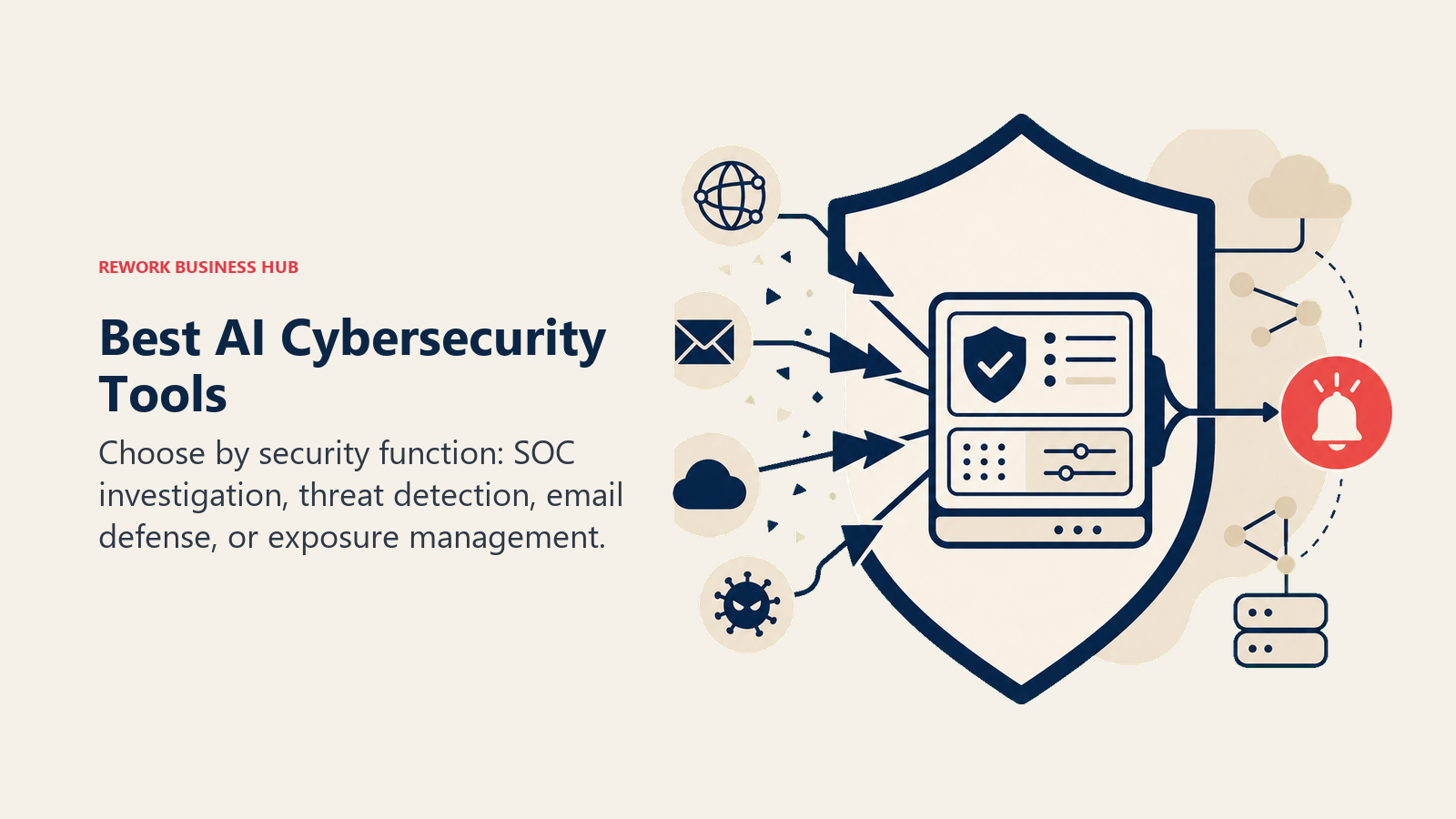
If you're building an AI-assisted security stack in 2026, Microsoft Security Copilot and CrowdStrike Charlotte AI lead AI embedded directly in the platforms most enterprises already run, Darktrace and Vectra AI lead AI-driven threat detection across network and cloud, Abnormal Security leads AI email defense, Wiz and Tenable lead AI-powered security posture and exposure management, and Dropzone AI and Prophet Security lead the new category of agentic AI SOC analysts that triage alerts without a human touching every ticket. This guide ranks 15 tools by the security job you actually need done, not by whichever vendor shouts "agentic" the loudest.
Most "AI for cybersecurity" roundups mix a $450,000-a-year SOC automation platform with a $9-a-month endpoint agent add-on and call it a ranking. That's not useful when your CISO wants a shortlist by Friday. Each tool below is evaluated on what it actually automates (SOC investigation, network detection, email defense, vulnerability prioritization, or security posture), who it's built for, and what it costs. Most vendors in this category keep pricing behind a "contact us" form.
Updated July 2026: What Changed
- Microsoft folded Security Copilot into Microsoft 365 E5 and E7 as an included allotment rather than a pure pay-as-you-go add-on, giving eligible customers 400 Security Compute Units per month for every 1,000 paid licenses (up to 10,000 SCUs/month) before overage billing kicks in at $6/SCU.
- SentinelOne opened Purple AI's Agentic Investigation to all Singularity customers in 2026 and introduced Singularity Credits, a unified usage currency for AI-powered work across the platform, alongside a complimentary trial period.
- Tenable rolled out new "count once" flexible pricing across Tenable One in April 2026, aimed at making AI-prioritized exposure management easier to budget as customers add more asset types and attack surfaces over time.
- Verizon's 2026 Data Breach Investigations Report found the volume of AI-assisted text in malicious phishing emails doubled year over year, even as click-through success rates stayed roughly flat, a sign AI is scaling attacker output faster than attacker skill right now.
- Torq closed a $140 million Series D at a $1.2 billion valuation in early 2026, and its customer count has roughly doubled in a year, a signal of how much capital and enterprise budget is chasing agentic AI SOC platforms specifically.
Key Facts
- Organizations using AI and automation extensively in security saved $1.9 million per breach and identified incidents 80 days faster than those with no AI or automation use, per IBM's Cost of a Data Breach research.
- Severe security-staffing shortages are tied to a $1.76 million increase in average breach costs compared to well-staffed organizations, per IBM.
- The global cybersecurity workforce gap sits at 4.8 million unfilled roles, a 19% year-over-year increase, and the workforce needs to grow 87% to meet current demand, per ISC2's Cybersecurity Workforce Study.
- Gartner predicts 50% of security operations centers will deploy AI-based decision support by the end of 2026, per Gartner's Top Cybersecurity Trends.
- 76% of defenders say AI agents already handle more than 10% of their daily workload, per Vectra AI's 2026 State of Threat Detection report.
- The volume of AI-assisted text found in malicious phishing emails doubled year over year, and the human element remained present in 62% of breaches, per Verizon's 2026 Data Breach Investigations Report.
- AI SOC agents sit at just 1%-5% market penetration today, a category Gartner rates "embryonic" with 2 to 5 years to mainstream adoption, per Gartner's Hype Cycle for Security Operations, cited via Simbian.
Quick Comparison Table
| Tool | Best For | Starting Price | Key Strength | Key Limitation |
|---|---|---|---|---|
| Microsoft Security Copilot | Microsoft-centric enterprises on E5/E7 | Included SCU allotment on E5/E7; pay-as-you-go from $4/SCU-hour otherwise | AI embedded across Defender, Sentinel, and Entra with no new console | Standalone pay-as-you-go pricing is expensive without the E5/E7 allotment |
| CrowdStrike (Charlotte AI) | Endpoint-first teams wanting an AI-native analyst | Falcon $7.99-$19.99/device/month; Charlotte AI adds ~$8-$14/endpoint/year | Deep endpoint telemetry powers genuinely contextual AI answers | Charlotte AI's value depends on being deep into the Falcon ecosystem already |
| SentinelOne (Purple AI) | Autonomous EDR/XDR investigation and response | Singularity Complete from $179.99/endpoint/year (negotiated deals lower) | Agentic investigation now open to all Singularity customers | Standalone Purple AI pricing isn't published separately from platform tiers |
| Darktrace | Anomaly-based detection without signature reliance | Custom; real deals average ~$55,200/year (range $12K-$132K) | Self-Learning AI baselines normal behavior instead of chasing known threats | Pricing is opaque; multi-module bundles get expensive fast at mid-market |
| Abnormal Security | Stopping AI-generated phishing and BEC | ~$15-$35/employee/year list; negotiated deals often land lower | Behavioral baseline per employee catches payloadless, signature-less attacks | Email-only; not a substitute for endpoint, network, or SIEM coverage |
| Vectra AI | AI-driven network detection and response | Custom; contact for quote | Attack Signal Intelligence cuts alert noise across hybrid/cloud networks | No published pricing; hard to shortlist quickly without a sales call |
| Wiz | Securing cloud and AI workloads (models, pipelines) | Custom; typically $30K-$50K/year entry, scales with workload count | AI-SPM extends CNAPP visibility to the AI stack itself, not just cloud infra | Enterprise-only pricing; costs scale fast with workload and cloud spend |
| Tenable | AI-prioritized vulnerability and exposure management | Vulnerability Management from ~$3,500/year; Tenable One from ~$25K/year | New 2026 "count once" pricing simplifies budgeting across asset types | Full Tenable One AI Exposure depth requires the Advanced tier |
| Exabeam | Behavioral-analytics SIEM replacing rule correlation | From $250/monitored user/year (entity-based, not per-seat) | UEBA-first detection catches insider threats rule-based SIEM misses | Doesn't publish a simple price list; quote varies by data volume and modules |
| Google Security Operations (Gemini) | High-volume log ingestion with natural-language investigation | Standard ~$30-$50/employee/year; Enterprise ~$60-$95/employee/year | Gemini investigation assistant bundled into tier pricing at hyperscale | Gemini features aren't itemized separately; hard to isolate their cost/value |
| Torq | Full-stack SOC automation replacing legacy SOAR | HyperSOC from $450,000/year (AWS Marketplace, 12-month term) | Multi-agent AI SOC with 300+ pre-built integrations, no-code workflows | Enterprise-grade entry price puts it out of reach for smaller security teams |
| Tines | Lean teams wanting flexible AI-assisted automation | Free (Community); Starter $500/month; Enterprise from ~$50K/year | Consumption-based pricing scales down to small-team budgets, not just up | AI credits add cost on top of the base plan unless you bring your own API keys |
| Dropzone AI | Autonomous Tier-1 alert triage at high alert volume | From $36,000/year for 4,000 investigations, unlimited users | Investigation-based pricing, not per-seat; 80+ integrations included | Per-alert-ingested billing can get costly with large, unpredictable alert volume |
| Prophet Security | AI analyst layered on an existing SIEM/EDR stack | $10/investigation ($50,000/year for 5,000 investigations) | Usage-based pricing ties cost directly to investigation volume, not headcount | Custom quotes only; harder to budget without knowing your investigation volume upfront |
| Huntress | SMBs and MSPs wanting 24/7 SOC without a security team | $2.50-$3.50/endpoint/month (MSP); ~$8.99/endpoint/month direct | 24/7 human-plus-AI SOC, threat hunting, and managed AV bundled, no add-on fees | Not built for large enterprise scale or deep custom detection engineering |
Sizing and Deployment Fit
Use this table as a stage filter after you know roughly how many endpoints, employees, or investigations you're securing.
| Tool | SMB (under 200 employees) | Mid-Market (200-2,000) | Enterprise (2,000+) |
|---|---|---|---|
| Microsoft Security Copilot | Possible | Strong fit (if on M365) | Strong fit |
| CrowdStrike (Charlotte AI) | Possible | Strong fit | Strong fit |
| SentinelOne (Purple AI) | Possible | Strong fit | Strong fit |
| Darktrace | - | Possible | Strong fit |
| Abnormal Security | Possible | Strong fit | Strong fit |
| Vectra AI | - | Possible | Strong fit |
| Wiz | - | Possible | Strong fit |
| Tenable | Possible | Strong fit | Strong fit |
| Exabeam | - | Possible | Strong fit |
| Google Security Operations | - | Possible | Strong fit |
| Torq | - | - | Strong fit |
| Tines | Strong fit | Strong fit | Possible |
| Dropzone AI | Possible | Strong fit | Possible |
| Prophet Security | Possible | Strong fit | Possible |
| Huntress | Strong fit | Strong fit | - |
1. Microsoft Security Copilot: AI Embedded Across Defender, Sentinel, and Entra
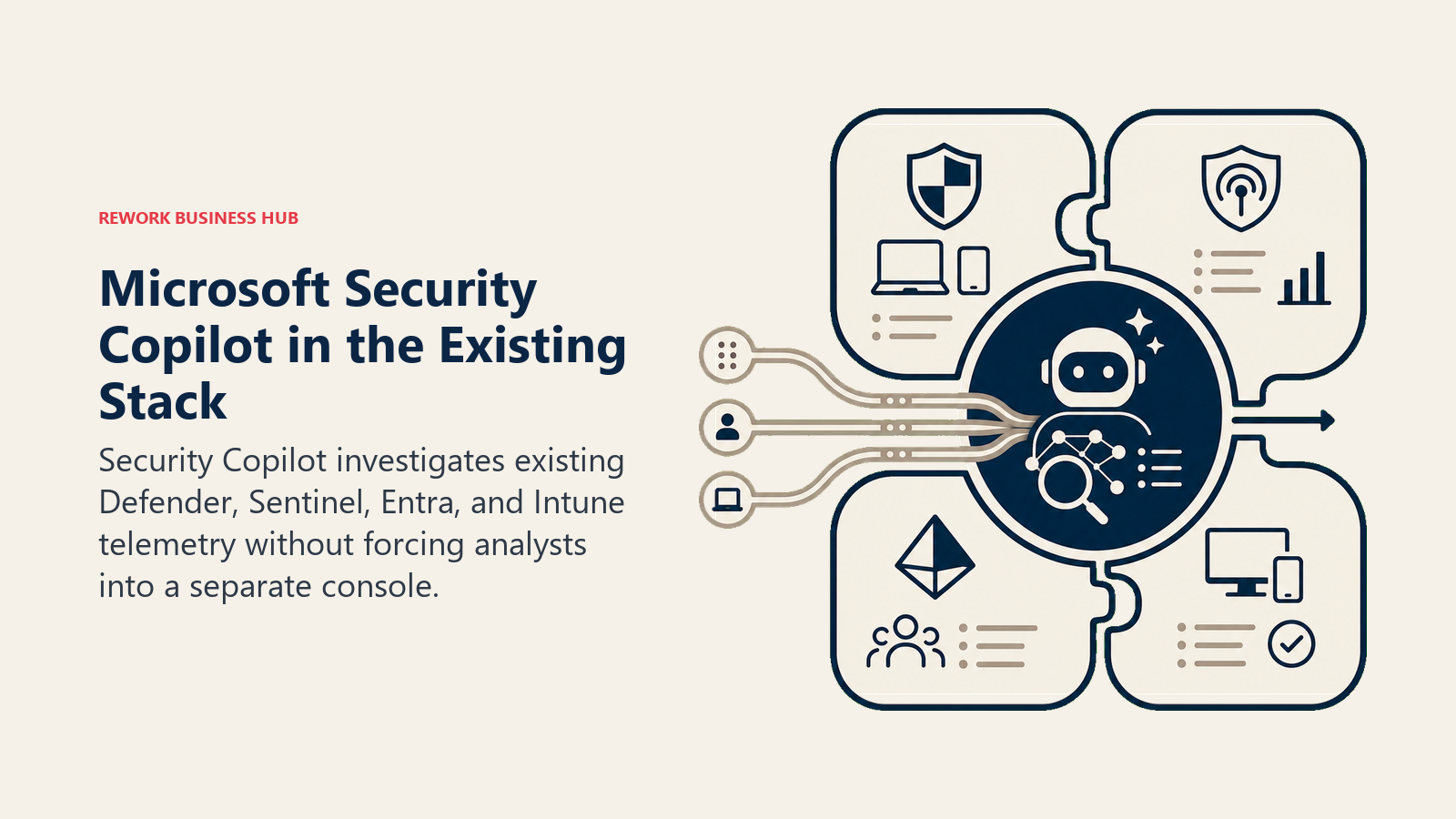
Microsoft's bet is that security AI shouldn't live in a separate console. Security Copilot sits inside Defender, Sentinel, Entra, and Intune, answering natural-language questions against telemetry you're already collecting and drafting incident summaries, KQL queries, and reverse-engineering notes without a context switch.
The pricing shift in 2026 matters more than the product itself for most buyers. Microsoft 365 E5 and E7 customers now get a monthly SCU allotment (400 SCUs per 1,000 licenses, up to 10,000/month) at no extra cost, which makes Copilot effectively free to try for anyone already paying for E5/E7. Standalone pay-as-you-go pricing, by contrast, runs roughly $35,000/year for a single provisioned SCU, and most real deployments need at least three.
| What you get | What you don't |
|---|---|
| AI embedded across Defender, Sentinel, and Entra with no new tool to learn | Full value requires deep investment in the Microsoft security stack already |
| Included SCU allotment for M365 E5/E7 customers as of July 2026 | Standalone pay-as-you-go pricing is expensive outside that allotment |
| Natural-language incident investigation and KQL query generation | SCU allocations reset monthly and don't roll over if unused |
| Scales from a single analyst to a full enterprise SOC | Less useful for teams running a primarily non-Microsoft security stack |
Pricing: Included SCU allotment for Microsoft 365 E5/E7 customers (400 SCUs/month per 1,000 licenses, up to 10,000/month); standalone provisioned SCUs from $4/hour (~$35,000/year for one), overage at $6/SCU.
Best for: Enterprises already running Defender, Sentinel, or Entra as their core security stack and wanting AI investigation without adding a new vendor.
2. CrowdStrike (Charlotte AI): Agentic Analyst on the Falcon Endpoint Platform
CrowdStrike's philosophy is that endpoint telemetry is the richest signal in security, and Charlotte AI is built to reason over that telemetry directly. It's positioned as a generative security analyst that answers natural-language questions against your Falcon data and, through Charlotte Agentic SOAR, takes credit-based automated actions across your environment.
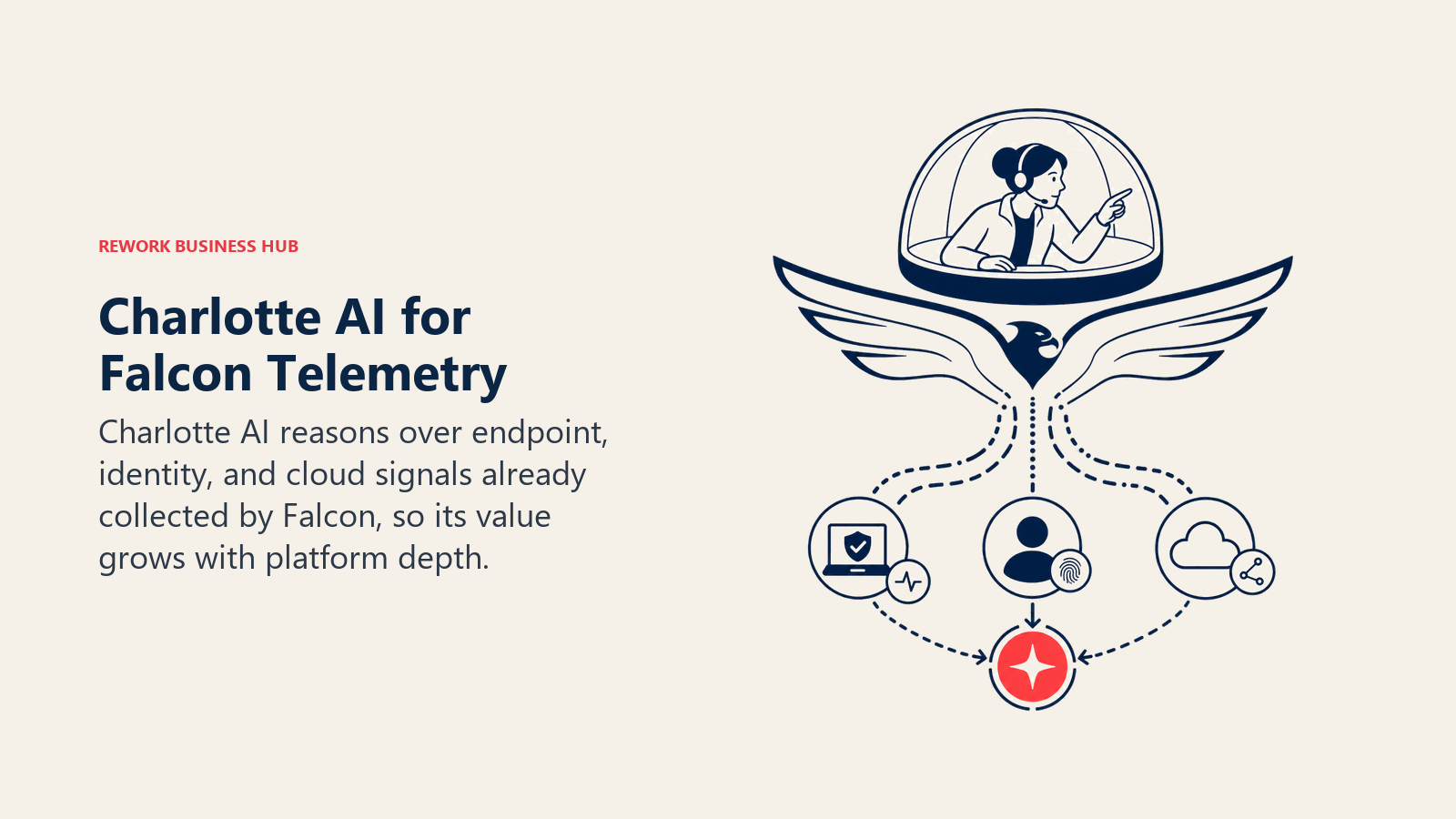
The catch is that Charlotte AI's usefulness scales with how deep you already are in the Falcon ecosystem. Teams running Falcon for endpoint, identity, and cloud protection get genuinely contextual answers; teams bolting Charlotte AI onto a thin Falcon deployment get a less capable assistant. Falcon itself spans four tiers from $7.99 to $19.99 per device per month, with Charlotte AI features included at the higher tiers and available as an add-on elsewhere.
| What you get | What you don't |
|---|---|
| Generative AI analyst reasoning over deep endpoint, identity, and cloud telemetry | Value is tied directly to how much of the Falcon platform you've already adopted |
| Charlotte Agentic SOAR for credit-based automated response actions | Credit-based pricing for agentic actions adds a second cost dimension to track |
| AI-native positioning across the unified Falcon console | Charlotte AI pricing benchmarks are still settling as a newer add-on |
| Strong fit for teams already standardized on CrowdStrike | Less compelling as a standalone AI layer for non-Falcon environments |
Pricing: Falcon platform from $7.99-$19.99/device/month across four tiers; Charlotte AI typically adds $8-$14/endpoint/year on enterprise contracts, per benchmark data from signed Falcon deals.
Best for: Endpoint-first security teams already standardized on CrowdStrike Falcon who want an AI analyst layered on top, not a replacement platform.
3. SentinelOne (Purple AI): Agentic Investigation Now Open to Every Singularity Customer
SentinelOne's Purple AI is built around a specific bet: that AI SOC value comes from autonomous investigation, not just chat. In 2026, SentinelOne opened Purple AI's Agentic Investigation capability to all Singularity customers and introduced Singularity Credits, a unified currency for running AI-powered work across the platform, with a complimentary trial to get teams started.
Purple AI ships inside the Singularity Complete tier rather than as a standalone SKU, so pricing tracks the broader platform. List price sits around $179.99/endpoint/year at Complete, though negotiated enterprise deals in the 200-2,000 endpoint range commonly land closer to $135-$153/endpoint. The tradeoff is that you can't buy Purple AI's specific capabilities without buying into Singularity Complete first.
| What you get | What you don't |
|---|---|
| Agentic Investigation now available to all Singularity customers | No standalone Purple AI SKU; requires the Singularity Complete tier |
| Singularity Credits unify AI usage billing across the platform | Credit consumption for heavy agentic use can be hard to forecast early on |
| Full EDR, Storyline visibility, and 14 days of retention included at Complete | List pricing per endpoint is high before enterprise negotiation |
| Strong fit for teams wanting autonomous investigation, not just Q&A | Less compelling for teams not already evaluating SentinelOne as their EDR |
Pricing: Singularity Complete (includes Purple AI) from $179.99/endpoint/year list; negotiated 200-2,000 endpoint deals commonly land $135-$153/endpoint.
Best for: Teams evaluating SentinelOne as their core EDR/XDR platform who want agentic, autonomous investigation included rather than bolted on.
4. Darktrace: Self-Learning AI for Anomaly Detection Without Signatures
Darktrace's founding conviction hasn't changed since 2013: security tools that rely on known signatures will always lag behind unknown attacks, so its AI builds a live, evolving model of "normal" for your network, email, and cloud, then flags and can autonomously contain deviations through Antigena, its automated response module.
That approach is genuinely differentiated for catching novel, slow-moving, or insider threats that signature-based tools miss entirely. The tradeoff is pricing transparency and cost at scale: Darktrace doesn't publish list pricing, and real contracts tracked by Vendr average $55,200/year but range from $12,000 to over $131,000 depending on devices monitored and modules deployed, with multi-module mid-market bundles running $150,000-$500,000/year.
| What you get | What you don't |
|---|---|
| Self-Learning AI baselines normal behavior across network, email, and cloud | No published pricing; every deal is a custom negotiation |
| Antigena autonomous response contains threats without waiting on a human | Multi-module bundles get expensive quickly past small deployments |
| Strong at catching novel and insider threats signature tools miss | Requires tuning time for the AI to learn your environment's baseline |
| Discounts of 20-35% off initial quotes are common with preparation | Contract escalators (3-7%/year) on multi-year deals add up |
Pricing: Custom quotes; real deals average ~$55,200/year (range $12,000-$131,667); small deployments (100-500 devices) run $50,000-$150,000/year for one module.
Best for: Mid-market to enterprise teams wanting anomaly-based detection across network, email, and cloud without relying on known-threat signatures.
5. Abnormal Security: AI-Native Defense Against Phishing and Business Email Compromise
Abnormal's entire product is built on one insight: modern phishing and business email compromise rarely carry a malicious payload, so signature and reputation-based email gateways miss them. Abnormal instead builds a behavioral baseline for every employee and vendor relationship, then flags anomalies in real time, whether that's a vendor invoice from a slightly wrong domain or a CEO impersonation with perfect grammar.
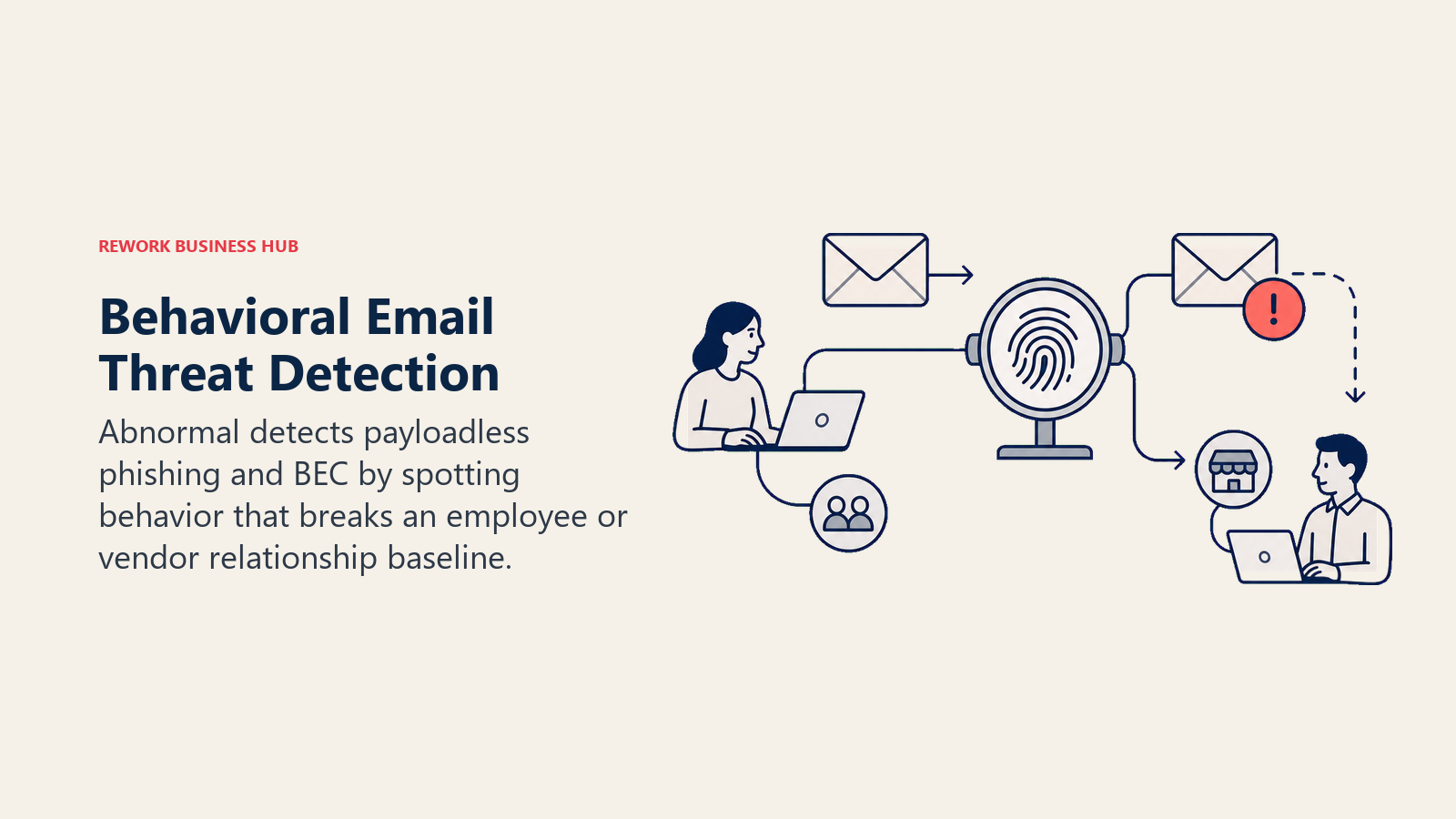
That behavioral approach matters more every quarter. Verizon's 2026 DBIR found AI-assisted text in malicious phishing emails doubled year over year, and phishing remains the single largest AI-assisted initial access vector at 44%. Abnormal's limitation is scope: it's an email security specialist, not a full platform, so it needs to sit alongside endpoint, network, and SIEM coverage rather than replace them.
| What you get | What you don't |
|---|---|
| Behavioral baseline per employee/vendor catches payloadless attacks | Email-only; doesn't cover endpoint, network, or cloud workloads |
| Detects BEC and account takeover that gateway-style tools miss | List pricing ($15-$35/employee/year) leaves real room for negotiation |
| API-based deployment sits alongside Microsoft 365/Google Workspace | Doesn't replace the need for a broader detection and response stack |
| Purpose-built for the AI-assisted phishing surge documented in the 2026 DBIR | Smaller organizations may find dedicated email AI overkill vs. bundled suites |
Pricing: List pricing roughly $15-$35/employee/year; negotiated multi-year deals for 500-2,000 employees commonly land $18-$28/employee/year, and 5,000+ employee enterprises often see $12-$20/employee/year.
Best for: Any organization, regardless of size, whose primary email platform is Microsoft 365 or Google Workspace and wants behavioral AI defense against phishing and BEC specifically.
6. Vectra AI: AI-Driven Network Detection and Response Across Hybrid Cloud
Vectra's product philosophy centers on Attack Signal Intelligence, its AI engine for cutting through alert noise by scoring and prioritizing the signals that actually indicate an active attacker, rather than surfacing every anomaly a network sees. It covers hybrid and multi-cloud networks, not just on-premises traffic, which matters as more attack surface shifts off the traditional perimeter.
Vectra's own 2026 research found 76% of defenders say AI agents already handle more than 10% of their daily workload, a data point Vectra uses to argue AI-augmented triage is no longer optional. The tradeoff for buyers is pricing opacity: Vectra doesn't publish rates publicly, and every deployment requires a sales conversation to scope, though flexible packaging means both mid-market and enterprise teams can be accommodated.
| What you get | What you don't |
|---|---|
| Attack Signal Intelligence prioritizes real attacker behavior over noise | No published pricing; every deal starts with a sales conversation |
| Coverage spans hybrid, multi-cloud, and on-premises network traffic | Best value requires integration work with your existing SOC tooling |
| Backed by Vectra's own annual State of Threat Detection research | Overkill for smaller organizations without a dedicated network security need |
| Flexible, deployment-size-based packaging | Harder to comparison-shop quickly without a formal RFP process |
Pricing: Custom; contact Vectra for a quote based on network size and deployment scope. No published list pricing.
Best for: Mid-market to enterprise teams needing AI-driven network detection and response across hybrid or multi-cloud environments, not just endpoints.
7. Wiz: AI Security Posture Management for Cloud and AI Workloads
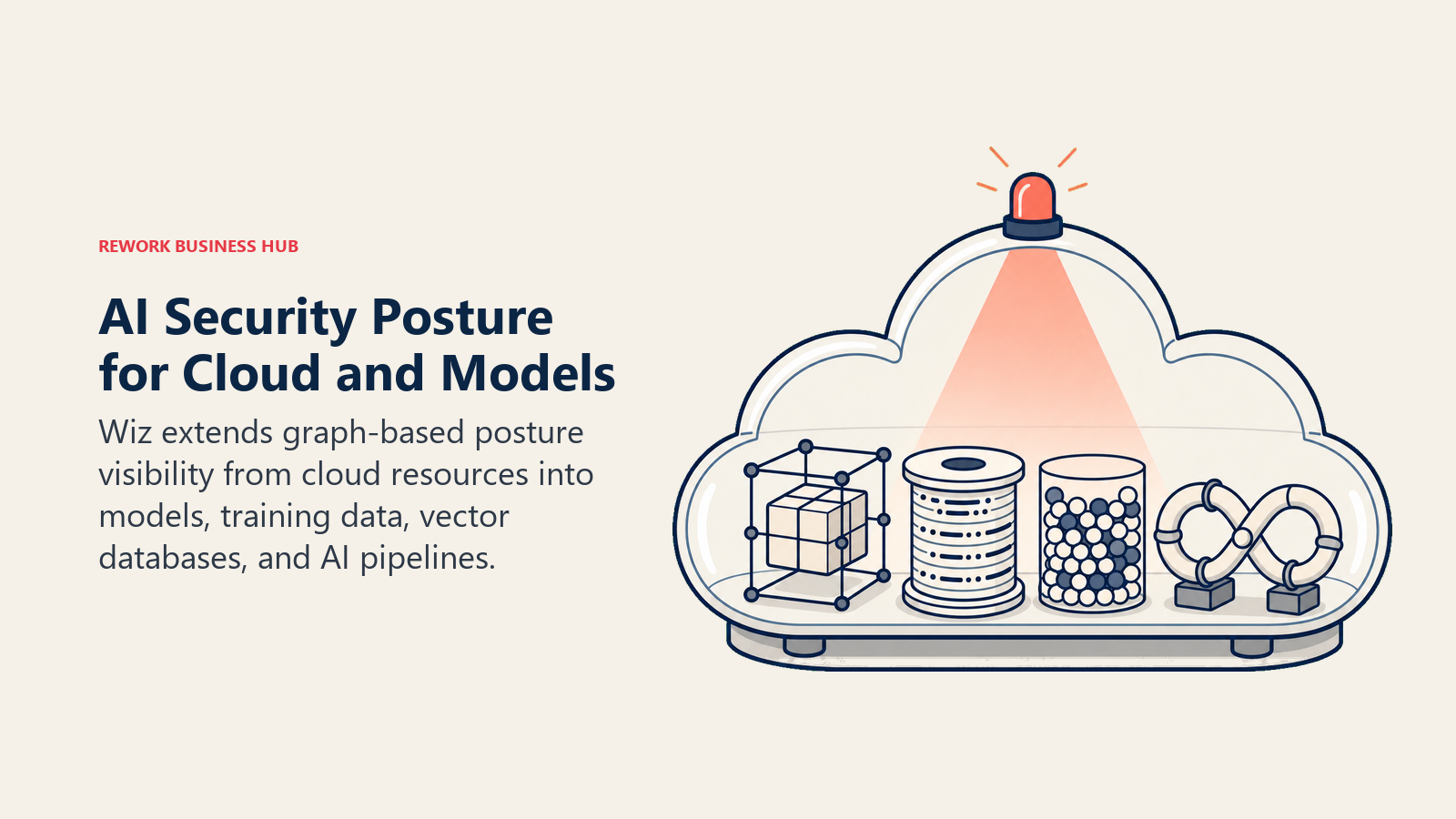
Wiz built its name on agentless cloud security posture management, and its AI-SPM module extends that same graph-based visibility to the AI stack itself: the models, training data, vector databases, and pipelines that traditional CNAPP tools were never built to see. As more companies ship their own AI features, securing the AI supply chain has become as urgent as securing the cloud infrastructure underneath it.
Wiz doesn't publish per-workload pricing; contracts scale with the number of cloud resources, containers, and serverless functions under management, and sometimes as a percentage of cloud spend. Entry contracts typically start $30,000-$50,000/year for smaller footprints (500-1,000 workloads), climbing into six and seven figures for enterprises managing tens of thousands of resources.
| What you get | What you don't |
|---|---|
| Graph-based visibility across cloud infrastructure and AI pipelines | No published per-workload pricing; every quote is custom |
| AI-SPM extends coverage to models, training data, and vector databases | Costs scale directly with workload count and cloud footprint size |
| Agentless deployment reduces implementation friction | Enterprise-only pricing puts it out of reach for very small teams |
| Strong fit for teams shipping their own AI features internally | Multi-year commitments needed to unlock meaningful discounts |
Pricing: Custom; entry contracts typically $30,000-$50,000/year for 500-1,000 workloads, scaling into six and seven figures for large enterprise cloud footprints.
Best for: Cloud-native and AI-building organizations that need posture visibility across both traditional cloud infrastructure and the AI models/pipelines sitting on top of it.
8. Tenable: AI-Prioritized Vulnerability and Exposure Management
Tenable's bet is that vulnerability management alone was never the point; the point is understanding which exposures actually create business risk when combined, and that's what Tenable One (its unified exposure management platform) and its AI Exposure capabilities are built to do. Instead of a flat list of CVEs ranked by CVSS score, AI-driven prioritization surfaces the exposure paths an attacker would actually chain together.
Tenable's April 2026 pricing overhaul introduced a simplified "count once" model, so an asset scanned by multiple sensors is billed a single time, a meaningful change for teams tired of paying twice for the same server. Standalone Tenable Vulnerability Management starts around $3,500/year for smaller environments, while Tenable One deployments for 500-2,000 assets typically run $25,000-$150,000/year.
| What you get | What you don't |
|---|---|
| AI-prioritized exposure management, not just a CVE severity list | Full AI Exposure depth requires the Tenable One Advanced tier |
| New 2026 "count once" pricing simplifies multi-sensor asset billing | Enterprise deployments (10,000+ assets) can exceed $500,000/year |
| Covers vulnerability management, cloud, identity, and OT in one platform | Complexity of the unified platform requires ramp-up time to configure well |
| Strong analyst and market recognition in vulnerability management | Standalone VM product alone doesn't include the newer AI Exposure features |
Pricing: Tenable Vulnerability Management from ~$3,500/year; Tenable One (Foundation/Advanced) typically $25,000-$150,000/year for 500-2,000 assets, scaling past $500,000/year at 10,000+ assets.
Best for: Security teams that want vulnerability management and AI-prioritized exposure/risk scoring unified in one platform instead of stitched together.
9. Exabeam: Behavioral-Analytics SIEM That Doesn't Rely on Correlation Rules Alone
Exabeam's differentiation has always been UEBA-first detection: instead of relying purely on correlation rules that miss slow, low-and-slow insider threats, Exabeam builds behavioral baselines for every user and entity, then flags deviations a rules engine would never catch. Its newer Nova platform is cloud-native and modular, letting teams buy data plane, analytics, UEBA, and response capacity separately.
Pricing is billed per monitored entity, not per analyst seat, starting around $250/user/year, which changes the cost math compared to seat-based SIEMs as your monitored population (not your SOC headcount) grows. Existing Fusion SIEM customers get migration credits worth 20-40% of first-year Nova licensing to move onto the newer platform.
| What you get | What you don't |
|---|---|
| UEBA-first detection catches insider threats rule-based SIEM misses | No simple public price list; quote depends on data volume and modules |
| Entity-based billing decouples cost from SOC analyst headcount | Modular Nova pricing (data plane, analytics, UEBA, response) adds complexity |
| Fusion-to-Nova migration credits ease the move to the cloud-native platform | Legacy Fusion SIEM customers face a real platform migration decision |
| 20-30% multi-year discounts are routine with deliberate use-case staging | Full behavioral analytics value takes time to mature as baselines build |
Pricing: From $250/monitored user/year (entity-based, not per-seat); modular Nova pricing lets teams buy data plane, analytics, UEBA, and response separately; 20-30% multi-year discounts common.
Best for: Security teams wanting SIEM detection built on behavioral analytics from day one, especially for catching insider threats correlation rules miss.
10. Google Security Operations (Chronicle) with Gemini: AI Investigation at Hyperscale
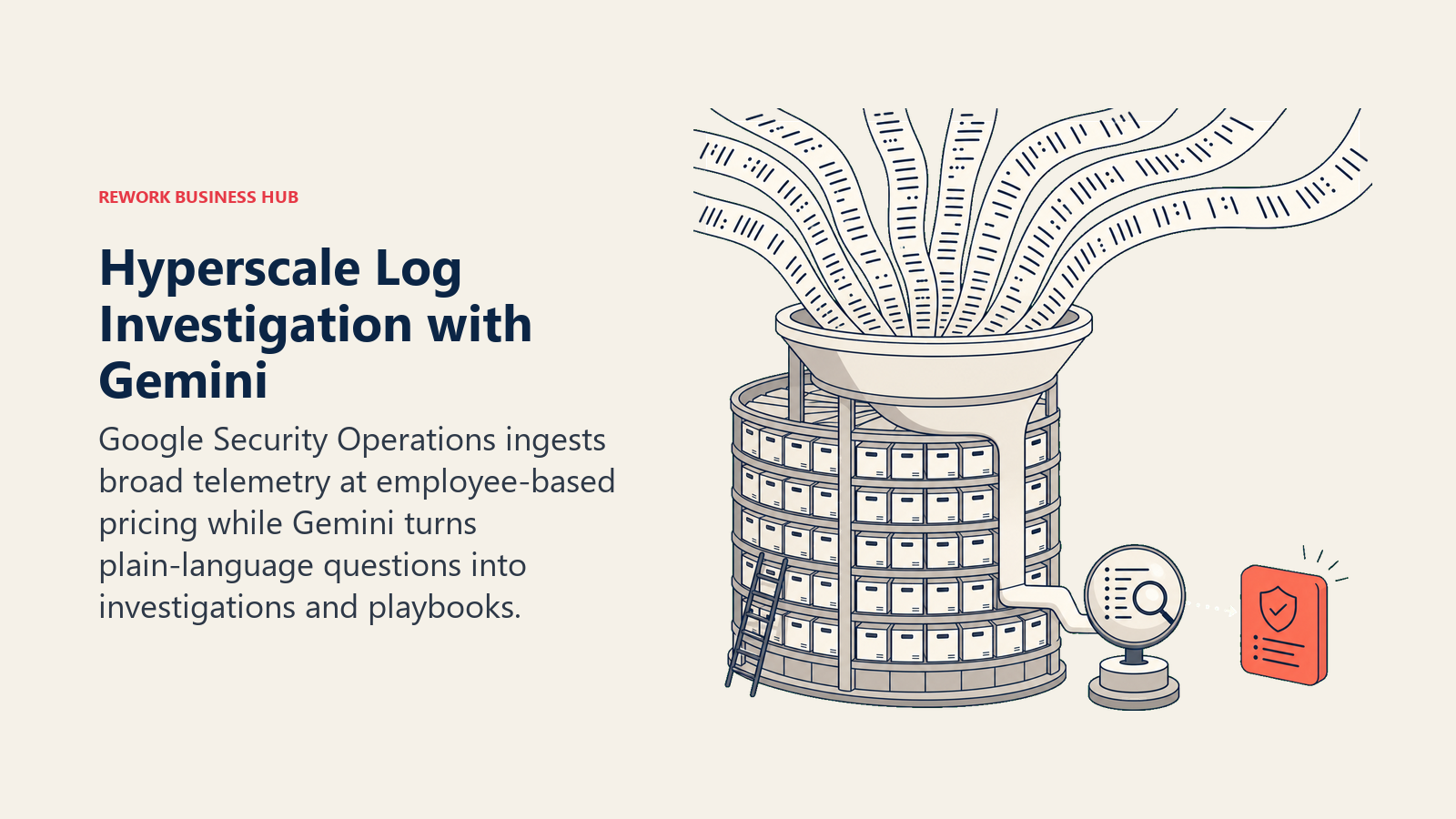
Google's pitch with Security Operations (formerly Chronicle) is ingestion scale without the per-GB pricing anxiety that plagues legacy SIEM: pricing is per employee per year, not per gigabyte logged, which removes the incentive to under-log your environment to control cost. Gemini layers on top as a natural-language investigation assistant, generating contextualized summaries, recommended response actions, and even detection/playbook creation from plain-English prompts.
The three tiers (Standard, Enterprise, Enterprise Plus) run roughly $30-$140 per employee per year depending on depth, and a 1,000-employee organization on Enterprise typically lands $60,000-$95,000/year before the 25-35% discounts that are routine at scale. Gemini's specific capabilities aren't broken out as a separate line item, which makes it hard to isolate exactly what the AI layer costs versus the base platform.
| What you get | What you don't |
|---|---|
| Per-employee pricing removes the incentive to under-log your environment | Gemini features aren't itemized separately from base tier pricing |
| Natural-language investigation and automated playbook generation | Full Enterprise Plus tier needed for the deepest data retention and Gemini use |
| One year of telemetry retention included at no additional cost | Requires genuine Google Cloud ecosystem investment to get full value |
| Backed by Google's threat intelligence (Mandiant, VirusTotal) integration | 20,000+ employee enterprise contracts can reach $900K-$1.4M before discount |
Pricing: Standard ~$30-$50/employee/year; Enterprise ~$60-$95/employee/year; Enterprise Plus ~$100-$140/employee/year; 25-35% discounts routinely negotiated at scale.
Best for: High-volume enterprises wanting hyperscale log ingestion with natural-language AI investigation, especially those already invested in Google Cloud.
11. Torq: AI SOC Platform Built to Replace Legacy SOAR
Torq's argument is that traditional SOAR (security orchestration, automation, and response) hit its ceiling: playbooks built for narrow, rule-based automation can't keep up with the volume and complexity of a modern SOC. HyperSOC, Torq's flagship product, is a multi-agent AI system, reportedly the first AI SOC with native MCP (Model Context Protocol) support, with 300+ pre-built integrations and 4,000+ pre-built automation steps.
The ambition shows up in the price tag. HyperSOC lists at $450,000/year on AWS Marketplace with a 12-month contract, an enterprise-grade commitment that reflects Torq's positioning: full-stack security hyperautomation, not a point tool. The company's $140M Series D at a $1.2B valuation in early 2026 and roughly doubled customer count suggest real enterprise traction at that price point.
| What you get | What you don't |
|---|---|
| Multi-agent AI SOC with native MCP support and 300+ integrations | $450,000/year entry price puts it out of reach for most mid-market teams |
| 4,000+ pre-built automation steps reduce custom playbook-building | Positioned to replace legacy SOAR entirely, a significant migration project |
| Well-capitalized vendor ($332M total funding, $1.2B valuation in 2026) | Workflow/integration/action-based pricing can be hard to forecast precisely |
| Built for full-stack security hyperautomation, not narrow use cases | Overkill for teams that just need alert triage, not full SOC automation |
Pricing: HyperSOC from $450,000/year (12-month contract, AWS Marketplace listing); broader platform pricing scales by workflows, integrations, and automation actions.
Best for: Large enterprises ready to replace legacy SOAR entirely with a full-stack, multi-agent AI SOC automation platform.
12. Tines: Flexible AI-Assisted Automation That Scales Down, Not Just Up
Tines built its reputation on no-code security workflow automation that doesn't lock teams into rigid, vendor-prescribed playbooks, and its AI layer (the AI Agent action and Workbench) extends that same flexibility to AI-assisted investigation and response. Where Torq is built for enterprise-scale hyperautomation, Tines is deliberately built to work for a two-person security team too.
That's the real differentiator: a permanent free Community tier for proof-of-concepts, a $500/month Starter tier (launched February 2026) for small teams running production workloads, and Enterprise pricing that only kicks in near $50,000/year for department-scale deployments. AI credits are billed at actual AWS Bedrock cost with no markup, and teams that bring their own API keys avoid the credit system entirely while getting higher rate limits.
| What you get | What you don't |
|---|---|
| Free Community tier and $500/month Starter make it accessible to lean teams | AI credits add cost on top of the base subscription unless self-hosted keys are used |
| No-code workflow builder avoids vendor-prescribed playbook lock-in | Consumption-based pricing means cost tracks automation volume, which can surprise |
| Scales from a two-person team to department-wide Enterprise deployment | Less pre-built integration depth out of the box than Torq's 300+ library |
| AI credits billed at actual cost, no markup, transparent pricing model | Enterprise features (SCIM, dedicated infrastructure) require the top tier |
Pricing: Community free; Starter $500/month (1M events/month, 5-20 flows); Business scales to department level; Enterprise quote-based, typically from ~$50,000/year.
Best for: Lean security teams and mid-market SOCs wanting flexible, no-code AI-assisted automation without an enterprise-only price floor.
13. Dropzone AI: Autonomous Tier-1 Alert Triage at Scale
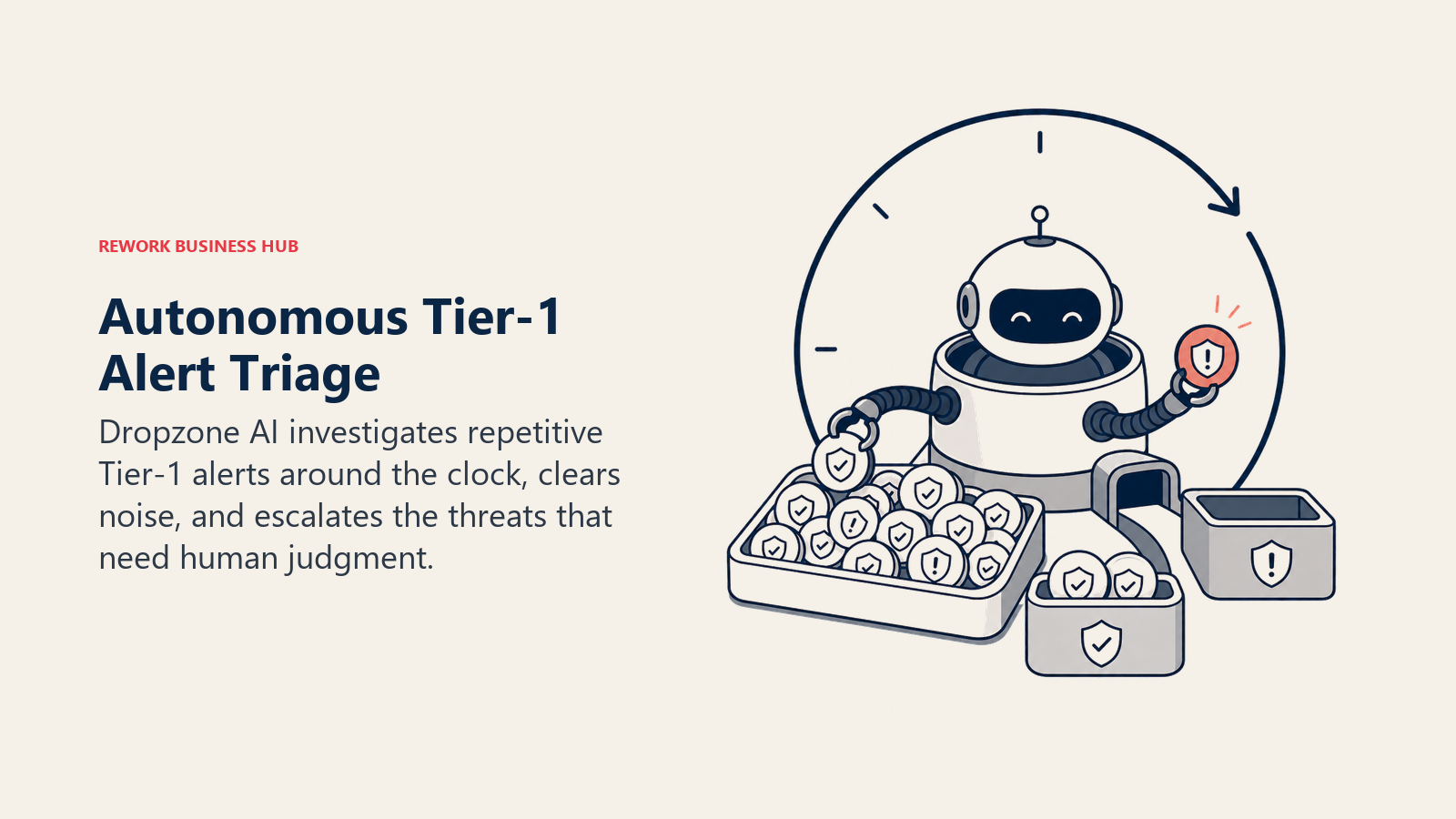
Dropzone AI's pitch is specific: most SOC alert fatigue comes from Tier-1 triage, the repetitive work of investigating whether an alert is a real threat or noise, and that work is exactly what an AI agent can do autonomously, 24/7, without getting tired or missing steps. It ships with 80+ integrations and threat intel baked in, and the base subscription covers unlimited users rather than charging per analyst seat.
Pricing is investigation-based rather than seat-based: $36,000/year covers 4,000 investigations annually, with volume discounts and custom Enterprise/MSSP pricing above that. The honest limitation is that Dropzone charges per alert ingested, which can get expensive fast for organizations with large, unpredictable alert volumes, and some customers report having to cherry-pick which alert sources to connect as a result.
| What you get | What you don't |
|---|---|
| Autonomous, 24/7 Tier-1 alert investigation without per-seat pricing | Per-alert-ingested billing can spike with unpredictable alert volume |
| 80+ integrations and threat intel included in the base subscription | Custom Enterprise/MSSP pricing required beyond standard investigation volume |
| Unlimited users on the base plan, unusual for security tooling | Newer entrant; less enterprise track record than platform incumbents |
| Investigation-based pricing ties cost to actual usage, not headcount | Requires careful alert-source selection to avoid runaway investigation costs |
Pricing: From $36,000/year for 4,000 investigations annually, unlimited users, 80+ integrations, and threat intel included; volume discounts and custom Enterprise/MSSP pricing above that.
Best for: Security teams drowning in Tier-1 alert volume who want autonomous triage without hiring additional Tier-1 analysts.
14. Prophet Security: AI Analyst Layered On Your Existing SIEM and EDR
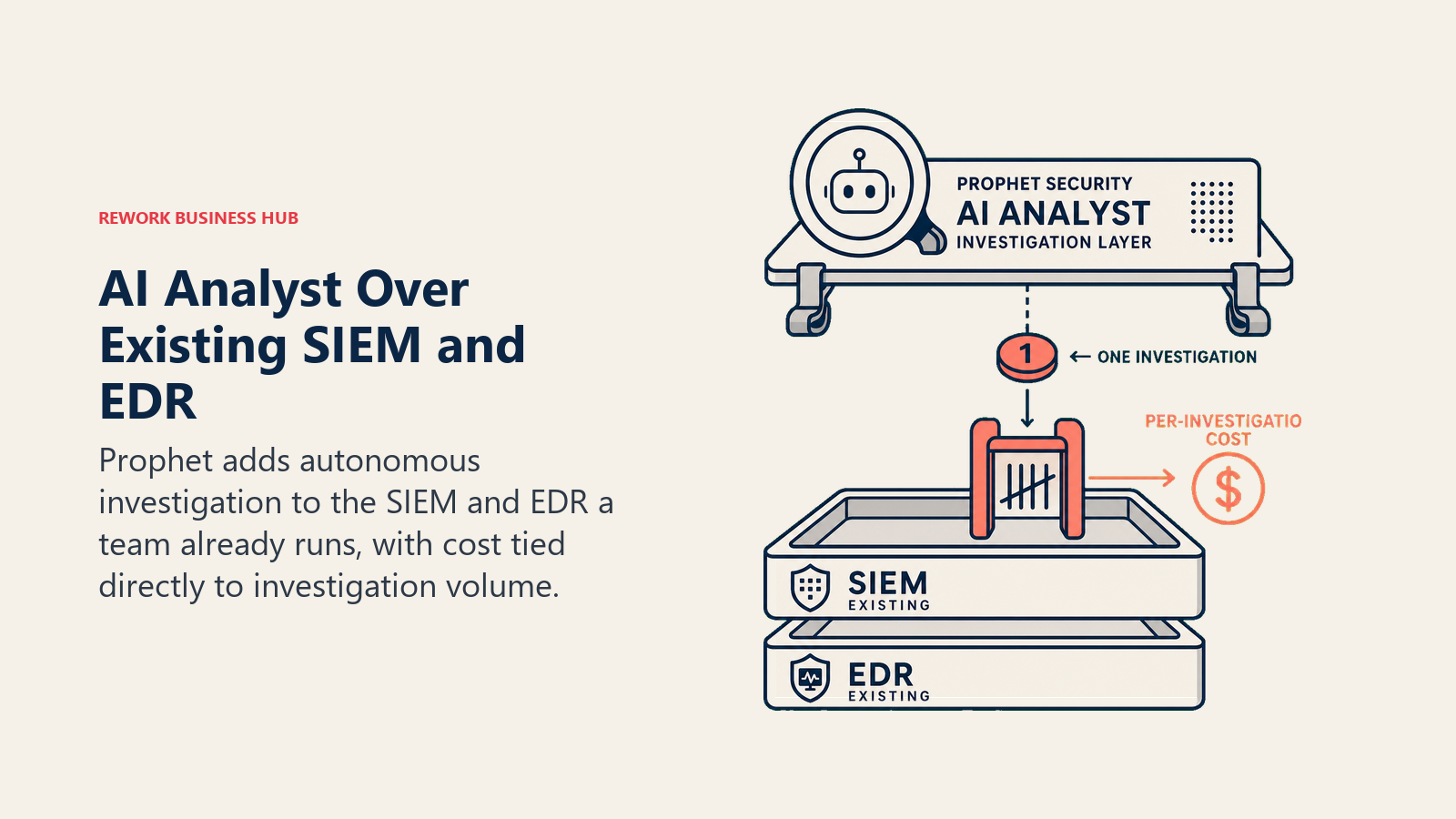
Prophet Security's positioning is similar to Dropzone's (an AI SOC analyst focused on autonomous investigation) but its pricing model is even more directly usage-based: roughly $10 per investigation, meaning a team running 5,000 investigations a year budgets around $50,000/year plus overage at the same per-investigation rate. The pitch is that Prophet integrates with the SIEM and EDR stack you already run rather than asking you to replace it.
That usage-based model is honest but requires knowing your investigation volume before you can budget confidently, which is harder for teams that haven't measured it before. Prophet doesn't publish tiered pricing publicly, so an accurate quote requires walking a sales team through your current alert and investigation volume.
| What you get | What you don't |
|---|---|
| AI analyst layered on your existing SIEM/EDR, not a rip-and-replace | Usage-based pricing requires knowing your investigation volume upfront |
| Per-investigation pricing ties cost directly to actual usage | No published tiered pricing; every quote is custom |
| Positioned specifically to integrate with, not replace, current tooling | Newer entrant still building the track record larger platforms have |
| Straightforward cost math once investigation volume is known | Overage investigations bill at the same rate, so spikes cost real money |
Pricing: Usage-based, roughly $10/investigation (~$50,000/year for 5,000 investigations), plus $10 per overage investigation. Custom quotes for larger volumes.
Best for: Teams with an established SIEM and EDR stack that want an AI analyst layered on top for investigation, not a platform migration.
15. Huntress: Managed AI-Assisted SOC for Teams Without a Security Team
Huntress exists for a specific buyer: the small business or mid-size company that needs 24/7 threat detection and response but has no in-house SOC and no realistic path to building one. Its managed EDR, ITDR, and SIEM products bundle a 24/7 human-plus-AI SOC, active threat hunting, ransomware canaries, and managed antivirus into one price with no separate SOC fee and no feature gating across tiers.
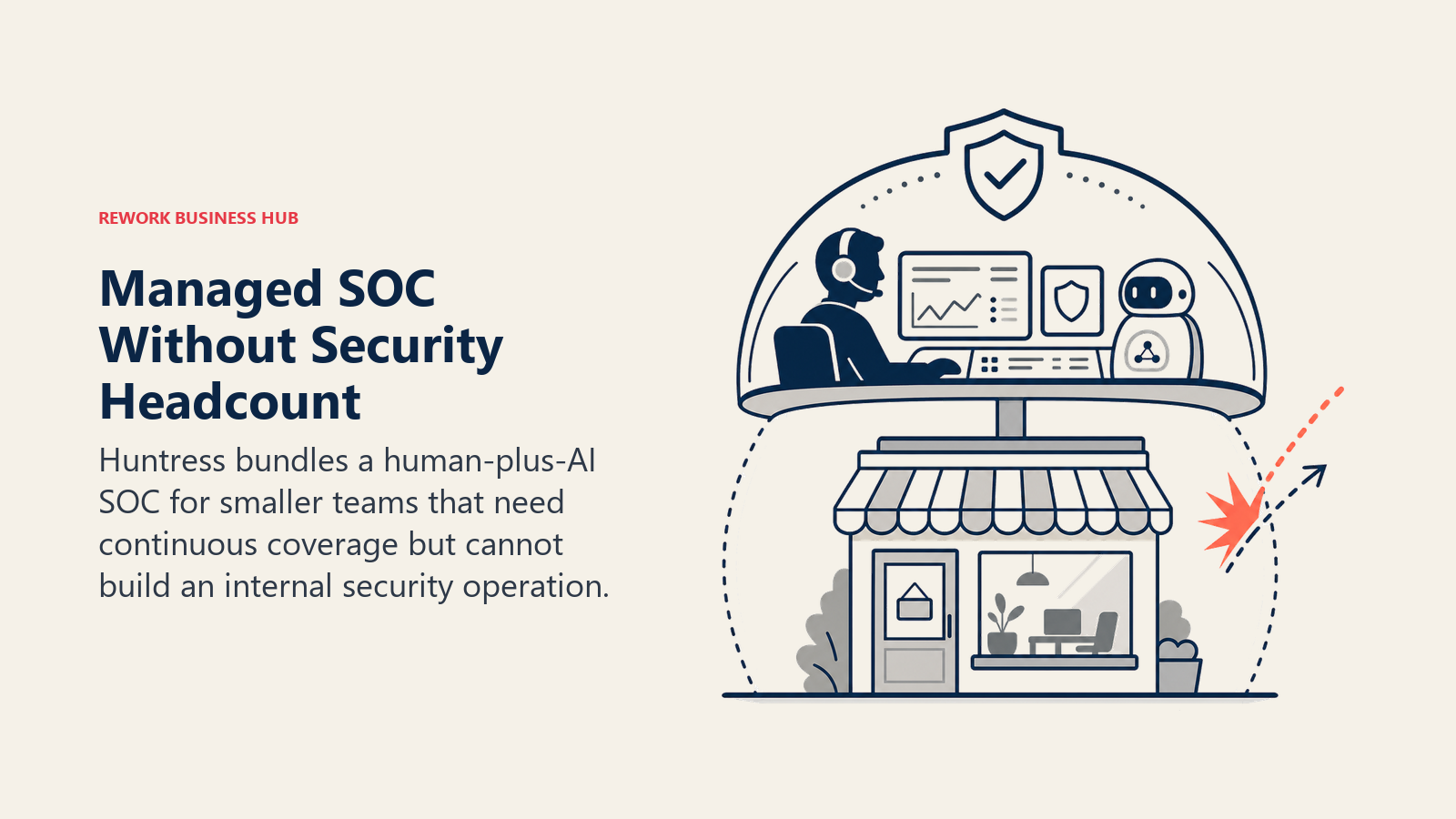
At $2.50-$3.50 per endpoint per month through MSP partners (or about $8.99/endpoint/month buying direct), a 100-endpoint SMB gets what would otherwise cost $2,000-$3,000/month in unbundled enterprise tooling for a few hundred dollars. The tradeoff, honestly, is scale: Huntress is not built for large enterprise environments or deep custom detection engineering, and its 50-endpoint minimum commitment means it isn't the cheapest option for very small teams either.
| What you get | What you don't |
|---|---|
| 24/7 human-plus-AI SOC, threat hunting, and managed AV in one price | Not built for large enterprise scale or deep custom detection engineering |
| No separate SOC fee, no AI add-on SKU, no feature gating by tier | 50-endpoint minimum commitment on a standard 12-month term |
| MSP-friendly volume discounts at 50, 100, 250, 500, and 1,000+ tiers | Buying direct (vs. through an MSP) costs meaningfully more per endpoint |
| Dramatically lower cost than assembling enterprise tools individually | Less depth in AI-driven investigation than dedicated AI SOC analyst tools |
Pricing: $2.50-$3.50/endpoint/month at MSP partner rates; ~$8.99/endpoint/month buying direct; 50-endpoint minimum on a 12-month standard term.
Best for: Small businesses and MSPs that need 24/7 detection and response coverage without the budget or headcount for an in-house security team.
Decision Framework
Use this table as your final filter. Match your situation to the right tool.
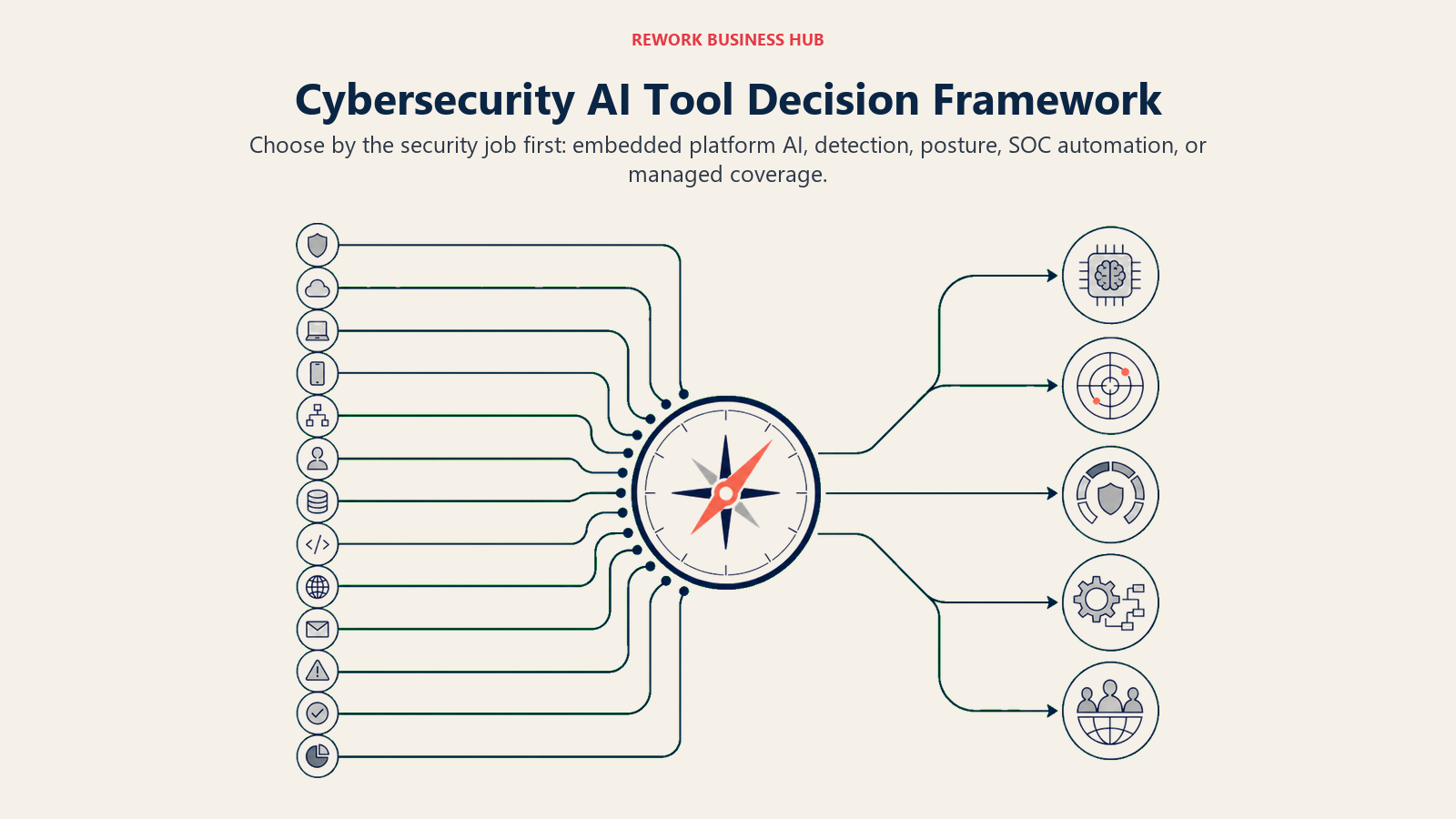
| If you need... | Pick... | Why |
|---|---|---|
| AI embedded across a Microsoft-centric security stack you already run | Microsoft Security Copilot | Included SCU allotment on E5/E7 makes it near-free to start |
| An AI-native agentic analyst on top of endpoint/XDR you're standardized on | CrowdStrike Charlotte AI or SentinelOne Purple AI | Both reason over deep endpoint telemetry already flowing through the platform |
| Autonomous anomaly detection without relying on known-threat signatures | Darktrace | Self-Learning AI catches novel and insider threats signature tools miss |
| To stop AI-generated phishing and BEC before it lands in an inbox | Abnormal Security | Behavioral baselines catch payloadless attacks gateway tools miss entirely |
| AI-driven network detection and response across hybrid or multi-cloud | Vectra AI | Attack Signal Intelligence cuts through alert noise at the network layer |
| To secure cloud infrastructure and the AI models/pipelines running on it | Wiz | AI-SPM is the only offering here purpose-built for securing the AI stack itself |
| AI-prioritized vulnerability and exposure management, not just a CVE list | Tenable | AI Exposure surfaces the attack paths that actually create business risk |
| A SIEM built on behavioral analytics instead of correlation rules alone | Exabeam | UEBA-first detection catches insider threats rule-based SIEM misses |
| Hyperscale log ingestion with natural-language AI investigation | Google Security Operations | Per-employee pricing removes the incentive to under-log your environment |
| To replace legacy SOAR with full-stack, multi-agent SOC automation | Torq | HyperSOC is built for hyperautomation, not narrow point-tool automation |
| Flexible AI-assisted automation that works on a lean security team's budget | Tines | Free and $500/month tiers make it accessible below Torq's enterprise floor |
| Autonomous Tier-1 alert triage without hiring more Tier-1 analysts | Dropzone AI or Prophet Security | Both price by investigation volume, not by seat, and triage around the clock |
| Enterprise-grade 24/7 detection and response on an SMB budget | Huntress | Bundled human-plus-AI SOC beats the cost of assembling enterprise tools alone |
What to Do Next
Pick the security function that hurts most right now (Tier-1 alert fatigue, phishing that's getting past your gateway, unpatched exposure you can't prioritize, or a SOC that can't scale with headcount), not the tool with the flashiest agentic demo. Shortlist two options from the same row of the decision framework above, and pilot against a defined, bounded set of alert types or use cases before connecting your entire environment.
If your organization already runs Microsoft, CrowdStrike, or SentinelOne as its core platform, start by asking what AI is already included before buying a new point tool. If you're evaluating the newer AI SOC analyst category (Dropzone AI, Prophet Security, Torq, Tines), measure your actual alert or investigation volume first since that number drives almost all of the pricing math in this list. And if cybersecurity turns out not to be your actual gap, the broader best AI tools in 2026 roundup and the best AI tools for enterprise guide cover adjacent categories worth a look.
For teams building or overseeing the humans behind these tools, the cybersecurity awareness framework and the Cybersecurity AI Specialist job description are useful starting points, and the AI security and API security explainers cover the underlying concepts several tools on this list are built to defend. If you're weighing whether to build a security automation layer yourself, the AI security monitoring agent blueprint walks through what a homegrown version of Dropzone AI or Prophet Security's core function actually involves, and AI security and compliance covers the governance side most of these tools don't handle for you. For a broader look at AI automation beyond security specifically, see best AI automation tools and best AI agents.

Principal Product Marketing Strategist
On this page
- Updated July 2026: What Changed
- Key Facts
- Quick Comparison Table
- Sizing and Deployment Fit
- 1. Microsoft Security Copilot: AI Embedded Across Defender, Sentinel, and Entra
- 2. CrowdStrike (Charlotte AI): Agentic Analyst on the Falcon Endpoint Platform
- 3. SentinelOne (Purple AI): Agentic Investigation Now Open to Every Singularity Customer
- 4. Darktrace: Self-Learning AI for Anomaly Detection Without Signatures
- 5. Abnormal Security: AI-Native Defense Against Phishing and Business Email Compromise
- 6. Vectra AI: AI-Driven Network Detection and Response Across Hybrid Cloud
- 7. Wiz: AI Security Posture Management for Cloud and AI Workloads
- 8. Tenable: AI-Prioritized Vulnerability and Exposure Management
- 9. Exabeam: Behavioral-Analytics SIEM That Doesn't Rely on Correlation Rules Alone
- 10. Google Security Operations (Chronicle) with Gemini: AI Investigation at Hyperscale
- 11. Torq: AI SOC Platform Built to Replace Legacy SOAR
- 12. Tines: Flexible AI-Assisted Automation That Scales Down, Not Just Up
- 13. Dropzone AI: Autonomous Tier-1 Alert Triage at Scale
- 14. Prophet Security: AI Analyst Layered On Your Existing SIEM and EDR
- 15. Huntress: Managed AI-Assisted SOC for Teams Without a Security Team
- Decision Framework
- What to Do Next