Best AI Tools for Enterprise in 2026: 14 Platforms Ranked by Fit, Governance, and Cost
Turn this article into takeaways for your work.


Each assistant summarizes the article only for you and suggests best practices for your work.
The best AI tool for a 5,000-person enterprise is rarely the one topping a general "best AI tools" list. ChatGPT Enterprise and Microsoft 365 Copilot dominate daily assistant use, Claude Enterprise and Google Gemini Enterprise lead on reasoning and cloud-native integration, and Palantir AIP, Databricks Mosaic AI, and IBM watsonx exist for a different job entirely: mission-critical, governed, auditable AI wired into regulated data. This guide ranks 14 enterprise-grade AI platforms by the questions that actually decide a Fortune 1000 shortlist: data residency, seat minimums, governance controls, and what the vendor actually charges once the pilot ends.
Every tool below was evaluated on enterprise readiness (SSO, audit logs, data isolation, compliance certifications), pricing transparency, and where it sits in the build-versus-buy spectrum, not on marketing claims. Most enterprise AI vendors do not publish list prices; where a number isn't public, that's stated directly and the closest verifiable anchor (an official pricing page tier, or an independently tracked street rate) is cited instead.
Key Facts
- 88% of organizations report using AI in at least one business function, but only about a third have scaled AI beyond pilots, and just 39% report any EBIT impact attributable to AI at the enterprise level, per McKinsey's State of AI research.
- Enterprise generative AI spending hit $37 billion in 2025, a 3.2x increase year over year, with general-purpose copilots alone capturing $8.4 billion of that total, according to Menlo Ventures' State of Generative AI in the Enterprise report.
- Gartner predicts 40% of enterprise applications will carry task-specific AI agents by the end of 2026, up from less than 5% in 2025, per Gartner's newsroom.
- Gartner also predicts more than 40% of agentic AI projects will be canceled by the end of 2027 due to escalating costs, unclear business value, or inadequate risk controls, per Gartner's press release.
- 66% of organizations report productivity and efficiency gains from enterprise AI adoption, but only 34% say they're using AI to deeply transform the business, per Deloitte's State of AI in the Enterprise 2026 report.
Updated July 2026: What Changed
- Anthropic unbundled tokens from Claude Enterprise seats. The headline seat price dropped to roughly $20/user/month, but that fee no longer includes usage. All prompts and API activity now bill separately at standard token rates, which pushes real total spend closer to $60 to $250+ per user per month depending on how heavily teams use it.
- ServiceNow retired its legacy license tiers. As of April 2026, everything consolidated into three AI-native tiers (Foundation, Advanced, Prime), and Now Assist generative AI is bundled into all three instead of sold as a separate add-on.
- Amazon Q Business is closing to new customers on July 31, 2026. AWS has stopped onboarding net-new accounts; existing customers continue as normal, but this changes the AWS-native shortlist for any enterprise starting evaluation now.
- Salesforce split its agent pricing into three incompatible models. Per-conversation ($2 each), Flex Credits (consumption-based), and per-user Agentforce licenses now coexist, but Flex Credits and Conversations cannot run in the same org, which forces a commitment before deployment.
Quick Comparison Table
Pricing marked "quote-only" means the vendor does not publish a number; the figure shown is the closest verified public anchor (an official tier price, or a widely reported street rate).
| Tool | Best For | Starting Price | Key Strength | Key Limitation |
|---|---|---|---|---|
| ChatGPT Enterprise | General-purpose assistant at scale | Quote-only, ~$45-75/seat/mo, 150-seat minimum | Broadest model access, largest ecosystem | No published pricing; steep seat floor |
| Microsoft 365 Copilot | Teams already standardized on M365 | $30/seat/mo (annual, enterprise) | Embedded in Word, Excel, Teams, Outlook | Requires a separate qualifying M365 license |
| Claude Enterprise | Reasoning-heavy, safety-conscious work | ~$20/seat/mo + usage billed separately | Long context, strong agentic coding and analysis | Unbundled pricing makes true cost hard to forecast |
| Google Gemini Enterprise | Google Cloud and Workspace-native orgs | $21-60+/seat/mo across 4 editions | Deep Google Cloud and Workspace integration | Two separate "Gemini Enterprise" products causes buyer confusion |
| Glean | Enterprise search across all company systems | Quote-only, ~$50-75+/seat/mo, ~100-seat minimum | Unifies search across 100+ SaaS connectors | High minimum ACV; consumption charges beyond seat |
| Writer | Governed, brand-consistent content generation | $29/seat/mo (annual, Starter) | Enterprise-grade content governance and brand controls | Best value requires committing to the full platform |
| Cohere (North) | Private, air-gapped or VPC-isolated deployment | Quote-only, ~$100K+ annual minimum | Full data isolation, deploy in your own cloud | Not for self-serve or fast timelines |
| Salesforce Agentforce | Agents embedded in existing Salesforce CRM | $2/conversation or $5/seat/mo (Flex Credits req.) | Native to Salesforce data model, no integration needed | Three incompatible pricing models to navigate |
| ServiceNow (Now Assist) | AI embedded in ITSM/HR/CS workflow automation | Quote-only, ~$70-100/seat/mo (Foundation tier est.) | Deep workflow and ticketing automation | No public pricing; premium stacks on top of base license |
| Amazon Q Business | AWS-native teams needing a business assistant | $3/seat/mo (Lite); $20/seat/mo (Pro) | Native AWS data source connectors | Closed to new customers as of July 31, 2026 |
| IBM watsonx | Regulated industries needing built-in governance | ~$1,110/mo (Standard runtime) + token usage | watsonx.governance for model risk and audit trails | Complex, multi-product pricing to model |
| Databricks Mosaic AI | Custom AI/ML built on your own data lakehouse | Consumption-based, ~$0.07-$0.70+/DBU | Full model training and fine-tuning control | Not an off-the-shelf assistant; needs ML engineering |
| Palantir AIP | Mission-critical, decision-grade AI in complex data environments | Quote-only, negotiated annual platform fee | Deepest data integration for high-stakes decisions | Long, sales-led deployment cycles |
| Grok (SpaceXAI) | Teams with engineers wanting one model family on a public rate card | $2/$6 per million tokens (grok-4.7) | Published per-token pricing across text, voice, and video | An API, not an app; you build the interface |
How to Evaluate Enterprise AI Tools
Most enterprise AI mistakes happen before a single seat is provisioned, when buyers shortlist on model quality alone and skip the questions that actually determine whether a deployment survives its first compliance review.
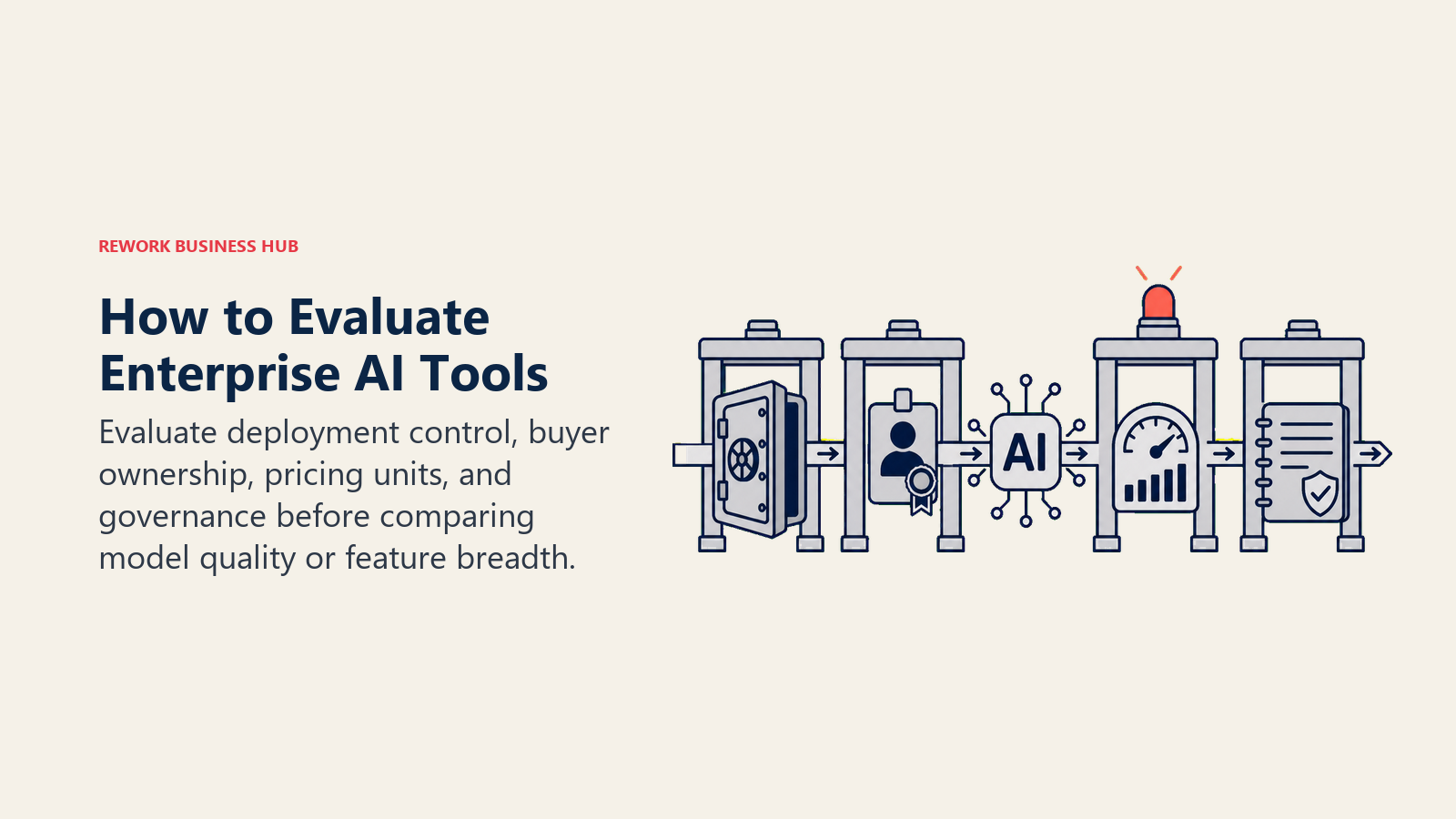
- Where does your data go? SaaS-only, VPC-isolated, or fully on-premise are three different risk profiles, and not every vendor on this list offers all three.
- Who's the actual buyer? A CIO buying a company-wide assistant, a Chief AI Officer buying an agent platform, and a business unit buying a point solution have different budgets and different governance bars.
- What's the real unit of pricing? Per-seat, per-conversation, per-token, and per-DBU are four different cost models on this list, and they don't compare cleanly on a single spreadsheet without normalizing to expected usage.
- What does "enterprise-grade" actually include? SSO, SOC 2, audit logs, and admin controls are table stakes in 2026, not differentiators. The differentiator is what happens when a model hallucinates inside a regulated workflow, which is where AI governance frameworks and model-level AI vendor evaluation criteria matter more than the benchmark scores in a vendor's pitch deck.
Answer those four questions before comparing feature lists. It also helps to run the true multi-year number, not just the seat price, through an AI total cost of ownership model before you sign, since implementation, integration, and consumption overages routinely double or triple the sticker price on this list.
Deployment Model Comparison
| Tool | SaaS (Multi-Tenant) | VPC / Private Cloud | On-Premise / Air-Gapped |
|---|---|---|---|
| ChatGPT Enterprise | Yes | Limited (Azure OpenAI route) | No |
| Microsoft 365 Copilot | Yes | Via Azure tenant controls | No |
| Claude Enterprise | Yes | Yes (AWS Bedrock, GCP Vertex) | No |
| Google Gemini Enterprise | Yes | Yes (Google Cloud VPC) | No |
| Glean | Yes | Yes | No |
| Writer | Yes | Yes | No |
| Cohere (North) | Yes | Yes | Yes |
| Salesforce Agentforce | Yes | No | No |
| ServiceNow (Now Assist) | Yes | Limited | No |
| Amazon Q Business | Yes | Yes (AWS VPC) | No |
| IBM watsonx | Yes | Yes | Yes |
| Databricks Mosaic AI | Yes | Yes | Limited |
| Palantir AIP | Yes | Yes | Yes |
| Grok (SpaceXAI) | Yes | Yes (Vertex AI, Microsoft Foundry) | No |
Rollout Scope Fit Matrix
| Tool | Team Pilot | Department-Wide | Company-Wide (10,000+ employees) |
|---|---|---|---|
| ChatGPT Enterprise | Possible | Strong fit | Strong fit |
| Microsoft 365 Copilot | Possible | Strong fit | Strong fit |
| Claude Enterprise | Strong fit | Strong fit | Possible |
| Google Gemini Enterprise | Possible | Strong fit | Strong fit |
| Glean | - | Strong fit | Strong fit |
| Writer | Possible | Strong fit | Possible |
| Cohere (North) | - | Possible | Strong fit |
| Salesforce Agentforce | Possible | Strong fit | Strong fit |
| ServiceNow (Now Assist) | - | Strong fit | Strong fit |
| Amazon Q Business | Strong fit | Strong fit | Possible |
| IBM watsonx | - | Possible | Strong fit |
| Databricks Mosaic AI | - | Possible | Strong fit |
| Palantir AIP | - | Possible | Strong fit |
| Grok (SpaceXAI) | Possible | Strong fit | Possible |
Sizing and Persona Table
| Tool | Ideal Org Size | Primary Buyer Persona |
|---|---|---|
| ChatGPT Enterprise | 150+ employees (seat minimum) | CIO, Chief AI Officer, IT Procurement |
| Microsoft 365 Copilot | 300+ employees for enterprise tier | CIO, IT Director, Workplace Technology lead |
| Claude Enterprise | 200-10,000+ employees | Chief AI Officer, VP Engineering, Data Science lead |
| Google Gemini Enterprise | 500-10,000+ employees | CIO, Cloud Platform lead, Chief AI Officer |
| Glean | 500-20,000+ employees | CIO, Chief Knowledge Officer, IT Ops |
| Writer | 200-10,000+ employees | CMO, VP Content, Chief AI Officer |
| Cohere (North) | 1,000-50,000+ employees | CISO, Chief AI Officer, VP Data Security |
| Salesforce Agentforce | 200-10,000+ employees (Salesforce customers) | VP Sales Ops, CRO, RevOps leader |
| ServiceNow (Now Assist) | 1,000-50,000+ employees | CIO, VP IT Service Management, HR Ops |
| Amazon Q Business | 100-5,000 employees (AWS-native) | CTO, VP Engineering, Cloud Platform lead |
| IBM watsonx | 1,000-50,000+ employees, regulated industries | Chief AI Officer, Chief Risk Officer, CIO |
| Databricks Mosaic AI | 500-50,000+ employees with a data platform team | VP Data Engineering, Chief Data Officer |
| Palantir AIP | 5,000-100,000+ employees, government, defense, critical infrastructure | Chief Data Officer, COO, government program lead |
| Grok (SpaceXAI) | 100-10,000+ employees with an engineering team | CTO, VP Engineering, Head of AI |
1. ChatGPT Enterprise: Broadest Model Access, Largest Ecosystem
OpenAI's enterprise bet is breadth: the largest consumer mindshare of any AI assistant, the widest range of first-party tools (Advanced Data Analysis, Deep Research, Codex baseline for coding), and the fastest release cadence of any major lab. For enterprises that want one assistant employees already know how to use from day one, that familiarity is the product.
The catch is the buying process. OpenAI does not publish Enterprise pricing, and street-rate estimates from independent pricing trackers cluster around $45 to $75 per user per month, with a hard 150-seat minimum and an annual contract required (no month-to-month option). At that floor, minimum annual spend lands near $108,000 before any usage overages. Heavy Codex usage bills separately through workspace credits on top of the seat fee.
| What you get | What you don't |
|---|---|
| Widest model and tool access (chat, Deep Research, Codex, Advanced Data Analysis) | No published pricing; negotiate every deal from scratch |
| Fastest feature release cadence in the category | 150-seat minimum locks out smaller enterprise pilots |
| Admin console, SSO, data retention controls | Data residency options behind Azure OpenAI, not native |
| Familiar UX drives fast employee adoption | Codex and heavy usage bill separately from the seat |
Pricing: Quote-only. Independent trackers report roughly $45-75/seat/month, 150-seat minimum, annual contract required.
Best for: Enterprises standardizing on a single general-purpose assistant across departments, especially where employee familiarity with ChatGPT already exists.
2. Microsoft 365 Copilot: Embedded Where Enterprise Work Already Happens
Microsoft's advantage isn't a better model, it's placement. Copilot sits directly inside Word, Excel, PowerPoint, Outlook, and Teams, which means adoption doesn't require employees to open a new app or change a workflow. For enterprises already standardized on Microsoft 365, that embedded distribution is hard for any standalone chatbot to match.
Enterprise pricing is $30 per user per month on an annual commitment, but that's an add-on: a qualifying Microsoft 365 base license is required separately, which means the real combined cost per seat often runs two to three times the headline Copilot number once the base license is factored in. SMB and mid-market buyers under 300 seats pay a different, lower rate ($18-21/seat/month depending on term).
| What you get | What you don't |
|---|---|
| Native integration across the entire Office suite and Teams | Requires a separate, qualifying M365 base license |
| Enterprise-grade compliance inherited from the M365 tenant | Combined cost is 2-3x the headline $30 add-on price |
| Copilot Studio for building custom agents on your own data | Model choice is narrower than OpenAI or Anthropic direct |
| Fastest adoption curve for Microsoft-standardized orgs | Weaker fit for enterprises not already on Microsoft 365 |
Pricing: $30/seat/month (annual commitment, enterprise, 300+ users), plus a required qualifying M365 license. Official pricing.
Best for: Enterprises already standardized on Microsoft 365 that want AI embedded directly into existing productivity tools without a new login.
3. Claude Enterprise: Long Context, Agentic Coding, and Careful Reasoning
Anthropic's product philosophy centers on reliability at long context windows and stronger performance on multi-step reasoning and agentic coding tasks, areas where Claude has consistently led independent benchmarks. For teams doing deep document analysis, code review at repository scale, or building custom agents, Claude Enterprise is frequently the model layer underneath Glean, Writer, and other platforms on this list.
The pricing story changed materially in 2026. Anthropic unbundled tokens from the seat price for new Enterprise agreements starting in February 2026: the headline dropped from $40-200/seat to a flat ~$20/seat, but that base fee no longer includes any usage. All prompts, workflows, and API activity now bill separately at standard token rates ($5/million input, $25/million output on the current flagship model), which pushes real total spend to $60-250+ per user per month depending on usage intensity. See our Claude vs ChatGPT vs Gemini breakdown for a head-to-head on model quality and pricing structure.
| What you get | What you don't |
|---|---|
| Strong long-context and agentic coding performance | Unbundled pricing makes budgeting harder to forecast |
| VPC deployment via AWS Bedrock or GCP Vertex | Smaller first-party app ecosystem than OpenAI or Microsoft |
| Enterprise data isolation, no training on customer data | True cost only becomes clear after real usage data exists |
| Popular as the model layer inside other enterprise AI tools | Requires separate procurement of a full application layer |
Pricing: ~$20/seat/month base, plus usage billed separately at standard API rates. Official pricing.
Best for: Engineering-heavy enterprises and teams building custom agents that need strong reasoning and long-context performance more than a polished off-the-shelf UI.
4. Google Gemini Enterprise: Deepest Fit for Google Cloud and Workspace Shops
Google actually ships two different products under similar names, which trips up more buyers than it should. Gemini Enterprise is Google Cloud's agentic AI platform (built on what used to be called Agentspace), priced separately from Gemini bundled into Google Workspace plans. Enterprises evaluating Google need to know which one they're pricing before comparing it to ChatGPT Enterprise or Copilot.
Gemini Enterprise (the agent platform) runs $21-60+ per user per month across four editions: Business at $21, Enterprise Standard at $30-35, and Enterprise Plus at $50-60, plus separate token and compute billing for custom agents. Gemini bundled into Workspace is priced differently and folded into Workspace Business and Enterprise plan tiers.
| What you get | What you don't |
|---|---|
| Deepest native integration with Google Cloud and BigQuery | Two similarly named products create real buyer confusion |
| Four editions let you match spend to actual agent usage | Custom agent token and compute costs bill separately |
| Strong fit for orgs already on Google Cloud infrastructure | Weaker mindshare among employees vs ChatGPT or Copilot |
| Agentspace lineage brings mature enterprise search features | Enterprise tier still custom-quoted for large deployments |
Pricing: $21-60+/seat/month across four editions (Gemini Enterprise agent platform); Workspace-bundled Gemini priced separately. Official pricing.
Best for: Enterprises already running on Google Cloud or Workspace that want AI agents integrated with existing Google infrastructure and data.
5. Glean: Enterprise Search Across Every System You Already Own
Glean's pitch is simple: most enterprise knowledge is scattered across 50-plus SaaS tools, and no single assistant can answer a real question without searching all of them. Glean indexes Slack, Confluence, Google Drive, Salesforce, Jira, and dozens of other systems, then layers a permissions-aware AI assistant on top so answers respect the same access controls as the source system.
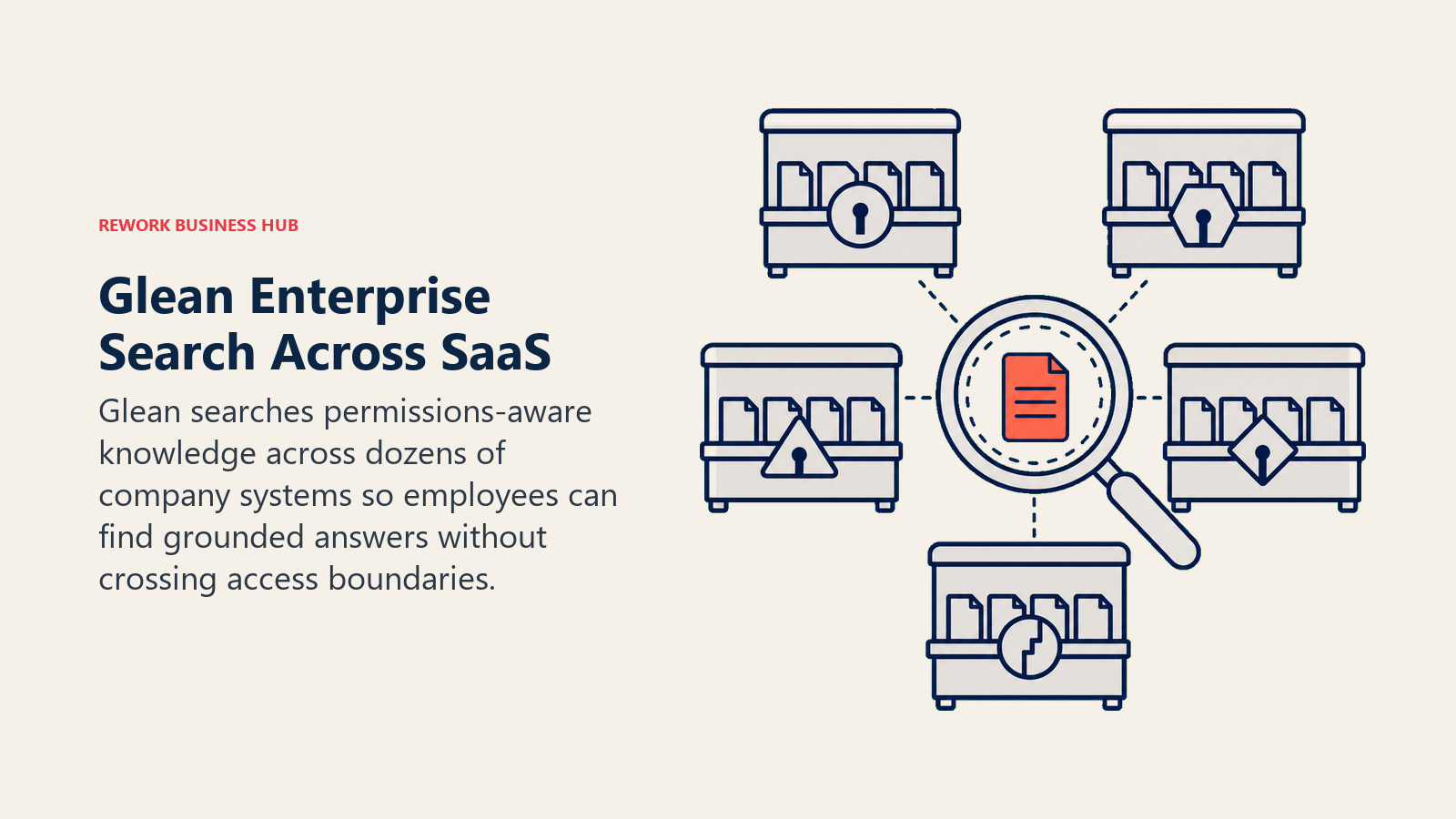
For large enterprises drowning in tool sprawl, that unified search layer solves a real problem generic chatbots can't: ChatGPT and Copilot are excellent at generating and reasoning, but they don't know what's in your company's internal wiki unless you build the integration yourself. Glean does that integration work as the product.
| What you get | What you don't |
|---|---|
| 100+ pre-built connectors across enterprise SaaS tools | Quote-only pricing with a high enterprise ACV floor |
| Permissions-aware search respects existing access controls | ~100-seat minimum locks out smaller deployments |
| FlexCredits meter advanced "thinking mode" usage separately | Consumption charges beyond seat can be hard to forecast |
| Strong fit for knowledge-heavy, tool-sprawling enterprises | Overlaps with Copilot and Gemini's native search features |
Pricing: Quote-only. Industry estimates run $50-75+/seat/month (base seat plus AI add-on), with enterprise contracts typically starting around a $60,000/year minimum.
Best for: Large enterprises with significant SaaS tool sprawl that need one search and assistant layer across all of it, not just Microsoft or Google's own ecosystem.
6. Writer: Governed Content Generation at Brand Scale
Writer's differentiator is governance, not raw model capability. The platform layers brand voice controls, style guide enforcement, and a "Knowledge Graph" of approved company data on top of underlying foundation models, so content generated across a 5,000-person marketing and communications org stays on-brand and factually grounded in real company data rather than the model's general training.
That governance layer is exactly what generic chatbots lack out of the box: ChatGPT and Claude can write well, but they don't know your brand guidelines or your approved product claims unless you build that context every time. Writer builds it once, centrally, and applies it everywhere.
| What you get | What you don't |
|---|---|
| Centralized brand voice and style guide enforcement | Full governance value requires the Enterprise tier |
| Knowledge Graph grounds output in approved company data | Custom agent limits are capped below Enterprise tier |
| 100+ prebuilt agents for common content workflows | Narrower general-purpose reasoning than Claude or ChatGPT |
| Strong fit for regulated marketing (financial services, healthcare) | Best value requires committing to the full platform, not a la carte |
Pricing: Starter $29/seat/month (annual) or $39/month billed monthly; Enterprise custom-quoted. Official pricing.
Best for: Enterprise marketing, communications, and content operations teams that need brand-consistent, governed AI writing at scale, not general-purpose reasoning.
7. Cohere (North): Private, Isolated AI for Security-First Enterprises
Cohere's enterprise product, North, is built for one specific buyer: the enterprise that cannot put its data in a shared multi-tenant cloud, full stop. North deploys AI agents, search, and automation inside your own environment with full data isolation, which makes it a fit for financial services, defense-adjacent, and highly regulated industries where "we'll sign a DPA" isn't a sufficient answer to the security team.
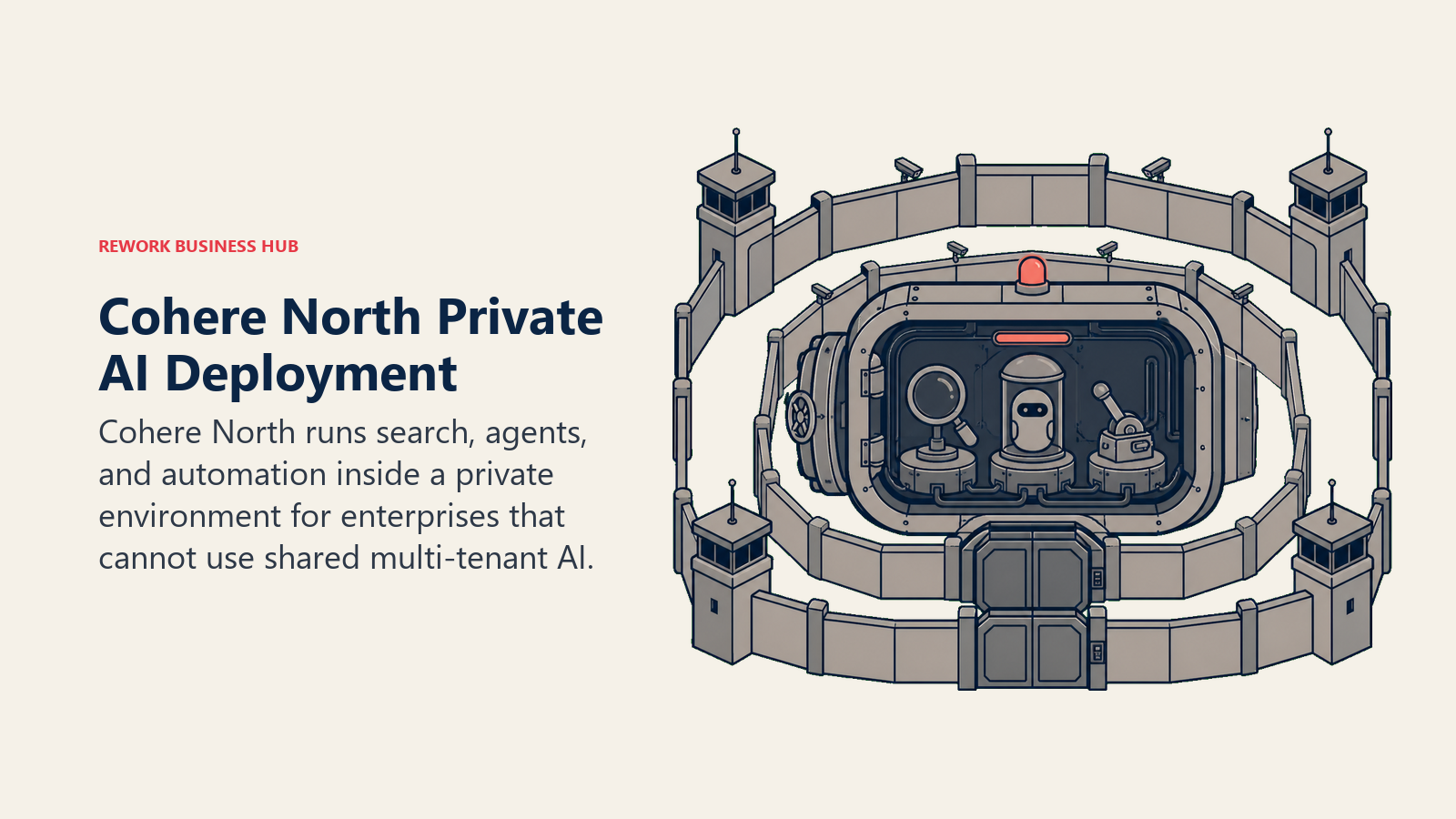
That isolation comes at a real cost floor. North is enterprise-only, with no self-serve tier and typical annual minimums reported north of $100,000. Deployments take weeks to months to configure fully, which rules it out for teams on a tight timeline or without a dedicated implementation budget.
| What you get | What you don't |
|---|---|
| Full data isolation, deployable in your own cloud environment | No self-serve tier or free trial; sales-led only |
| Strong fit for financial services and regulated industries | Typical $100K+ annual minimum commitment |
| Command R+ and Command A models tuned for enterprise RAG | Deployment timelines run weeks to months, not days |
| Model Vault option for dedicated inference infrastructure | Not a fit for SMB or fast-moving mid-market teams |
Pricing: Quote-only, enterprise sales-led. Typical minimums reported at $100,000+ annually. Official pricing page.
Best for: Security-first enterprises (financial services, defense-adjacent, highly regulated industries) that need full data isolation and cannot use a shared multi-tenant AI service.
8. Salesforce Agentforce: Agents Native to Your CRM Data
Agentforce's advantage is that it doesn't require moving data anywhere: agents run directly inside the Salesforce data model, so a customer service or sales agent has native access to case history, opportunity data, and CRM records without a separate integration project. For enterprises already running Salesforce at scale, that native access is the fastest path to a working agent.
The pricing is genuinely confusing in 2026, and worth reading carefully before committing. Salesforce offers $2 per conversation for customer-facing agents, Flex Credits at $500 per 100,000 credits (roughly $0.10 per agent action) for broader consumption-based use, and a $5 per user per month Agentforce User License that still requires Flex Credits underneath it. A free "Foundations" tier (200,000 Flex Credits included) ships with Enterprise Edition and above. Critically, Flex Credits and Conversations cannot run in the same org, so pick a model before deployment, not after. If you're building sales-specific agents rather than general assistants, our best AI tools for sales guide covers the broader field.
| What you get | What you don't |
|---|---|
| Native to existing Salesforce CRM data, no integration needed | Three incompatible pricing models require an upfront decision |
| Free Foundations tier included with Enterprise Edition+ | Foundations tier is limited; real usage needs a paid tier |
| Strong fit for sales and service agents inside Salesforce | Limited value if your CRM isn't already Salesforce |
| Flex Credits scale with actual agent action volume | Per-action pricing is hard to forecast before deployment |
Pricing: $2/conversation (customer-facing agents) or Flex Credits at $500/100K credits, or Agentforce User License $5/seat/month (requires Flex Credits). Official pricing.
Best for: Enterprises already running Salesforce that want agents embedded directly in existing sales and service workflows without a separate data integration project.
9. ServiceNow (Now Assist): AI Embedded in Enterprise Workflow Automation
ServiceNow's bet is that the highest-value enterprise AI isn't a chatbot, it's automation embedded inside the workflows that already run IT service management, HR case management, and customer service operations. Now Assist generates ticket summaries, suggests resolutions, and automates routine workflow steps directly inside the Now Platform rather than as a separate assistant employees have to remember to open.
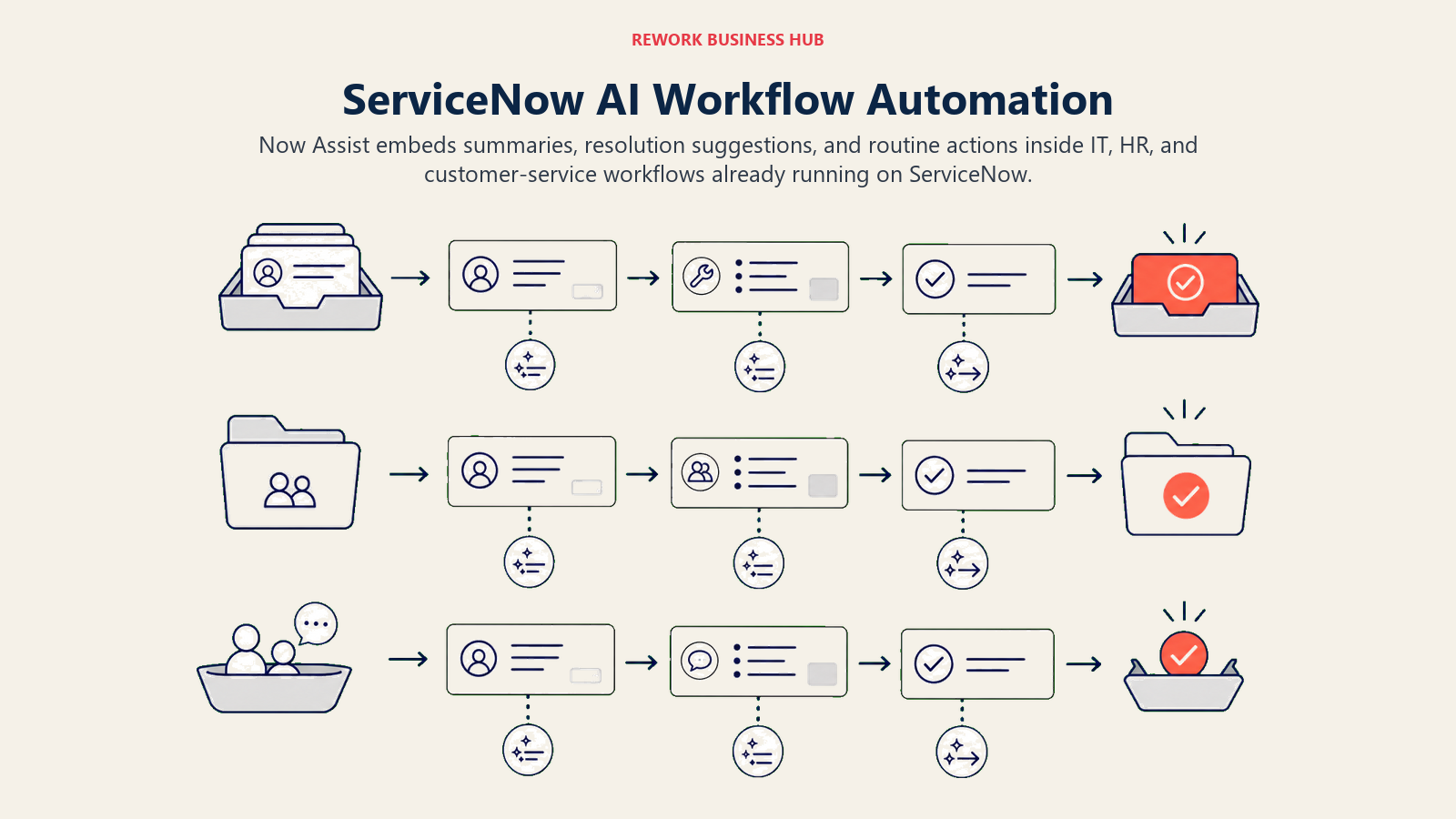
As of April 2026, ServiceNow retired its older, more fragmented licensing structure and consolidated everything into three AI-native tiers: Foundation, Advanced, and Prime, with Now Assist bundled into all three instead of sold separately. Pricing remains entirely quote-only; industry estimates put Foundation-level access around $70-100 per user before AI consumption, climbing to $160-200+ for Prime, with Now Assist adding roughly a 25-45% premium on top depending on usage. For enterprises running high-volume support operations, the best AI tools for customer support guide covers dedicated CX platforms alongside ITSM-embedded options like this one.
| What you get | What you don't |
|---|---|
| AI embedded directly in ITSM, HR, and CS workflows | No published pricing anywhere in the product line |
| Simplified into 3 tiers as of April 2026 (was more fragmented) | Now Assist premium adds 25-45% on top of base licensing |
| Strong fit for large enterprises already running ServiceNow | Real-world cost swings widely by platform size and usage |
| Consumption-based "assist" units track granular AI usage | Requires ServiceNow platform commitment, not standalone |
Pricing: Quote-only. Industry estimates: Foundation ~$70-100/user/month, Prime $160-200+/user/month, before AI consumption. Now Assist adds an estimated 25-45% premium.
Best for: Large enterprises already running ServiceNow for IT, HR, or customer service that want AI embedded directly into existing workflow automation.
10. Amazon Q Business: AWS-Native Assistant (Closing to New Customers)
Amazon Q Business connects directly to AWS-native data sources (S3, Redshift, internal AWS applications) and enterprise SaaS connectors, giving AWS-standardized engineering organizations an assistant that understands their existing cloud infrastructure without a separate data pipeline. Pricing is the most transparent on this list: Lite at $3 per user per month for basic functionality, Pro at $20 per user per month for the full feature set including Amazon Q Apps.
The critical caveat, and the reason this entry ranks lower despite clean pricing: Amazon Q Business stops accepting new customers on July 31, 2026. Existing customers continue unaffected, but any enterprise starting a fresh evaluation today needs to know this before building a shortlist around it.
| What you get | What you don't |
|---|---|
| Clearest, most transparent published pricing on this list | Closed to new customers as of July 31, 2026 |
| Native AWS data source connectors (S3, Redshift, and more) | Weaker fit for non-AWS or multi-cloud enterprises |
| Amazon Q Apps for lightweight internal app building | Feature set narrower than Glean or Gemini Enterprise |
| Low entry price at $3/seat/month for the Lite tier | New-customer freeze makes it a poor long-term bet today |
Pricing: Lite $3/seat/month; Pro $20/seat/month. Closed to new customers starting July 31, 2026. Official pricing.
Best for: Existing AWS Business customers already using Q Business; not recommended as a new evaluation given the July 2026 new-customer freeze.
11. IBM watsonx: Built-In Governance for Regulated Industries
IBM's watsonx suite (watsonx.ai, watsonx.data, watsonx.governance) is built around a single conviction: regulated enterprises won't deploy AI without model risk management, audit trails, and explainability built in from day one, not bolted on afterward. watsonx.governance specifically tracks model lineage, bias, and compliance across every model in production, including third-party models, which is a genuinely differentiated capability for banks, insurers, and healthcare systems facing model-risk regulation.
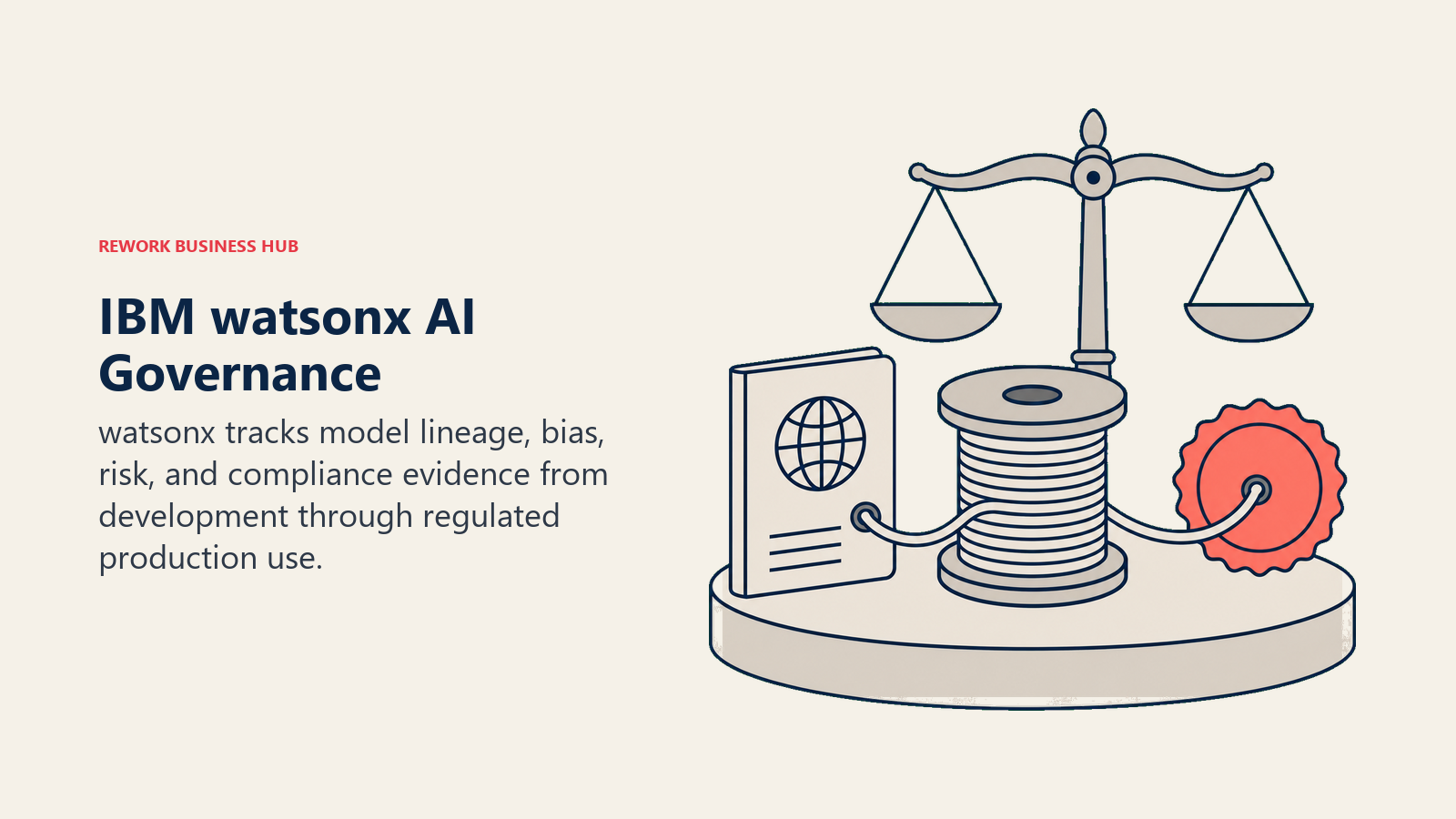
Pricing is complex and multi-product. watsonx.ai runs $0.60-$20 per million tokens on IBM's Granite models with a $1,500-$5,000 per month regional minimum; the Standard runtime plan is a flat $1,110 per month including a block of compute-unit hours; watsonx.governance runs $5,000-$25,000 per month flat for the standard tier. Enterprises bundling all three products at $1.5M+ in annual contract value typically see 30-45% discounts off standalone pricing.
| What you get | What you don't |
|---|---|
| watsonx.governance tracks model risk across all production models | Multi-product pricing is genuinely complex to model upfront |
| On-premise and hybrid deployment via watsonx Software | SaaS pricing adds 10-25% for hyperscaler infrastructure |
| Strong fit for banks, insurers, healthcare under model-risk rules | Less mindshare and ecosystem than OpenAI, Microsoft, or Google |
| Bundle discounts of 30-45% at large enterprise contract sizes | Requires real commitment to see the best pricing |
Pricing: watsonx.ai $0.60-$20/million tokens ($1,500-$5,000/mo regional minimum); Standard runtime $1,110/mo; watsonx.governance $5,000-$25,000/mo. Official pricing.
Best for: Banks, insurers, healthcare systems, and other regulated enterprises where model governance and audit trails are a compliance requirement, not a nice-to-have.
12. Databricks Mosaic AI: Custom AI Built on Your Own Data Lakehouse
Databricks isn't an off-the-shelf assistant, it's the platform enterprises use to build one on their own data. Mosaic AI provides model training, fine-tuning, and serving infrastructure directly on top of the Databricks lakehouse, so data science and ML engineering teams can build custom models grounded in proprietary company data rather than relying entirely on a third-party foundation model. Enterprises running heavy internal analytics workloads often pair this with our best AI tools for data analysis guide when deciding which layer of the stack to buy versus build.
Pricing is entirely consumption-based, not per-seat, which is a fundamentally different budgeting exercise than every other tool on this list. Foundation model serving starts around $0.07 per DBU and can exceed $0.70 per DBU for serverless SQL operations; GPU-intensive training workloads range $0.55-$3.75 per DBU-hour. Production agents requiring always-on availability commonly run $5,000-$15,000 per month in base compute for a single workflow, before the platform license itself.
| What you get | What you don't |
|---|---|
| Full model training and fine-tuning control on your own data | Not an off-the-shelf assistant; requires ML engineering capacity |
| Consumption-based pricing scales precisely with actual usage | Consumption billing is hard to forecast without usage history |
| Deep integration with existing Databricks lakehouse data | Enterprise tier pricing negotiated, not published |
| Strong fit for teams building proprietary, differentiated AI | Overkill for enterprises that just need a chat assistant |
Pricing: Consumption-based DBU pricing, roughly $0.07-$0.70+/DBU depending on workload; GPU training $0.55-$3.75/DBU-hour. Enterprise tier negotiated. Official pricing.
Best for: Enterprises with a dedicated data engineering and ML team that need to build custom, proprietary AI on their own data rather than buy a general-purpose assistant.
13. Palantir AIP: Mission-Critical Decision Intelligence
Palantir's positioning is deliberately different from every other tool on this list: AIP is built for high-stakes, complex-data decisions in government, defense, healthcare, and critical infrastructure, where the AI's output feeds directly into operational decisions, not draft content or search results. The platform's core strength is data integration across dozens of disconnected, often classified or highly sensitive systems, then applying AI reasoning on top of that unified operational picture.
Pricing reflects that positioning: there's no published list price, and enterprise Foundry and AIP deals are negotiated annual platform fees that vary by a factor of two to three between comparable mid-size deployments depending on data volume, integration complexity, and professional services scope. A free self-serve tier (AIP Now) exists for small-scale experimentation, but real enterprise deployment runs through a sales-led, often multi-month process.
| What you get | What you don't |
|---|---|
| Deepest data integration for complex, high-stakes environments | No published pricing; every deal is individually negotiated |
| Full on-premise and air-gapped deployment options | Long, sales-led deployment cycles (weeks to months) |
| Strong government, defense, and critical infrastructure track record | Overkill and cost-prohibitive for typical commercial use cases |
| Free AIP Now tier for small-scale self-serve experimentation | Not built for general-purpose office productivity use |
Pricing: Quote-only, negotiated annual platform fee. Free self-serve tier available for small-scale use. Official product page.
Best for: Government agencies, defense contractors, and critical infrastructure operators making high-stakes operational decisions on complex, sensitive data.
14. Grok (SpaceXAI): One Model Family Across Text, Code, Voice, and Video
Grok is the odd entry on this list, and it is worth saying why before the detail. Most platforms above are enterprise applications: a seat, an admin console, a deployment project. Grok is a model family reached through one API, so what an enterprise buys here is capacity rather than a product, and someone internal has to build the thing employees actually use. For a company that already has that team, the appeal is consolidation: text, code, voice, images, and video from one vendor and one contract instead of four.
On cost it is genuinely cheap for a frontier model, and unusually, the rate card is public. The flagship grok-4.7 runs $2.00 per million input tokens and $6.00 per million output against a 500,000-token context window. The other modalities meter separately: the voice agent at $0.08 a minute, text to speech at $15 per million characters, speech to text from $0.10 an hour, images from $0.02 each, and video from $0.05 a second. Access is also available through Google Cloud Vertex AI and Microsoft Foundry, which matters if procurement would rather add a line to an existing cloud contract than onboard a new vendor.
On governance, this is the newest name on the list and should be evaluated that way. The published enterprise plumbing is real: regional endpoints for data residency, mTLS authentication, prompt caching, and a batch API. But compliance paperwork and volume terms route through sales rather than a self-serve page, and the platform publishes model retirement dates, which means version pinning and periodic migration work that a stable enterprise app would not impose. Regulated buyers should confirm the specific certifications they need rather than assume parity with the incumbents above. Teams scoping a broader shortlist first should start with our best AI tools overview.
| What you get | What you don't |
|---|---|
| Public per-token pricing, cheap for a frontier model | A finished enterprise app; you build the interface |
| One API spanning text, code, voice, images, and video | Self-serve compliance terms; those go through sales |
| Available via Google Cloud Vertex AI and Microsoft Foundry | On-premise or air-gapped deployment |
| Regional endpoints, mTLS, prompt caching, batch API | A long governance track record to point procurement at |
Pricing: grok-4.7 at $2.00 per million input tokens and $6.00 per million output, 500k context. Voice agent $0.08/minute, TTS $15 per million characters, STT from $0.10/hour, images from $0.02, video from $0.05/second. Enterprise terms via sales. Official pricing.
Best for: Enterprises with an internal engineering team that want one model family across text, code, and media on a published rate card, and that do not need on-premise deployment.
Enterprise AI Buying Mistakes to Avoid
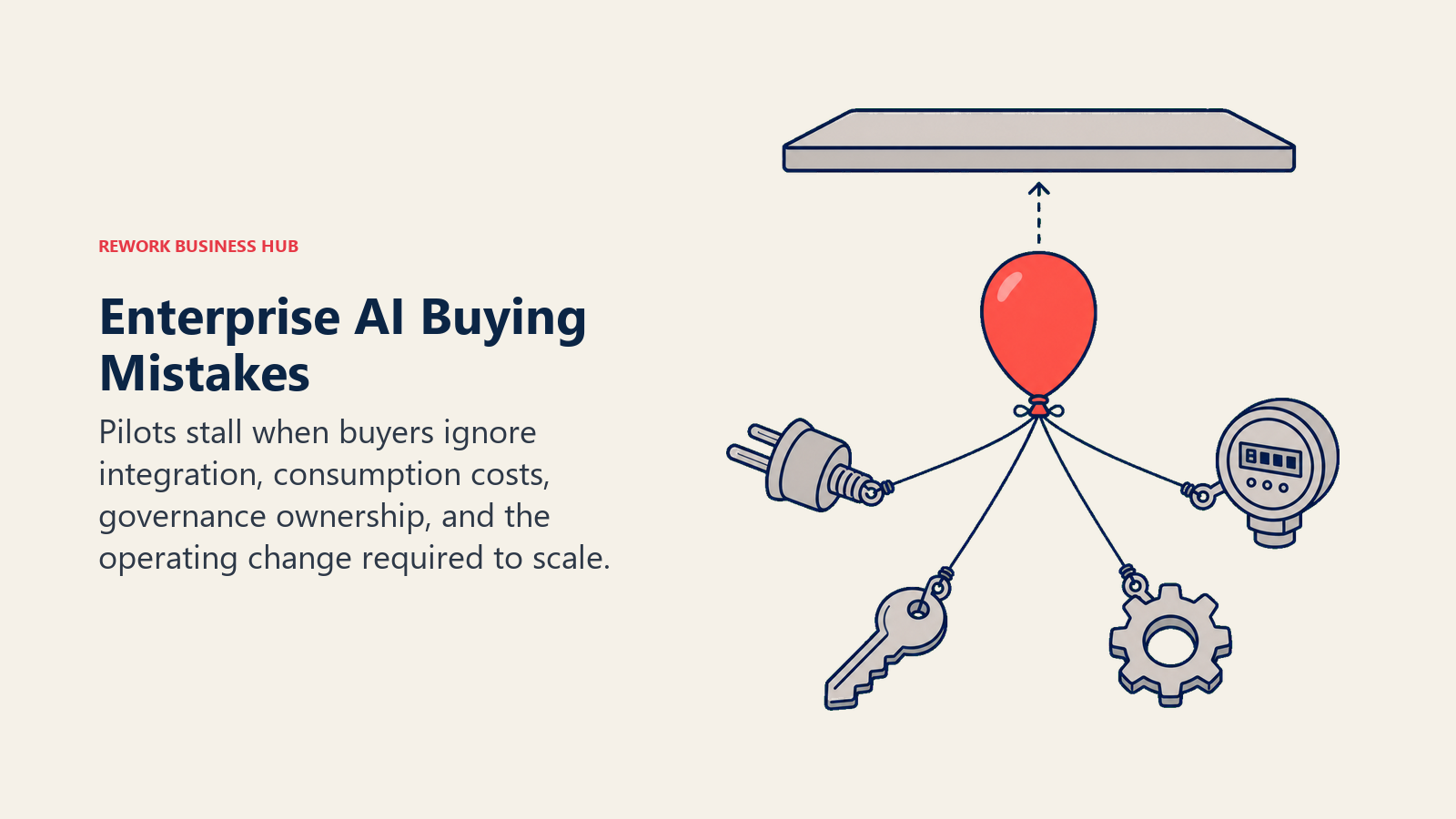
Most enterprise AI deployments fail to scale past the pilot stage, and the data backs that up: per McKinsey, only about a third of organizations have scaled AI beyond pilots, and just 6% qualify as AI high performers attributing more than 5% of EBIT to AI. Per Deloitte, 85% of companies expect to customize agents to their business, but only 34% report using AI to deeply transform how the business runs. Before you buy, it helps to understand the governance gap in AI at work that causes most of these stalls.
| Mistake | What It Looks Like | What to Do Instead |
|---|---|---|
| Buying the model, not the governance layer | Choosing the best benchmark score without asking about audit trails | Evaluate governance and compliance controls before model quality |
| Ignoring the seat-plus-usage math | Budgeting only for the published seat price | Model total cost including token, credit, or DBU consumption |
| Committing to one pricing model too early | Locking into Flex Credits or per-conversation pricing blind | Pilot with real usage data before committing to a billing model |
| Skipping the data residency question | Assuming SaaS-only is fine until legal or security objects | Confirm VPC or on-premise options exist before shortlisting |
| Treating agentic AI as a sure thing | Greenlighting broad agent rollouts on hype alone | Scope pilots narrowly; Gartner expects 40%+ of agentic projects canceled by 2027 |
| Underestimating change management | Assuming a good tool guarantees adoption | Budget for training and workflow redesign, not just licenses |
| Not defining what ROI actually means | Measuring seat activation instead of business outcomes | Tie AI spend to a specific, measurable outcome before renewal |
Understanding how AI actually earns its keep matters more than the tool itself. Our guide on measuring AI ROI walks through the frameworks that separate a real productivity gain from an activation metric that looks good in a board deck but doesn't move EBIT.
Decision Framework
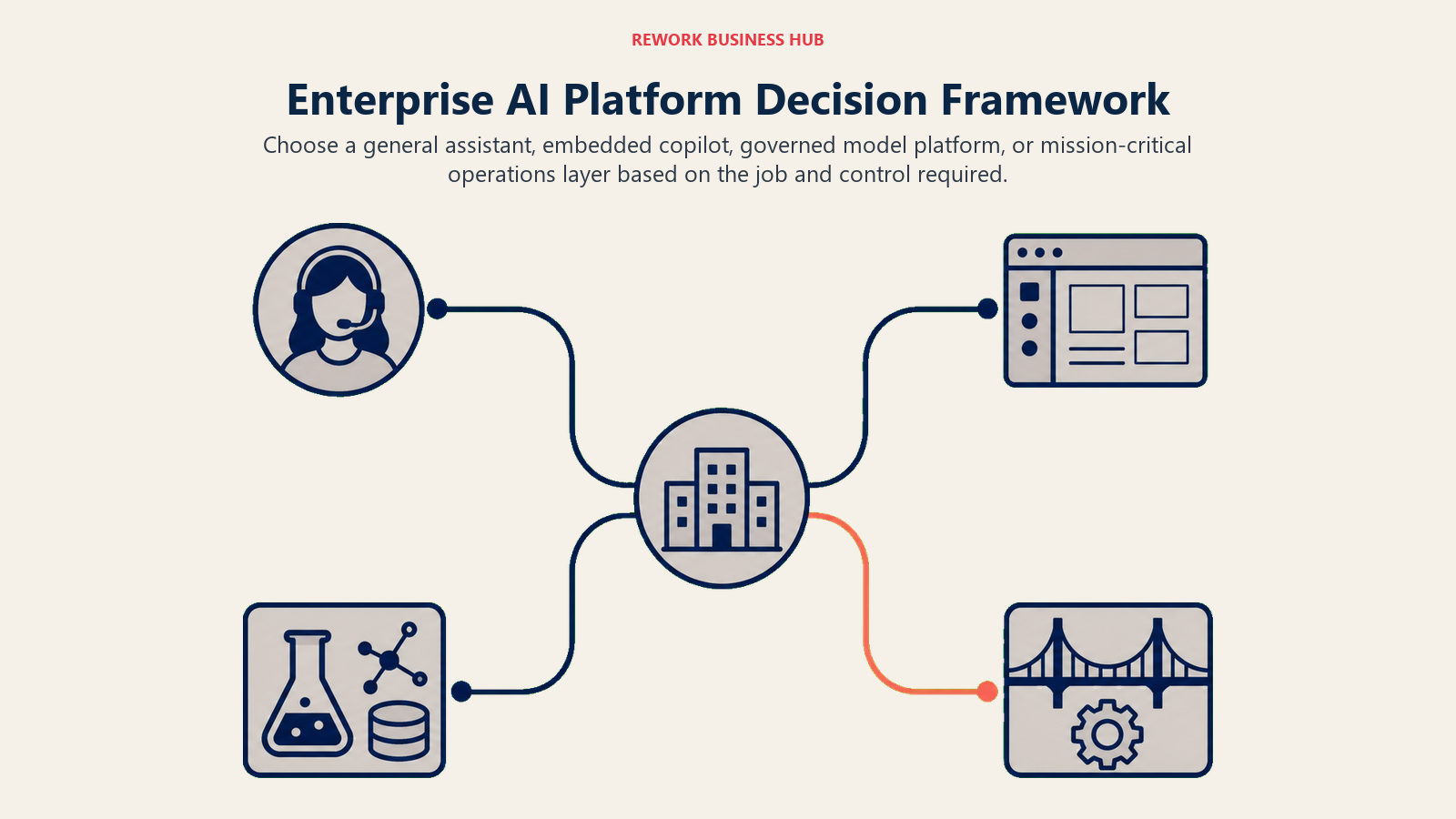
The right platform category depends on the job, existing system, and control level the enterprise needs.
| If you need... | Pick... | Why |
|---|---|---|
| A general-purpose assistant with the widest model access | ChatGPT Enterprise | Broadest tool ecosystem, fastest release cadence |
| AI embedded directly into Word, Excel, Teams, Outlook | Microsoft 365 Copilot | Native to the Office suite; no new app to adopt |
| The strongest long-context reasoning and agentic coding | Claude Enterprise | Consistently leads independent reasoning benchmarks |
| Deep integration with Google Cloud and Workspace | Google Gemini Enterprise | Native fit for orgs already on Google infrastructure |
| Unified search across 50+ scattered enterprise SaaS tools | Glean | Purpose-built for tool-sprawl knowledge search |
| Brand-governed content generation at marketing scale | Writer | Centralized brand voice and approved-data grounding |
| Full data isolation for security-first industries | Cohere (North) | Deploy entirely inside your own environment |
| Agents that run natively inside existing Salesforce data | Salesforce Agentforce | No separate integration project required |
| AI embedded in ITSM, HR, and CS workflow automation | ServiceNow (Now Assist) | Deepest fit for enterprises already on the Now Platform |
| Built-in model governance for regulated industries | IBM watsonx | watsonx.governance tracks model risk and compliance |
| Custom AI trained and served on your own data lakehouse | Databricks Mosaic AI | Full control for teams with ML engineering capacity |
| Mission-critical decision intelligence on complex, sensitive data | Palantir AIP | Deepest data integration for high-stakes operational decisions |
| One vendor for text, code, voice, and video generation | Grok (SpaceXAI) | Single API and contract across every modality, priced per token |
Frequently Asked Questions about Enterprise AI Tools
What's the best AI tool for enterprise in 2026?
There's no single best enterprise AI tool. ChatGPT Enterprise and Microsoft 365 Copilot lead general-purpose assistant use, Claude Enterprise leads on reasoning and agentic coding, and specialized platforms like Glean, Writer, ServiceNow, and Palantir AIP fit specific workflows better than a general chatbot ever will. Match the tool to the job before comparing model quality.
How much does enterprise AI software actually cost?
Most enterprise AI vendors don't publish list prices. Where pricing is public, per-seat costs range from about $3/month (Amazon Q Lite) to $60+/month (Google Gemini Enterprise Plus), and consumption-based platforms like Claude Enterprise, Databricks, and watsonx can push real total spend well beyond the headline seat price once usage is factored in.
What's the difference between ChatGPT Enterprise and Microsoft 365 Copilot?
ChatGPT Enterprise is a standalone assistant with the widest model and tool access; Microsoft 365 Copilot is embedded directly inside Word, Excel, Outlook, and Teams and requires a separate M365 base license. Enterprises already standardized on Microsoft 365 generally see faster adoption with Copilot; those wanting the broadest model capability tend to prefer ChatGPT Enterprise.
Which enterprise AI tools support on-premise or air-gapped deployment?
Cohere (North), IBM watsonx, and Palantir AIP all offer on-premise or air-gapped deployment options. Claude Enterprise, Google Gemini Enterprise, Amazon Q Business, and Databricks Mosaic AI support VPC or private-cloud deployment but not full on-premise. ChatGPT Enterprise, Microsoft 365 Copilot, and Salesforce Agentforce are SaaS-only.
Should an enterprise standardize on one AI vendor or run multiple?
Most large enterprises now run more than one model family in production rather than standardizing on a single vendor, since different tools genuinely win at different jobs (reasoning, workflow embedding, governance, data isolation). The tradeoff is added procurement and governance overhead, which is why a clear, documented vendor evaluation process matters more as the stack grows.
What security and compliance certifications should enterprise AI tools have?
At minimum, SSO/SAML, SOC 2 Type II, audit logging, and data retention controls. Regulated industries should also confirm model-level governance (lineage, bias tracking, explainability), which is where watsonx.governance and similar tools differentiate from platforms that only offer access controls without model risk management.
Is agentic AI actually ready for enterprise deployment in 2026?
Selectively. Gartner projects 40% of enterprise applications will carry task-specific agents by the end of 2026, but also predicts more than 40% of agentic AI projects will be canceled by the end of 2027 due to unclear value or inadequate risk controls. Treat broad agentic rollouts with the same scrutiny as any other high-risk IT investment, not as a guaranteed win.
How long does a typical enterprise AI deployment take?
It varies enormously by platform. Microsoft 365 Copilot and ChatGPT Enterprise can be provisioned in days for teams already on the underlying infrastructure. Glean, ServiceNow, watsonx, and Palantir AIP typically involve weeks-to-months of integration and configuration work before a production rollout.
What to Do Next
Narrow to two or three platforms before you schedule a demo, and treat the deployment model and pricing structure as disqualifying criteria just as much as capability. Run a scoped pilot with real usage data (not a sales demo) before committing to any per-conversation, Flex Credit, or DBU-based pricing model, since those only make sense once you know your actual volume. And if governance is a compliance requirement rather than a nice-to-have, revisit it before you sign anything, not after.
If your team is evaluating a broader AI stack rather than a single enterprise platform, our best AI tools in 2026 guide covers the full category landscape, from coding assistants to content generation to meeting tools, for teams building a complete stack rather than a single enterprise deployment.

Principal Product Marketing Strategist
On this page
- Key Facts
- Updated July 2026: What Changed
- Quick Comparison Table
- How to Evaluate Enterprise AI Tools
- Deployment Model Comparison
- Rollout Scope Fit Matrix
- Sizing and Persona Table
- 1. ChatGPT Enterprise: Broadest Model Access, Largest Ecosystem
- 2. Microsoft 365 Copilot: Embedded Where Enterprise Work Already Happens
- 3. Claude Enterprise: Long Context, Agentic Coding, and Careful Reasoning
- 4. Google Gemini Enterprise: Deepest Fit for Google Cloud and Workspace Shops
- 5. Glean: Enterprise Search Across Every System You Already Own
- 6. Writer: Governed Content Generation at Brand Scale
- 7. Cohere (North): Private, Isolated AI for Security-First Enterprises
- 8. Salesforce Agentforce: Agents Native to Your CRM Data
- 9. ServiceNow (Now Assist): AI Embedded in Enterprise Workflow Automation
- 10. Amazon Q Business: AWS-Native Assistant (Closing to New Customers)
- 11. IBM watsonx: Built-In Governance for Regulated Industries
- 12. Databricks Mosaic AI: Custom AI Built on Your Own Data Lakehouse
- 13. Palantir AIP: Mission-Critical Decision Intelligence
- 14. Grok (SpaceXAI): One Model Family Across Text, Code, Voice, and Video
- Enterprise AI Buying Mistakes to Avoid
- Decision Framework
- What to Do Next