More in
Sales Tech News
AI Sales Teams Grow 2.6x Faster. Gartner Says Buyers Still Want a Rep
Jun 6, 2026
Aircall Bought Piper AI to Turn Every Sales Call Into Pipeline
Jun 6, 2026
Salesforce Just Handed Marketers AI Agents That Build Sales Pipeline
Jun 6, 2026
Revenue Intelligence Showed You the Risk. Revenue Execution Acts on It.
Jun 5, 2026
Meta Put an AI Agent in WhatsApp That Closes Sales for Any Business
Jun 4, 2026
VCs Poured Over $200M Into AI Sales Startups: The GTM Stack Signal
Jun 4, 2026
Are AI SDRs Worth It in 2026? The Data Says Build a Hybrid Team
Jun 3, 2026
GTM Engineering in 2026: The Sales Hire That Replaces Three Roles
Jun 3, 2026
ZoomInfo Feeds Verified Data to Your AI Sales Agents: The Single-Vendor Tradeoff
Jun 3, 2026
Salesforce Summer '26 Drops Multi-Agent Orchestration June 15. Here's the Sales Ops Audit Before Your Agents Start Handing Off
Jun 2, 2026
ZoomInfo Is Now $GTM: Your Sales Stack Evaluation Just Got More Complicated
Turn this article into takeaways for your work.


Each assistant summarizes the article only for you and suggests best practices for your work.
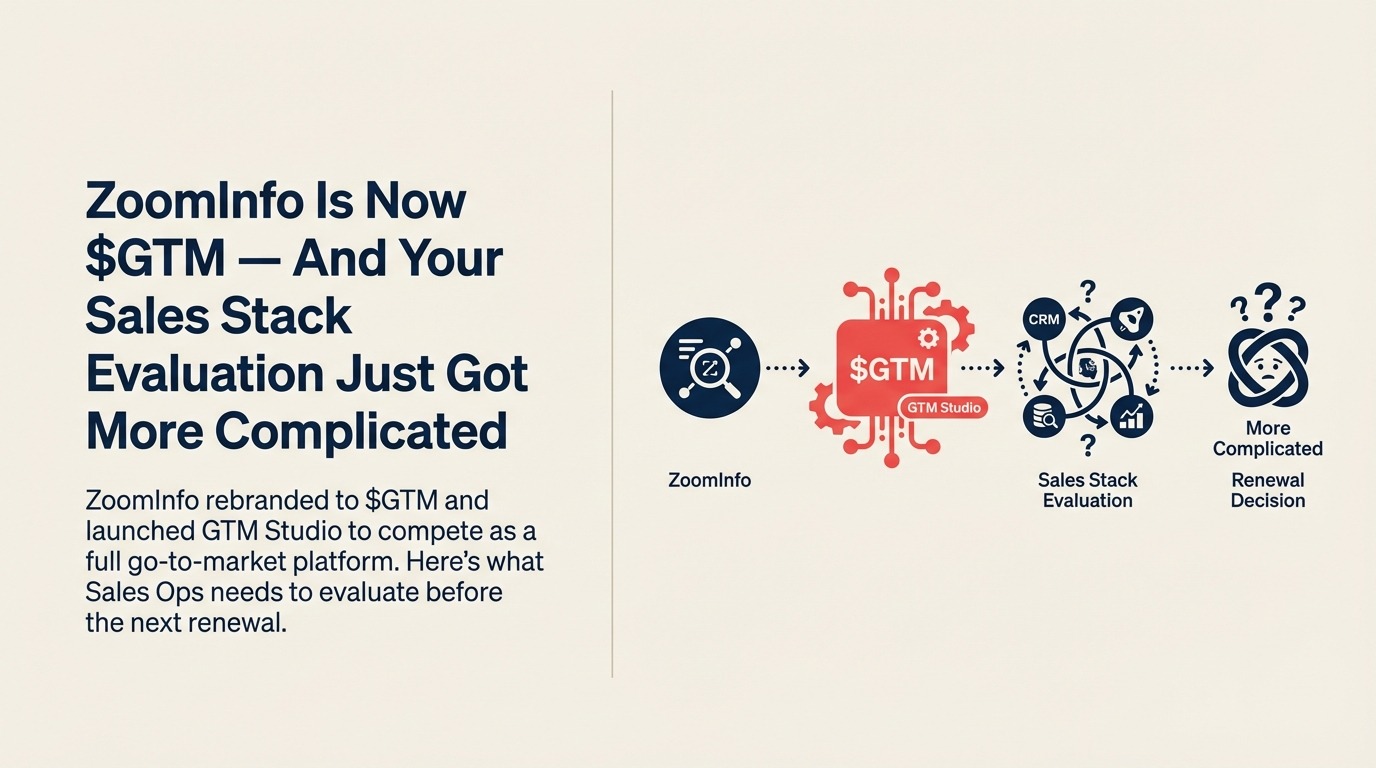
When a company changes its stock ticker, it's rarely a neutral signal. Tickers are how companies signal to Wall Street, and to their customers, what they think they are. ZoomInfo changing from ZI to GTM in May 2025 was a declaration that the company no longer wants to be evaluated as a B2B data vendor. It wants to be evaluated as a go-to-market platform.
According to a Business Wire announcement, ZoomInfo changed its Nasdaq trading symbol to GTM on May 13, 2025, alongside the simultaneous launch of GTM Studio. The market responded with a 7% stock jump on the day of the announcement. Whether that momentum reflects the product's actual capability is the question Sales Ops teams need to answer before their next contract cycle.
What ZoomInfo Actually Changed
The ticker change is symbolic. GTM Studio is substantive.
GTM Studio is described as an AI-powered workspace that lets revenue teams design, orchestrate, and activate go-to-market campaigns in real time using ZoomInfo's data as the underlying engine. The pitch is that instead of exporting ZoomInfo data into separate tools for segmentation, sequencing, and campaign execution, teams can do that work directly inside ZoomInfo's platform.
The company's existing Copilot product plays alongside this. Copilot surfaces prioritized accounts based on real-time intent signals and recommends next actions for sales reps. Copilot Workflows extend that by automating the follow-through, triggering outreach sequences, updating CRM fields, and assigning tasks based on account changes or engagement thresholds.
The fuller platform picture includes over 500 million contacts, 100 million companies, and over 135 million verified phone numbers, processed against more than a billion buying signals per month. That data foundation is still the core asset. What's new is the orchestration layer built on top of it.
The Mental Model Shift You Need to Make
Most Sales Ops teams evaluate ZoomInfo as a prospecting data source. You evaluate it against Cognism, Apollo, Lusha, and similar vendors on data quality, coverage, compliance, and enrichment accuracy. That's still a valid evaluation lens.
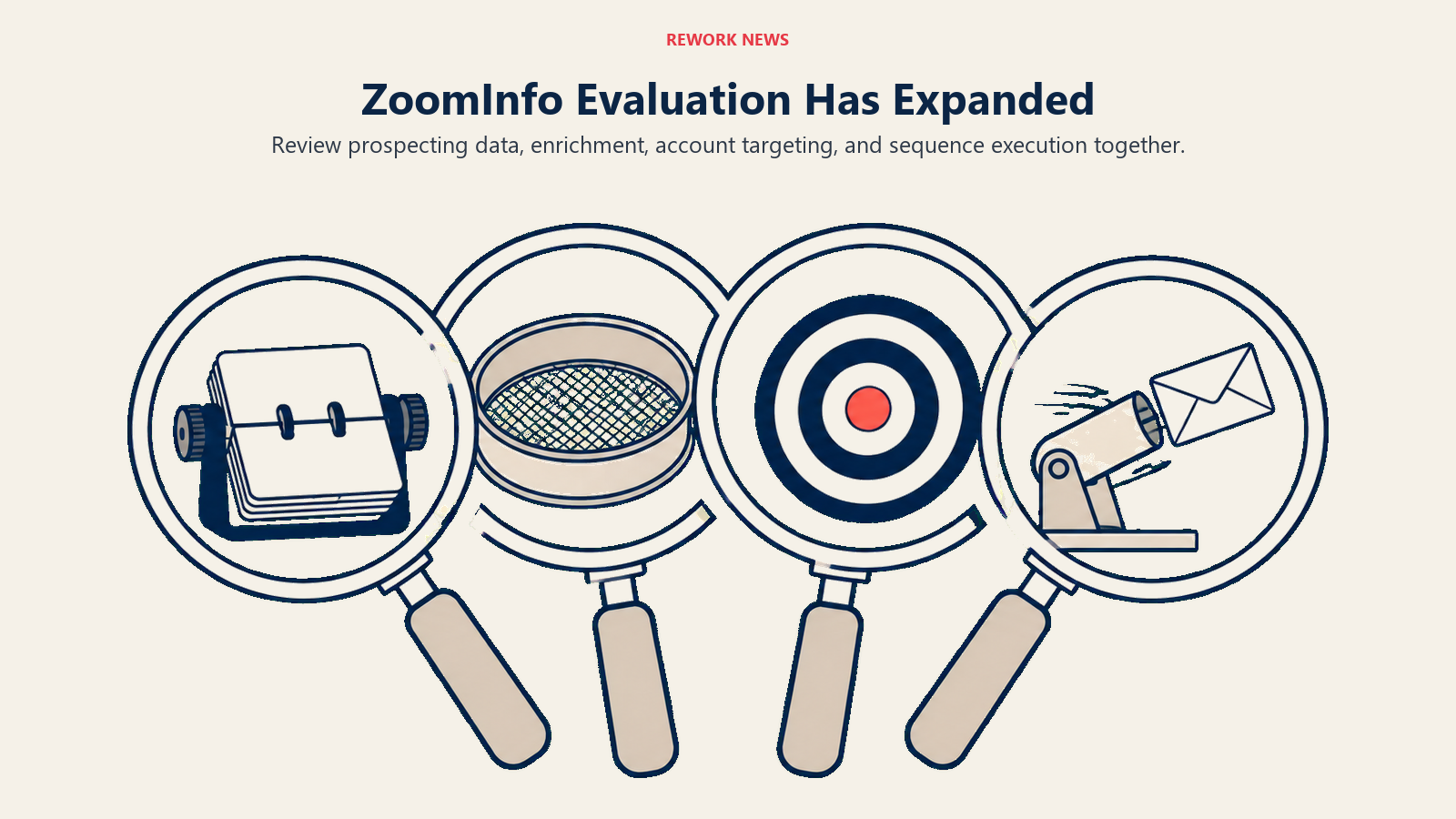
But ZoomInfo is now also trying to compete with a different set of vendors. GTM Studio puts it in the same conversation as Clay for data enrichment and workflow orchestration, 6sense and Demandbase for ABM execution, Outreach and Salesloft for sequence execution logic, and potentially Salesforce and HubSpot at the campaign orchestration layer.
That expansion creates a different kind of evaluation question for Sales Ops: is the value in ZoomInfo's data asset, ZoomInfo's workflow capability, or both, and at what price point compared to assembling best-of-breed tools for each function?
A Framework for Re-Evaluating ZoomInfo in 2026
Step 1: Audit how you actually use ZoomInfo today. The most common failure mode in this evaluation is assuming that ZoomInfo GTM Studio is relevant because you already pay for ZoomInfo. Pull a usage report. What percentage of your ZoomInfo seats are actively used for prospecting versus enrichment versus intent monitoring? If most usage is data export into a separate tool, you're not yet getting value from the orchestration layer and don't have a baseline to evaluate GTM Studio against.
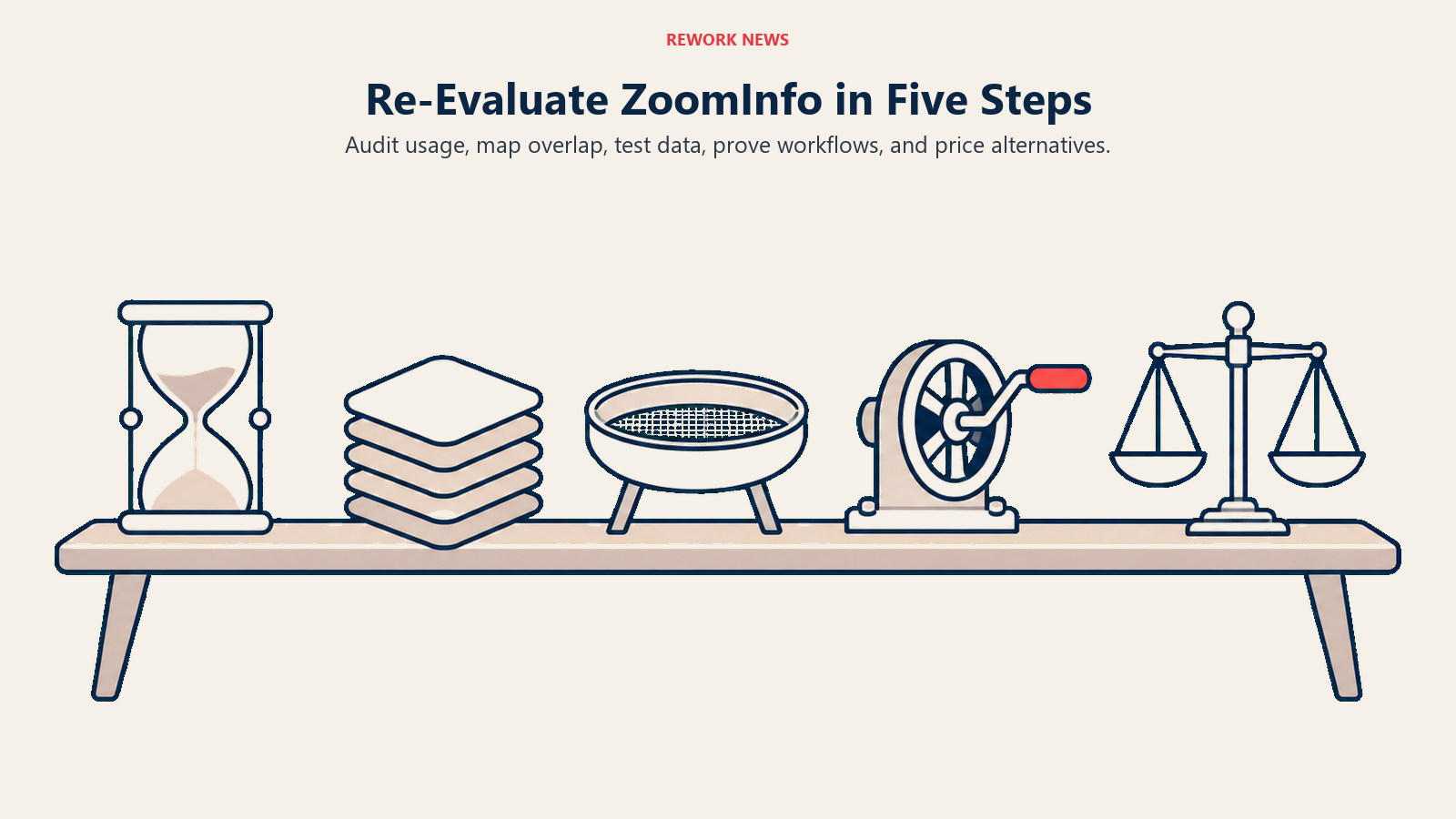
Step 2: Map the overlap between ZoomInfo's new capabilities and your current stack. Draw a one-page diagram of your current sales tech stack with arrows showing data flow. Then mark which tools GTM Studio claims to address. Where's the overlap? Where ZoomInfo already does something your team doesn't use in a separate tool, GTM Studio may be genuinely additive. Where it overlaps with tools you've built significant workflows in, the switching cost matters.
Step 3: Evaluate data quality separately from platform capability. ZoomInfo's competitive position historically rested on data coverage and accuracy. That hasn't changed. If Cognism or Apollo has caught up on data quality in your target market (especially for European contacts where GDPR compliance is a real differentiator), that's a separate evaluation track from whether GTM Studio works as an orchestration layer. Don't conflate them.
Step 4: Ask about Copilot Workflow limits and customization depth. The automated workflow capability sounds compelling in a demo, but Sales Ops teams know that sales workflows are rarely generic. Ask to see a live demonstration of a Copilot Workflow built around your specific qualification criteria and CRM field structure. The gap between what's demoed and what's configurable is where most platform evaluations reveal their actual scope.
Step 5: Price the full-platform versus point-tool comparison explicitly. ZoomInfo will offer bundled pricing to get you onto GTM Studio alongside your data license. Before you accept that bundled number as a benchmark, price what it would cost to get equivalent functionality from Apollo (data) plus Clay (enrichment workflows) plus your existing sequence tool. The comparison may favor ZoomInfo on simplicity. It may not favor them on cost per capability.
For a more detailed breakdown of CRM and data platform evaluation criteria, the CRM comparisons library has structured rubrics that apply directly to this kind of vendor reassessment. And if you're running a broader CRM implementation review, the data layer decision directly affects your integration architecture.
The Consolidation Bet Risk
ZoomInfo's GTM pivot is a consolidation bet. The company is betting that revenue teams will prefer one AI-native platform that does everything adequately over multiple specialized tools that each do one thing exceptionally well.
That bet works well for some teams. If you're a 30-person sales organization that doesn't have RevOps headcount to manage a complex tool stack, GTM Studio's all-in-one approach reduces operational overhead significantly. If you're a 200-person revenue team with differentiated workflows for enterprise and mid-market segments, best-of-breed probably still outperforms a single-vendor solution.
The layoff cycle ZoomInfo ran before the rebrand is also context worth holding. The company cut 6% of its global workforce as part of its upmarket refocus. That means ZoomInfo is a leaner organization now, with its engineering investment more concentrated. Watch closely whether product velocity on GTM Studio sustains through 2026 or whether it slows after the initial launch energy. Customer support quality sometimes degrades during these transitions. Check recent G2 and Gartner peer reviews for patterns before signing a multi-year deal.
For perspective on how the sales intelligence category is shifting alongside AI-native GTM platforms, the sales leadership insights library covers the broader strategic context for these vendor decisions.
What to Do This Week
Start with the renewal timeline, then test GTM Studio against the workflows your SDRs already use.

- Check your ZoomInfo contract end date and current ARR. If you're more than 6 months from renewal, add a calendar reminder for 90 days out to revisit this with fresh eyes on GTM Studio's maturity at that point.
- Request a GTM Studio demo focused on your actual workflows, not the scripted product demo. Bring two specific use cases: one where you currently export ZoomInfo data to a separate tool, and one where you manage account intent monitoring. See whether GTM Studio handles both without the export step.
- Run a one-week pilot of Copilot with your highest-performing SDR and give them full autonomy to use Copilot recommendations as their primary prioritization signal. Measure whether their meeting-booked rate changes. One rep's experience for one week isn't statistically significant, but it gives you a gut-check baseline before a broader evaluation.
- Survey your SDR team on current ZoomInfo usage friction. The most valuable input for a GTM Studio evaluation isn't what the vendor shows you. It's what your reps tell you they're not doing because the current tool is too slow or too cumbersome.
ZoomInfo changing its ticker to GTM is a signal worth taking seriously. But tickers don't close deals and press releases don't qualify leads. The GTM Studio launch deserves an evaluation on its own merits, with your actual workflows, your actual data needs, and your actual stack complexity as the measuring stick.
Learn More
- When Your Data Vendor Becomes Your Engagement Platform: Apollo's Shift, The same data-to-engagement consolidation story from a different vendor's angle
- Cognism Sales Companion: The Compliance-First Challenger, Comparing ZoomInfo's rebrand against a GDPR-native alternative
- CRM Buyers Checklist, Structured evaluation framework before any data vendor expansion
- AI Augmented Sales Teams Performance Data, What the research says about AI-assisted prospecting tools and actual meeting quality
Source: ZoomInfo Cements Go-To-Market Leadership with New Nasdaq Trading Symbol 'GTM' and Launch of GTM Studio | Business Wire, May 2025
