Single Source of Truth: Building a Customer Record Both Sales and CS Trust
Turn this article into takeaways for your work.


Each assistant summarizes the article only for you and suggests best practices for your work.
The new customer calls the CSM on Day 5 of onboarding. "Can I ask you something? Why did your sales team ask me about our ERP setup three times? Once during demos, once in the final proposal call, and now your implementation team is asking again."
The CSM pulls up the CRM. The AE's notes say "ERP integration discussed." That's it. No details, no requirements, no context on what was actually committed. The AE is already working two new deals. The CSM calls her own implementation lead to find out what they were asking the customer. Fifteen minutes of internal coordination on Day 5 of what was supposed to be a smooth onboarding.
This is the two-record problem. The AE has the deal story: the full context, the commitments made, the stakeholder dynamics, the reason the customer signed. That story lives in the AE's head, in a few disjointed CRM notes, and in email threads nobody will ever find. The CSM has the onboarding context: what's been configured, what's been promised in implementation, what the customer is tracking toward. That lives in the CS platform. Neither talks to the other. The customer record is actually two partial records pretending to be one.
The result is a customer who feels poorly handed off, a CSM who's reconstructing context that already existed, and an AE who gets pulled back into accounts they thought they'd closed because the CSM doesn't have enough information to operate independently.
What "Single Source of Truth" Actually Means
It doesn't mean one platform. It means one data ownership model.
The term itself has a precise technical origin: in information science, single source of truth (SSOT) refers to structuring data models so every element is mastered in exactly one place. The revenue ops application is the same principle applied to customer records: one ownership model, not necessarily one platform.
A single source of truth for a customer record is a defined set of fields, owned by defined roles, that both teams read from and write to as the authoritative account state. The specific system where those fields live (CRM, CS platform, or a shared document layer) is a secondary decision. The primary decision is: for each type of customer information, who owns it, who can update it, and where does it live? Marketing and Sales teams face the same challenge on the pre-sale side. The CRM as a single source of truth for the full revenue team covers how the same principles apply upstream, before a deal even reaches CS.
The customer record as a living document covers seven dimensions: account metadata, stakeholder map, deal history, commitments made, current health, open implementation and support issues, and renewal timeline. Each of these dimensions has a natural owner, a natural home, and an update cadence. The problem isn't that teams disagree about the data. It's that nobody wrote down who owns what, so both teams build parallel versions and diverge.
A single source of truth is also a shared contract between Sales and CS. When the AE marks an opportunity Closed-Won, they're committing to populate the record with everything CS needs to onboard the account. When the CSM takes over, they're committing to keep that record current through the customer lifecycle. The record isn't a CRM hygiene exercise. It's the mechanism that allows two teams to share accountability for a customer without needing a joint meeting every time one of them needs information. Shared NRR accountability only works when both teams are drawing from the same data. A fragmented record makes joint accountability impossible in practice.
Key Facts: The Cost of Fragmented Customer Records
- 67% of B2B customers report being asked the same questions multiple times by different people at the same vendor, per Salesforce's State of the Connected Customer report.
- Companies with a formally defined shared customer record show 14% higher 12-month NRR than those without, per Gainsight's platform benchmark data.
- 71% of B2B SaaS RevOps leaders cite "siloed customer data between Sales and CS" as a top-3 operational challenge, per the 2024 RevOps Alliance benchmark survey.
The Shared Customer Record SoT Model: A Named Framework
Most teams try to solve the two-record problem with a platform decision: "we'll make everyone use the CRM" or "we'll buy a CS platform with a Sales integration." That approach fails because it changes the tool without changing the ownership model. The Shared Customer Record SoT Model is a four-layer architecture that works regardless of which platform is primary.
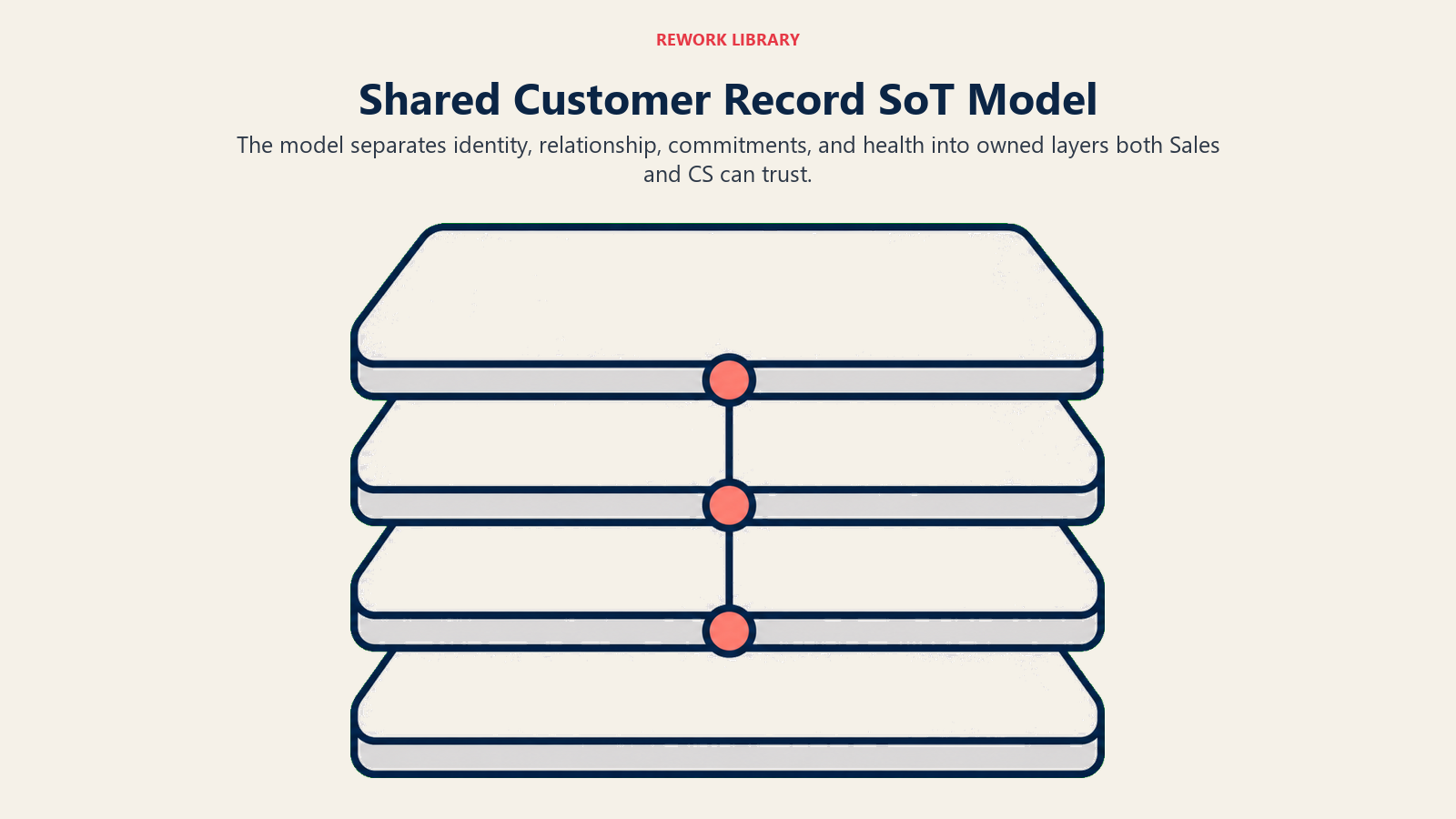
The four layers:
Identity Layer: Account metadata that never changes after close: company name, ARR, contract term, tier, renewal date. Owned by RevOps. Updated only by system events (contract amendment, renewal). This layer must be identical in every system.
Relationship Layer: Stakeholder map and deal context. Who the humans are, why they bought, who objected, what almost killed the deal. Owned by the AE at close; updated by the CSM when contacts change. This is the layer most likely to be empty or stale.
Commitments Layer: The log of every specific promise made during the deal and onboarding: timelines, feature commitments, service inclusions. Owned jointly (AE writes during the deal, CSM writes during onboarding). This layer never goes stale on its own; it must be actively maintained until every commitment is either delivered or formally renegotiated.
Health Layer: Current account state: health score, open issues, NPS trend, onboarding status, next renewal timeline. Owned by the CSM. Updated continuously. This is the layer Sales most often lacks access to, and that CS most often builds in a system the AE never opens.
Rework Analysis: Most two-record problems originate in Layer 2 (Relationship) and Layer 3 (Commitments). Product usage data in Layer 4 is usually well-captured by CS platforms. Account metadata in Layer 1 is usually clean in the CRM. The failure point is almost always the qualitative context, the story of the sale and the promises made, that lives in neither system because neither team was assigned to write it down. Defining named ownership for layers 2 and 3 solves 80% of the two-record problem without a platform change.
Quotable benchmark: 67% of B2B customers report being asked the same questions by multiple people at the same vendor, a direct symptom of the two-record problem, where deal context captured by Sales never reaches the CS team that inherits the account. (Salesforce, State of the Connected Customer)
Quotable benchmark: Companies with a formally defined shared customer record (one that both Sales and CS read from and write to) show 14% higher 12-month NRR than those without, per Gainsight's platform benchmark data. The NRR gap is not a product quality gap; it's a context continuity gap.
Quotable benchmark: 71% of B2B SaaS RevOps leaders cite "siloed customer data between Sales and CS" as a top-3 operational challenge, making fragmented customer records the most commonly cited structural problem in post-sale operations, ahead of headcount, tooling, and process. (RevOps Alliance, 2024)
The Seven Fields Both Teams Must Agree On
These are the fields with the highest frequency of either being missing or being owned by neither team. Define them explicitly and the two-record problem becomes manageable.
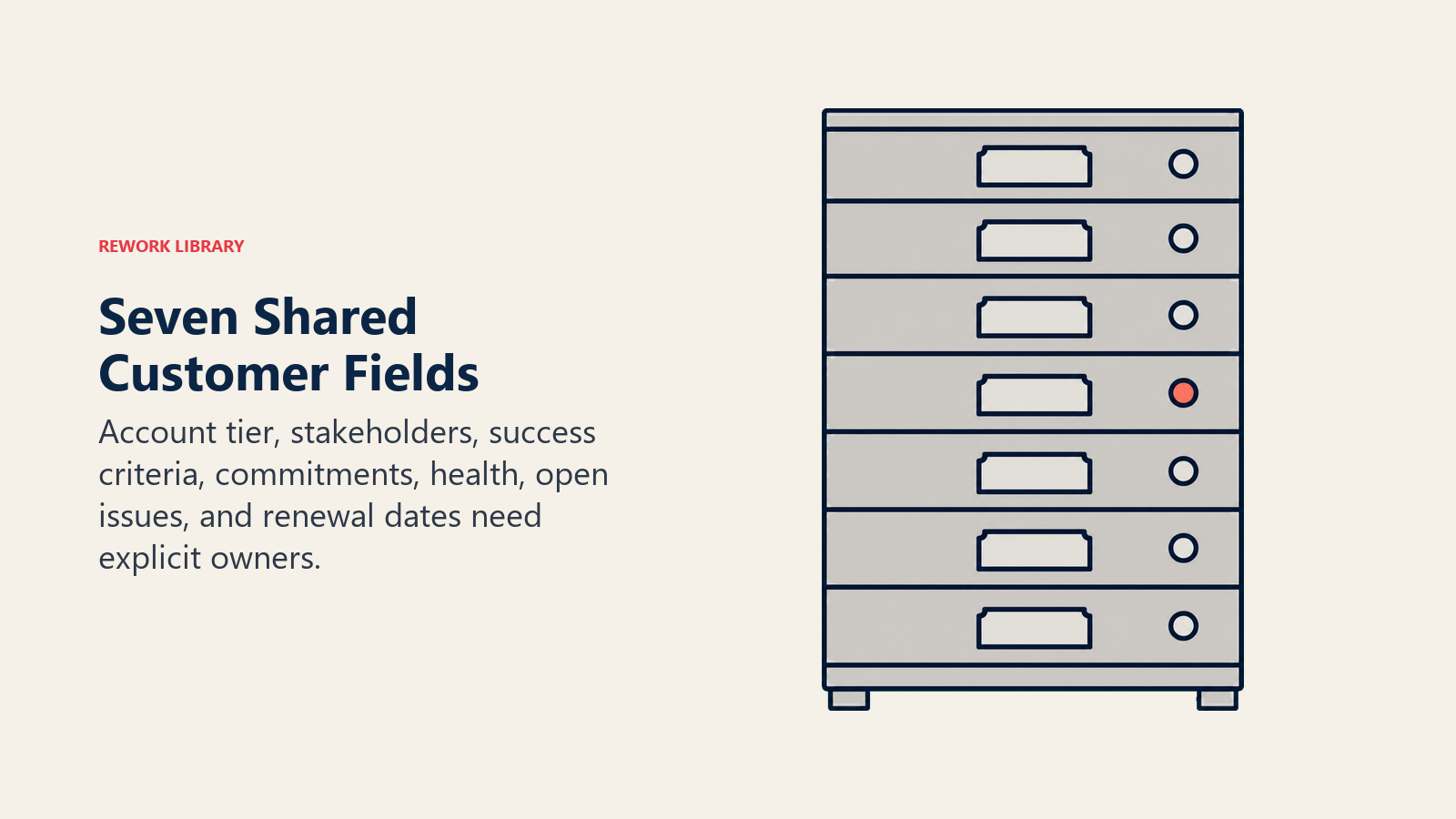
| Field | Owner | Update Trigger | Where It Lives |
|---|---|---|---|
| Account Tier | RevOps / CS Manager | At close; updated at renewal | CRM account record |
| Stakeholder Map (champion, sponsor, day-to-day contact) | AE at close; CSM ongoing | At close; when contact changes | CRM contacts + custom field |
| Success Criteria (from discovery) | AE at close; CSM confirms at kickoff | At close; amended at kickoff if needed | CRM opportunity notes → account record |
| Commitments Log | AE during deal; CSM during onboarding | When any commitment is made or delivered | CRM custom section or linked doc |
| Health Score | CS platform feeds CRM | Weekly automated update; manual override when signal changes | CS platform; synced to CRM account field |
| Open Issues (support, implementation) | CSM | When tickets open/close; when escalations occur | CS platform; summarized in CRM weekly |
| Next Renewal Date | RevOps at close; CSM 90 days prior | At contract signature; 90 days before renewal | CRM opportunity record |
The stakeholder map and commitments log are the two fields most likely to be incomplete at handoff. Both require the AE to write something qualitative, not just populate a dropdown. Both are also the highest-value fields for the CSM in the first 90 days. That's not a coincidence. What causes the gap matters as much as the gap itself.
Why Records Diverge
Three root causes account for most two-record problems.
CRM fields are filled at deal close and never updated post-sale. The CRM is built around the Sales motion. It's optimized for creating opportunities, tracking pipeline stages, and recording close dates. Once a deal is won, the CRM record is largely done from the Sales team's perspective. But the account doesn't stop generating relevant information. Stakeholders change. Commitments get delivered or not. The health trajectory develops. None of this naturally flows back into the CRM because there's no defined process for post-close updates by CS.
CS platforms track engagement but don't pull deal history. Gainsight, Totango, ChurnZero: these platforms are built for post-sale operations. They track product usage, support tickets, health signals, and NPS. But they don't contain the deal context: why the customer bought, what was promised, who the internal champion is. The CSM using the CS platform is working with excellent post-sale data and zero pre-sale context. McKinsey's customer success research identifies this pre-sale context gap as one of the primary reasons CS teams underperform on expansion. They lack the deal narrative that would tell them which conversations to open.
No defined owner for the transition period between close and onboarding. The gap between Closed-Won and kickoff is where the most context gets lost. The AE is working new deals. The CSM is preparing for the onboarding. Nobody is actively maintaining the record during the handoff window. If the handoff packet wasn't complete at close, that window passes without anyone catching the gap, and the CSM starts the kickoff call already missing information. The closed-won to onboarded handoff process defines who owns this window and what "complete" looks like before it transfers.
Architecture Options for SMB and Mid-Market Teams
There are three practical approaches to consolidating the customer record for teams that don't have a dedicated RevOps team to build complex integrations.
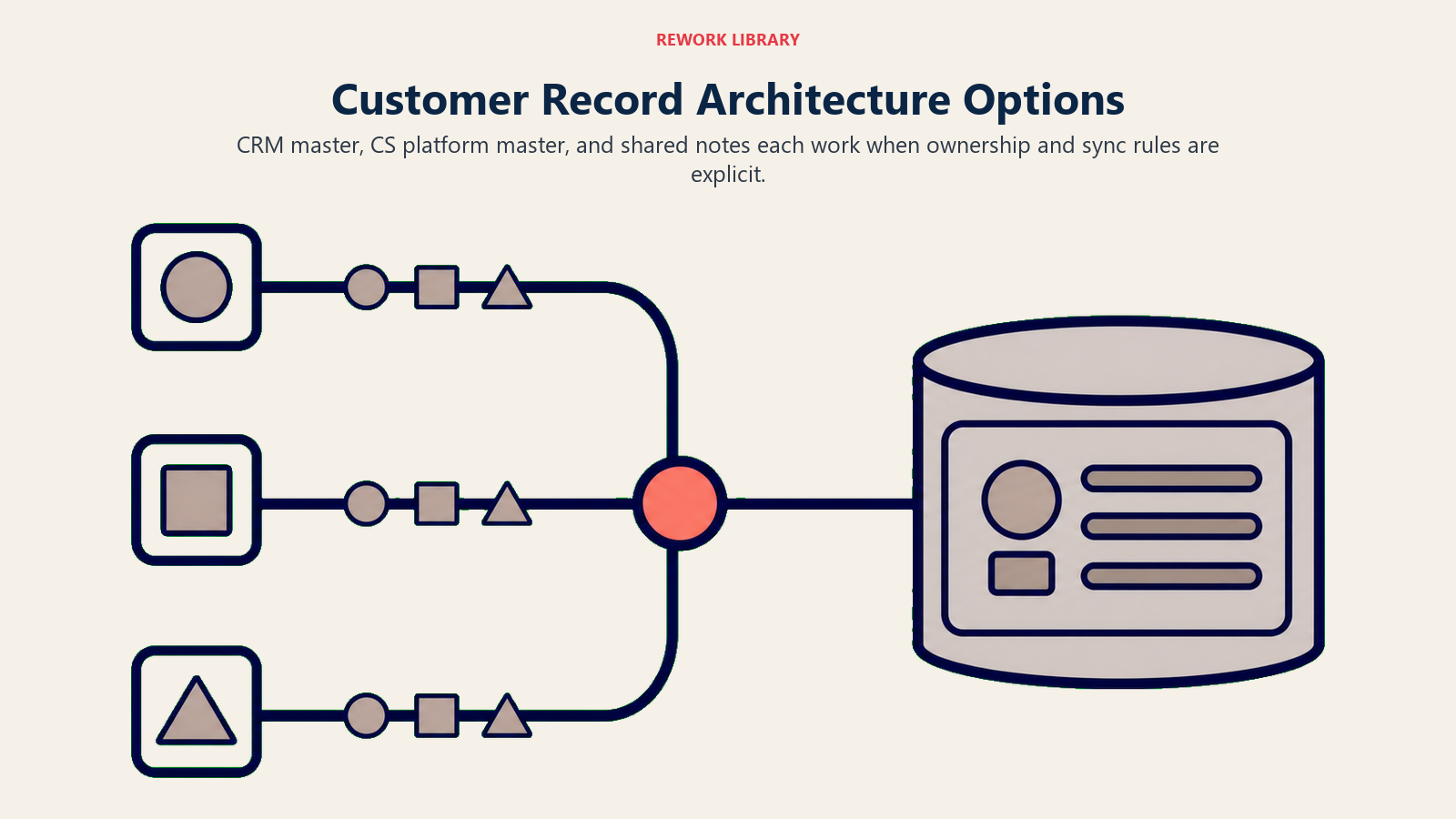
Option 1: CRM-as-Master (CS Platform Pulls from CRM)
The CRM is the system of record. All seven fields live in CRM. The CS platform reads account data from CRM (via native integration or API sync) and uses it for health scoring, engagement tracking, and task management. CS writes health scores, open issues, and onboarding milestones back to CRM via sync.
Trade-offs: Clean data model. Everyone knows where to look. But CS platforms have richer engagement tracking than most CRMs, and some data (detailed usage logs, support ticket history) doesn't map cleanly into CRM fields without heavy customization. Works best for teams already running a strong CRM practice with clean data.
Option 2: CS Platform-as-Master (CRM Syncs Account Status to CS)
The CS platform is the system of record post-close. The CRM passes account and deal data to the CS platform at Closed-Won, and the CS platform becomes the authoritative source for everything post-sale: health, onboarding status, renewal timeline. Sales still works out of the CRM, but account data is pulled from the CS platform for account reviews and renewal conversations.
Trade-offs: Better engagement and health data quality. But requires deliberate effort to keep Sales using the CRM for account-level context (they'll stop updating CRM if CS has its own authoritative record). Works best for CS-led organizations where post-sale operations are the primary revenue motion.
Option 3: Shared Notes Layer (Lightweight, Works for Early-Stage Teams)
A shared document or wiki page (Notion, Google Doc, Confluence) linked from both the CRM account record and the CS platform account. The document holds the fields that both teams need: the commitments log, the stakeholder map, the success criteria, and the account narrative. Both AE and CSM write to the same document. Both CRM and CS platform link to it as the narrative context layer.
Trade-offs: Low implementation cost. Easy to start. But doesn't scale past 100-150 accounts without degrading into inconsistent formatting and outdated pages. Version control is manual. Works best as a transitional solution while the team builds the system maturity to implement Option 1 or 2.
The Commitments Log: Special Focus
The commitments log is the single field that causes the most friction between Sales and CS, and it's the one most likely to be empty when CS needs it most.
The commitments log is a running record of every specific promise made during the sales cycle: timelines, feature commitments, service inclusions, pricing exceptions, and any "we'll make sure that happens" statements that didn't make it into the contract. It's distinct from a feature request list (those go to product) and distinct from the contract terms (that's a legal document). It's the operational record of what was said.
Format. Keep it simple: date, what was committed, by whom, whether it's been delivered.
2026-03-15 | AE committed to ERP integration live by Day 30 | AE: Jordan Lee | Status: In progress
2026-03-15 | Custom reporting dashboard by Day 45 | AE: Jordan Lee | Status: Scoped with CSE
2026-03-10 | Dedicated CSE for first 60 days | AE: Jordan Lee | Status: Confirmed, CSE: Sam Park
Who writes to it. The AE writes to it during the deal as commitments are made. The CSM writes to it during onboarding as commitments are fulfilled or modified. Nobody should be adding to the commitments log after kickoff without the other team knowing.
How it differs from a feature request. A feature request is "the customer wants X capability that doesn't exist yet." A commitment is "we told the customer X capability would be ready by date Y." Feature requests go to the product backlog. Commitments go in the log and stay there until they're delivered or formally renegotiated with the customer.
Ownership Transitions: How the Record Passes
At Closed-Won, the AE owns the record. Their job is to populate it completely within 48 hours of close: deal context, stakeholder map, commitments log, and success criteria. The handoff scorecard measures how well they did.
Between close and kickoff, ownership is shared. The AE is still the authoritative source for deal history. The CSM is beginning to build the onboarding context. This is the highest-risk window for record divergence, as both teams are working in parallel and the handoff isn't fully transferred yet.
At kickoff, the record transfer completes. The CSM takes primary ownership. The AE's job becomes responding to CSM questions (within one business day for standard questions) and joining the account only when escalated. After the kickoff, the AE should not be the person maintaining day-to-day account context.
At 90 days post-onboarding, the steady-state ownership is clear: CSM owns the record. AE has read access and contributes to the expansion and renewal conversation. Health score, open issues, and commitments log are all CSM-maintained. The success criteria field may be updated as the customer's goals evolve.
Making It Stick: Change Management in Three Steps
A shared customer record design that lives in a slide deck and never gets adopted is not a solution. Three concrete steps make the change operational.
Step 1: Name every field with a named owner. Not "Sales" or "CS." A specific role. "Account Tier: owned by CS Manager, updated at close and at renewal." "Commitments Log: AE writes during deal, CSM writes during onboarding." When ownership is specific, accountability is specific.
Step 2: Review the record in joint account reviews. The monthly or quarterly account review is the natural reinforcement point. When the CS manager and Sales manager review the account together, they're reading from the same record. Gaps become visible in the meeting, not after the account churns. The review forces both teams to maintain the record as a live document rather than a one-time handoff artifact. Forrester's postsale lifecycle research recommends joint cross-functional visibility as the single highest-leverage intervention for improving post-sale revenue outcomes. The joint at-risk account review cadence is the right forum for this: same record, both teams, one conversation.
Step 3: Tie handoff quality (via scorecard) to record completeness. The handoff scorecard measures whether the seven fields are complete at close. A low scorecard score is evidence of an incomplete record. A high score is evidence of a strong handoff. When handoff scores trend into the management conversation (as they should), maintaining the record becomes an AE metric, not just a CS ask.
Frequently Asked Questions about Single Source of Truth
Do Sales and CS need to be on the same platform for this to work?
No. The architecture options in this article are specifically designed for teams running separate CRM and CS platforms. What's required isn't one platform. It's defined ownership of each field and a sync mechanism (native integration, Zapier, or a shared notes layer) that makes the data accessible to both teams. Teams that force a platform consolidation before defining ownership end up with one platform and the same two-record problem.
What's the minimum viable customer record for an early-stage team?
For a team under 50 accounts total, the shared notes layer (Option 3) is sufficient. The minimum viable record is five fields: stakeholder map, success criteria, commitments log, health status (simple red/yellow/green), and next renewal date. Everything else can be added as the team scales. Start with the fields that prevent the most expensive problems (over-promise discovery at kickoff, champion departure without notice) and build from there.
How do you handle the transition period when a new CS system is being implemented?
During a system migration, the existing partial records will have gaps regardless of what process is in place. Prioritize the commitments log and stakeholder map for any accounts currently in onboarding. These are the fields with the highest immediate impact. Backfill deal context for the existing book of accounts opportunistically, starting with accounts up for renewal within 90 days. Don't try to backfill everything before going live with the new system.
What happens when a customer's champion leaves mid-contract?
Champion departure is a red flag that should immediately trigger a CSM update to the stakeholder map: who left, who is the interim contact, is there a named replacement. The AE should be notified within 24 hours because champion departure frequently precedes a stalled or at-risk renewal. The record update is not optional. An out-of-date stakeholder map after a champion departure is the most common cause of a missed renewal conversation.
Which CRM should teams use as the single source of truth?
The platform choice is secondary to the ownership model. Salesforce, HubSpot, and Pipedrive all support the seven-field architecture described in this article. The question is which team has stronger discipline in maintaining their system. In most B2B SaaS companies, Sales runs a cleaner CRM practice than CS runs a CS platform practice, which makes the CRM-as-master approach the lower-friction starting point. But if your CS team has stronger system hygiene, the CS platform-as-master model can work equally well. Pick the system your teams will actually update.
How do you handle it when Marketing has its own MAP (marketing automation platform) with a separate customer record?
Marketing automation platforms (Marketo, HubSpot Marketing Hub, Pardot) typically hold contact-level engagement data that doesn't need to live in the Sales-CS shared record. The key is ensuring that the MAP doesn't become a competing identity layer. Company name, contract tier, and renewal date should flow from the CRM as the system of record, not be maintained separately in the MAP. Use a native CRM-MAP sync for contact data, and keep account-level fields (ARR, tier, health status) exclusively in the CRM-owned identity layer.
How do you enforce record hygiene when AEs deprioritize documentation after close?
Enforcement via management visibility works better than enforcement via system gates. Make the handoff scorecard visible to Sales management monthly. When AEs see their category scores, especially Relationship Layer fields (deal context, stakeholder map), alongside their pipeline metrics in a leadership review, documentation becomes part of the definition of "done" rather than an afterthought. Mandatory CRM fields that block Closed-Won marking are effective as a last resort, but they create workarounds (AEs enter placeholder text) rather than genuine documentation. Score-based visibility changes the incentive.
What's the minimum viable shared record for a team that's still pre-CRM?
Five fields: stakeholder map (champion name and email), success criteria (what the customer said they need to achieve), commitments log (what was promised beyond the contract), health status (red/yellow/green with a date), and next renewal date. A shared Google Doc or Notion page per account linked from whatever system the team uses works as a transitional solution up to about 75-100 accounts. Past that threshold, the manual overhead degrades quality faster than the benefit offsets it, and a CRM becomes necessary.
Learn More

Principal Solution Architect
On this page
- What "Single Source of Truth" Actually Means
- The Shared Customer Record SoT Model: A Named Framework
- The Seven Fields Both Teams Must Agree On
- Why Records Diverge
- Architecture Options for SMB and Mid-Market Teams
- Option 1: CRM-as-Master (CS Platform Pulls from CRM)
- Option 2: CS Platform-as-Master (CRM Syncs Account Status to CS)
- Option 3: Shared Notes Layer (Lightweight, Works for Early-Stage Teams)
- The Commitments Log: Special Focus
- Ownership Transitions: How the Record Passes
- Making It Stick: Change Management in Three Steps
- Learn More