Joint Kickoff Call Agenda: A Ready-to-Use Template for Sales and CS Leaders
Turn this article into takeaways for your work.


Each assistant summarizes the article only for you and suggests best practices for your work.
The joint kickoff call is the highest-leverage call in the customer lifecycle. The quarterly business review matters. The renewal negotiation matters. But this call shapes everything that makes those conversations easy or hard (adoption, expansion, trust), and it happens before any of them.
Think about the last time you watched a vendor hand off a new customer. The account executive (AE) knew the deal cold. The customer success manager (CSM) was meeting the champion for the first time. Nobody had agreed on who runs what. The AE filled the silence. The CSM presented slides the customer didn't need. The call ran over on the wrong topic and skipped the one conversation that would have mattered: what does success actually look like for this customer?
That's the typical joint kickoff. And it's why so many accounts start onboarding in deficit.
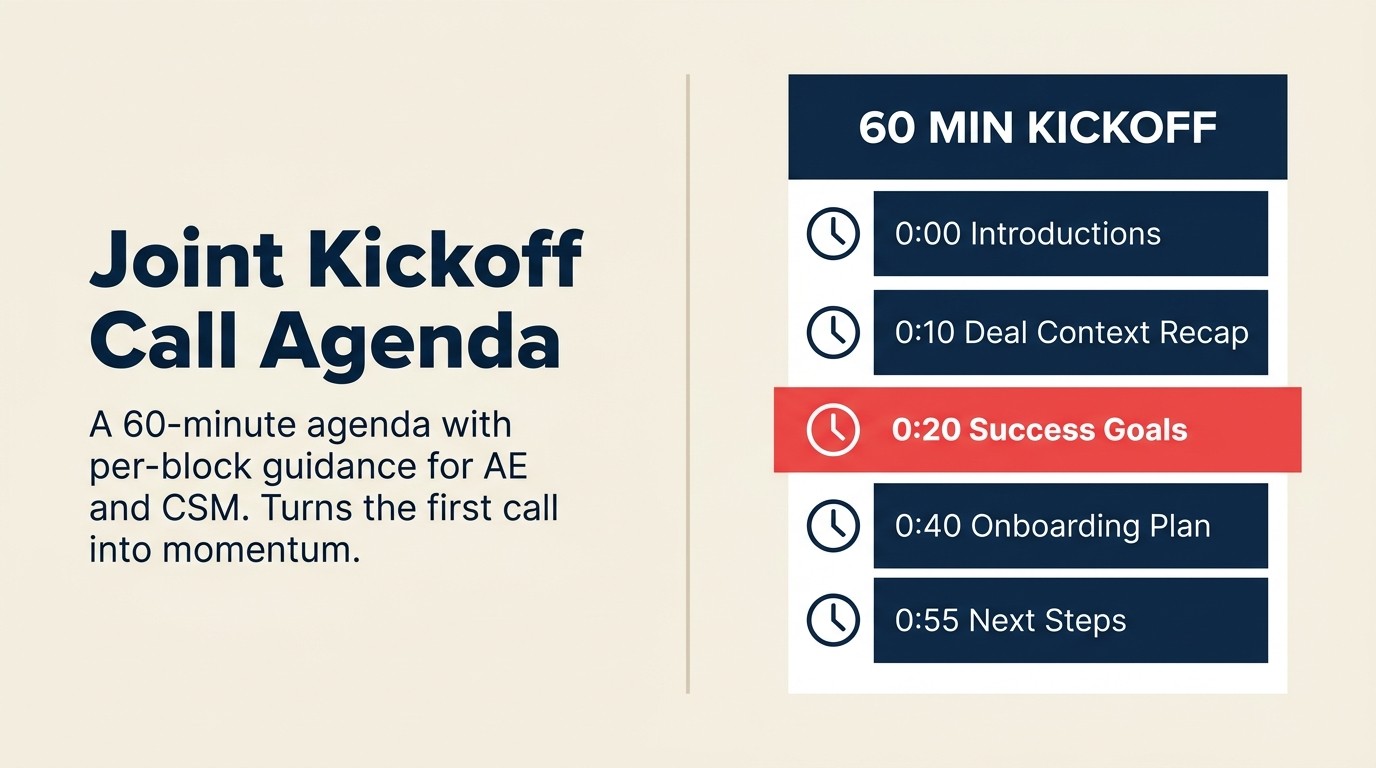
This article gives you the agenda. Not a rough framework but a specific, timed agenda you can copy into your kickoff template today. It includes per-block guidance for both roles, a 30-minute compressed variant, and the pre-call and post-call email templates that make the agenda stick.
The 60-Minute Joint Kickoff Format is the named framework this article defines. Six timed blocks: Welcome and Introductions (5 min, AE opens then hands to CSM), Confirm Success Criteria (10 min, the non-negotiable block), Meet Your CS Team and Onboarding Process (10 min, CSM only), 90-Day Success Plan (15 min, CSM presents draft, customer co-creates), Open Questions and Concerns (10 min, CSM facilitates silence), and Agreements and Next Steps plus AE closing (10 min split). The format's central rule: CS leads, Sales supports. When AEs run kickoff calls, CSMs start the account without authority and the relationship clock resets.
What Makes This Call "Joint"
Joint kickoff only works when Sales and CS have distinct roles on the call instead of simply sharing the calendar invite.
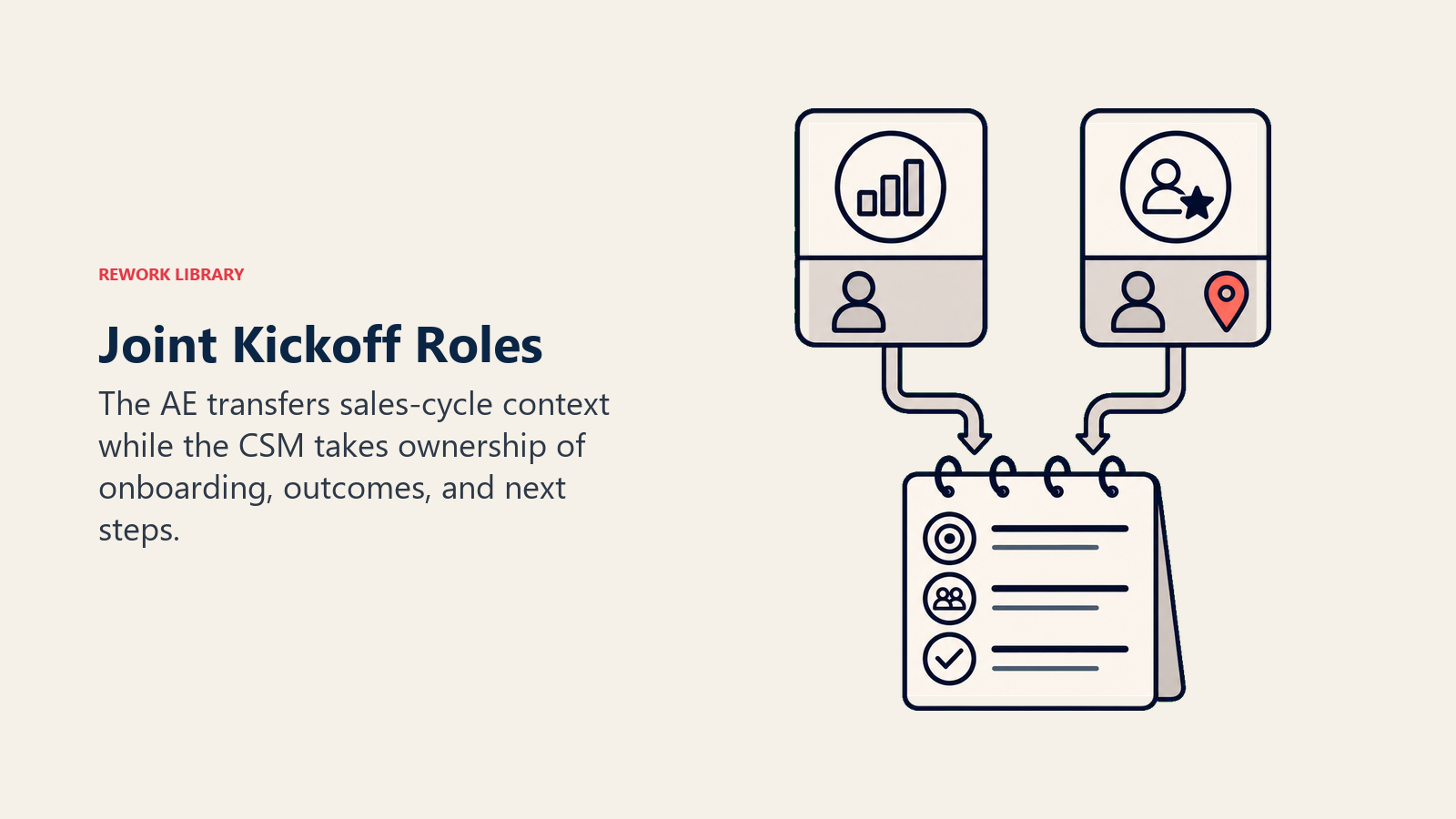
Joint means both the AE and CSM are present. But "both present" doesn't mean "both running the show." The roles are specific:
AE's role: Legitimize the relationship. Pass the baton. Demonstrate that the vendor is internally aligned. The AE opens, makes the introduction, reinforces key context from the sales conversation, and closes. That's it. The full picture of what the AE is responsible for through this transition is in the AE-to-CSM lifecycle handoff.
CSM's role: Establish authority. Set the tone for the post-sale relationship. Drive the agenda. Confirm success criteria. Build the 90-day plan with the customer in real time. Own everything after the AE's opening.
The rule: CS leads; Sales supports. Not the other way around. When AEs run kickoff calls, the CSM starts the account without authority. The customer's primary reference point for commitments and expectations stays the AE, which means the AE is still the de facto account manager weeks after close. That's bad for the AE: they're managing a closed account while trying to close new ones. And it sets the CSM up to spend the first month rebuilding authority the kickoff should have established. So before you decide whether to run the call at all, there's a more important question: when is a joint kickoff actually worth it?
Key Facts: The Stakes of the First Call
- Customers who report a "strong first kickoff" are 2.4x more likely to reach their first value milestone on time (Gainsight CS Impact benchmarks).
- 72% of early churn decisions (within 12 months) are traceable to a negative impression formed within the first 30 days, and the kickoff is the most visible event in that window (Bain & Company, 2023).
- CSMs who enter kickoff with a pre-built 90-day success plan draft reduce time-to-first-value by an average of 18 days compared to those who build the plan from scratch on the call (Winning by Design, 2024).
When to Run a Joint Kickoff vs. CS-Only
Joint kickoff is not the right call for every deal. Running it by default, regardless of deal size, creates process overhead that slows down high-volume SMB motions and doesn't justify the AE's time.
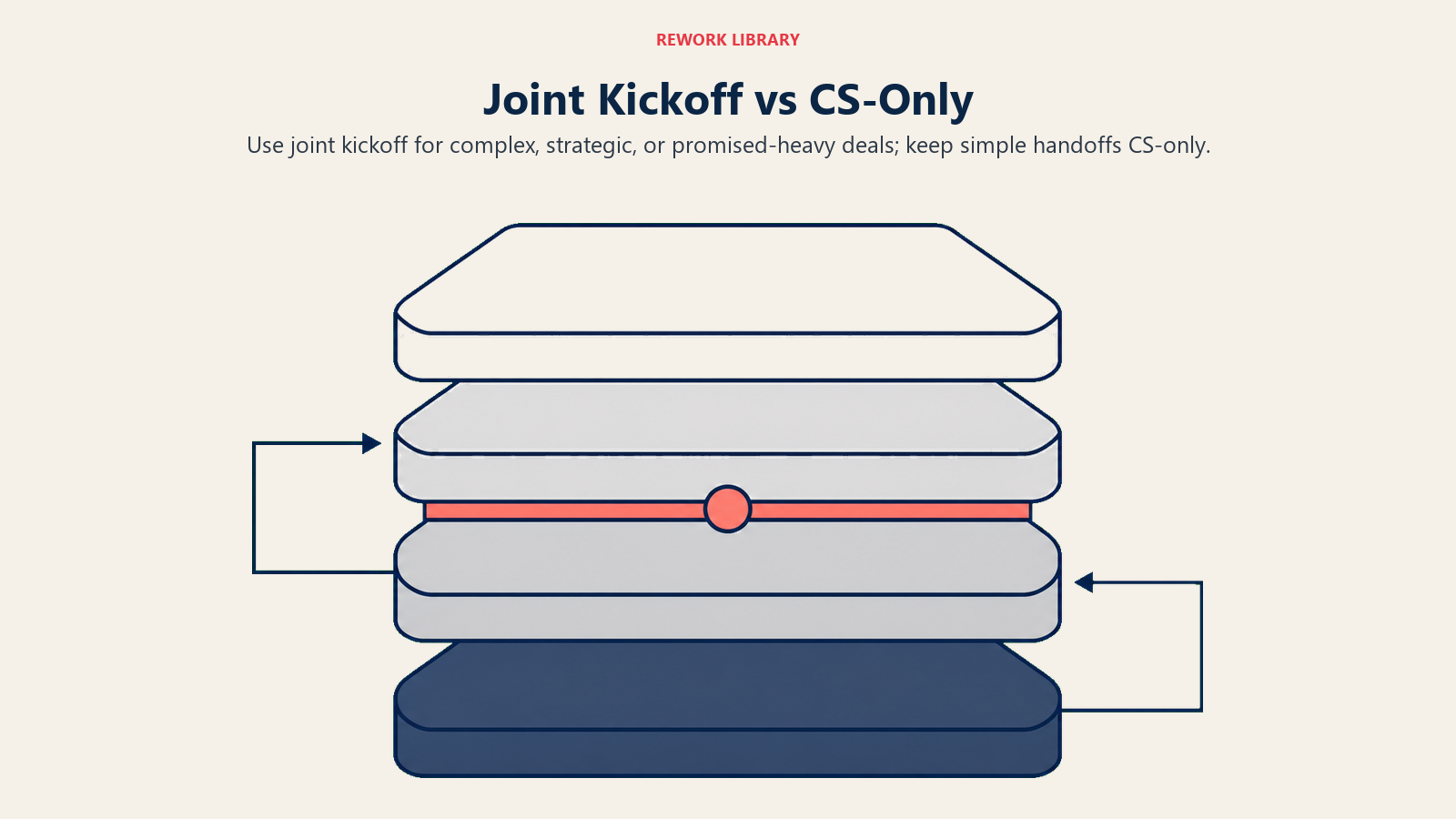
Run a joint kickoff when:
- Deal annual contract value (ACV) is over $30K
- Onboarding has real complexity: more than one stakeholder involved, integration work required, or a timeline longer than 30 days
- The AE built a strong personal relationship with the champion during the sales cycle
- Any enterprise deal, regardless of the above
Run a CS-only kickoff when:
- High-volume SMB: deals under $15K with self-directed onboarding
- Pooled CS model where the CSM doesn't have a named relationship with the AE
- Transactional product where the customer expects a digital-first experience
- The champion explicitly requested not to have another group call so quickly after signing
The mistake to avoid: Defaulting to joint for every deal because it "feels safer" or because "the customer likes the AE." Running a joint kickoff on a $9K deal with a self-directed onboarding path wastes the AE's time, creates false expectations about white-glove treatment, and may actually delay time-to-value because the customer is waiting for the joint call rather than starting with the product.
Rework Analysis: The most consistent kickoff failure isn't an unprepared CSM or an overbearing AE. It's a missing success criteria conversation. Block 2 of this agenda (Confirm Success Criteria, minutes 5-15) is the highest-leverage 10 minutes in the entire call, and it's the block most commonly abbreviated or skipped when the call runs long. The reason is structural: CSMs feel uncomfortable challenging the customer's definition of success in a first meeting, so they default to presenting the 90-day plan and assuming the customer's goals match what the handoff record said. They often don't. Teams that use Rework's shared workspace to surface success criteria before kickoff (building the 90-day plan as a visible draft the customer can react to, rather than a document revealed for the first time on the call) consistently shorten the time-to-confirmation gap. The customer arrives having already seen the draft, the kickoff becomes a refinement conversation rather than a reveal, and the CSM spends those 10 minutes confirming rather than proposing.
The 60-Minute Joint Kickoff Agenda
The agenda gives the call enough structure to transfer context, confirm goals, and establish ownership without turning kickoff into a status meeting.
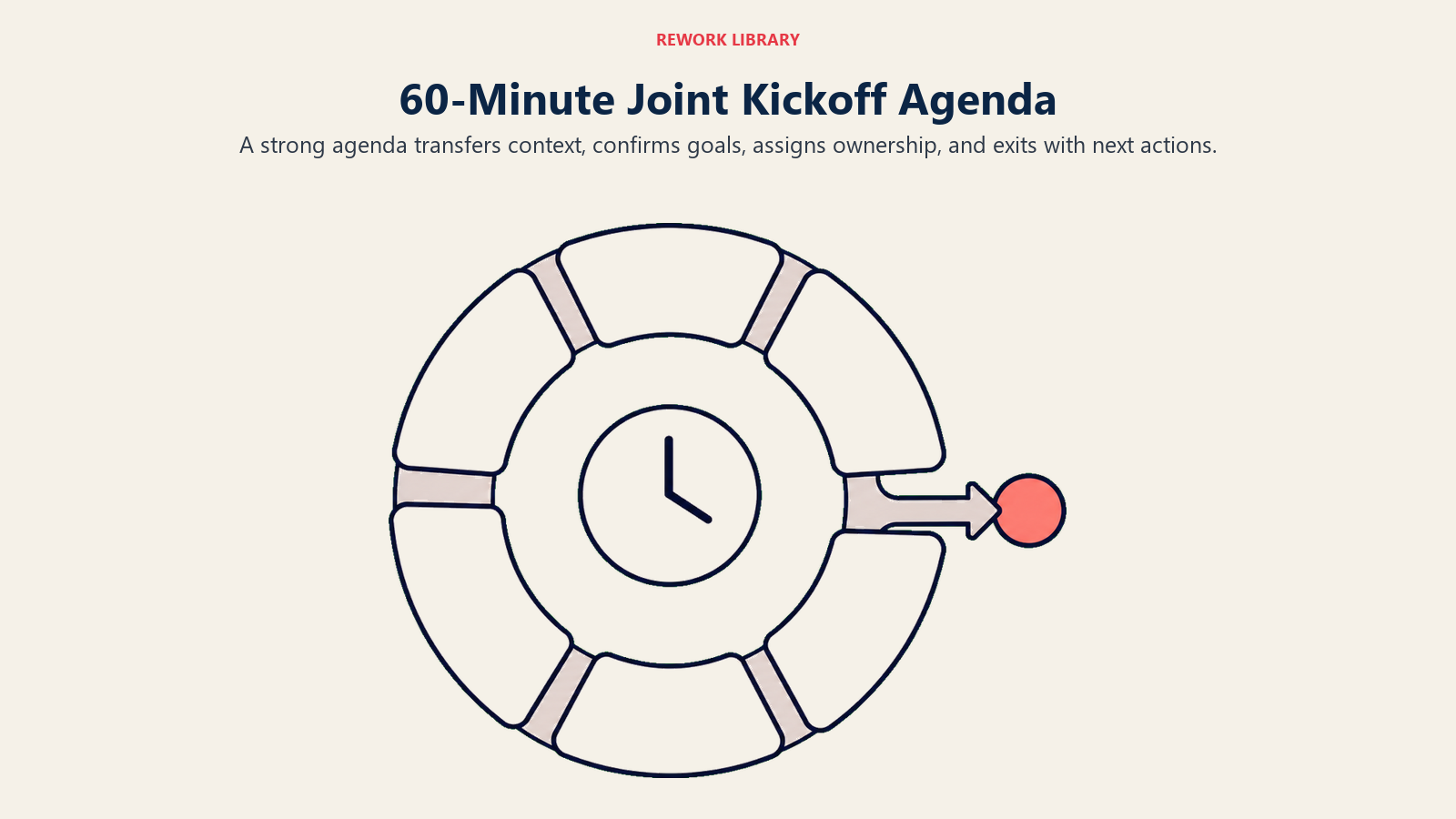
Copy this section directly into your kickoff template. This agenda is designed for mid-market deals ($25K-$150K ACV) with a named CSM and a defined champion relationship.
Sample Agenda: 60-Minute Joint Kickoff Call
[0:00-0:05] Welcome and Introductions Owner: AE opens, CSM takes over at 0:03
What the AE does:
- Open with something brief and personal: "It's great to see this moving forward. I know how long we worked on getting here."
- Introduce the CSM by name and with a specific, genuine comment: not "This is Alex, your CSM" but "I want to introduce Priya Sharma. I've worked alongside Priya on accounts with similar operational goals and she's exceptional at this kind of implementation."
- Hand off to the CSM: "Priya is going to drive the agenda today. I'm here for support."
What the CSM does:
- Introduce themselves with one sentence of personal context: role, how long they've been at the company, and one relevant experience. Not a biography. 30 seconds.
- Introduce any other team members on the call and their roles.
- Frame the purpose of the call clearly: "Our goal today is to align on your success criteria, walk through what the first 90 days look like, and leave with a clear set of next steps we both own."
What to avoid:
- AE monologuing about the sales process or deal history
- CSM presenting a company overview or product pitch. The customer already bought.
- Going around the room for lengthy introductions when the invite had 6+ attendees
[0:05-0:15] Why You Bought: Confirm Success Criteria Owner: CSM leads, AE reinforces one key point
This is the most important 10 minutes in the call. The CSM's job is to confirm, not assume, what success looks like for this specific customer. The CSM has a hypothesis based on the handoff record. The kickoff is where that hypothesis becomes a mutual agreement. What that handoff record should contain, specifically the success criteria fields, is documented in deal context transfer to CS.
What the CSM does:
- Open with: "Before we get into the 90-day plan, I want to make sure we're aligned on what a successful implementation looks like for you. Based on what [AE name] shared with me, [state the success criteria from the handoff record]. Does that capture it accurately, or should we adjust the framing?"
- Listen actively to the customer's response. If they confirm, great, note it explicitly. If they add nuance or reframe, that's the most valuable 3 minutes of the call.
- Confirm: "So if we've hit [these specific milestones] by [timeframe], that would be a success in your view?" Get an explicit yes.
What the AE does:
- One reinforcing comment, maximum: "That maps to what Dana and I talked about, particularly the 90-day onboarding timeline goal."
- No new commitments. No promises that weren't already in the handoff record.
- Stay quiet otherwise. This is a CS-customer conversation.
Why this block matters: Many onboarding failures happen because the CSM and the customer were never explicitly aligned on what "success" means. The customer has a definition. The CSM has a definition. They're often different. This block surface the gap before it becomes a problem at the 60-day check-in.
[0:15-0:25] Meet Your CS Team and Onboarding Process Owner: CSM
What the CSM does:
- Briefly introduce the team structure: who is the CSM, who is the implementation specialist or solutions architect (if applicable), how do they coordinate, what's the escalation path if something needs to move quickly.
- Walk through the onboarding phases at a high level, not a detailed project plan, just a map: "Here are the three phases of your onboarding and roughly how long each takes."
- Explain how the customer will interact with the team: communication channels, response SLAs, how to ask for help, how to escalate.
Keep this tight. Ten minutes feels like a lot for this section, and it is, if used for a company overview. The only question the customer needs answered here is: "Who is responsible for my success and how do I reach them?" Answer that clearly and move on.
What to avoid:
- Presenting the company's CS team org chart
- Talking about the vendor's onboarding "methodology" in abstract terms
- Promising specific timelines that aren't yet confirmed with implementation resources
[0:25-0:40] Your 90-Day Success Plan Owner: CSM presents, customer reacts and co-creates
This block is the operational core of the kickoff. The CSM walks into this call with a draft 90-day success plan, built based on the handoff record and the success criteria confirmed in the previous block. Not a blank template to fill in together. A draft with specific milestones, owners, and timeframes that the customer responds to, adjusts, and ultimately co-owns.
What the CSM does:
- Share the draft 90-day plan: "Based on what you've shared, here's what I think the first 90 days should look like. I want to walk through this together and adjust anything that doesn't fit."
- Break the plan into three phases: Weeks 1-2 (setup and technical configuration), Weeks 3-6 (initial adoption and first wins), Weeks 7-12 (expanded rollout and success measurement).
- For each phase, state: what the milestone is, who owns it (vendor vs. customer), and what "done" looks like.
- Invite the customer to push back: "Does this timeline feel right given your current capacity? Is there anything we're assuming that you'd want to adjust?"
The 90-day plan is not final at kickoff. It's a starting point both parties agree to work from. Some customers will want to move faster; some will need to slow specific phases. The goal is explicit alignment on what the first quarter looks like, not a signed project charter.
What to avoid:
- Presenting a plan the customer had no input into and asking them to rubber-stamp it
- Being so vague that the plan communicates nothing ("we'll work together to drive adoption")
- Committing to specific integration completion dates without implementation team confirmation
[0:40-0:50] Open Questions and Concerns Owner: CSM facilitates
This block exists for the things the customer didn't feel comfortable raising during the structured parts of the call. The CSM's job is to create space, not to fill the time.
What the CSM does:
- Open explicitly: "Before we close out, I want to make sure there's space for anything we haven't addressed: questions about the process, concerns about timeline, anything that came up as we were talking."
- Pause. Wait for a response. The first silence after this question is often where the most important feedback lives.
- If the customer raises a concern: don't dismiss or immediately reassure. Acknowledge it: "That's a fair concern. Here's how I'd suggest we handle that..." or "I want to be honest. I'll need to confirm that with the team before I give you a definitive answer."
Common topics that surface in this block:
- The IT integration question that's been on the champion's mind since the sales process
- Concerns about user adoption from a specific team that was resistant
- A timeline question tied to an internal deadline the customer hadn't mentioned yet
- Questions about what happens if a key contact on the customer side leaves
Surface these here. Addressing them on the call is better than discovering them at week three.
What to avoid:
- Using this block to do more presenting
- Dismissing concerns with generic reassurances ("don't worry, we handle this all the time")
- Committing to resolutions for complex concerns in the moment. Note them, own them, follow up in writing.
[0:50-0:57] Agreements and Next Steps Owner: CSM
What the CSM does:
- Summarize the specific agreements made during the call: "We've agreed on [success criteria]. We've aligned on a 90-day plan with [key milestones]. We've identified [specific concern] as something we'll follow up on by [date]."
- State the next steps explicitly, with owners and dates: "The next thing that needs to happen is [action]. That's on [owner] by [date]."
- Confirm the customer's immediate action items, not just the vendor's. A kickoff that ends with only vendor action items creates passive customers. "Your side: we need [technical contact] to complete the system access request by [date]. We'll send you the link in the follow-up email."
- Confirm the next scheduled touchpoint: "Our next check-in is [date]. I'll send a calendar invite before the end of today."
This block should feel like a formal close, not a trailing off. The customer should leave with complete clarity on what happens next and who owns what.
[0:57-1:00] AE Closing Remarks and Relationship Pass Owner: AE
Three minutes. No more.
What the AE says:
- Something that validates the CSM: "You're in excellent hands. Priya has done this for teams with exactly your kind of complexity and she's great at it."
- An expression of continued availability that doesn't undermine CS authority: "I'll be available if anything commercial comes up on your side. For everything else, Priya is your person."
- A brief personal close: "I'm genuinely excited to see where this goes for your team. Looking forward to hearing about progress."
What the AE does not say:
- Anything that reopens commercial discussions ("if you ever want to add seats...")
- Anything that creates confusion about who owns the account ("feel free to reach out to either of us")
- Anything that signals the relationship quality will drop post-close ("I know I'll be less involved from here...")
The last impression of the joint kickoff should be: the vendor is aligned, the CSM is capable, and the champion is supported.
The 30-Minute Compressed Variant
When the customer can only give 30 minutes, or when deal complexity genuinely doesn't warrant a full-hour kickoff, here's what survives compression:
Sample Agenda: 30-Minute Joint Kickoff Call
| Time | Block | What Changes |
|---|---|---|
| 0:00-0:03 | Welcome and introductions | AE intro compressed to 60 seconds; CSM intro combined with team overview |
| 0:03-0:10 | Confirm success criteria | Keep this: it's the non-negotiable block |
| 0:10-0:20 | 90-day success plan (high level) | Present phases only, not individual milestones; send detailed plan as follow-up |
| 0:20-0:27 | Open questions | Keep: 7 minutes instead of 10 |
| 0:27-0:30 | Agreements + next steps (AE closes) | Combine into one block; CSM and AE each get 90 seconds |
What moves async:
- Full team introductions (send in the pre-call email and the follow-up)
- Detailed 90-day plan walkthrough (send as a doc; review async before the next check-in)
- Onboarding process explanation (covered in the welcome sequence)
What to skip entirely:
- Open Q&A block: move to end of next scheduled check-in if the 30-minute call runs out of time
The risk with the 30-minute call: Success criteria confirmation gets rushed. Don't skip it or abbreviate it to a yes/no. If you're running out of time, cut everything else and protect that block. The rest is recoverable.
The CSM's Prep Checklist
The kickoff agenda only works if the CSM is prepared to run it. This checklist is for the 48 hours before the call:
- Read the full handoff record, not just the CRM opportunity record
- Identify the one or two commitments from the sales cycle that are most likely to surface in the open questions block
- Build the 90-day success plan draft: specific milestones, not just phases
- Confirm attendees 48 hours before the call; resend the agenda if anyone new was added
- Prepare your opening line for the success criteria block: not scripted, but the specific question you'll use to invite the customer to react to your hypothesis
- Know the champion's communication preferences (from the handoff record) before the call
- Confirm any implementation resources or integrations that were mentioned in the sales cycle are actually available
If the CSM hasn't read the full handoff record, reschedule the call. Running a kickoff without that context isn't just a bad experience. It signals to the champion that the transition was poorly managed. The champion transition protocol explains what the AE should have done before the CSM ever reaches this checklist.
What to Send Before and After
The pre-call and post-call messages make the kickoff feel intentional before the meeting starts and actionable after it ends.
48 hours before the call: Pre-kickoff email (from CSM):
Subject: Your kickoff call: agenda + a few things to prepare
Hi [Champion name],
Looking forward to our kickoff on [date/time]. Here's the agenda we'll follow:
- Confirm your success criteria and key milestones
- Walk through your 90-day onboarding plan
- Agree on next steps and communication cadence
- Open questions
To make the most of our time, it would help if you could bring: [specific ask, e.g., "the 2-3 metrics you'll use to measure success internally" or "your IT contact's name and email for the integration setup"].
[James / AE name] will be joining us for the first part of the call. I'll be leading the agenda.
See you Thursday.
[CSM name] | [Title] | [Direct contact]
Within 24 hours after the call: Post-kickoff summary email (from CSM):
Subject: Kickoff summary + your next steps: [Company name]
Hi [Champion name],
Thanks for the time today. Here's what we aligned on:
Success criteria: [2-3 bullet points from the confirmed success criteria block]
90-day plan milestones:
- Weeks 1-2: [milestone + owner]
- Weeks 3-6: [milestone + owner]
- Weeks 7-12: [milestone + owner]
Open items:
- [Any concern raised in the Q&A block + how it will be addressed + by when]
Your next steps:
- [Customer action 1], due [date]
- [Customer action 2], due [date]
Our next touchpoint: [date/time], [calendar invite to follow]
Reply to this email with anything I missed or any updates on your side.
[CSM name]
Red Flags During the Call
1. The champion redirects questions to the AE mid-call. Don't let the AE answer without passing back to CS: "Actually, Priya is the best person for that." If the pattern continues, the AE should explicitly redirect: "Dana, Priya will take that one. She's got the full picture."
2. The customer seems confused about who owns what. Often a sign the AE's closing transition language wasn't clear. The CSM should state it plainly: "Just to confirm: for everything related to your implementation and onboarding, I'm your primary contact. [AE name] stays available for any commercial questions, but day-to-day that's me."
3. The customer raises a commitment that isn't in the handoff record. Don't dismiss it or promise it. Write it down, note it explicitly: "I want to make sure we address that properly. Let me take that as an action item and get back to you with a concrete answer by [date]." Then follow up the same day.
4. Success criteria can't be confirmed. The customer says "I'm not sure what success looks like yet" or gives you a very vague answer. This is actually useful. It tells you the sales-side definition of success wasn't explicit. Schedule a follow-up to build the success criteria document together before the 90-day plan is finalized.
5. Key stakeholders are missing. The IT Director who has concerns about integration wasn't on the call. The CFO who's watching the implementation doesn't know what was agreed. Confirm in the post-call summary who wasn't on the call and needs to be looped in, and agree on who does that outreach.
The Kickoff Sets the Trajectory
Every conversation the CSM has with this customer for the next 12 months will be shaped by what happens in this call. Not the product quality, not the QBR prep, not the renewal negotiation. Those all matter, but they're downstream of the relationship that starts here. Forrester's investment in customer success research puts a concrete number on it: companies that invest properly in customer success (starting from the kickoff) see 107% ROI within three years, driven by reduced churn and expanded accounts. For context on the full process this call sits inside, the closed-won to onboarded handoff process is the four-stage framework of which the kickoff is Stage 4. And if you're standing up a new kickoff motion from scratch, the onboarding strategy framework covers how post-sale teams structure the first 90 days that follow.
A well-run joint kickoff tells the champion three things: this vendor is organized, this team is aligned, and you made the right decision. Those three impressions are the foundation of everything that follows.
Copy the agenda. Brief the AE on their role. Send the pre-call email 48 hours out. Run the call with the CSM in the lead. Send the summary within 24 hours.
The FAQ below covers the questions most teams hit when they first try to implement this, including what to do when success criteria can't be confirmed and which blocks survive compression to 30 minutes.
Frequently Asked Questions about Joint Kickoff Call Agenda
Should a kickoff call be 60 minutes or 30 minutes?
Use 60 minutes for any deal over $30K ACV with named stakeholders and a defined implementation path. Use 30 minutes when the customer explicitly can't give more time, or when deal complexity genuinely doesn't justify a full hour: typically high-volume SMB or transactional products with self-directed onboarding. The non-negotiable block in both formats is the success criteria confirmation. If the 30-minute call is running short, cut everything else and protect that 7 minutes. Every other block is recoverable in a follow-up; a success criteria misalignment discovered at month two is not.
Who should attend the joint kickoff call?
From the vendor side: the CSM (leads the agenda), the AE (opens and closes only), and any implementation specialists or solutions architects who will own technical configuration. From the customer side: the champion is required; their project manager or implementation lead is strongly recommended; the economic buyer is optional unless they want to attend. Keep the vendor side lean: too many vendor participants signals internal complexity and can make the customer feel outnumbered. If the IT Director or a skeptical stakeholder is on the customer side, flag it to the AE before the call so both parties can prepare.
What should the CSM prepare before the kickoff call?
Seven things in the 48 hours before the call: read the full handoff record (not just the CRM record), identify the one or two sales-cycle commitments most likely to surface in the open questions block, build a draft 90-day success plan with specific milestones and owners, confirm attendees and resend the agenda if anyone new was added, prepare your opening question for the success criteria block, know the champion's communication preferences from the handoff record, and verify that any implementation resources or integrations mentioned in the sales cycle are actually available. If the handoff record wasn't completed, request it from the AE before the call, or reschedule the kickoff rather than run it without context.
What happens after the kickoff call?
Two things must happen within 24 hours: the CSM sends the post-kickoff summary email (success criteria confirmed, 90-day plan milestones with owners and dates, open items with resolution commitments, customer next steps, next scheduled touchpoint), and any calendar invites for upcoming check-ins go out. Customers who receive the summary within 24 hours have 44% higher engagement with onboarding materials in the first two weeks. The summary isn't a courtesy. It's the first operational signal that the vendor follows through on what was agreed.
What if the success criteria can't be confirmed in the kickoff?
This is actually useful information. If the customer says "I'm not sure what success looks like yet" or gives a vague answer, it tells you the sales-side definition of success wasn't explicit. Don't force a definition in the moment. Acknowledge it: "That's worth getting right before we build the plan around it." Schedule a 30-minute follow-up specifically for building the success criteria document together before the 90-day plan is finalized. A kickoff that surfaces this gap is better than a kickoff that glosses over it: you're discovering the misalignment before it becomes a month-three problem.
What does a good post-kickoff output look like?
Three specific deliverables: a written summary email (sent within 24 hours) covering confirmed success criteria, 90-day plan milestones with owners and dates, open items with resolution commitments, and both sides' next steps; a calendar invite for the next scheduled touchpoint; and any system access or technical setup requests sent to the relevant customer contact. The customer should finish the kickoff knowing exactly what happens next and who owns it. If the call ends without that clarity, the CSM should state it directly in closing: "Before we wrap up, I want to make sure we both leave knowing exactly what happens this week."
Learn More

Principal Solution Architect
On this page
- What Makes This Call "Joint"
- When to Run a Joint Kickoff vs. CS-Only
- The 60-Minute Joint Kickoff Agenda
- Sample Agenda: 60-Minute Joint Kickoff Call
- The 30-Minute Compressed Variant
- Sample Agenda: 30-Minute Joint Kickoff Call
- The CSM's Prep Checklist
- What to Send Before and After
- Red Flags During the Call
- The Kickoff Sets the Trajectory
- Learn More