Managing Subcultures: Leading Unity Without Uniformity
Turn this article into takeaways for your work.


Each assistant summarizes the article only for you and suggests best practices for your work.
A subculture is a distinct set of norms, language, and behaviors that forms inside a smaller group within an organization, usually a team, department, function, or office, while the organization's broader dominant culture still holds. Every company beyond a handful of people has them. The engineering org talks and works differently than sales. The Singapore office runs differently than the one in Chicago. Managing subcultures well means telling which differences are healthy variation and which ones are quietly working against the company, then acting only on the second kind.
Most leadership advice about "building a strong culture" quietly assumes a company has one culture to build. It doesn't. It has a dominant culture, the pattern that shows up on the leadership team and in official communication, and a set of subcultures that form wherever people spend most of their working hours together: a team, a department, a regional office, a tenure cohort of people who joined in the same hard year. Ignoring that structure doesn't make it go away. It just means leaders find out about the gap between departments during a crisis instead of during a normal planning cycle.
Why Subcultures Are the Default, Not the Exception
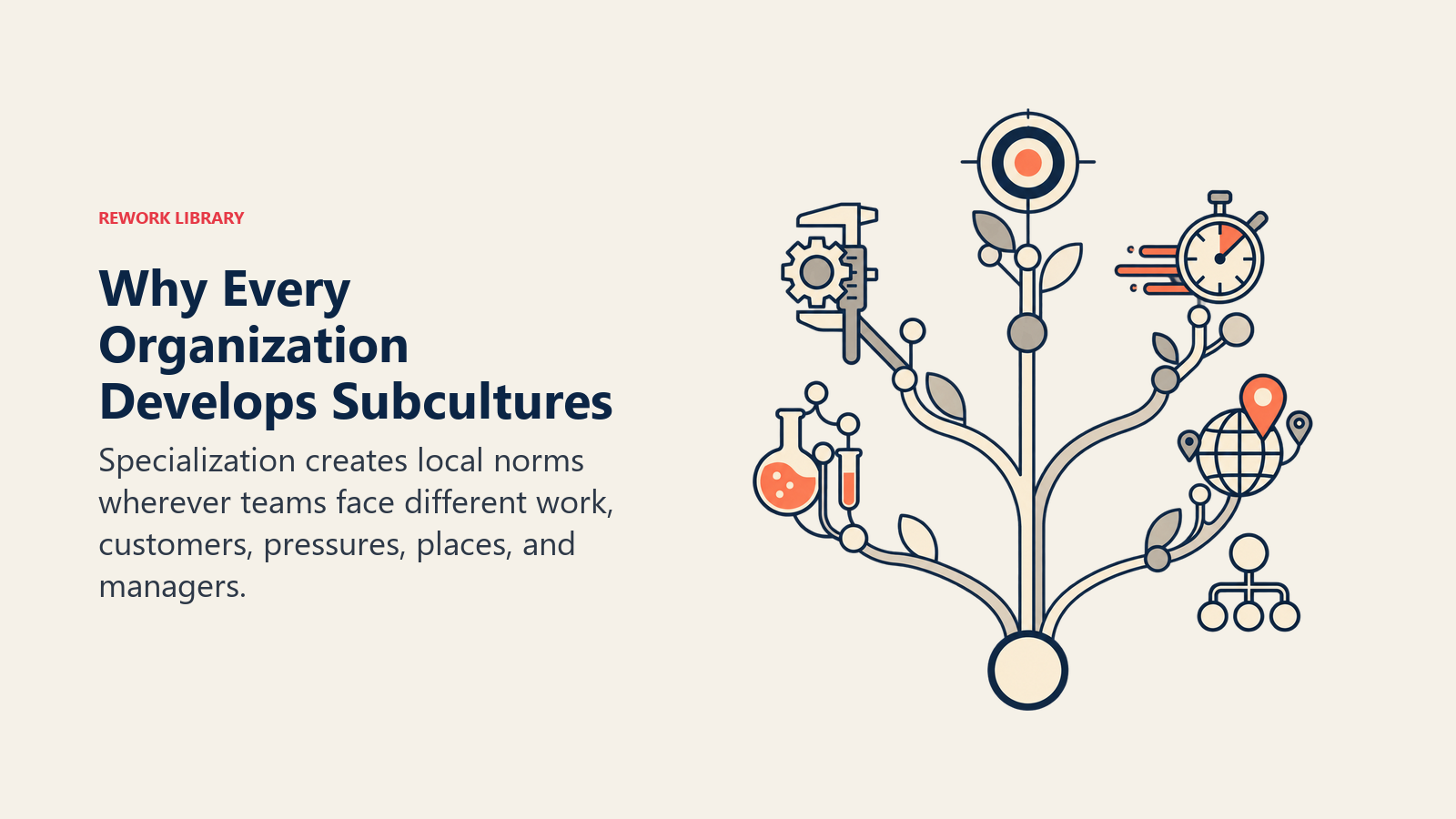
Organizational culture research has treated subcultures as normal for decades, not as a failure of the "real" culture to take hold. A widely cited Harvard Business School working paper on strong cultures and subcultures in dynamic organizations argues that subcultures are a predictable outcome of specialization: the moment an organization grows past the size where everyone works face to face on the same problems, groups develop local norms shaped by their specific work, their specific customers, and their specific pressures. A finance team that has to close the books accurately every month develops different norms around precision and double-checking than a product team that ships experiments daily and treats a wrong guess as data.
Schein's three levels of culture gives the underlying reason this happens. Espoused values, the ones printed on the wall, are usually shared company-wide. Underlying assumptions, the unconscious beliefs about how work actually gets done, form locally, inside the group that lives with the daily consequences of a given way of working. Two teams can recite the same values statement and still operate on different assumptions about how much risk is acceptable, how directly to disagree with a manager, or how much documentation counts as "done." That gap is a subculture, whether anyone has named it or not.
Where Subcultures Form
The same four fault lines show up in almost every organization, though rarely in isolation:
By department or function. Engineering, sales, finance, and support each develop norms shaped by what their job actually rewards. A sales team paid on quota develops urgency and self-promotion as default behaviors. A finance team penalized for errors develops caution and verification as default behaviors. Neither is wrong. They're adaptive to different jobs.
By geography. A regional office absorbs the surrounding national business culture whether headquarters intends it to or not. A hierarchical local business norm can sit uneasily inside a company that espouses flat, direct feedback, producing a regional subculture that looks, from headquarters, like people are being unusually quiet in meetings.
By tenure or cohort. People who joined during a specific hard stretch, a layoff, a founder departure, a brutal launch, often carry a shared read on "how things really work here" that newer hires never absorb and don't fully understand. This is one of the more overlooked subculture sources: a "we survived that" cohort inside an otherwise healthy company.
By manager. This is the fault line most leaders underweight. Gallup's research on employee engagement found that the individual manager accounts for roughly 70% of the variance between a company's most engaged team and its least engaged one, more than compensation, role, or even the stated company culture. A single manager's habits, who they praise, what they tolerate, how they run a meeting, can functionally create a subculture for their reports regardless of what the handbook says.
Martin and Siehl's Three Types of Subculture
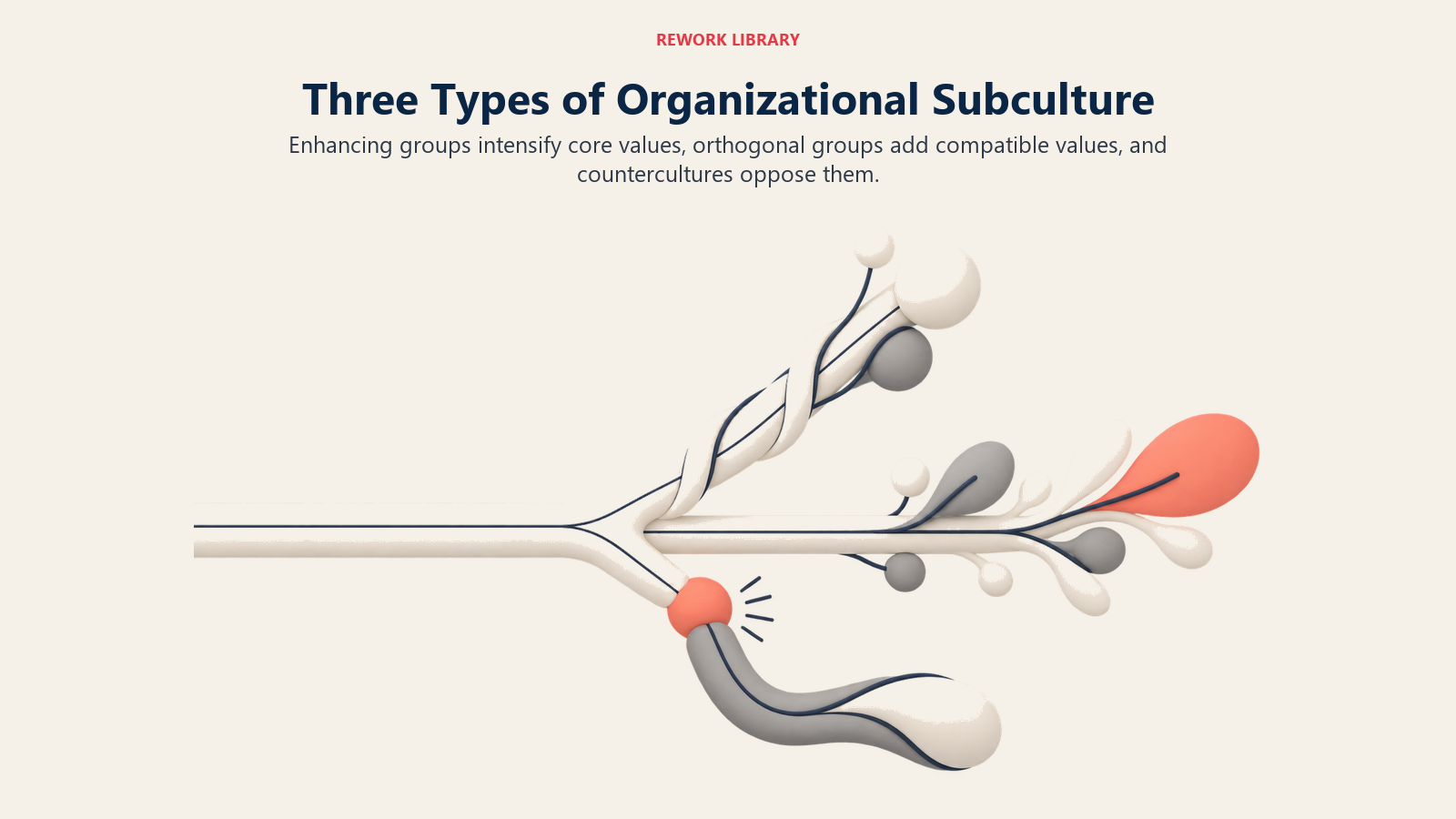
The most useful framework for deciding what to do about a subculture comes from Joanne Martin and Caren Siehl's 1983 paper "Organizational Culture and Counterculture: An Uneasy Symbiosis," which classified subcultures by their relationship to the values of the dominant culture rather than by where they sit on an org chart.
Enhancing Subcultures
An enhancing subculture holds the dominant culture's core values even more intensely than the rest of the organization. If the company espouses customer obsession, a support team that has built an entire local ritual around root-causing every complaint is enhancing that value, not deviating from it. These subcultures are usually a leader's best asset: they prove the value works in practice and often generate the internal case studies and champions who spread it elsewhere. The mistake most leaders make with an enhancing subculture is trying to standardize it into a company-wide process too fast, flattening the specific practices that made it work in that context in the first place.
Orthogonal Subcultures
An orthogonal subculture accepts the dominant culture's core values while also holding a separate, additional set of values specific to its own work, values that don't contradict the dominant culture but also aren't derived from it. A legal or compliance team inside a fast-moving startup is a common example: it fully accepts the company's mission and customer focus while also operating on a parallel professional value system, thoroughness and risk aversion, that the rest of the company doesn't share and doesn't need to. Orthogonal subcultures are the normal, healthy majority of subcultures in any functioning organization. The leader's job here isn't to eliminate the difference. It's to make sure the orthogonal group and the rest of the company understand why the other operates the way it does, so "compliance is slow" doesn't calcify into a company-wide resentment that never gets examined.
Countercultures
A counterculture holds values that directly oppose the dominant culture's core values. Martin and Siehl's original paper used John DeLorean's engineering division inside General Motors as their central case: DeLorean built a group inside GM that explicitly rejected the parent company's centralized, consensus-driven decision style in favor of fast, individually-driven engineering calls, a direct value inversion that GM's decentralized structure at the time allowed to persist and grow. Countercultures aren't automatically toxic. Sometimes they're where a necessary correction to a company's blind spot gets incubated, a team that insists on shipping fast inside a company that has become too consensus-bound, or a team that insists on saying no to bad deals inside a company that has started chasing revenue at any cost. But a counterculture that isn't watched closely, and isn't given a legitimate channel to actually change the dominant culture's behavior, tends to end the way DeLorean's did: as a separate empire that eventually has to be split off or shut down.
When Divergence Is Healthy vs When It's Corrosive
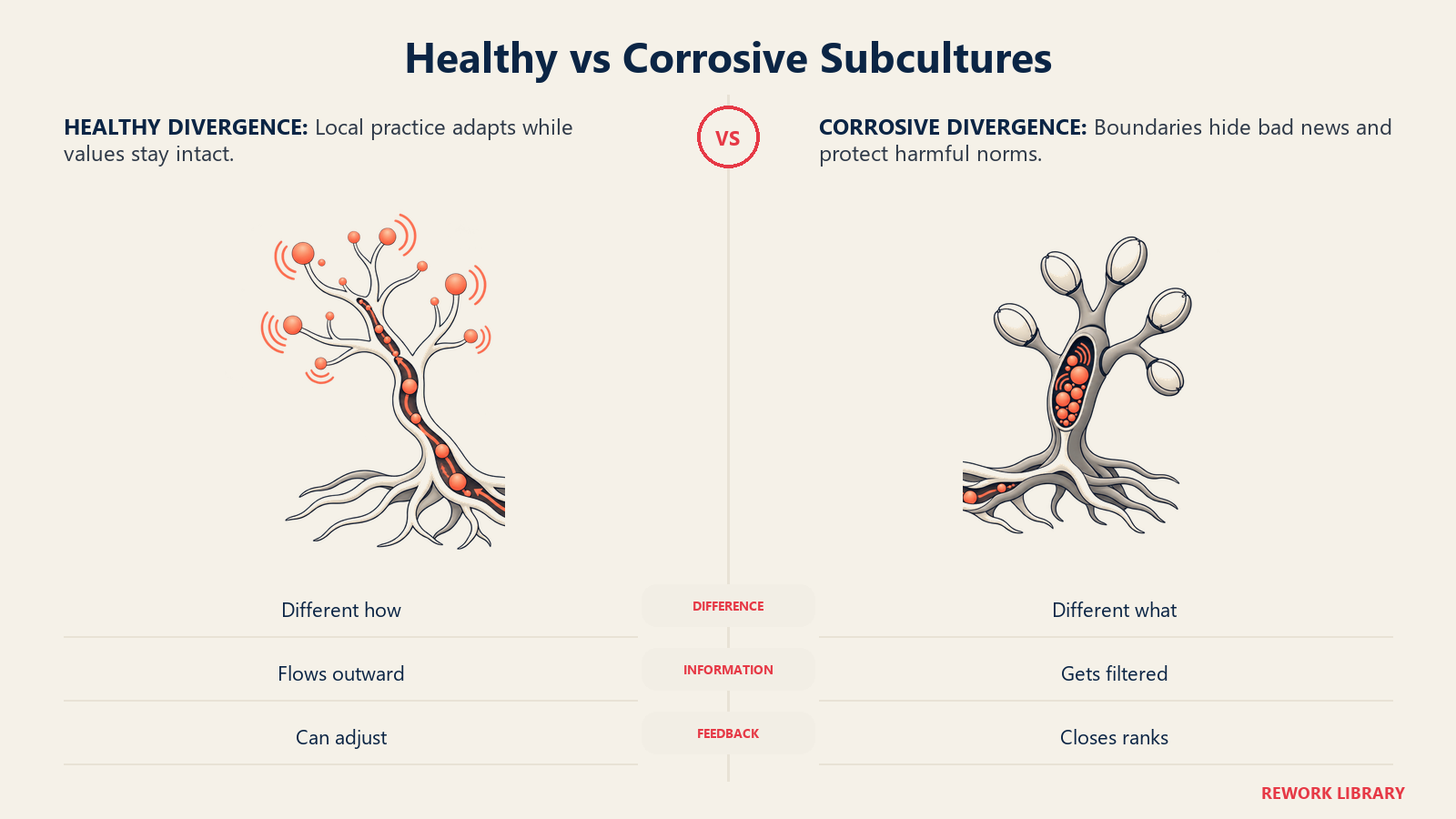
Not every gap between a team's norms and the company's stated culture is a problem to solve. The test isn't whether a subculture looks different. It's whether the difference is adaptive to real local conditions or whether it's quietly undermining something the whole company depends on, like trust, safety, or the ability to move information across teams.
| Signal | Healthy divergence | Corrosive divergence |
|---|---|---|
| Source of the difference | Adapts to real local work (regulatory load, local market, technical domain) | Adapts to avoiding accountability or hiding problems |
| Effect on trust | The rest of the company understands and respects why the group works differently | Other teams describe the group as "a black box" or "untouchable" |
| Information flow | Group shares context outward; other teams can ask questions and get real answers | Group closes ranks; bad news gets filtered before it reaches leadership |
| Core values | Same core values (integrity, customer respect, ownership), different local practices | Core values diverge: what the group tolerates would embarrass the company if said aloud |
| Response to feedback | Group can explain its norms and will adjust when shown a real cost | Group treats any outside challenge as an attack, not a signal |
| Leadership visibility | Leaders can name the subculture and explain why it exists | Leaders find out about the subculture's real norms only after something breaks |
A useful shortcut: healthy divergence produces a different how, corrosive divergence produces a different what. A regional sales team that runs its pipeline reviews differently than headquarters is a how difference. A regional sales team that has quietly stopped reporting deal risk honestly because the local manager punishes bad news is a what difference, and it's corrosive regardless of how good the numbers look on the surface.
Subcultures After a Merger or Acquisition
Nowhere does subculture management get tested harder, faster, than in a merger. Two organizations that each had their own dominant culture, their own internal subcultures, and their own unexamined assumptions get put under one roof on an integration timeline that rarely accounts for any of it.
The data on how often this goes wrong is not close. A 2025 Mercer survey of post-close integration leaders found that 67% ranked cultural misalignment as the single largest barrier to capturing deal synergies, ahead of IT integration, customer attrition, and regulatory friction. Mercer's broader research on M&A culture risk has separately found that cultural issues contribute to roughly 30% of deals missing their financial targets outright. The pattern behind both numbers is usually the same: the acquiring company treats the target's culture as something to be absorbed rather than something to be understood first, and what looked like one culture clash at the leadership level turns out to be a dozen smaller subculture clashes at the team level, an engineering group with a completely different code review norm, a support team with a completely different escalation threshold, that nobody mapped before day one.
Managing this well starts with the same instinct that works for internal subcultures: identify which of the acquired company's team-level norms are enhancing (worth protecting and even learning from), which are orthogonal (fine to leave alone), and which genuinely conflict with something the combined company can't compromise on. Forcing every team onto the acquirer's process on week one treats every acquired subculture as a counterculture by default, which is usually the fastest way to lose the people whose expertise justified the acquisition in the first place. Culture in mergers and acquisitions covers the fuller integration playbook; the subculture lens above is the diagnostic step that should happen before any of it.
Subcultures in Distributed and Remote Teams
Distributed teams don't create subcultures out of nothing. They remove the informal mechanisms, hallway conversations, shared lunches, the same time zone, that used to blend subcultures back together without anyone managing the process on purpose. A fully remote company can end up with a subculture per time zone cluster, each one developing its own norms about response times, meeting etiquette, and what counts as "urgent," simply because each cluster spends most of its working hours only with itself.
This compounds when the team is also cross-border. A distributed team spanning multiple countries is managing subcultures on two axes at once: the normal team-and-function fault lines, plus the underlying national culture each office sits inside. Managing a multicultural team covers the national-culture layer directly; the practical implication for subculture management is that a distributed leader can't rely on physical proximity to catch drift the way a co-located leader can. Deliberate, scheduled cross-team visibility, shared documentation habits, recorded decisions, regular cross-cluster syncs, has to substitute for the hallway conversation that used to do this work automatically. Culture in remote and hybrid teams covers the operating rhythm that keeps a distributed dominant culture from quietly fragmenting into unmanaged local ones.
The New Fault Line: AI-Adopter vs AI-Skeptic Subcultures
A newer subculture split is showing up inside organizations that have not deliberately built one: teams and individuals who have adopted AI tools deeply into daily work, and those who haven't, or who actively distrust the shift. This is worth naming honestly rather than treating it as a minor tooling preference, because the research suggests the gap is already large and mostly unmanaged.
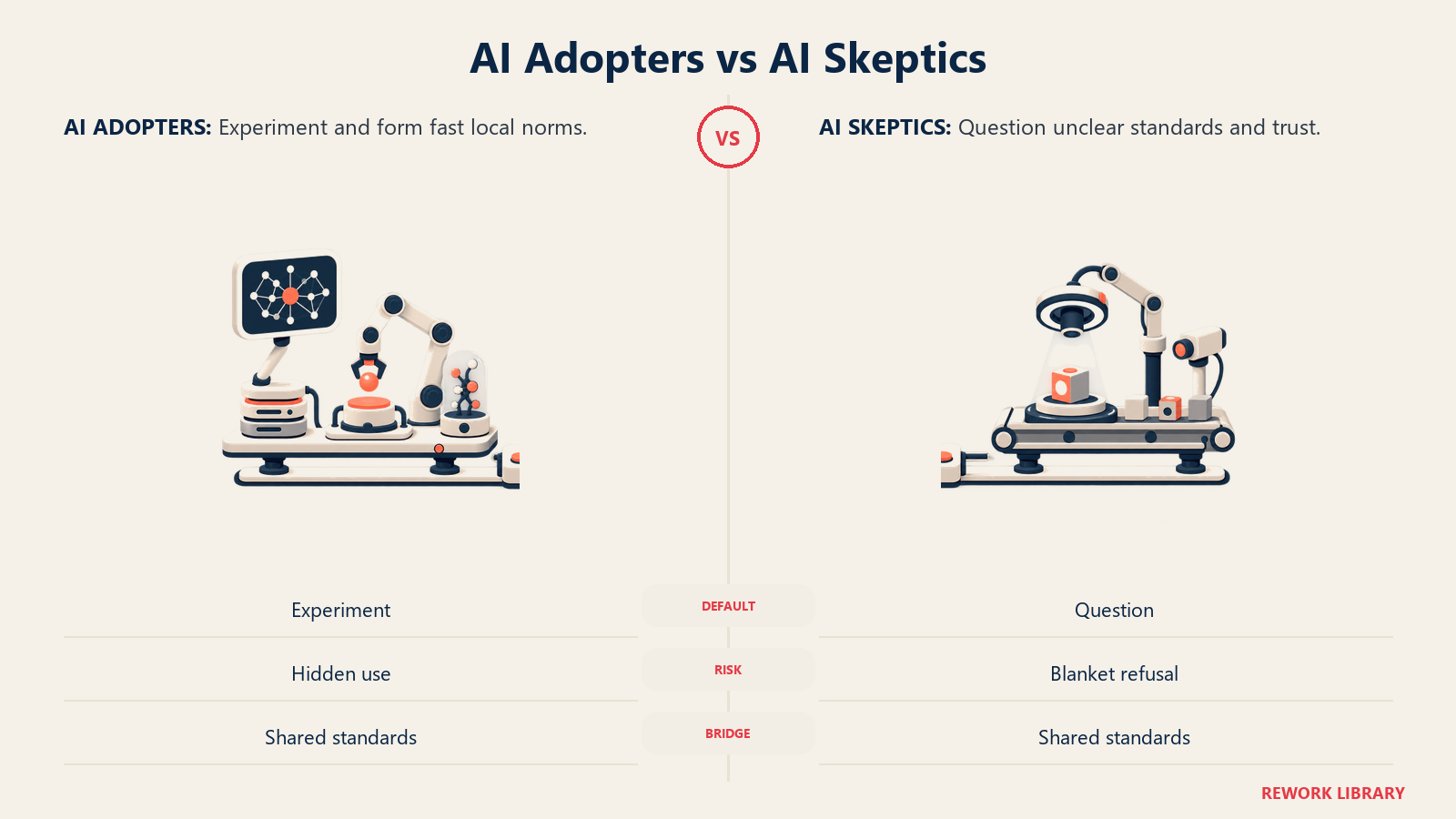
Microsoft's 2026 Work Trend Index found that a group it calls Frontier Professionals, employees whose AI use and organizational context reinforce each other, makes up roughly 19% of the workforce, and behaves noticeably differently than everyone else: they're far more likely to brainstorm process improvements with colleagues (63% versus 32%), share AI tips and learnings (61% versus 36%), and discuss quality standards for AI-assisted work (54% versus 29%). That's not a skills gap. It's a subculture gap, a group that has developed its own local norms around a new way of working while the rest of the organization hasn't caught up, and often doesn't know what the frontier group's norms even are.
Left unmanaged, this gap has a name and a real cost. Deloitte's 2026 Global Human Capital Trends research on what it calls "cultural debt" found that 65% of organizations believe their culture needs significant change because of AI, while 34% say their existing culture is actively holding back their AI goals, and separately found that only 5% of executives using AI in decision-making say they manage that use well. Cultural debt accumulates the same way technical debt does: quietly, in the gap between what a fast-adopting subculture is already doing and what the rest of the organization has agreed to, until the gap surfaces as a trust problem, a quality problem, or both.
The honest framing here is that this is closer to an orthogonal subculture than a counterculture, at least at the outset. AI-adopters aren't rejecting the company's core values by using new tools faster. But an unmanaged AI-adoption gap can curdle into something closer to a counterculture in either direction: adopters who quietly stop disclosing AI use because leadership has signaled disapproval, or skeptics who dig in against any AI-assisted work because nobody has set a clear, shared standard for what good AI-assisted work looks like. AI cultural debt covers the mechanics of that accumulation in depth, and human-agent teams covers what changes once some of the "teammates" whose norms need managing aren't people at all.
The Leader's Job: Unity Without Uniformity
Subculture management is not a one-time diagnostic. It's an ongoing discipline built on a few concrete habits.
Name the subcultures out loud. A leader who can describe, specifically, how the finance team's norms differ from the product team's, and why, is already ahead of most. Naming a subculture removes its power to operate unexamined, whether it's healthy or corrosive.
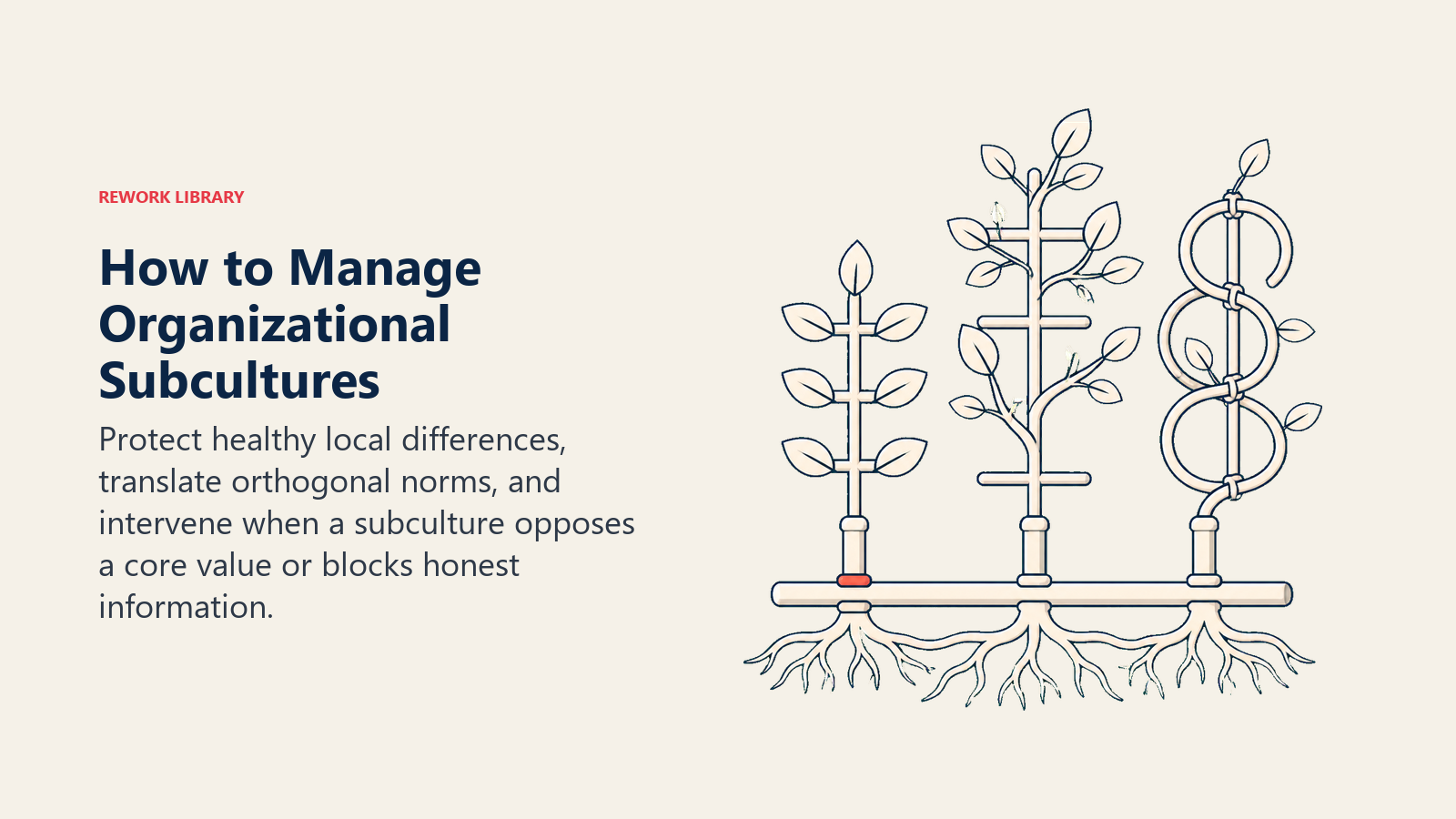
Classify before you intervene. Ask, for each visible gap: is this enhancing the values we say we hold, orthogonal to them, or actually opposed to them? Enhancing subcultures deserve protection and often deserve to be studied and spread. Orthogonal ones deserve to be left alone, with translation across the gap rather than pressure to conform. Only genuine countercultures, ones that oppose a core value rather than just a surface process, need direct intervention.
Protect the few non-negotiables, and only those. How to change organizational culture applies here directly: the fewer things a leader insists must be identical everywhere, honesty, safety, how customers are treated, the more credible the insistence becomes, and the more room every other local norm has to adapt sensibly to real conditions. A long list of "how we do things here" rules that goes beyond those non-negotiables just manufactures countercultures out of teams that had a perfectly good reason to work differently.
Build real channels for information to cross subculture lines. The corrosive version of divergence spreads because bad news gets filtered at the subculture boundary before it reaches anyone who can act on it. Psychological safety and trust aren't abstractions here; they're the specific mechanism that determines whether a team with different local norms tells leadership the truth about what those norms are actually producing.
Watch growth stage as a trigger, not just structure. Scaling culture in hypergrowth is often when subcultures first become visible at all, because a 30-person company that felt like one culture becomes, almost overnight, five or six team-level ones once headcount crosses a threshold where the founder can no longer be in every room. That's not a sign something broke. It's the predictable moment when subculture management stops being optional.
None of this requires eliminating difference. What is business culture makes the broader case that culture is the pattern of what actually gets rewarded and tolerated, not a single sentence everyone recites. A leader managing subcultures well is running the same system at two altitudes at once: a small set of company-wide non-negotiables held tightly everywhere, and a much larger space of local practice held loosely, on purpose, because it's adapted to work the rest of the company doesn't have to do.
Key Facts
- Martin and Siehl's foundational 1983 paper classified organizational subcultures into three types by their relationship to dominant values: enhancing, orthogonal, and counterculture. Source: Organizational Culture and Counterculture: An Uneasy Symbiosis, Semantic Scholar
- Gallup's research found that the individual manager accounts for roughly 70% of the variance between a company's most-engaged and least-engaged teams, more than compensation or stated company culture. Source: Gallup Business Journal
- A 2025 Mercer survey of post-close integration leaders found 67% ranked cultural misalignment as the single largest barrier to capturing merger synergies. Source: Mercer, Culture Risk in M&A
- Deloitte's 2026 Global Human Capital Trends research found 65% of organizations believe their culture needs significant change because of AI, and 34% say culture actively inhibits their AI goals. Source: Deloitte, Dealing with AI's Cultural Debt
- Microsoft's 2026 Work Trend Index found "Frontier Professionals," roughly 19% of the workforce, are far more likely than others to brainstorm process improvements (63% vs. 32%) and share AI tips with colleagues (61% vs. 36%). Source: Microsoft Work Trend Index 2026
- A Harvard Business School working paper on subcultures in dynamic organizations argues subcultures are a predictable, normal outcome of organizational specialization, not a sign of a failed culture-building effort. Source: Boisnier & Chatman, HBS
Rework's People app exists for the operational side of this problem: giving leaders one place to see engagement, onboarding, and manager patterns across teams, so a corrosive subculture shows up in the data before it shows up in an exit interview. It doesn't replace the judgment call above about which differences to protect and which to challenge. It just makes sure a leader has the visibility to make that call on purpose, rather than after the fact.
Frequently Asked Questions about Managing Subcultures
What is a subculture in an organization?
A subculture is a distinct set of norms, language, and behaviors that develops inside a smaller group, usually a team, department, function, or office, while the organization's broader dominant culture still holds. Every organization beyond a handful of people develops them, most often along department, geography, tenure, or manager lines.
What are Martin and Siehl's three types of subculture?
Enhancing subcultures hold the dominant culture's values even more intensely than the rest of the organization. Orthogonal subcultures accept the dominant culture's values while adding their own separate, non-conflicting values specific to their work. Countercultures hold values that directly oppose the dominant culture's core values.
Is it bad for a company to have subcultures?
No. Research on organizational culture treats subcultures as a normal, predictable result of specialization, not a failure. Most subcultures are enhancing or orthogonal, meaning they adapt sensibly to local work without threatening anything the company depends on. Only countercultures that oppose a core value, and corrosive divergence that hides problems or erodes trust, need direct intervention.
How do you tell a healthy subculture from a corrosive one?
Healthy divergence changes how a group works while keeping the same core values, and the group can explain its norms openly when asked. Corrosive divergence changes what actually happens, closing off information, hiding bad news, or tolerating behavior that would embarrass the company if said aloud, and it tends to resist outside challenge rather than respond to it.
Why do subcultures cause so many problems during mergers and acquisitions?
A 2025 Mercer survey found 67% of post-close integration leaders ranked cultural misalignment as the single largest barrier to capturing deal synergies. What looks like one culture clash at the leadership level is usually several smaller subculture clashes at the team level, different code review norms, different escalation thresholds, that go unmapped before the deal closes.
Do remote and distributed teams develop more subcultures than co-located ones?
Distributed teams don't necessarily develop more subcultures, but they lose the informal mechanisms, hallway conversations, shared lunches, that used to blend subcultures back together automatically. Without deliberate cross-team visibility and shared documentation habits, a distributed company can end up with an unmanaged subculture per time zone or office.
Is the AI-adopter vs AI-skeptic split a real subculture, or just a skills gap?
It behaves like a subculture, not just a skills gap. Microsoft's 2026 Work Trend Index found that fast AI-adopting employees are far more likely to share tips and discuss quality standards with each other than the rest of the workforce, a local norm forming inside a group, largely without the rest of the organization's involvement.
How should a leader intervene in a subculture without destroying what makes it work?
Classify it first: is it enhancing a core value, orthogonal to one, or actually opposed to one? Only genuine countercultures that oppose a core value need direct intervention. Enhancing subcultures deserve protection, and orthogonal ones deserve translation across the gap rather than pressure to conform to a single company-wide process.
What is the single biggest sign a subculture has become corrosive?
Information stops crossing the boundary honestly. A subculture that filters bad news before it reaches leadership, or that treats any outside challenge as an attack rather than a signal, has moved from healthy local adaptation into something that is actively working against the organization's ability to see and fix its own problems.
Managing subcultures is not the same job as building "one culture." It's the job of deciding, deliberately and repeatedly, which differences deserve protection and which ones deserve a direct conversation, then having the visibility to tell the two apart before a crisis does it for you.

Co-Founder, Rework.com
On this page
- Why Subcultures Are the Default, Not the Exception
- Where Subcultures Form
- Martin and Siehl's Three Types of Subculture
- Enhancing Subcultures
- Orthogonal Subcultures
- Countercultures
- When Divergence Is Healthy vs When It's Corrosive
- Subcultures After a Merger or Acquisition
- Subcultures in Distributed and Remote Teams
- The New Fault Line: AI-Adopter vs AI-Skeptic Subcultures
- The Leader's Job: Unity Without Uniformity
- Key Facts