How to Manage a Multicultural Team: A Practical Playbook
Turn this article into takeaways for your work.


Each assistant summarizes the article only for you and suggests best practices for your work.
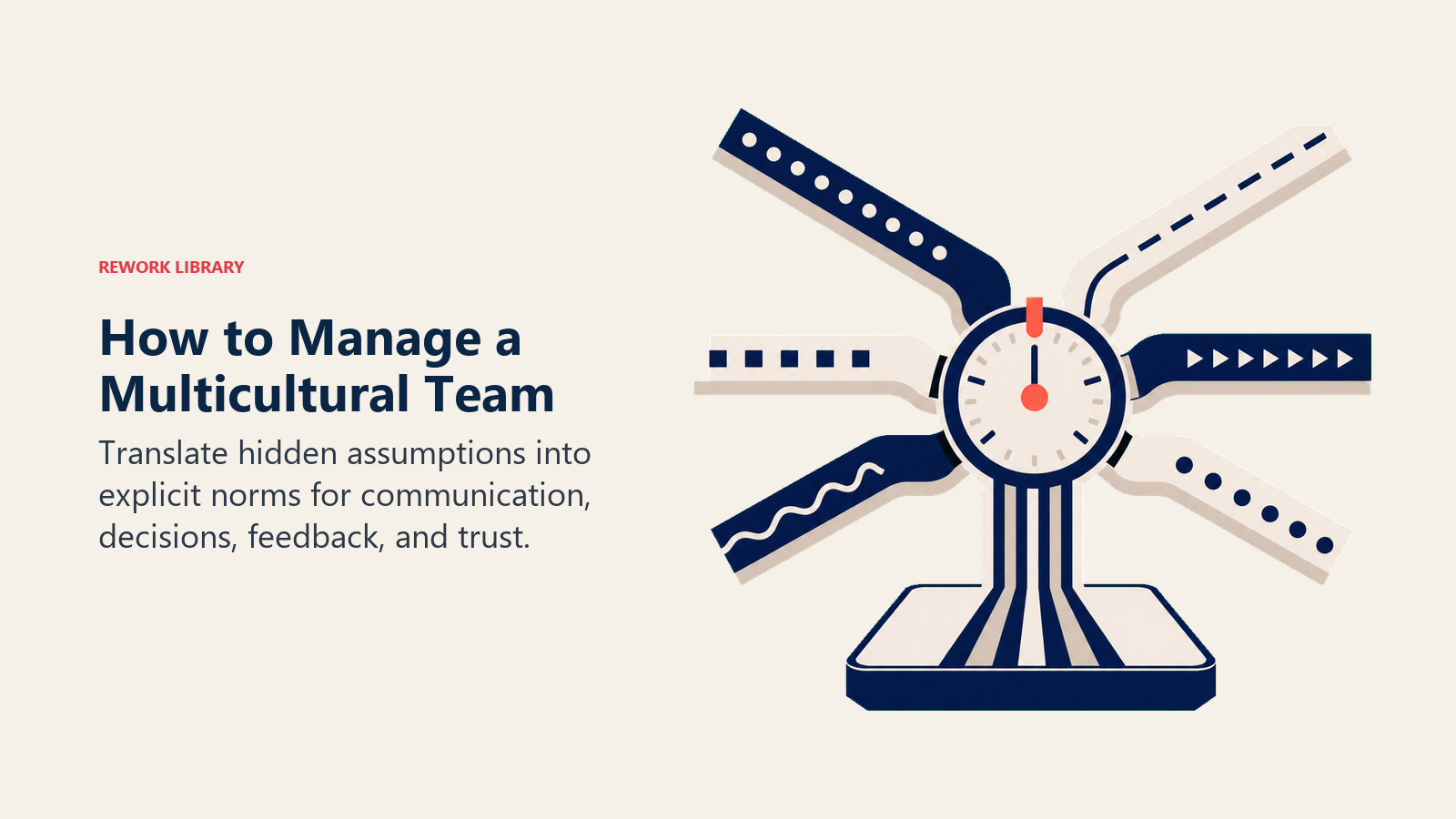
Managing a multicultural team means leading people who bring different national defaults for communication, hierarchy, decision-making, feedback, trust, and time, and building one working team culture on top of those differences instead of assuming everyone already shares yours. Done well, that range becomes an advantage. Left on autopilot, it quietly erodes trust one misread signal at a time.
Most leaders do not fail at this because they are careless. They fail because a team where everyone shares the same unwritten rules trains instincts that stop working the moment those rules stop being universal. A blunt piece of feedback that reads as respectful directness in Amsterdam reads as a public dressing-down in Manila. A quiet meeting that looks like consensus in Tokyo can just as easily be five people who disagree but were never going to say so out loud.
This guide covers the failure modes that trip up most managers, a tactic-by-tactic playbook organized by the axes where business culture actually varies, and how those tactics shift when the team is remote and increasingly working alongside AI.
Why Multicultural Teams Fail More Often Than They Should
The failures rarely look dramatic in the moment. Nobody storms out of a meeting. A project just slips, a good hire quietly disengages, or a decision that looked settled unravels two weeks later once someone finally says what they actually thought. Four patterns explain most of it.
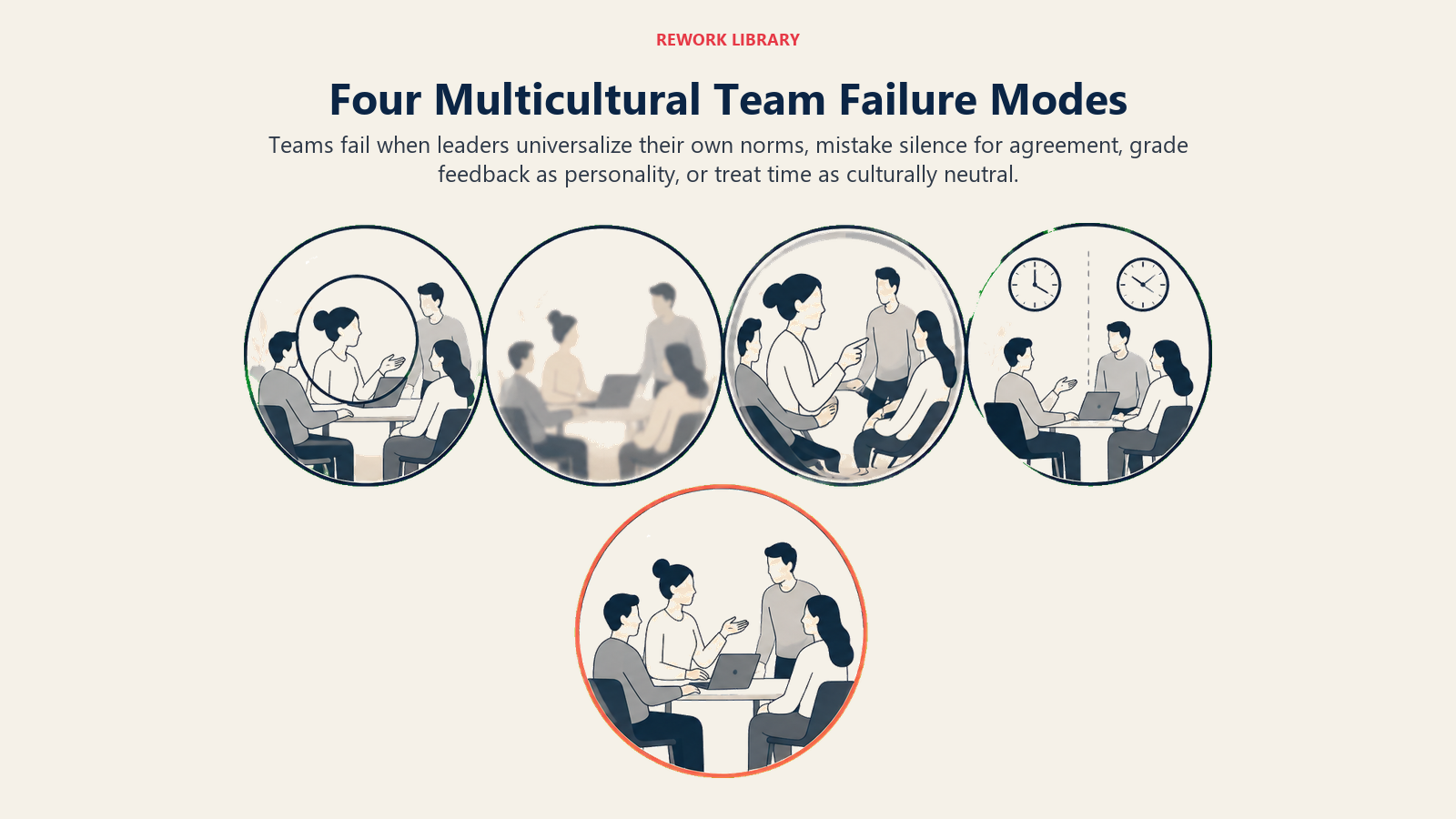
Assuming Your Norms Are the Default
The single biggest failure mode is not malice, it is gravity. Whatever style got you promoted (direct feedback, fast top-down calls, speaking up in a meeting) feels like "just how good teams work," not like one cultural default among several. A manager who built their instincts in a low power-distance, task-based culture keeps applying them to a team running on different defaults, then stays confused when the results do not match. We cover exactly which axes differ, and by how much, in how business culture differs across the world.
Misreading Silence as Agreement
Silence in a meeting almost never means agreement, and even less so on a multicultural team. In high power-distance or collectivist cultures, staying quiet in front of the group is often the respectful choice, not the honest one, and a manager who takes it at face value walks out believing a decision has buy-in it never actually had. We break this pattern down, with a full diagnostic, in why teams stay silent in meetings.
Misreading Feedback Style as a Personality Trait
Direct feedback and indirect feedback are cultural defaults, not character traits, and mixing that up costs managers good people. A manager who reads an indirect communicator as "not confident enough" or a direct communicator as "abrasive" is grading someone against the wrong scale. Erin Meyer's Evaluating scale in The Culture Map exists precisely because this misread is so common and so avoidable.
Misreading Time as Universal
Monochronic managers (schedules as commitments, one thing at a time) can read a polychronic colleague's flexible relationship with a start time as unprofessional, when it usually signals the opposite: the relationship in the room matters more than the clock. The reverse happens too, where a polychronic team reads a monochronic manager's insistence on punctuality as coldness rather than respect. Neither read is correct. Both are a culture clash wearing the costume of a personality problem.
Key Facts
- McKinsey's "Diversity Wins" research found companies in the top quartile for ethnic and cultural diversity on their executive teams were 36% more likely to post above-average profitability than those in the bottom quartile. Source: McKinsey
- BCG's study of more than 1,700 companies across eight countries found firms with above-average diversity on their management teams reported innovation revenue 19 percentage points higher than firms with below-average leadership diversity. Source: BCG
- The GLOBE study, one of the largest cross-cultural leadership research projects ever run, surveyed roughly 17,000 middle managers across 950 organizations in 62 societies to map how culture shapes leadership expectations. Source: globeproject.com
- On Hofstede's Power Distance Index, Malaysia scores 100 versus 11 for Austria, the lowest score in the dataset, a gap wide enough that "speak up if you disagree" means something close to opposite things in each culture. Source: hofstede-insights.com
- Gallup research found only 3 in 10 U.S. employees strongly agree their opinions count at work, and estimates moving that ratio to 6 in 10 could cut turnover by 27% and lift productivity by 12%. Source: Gallup
The Playbook, By Axis
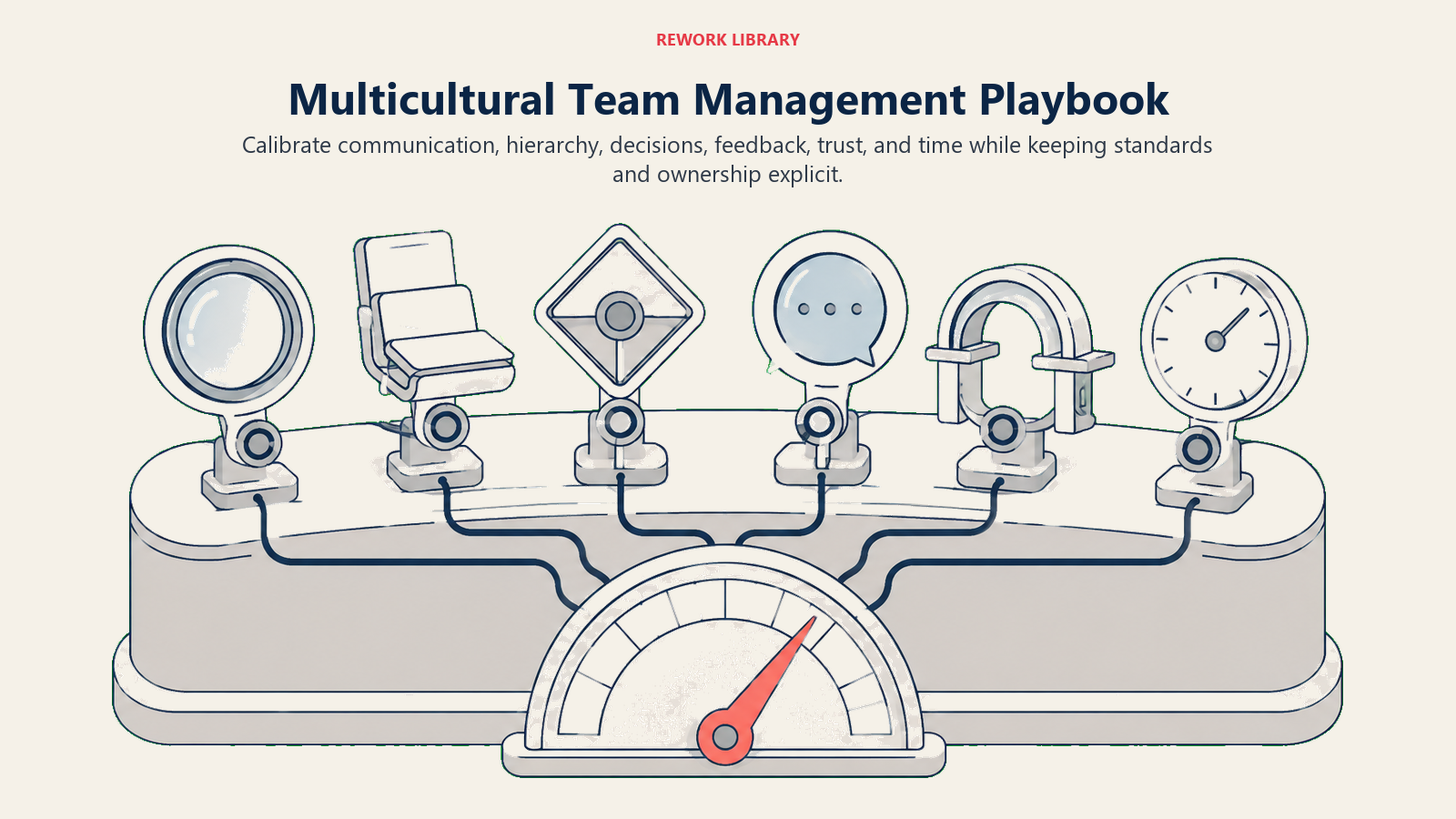
Once you can name which axis is actually causing the friction, the fix usually stops being a mystery. Run your team through these six, the same axes covered in how business culture differs across the world and mapped in more depth by Hofstede's cultural dimensions.
Communication: Bridge High-Context and Low-Context
Low-context team members want the point stated plainly, in writing, with no ambiguity. High-context team members expect meaning to live partly in tone, relationship, and what is deliberately left unsaid. Neither is wrong, but a team that only runs one mode loses the other half of its people.
- Follow every verbal decision with a short written summary. It gives low-context members the explicit record they expect and gives high-context members a face-saving way to flag a concern in a comment instead of out loud.
- When a high-context colleague hedges ("that could be difficult," "let me check on that"), treat it as a soft no until proven otherwise, not as a maybe you can push past.
Hierarchy: Decide Who Gets to Speak First, and When
High power-distance team members expect direction from the top and are unlikely to challenge it in front of the group. Low power-distance team members expect to be asked, and read silence from leadership as an invitation to fill it.
- In mixed-hierarchy meetings, ask junior or high-power-distance team members for their view before senior voices weigh in, not after. Once the senior person has spoken, the room has effectively already decided.
- Model the behavior you want copied. If you want people to challenge your thinking, visibly reward the first person who does it, in front of the team, the same day it happens.
Decision-Making: Match Your Speed to the Culture You Are Deciding In
A fast, top-down call plays as decisive in the US or UK. The same call, made without visible consultation, can read as reckless in Japan, Germany, or much of continental Europe, where stakeholders expect to be looped in before a decision lands, not after.
- Build a short consensus pass into decisions that touch consensus-oriented team members, even a single async round of "any concerns before I finalize this." It costs a day. Skipping it can cost the team's trust in the decision.
- Write down who actually has the final say on which categories of decisions. Ambiguity about who decides is often mistaken for a cultural clash when it is really a missing org chart.
Feedback: Separate the Substance From the Delivery
Keep the bar identical for everyone. Change how the same substance gets delivered. That single distinction, covered in depth in giving feedback well and in the practice of radical candor, is the whole skill.
- With direct, low-context team members, say the critical point plainly and early. Softening it too much reads as evasive or as if the issue is not serious.
- With indirect, high-context team members, lead with what is working and deliver the correction privately, never in front of peers, where a normal moment of accountability can land as public humiliation instead.
Trust: Know Whether You Are Building It Through Work or Through Relationship
Task-based cultures (the US, UK, much of Northern Europe) build trust by delivering on commitments: do what you said, and trust follows. Relationship-based cultures (much of Southeast Asia, Latin America, China, the Middle East) build trust through time spent together first, and read a rush to business as a mild red flag, not efficiency.
- With relationship-based colleagues, spend the first few minutes of a call on genuine, unhurried personal conversation before the agenda. It is not wasted time, it is the actual mechanism that earns you the benefit of the doubt later.
- With task-based colleagues, do not over-invest in small talk they read as stalling. Get to the point, deliver reliably, and let the track record do the trust-building.
Time: Protect Punctuality Where It Signals Respect, and Flexibility Where It Does Not
Monochronic cultures (Germany, the US, Japan) treat schedules as commitments and read lateness as disrespect. Polychronic cultures (much of Latin America, the Middle East, and South Asia) treat time as flexible and relationships as more important than the agenda, and a meeting running long is not automatically a problem.
- Do not assume a late start from a polychronic colleague is a lack of professionalism, and do not assume a strict agenda from a monochronic one is coldness. Ask before you judge either.
- For deadlines that genuinely cannot slip, say so explicitly and explain why, instead of relying on the team to intuit which dates are firm and which are aspirational.
Team Culture Beats National Defaults
Every axis above describes a starting hypothesis, not a script, and the fastest way to waste this whole framework is to treat a colleague's passport as a personality test. A Vietnamese engineer who spent five years at a US startup may communicate more like a low-context Californian than like the national average. The map tells you what to expect from someone you have not worked with yet. The person in front of you always gets the final say.
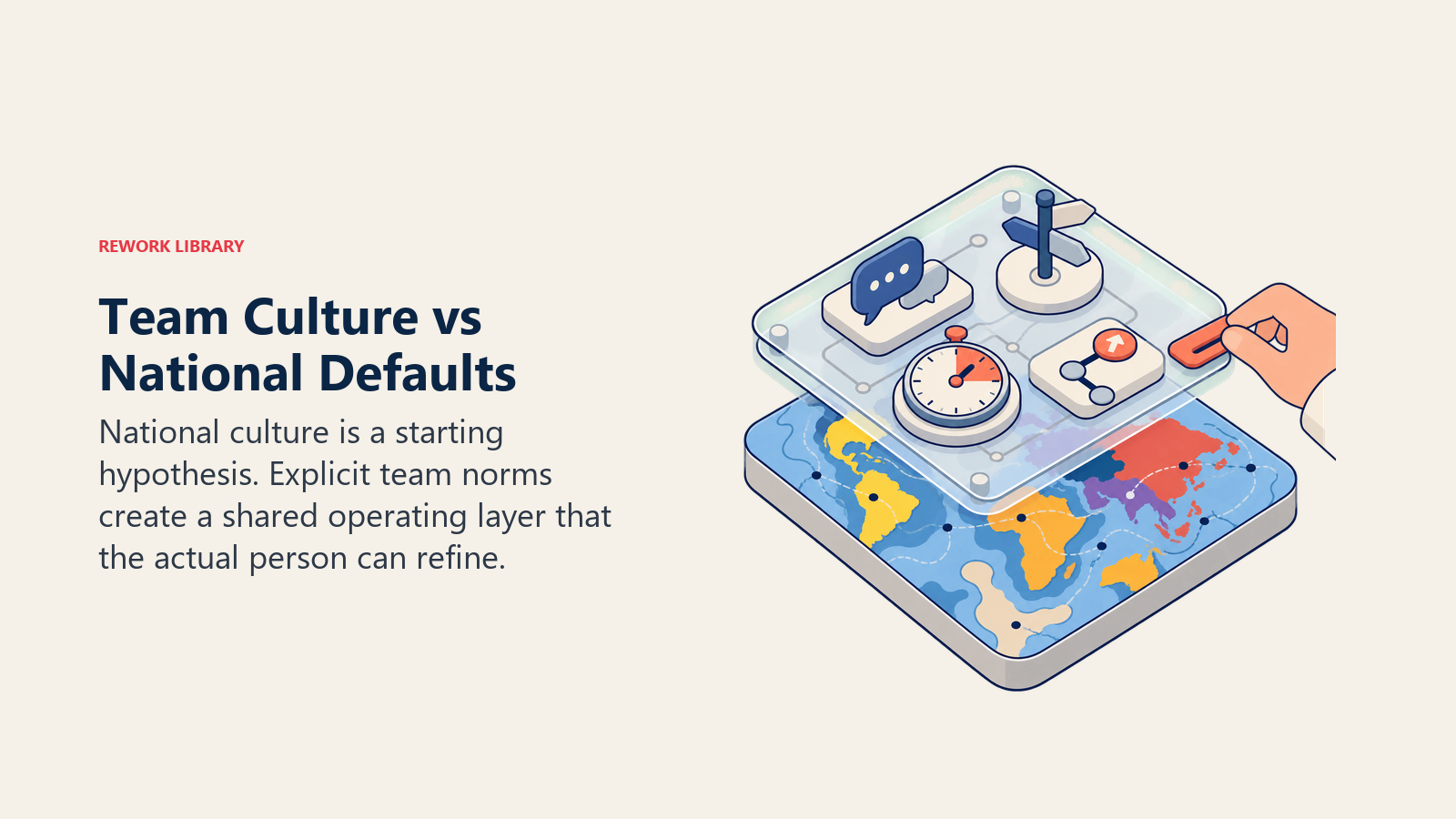
That is exactly why the highest-leverage move is not memorizing more country data, it is building an explicit team culture on top of whatever national defaults people arrive with. A deliberately built company culture does not erase national culture, but it gives a team a shared, chosen layer of norms that usually outperforms whatever the national averages would predict on their own.
In practice, that means writing your norms down instead of leaving them to be discovered by trial and error:
- How does this team give feedback: in the moment, in writing first, or privately after the meeting?
- How do we decide: does the most senior person decide, or do specific roles need visible sign-off before something ships?
- What does "urgent" actually mean here, and what is the expected response time for a message flagged that way?
- What is the escalation path when someone disagrees with a decision after it has already been made?
A written norm removes the guesswork for every new hire, in every country, instead of leaving it to whoever happens to explain it to them first, correctly or not. Treat the document as a living one. Revisit it after the first real conflict it fails to prevent, because that failure is exactly the signal that a norm was assumed rather than agreed.
Running Inclusive Meetings Across a Multicultural Team
Meetings are where cultural mismatches show up first, because a quiet room looks the same whether the cause is agreement, hierarchy, face-saving, or a bad format. The full diagnostic lives in why teams stay silent in meetings, and the same fixes work especially well on multicultural teams:
- Run round-robin instead of open floor. Go person by person and ask each one directly what they think. It removes the need to compete for airtime, which favors whoever is culturally comfortable interrupting, and signals that everyone's input is expected rather than optional.
- Hold pre-meeting 1:1s for contentious decisions. People who will not contradict a peer or a senior colleague in public will often tell you plainly one-on-one, surfacing objections while they are still cheap to address.
- Go written-first for high-stakes calls. Circulate a short proposal beforehand and collect comments in writing. It levels the field between fast talkers and people who think best with time, and gives high power-distance colleagues a lower-cost channel to flag a concern.
- Add an anonymous input channel. A quick anonymous poll or shared form before a decision meeting is a fast way to check whether the room's silence is hiding real disagreement.
- Name the room as safe, out loud, and mean it. Psychological safety is the foundation this whole approach sits on. The structural fixes above only work if people also believe, from experience and not just from a stated policy, that speaking up will not cost them.
None of this asks anyone to act against their own cultural instincts. It changes the format so people who were never going to interrupt in an open meeting get an equally real channel to be heard, and inclusive leadership is largely the discipline of building that channel on purpose instead of hoping it appears.
Remote and Distributed Nuances
A multicultural team is hard enough in one room. Spread it across time zones and the same failure modes compound, because video calls strip out most of the small physical cues (a leaning-forward posture, a half-raised hand) that experienced facilitators use to draw a quieter colleague in. Hybrid team leadership and strong async communication practices matter more on a distributed multicultural team than on a distributed team that shares one national default, not less.
A few things change specifically because the team is both remote and multicultural, not just one or the other:
- Unmuting carries a real social cost, and it is not the same cost in every culture. A colleague from a high power-distance or high-context background is already less likely to interrupt a senior person; doing it over video, where the tell-tale cues of "I have something to say" are invisible, makes it even less likely. Build in structured turns rather than relying on someone to unmute unprompted.
- Async-first defaults help high-context team members more than anyone else. Writing gives someone time to compose a face-saving way to raise a concern that a live call does not allow.
- Time zone scheduling is itself a cultural signal. Always putting the same region on the 9pm or 6am call quietly tells that region their time matters less. Rotate the inconvenient slot, and say out loud that you are doing it.
- Rituals that depend on one manager remembering to run them fade fast. The round-robin prompt, the written-first proposal, the anonymous check-in: build them into a recurring meeting workflow so the habit survives past the first few times it feels new, rather than relying on individual discipline every single week.
Managing a Multicultural Team in the Age of AI
AI is genuinely reshaping global teams, and it is worth being honest about both the gains and the limits rather than overselling either. Real-time translation and AI-drafted first passes at written communication have already lowered the language barrier that used to slow down cross-border work, and AI agents handling repetitive coordination (scheduling across time zones, chasing status updates, drafting the written-first proposal a team asked for) free up a manager's attention for the parts of cross-cultural work that still require judgment.
What AI has not solved is the interpretation layer. A translated sentence still needs someone to read the silence, the hedge, or the tone underneath it correctly, and an agent trained mostly on low-context, direct communication can flatten exactly the high-context nuance a multicultural team needs preserved. As more teams operate as Frontier Firms with agent bosses, the multicultural skill set does not shrink. It expands to include reading how comfortable each team member is pushing back on an AI-generated recommendation, which tracks the same power-distance patterns that already shape how comfortable they are pushing back on a human manager.
Where Rework Fits
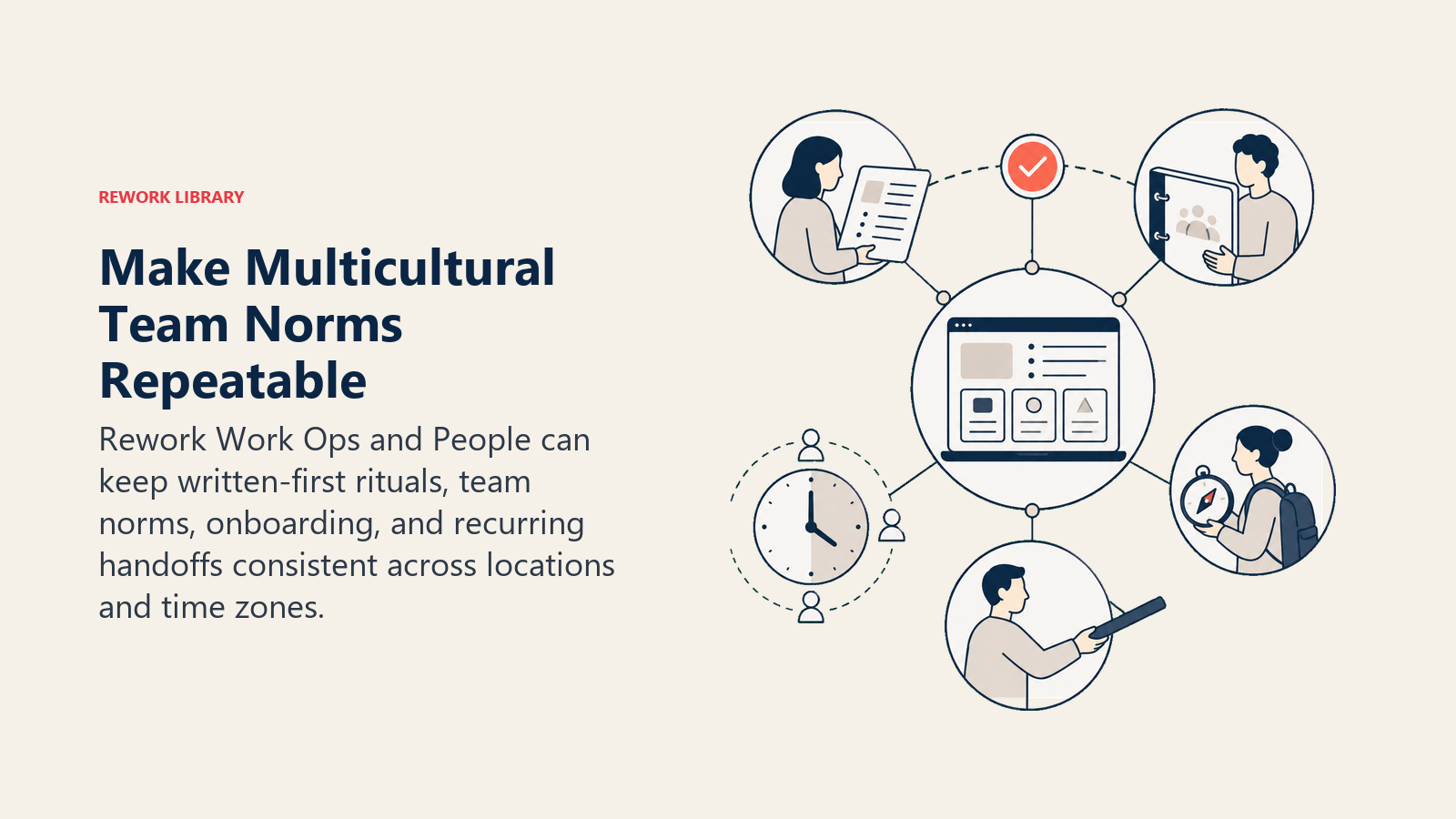
Managing across cultures is a leadership skill first, not a software problem, and no tool replaces the judgment above. But the operational side, a written-first ritual, a documented team norms page, onboarding that explains "how we work here" the same way to every new hire regardless of time zone, is easier to run without drift in one system than scattered across five disconnected tools and one manager's memory. That kind of unglamorous consistency is what Rework's Work Ops and People app are built to support.
Frequently Asked Questions about Managing a Multicultural Team
What does it mean to manage a multicultural team?
It means leading people who bring different national defaults for communication, hierarchy, decision-making, feedback, trust, and time, and building one shared, explicit team culture on top of those differences instead of assuming everyone already works the way you do.
What is the biggest mistake leaders make with multicultural teams?
Assuming their own cultural default is simply "how good teams work" rather than one style among several. This shows up most often as taking silence for agreement, reading indirect feedback as low confidence, or reading a flexible relationship with time as unprofessional.
How do I know if my team's silence means agreement or something else?
Ask the same question privately, in a 1:1, right after the meeting. A clear, confident answer in private but silence in the group usually points to hierarchy, face-saving, or fear rather than genuine agreement. The full diagnostic is in why teams stay silent in meetings.
Should I give the same feedback to every culture the same way?
Keep the substance and the standard identical for everyone. Change the delivery: direct and immediate for low-context colleagues, private and framed around what's working first for high-context colleagues. The bar should never move, only the way you communicate it.
Does building a strong team culture matter more than national culture?
A well-built, explicit team culture usually matters more day to day than national defaults on their own, especially once new hires are onboarded consistently into it. It does not erase national culture, but it gives everyone a shared, chosen layer of norms that sits above whatever background each person arrives with.
How does remote work change multicultural team management?
It removes the physical cues that help a facilitator draw a quieter colleague into a discussion, and it raises the social cost of unmuting to speak, which disproportionately affects team members from high power-distance or high-context cultures. Async-first defaults and structured turn-taking matter more, not less, on a distributed multicultural team.
Is it disrespectful to research a colleague's national culture before working with them?
No, as long as you treat what you learn as a starting hypothesis to test against the actual person, not a fixed label. Frameworks like Hofstede's dimensions and The Culture Map exist to give you an informed first guess, not a stereotype to apply regardless of who is actually in the room.
How is AI changing how multicultural teams work together?
Real-time translation and AI-drafted communication have lowered the language barrier for cross-border teams, and AI agents can take repetitive coordination work off a manager's plate. What AI has not solved is interpreting tone, hedging, and silence correctly across cultures, which still requires human judgment, and increasingly extends to how comfortable someone is pushing back on an AI agent's recommendation.
What's the fastest way to start improving how I manage a multicultural team?
Write your team's actual norms down: how feedback gets delivered, how decisions get made, what "urgent" means, and what the escalation path is when someone disagrees after a decision has landed. A documented norm removes the guesswork that causes most of the early friction on a new multicultural team.
A multicultural team is not harder to manage because the people are harder to work with. It is harder because the defaults you learned to trust stop being universal once the team stops sharing your background. Name the axis causing the friction, apply the fix that matches it, and write the team's real norms down instead of leaving them to be guessed at. That is most of the skill, and none of it requires treating anyone's culture as a problem to be managed around.

Co-Founder, Rework.com
On this page
- Why Multicultural Teams Fail More Often Than They Should
- Assuming Your Norms Are the Default
- Misreading Silence as Agreement
- Misreading Feedback Style as a Personality Trait
- Misreading Time as Universal
- Key Facts
- The Playbook, By Axis
- Communication: Bridge High-Context and Low-Context
- Hierarchy: Decide Who Gets to Speak First, and When
- Decision-Making: Match Your Speed to the Culture You Are Deciding In
- Feedback: Separate the Substance From the Delivery
- Trust: Know Whether You Are Building It Through Work or Through Relationship
- Time: Protect Punctuality Where It Signals Respect, and Flexibility Where It Does Not
- Team Culture Beats National Defaults
- Running Inclusive Meetings Across a Multicultural Team
- Remote and Distributed Nuances
- Managing a Multicultural Team in the Age of AI
- Where Rework Fits