How to Scale Culture in a Fast-Growing Company
Turn this article into takeaways for your work.


Each assistant summarizes the article only for you and suggests best practices for your work.
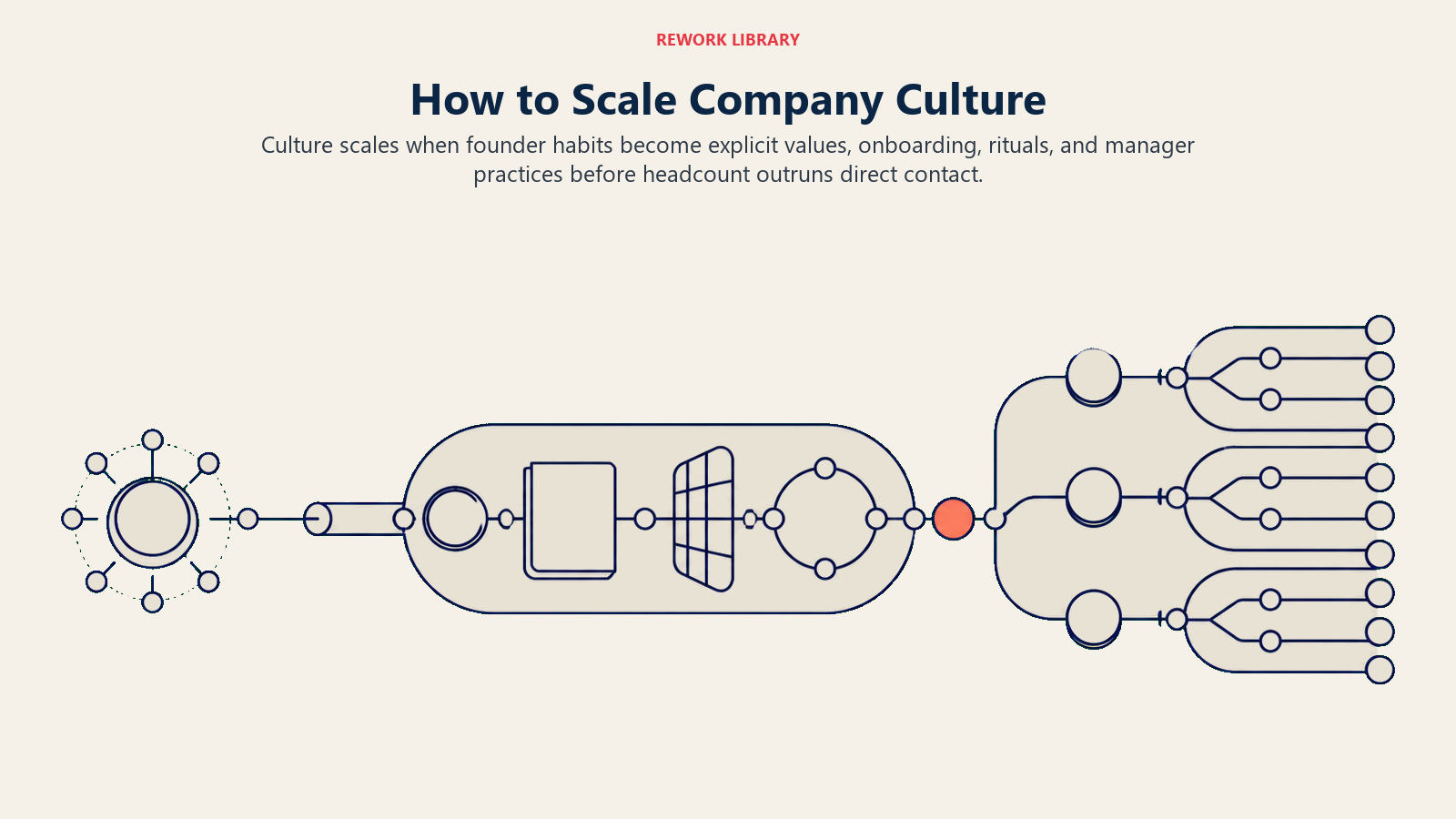
Scaling company culture means keeping your values and unwritten rules intact while headcount, offices, and management layers grow faster than any one person can personally model them. It's hard because culture doesn't scale on its own. It has to be deliberately written down, taught, and re-taught at every size, or it drifts into whatever the newest hires happen to bring with them.
Most founders don't plan for this. Early on, culture isn't a program, it's a person: the founder decides, explains the reasoning out loud, and everyone absorbs it by watching. That works beautifully at ten people and starts to strain at fifty. By three hundred, it has usually broken in ways nobody notices until a new VP asks why two teams solve the same problem in opposite ways and gets two equally confident, contradictory answers.
What Scaling Culture Actually Means
Scaling culture isn't the same as protecting it, and treating them as identical is where this usually goes wrong. Protecting culture means refusing to change anything, forcing the habits of a ten-person team onto a division of eight hundred who need different levels of formality and different decision processes. Scaling culture means keeping the underlying values consistent while the mechanisms that transmit them change completely, from a founder's lunch table to a written playbook, manager training, and deliberate onboarding.
As what is business culture covers, culture is the pattern of behavior that repeats when nobody is grading the performance, not the poster on the wall. Scaling it means making sure that pattern keeps repeating correctly once the founder is no longer in the room to model it, a far more mechanical problem than most growth plans account for.
Why Culture Dilutes as You Scale
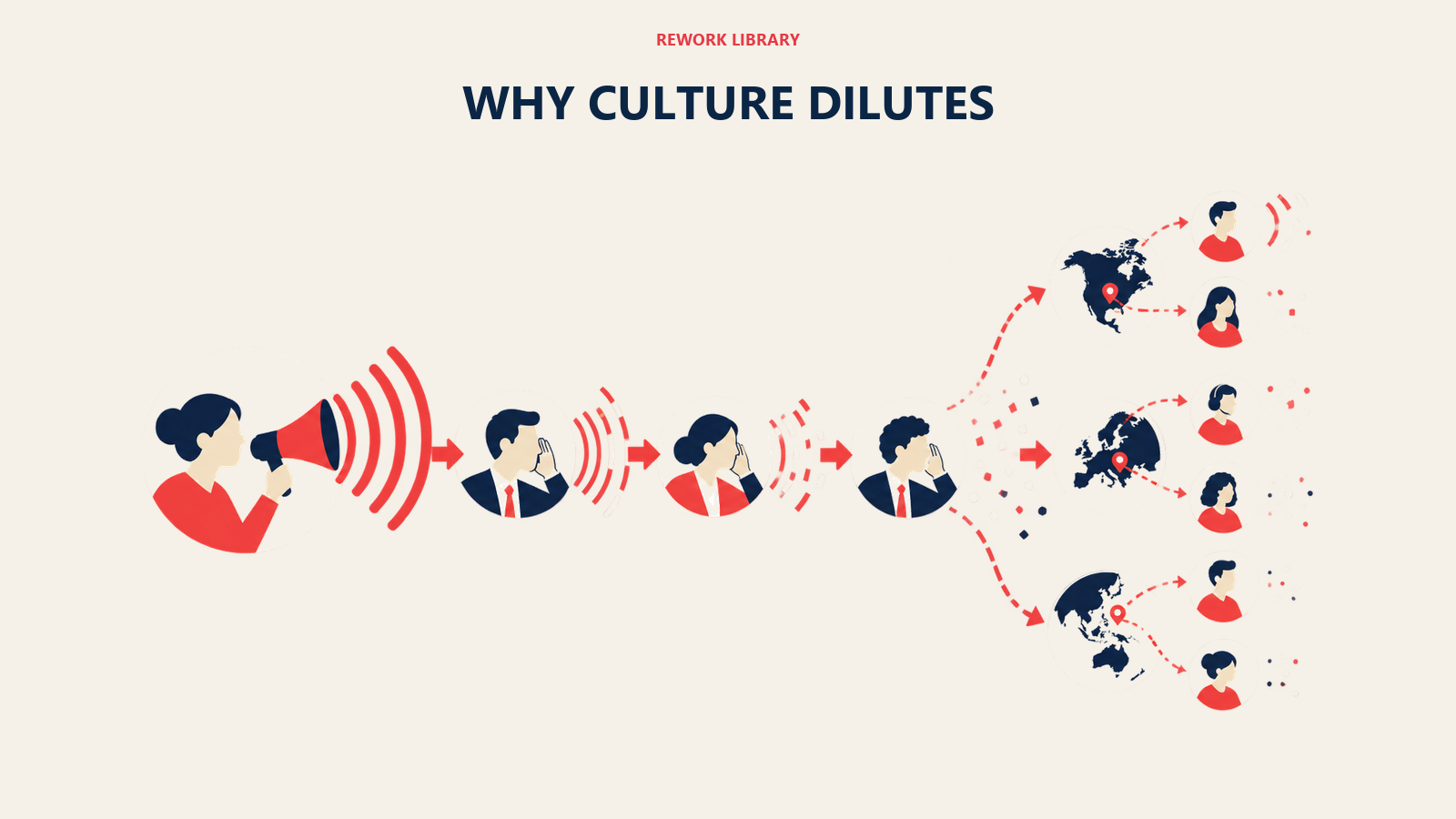
Culture dilution isn't a mysterious loss of vibe. It's a predictable consequence of three things happening together: the number of relationships one person can maintain hits a hard ceiling, the ratio of people who've internalized the culture to people who haven't gets worse with every bulk hiring round, and every added management layer is one more place for the signal to get garbled.
Dunbar's Number and the Limits of Personal Trust
Anthropologist Robin Dunbar's research proposed that humans can comfortably maintain roughly 150 stable social relationships, the number of people whose place in your social world you can actually track. Dunbar has defended the figure for three decades against academic pushback, and versions of it keep showing up in hunter-gatherer bands, military units, and even Christmas card lists.
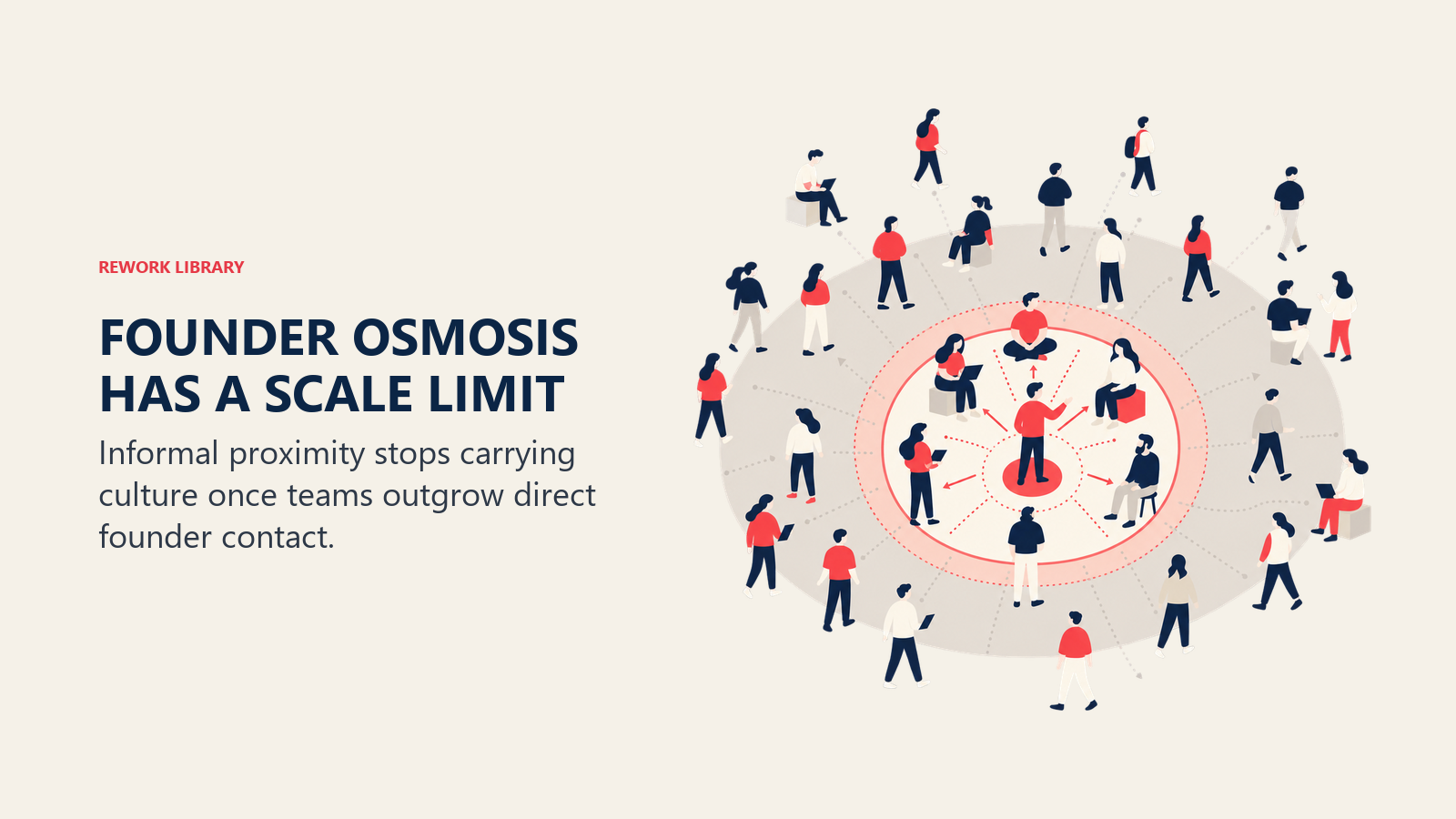
A founder building culture through personal relationships runs headfirst into this ceiling, whether they realize it or not. Below roughly 150 people, a founder can plausibly know everyone's name and correct a bad pattern in a hallway conversation before it hardens into a norm. Past that point, no amount of extra hours changes the math. Culture built entirely on proximity runs out of road right around the size most companies consider early success.
The New-Hire Ratio Problem
Rapid hiring changes who's in the room to model culture. Startup employees stick around for a median of about two years, versus roughly four years across the broader economy, so fast-growing companies constantly refill their workforce with people who haven't absorbed anything yet. Double headcount in a year and roughly half the building wasn't there twelve months ago.
The people who absorbed culture directly from the founders get outnumbered fast, and outnumbered carriers can't correct drift the way they could as the majority. New hires aren't blank slates either. They arrive with habits from their last job, and without a deliberate counterforce, those habits fill the vacuum a stretched-thin founder leaves behind.
More Layers, Less Signal
Every management layer added is one more retransmission of the signal, and every retransmission loses fidelity, the way a message degrades down a long chain of people repeating it. Gallup found the average number of people reporting to one manager has climbed to about 12.1, up nearly 50 percent since 2013, well past the roughly eight or nine reports where manager engagement peaks. A manager stretched across a dozen reports has less time to explain the "why" behind a decision, exactly the part of culture that doesn't survive compression. Stack three or four thinning layers between founder and frontline, and the original intent is usually simplified, reinterpreted, or quietly reversed by the time it lands.
Key Facts
- Robin Dunbar's research puts the number of stable relationships a person can maintain at roughly 150, a cognitive ceiling that limits how far founder-led, relationship-based culture transmission can scale. Source: The Conversation
- 74% of high-growth startups fail at least in part due to premature scaling, growing headcount, spend, or footprint ahead of a validated operating model. Source: Startup Genome
- The median job tenure at a startup is about 2.0 years, compared with roughly 4.2 years across the broader U.S. economy, meaning fast-growing companies constantly refill their workforce with people who haven't absorbed the culture. Source: Carta
- New employees who go through a structured onboarding program are 58% more likely to still be with the company after three years. Source: SHRM
- The average number of direct reports per manager has grown to about 12.1, up nearly 50% since 2013, well beyond the roughly 8 to 9 reports where manager engagement tends to peak. Source: Gallup
- Netflix's 2009 culture deck, one of the earliest attempts to formally codify culture instead of leaving it to osmosis, has been viewed more than 13 million times and was called "maybe the most important document ever to come out of the Valley" by Meta's Sheryl Sandberg. Source: Fast Company
When Founder Osmosis Stops Working
"Founder osmosis" is a useful name for the informal way culture spreads early on: new hires absorb norms by watching the founder decide things and copying what gets rewarded versus what gets a raised eyebrow. It costs nothing and works remarkably well up to a point, which is exactly why so few founders replace it before it fails.
The failure is rarely one dramatic moment. It shows up as managers who were never in the founding conversations making calls that technically follow the rulebook but violate the spirit behind it, because nobody explained the spirit to them. It shows up as two offices developing incompatible norms around handling disagreement, one direct, one conflict-avoidant, with neither side aware of the gap until a cross-team project exposes it. And it shows up in exactly the pattern covered in why teams stay silent in meetings: a manager the founder never worked closely with quietly punishes dissent, and with no shared sense of "that's not how we operate here" left to catch it, nobody does.
Osmosis depends on trust built through direct contact. Once a founder can't have that contact with most of the company, trust has to come from systems instead, the argument behind how to build trust in the workplace: consistency and fairness people can observe even from someone whose policy they've never met.
How to Codify Culture Before You Need To
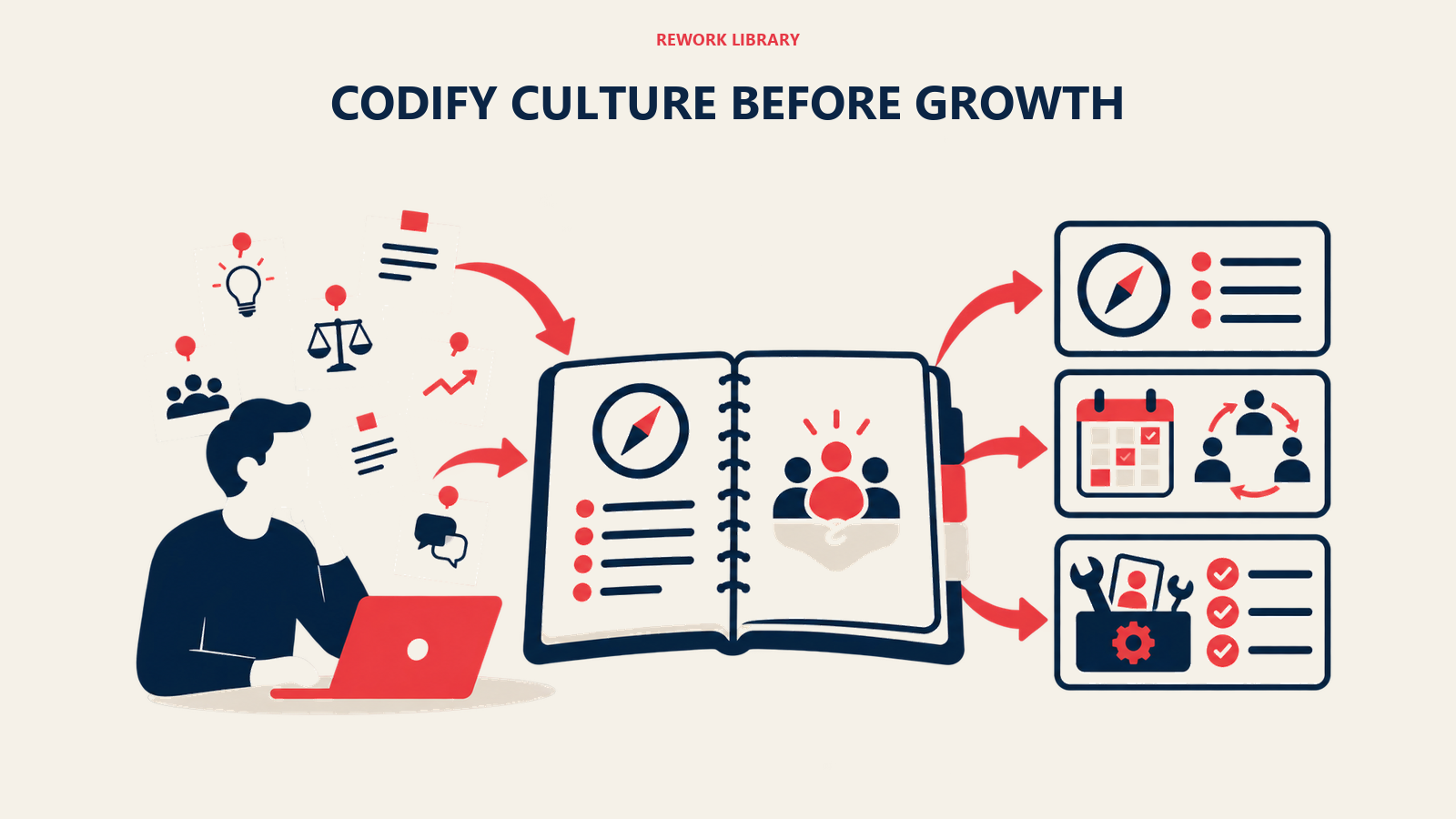
The fix isn't more communication. It's turning something that used to live in one person's head and daily habits into something written, teachable, and repeatable by people who were never in the founding conversations.
Write the Values Down, Precisely
Vague values fail exactly when needed most, because "integrity" or "excellence" gives a stressed manager nothing to act on in an ambiguous moment. How to define company values that actually work covers this in depth, but the short version: a usable value states a real trade-off, which of two good things wins when they conflict, and what behavior you'd lose a good employee over rather than let slide.
This matters more as a company grows, because Schein's three levels of organizational culture explains why: a founding team shares deep, unspoken assumptions without discussing them, but a thousand-person company drawn from dozens of backgrounds can't rely on assumptions nobody wrote down. What used to be obvious has to become explicit, because the underlying-assumptions layer that held a ten-person team together doesn't exist yet for someone who joined last month.
The Culture Deck Approach
Netflix's 2009 culture deck is the clearest example of codification done well: specific, sometimes uncomfortable statements about real trade-offs (paying top of market instead of average raises, favoring "highly aligned, loosely coupled" teams over heavy process) rather than a generic values poster. It worked because it read like an honest description of how the company actually operated, warts included.
Copy the format, not the content, since Netflix's answers were built for Netflix's business. A culture deck should be a living document, owned by leadership and revised in public, stating what the company actually rewards and won't tolerate, concrete enough for a manager who never met the founders to apply next week.
Onboarding as the Transmission Mechanism
Once osmosis stops covering most of the company, onboarding becomes the primary channel for transmitting culture, which is why the retention numbers around it are so strong. Onboarding for culture covers the first-90-days mechanics, but the principle here is that onboarding at scale has to do the job a founder's proximity used to do: explain not just what the rules are, but why they exist.
Skipping this because "we're moving too fast to slow down for onboarding" is the single most common way hypergrowth companies lose the culture they're trying to protect. The company isn't too fast for onboarding. It has stopped noticing that the founder used to do this job personally, and nobody replaced it.
Rituals and Managers Carry the Rest
Rituals are the small, low-cost mechanisms that keep transmitting culture once a founder can't be everywhere: an all-hands where real mistakes get discussed openly, a decision log that shows the reasoning behind calls, a channel where disagreement is visibly allowed. None require the founder's presence, which is the point. A "wins only" newsletter teaches people that hiding bad news is the norm; rituals that survive scale show real behavior instead.
Managers are the other half. Past the size where a founder can reach every team, managers become the mechanism through which culture reaches the frontline, for better or worse. A company can have a beautifully written culture deck and still have a toxic pocket wherever a manager was never trained to apply it, because employees experience culture through their manager's daily behavior far more than any document.
Stage by Stage: What Changes as You Scale
Culture doesn't fail all at once. It shifts through fairly predictable stages, and the mechanism that worked at the previous stage is usually the first thing that needs replacing at the next.
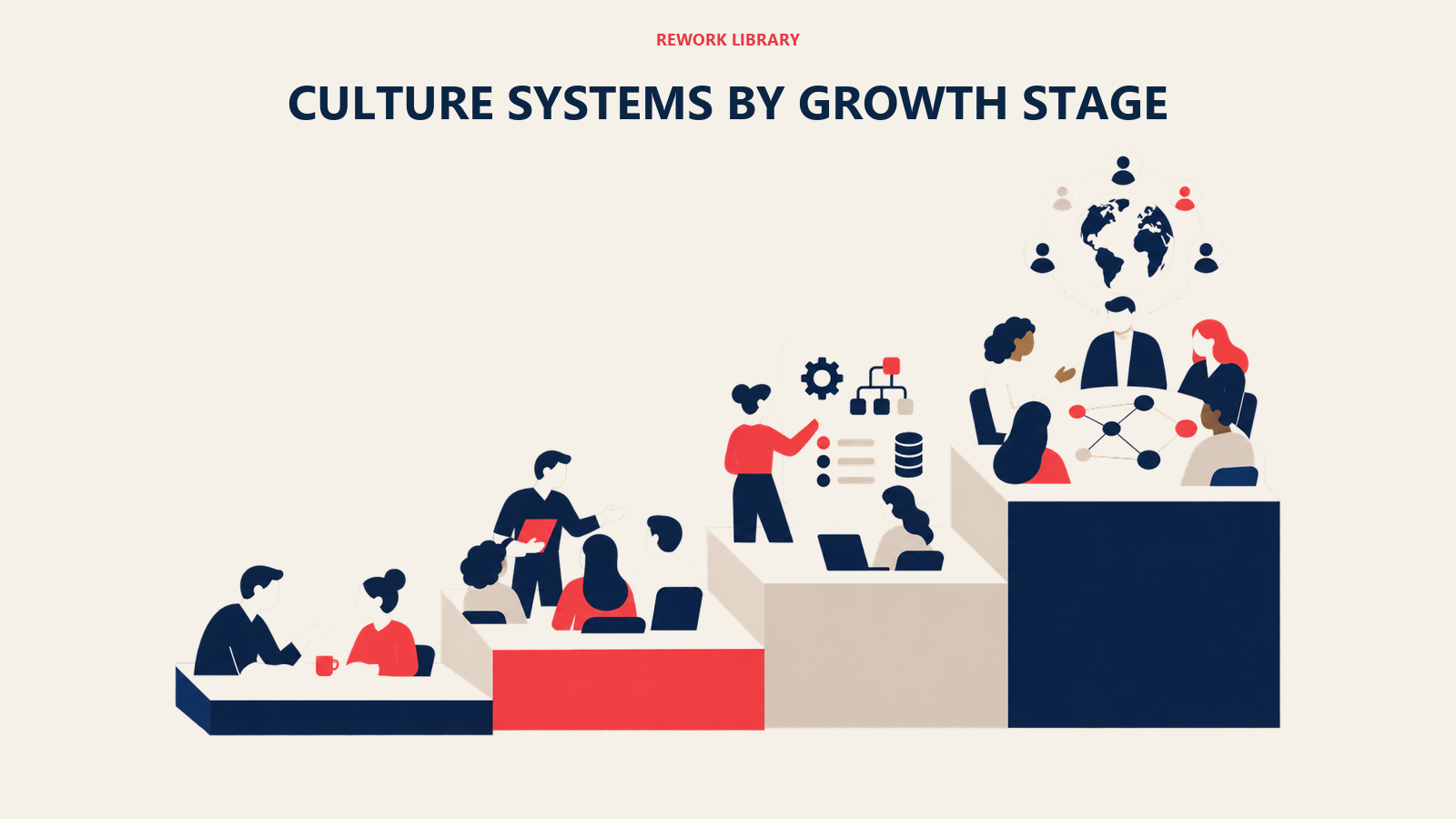
| Stage | Rough headcount | Main transmission mechanism | What typically breaks first |
|---|---|---|---|
| Startup | 1 to 50 | Founder osmosis: proximity, direct decisions, shared meals | Nothing yet, but nothing is written down either |
| Scaleup | 50 to 500 | Written values, onboarding, first management layer | Founder can't reach everyone; managers start improvising |
| Enterprise | 500+ | Formal culture deck, manager training, HR systems, engagement data | Subcultures diverge across offices, functions, and acquisitions |
Startup (roughly 1 to 50 people). Culture is almost entirely a function of who the founders are and what they visibly reward. There's little need for formal documentation, but this is the window to start writing down the reasoning behind key calls, before the founder is too far from day to day to remember why a rule exists.
Scaleup (roughly 50 to 500 people). This is where dilution starts in earnest and where most of the codification work above needs to happen. The company adds its first layer of middle management, opens a second office or a remote cohort, and crosses the point where the founder can no longer personally onboard every new hire. Values need writing down here, not later.
Enterprise (500+ people). Culture work looks less like inspiration and more like systems administration: manager training at volume, structured onboarding, engagement surveys segmented by team and geography, and a formal process for updating the culture deck as the business changes. The founder's personal influence on any employee is now close to zero, so the systems built during the scaleup stage carry essentially all the weight.
The Subculture Reality
Here's the part most culture advice glosses over: a company this size never has one culture again, and forcing one is a losing battle. What you actually get, and should aim for, is a set of subcultures, by function and office, sharing a common core while expressing it differently based on the work. Engineering and sales look different for good reasons; the goal is shared values with locally appropriate norms, not identical behavior everywhere.
National vs company vs team culture breaks down why: culture operates in nested layers, and the team layer, controlled almost entirely by whoever manages it day to day, is often more powerful than anything company-wide leadership says. Two teams with the same handbook can feel completely different depending on who runs the room.
The practical response isn't to eliminate subcultures. It's to measure them so divergence gets caught early instead of surfacing only after it's caused damage. How to measure company culture and culture and engagement surveys cover segmenting results by team and office to catch quiet drift. When drift needs correcting rather than just monitoring, how to change organizational culture covers the systems-level work that actually moves it, since messaging alone won't fix a subculture built around what one manager tolerates.
Culture in the Age of AI
Hypergrowth already strains how far culture can travel from its source. Adding AI agents into the daily work stretches that problem further: a leaner human workforce means fewer people are around to absorb culture the old-fashioned way, and whatever is written down, or left unwritten, becomes the only thing an AI system has to work from. A human absorbs a company's tone and judgment calls over months of osmosis; an AI-handled workflow only reflects the norms someone actually documented.
That's a real argument for codifying culture earlier than growth alone would demand, not a reason to treat it as a separate project. What is AI-native culture goes deeper on how culture changes once AI systems work alongside people day to day, but the throughline is the same one running through this article: culture that only exists in someone's head doesn't survive scale, human or otherwise.
Where to Go Next
- How to define company values that actually work
- Onboarding for culture
- National vs company vs team culture
- How to change organizational culture
Frequently Asked Questions about Scaling Company Culture
What does it mean to scale company culture?
Scaling company culture means keeping the underlying values and norms consistent as headcount, offices, and management layers grow, even though the way those values get transmitted has to change from a founder's direct example to written values, structured onboarding, and trained managers.
Why does culture dilute so quickly during hypergrowth?
Three forces compound at once: the founder hits a natural limit on how many relationships they can maintain, rapid hiring means a growing share of the company hasn't yet absorbed the culture, and each added management layer distorts the signal before it reaches the frontline.
What is founder osmosis, and why does it stop working?
Founder osmosis is the informal way early employees absorb culture by watching a founder make decisions and copying what gets rewarded. It stops working once the company outgrows the founder's ability to have regular direct contact with most employees, usually somewhere between 50 and 150 people.
What is a culture deck, and does every company need one?
A culture deck is a written document, popularized by Netflix's 2009 deck, that states what a company rewards, tolerates, and won't accept, in language concrete enough to guide a real decision. Not every startup needs one on day one, but most benefit from writing values down past 50 to 100 people.
Is it a bad sign if different teams or offices develop different subcultures?
No. Subcultures are normal and often healthy, since engineering, sales, and a regional office legitimately need different norms to do their jobs well. The problem is subcultures drifting from the company's core shared values without anyone measuring it.
When should a growing company formalize its culture in writing?
The scaleup stage, roughly 50 to 500 employees, is the window that matters most, since that's when the founder starts losing the ability to reach every new hire directly. Waiting until the enterprise stage usually means codifying whatever culture has already drifted into, not the one leadership intended.
Does hiring fast always damage company culture?
Not inherently, but hiring fast without a deliberate transmission system almost always does, because new hires fill the cultural vacuum with habits from their last job. Pairing fast hiring with strong onboarding and specific values scales culture successfully; hiring and hoping doesn't.
Culture in a fast-growing company doesn't fail because leadership stopped caring about it. It fails because the mechanism that used to carry it, a founder's direct presence, quietly stopped reaching most of the company before anyone built a replacement. The fix is unglamorous and has to come early: onboarding, rituals, and manager training that carry the culture once osmosis can't. Put them in before the gap between the stated culture and the lived one gets too wide, because closing that gap later costs far more than holding it now.

Co-Founder, Rework.com
On this page
- What Scaling Culture Actually Means
- Why Culture Dilutes as You Scale
- Dunbar's Number and the Limits of Personal Trust
- The New-Hire Ratio Problem
- More Layers, Less Signal
- Key Facts
- When Founder Osmosis Stops Working
- How to Codify Culture Before You Need To
- Write the Values Down, Precisely
- The Culture Deck Approach
- Onboarding as the Transmission Mechanism
- Rituals and Managers Carry the Rest
- Stage by Stage: What Changes as You Scale
- The Subculture Reality
- Culture in the Age of AI
- Where to Go Next