Why Culture Makes or Breaks Mergers and Acquisitions
Turn this article into takeaways for your work.


Each assistant summarizes the article only for you and suggests best practices for your work.
Culture in mergers and acquisitions is the fit, or the clash, between how two organizations actually make decisions, communicate, and get work done, separate from whatever the balance sheets say. Financial due diligence gets teams of analysts and months of modeling. Whether the two workforces can actually function as one company usually gets a handshake, a few leadership dinners, and a lot of assumption. That gap is where deals quietly lose value long after the ink dries, and it is usually the difference between a deal that hits its financial targets and one that spends three years fighting its own org chart.
Why Most M&A Deals Fail on Culture, Not Finance
You have probably seen some version of the stat that 70 to 90 percent of acquisitions fail. It is a real number, not an urban legend: Harvard Business Review has repeated it for years, including in a widely cited 2016 piece arguing that most acquisitions never deliver the value the acquirer promised shareholders. It is worth being precise about what that range measures, though. It covers overall M&A failure against strategic and financial goals, not a specific "caused by culture" tally, and the definition of failure varies study to study. Treat 70-to-90 as directionally real and widely repeated, not as a precise culture-attribution statistic.
The culture-specific numbers are still striking on their own. In a 2023 McKinsey survey of nearly 1,100 M&A leaders, 44 percent named a lack of cultural fit and friction between the acquiring and target companies as a top reason integrations fail. PwC found that roughly 65 percent of acquirers say cultural issues hampered their ability to create value in their most recent major deal. And a Mercer study of over 1,400 M&A professionals found that 43 percent of deals had the price impacted, the timeline delayed, or the deal derailed by culture problems, with 30 percent of completed deals still missing their financial targets for the same reason.
The pattern behind all of that: financial due diligence is quantifiable, so it gets rigor. Culture is fuzzy, so it gets a gut check from a few executive dinners, if it gets checked at all. By the time the culture problem is undeniable, the deal has closed and the two workforces are already trying, and failing, to work together.
What Culture Clash Actually Looks Like in a Deal
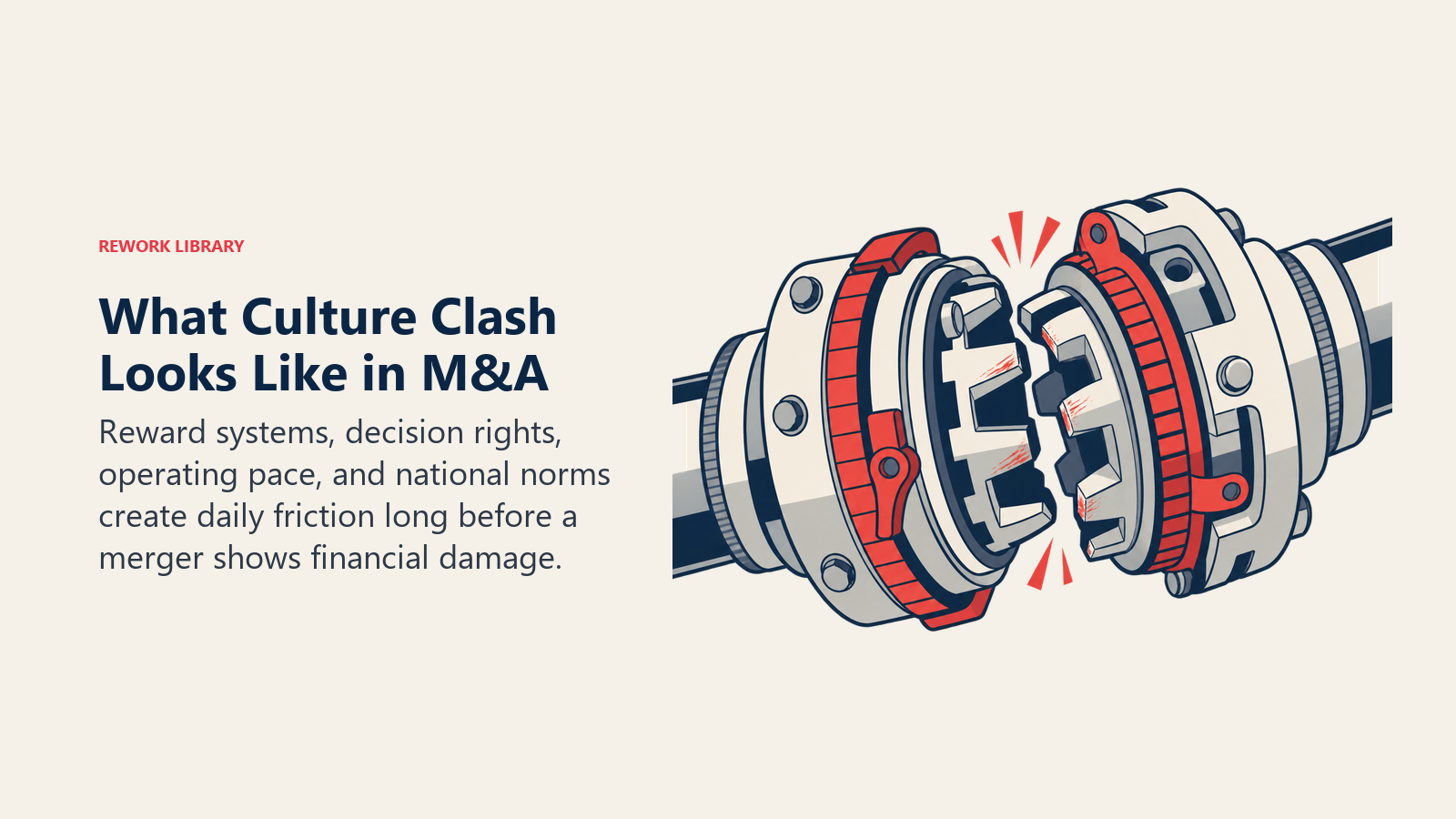
Culture clash rarely shows up as a dramatic blowup on day one. It shows up as friction that accumulates: meetings that run long because nobody agrees on how decisions get made, good people who quietly update their resumes, and a slow realization that "we're now one company" is true on the org chart and false in practice.
Values: What Gets Rewarded, Not What Gets Printed
Two companies can publish nearly identical values statements and still run on opposite reward systems. One might genuinely reward individual heroics and speed; the other rewards process discipline and consensus. When those systems merge, whichever behavior gets punished feels like a betrayal to the people who built their careers on it, even if nobody intended it that way.
Decision-Making Style: Consensus vs. Top-Down
A team used to making calls fast, with one accountable owner, can find itself paralyzed inside an organization that expects sign-off from five stakeholders before anything moves. The reverse is just as painful: a consensus-driven team suddenly told to execute a decision it never got to weigh in on reads that as disrespect, not efficiency.
Pace: Startup Speed vs. Enterprise Process
Acquisitions that bring a smaller, faster company into a larger, more process-heavy one run into this constantly. The acquired team built its edge on shipping fast and fixing later. The acquirer built its scale on documentation and predictability. Neither pace is wrong on its own, but forcing one onto the other without acknowledging the tradeoff is what kills the acquired team's morale, and often its best people, within the first year.
National Culture Layered on Top of Company Culture
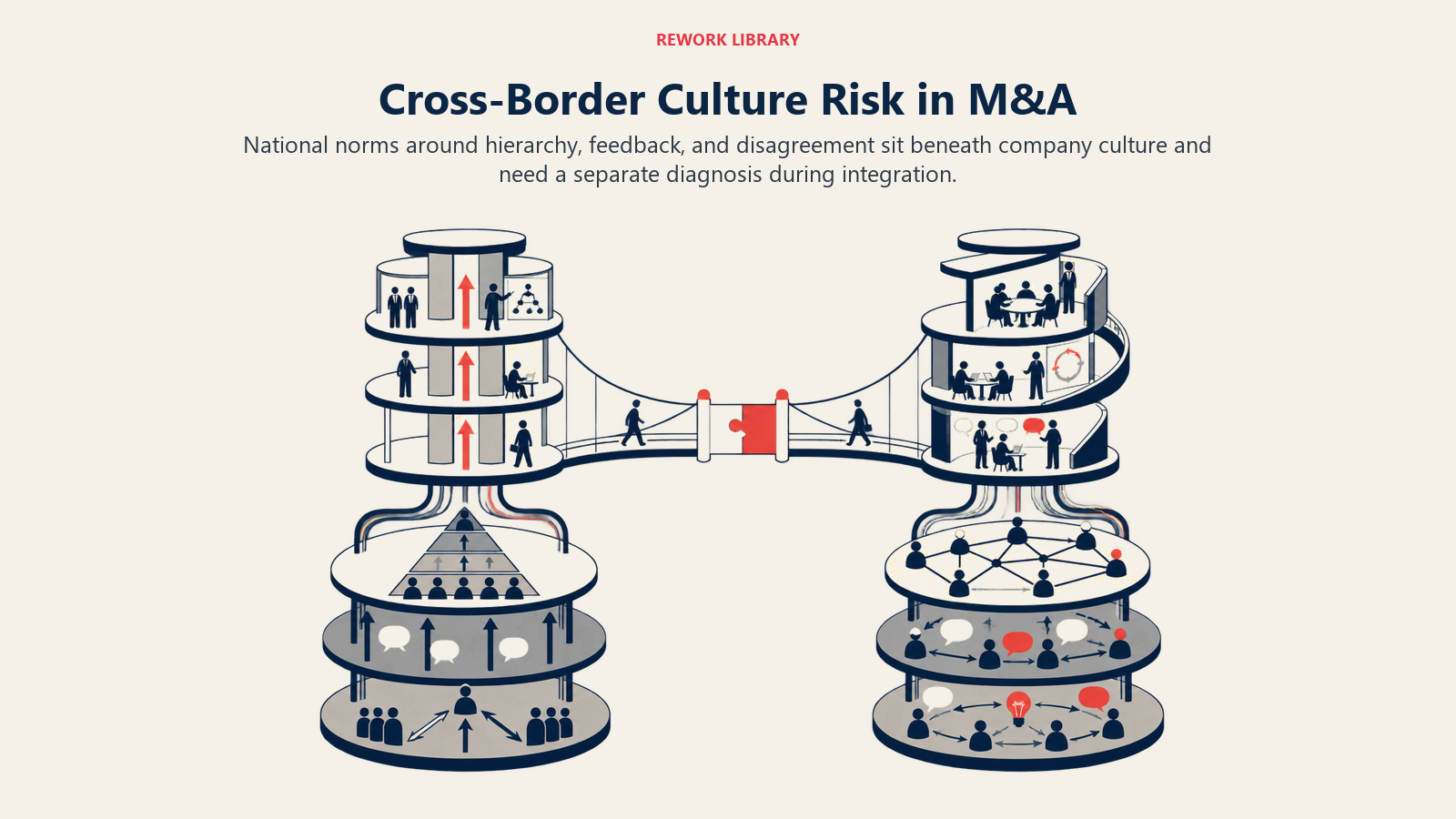
Cross-border deals stack a second, deeper layer on top of company culture: how directly people give feedback, how much authority a title carries, and how comfortable people are challenging a decision in a meeting. A company culture problem tangled up with national culture differences is easy to misread as "they just don't get it," when what is actually happening is two reasonable but different operating systems colliding.
Key Facts
- Harvard Business Review has repeated for years that some 70 to 90 percent of acquisitions fail to deliver the value promised, though this range measures overall M&A failure, not a precise culture-only figure. Source: Harvard Business Review
- In a 2023 McKinsey survey of nearly 1,100 M&A leaders, 44% cited lack of cultural fit and friction between the acquiring and target companies as a top reason integrations fail. Source: McKinsey
- Roughly 65% of acquirers say cultural issues hampered their ability to create value in their last major deal. Source: PwC 2023 M&A Integration Survey
- Mercer's global survey of more than 1,400 M&A professionals found 43% of deals had their price cut, timeline delayed, or closing derailed by culture issues, and 30% of completed deals still missed their financial targets for the same reason. Source: Mercer, via Business Wire
Two Case Studies in What Happens When Culture Is Ignored
AOL and Time Warner: A Speed Mismatch Dressed Up as Synergy
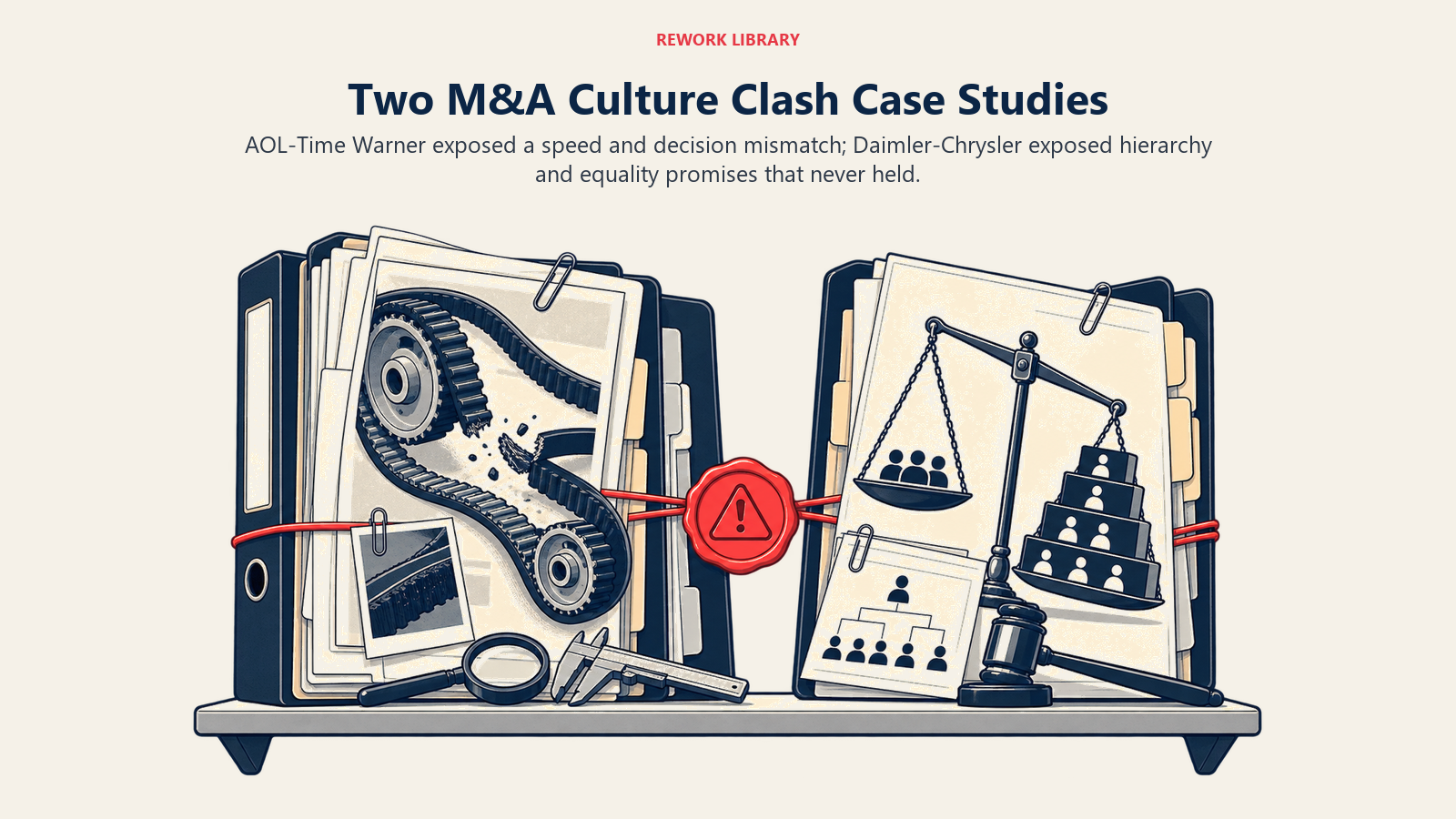
When AOL and Time Warner announced their 2000 merger, the pitch was a $350 billion combination of internet reach and media content. What actually merged were two incompatible operating speeds. AOL ran on a fast, sales-driven, internet-time culture. Time Warner's editorial and entertainment executives ran on a slower, relationship-driven, prestige-conscious culture, and neither side had a clear model for who actually made decisions once the deal closed. The two cultures spent years openly distrusting each other while the market also turned against the underlying dot-com bet. By January 2003, the combined company recorded a $99 billion writedown, at the time the largest annual loss ever reported by a US corporation, and the culture clash between the two workforces was a constant, well-documented part of why the promised synergies never showed up.
Daimler and Chrysler: A "Merger of Equals" That Was Never Equal
The 1998 Daimler-Benz and Chrysler combination was announced as a merger of equals between a formal, engineering-precise German culture and a faster, more informal American one. In practice, Daimler's centralized management style was imposed on Chrysler's more experimental, trial-and-error approach almost immediately. Within roughly 19 months, American leadership had been replaced by German executives, and the "equals" framing quietly disappeared. Distrust between the two management teams, compounded by real strategic pressure from Asian competitors, undermined the cost synergies the deal was supposed to deliver. In 2007, Daimler sold its remaining stake in Chrysler, and the company was renamed back to Daimler AG, closing an integration most retrospectives describe as a cultural mismatch from the start.
Cultural Due Diligence: Testing Fit Before You Sign
Cultural due diligence means testing whether two organizations can actually work together, with the same rigor applied to financial and legal due diligence, rather than trusting a few executive meetings to reveal it. It is not a personality quiz. It looks at the same kind of behavioral evidence covered in how to measure company culture: how decisions actually get made day to day, what behavior gets rewarded versus punished, and what a new hire learns about "how things really work" in their first ninety days.
In practice, that means structured leadership interviews on both sides about decision rights, a look at how each company's promotion system actually rewards behavior, conversations with middle managers rather than just the executives running the deal, and, for cross-border deals, an honest read on hierarchy and how comfortable people are disagreeing with a superior in the room.
The ideal timing is before signing, so culture risk shows up in price or deal structure the way financial risk does. Once that window has closed, the fallback is doing this work seriously before Day 1, not after the first quarter of integration problems forces the issue.
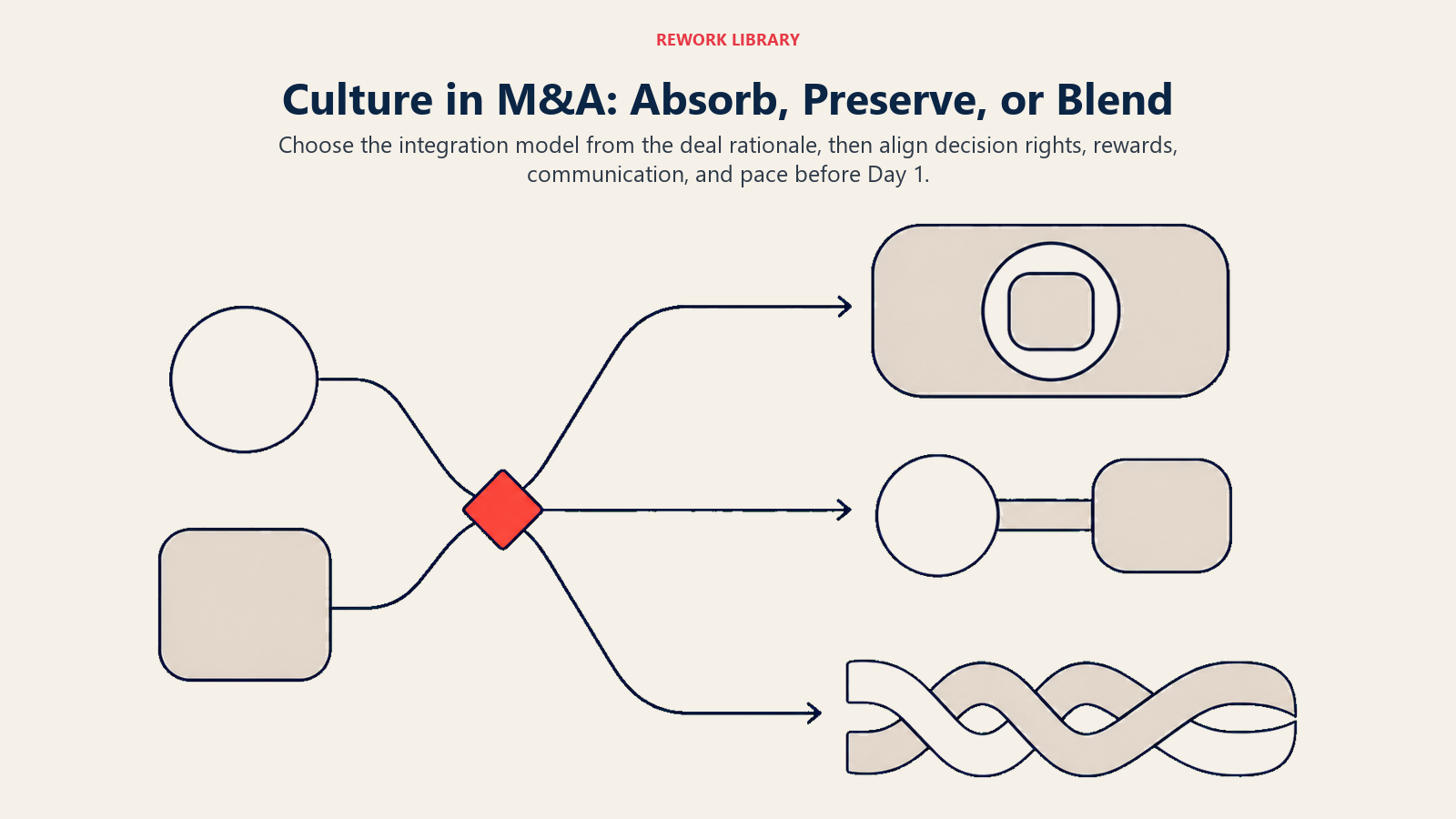
Three Integration Approaches: Absorb, Preserve, or Blend
There is no single right way to merge two cultures. The right approach depends on why the deal happened in the first place, and picking the wrong one for the deal's actual rationale is a common, avoidable mistake.
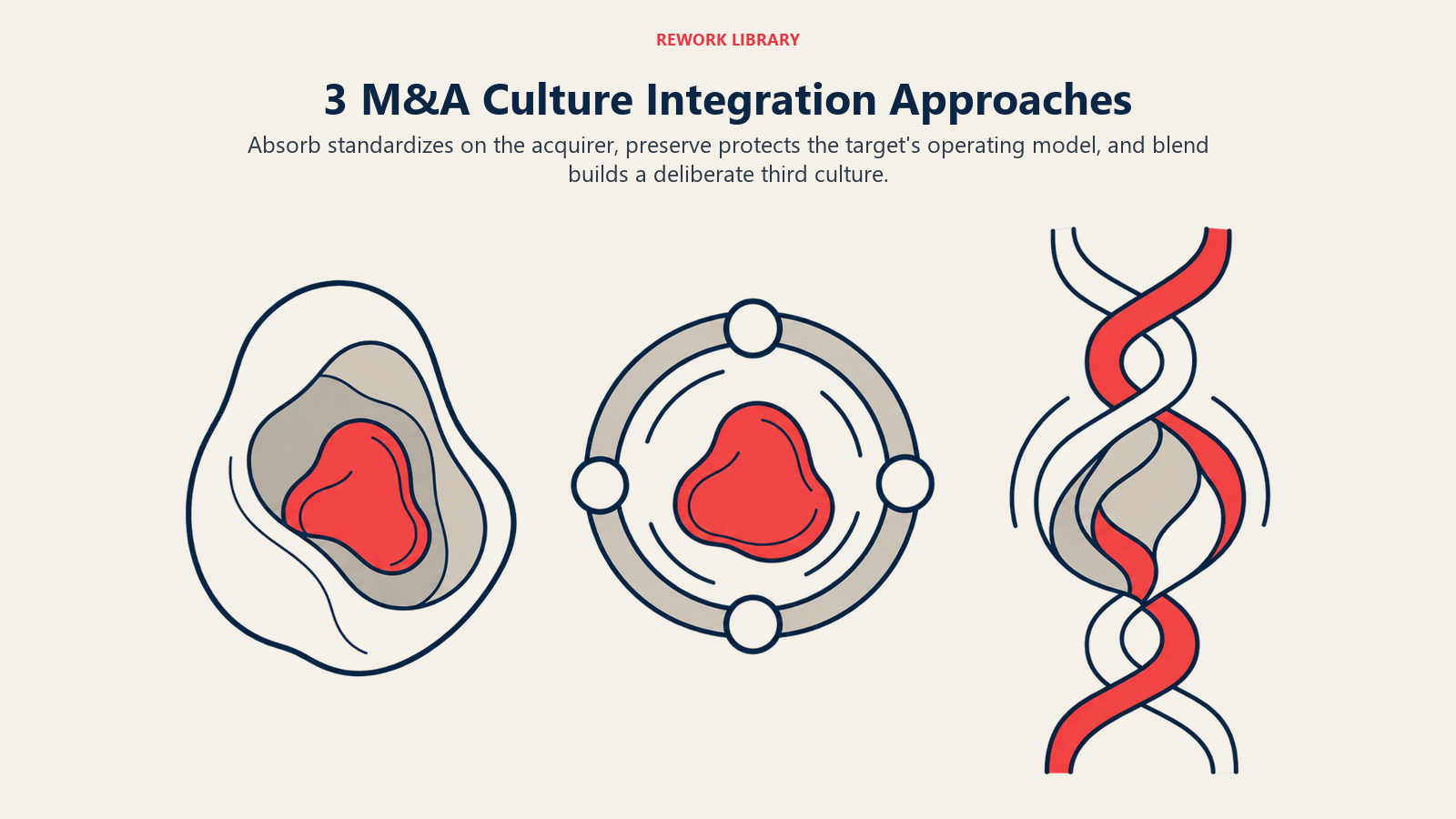
Absorb. The acquirer's culture, systems, and decision-making style become the standard, and the acquired company adopts them. This fits a straightforward consolidation or competitor rollup, where the acquirer's operating model is genuinely why the deal makes sense. It fails badly when the deal was actually about acquiring the target's talent or way of working, since absorbing erases the exact thing that was purchased.
Preserve. The acquired company keeps operating largely as its own entity, often under a holding structure, while the acquirer provides capital, back-office scale, or distribution without dictating day-to-day culture. This fits acquihires and product-led businesses where the target's culture is itself part of the asset being bought. See national vs. company vs. team culture for how this plays out at the team level even inside a preserved structure.
Blend. Both organizations deliberately build a third culture that takes the strongest elements from each, rather than one side winning outright. This is the hardest to execute because it takes real leadership time and genuine change from both sides, not just the acquired company. It tends to work best in true mergers of comparable-sized companies, where a one-sided absorb approach would alienate half the combined workforce, which is exactly what a poorly handled "merger of equals" gets wrong.
Choosing among the three is itself a culture decision, made deliberately during integration planning, guided by the same principle behind how to change organizational culture: change the systems that produce behavior, not just the messaging about which culture is better.
The Cross-Border Layer: When National Culture Complicates Company Culture
Cross-border M&A adds a layer domestic deals do not deal with: national culture sitting underneath company culture, shaping things leaders often mistake for personality. A team that goes quiet in integration meetings is not necessarily avoiding a difficult topic. In a high-context, hierarchy-respecting culture, disagreeing with a new foreign leadership team in front of peers can feel genuinely inappropriate, not evasive.
This is where cross-cultural frameworks earn their place in a merger. Hofstede's research on power distance and individualism, detailed in Hofstede's cultural dimensions explained, gives integration teams a citable, country-level starting point for where two national cultures are likely to clash. Erin Meyer's framework in The Culture Map, explained is built for reading these gaps in real time, particularly around feedback style. The broader patterns are mapped in how business culture differs across the world, and the practical playbook for running a team across them is in managing a multicultural team.
The mistake to avoid is treating a cross-border deal as a company-culture problem alone and being surprised when national-level differences in hierarchy or pace show up on top of it. Both layers need diagnosing, and they need different fixes.
A Leader's Playbook for Culture in M&A
Start cultural due diligence before signing, not after. Treat it as a real input to the deal, not a courtesy exercise. If the deal is already signed, do the diagnostic work seriously before Day 1 instead of skipping it.
Pick the integration approach on purpose. Decide deliberately whether the deal calls for absorb, preserve, or blend based on why you actually did the deal, and say that choice out loud instead of letting people guess and assume the worst.
Protect the people you cannot afford to lose. Culturally driven attrition tends to hit the highest performers first, since they have the most options elsewhere. Culture and employee retention covers why the people most likely to leave after a rough integration are the ones a company can least afford to lose.
Overcommunicate on Day 1, especially about what is not changing. Silence gets filled with the worst-case assumption, so naming what stays the same is often more reassuring than describing what is new.
Build trust through consistent behavior, not a slogan. Leadership's role in shaping culture and building trust in the workplace point to the same lesson: what leaders do under pressure in the first few months becomes the real culture template, whatever the integration deck promised.
Tooling has a supporting role here, not a starring one. Merging two workforces onto one system, one onboarding flow, one place for time and attendance, one HRIS record instead of two, removes a real source of Day 1 friction, which is the kind of unglamorous consistency Rework's People app is built to support. It will not fix a genuine culture mismatch, but it removes an avoidable irritant while leaders do the harder work above it.
Culture Due Diligence in the Age of AI
AI tools are starting to show up in the mechanics of M&A: summarizing data-room documents and flagging where two companies' policy manuals genuinely conflict, faster than a team of analysts reading everything by hand. That is a real, useful speedup on the research side.
It is worth being honest about the limit, though. No tool reliably measures whether two workforces will trust each other, and vendor claims about AI "measuring culture fit" from internal communications deserve real skepticism, both on accuracy and on the privacy questions that come with mining employee messages. AI can compress the research phase of cultural due diligence. It cannot substitute for the diagnostic conversations and trust-building that still have to happen between people.
Where to Go Next
Culture in M&A sits at the intersection of two bigger topics in this collection. For the foundation on why culture drives outcomes at all, start with what is business culture and the link between culture and performance. For the cross-border layer specific to global deals, how business culture differs across the world is the deeper map.
The companies that get culture right in M&A did not stumble into it. They treated compatibility as a real input to the deal, not a footnote handled after the ink dried, and kept treating it that way through the first year of integration, when most of the actual damage or the actual success gets decided.

Co-Founder, Rework.com
On this page
- Why Most M&A Deals Fail on Culture, Not Finance
- What Culture Clash Actually Looks Like in a Deal
- Values: What Gets Rewarded, Not What Gets Printed
- Decision-Making Style: Consensus vs. Top-Down
- Pace: Startup Speed vs. Enterprise Process
- National Culture Layered on Top of Company Culture
- Key Facts
- Two Case Studies in What Happens When Culture Is Ignored
- AOL and Time Warner: A Speed Mismatch Dressed Up as Synergy
- Daimler and Chrysler: A "Merger of Equals" That Was Never Equal
- Cultural Due Diligence: Testing Fit Before You Sign
- Three Integration Approaches: Absorb, Preserve, or Blend
- The Cross-Border Layer: When National Culture Complicates Company Culture
- A Leader's Playbook for Culture in M&A
- Culture Due Diligence in the Age of AI
- Where to Go Next