How to Change Organizational Culture (Without It Backfiring)
Turn this article into takeaways for your work.


Each assistant summarizes the article only for you and suggests best practices for your work.
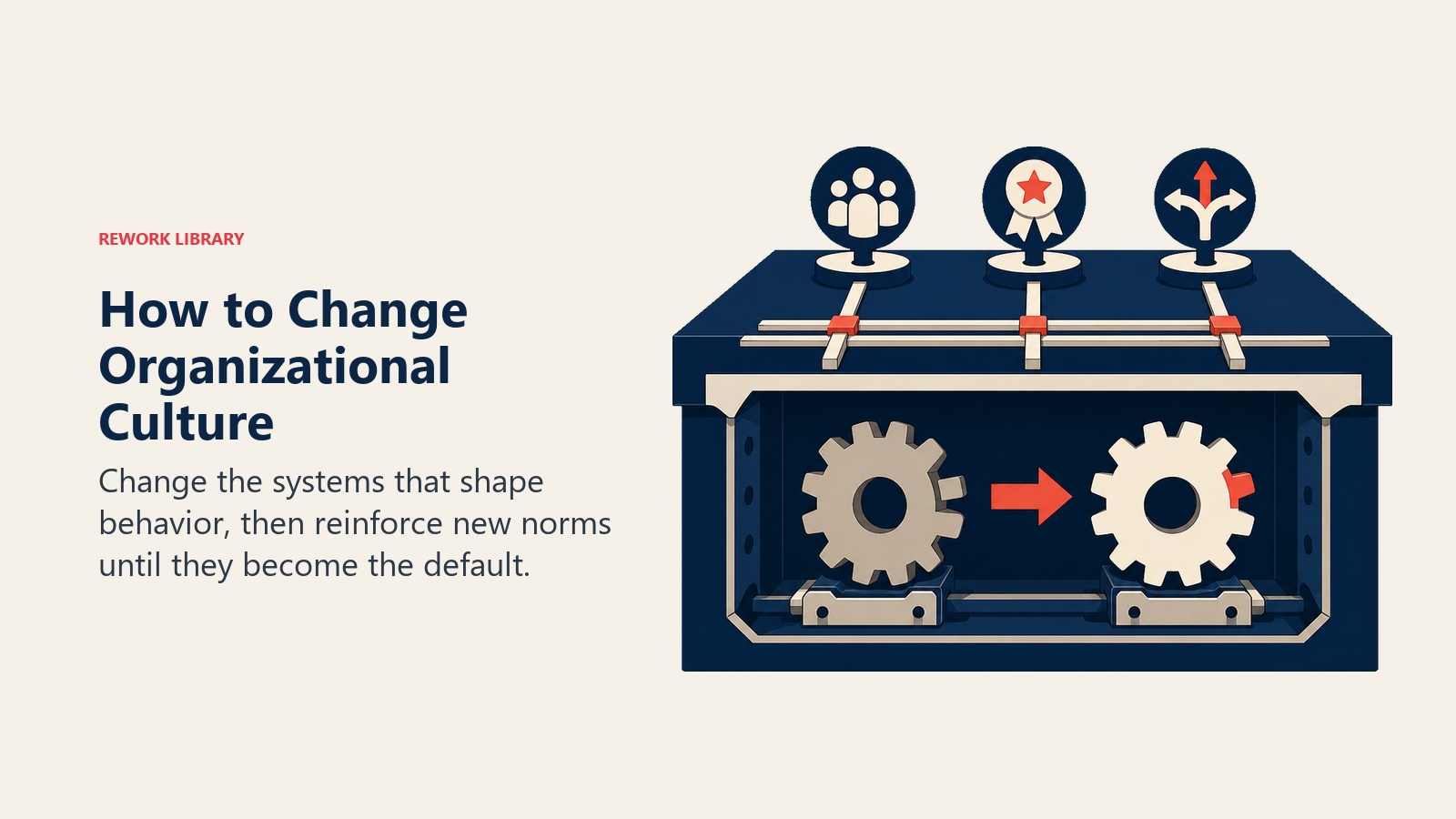
Changing organizational culture means deliberately shifting the systems that produce behavior, who gets hired and promoted, what gets measured, what a high performer can get away with, and what leaders model under pressure. It does not mean rewriting the values statement. Done through systems, culture change is slow but real. Done through slogans, it makes people more cynical than before you started.
That second part is where most attempts go wrong. A CEO unveils refreshed values at an all-hands. New posters go up in the break room. A year later, engagement survey scores come back flat, or worse, because employees watched leadership talk about change while promotions, reviews, and what got excused from the top salesperson kept rewarding exactly what they always had. What business culture actually is covers the concept in the abstract. This is what happens when you try to move it on purpose, and why so many attempts backfire.
Why Most Culture Change Efforts Fail
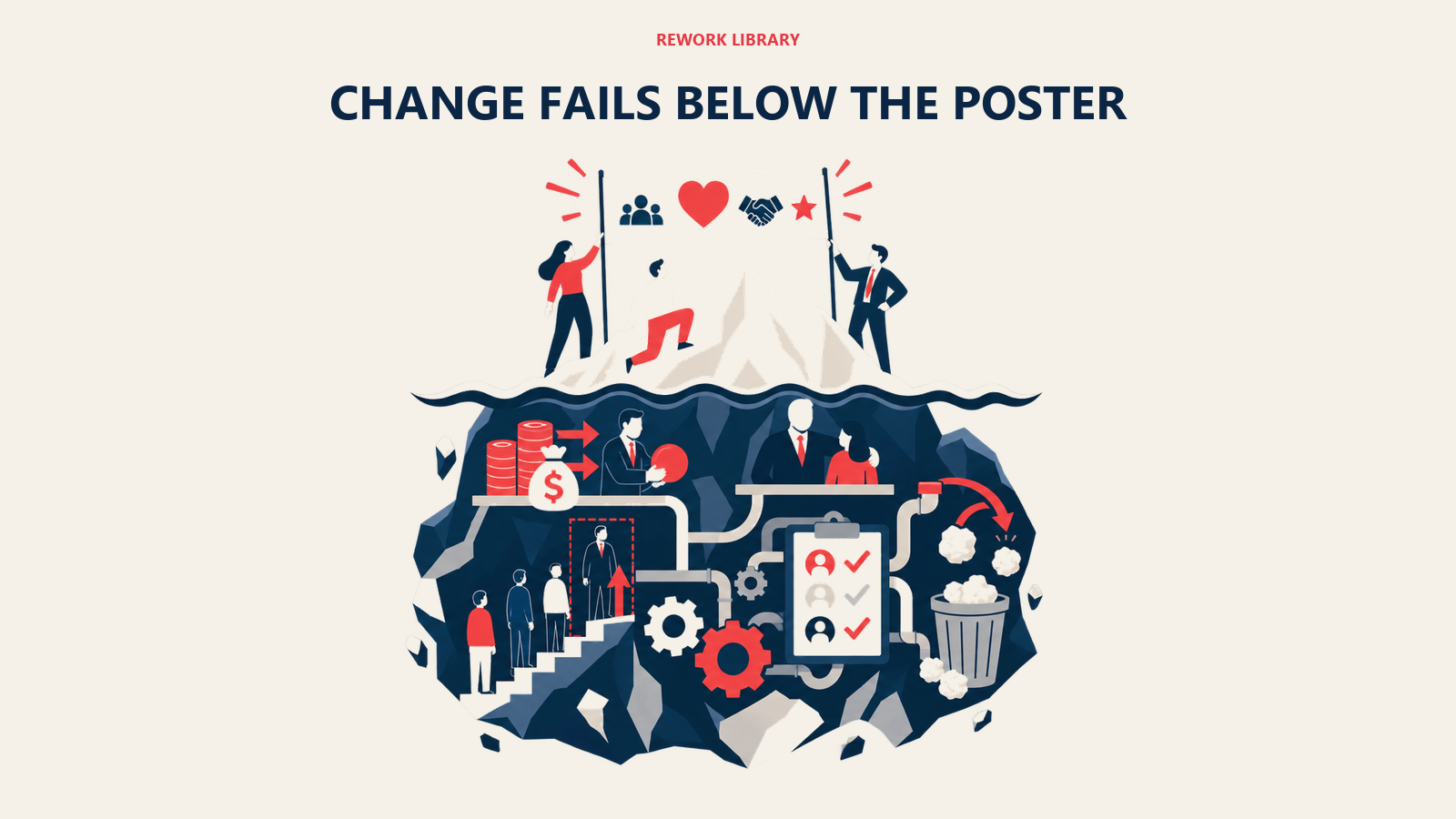
Most culture change fails before behavior moves, because visible artifacts change while deeper assumptions and rewards stay intact.
The artifact gets changed, not the assumption
Edgar Schein described culture as three nested layers: artifacts you can see, espoused values the organization claims, and underlying assumptions, the unconscious beliefs that actually drive behavior. Most change programs operate entirely at the artifact layer, a new logo, a redesigned office, a fresh values deck, because that layer is visible and fast to change. The three levels of culture explains why that is the least effective place to intervene: assumptions like "conflict is dangerous, so smooth it over" sit underneath the artifacts and keep producing the old behavior no matter how the office looks.
Leaders believe the change happened. The frontline does not
There's a specific, measurable gap in almost every serious culture survey: the people announcing the change believe it worked, and the people living under it do not. Strategy&'s Global Culture Survey found 66% of C-suite and board members now say culture matters more to performance than strategy does, but the share of frontline employees who agree fell, from 66% in 2018 down to 46% more recently. Leadership's confidence went up while the ground floor's belief went down. That is not a communication problem you fix with a better slide. It means the change touched the top of the org chart and stopped there.
The stat everyone cites to justify urgency doesn't hold up
You've probably heard that "70% of change initiatives fail." It gets quoted in decks and consulting pitches, usually without a source, because there isn't a solid one. Researcher Mark Hughes reviewed the five most commonly cited origins of that number, Hammer and Champy, Beer and Nohria, a Bain article, a McKinsey article, and Kotter, and found each one either stated the figure with no supporting data or pointed back to one of the others doing the same thing. The number persists because it's dramatic, not because anyone measured it.
The real, evidenced obstacle is duller and more fixable: a lack of active, visible executive sponsorship. Prosci's benchmarking research, run since 1998, finds sponsorship is the single largest contributor to whether a change effort succeeds, cited more than three times as often as the next factor, and that an effective sponsor can lift a project's odds of hitting its outcome from roughly 25% up to 85%. Most failed culture change isn't a mystery. It's a change leadership announced but never stood behind once it got uncomfortable.
Key Facts
- Strategy&'s Global Culture Survey found 66% of C-suite and board members say culture matters more to performance than strategy, while only 46% of frontline employees agree, down from 66% in 2018. Source: PwC / Strategy&
- Researcher Mark Hughes reviewed the five most-cited sources for the "70% of change initiatives fail" claim and found none of them backed by valid empirical evidence. Source: Journal of Change Management
- Active, visible executive sponsorship has ranked as the number one contributor to change success in every Prosci benchmarking report since 1998, and an effective sponsor can raise a project's odds of hitting its business goal from about 25% to 85%. Source: Prosci
- Roughly half of a transformation's total value shows up in the first 18 months, with the rest realized after, and organizations ready to launch within that window are 1.6 times more likely to succeed overall. Source: McKinsey
- Managers account for at least 70% of the variance in team engagement scores, meaning a culture change plan that skips manager behavior is skipping the layer employees actually experience day to day. Source: Gallup
The Levers That Actually Move Culture
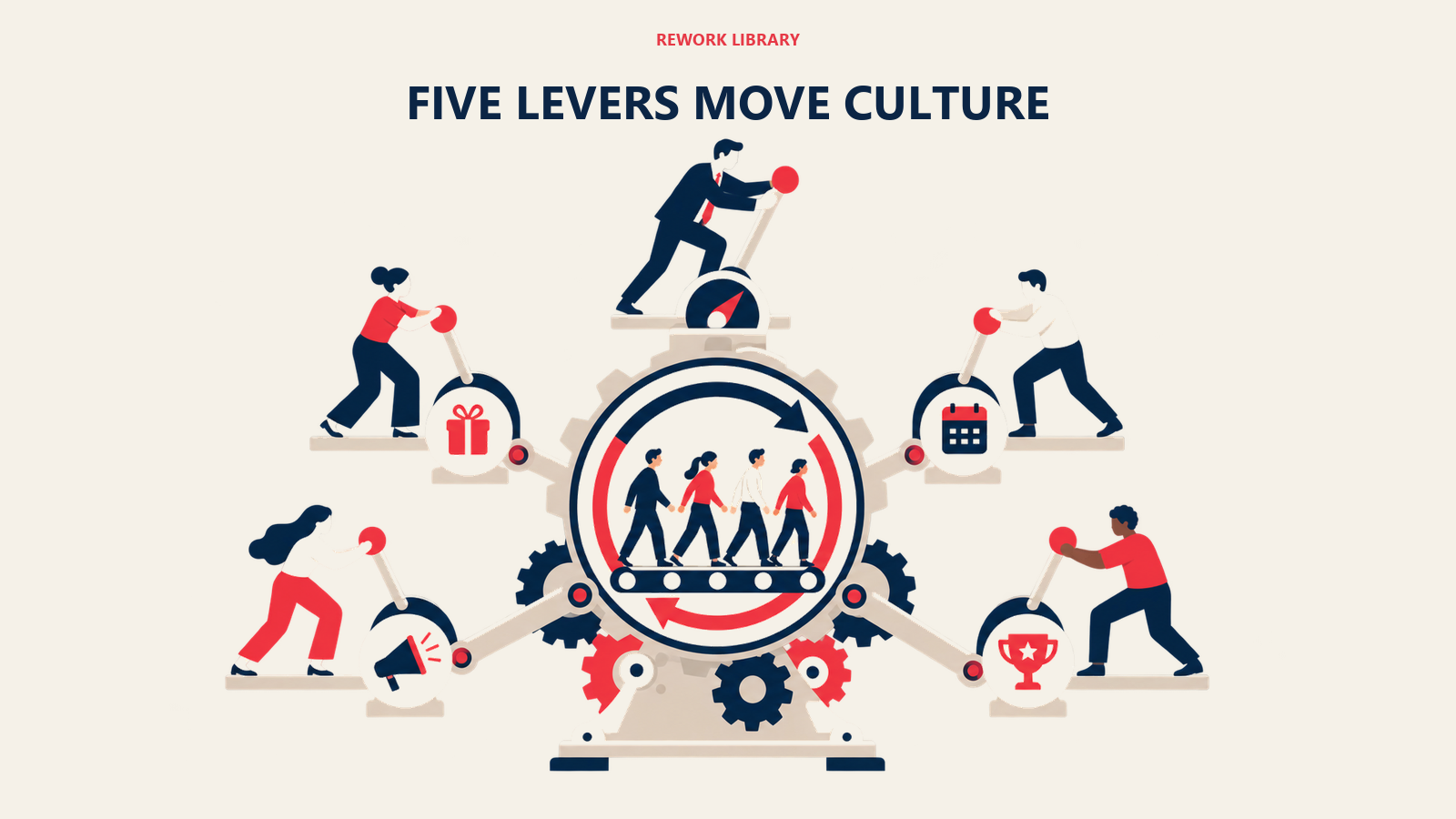
Culture does not move because people got told to behave differently. It moves when the systems around behavior change, so that the old behavior stops getting rewarded and the new behavior starts getting reinforced. Five levers do almost all of the real work.
Leader behavior under pressure
Employees do not learn what a company values from the mission statement. They learn it from watching what a leader does the first time following the stated value is inconvenient, the first time honesty costs a leader a good story for the board, or accountability means disciplining a strong performer. That moment becomes the template everyone quietly copies. A leader who says "we value candor" and then punishes the first person who is candid with them has just taught the room the real rule, and no later speech undoes it.
Systems and incentives
If the stated value is collaboration but the bonus structure only rewards individual output, the bonus structure wins every time, because it's the system people respond to under pressure. Changing culture means auditing performance criteria, promotion rubrics, and recognition programs for whether they reward the behavior leadership claims to want, then rebuilding the ones that don't. This is the least glamorous part of a culture change effort, and the part that determines whether anything else sticks.
Rituals
Onboarding, recurring meetings, how wins get recognized, and how mistakes get discussed out loud are all rituals, and rituals are where new norms get practiced until they stop feeling deliberate. A company trying to build psychological safety has to build it into a specific ritual, like a blameless retro or a leader who visibly asks "what did I miss?" in front of the team, not just into a values line. This is also where consistency tends to break down at a fast-growing company: onboarding, recognition, and HR handoffs scattered across five disconnected tools, which is the unglamorous problem Rework's Work Ops and People app help make consistent, not a substitute for the leadership work above it.
The stories leadership tells
Every organization retells a handful of stories about its own history: who got let go and why, who took a risk and was rewarded, who raised a concern that turned out to matter. Those stories carry more cultural weight than any values statement, because they're concrete instead of abstract. A change effort that doesn't replace the old cautionary stories with new, true ones will keep losing to the stories already circulating.
Who gets promoted, and who gets a pass
This is the sharpest lever and the one leaders are most tempted to skip. If a high performer who violates a stated value keeps getting promoted, every employee watching updates their real understanding of what the company rewards, faster than any campaign can counter it. Promoting someone specifically because they modeled the target behavior under pressure sends a signal that outweighs a dozen town halls. National vs. company vs. team culture covers why this lever is often strongest at the team level, since a manager's promotion and tolerance decisions shape daily experience more than company-wide policy does.
A Change Roadmap: Diagnose, Target, Intervene, Reinforce, Measure
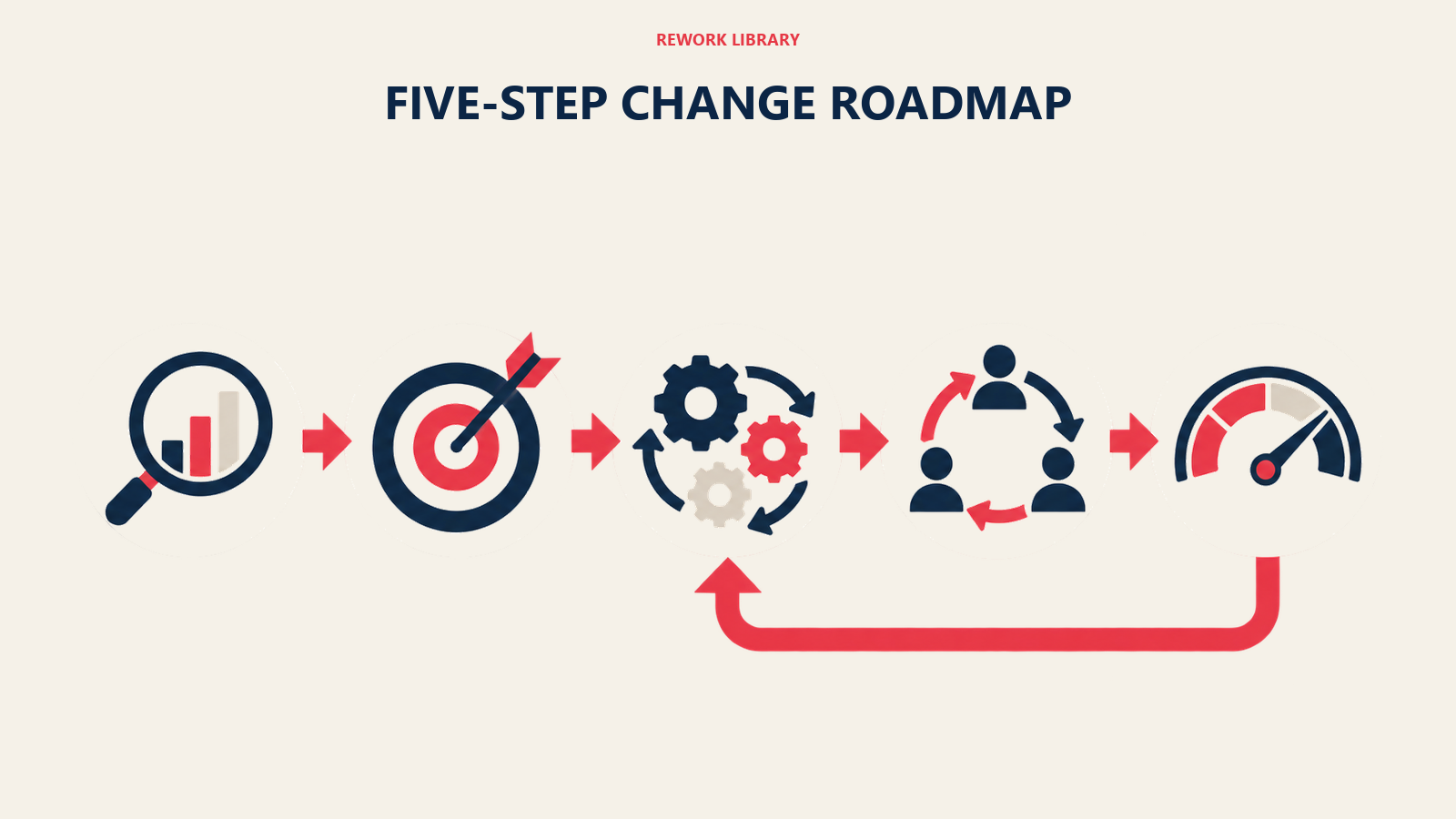
Culture change that actually holds tends to follow the same five-step sequence, in this order, because skipping a step usually means redoing an earlier one later.
Step 1: Diagnose the real culture, not the stated one
Before touching anything, find out what's actually happening: who gets promoted and why, what a new hire learns about "how things really work" in their first ninety days, and what gets tolerated from a top performer that would get anyone else disciplined. Organizational culture vs. climate vs. values helps here, since it's easy to mistake a bad quarter's mood for a deep cultural problem, and diagnosing the wrong layer means fixing the wrong thing.
Step 2: Define the target culture in specific, observable terms
"Be more innovative" is a wish, not a target. A usable target describes specific behaviors: engineers get two days a month for self-directed projects, managers can greenlight a reversible decision without escalating it, failed experiments get presented at the same all-hands as successes. The Competing Values Framework helps at this step, since it forces a concrete choice between, say, a more clan-like collaborative culture and a more market-driven results culture, instead of trying to be all four types at once.
Step 3: Intervene in the systems, not the messaging
This is where the five levers above get applied deliberately: adjust the performance rubric, redesign the onboarding ritual, change who gets the visible promotion, retire the story that no longer fits. Announce the change once, plainly, then let the systems do the persuading. A second town hall doesn't move culture. A changed promotion decision does.
Step 4: Reinforce until it stops feeling like a program
Culture change dies most often in year two, right after the initial push, when the task force disbands and the new behavior hasn't become automatic yet. Reinforcement means the new ritual keeps happening without a champion in the room, the new promotion criteria get applied the fifth time as consistently as the first, and leaders keep modeling the behavior after the initiative technically ends. Stop reinforcing before the pattern is boring and automatic, and culture reverts to whatever the underlying systems were quietly rewarding all along.
Step 5: Measure without letting people game the score
A culture change plan without measurement is a guess dressed up as a strategy, but the measurement has to resist gaming, since employees learn fast to answer a survey the way they think leadership wants. How to measure company culture walks through a scorecard that mixes perception data with harder behavioral signals, like promotion patterns, exit interview themes, and manager turnover, so the numbers reflect what's actually happening.
Timeframe Reality: This Takes Years, Not a Quarter
Anyone promising a 90-day culture turnaround is selling something. McKinsey's research on large-scale transformations found roughly half the total value shows up within the first 18 months and the other half after that, and companies that got their leadership team genuinely aligned before launching, rather than rushing to hit an arbitrary date, were 1.6 times more likely to succeed overall. That's the transformation literature's version of what culture researchers have said for decades: the underlying assumptions Schein described don't update on a quarterly cadence, because they formed over years of repeated experience, not a single announcement.
Set expectations accordingly: visible shifts in specific rituals and decisions can show up within months, but the deeper marker, employees no longer describing the old norm as "how things really work here", typically takes two to three years of consistent reinforcement across multiple promotion and review cycles. Leaders who promise faster than that either shrink success down to something artifact-level, or set the effort up to look like it failed when the real work was still in progress.
The Role of Leadership (This Cannot Be Delegated to HR)
Culture change gets treated as an HR initiative more often than it should, and that mislabeling is itself a predictor of failure. HR can design the new performance rubric, run the survey, and facilitate the workshop. It cannot make the CEO discipline a star performer for violating a stated value, or make a VP stop quietly protecting a favorite manager from a pattern of complaints. Those decisions sit with line leadership, and they're exactly what determines whether employees believe the change is real.
This is also why active, visible sponsorship keeps showing up as the strongest predictor of success in the change research. A leader who sponsors the change from a podium once, then goes back to rewarding the old behavior in private one-on-ones, hasn't sponsored anything. Sponsorship that moves culture looks like a leader personally reviewing promotion slates for alignment with the target behavior, telling the story of a decision that cost them something, and absorbing the short-term discomfort of holding a high performer accountable in public. None of that scales through a memo.
Culture Change in the Age of AI
AI rollouts are, whether leadership frames them this way or not, a culture change event, and treating one as a pure technology deployment is how most of them backfire quietly. The moment a team gets a copilot or an approval bot, old assumptions about what "good effort" looks like, who owns a decision an AI helped shape, and whether using AI is expected or something to hide, all become unsettled at once. Left unaddressed, that period hardens into AI cultural debt: a quiet erosion of trust and ownership norms that compounds the same way any unmanaged culture change does, except most leaders don't realize they launched a change program the day they turned the tool on.
The fix follows the same roadmap as any other culture change, applied to a new set of assumptions: diagnose what the team believes about AI-assisted work, define observable norms (disclosure expectations, what "reviewed" means, how credit gets assigned), intervene in the systems that enforce those norms, and reinforce them through what gets promoted and what gets quietly tolerated. What is AI-native culture covers what the target state looks like once that work is done well, instead of left to form on its own.
Where to Go Next
Changing culture on purpose starts with an honest diagnosis, not a new slogan. From here:
- Schein's three levels of culture, for why artifacts change fast and assumptions change slow
- How to measure company culture, for a scorecard that survives Step 5 without getting gamed
- The link between culture and performance, for the business case to bring into the room
- Why teams stay silent in meetings, a common symptom worth fixing first
- Building a feedback culture and psychological safety at work, two common target states behind a change effort
Culture change is not a communication project with a launch date and a wrap party. It's a systems project that happens to require a lot of talking along the way. Organizations that move their culture on purpose do it by changing who gets hired, who gets promoted, what gets measured, and what leadership tolerates from its best people, then holding that line long enough for it to stop feeling like an initiative and start feeling like just how things are done here.

Co-Founder, Rework.com
On this page
- Why Most Culture Change Efforts Fail
- The artifact gets changed, not the assumption
- Leaders believe the change happened. The frontline does not
- The stat everyone cites to justify urgency doesn't hold up
- Key Facts
- The Levers That Actually Move Culture
- Leader behavior under pressure
- Systems and incentives
- Rituals
- The stories leadership tells
- Who gets promoted, and who gets a pass
- A Change Roadmap: Diagnose, Target, Intervene, Reinforce, Measure
- Step 1: Diagnose the real culture, not the stated one
- Step 2: Define the target culture in specific, observable terms
- Step 3: Intervene in the systems, not the messaging
- Step 4: Reinforce until it stops feeling like a program
- Step 5: Measure without letting people game the score
- Timeframe Reality: This Takes Years, Not a Quarter
- The Role of Leadership (This Cannot Be Delegated to HR)
- Culture Change in the Age of AI
- Where to Go Next