National vs Company vs Team Culture: How the Layers Interact
Turn this article into takeaways for your work.


Each assistant summarizes the article only for you and suggests best practices for your work.
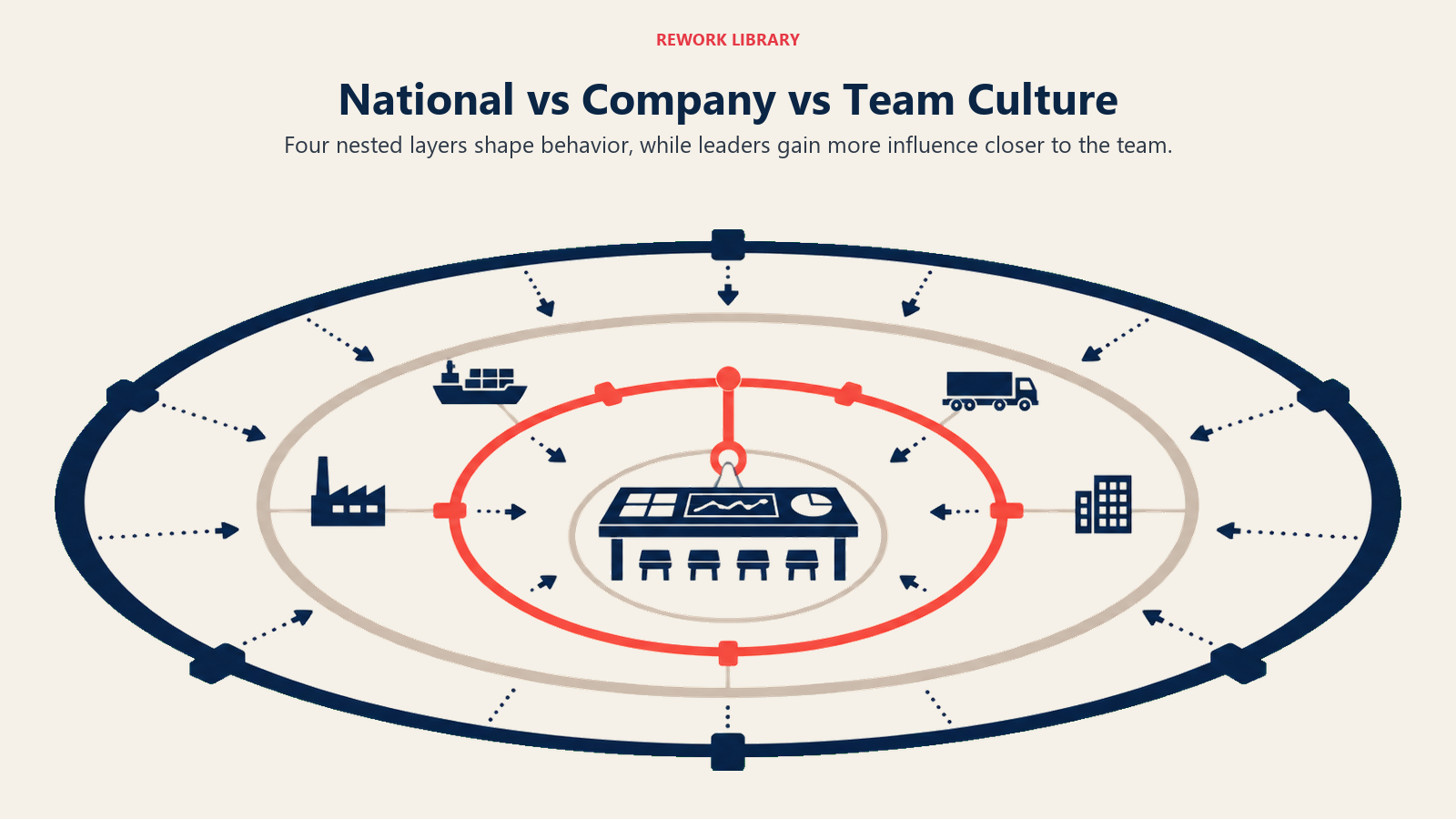
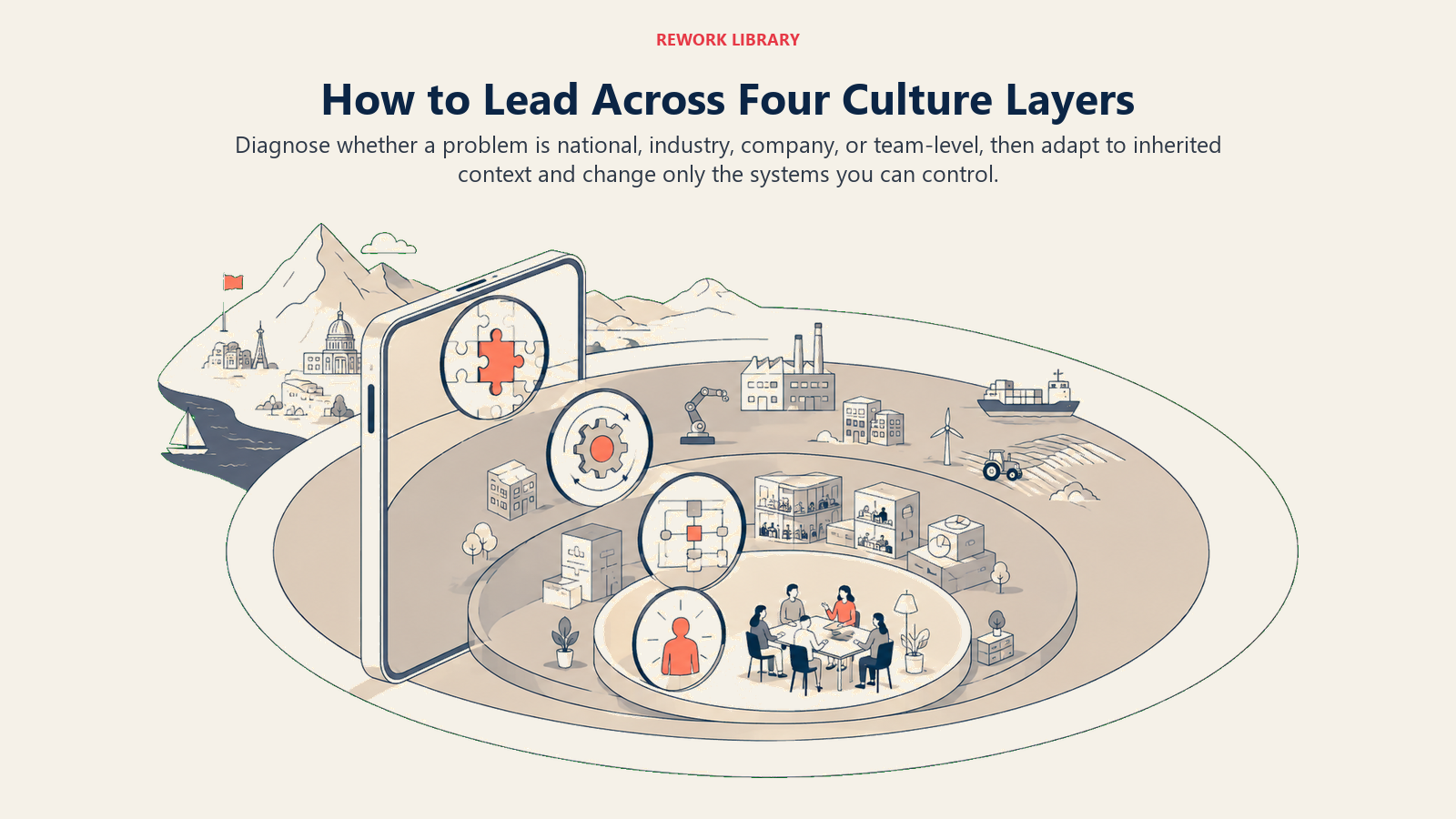
National culture vs organizational culture is not an either/or question. Business culture actually operates in four nested layers: national culture (a country's broad, slow-changing norms), industry culture (the habits a sector develops from its regulation and risk profile), company culture (what an organization deliberately builds), and team culture (what a specific manager reinforces day to day). Each layer filters the one above it, and a leader who only manages one layer keeps getting surprised by the other three.
Most culture advice talks about "company culture" as if it exists in a vacuum, something a founder designs from a blank page and installs uniformly across every office. That's not how it works. A company's stated values get refracted through the country its employees grew up in, the norms its industry already expects, and the habits of whoever runs the room. Two engineers with the same job title, the same handbook, and the same values deck can experience completely different cultures depending on which country office they sit in and which manager they report to. This guide breaks down the four layers, how they reinforce or clash, and which one a leader can actually move.
The Four Nested Layers of Culture
Think of these layers less like an org chart and more like concentric rings, each one shaped by everything outside it, but each one also capable of pushing back on the layer it sits inside.
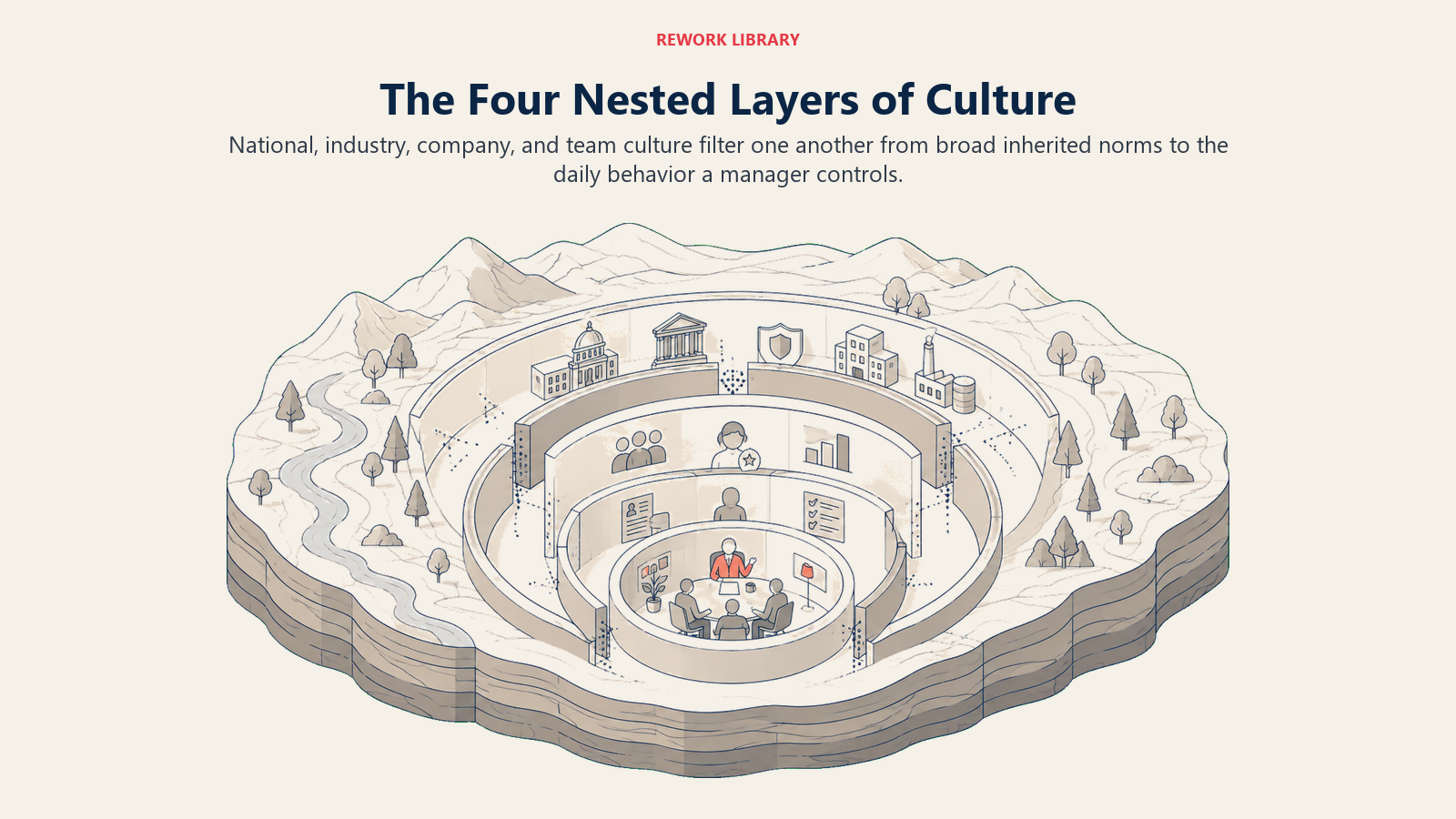
| Layer | What shapes it | Who controls it | How fast it changes |
|---|---|---|---|
| National culture | Generations of history, language, religion, and social structure | No single organization; shared by an entire population | Decades, sometimes centuries |
| Industry culture | Regulation, risk profile, competitive dynamics, and professional norms within a sector | Standards bodies, regulators, and dominant competitors, collectively | Years to a decade, faster after a crisis or scandal |
| Company culture | Deliberate choices: who gets hired, promoted, measured, and excused | Founders and senior leadership, through systems more than speeches | 1-3 years of consistent effort, with real setbacks along the way |
| Team culture | A specific manager's daily behavior and what they tolerate | The manager running that team, more than any policy above them | Weeks to months, for better or worse |
National Culture: The Water Everyone Grew Up Swimming In
National culture is the broadest and slowest layer. It's the set of default assumptions a country's population tends to share about hierarchy, communication, decision-making, and trust, formed over generations before anyone joins a company. Geert Hofstede's research is the most widely cited attempt to measure this layer directly, scoring countries on dimensions like power distance and individualism. We break the full model down, with real country scores, in Hofstede's cultural dimensions explained, and the practical version, how these differences show up in meetings and feedback across regions, is covered in how business culture differs across the world.
No employee arrives at work as a blank slate. A new hire in a high power-distance country has likely spent their life in schools and prior jobs where deference to seniority was the norm, not a preference. That default doesn't disappear the moment they sign an offer letter, no matter what the onboarding deck says about "flat hierarchy."
Industry Culture: The Layer Most Leaders Skip Past
Between country and company sits a layer that gets far less attention than it deserves: industry culture. A bank, a hospital, and a fast-growing software startup can operate in the same city, hire from the same universities, and still develop wildly different defaults around risk, formality, and speed, simply because of what their industry punishes and rewards.
Regulated industries (banking, aviation, pharmaceuticals, healthcare) develop cultures that prize documentation, sign-off chains, and caution, because the cost of a mistake is measured in fines and lawsuits. Fast-moving industries (consumer software, early-stage startups) develop cultures that prize speed and iteration, because the cost of moving too slowly is more visible day to day than the cost of an occasional broken feature. Neither instinct is wrong. Each is a rational adaptation to what the industry punishes.
This matters most for leaders who move between industries. A product leader who joins a healthcare company from a consumer app background often has to unlearn "ship fast and fix it live" before it does real damage. A finance executive who moves into a startup often has to unlearn "get every sign-off before acting" before it kills the company's speed advantage. Industry culture isn't fixed forever, but it changes on the timescale of a sector-wide crisis or new regulation, not a single leader's tenure.
Company Culture: What Gets Deliberately Built on Top
Company culture is the narrower, chosen layer an organization builds on top of whatever national and industry defaults its people already carry. It's the layer covered in depth in what is business culture: the shared values, systems, and unwritten rules that shape how people at a specific company actually behave, distinct from what a careers page claims.
This is also the layer with the most leverage, because it's the only one an organization can genuinely design rather than inherit. A company operating across a dozen countries can't change Vietnam's power-distance default or banking's risk aversion. It can decide how its own performance reviews, promotion criteria, and escalation paths work, and those systems are what actually produce company culture, not the mission statement. Culture architecture covers this system-by-system design process directly.
Team Culture and Subcultures: The Layer Employees Actually Feel
Team culture is the most local layer, and for most employees, it's the one that matters most day to day. Two teams inside the same company, under the same stated values, can feel like entirely different organizations depending on who manages them. A manager who models curiosity, admits mistakes openly, and protects dissent produces a team culture that looks nothing like a peer manager's team down the hall, run with a closed door and a "don't bring me problems, bring me solutions" rule.
This is also where subcultures form: pockets of shared norms within a larger organization that don't match the company-wide default. Engineering subcultures often run more informally than sales subcultures at the same company, because the work rewards different behaviors, fast confident calls versus careful documented ones. A subculture isn't automatically a problem. It becomes one when it actively works against the company's stated values, for example when a high-performing sales team tolerates behavior toward support staff that the company's values explicitly forbid everywhere else.
Key Facts
- Hofstede's national culture research surveyed more than 100,000 IBM employees across 40 countries between 1967 and 1973, and the resulting model has since been extended to cover more than 100 countries and regions. Source: geerthofstede.com
- The GLOBE study, one of the largest cross-cultural leadership research projects ever conducted, surveyed roughly 17,000 middle managers across 950 organizations in 62 societies to map how national culture shapes leadership expectations. Source: globeproject.com
- Managers account for at least 70% of the variance in team engagement scores across business units, meaning the team-culture layer usually comes down to who is managing it, not company-wide policy. Source: Gallup
- Companies in the top quartile of McKinsey's Organizational Health Index deliver total shareholder returns roughly three times higher than bottom-quartile companies, a company-layer effect that holds across industries and countries. Source: McKinsey
- A Harvard Business Review analysis found 89% of white-collar workers surveyed across 90 countries said they at least occasionally work on global virtual teams that cross national boundaries, the exact setting where national and company culture collide most often. Source: hbr.org
How the Layers Reinforce Each Other
When the layers align, culture feels effortless, which is exactly why it's easy to underestimate how much work went into building it. A software company with a low power-distance company culture, operating in a low power-distance country (the US or the Netherlands) in a fast-iterating industry, gets three layers pulling in the same direction. Junior employees already expect to speak up because national culture supports it, the industry rewards fast iteration over caution, and the company's own systems reinforce open debate. None of the three layers has to fight the other two.
This alignment is also why "just copy our culture deck" advice fails when a company expands into a country where the layers don't match. A deck written by a founding team in a low power-distance country and a move-fast industry encodes assumptions a country office in a high power-distance culture doesn't share by default. The deck isn't wrong. It's just missing three layers of context the founding team never had to think about, because their own layers happened to reinforce each other.
How the Layers Clash
Clashes are where the real leadership work happens, and the most instructive case is an egalitarian company culture operating inside a high power-distance country. Picture a US-headquartered tech company that prides itself on flat hierarchy, opening an office in a country where Hofstede's power distance score sits well above 80. The company's stated values say "anyone can challenge any idea in any meeting." The national default says deference to seniority is a sign of respect, not weakness, and challenging a senior person publicly can cost that senior person face in front of the room.
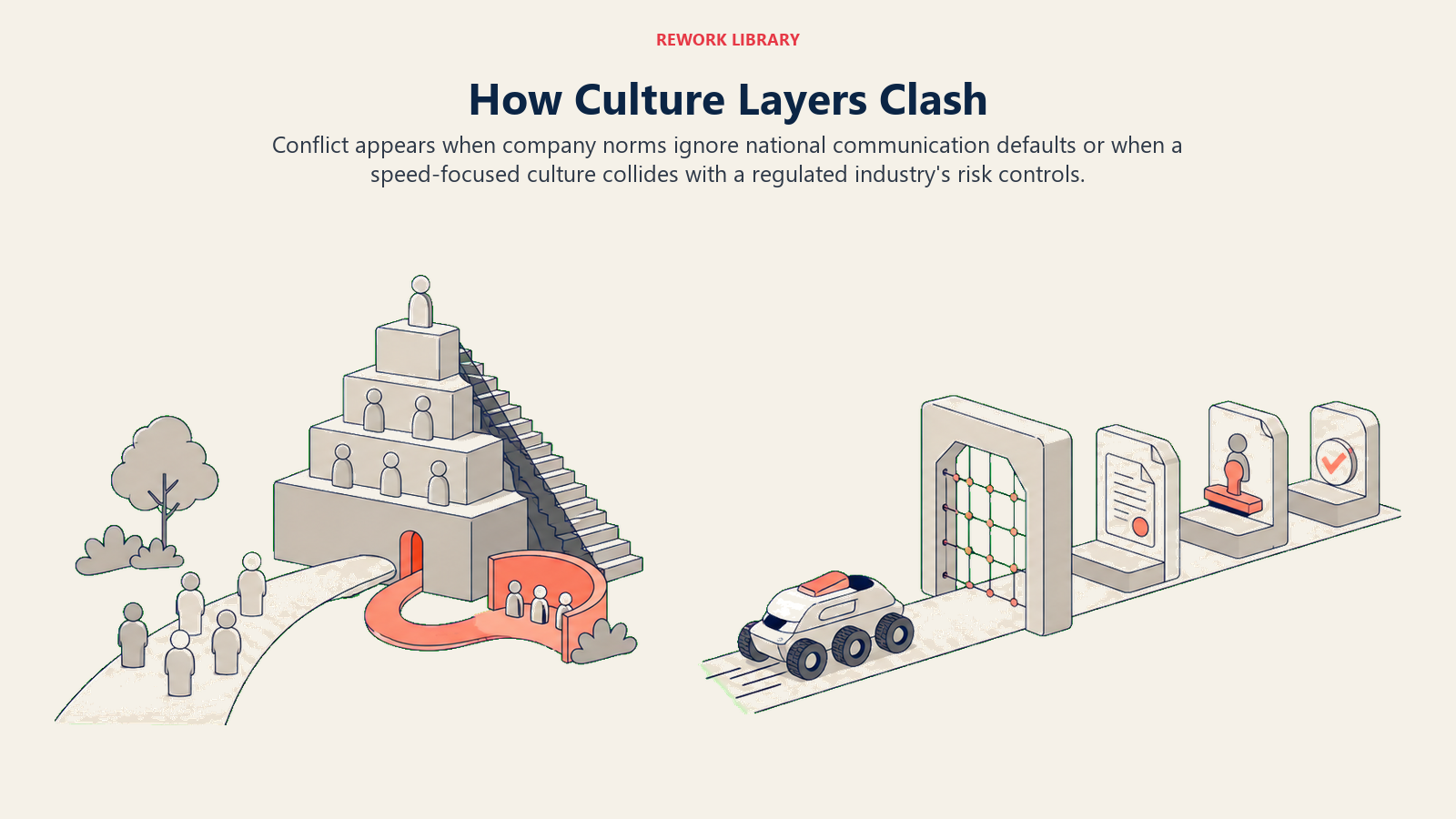
Both are functioning as designed. Neither the company culture nor the national culture is broken. What breaks is the assumption that a values statement travels unchanged across a national-culture boundary. In practice, this shows up as a local office that looks quiet in company-wide meetings, not because people have no opinions, but because the "speak up in the room" norm conflicts with a national default that routes disagreement elsewhere: a private message, a conversation after the call, silence that reads as agreement to a visiting executive but means something different locally. This exact pattern, and how to build private channels that let dissent surface without violating the local norm, is covered in why teams stay silent in meetings.
Industry and company culture clash in a quieter but equally common way: a culture built for speed operating inside a highly regulated industry. A startup's "move fast, ask forgiveness" instinct, imported wholesale into healthcare or financial services, doesn't just create friction. It creates real compliance risk, because the industry's caution is a rational response to consequences the company culture wasn't built to weigh.
Which Layer a Leader Can Actually Change
This is the question that actually matters, because most of the frustration leaders feel about "culture problems" comes from trying to change the wrong layer.
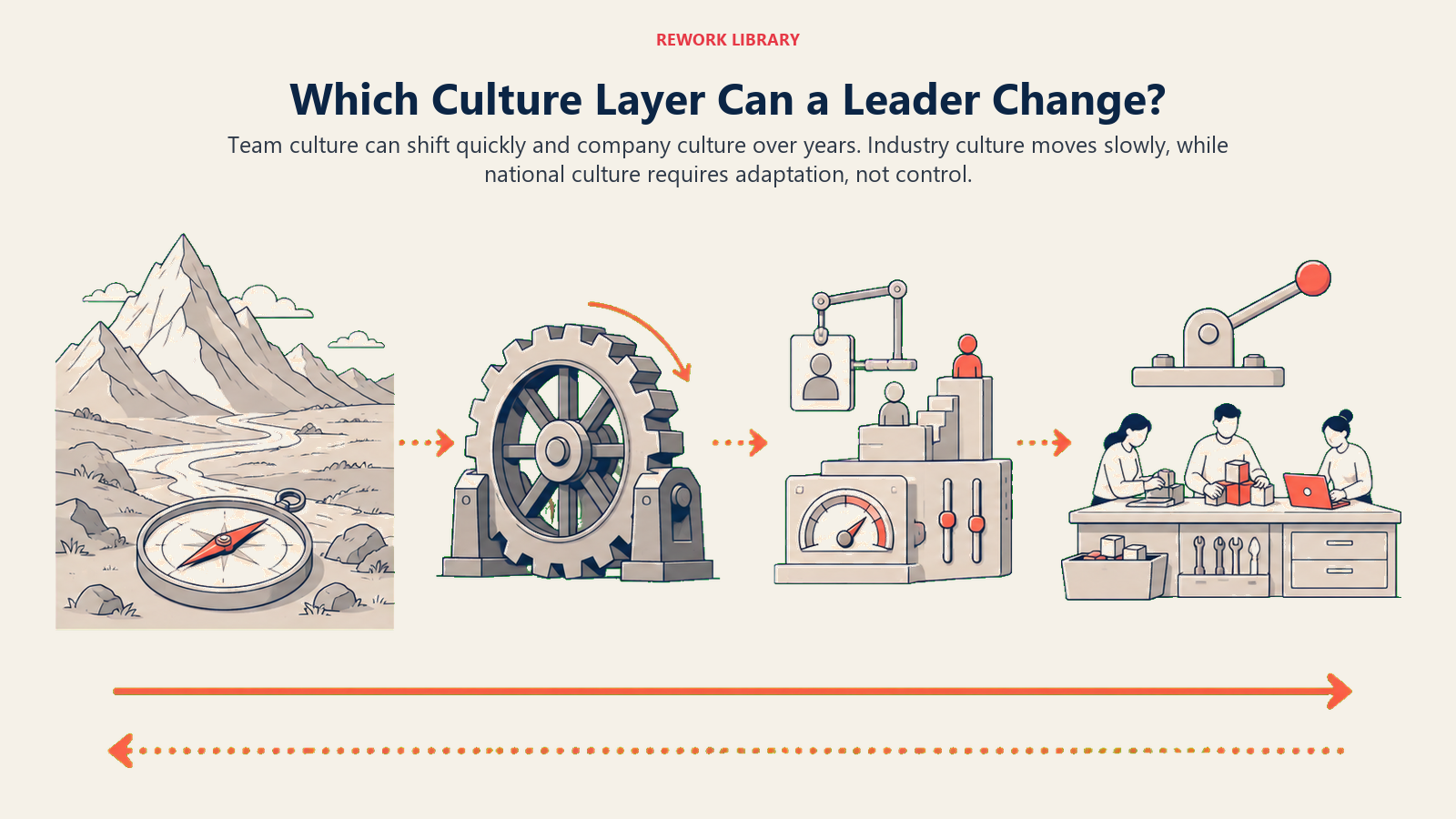
| Layer | Can a leader change it directly? | What actually moves it |
|---|---|---|
| National culture | No | Nothing on a leader's timescale; adapt to it, don't fight it |
| Industry culture | Rarely, and slowly | Sector-wide crises, new regulation, or a dominant competitor changing norms |
| Company culture | Yes, over 1-3 years | Hiring criteria, promotion systems, what gets measured, what gets excused from a high performer |
| Team culture | Yes, almost immediately | A manager's own daily behavior, what they model, and what they let slide |
National culture is off the table entirely. No leader changes what an entire country believes about hierarchy or trust inside a single company's tenure, and treating a national default as a problem to fix, rather than a context to adapt to, is a fast way to lose an office's trust. The honest move is adapting how values get communicated and reinforced locally, without abandoning the values themselves.
Industry culture moves slowly and mostly through outside forces: a scandal that tightens a sector's compliance culture, a regulator that mandates new disclosure, or a dominant player shifting what "normal" looks like industry-wide. A leader can position their company ahead of or behind that shift, but rarely causes it alone.
Company culture is where real leverage lives, and it's a systems problem, not a communication one. Changing who gets hired, who gets promoted, what gets measured, and what gets tolerated from a high performer moves company culture over one to three years. It's also the layer tied to succession planning, since who gets developed into future leadership roles signals what a company's culture actually rewards.
Team culture is the fastest layer to move and the one most directly under a single person's control. A new manager can change how safe a team feels raising concerns within weeks, because psychological safety at the team level is overwhelmingly a function of one person's behavior, not policy. This is also the layer where radical candor either works or backfires, since the same feedback style that builds trust with one manager's team can read as harsh coming from another.
When National Culture Bends to Strong Company Culture
National culture is durable, but it's not absolute, and there's real evidence that a sufficiently strong, sufficiently consistent company or industry culture can override a national default inside a specific context. The clearest documented case comes from commercial aviation.
Cockpit culture in the mid-20th century largely mirrored each airline's national culture, including its power distance default. Investigations into a string of accidents, most notably a 1997 crash involving a Korean-flagged carrier, found that first officers had noticed the captain's error but hesitated to challenge it directly, a pattern consistent with a high power-distance default carried into the cockpit. The industry's response was Crew Resource Management (CRM): a deliberately engineered protocol that trains every first officer, regardless of national background, to challenge a captain using specific, rehearsed language the moment they see a problem. CRM didn't ask crews to become a different nationality. It built a system strong enough to override a national default in one specific, high-stakes context, and airlines that adopted it saw meaningfully fewer accidents traced to unchallenged cockpit errors.
The same principle scales down to ordinary companies. The Toyota Production System exported lean manufacturing discipline, andon cords, standardized work, relentless small-scale problem surfacing, into plants across dozens of countries with very different national defaults, and it worked because it was built as an explicit, trained protocol rather than a vague cultural aspiration. The lesson isn't that national culture doesn't matter. It's that overriding it, even narrowly, takes an explicit system with real training and real consequences, not a values poster asking people to "speak up more."
Culture Layers in the Age of AI
AI agents are starting to add something close to a fifth layer, one with no national culture of its own but with real defaults baked in from training and design choices. An AI teammate doesn't carry a country's power-distance default, but it does carry the defaults of however it was built and instructed, which a company can shape far more directly than any human-culture layer. That's the subject of what is AI-native culture.
The honest caveat: early evidence on "human-agent teams" is thin and mostly vendor-reported, and plenty of pilots have produced more busywork reviewing AI output than time saved. What is clearer is that a company culture already weak at the human layers, unclear ownership, thin psychological safety, tends to reproduce those weaknesses once AI agents enter the mix rather than fixing them, a dynamic covered in AI cultural debt.
Leading Across All Four Layers at Once
The practical takeaway is to diagnose which layer a problem actually lives in before trying to fix it. A quiet country office isn't automatically a company-culture failure; it might be a healthy national default meeting a company norm never adapted locally. A struggling regulated-industry rollout isn't automatically a leadership failure; it might be an industry-culture mismatch that needs a different playbook. And a single toxic team inside an otherwise healthy company is almost always a team-culture problem with one person at the center, not a sign the whole company needs a values refresh.
This is also where the broader distinction between leadership and management matters most: managing a team means running its systems inside whatever national and industry layers surround it, while leading it means being honest about which of those layers you can actually move and which ones you're better off adapting to. Getting that diagnosis right is most of the work. Treating culture as strategy, rather than an afterthought bolted onto quarterly planning, starts with knowing exactly which layer you're trying to change.
Frequently Asked Questions about National, Company, and Team Culture
What is the difference between national culture and organizational culture?
National culture is the broad set of norms a country's population shares around hierarchy, communication, and trust, shaped over generations before anyone joins a company. Organizational culture is the narrower, deliberately chosen set of values and systems a specific company builds, which has to work alongside national culture rather than override it, especially for teams spread across several countries.
How many layers of business culture are there?
Four layers nest inside each other: national culture (a country's broad norms), industry culture (habits shaped by a sector's regulation and risk profile), company culture (what an organization deliberately builds), and team culture (what a specific manager reinforces daily). Some organizations also develop subcultures, pockets that diverge from the company-wide default within a single team or function.
Can a company change its national culture?
No. National culture is shared by an entire population and shaped over generations, well outside what any single organization can move within a normal business timescale. The realistic goal is adapting how company values get communicated and reinforced in a given country, not attempting to change the national default itself.
Which layer of culture has the most impact on a typical employee's daily experience?
Team culture, in most cases. Research on manager impact shows managers account for the large majority of variance in team engagement, meaning two employees at the same company, under the same stated values, can have very different daily experiences depending entirely on who manages them.
What happens when company culture conflicts with national culture?
The clash usually shows up as a mismatch between a stated norm and a local default, most commonly when a company's "speak up in any meeting" value meets a country's high power-distance expectation that dissent gets routed privately rather than voiced openly. The fix is building parallel channels that respect the local norm while still surfacing the same information, not insisting the local team adopt the company's default communication style overnight.
Can strong company culture override national culture?
In specific, high-stakes contexts, yes, but only through an explicit, trained system rather than a values statement. Commercial aviation's Crew Resource Management protocol is the clearest documented example: it trains crews from any national background to challenge a captain using specific language, deliberately overriding a power-distance default that had contributed to prior accidents.
What is a subculture, and is it always a problem?
A subculture is a set of norms within one team or function that diverges from the company-wide culture, often because different work rewards different behavior, for example a faster-moving sales subculture inside a more process-driven company. A subculture becomes a problem only when it actively works against the company's stated values, not simply because it looks different from the company average.
Does industry culture matter as much as national or company culture?
It matters more than most leaders assume, particularly for anyone moving between industries. A regulated industry like banking or healthcare develops caution and documentation as rational responses to real consequences, while a fast-moving industry like consumer software develops speed and iteration for the same reason. Importing one industry's instincts wholesale into another is a common and costly mistake.

Co-Founder, Rework.com
On this page
- The Four Nested Layers of Culture
- National Culture: The Water Everyone Grew Up Swimming In
- Industry Culture: The Layer Most Leaders Skip Past
- Company Culture: What Gets Deliberately Built on Top
- Team Culture and Subcultures: The Layer Employees Actually Feel
- Key Facts
- How the Layers Reinforce Each Other
- How the Layers Clash
- Which Layer a Leader Can Actually Change
- When National Culture Bends to Strong Company Culture
- Culture Layers in the Age of AI
- Leading Across All Four Layers at Once