Leading Culture in the Age of AI: A Leader's Playbook
Turn this article into takeaways for your work.


Each assistant summarizes the article only for you and suggests best practices for your work.
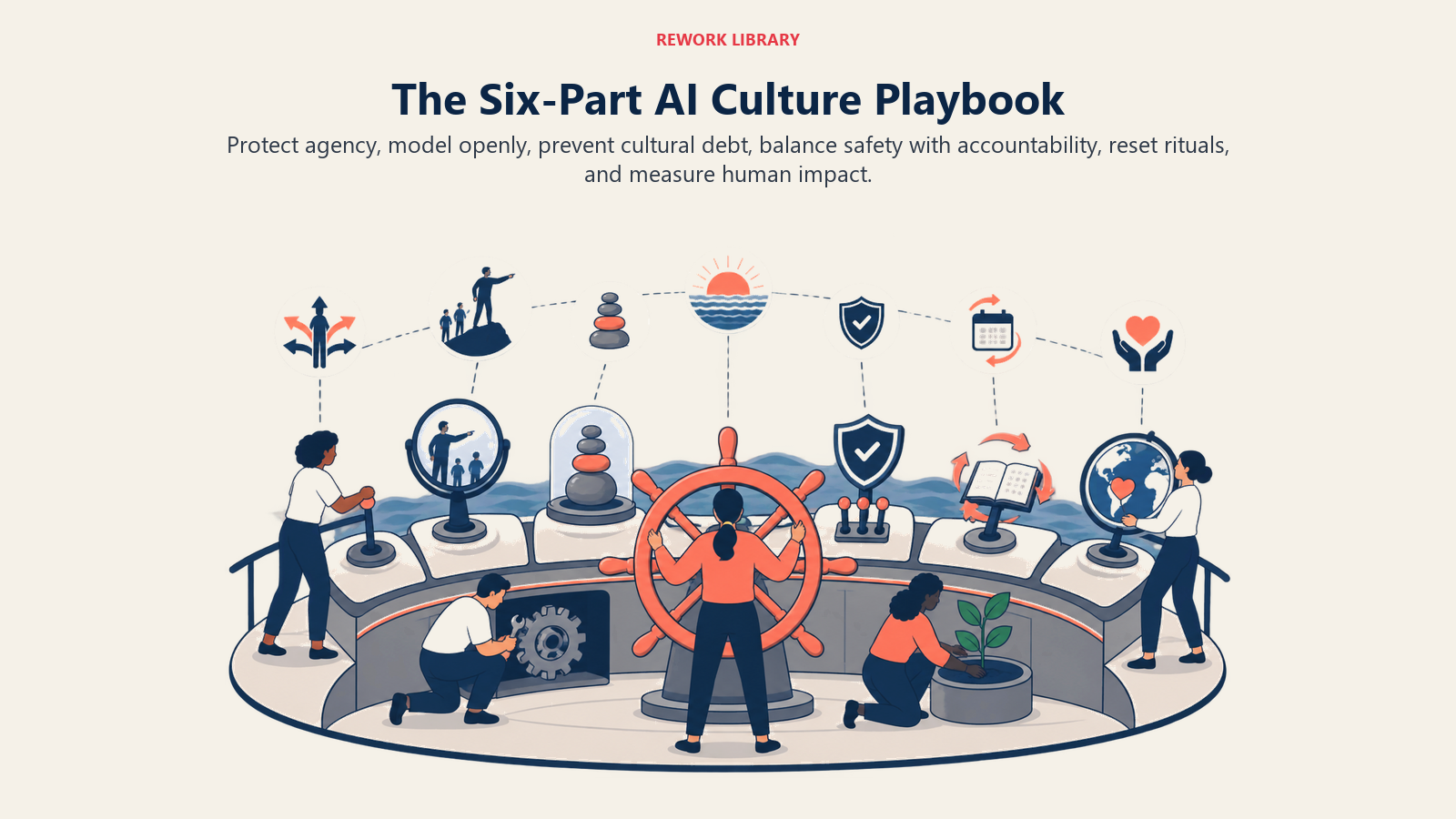
Leading culture in the age of AI means treating an agent's arrival on the team as a culture event to manage deliberately, not a software rollout to announce and move past. In practice it comes down to six moves: protect human agency, model AI use openly instead of mandating it from a distance, prevent AI cultural debt before it compounds, keep psychological safety and accountability intact at the same time, reset norms and rituals on purpose, and measure the human impact of the rollout, not just how many people logged in.
This is the capstone article for this collection's AI section. What is AI-native culture named the concept. How to build an AI-ready culture laid out the roadmap. This one is written for the person who has to actually run the thing: what to do, in what order, and which parts of the current hype cycle deserve real weight versus healthy skepticism.
Why This Is a Leadership Job, Not an IT Rollout
Handing AI to IT and calling it done is the single most common mistake in this whole area, and it's an understandable one. AI tools ship through the same channel as every other piece of software: a license, a login, a training deck. But an AI agent that plans a sequence of steps and hands back a finished result changes what a job feels like to do, and that's a culture question whether or not anyone labeled it one at rollout time.
Microsoft's 2025 Work Trend Index put a name on the organizations getting this right: the Frontier Firm, built around on-demand intelligence and fluid human-agent teams, with a new role called the agent boss that every worker ends up playing, not just executives. The Frontier Firm and agent boss framing is useful shorthand, and the performance case behind it is real: Frontier Firm workers report their company is thriving at nearly double the rate of the global average. But it's a vendor coinage describing a real pattern, not a settled science, and the honest version of this article treats it that way rather than as gospel.
The reason it has to sit with leadership rather than IT is simple: culture change runs through what leaders reward, tolerate, and model, the same mechanism covered in the leader's role in shaping company culture. A rollout memo from IT cannot change what people believe is safe to admit or who gets credit for a result. Only visible leadership behavior does that, and it does it slowly, one observed moment at a time.
Key Facts
- Frontier Firm workers report their company is thriving at 71%, compared to 37% of workers globally. Source: Microsoft Work Trend Index 2025
- Organizational factors, culture, manager support, and talent practices, account for 67% of the variance in AI's business impact, roughly twice the weight of individual skill or effort. Source: Microsoft Work Trend Index 2026
- Where managers visibly modeled their own AI use, employees reported a 30-point lift in trust toward agentic AI and a 22-point lift in critical thinking about how they used it. Source: Microsoft Work Trend Index 2026
- MIT's Project NANDA studied over 300 enterprise generative AI deployments and found 95% delivered no measurable P&L impact, tracing the gap to an organizational "learning gap," not model quality. Source: Fortune, reporting on MIT Project NANDA
- Gartner predicts more than 40% of agentic AI projects will be canceled by the end of 2027, citing escalating costs, unclear business value, and inadequate risk controls. Source: Gartner
- Deloitte's 2026 Global Human Capital Trends research found 60% of executives already use AI in decision-making, but only 5% say they manage it well, a gap it names "cultural debt." Source: Deloitte, 2026 Global Human Capital Trends
- McKinsey's 2025 global AI survey found 88% of organizations regularly use AI, but only 6% qualify as "high performers" capturing significant enterprise-wide value. Source: McKinsey, The State of AI: Global Survey 2025
The Six-Part Playbook for Leading Culture in the AI Era
Each of the six moves below reinforces the others. Skip one and the rest work at a fraction of their potential, the same warning that runs through every article in this section.
1. Protect Human Agency
The fastest way to lose a team's trust is to let agents absorb judgment calls that people never agreed to hand over. Human agency means people still decide which decisions get delegated, still understand how a result was produced, and still feel like the author of their own work rather than an editor of an agent's draft. Human-agent teams covers the mechanics of this shift in depth: the moment an agent starts acting instead of just answering, the boundaries a leader sets before the work starts matter more than any correction made after the fact, because nobody is in the room to catch a mistake mid-stream the way a colleague would.
Protecting agency also means protecting the skill of judging AI output well, which research increasingly treats as the scarce resource. Trust when your teammate is an AI covers the specific failure modes: teams that quietly redo everything an agent produces, erasing the productivity gain, and teams that swing the other way and rubber-stamp confidently wrong output. A leader's job is naming which decisions never get delegated without a human check, before the pressure of a deadline makes that call for them.
2. Model AI Use Openly
Norms spread through what leaders visibly do, not what they announce. Microsoft's 2026 research found a 30-point trust lift and a 22-point critical-thinking lift tied specifically to managers who modeled their own AI use in the open, including their uncertainty about it. A leader who mandates adoption while never touching the tools themselves sends the opposite signal: this is required, not trusted. People read that gap faster than any survey captures it.
Modeling is also where disclosure norms actually get set. AI etiquette and workplace norms covers the specifics, when to say you used AI, who gets credit, which categories of work should never be silently agent-drafted, and the honest finding there is that most companies have a usage policy and almost nothing written down about the social layer underneath it. A leader who says out loud "I used an agent for the first pass of this and then rewrote the parts I disagreed with" does more to set that norm than any policy document circulated the same week.
3. Prevent AI Cultural Debt Before It Compounds
AI cultural debt is Deloitte's term for the quiet erosion of trust, fairness, and ownership norms that builds up when AI usage outpaces the culture work around it. It compounds the way financial debt does: nobody notices the bill until execution quality or morale collapses under the weight of it, well after the adoption dashboard already looked healthy.
The leader's move here is to treat the rollout's first quarter as the highest-leverage window, before the shortcuts pile up. How to build an AI-ready culture lays out the roadmap in detail: assess what's already happening informally, set norms before scaling access, train judgment rather than tool use, model at the top, and measure debt rather than just adoption. Doing that sequence early is far cheaper than reversing entrenched habits a year later, once "how we've always worked with AI here" has already hardened into the team's actual culture.
4. Keep Psychological Safety and Accountability Both Intact
These two things pull in opposite directions if a leader is careless, and holding both at once is the hardest move on this list. Psychological safety means people feel safe admitting "I let an agent draft this and I'm not fully sure it's right." Psychological safety at work was already the clearest predictor of high-performing teams before AI arrived, and Microsoft's data shows why it matters more now: teams with that safety were 1.4 times more likely to become high-frequency, confident users of agentic AI, because people who fear judgment for using AI go quiet about it instead of honest.
Accountability means a person is still answerable for a result even when an agent produced most of it. Those two things sound like they should conflict, but they don't if a leader separates two very different questions: "did you feel safe telling me how this got made" and "are you still responsible for whether it's right." Building trust in the workplace covers the underlying trust mechanics that both depend on, and the leaders who get this right are the ones who never let honesty about process become an excuse for a result nobody owns.
5. Reset Norms and Rituals Deliberately
Meetings, feedback cycles, and standups were built for an era when everyone in the room did their own work. An agent that drafts, summarizes, or pre-analyzes before a meeting even starts changes what that meeting is for, and most teams keep running the old ritual on autopilot without noticing it no longer fits. A leader's job is to name what changed on purpose: does a status meeting still need a full readout if an agent already surfaced the summary, or should the time move to judgment calls the agent couldn't make.
This is also where governance has to be explicit rather than assumed. AI agent guardrails covers the operational boundaries an agent runs inside, and AI governance for executives covers who owns that risk decision at the leadership level. Resetting a ritual without resetting the guardrail underneath it just moves the same unmanaged risk into a new meeting format.
6. Measure the Human Impact, Not Just Adoption
An adoption dashboard, how many people logged in, tells a leader almost nothing about whether the culture around AI is actually healthy. The better signal is qualitative and specific: are people disclosing AI use without hesitation, is credit for agent-assisted work handled consistently, has anyone quietly gone back to doing things the slow way because they don't trust the new process. How to measure company culture covers the broader measurement approach; the AI-specific version means adding a handful of pointed questions to the same engagement survey instrument rather than building a separate AI dashboard nobody reads.
Measuring this also gives a leader the evidence to make the business case for culture ROI when a finance conversation eventually asks why the culture work matters as much as the tooling budget. The honest answer, backed by McKinsey's 88-versus-6 adoption-to-impact gap, is that most companies already have comparable tools. The 6% that capture real value are the ones that measured and fixed the human side, not the ones with the newest model license.
The Leader's Playbook at a Glance
| Pillar | What good looks like | The leader's first move |
|---|---|---|
| Protect human agency | People still decide what gets delegated and understand how results were produced | Name which decisions never get delegated without a human check |
| Model AI use openly | Leaders use the same tools and admit the same uncertainty they ask of others | Say out loud, this quarter, how you personally used AI and where you didn't trust it |
| Prevent cultural debt | Norms for effort, credit, and ownership get updated as fast as the tools change | Run the informal-norms assessment before granting broader access |
| Keep safety and accountability | People disclose AI use freely and still own the outcome | Separate "was this disclosed honestly" from "is this correct" in every review |
| Reset rituals deliberately | Meetings and reviews reflect what an agent already handled, not the old default | Ask one team to redesign a single recurring meeting around what the agent now covers |
| Measure human impact | Surveys track disclosure, trust, and credit, not just login counts | Add three AI-specific questions to the next engagement survey |
The First 90 Days: A Sequenced Rollout
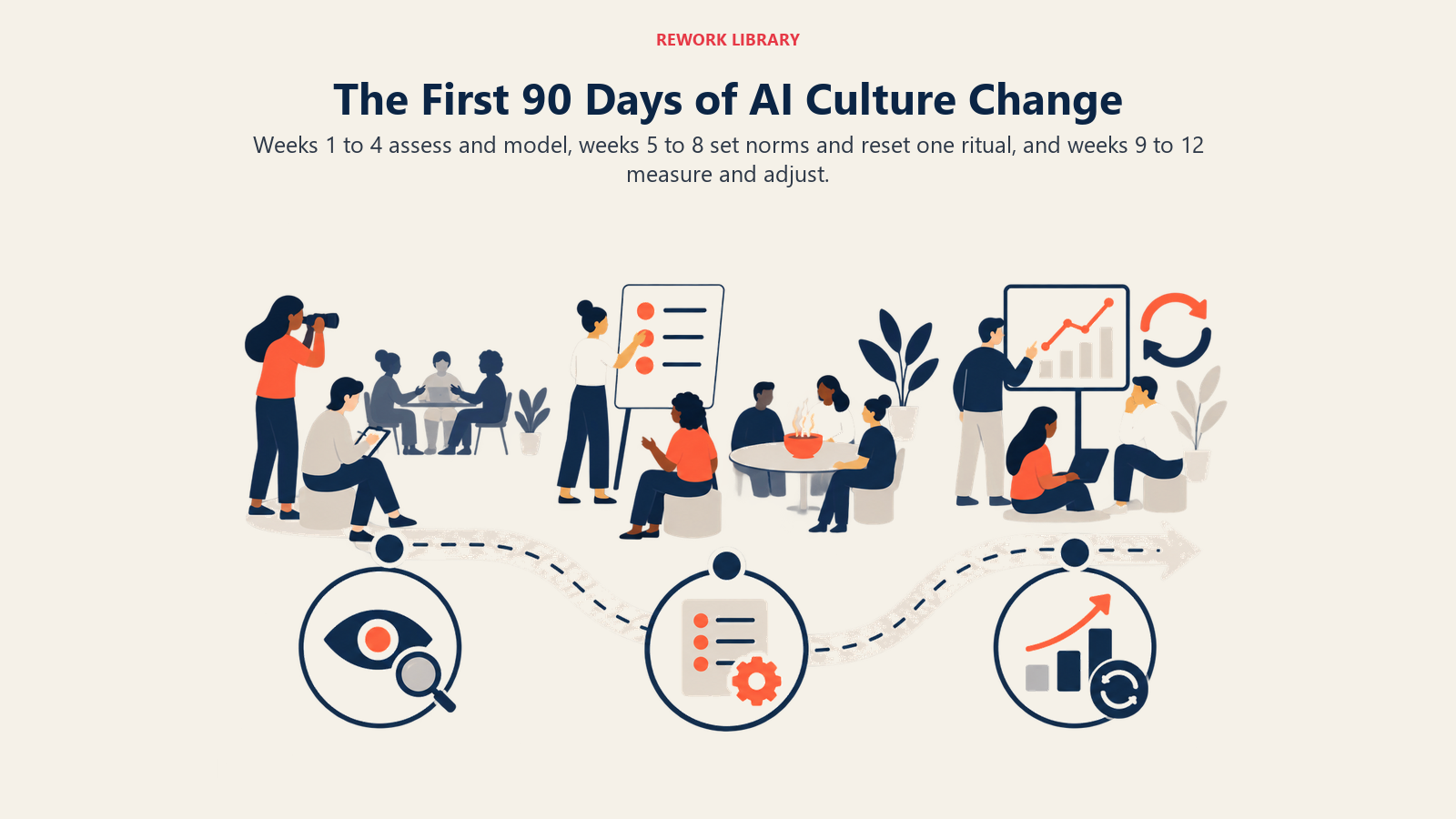
Leading this well is a sequence a leader personally runs, distinct from the org-wide rollout roadmap covered elsewhere in this collection. This is the leader's own calendar for the first quarter after agents show up on the team.
Weeks 1 to 4: Assess and Model
Spend the first month watching, not announcing. Find the team already using AI heavily and ask directly how they've been deciding what to trust and what to disclose. At the same time, start modeling immediately: use the tools yourself, in view of the team, including the parts that didn't work well. Waiting until the "official" rollout to start modeling wastes the highest-leverage move available in week one.
Weeks 5 to 8: Set Norms and Reset One Ritual
Write down disclosure, attribution, and no-go-zone norms before granting anyone broader access, then pick exactly one recurring ritual, a standup, a review cycle, a planning meeting, and redesign it around what the agent now handles. Trying to reset every ritual at once guarantees none of them stick; one well-run example gives the rest of the team a template to copy.
Weeks 9 to 12: Measure, Then Adjust the Playbook
Add the AI-specific questions to the next engagement survey and look for the early signals of cultural debt: quiet double-checking, murky credit, people who've gone back to the slow way without saying why. Whatever the data shows, treat the six-part playbook above as a loop to revisit each quarter, not a checklist to close out once and file away.
Where the Hype Gets Ahead of the Data
The Frontier Firm and agent boss framing is useful, but it's marketing language for a pattern that's still genuinely uneven across companies, and the skepticism deserves equal billing here. MIT's NANDA research found 95% of enterprise generative AI pilots delivered no measurable financial return, tracing the failure to organizational gaps rather than the models themselves. Gartner expects more than 40% of agentic AI projects to be canceled by the end of 2027 for reasons that are entirely about execution: escalating costs, unclear value, and risk controls nobody built in time.
None of that means the underlying shift is fake. It means most companies are attempting it without the culture work this article covers, which is exactly why the pilots stall. The leaders getting real results are not the ones with the boldest AI strategy slide. They're the ones treating this as a leadership discipline with a sequence, the same discipline covered in how to change organizational culture, applied to a genuinely new kind of teammate.
A Short, Honest Note on Where Rework Fits
Rework's Work Ops and People modules expose an MCP interface, so agents, including ones outside Rework, can act inside a company's actual workflows and records rather than sitting off to the side. That's a tooling detail worth naming plainly, not a substitute for the six moves above. Software can make disclosure easier to track and rituals easier to standardize once a leader has decided what those norms should be. It cannot decide them for you.
Where to Go Next
This article closes the loop on the AI section of this collection. For the concept and the build roadmap that sit underneath it:
- What is AI-native culture, for the underlying concept this playbook operationalizes
- How to build an AI-ready culture, for the detailed five-pillar, five-step build sequence
- AI cultural debt, for the specific cost of skipping this work
- The leader's role in shaping company culture, for the mechanisms that make leadership behavior the strongest culture signal, AI or not
Frequently Asked Questions about Leading Culture in the Age of AI
What does leading culture in the age of AI actually mean?
It means treating an AI agent's arrival on a team as a culture event to manage on purpose, not a software rollout to announce and move past. The practical version comes down to six moves: protect human agency, model AI use openly, prevent AI cultural debt, keep psychological safety and accountability intact together, reset norms and rituals deliberately, and measure the human impact rather than just adoption numbers.
Why is this a leadership job instead of something IT or HR can own alone?
Because culture change runs through what leaders visibly reward, tolerate, and model, not through a policy memo. Microsoft's 2026 research found organizational factors like culture and manager support account for 67% of the variance in AI's business impact, roughly twice the weight of individual skill, which puts the lever squarely in leadership's hands rather than a rollout team's.
What's the single biggest mistake leaders make with this?
Mandating AI adoption without modeling it themselves first. Microsoft found a 30-point trust lift and a 22-point critical-thinking lift tied directly to managers who visibly used the same tools and admitted the same uncertainty they asked of their teams. A leader who requires the tool but never touches it sends the opposite signal, and people notice the gap fast.
How does a leader actually prevent AI cultural debt?
By treating the first quarter of any rollout as the highest-leverage window: assess what norms already exist informally, write down disclosure and attribution rules before scaling access, and measure trust and credit issues the same way you'd measure any other early warning sign, rather than waiting for a good adoption dashboard to prove the culture is fine.
Is the Frontier Firm and agent boss framing real, or just vendor marketing?
Both, honestly. It names a real, measurable pattern: Frontier Firm workers report their company is thriving at nearly double the global average. But it's Microsoft's coinage for a trend that's still uneven across companies, and it should sit alongside real skepticism, including MIT NANDA's finding that 95% of enterprise AI pilots show no P&L impact and Gartner's forecast that over 40% of agentic AI projects will be canceled by 2027.
How should a leader measure whether this is actually working?
Skip the login-count dashboard and look for specific behaviors instead: are people disclosing AI use without hesitation, is credit for agent-assisted work handled consistently, and has anyone quietly reverted to doing things the slow way without saying why. Adding a few AI-specific questions to an existing engagement survey usually surfaces this faster than building a separate AI adoption report.
What's the first concrete thing a leader should do this quarter?
Model the behavior in public before anything else. Use the same AI tools the team is being asked to use, say out loud where the output was wrong or where you didn't trust it, and hold off on a formal rollout announcement until that modeling has actually happened. Every other step in the playbook works better once that one is in place first.
An agent joining the team is a reorg, not a software install. It changes who does what, who answers for it, and who people trust, and it earns the same treatment: a sequence, run in the open, measured honestly, and revisited each quarter. Lead it that way and the productivity tends to follow. Skip straight to the tooling and you usually get a good demo, and not much that outlives it.

Co-Founder, Rework.com
On this page
- Why This Is a Leadership Job, Not an IT Rollout
- Key Facts
- The Six-Part Playbook for Leading Culture in the AI Era
- 1. Protect Human Agency
- 2. Model AI Use Openly
- 3. Prevent AI Cultural Debt Before It Compounds
- 4. Keep Psychological Safety and Accountability Both Intact
- 5. Reset Norms and Rituals Deliberately
- 6. Measure the Human Impact, Not Just Adoption
- The Leader's Playbook at a Glance
- The First 90 Days: A Sequenced Rollout
- Weeks 1 to 4: Assess and Model
- Weeks 5 to 8: Set Norms and Reset One Ritual
- Weeks 9 to 12: Measure, Then Adjust the Playbook
- Where the Hype Gets Ahead of the Data
- A Short, Honest Note on Where Rework Fits
- Where to Go Next