The Business Case for Culture: How to Prove Culture ROI
Turn this article into takeaways for your work.


Each assistant summarizes the article only for you and suggests best practices for your work.
A CFO will fund almost anything with a number attached to it. Culture usually shows up without one, which is why it loses the budget fight to a new sales tool or a marketing campaign nine times out of ten. That is not because culture matters less. It is because the person asking for the money rarely translates it into terms finance already tracks.
What Culture ROI Actually Means
Culture ROI is not a single metric you pull from a dashboard. It is the practice of connecting specific culture investments (a leadership development program, a redesigned performance system, a psychological safety initiative) to specific financial outcomes the business already measures: turnover cost, productivity, safety incidents, customer retention, and revenue growth.
That distinction matters because most "culture and performance" claims stop at correlation. Companies with strong culture tend to perform better, the argument goes, therefore invest in culture. A finance leader hears that and asks the obvious follow-up: compared to what, and how much, and by when? Culture ROI is the attempt to answer that follow-up honestly, using the same discipline applied to any other capital request, while being upfront about where the math gets soft.
Why Leaders Struggle to Fund Culture
Three problems keep culture out of the budget conversation, and none of them are about whether culture matters.
It has no natural line item. A new CRM sits in the software budget. A hiring freeze sits in headcount planning. Culture work, mentorship programs, values redesigns, feedback training, gets scattered across HR, L&D, and whatever manager happens to care that quarter, which means nobody owns a business case for the whole.
The payoff arrives later than the cost. A leadership offsite costs money this month. The retention it protects shows up eighteen months from now, as an absence: the resignation that did not happen. Absences are hard to put in a slide deck, and a CFO evaluating competing requests will naturally favor the one with a visible, near-term return.
It gets treated as morale, not risk management. Framed as "making people happier," culture work sounds like a nice-to-have next to a revenue target. Framed as "the thing that determines whether your best people quit before your competitor does," it becomes a risk the board should want quantified. The framing problem is often the whole problem.
Key Facts
- Voluntary turnover costs U.S. businesses roughly $1 trillion a year in recruiting, onboarding, training, and lost productivity during the transition. Source: Gallup
- A toxic culture is 10.4 times more predictive of employee attrition than pay, based on an analysis of more than 170 cultural factors across 500 large companies. Source: MIT Sloan Management Review
- Replacing an employee typically costs 50 to 200 percent of that person's annual salary once recruiting, ramp-up time, and lost institutional knowledge are counted. Source: SHRM
- Companies in the top quartile of McKinsey's Organizational Health Index deliver total shareholder returns roughly three times higher than bottom-quartile companies. Source: McKinsey
- Business units in the top quartile of employee engagement post 23 percent higher profit and 10 percent higher customer ratings than bottom-quartile units, across a study spanning 183,806 teams. Source: Gallup Q12 Meta-Analysis
- Low employee engagement costs the global economy an estimated $8.8 trillion, roughly 9 percent of global GDP. Source: Gallup, State of the Global Workplace 2023
- The total cost of workplace injuries in the United States reached $176.5 billion in 2023, an average of about $43,000 per medically consulted injury. Source: National Safety Council, Injury Facts
The Hard ROI Links: Where Culture Actually Hits the P&L
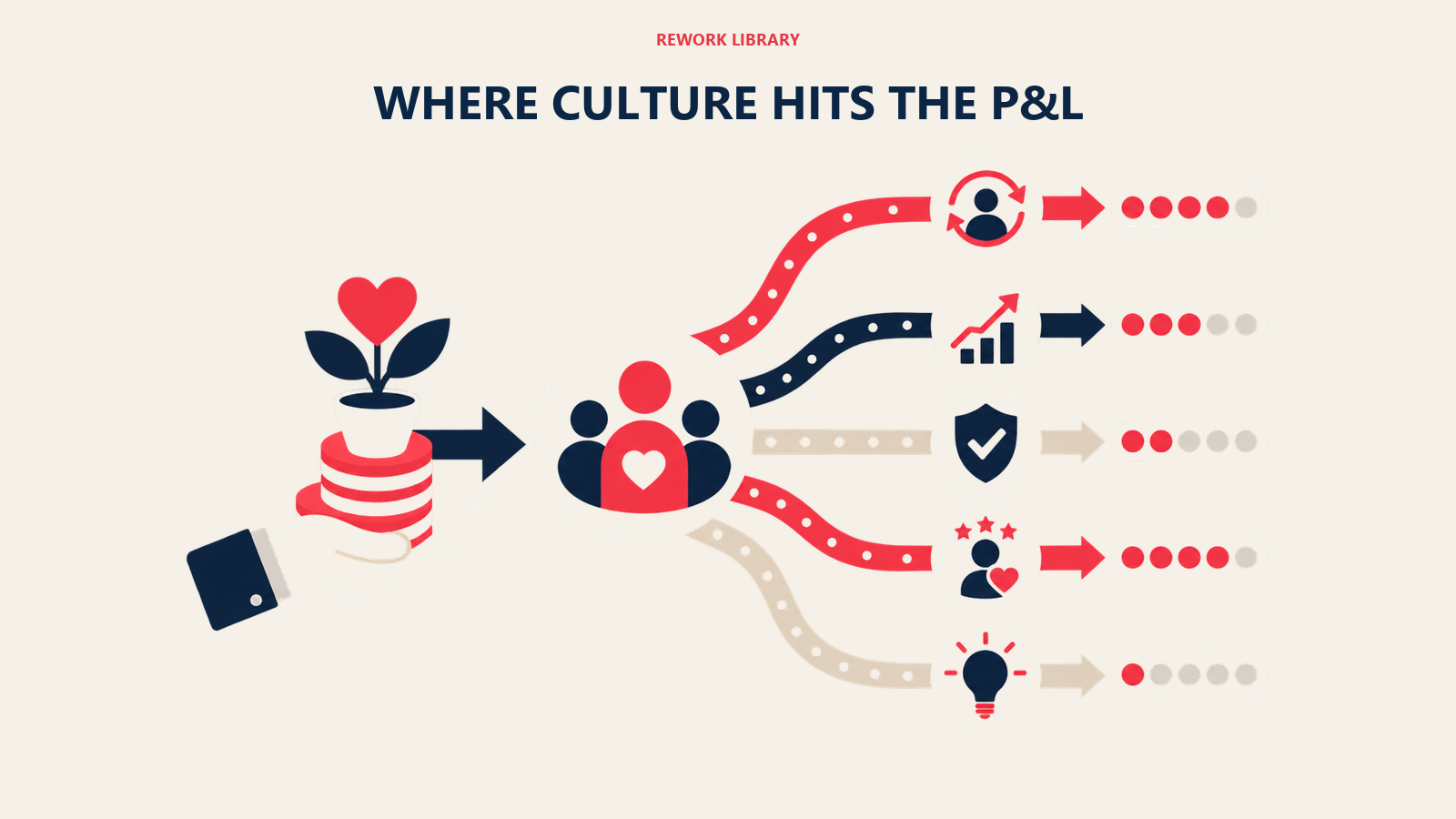
Culture does not affect the business in one place. It shows up in at least five lines a CFO already watches, some with tighter attribution than others.
Retention and Turnover Cost
This is the cleanest link in the whole business case, because turnover cost is already a number finance can calculate. Take the SHRM range of 50 to 200 percent of salary per departure, multiply by your attributable voluntary turnover (the share of exits tied to management, fairness, or belonging issues rather than pay or relocation), and you have a defensible cost of the status quo. Our deeper breakdown of the mechanism is in how company culture drives employee retention, and the warning signs worth tracking before someone resigns are in 10 signs of a toxic culture.
Productivity and Discretionary Effort
Engaged teams do not just feel better, they produce more, largely because people give discretionary effort (the extra care, the caught mistake, the unprompted improvement) only when they trust the environment enough to bother. The Gallup meta-analysis above is the strongest evidence here: a 23 percent profit gap between top- and bottom-quartile business units is too large to write off as noise. The full mechanism, including where the "culture causes performance" claim gets oversimplified, is in the link between culture and performance.
Safety
Safety culture is the ROI link most finance teams already respect, because insurance, workers' compensation, and OSHA reporting put a real number on every incident. The National Safety Council figure above, $176.5 billion in total US injury costs for 2023, is the size of the stakes; a strong safety culture (open reporting of near-misses, no punishment for flagging hazards, visible leadership commitment) is one of the few culture levers with a direct, auditable line to a cost center most CFOs already track closely.
Customer Experience
Employees who feel supported treat customers better, and the effect compounds in any people-facing business: support, sales, services, hospitality. The same Gallup meta-analysis found a 10 percent customer-rating gap between top- and bottom-quartile units. It is a smaller, noisier signal than retention, but it is directional, and it matters more the more your revenue depends on repeat business rather than one-time transactions.
Innovation
This is the softest link of the five, and worth naming honestly rather than inflating. Innovation depends on people surfacing half-formed ideas and admitting when an experiment failed, which requires the same trust that Google's Project Aristotle study identified as the top predictor of high-performing teams: psychological safety. The problem for a business case is that innovation output (a new feature, a saved product launch) has many causes besides culture, so this link belongs in the narrative of a business case, not in its spreadsheet. See psychological safety at work for the mechanism.
How to Build the Business Case for the CFO and Board
A culture proposal gets funded the same way any other proposal gets funded: by speaking the language of the person approving the budget.
Tie It to Metrics They Already Track
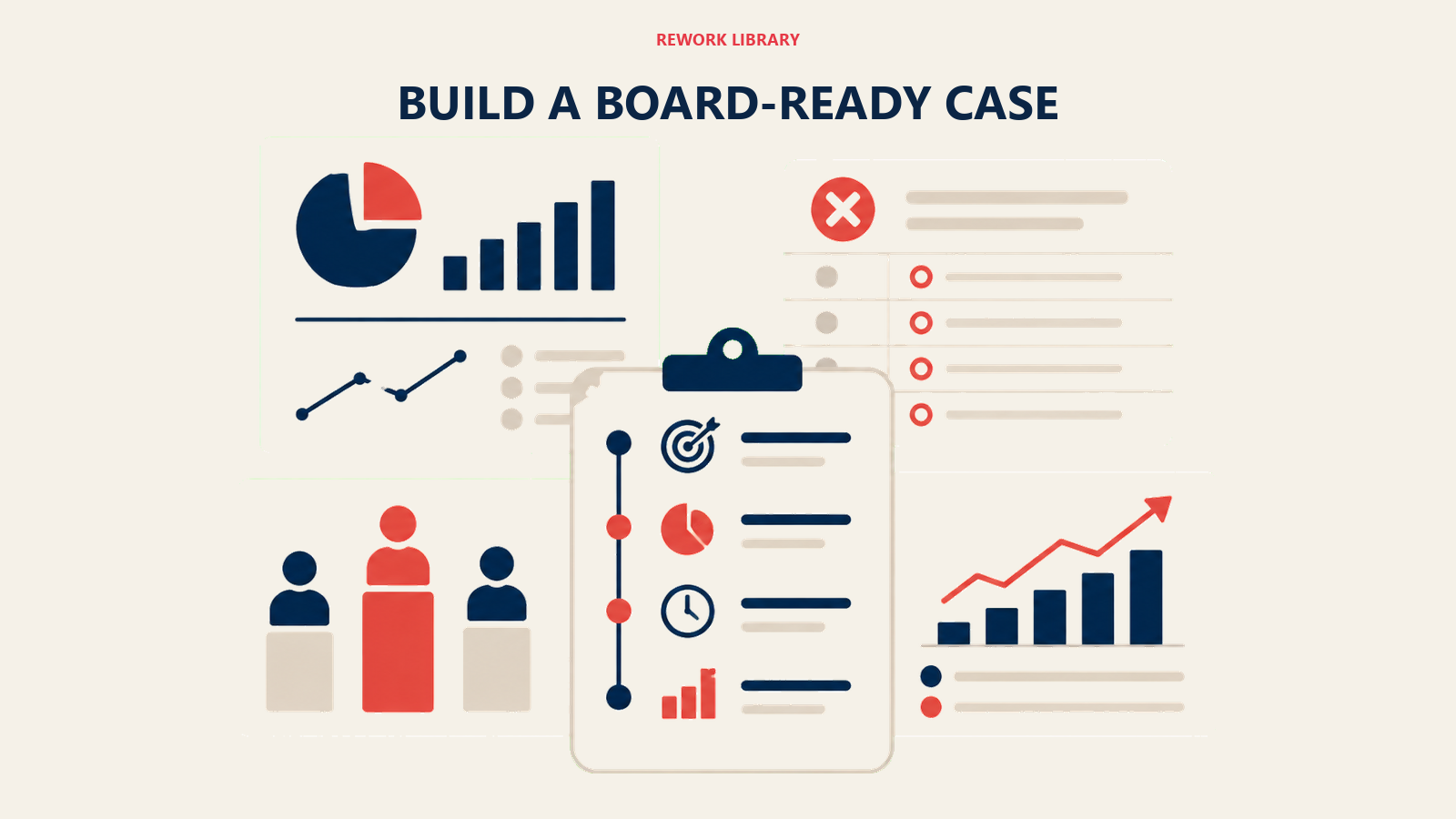
Do not introduce a new culture-specific metric and ask finance to trust it. Instead, map your ask to what already sits on their dashboard: voluntary turnover rate, cost per hire, revenue per employee, customer churn, safety incident rate, absenteeism. If your culture investment is supposed to move one of those numbers, say which one, by how much, and over what time frame. A specific, falsifiable claim earns more trust than a vague promise that "engagement will improve."
Getting to those numbers in the first place is its own obstacle in a lot of companies, where turnover, absenteeism, and engagement data live in three different spreadsheets owned by three different people. That is the unglamorous half of this work: having clean, current people data (which is the specific gap Rework's People app, HRIS, time and attendance, and timesheets in one platform, is built to close) so the business case does not stall out on a data-gathering exercise before it ever reaches the board.
Quantify the Cost of Inaction
A business case is stronger when it frames the choice correctly: this is not spend versus no spend, it is spend now versus a larger, delayed cost. Model your current attributable turnover, safety incidents, or engagement gap using the ranges above, and present it as the baseline cost the organization is already absorbing, whether or not anyone approves a culture budget. Boards fund risk mitigation more readily than they fund morale initiatives, and quantified inaction is a risk, not a mood.
Benchmark Against Peers
Where you have industry or size-matched benchmarks (turnover rates by sector, engagement scores from a vendor survey, safety incident rates from your industry association), use them to show whether you are ahead of, in line with, or behind comparable organizations. A board that hears "we are three points above the industry turnover average, and each point costs us roughly $X" is evaluating a competitive gap, not a philosophical preference.
A Simple ROI Framework for Culture Investments
You do not need a sophisticated model to make this credible. A framework the finance team can audit beats a black box they have to trust.
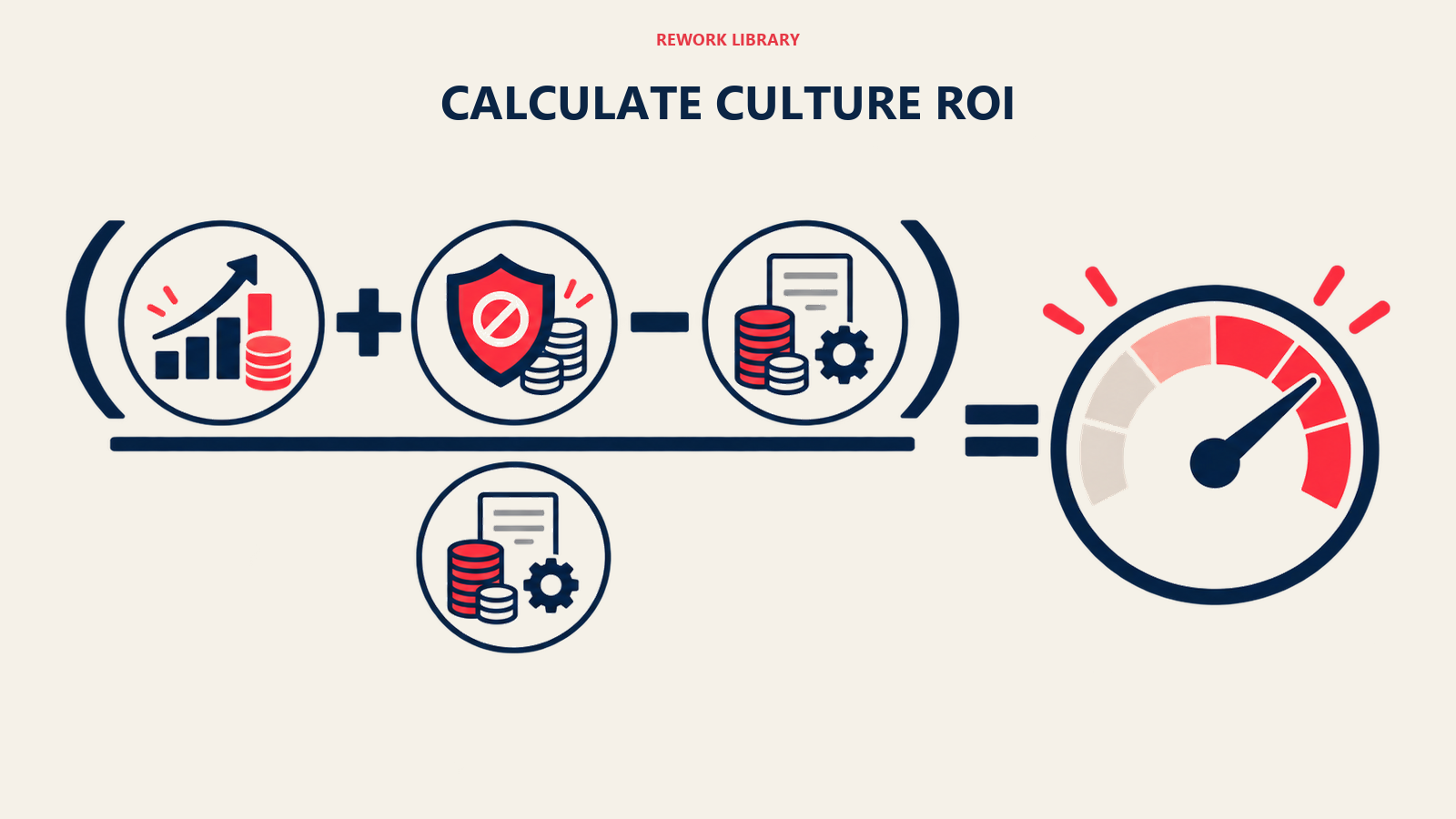
ROI = (Value Created + Cost Avoided − Investment Cost) ÷ Investment Cost
Here is how the pieces work with rough, illustrative numbers you would replace with your own:
Say a 500-person company spends $150,000 on a culture initiative: manager training on feedback and fairness, a redesigned exit-interview process, and a quarterly pulse survey. If the company's baseline voluntary turnover attributable to management and culture issues is 6 percent (30 people) at an average fully loaded replacement cost of $35,000 (the low end of the SHRM range for a $70,000 average salary), that is $1.05 million in annual turnover cost tied to fixable culture problems. If the initiative reduces attributable turnover by even a third, roughly 10 fewer departures, that is $350,000 in avoided cost against a $150,000 investment, for a first-year ROI above 130 percent before counting any productivity or customer-experience upside.
Run the same math with your own headcount, salary, and turnover numbers rather than borrowing this example as a fact about your organization. The value of the framework is that every input is a number your finance team can independently check, which is exactly what makes it more persuasive than a values-driven appeal.
Vanity Metrics to Avoid
Not every culture number belongs in a business case, and using the wrong ones erodes credibility fast.
- A single eNPS score with no trend or peer benchmark. eNPS is useful as one input, not a self-contained business case; see what is eNPS for what the number can and cannot tell you on its own.
- Survey participation rate. A high response rate tells you people filled out a form, not that culture is healthy. Pair it with actual sentiment and, ideally, engagement survey trends over time.
- Number of culture initiatives launched. Activity is not outcome. A dozen workshops with no measured change in retention or engagement is a cost, not a return.
- Anecdotes presented as data. One glowing quote from an all-hands survey does not offset a turnover spike in a specific team. Boards notice the gap between the story and the number quickly, and it costs credibility for the next ask.
The Honest Limits of Culture ROI
Attribution is the real weak point in every culture business case, and pretending otherwise is what makes finance teams distrust HR numbers in the first place.

Culture rarely moves alone. If turnover drops the same quarter you raised salaries, launched a manager training program, and the labor market cooled, you cannot cleanly credit the culture work for the full effect. The honest approach is to isolate what you can (a specific team that got the training versus a control group that did not, a before-and-after on a specific behavior) and be explicit about what you cannot: company-wide financial performance has too many simultaneous causes for any single culture initiative to claim sole credit.
The safest framing for a board is contribution, not attribution: "culture work was one of three factors behind this improvement, alongside compensation adjustments and market conditions" is a claim you can defend under scrutiny. "Culture work caused a 40 percent drop in turnover" usually is not, and a board member with a finance background will find the hole in that claim faster than you can patch it. Building the case honestly, including its limits, is also what makes it survivable the second and third time you ask for budget.
Culture ROI in the Age of AI
AI adds a new, harder-to-quantify line to this business case. As AI agents take over more routine tasks, the human contribution that is left, judgment, relationship-building, catching what the model gets wrong, depends even more heavily on the trust and psychological safety that culture produces. A team that is too afraid to say "the AI output looks wrong" will ship the AI's mistakes right along with its own, a pattern researchers have started calling workslop. That is a real cost, but it is early-stage territory: there is not yet a mature, widely cited dataset connecting AI-era culture debt to a specific financial figure the way turnover cost is documented. Treat this as a directional argument in your business case, not a line item, until better data exists. AI cultural debt covers the mechanism in more depth.
Where to Go Next
- How company culture drives employee retention, for the full mechanism behind the biggest number in this business case
- The link between culture and performance, for the evidence and where the causal claim gets oversimplified
- How to measure company culture, for the methods that feed the metrics in this framework
- How to change organizational culture, for what to do once the budget is approved
Frequently Asked Questions about Culture ROI
What is culture ROI?
Culture ROI is the practice of connecting a specific culture investment, such as leadership training or a redesigned performance system, to a specific financial outcome the business already tracks, like turnover cost, productivity, or safety incidents. It turns a vague claim that "culture matters" into a testable, falsifiable business case.
How do you calculate the ROI of a culture initiative?
Use the formula (Value Created + Cost Avoided − Investment Cost) ÷ Investment Cost. Estimate the cost your organization is already absorbing from turnover, absenteeism, or safety incidents tied to culture problems, estimate how much of that cost your initiative can realistically avoid, and compare that to what the initiative costs to run.
What metrics should go into a culture business case for the CFO?
Use metrics finance already tracks: voluntary turnover rate, cost per hire, revenue per employee, customer churn, and safety incident rate. Avoid introducing a brand-new culture-only metric and asking finance to trust it on faith; map your case to numbers already on their dashboard.
How do you get a CFO or board to approve a culture budget?
Frame the request as risk mitigation rather than a morale investment. Quantify the cost the organization is already absorbing from culture-related turnover or safety incidents, show a peer benchmark if one exists, and present the ask as spend now versus a larger, ongoing cost later.
What is the biggest weakness in most culture ROI arguments?
Attribution. Culture rarely moves alone, so when an outcome improves alongside other changes like a pay raise or a cooling labor market, it is dishonest to credit culture work with the entire result. The more defensible claim is contribution: culture was one of several factors, not the sole cause.
Can culture ROI ever be proven with full certainty?
No, not at the company-wide level. Retention and safety cost are the two links with the tightest, most auditable numbers. Innovation and long-term financial performance are directionally linked to culture but involve too many simultaneous causes to isolate cleanly, which is why a credible business case says so rather than overselling the certainty.
What is a vanity metric in a culture business case?
A number that looks impressive but does not connect to an outcome, such as survey participation rate, a single eNPS score with no trend, or a count of culture initiatives launched. These measure activity, not whether culture actually improved or whether that improvement moved a financial outcome.
Does investing in culture pay off faster than other business investments?
Rarely. The cost of a culture initiative lands immediately, while the payoff, mainly avoided turnover and safety incidents, plays out over twelve to twenty-four months. That lag is one of the main reasons culture loses out to investments with a faster, more visible return, which is exactly why the business case needs to make the delayed payoff explicit rather than implied.
How does AI change the business case for culture?
AI raises the stakes on trust and psychological safety, since a team afraid to flag a wrong AI output will ship that mistake alongside its own. There is not yet a mature dataset putting a dollar figure on this specific risk, so it belongs in the narrative of a business case as an emerging factor, not as a line item you can quantify the way turnover cost is quantified today.
The business case for culture does not need a bigger number to win, it needs a more honest one. Tie the request to metrics the CFO already tracks, quantify what inaction is already costing, and say plainly where the attribution gets thin. That is the version of the argument that survives contact with a board, and it is the only version worth making twice.

Co-Founder, Rework.com
On this page
- What Culture ROI Actually Means
- Why Leaders Struggle to Fund Culture
- Key Facts
- The Hard ROI Links: Where Culture Actually Hits the P&L
- Retention and Turnover Cost
- Productivity and Discretionary Effort
- Safety
- Customer Experience
- Innovation
- How to Build the Business Case for the CFO and Board
- Tie It to Metrics They Already Track
- Quantify the Cost of Inaction
- Benchmark Against Peers
- A Simple ROI Framework for Culture Investments
- Vanity Metrics to Avoid
- The Honest Limits of Culture ROI
- Culture ROI in the Age of AI
- Where to Go Next