How to Build an AI-Ready Culture
Turn this article into takeaways for your work.


Each assistant summarizes the article only for you and suggests best practices for your work.
An AI-ready culture is an organization where people feel safe experimenting with AI and admitting when they used it, where norms for review and disclosure are explicit rather than assumed, where leaders visibly use the tools they ask others to adopt, and where learning how to work with AI is treated as an ongoing habit, not a one-time training. It's built deliberately, through five specific moves. Most companies never make any of them and wonder why adoption stalls anyway.
What is AI-native culture covers the concept: the shared norms that form once AI agents work alongside people as teammates rather than tools. This article is the builder's version. If that one answers "what changed," this one answers "what do I actually do about it on Monday morning."
Why Culture, Not Tools, Decides Whether AI Adoption Works
The evidence on this is no longer a hunch. MIT's NANDA initiative studied over 300 generative AI deployments for its 2025 report and found that 95% of enterprise pilots delivered no measurable impact on the P&L, despite roughly $30 to $40 billion in corporate investment. The report's own conclusion is blunt: the failure traced back to a "learning gap" in how organizations integrated the tools into real workflows, not to the quality of the underlying models.
McKinsey's 2025 global AI survey tells a similar story. Eighty-eight percent of organizations now use AI regularly in at least one function, but only 6% qualify as "high performers" who can point to AI driving a meaningful share of enterprise profit. That gap, 88% adoption against 6% real impact, is not a technology gap. Everyone has access to roughly the same models. What separates the 6% is that they redesigned workflows and changed how decisions get made, instead of dropping a tool into an unchanged organization and hoping.
BCG has been making a version of this argument for years under what it calls the 10-20-70 rule: in a successful AI transformation, about 10% of the value comes from the algorithms themselves, 20% from the technology and data stack needed to run them, and the remaining 70% comes from people and process, change management, governance, workflow redesign, and the upskilling that lets people actually use what got built. Flip that ratio, spend most of the budget on tools and little on the people side, and the result is a well-funded pilot that never scales.
Put plainly: the technology is rarely the bottleneck anymore. The bottleneck is whether people trust the output, know what's expected of them, and feel safe enough to experiment out loud instead of quietly working around the rollout. That's a culture problem, and culture problems don't get solved by better software.
Key Facts
- MIT NANDA's 2025 study of over 300 enterprise AI deployments found 95% of generative AI pilots delivered no measurable P&L impact, tracing the failure to an organizational "learning gap" rather than model quality. Source: MIT NANDA, The GenAI Divide: State of AI in Business 2025, via Fortune
- McKinsey's 2025 global AI survey found 88% of organizations regularly use AI, but only 6% qualify as "high performers" capturing significant enterprise-wide value, a sign that adoption and impact are two very different measurements. Source: McKinsey, The State of AI: Global Survey 2025
- BCG's 10-20-70 rule holds that only 10% of AI transformation value comes from the algorithms and 20% from the technology stack; the remaining 70% comes from people and process, change management, governance, and upskilling. Source: BCG, AI Transformation Is a Workforce Transformation
- Microsoft's 2026 Work Trend Index found organizational factors, culture, manager support, and talent practices, account for 67% of the variance in AI's business impact, roughly twice the weight of individual skill or effort. Source: Microsoft Work Trend Index 2026
- Where managers created psychological safety around experimenting with AI, employees were 1.4 times more likely to become high-frequency users of agentic AI. Source: Microsoft Work Trend Index 2026
- Deloitte's 2026 Global Human Capital Trends research found 60% of executives already use AI in decision-making, but only 5% say they manage it well, the gap it names "cultural debt." Source: Deloitte, 2026 Global Human Capital Trends
The Five Pillars of an AI-Ready Culture
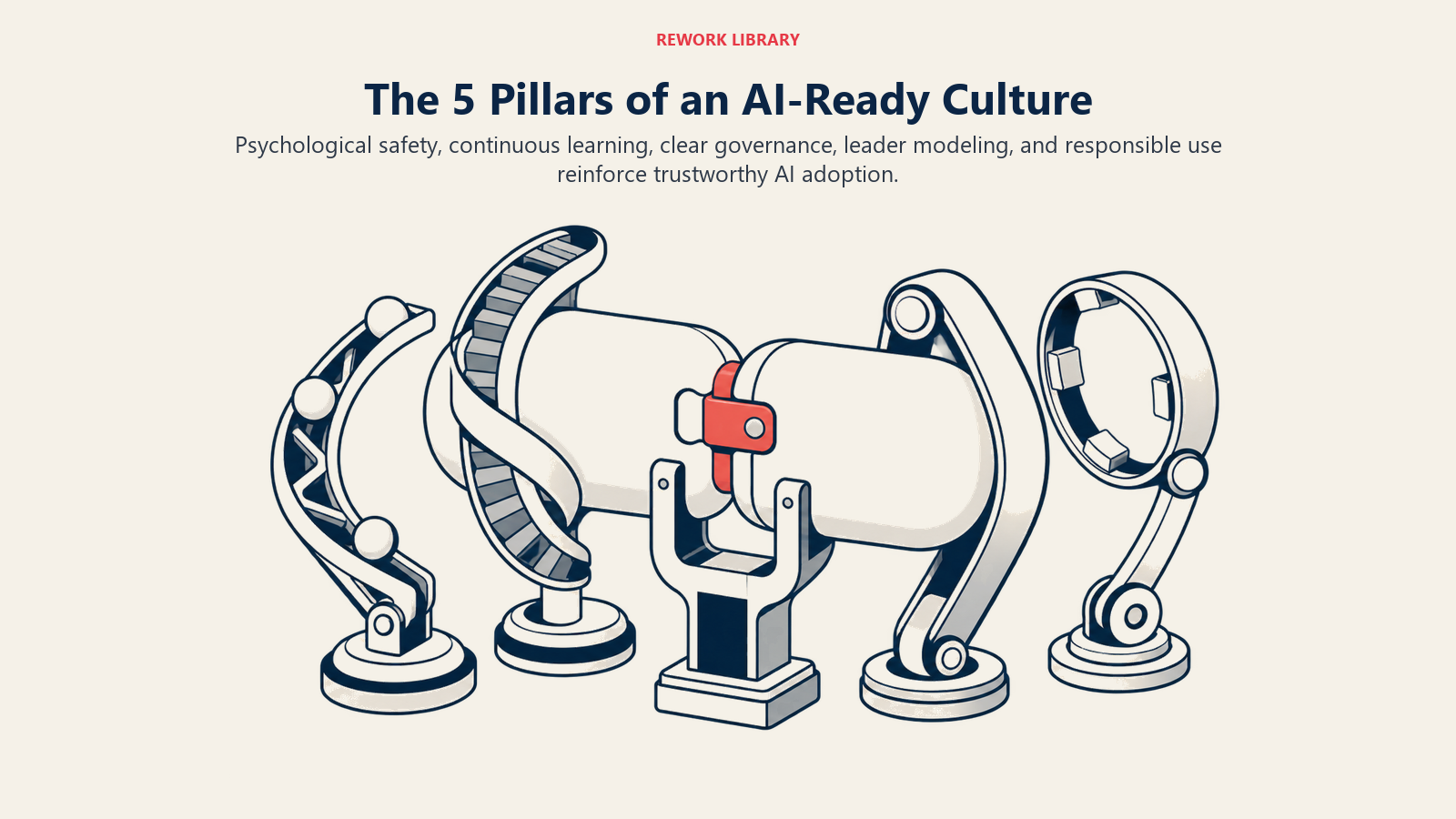
An AI-ready culture rests on five specific conditions that reinforce each other. Psychological safety without clear norms just produces confident guessing. Norms without leader modeling read as rules for everyone except the people who wrote them.
Psychological Safety to Experiment, and to Admit Using AI
People need to feel safe trying an agent on a task that might not work, and just as importantly, safe saying out loud that they used one. Psychological safety at work was already the clearest predictor of high-performing teams before AI entered the picture. Adding AI raises the stakes because now there are new things people need to feel safe admitting: "I let an agent draft this and I'm not fully sure it's right." "I don't understand how this output was generated, and I approved it anyway." Teams without that safety don't stop having these moments. They just stop reporting them, which is a worse outcome than the honest doubt itself.
The evidence backs this up directly: Microsoft's research found a 1.4x lift in high-frequency AI use tied specifically to psychological safety, not to training hours or tool access. Safety is not a soft nice-to-have sitting next to the real adoption work. It's a leading input to the adoption number itself.
Learning and Upskilling as an Ongoing Habit
An AI-ready culture treats learning as continuous, not a rollout event with a start and end date. Microsoft's research on "Frontier Professionals," the roughly 16% of AI users who redesign their workflows and share standards with teammates, found they didn't get there from a single training session. They got there because their organization normalized updating how work gets done as the tools kept changing underneath them.
AI capability moves fast enough that a one-time onboarding session is stale within a quarter. BCG's research on the same theme is pointed: companies capturing the most AI value also run the most ambitious upskilling programs, while most executives who cite a talent and skills gap as their biggest barrier haven't started meaningful upskilling at all. That gap, between naming the problem and building the habit, is where most companies stall.
Clear Norms and Governance
Policy tells people which tools are approved and what data can touch them. Norms are everything the policy document doesn't cover: whether you disclose that you used AI on a piece of work, who gets credit when an agent drafted most of it, which decisions never get delegated without a human check. AI etiquette and workplace norms covers this layer in depth, and the honest finding there is that most companies have a usage policy but almost nothing written down about the social norms, which is exactly where the friction actually lives.
Governance sits one level up from norms: who owns AI risk decisions, what gets escalated, and how the organization catches a bad outcome before it becomes a headline. AI governance for executives covers building that structure at the leadership level, and it should exist before scaling access, not after.
Leaders Who Model the Behavior
Norms spread through what leaders visibly do, far more than through what they announce. Microsoft's 2026 research found that when managers visibly modeled their own AI use, employees reported a 30-point lift in trust toward agentic AI and a 22-point lift in critical thinking about how they used it. That's not a marginal effect. It's evidence that the fastest path to team-level trust in AI is a manager's own behavior, not a policy memo or an all-hands announcement.
The reverse is just as common. A leader who mandates AI adoption while never using it themselves sends a clearer signal than any slide deck: this is something you're supposed to do, not something that's actually trusted. People notice the gap between what's said and what's modeled faster than any survey can measure it.
Responsible Use as a Named Standard, Not a Slogan
"Use AI responsibly" is not a standard. It's a phrase that sounds like one. An actual standard names what must get reviewed before publishing agent output, which categories of decisions stay with a person no matter how good the agent gets, what happens when someone skips a required check, and how sensitive data gets handled around AI tools. AI agent guardrails covers the operational version of this, the technical boundaries an agent operates inside. Responsible use is the human half of the same guardrail: what a person is expected to do before trusting and shipping what an agent produced.
A Practical Roadmap for Leaders
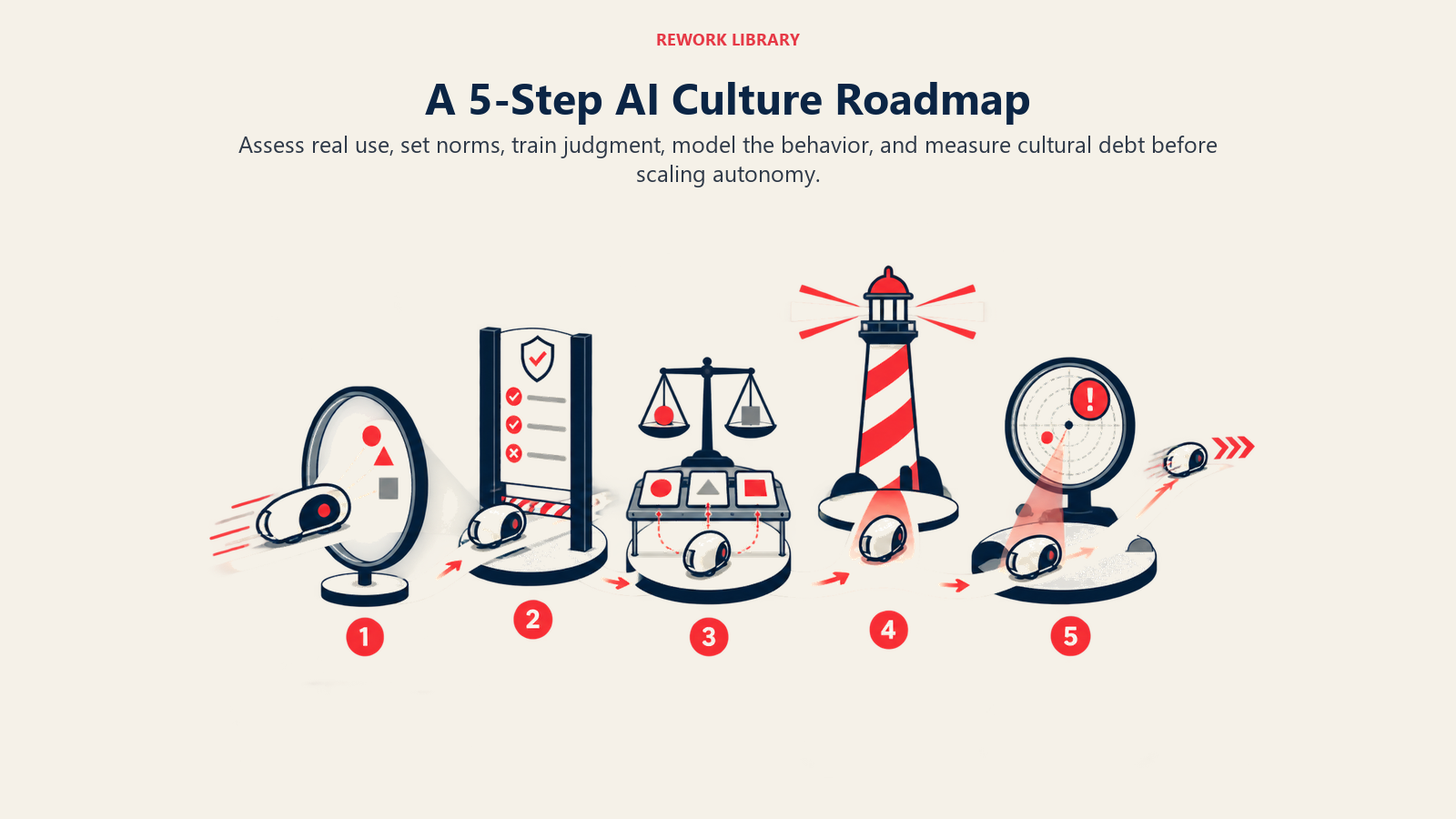
Building an AI-ready culture is a sequence, not a single announcement. Each step below sets up the next one; skipping ahead is the single most common way this goes wrong.
Step 1: Assess Where You Actually Stand
Before writing a single norm, find out what's already happening informally. Pick one or two teams already using AI heavily and ask them directly: how are you deciding what to trust, what to disclose, and what to escalate? Most of the time, an answer already exists in practice, developed quietly without anyone naming it. The work here is surfacing it, not inventing something from a blank page. This is also the moment to check for shadow AI, people already using personal AI accounts because the sanctioned tools aren't good enough or fast enough, since that gap tells you exactly where trust in the official rollout has already broken down.
Step 2: Set Norms Before Scaling Access
Once you know what's actually happening, write the norms down before granting broader tool access. Cover disclosure (when do you say you used AI), attribution (whose work is this when an agent did most of it), and no-go zones (which decisions never get delegated without a human check). How to change organizational culture makes the underlying point: culture change works through systems, not slogans, and a norm nobody wrote down is a norm that only exists until the first hard case tests it.
Step 3: Train for Judgment, Not Just Tool Use
Most AI training teaches people which buttons to click. An AI-ready culture trains judgment instead: when to trust an agent's output outright, when to double-check it, and when a task should never have gone to an agent in the first place. That's a fundamentally different skill than tool literacy, and it's the one Frontier Professionals actually built. Treat it as recurring, not a one-time session, because the judgment calls change as the tools get more capable.
Step 4: Model It at the Top
Leadership visibly using the same tools, admitting the same uncertainties, and following the same disclosure norms they've asked the rest of the company to follow. This step is cheap to execute and disproportionately effective given the 30-point trust lift Microsoft found tied directly to manager modeling. If a leadership team skips this step, every other step in this roadmap works at a fraction of its potential.
Step 5: Measure Cultural Debt, Not Just Adoption
Adoption dashboards, how many people logged into the tool this week, tell you almost nothing about whether the culture around AI is healthy. AI cultural debt is the better lens: the quiet erosion of trust, fairness, and ownership norms that builds up when AI usage outpaces the culture work around it. Track it through engagement surveys with AI-specific questions added, plugged into the broader approach covered in how to measure company culture.
Common Failure Modes
Most AI-ready culture efforts fail quietly, in one of four predictable ways.
Fear-Driven Silence
When people believe using AI, or admitting to it, will get them judged as lazy, replaceable, or behind, they go quiet instead of honest. The work doesn't stop, it moves underground. This is the opposite of the psychological safety pillar above, usually the byproduct of a leadership team that talks about AI in terms of headcount rather than capability and support.
The Top-Down Mandate
"Everyone will use the new AI tool starting Monday" skips every step in the roadmap above: no assessment, no norms, no training in judgment, no modeling. Mandates without the surrounding culture work produce compliance theater, people technically use the tool to avoid trouble, while the behaviors that matter (honest disclosure, real trust calibration, genuine experimentation) never develop. Human-agent teams covers why this failure mode is so common: agents get deployed with broad scope on day one because provisioning is instant, while the review discipline a company would normally build up gradually with a new hire never gets built at all.
No Norms, Just Access
Handing out licenses without discussing disclosure, attribution, or no-go zones leaves people to invent their own rules, unevenly and often incorrectly. Some over-disclose and get penalized by managers who react badly to it. Others under-disclose and quietly erode trust once it's discovered. Neither failure is really the individual's fault. It's what happens when norms are treated as self-evident instead of written down.
Shadow AI Filling the Vacuum
When official tools are clunky, slow, or under-provisioned, people don't stop using AI. They just stop using the sanctioned version. This is one of the clearest tells that the culture work hasn't happened: employees have already made their own trust and workflow decisions, informally, and the company has no visibility into what those decisions are. By the time leadership notices, the informal norms are already set, and changing them is harder than setting them deliberately from the start would have been.
Where to Go Next
This article is the practical build guide for the concept covered in what is AI-native culture. From here:
- AI cultural debt, for the specific cost of skipping this work
- AI etiquette and workplace norms, for the disclosure and attribution norms in detail
- Human-agent teams, for what changes once agents are doing real work alongside people
- The Frontier Firm and the agent boss, for the manager role this culture work eventually requires
- Culture architecture, for the systems-first approach to any culture change, AI-related or not
Rework's own Work Ops and People modules expose an MCP interface so agents, including ones outside Rework, can act inside a company's actual workflows and records. That's a tooling detail worth naming honestly, not a substitute for any of the five steps above. Software can make norms easier to enforce once they exist. It can't write them for you.
AI readiness turns out to be mostly ordinary leadership work done in the right order. Build the safety, the norms, the learning habits, and the manager behavior first, and the tools land on a culture that can actually absorb them. Skip that groundwork and the newest model just automates whatever was already broken, only faster.

Co-Founder, Rework.com
On this page
- Why Culture, Not Tools, Decides Whether AI Adoption Works
- Key Facts
- The Five Pillars of an AI-Ready Culture
- Psychological Safety to Experiment, and to Admit Using AI
- Learning and Upskilling as an Ongoing Habit
- Clear Norms and Governance
- Leaders Who Model the Behavior
- Responsible Use as a Named Standard, Not a Slogan
- A Practical Roadmap for Leaders
- Step 1: Assess Where You Actually Stand
- Step 2: Set Norms Before Scaling Access
- Step 3: Train for Judgment, Not Just Tool Use
- Step 4: Model It at the Top
- Step 5: Measure Cultural Debt, Not Just Adoption
- Common Failure Modes
- Fear-Driven Silence
- The Top-Down Mandate
- No Norms, Just Access
- Shadow AI Filling the Vacuum
- Where to Go Next