Organizational Culture vs Climate vs Values: What's the Difference?
Turn this article into takeaways for your work.


Each assistant summarizes the article only for you and suggests best practices for your work.
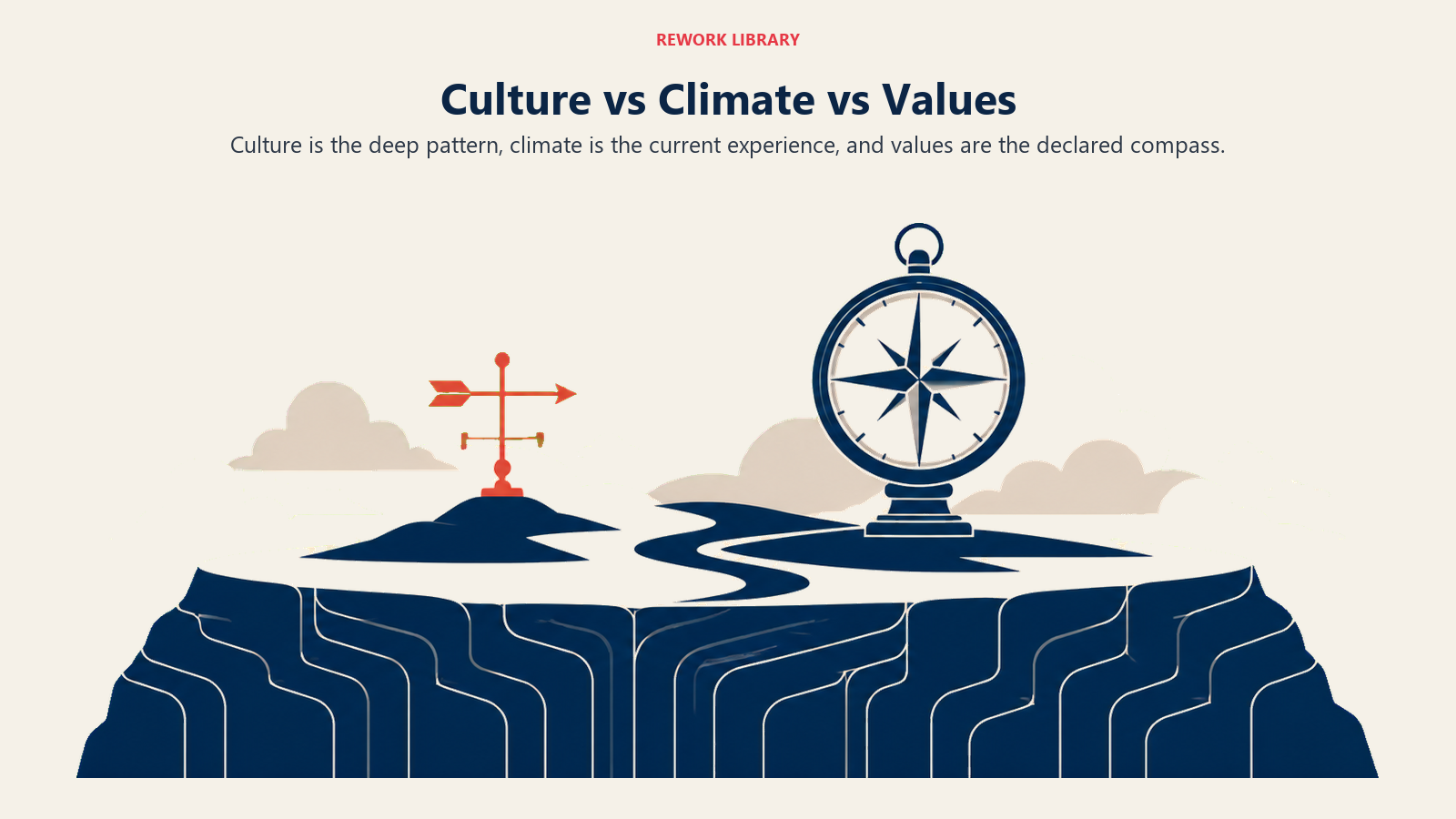
Organizational culture is the deep, slow-moving system of shared assumptions that shapes behavior over years. Climate is the current mood and perception of the work environment, which can shift in weeks. Values are the explicit principles a company says it holds, whether or not its culture lives up to them. All three get called "culture" in casual conversation, which is exactly why so many culture fixes fail.
Here is why the mix-up matters in practice. A leadership team notices morale is low after a reorg, runs an engagement survey, sees the scores drop, and announces a "culture transformation." Six months later scores have not moved, because what they measured was climate: a temporary reaction to a specific event. The underlying culture, the patterns of who gets promoted and what gets tolerated, never got touched.
Culture, Climate, and Values in One Table
Before going deep on each term, here is the fast version. Use this table to diagnose which one you are actually dealing with before you decide what to fix.
| Dimension | Organizational Culture | Organizational Climate | Organizational Values |
|---|---|---|---|
| What it is | Deep, shared assumptions and unwritten rules about how things work | The current, felt mood and perception of the work environment | The explicit, stated principles a company claims to hold |
| Time horizon | Years to decades to form or shift | Weeks to a quarter | Can change instantly on paper, but only matters if lived |
| Where it lives | Systems: hiring, promotion, what gets rewarded, what gets excused | People's day-to-day perception and morale | The careers page, the onboarding deck, the all-hands slide |
| How it is measured | Behavioral audit, retention patterns, what actually happens under pressure | Engagement or pulse surveys, sentiment, exit interview themes | A values statement compared against lived experience (the values-culture gap) |
| Who mainly shapes it | Leadership systems and enforcement over time, reinforced by every manager | A specific event, manager, or season: layoffs, a reorg, a hard deadline | Whoever wrote the values workshop, unless it gets reinforced structurally |
| Typical failure mode | Confused for a personality trait instead of a system, so nobody changes the systems | Mistaken for culture itself, so a bad quarter gets treated as a broken culture | Written and forgotten, creating a gap employees notice immediately |
| Example | "Nobody ships on a Friday here, that is just how we operate" | "Morale has been tense since the layoffs" | "Customer obsession," printed on a slide, regardless of whether it is practiced |
The three are related, but they are not interchangeable, and a leader who cannot tell them apart will keep fixing the wrong one.
What Is Organizational Culture
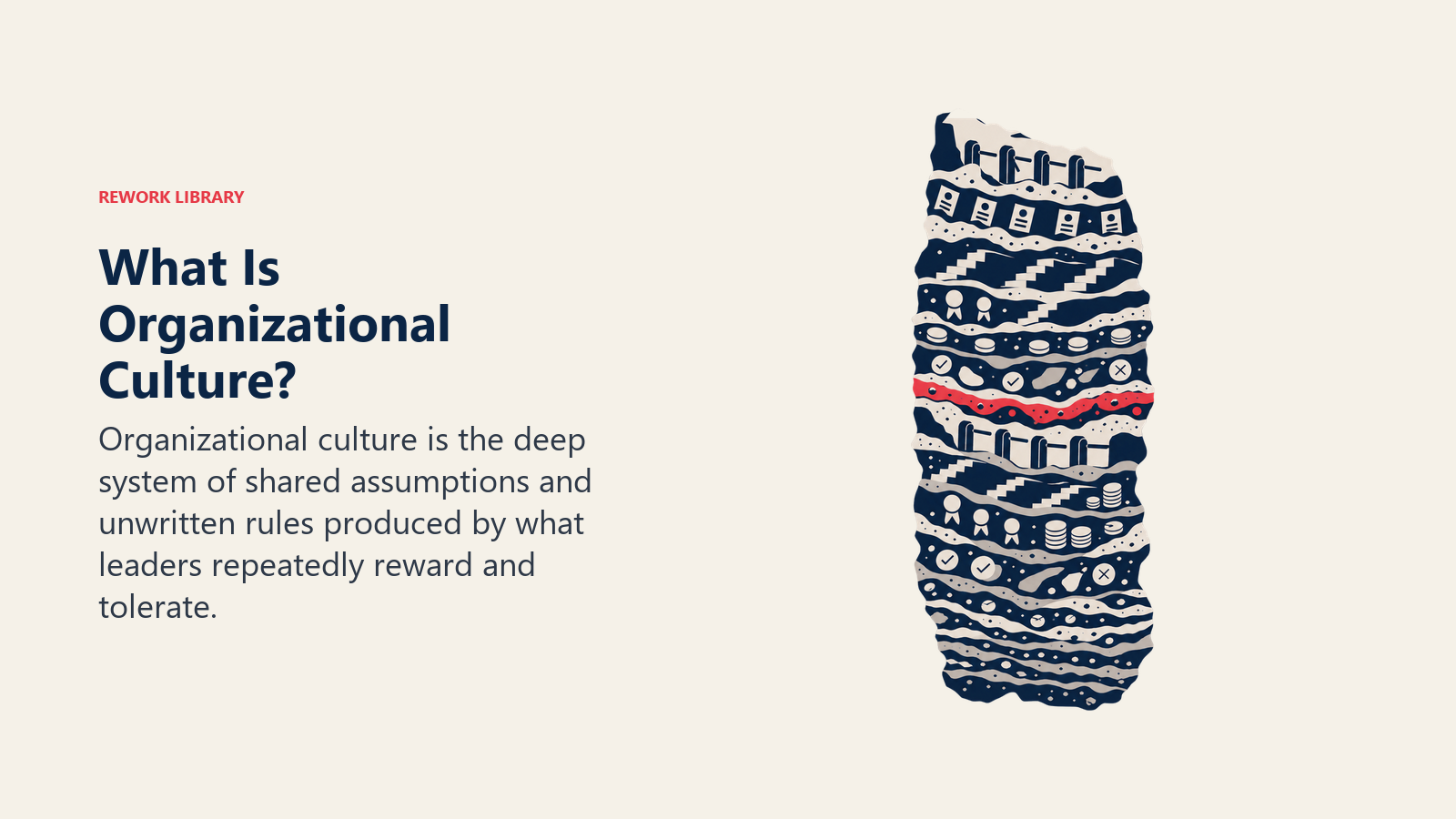
Organizational culture is the deep structure: the shared values, beliefs, and unwritten rules that shape how people actually behave when nobody is grading the performance. It is not designed in a single meeting. It accumulates, the way sediment accumulates, from thousands of small signals about what gets rewarded, what gets tolerated, and what gets quietly punished. We cover this definition in full in what is business culture, including the four dominant culture types and why culture is a systems problem rather than a communication problem.
Schein's three layers, and why culture is hard to see
Organizational psychologist Edgar Schein described culture as three nested layers. Artifacts sit on the surface: office layout, meeting rituals, the language people use, the metrics on the dashboard. Espoused values sit in the middle: what the company says it believes. Underlying assumptions sit at the bottom: unconscious beliefs about how the world works, so deeply held that the people who hold them experience them as plain facts rather than opinions that could be wrong.
That is why culture is so hard to change with a memo. A rebrand or a new mission statement touches the artifact layer. It does nothing to the underlying assumptions driving Tuesday-afternoon decisions, which is why so many culture initiatives produce a new poster and no new behavior.
Culture is a property of systems, not personalities
The most useful reframe: culture is not a personality trait an organization has, it is an output of its systems. Who gets hired. Who gets promoted. What gets measured. What a high performer gets away with that anyone else would get fired for. Culture architecture covers redesigning those systems deliberately, and culture that scales covers what breaks first when a growing company stops managing them on purpose.
What Is Organizational Climate
Organizational climate is the current, surface-level mood and shared perception of the work environment at a given moment. Where culture is the climate zone, climate itself is today's weather: it can be sunny after a product launch and stormy three weeks later after a layoff announcement, without the underlying culture (how decisions actually get made, how feedback flows) having changed at all.
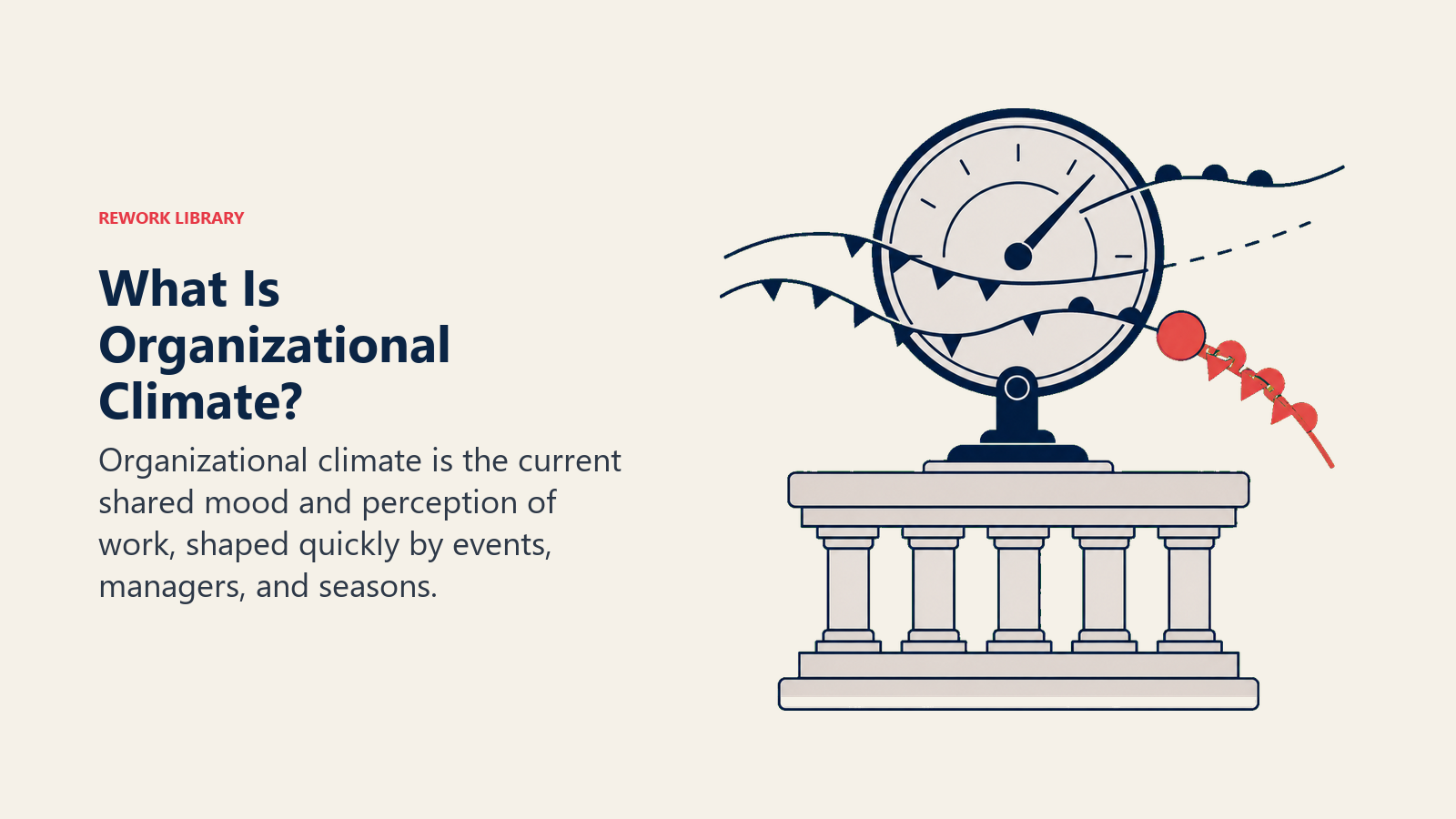
Climate is what an engagement or pulse survey actually captures: do people feel supported by their manager right now, do they feel safe raising a concern this quarter, do they trust leadership's most recent communication. Those questions are real and worth measuring. They are also volatile in a way culture is not, which is why treating a climate dip as proof of a "broken culture" leads to the wrong intervention.
Why climate moves faster than culture
Climate responds to events: a reorg, a round of layoffs, a missed bonus, a new manager, a public win. Gallup's 2026 State of the Global Workplace report is a clean illustration of how fast this layer can move. Manager engagement worldwide fell from 27% to 22% in a single year, a five-point drop reflecting a fast climate shift among people managing others, not a five-point shift in the underlying cultural systems of every company they work for.
That speed is a feature, not a flaw, if you use it correctly. A sharp climate dip after a specific event tells you something concrete just happened and is worth investigating. A climate score that has stayed low for two years running, with nothing specific changing, is telling you the problem has moved from the weather into the climate zone itself: it has become culture.
Where climate shows up first
Climate shows up first in the smallest unit: the team. Two teams inside the same company, with identical stated values and the same benefits, can report completely different climate scores depending entirely on who manages them day to day. When a team goes quiet in meetings and stops volunteering concerns, that is a climate signal with a specific, findable cause, usually tracing back to one manager's habits rather than a company-wide culture failure. We break down that exact pattern in why teams stay silent in meetings.
What Are Organizational Values
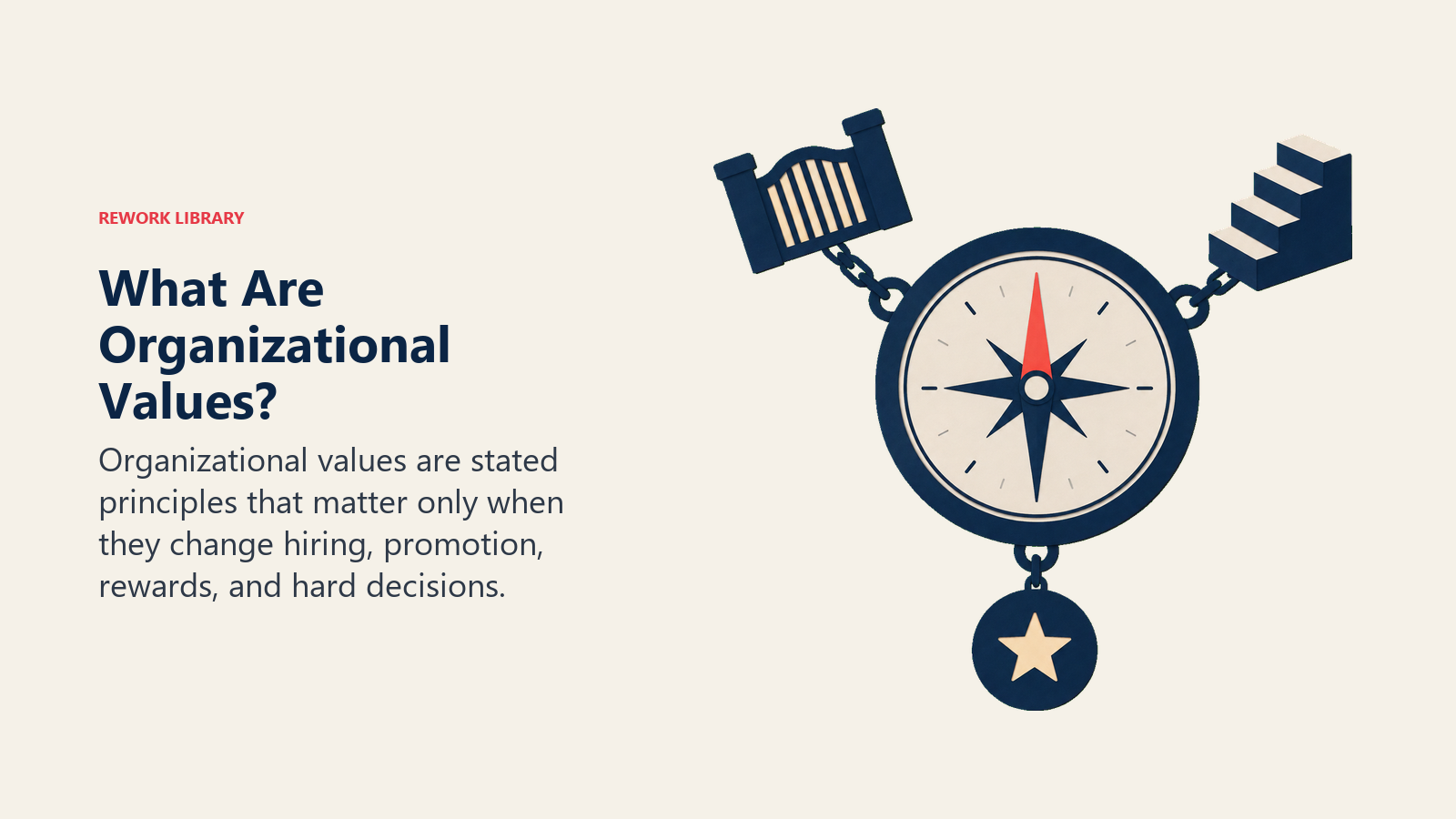
Organizational values are the explicit, stated principles a company claims to hold: integrity, customer obsession, ownership, transparency. They are the only one of the three terms fully within leadership's control to write down, which is exactly why they are the easiest to get wrong. A values statement costs nothing to produce and nothing to change. Its power comes entirely from whether it is reinforced by the systems underneath it, which is culture's job, not the values statement's job.
Espoused values vs. values-in-use
Schein's distinction between espoused values and underlying assumptions maps onto a distinction every employee makes instinctively: the values a company says it holds versus the values it acts on when a decision is expensive. "We value work-life balance" printed next to a promotion process that only rewards people who answer emails at midnight is not a values problem on paper. It is a values-in-use problem, and employees clock the gap almost immediately.
SHRM's research on this gap is a useful check for any leader who feels confident their stated values match reality. In one SHRM study, 72% of executives at the vice president level and above believed their organization's culture had genuinely improved, compared with only 21% of HR professionals and 14% of working Americans who agreed. That happens when the people who write the values statement are furthest removed from whether it is actually being lived, which is exactly why values need an outside check, not just a sign-off from the people who wrote them.
Why values alone never move behavior
A values statement with no enforcement mechanism is a wish, not a system. This is the most common leadership mistake in this collection: writing new values, announcing them at an all-hands, and expecting behavior to follow. Behavior follows what gets measured, rewarded, and tolerated, which is culture's mechanism, not the values statement's. Values only become real once built into hiring criteria, performance reviews, and promotion decisions, at which point they have effectively become part of the culture rather than a separate poster on the wall.
How Culture, Climate, and Values Interact
The three are not independent. They form a loop, and understanding the loop is what lets a leader diagnose which layer is actually broken.
Values, if genuinely enforced through systems over years, slowly become culture. An explicit principle gets built into how hiring, promotion, and feedback actually work, until "we value candor" is no longer a slide but a lived pattern new hires notice and copy without being told. Most values statements never make this trip, because nobody builds the enforcement mechanism.
Culture, in turn, produces climate on a rolling basis. A genuinely low-trust culture produces anxious, guarded climate readings across almost every team, almost every quarter, regardless of what specific event just happened. A genuinely strong culture can absorb a rough quarter, a layoff, a hard pivot, and see climate dip temporarily without the underlying trust collapsing, because the deeper system that produces trust was never actually damaged.
Climate then feeds back into whether people believe the values at all. A single bad climate event, handled badly, can permanently discredit a values statement in the minds of the people who witnessed it. If leadership announces "people are our greatest asset" the same month it conducts a layoff with no transparency about who or why, no later values refresh will undo what that moment taught employees about what the words actually mean. This is also why psychological safety belongs in the loop: teams that feel safe raising concerns catch small climate problems before they compound into culture problems, a dynamic covered in psychological safety and, at the team-norm level, in talent density and candor.
Why Leaders Confuse Them, and What It Costs
The confusion is not a vocabulary problem. It produces three specific, costly mistakes.
Mistake one: treating a climate dip as a culture crisis. A bad quarter produces a bad survey. Leadership panics, hires a culture consultant, launches a six-month "transformation," and burns budget and credibility fixing a problem that would have resolved itself once the triggering event passed. Worse, the effort itself becomes a new climate event, since employees correctly read "culture transformation" announcements as a signal that leadership thinks something is fundamentally broken with them.
Mistake two: treating a values rewrite as a culture fix. New values get workshopped, printed, and rolled out with genuine enthusiasm. Nothing in hiring, promotion, or performance management actually changes. A year later, engagement data shows no movement, and leadership concludes "culture change doesn't work here," when only the values layer was touched and the systems layer, where culture actually lives, was left alone.
Mistake three: treating a persistently bad climate as just "a rough patch." The opposite error is just as costly. When a climate problem repeats quarter after quarter with no new triggering event, it has stopped being weather. It has become the climate zone itself, which is now a culture problem in a climate costume, and it needs a systems fix, not another town hall.
All three mistakes share a root cause: nobody paused to ask which layer the data was actually describing before deciding what to do about it.
How to Work on Each One
Because the three operate on different timelines and different mechanisms, they need different interventions. Running a culture fix on a climate problem, or vice versa, wastes a leadership team's most limited resource: credibility with employees who are watching to see if anything actually changes.
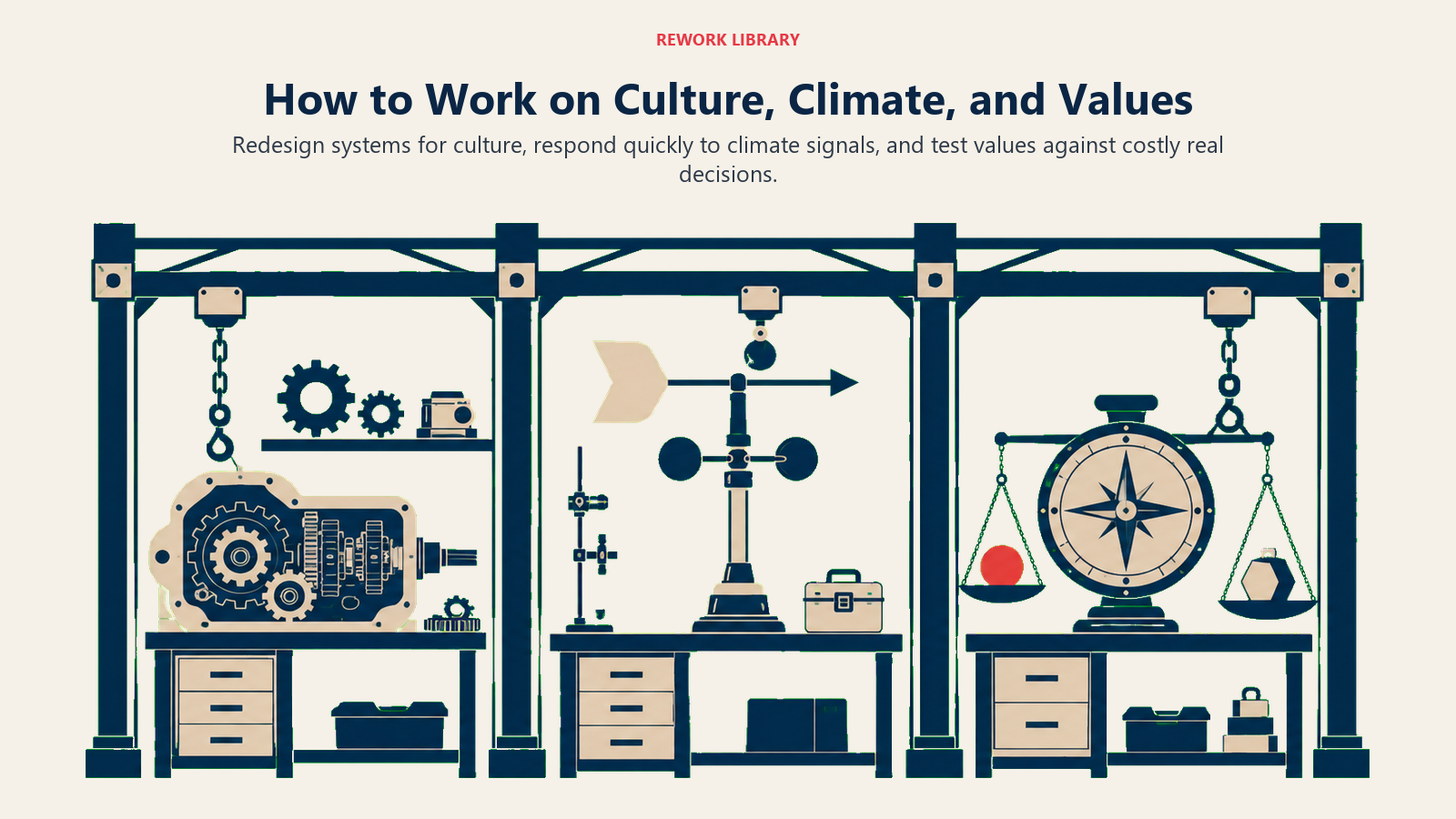
Working on culture
Culture change means changing the systems that produce behavior, not the messaging around it. Audit who actually gets promoted and why, not who the policy says should get promoted. Look at what a high performer gets away with that would get anyone else disciplined; that gap is usually the clearest true statement of what the culture rewards. Then rebuild hiring, performance criteria, and recognition so they reinforce the behavior leadership says it wants, rather than quietly rewarding the opposite. This is slow work, measured in review cycles and hiring rounds, not town halls. Culture architecture walks through this system-by-system redesign.
Working on climate
Climate needs frequent, lightweight measurement and fast response, because its value is as an early-warning signal. A single annual engagement survey is too slow to catch a climate problem while it is still small; by the time results come back, the triggering event is long past and the data is hard to act on. Shorter, more frequent pulse checks tied to specific teams and managers let a leader catch a silent-meeting pattern or a trust dip within weeks, while it is still a coaching conversation and not a resignation wave. Pair that cadence with direct, structured feedback; radical candor is a practical framework for making sure climate signals surface instead of getting smoothed over in a status update.
Working on values
A values statement only earns its keep once tested against a real decision. Before publishing or refreshing values, run each candidate through a simple filter: what would we do differently in an uncomfortable situation if we actually believed this, and are we willing to do it even when it is expensive? If a value never changes a hiring decision, a promotion decision, or a hard tradeoff, it is decoration, not a value. Once it survives that filter, wire it into the systems layer: hiring rubrics, review criteria, and what gets celebrated publicly, the only mechanism that turns a stated value into lived culture.
Culture and Climate in the Age of AI
Climate is the layer moving fastest right now, and AI is a big reason why. Microsoft's 2026 Work Trend Index found that just 27% of employees strongly agree they are comfortable delegating tasks to AI agents, and only 23% of organizations report they are meaningfully scaling an agentic AI system anywhere in the enterprise. That gap between rollout speed and comfort is a climate signal: it captures how people feel about a specific, recent change, not a verdict on the company's underlying culture.
The risk is treating that climate signal as a culture problem, or ignoring it because it looks temporary. If employees do not trust an AI teammate's output, or feel pressure to rubber-stamp AI-generated work rather than push back on it, that discomfort will calcify into an underlying assumption ("raising concerns about AI outputs is not worth the friction") if it goes unaddressed long enough. At that point it has crossed from climate into culture, which is a much harder thing to undo. We cover this specific transition, and how to catch it early, in AI cultural debt and in what is AI-native culture, with the broader shift toward human-AI teams covered in the Frontier Firm and the rise of the agent boss.
Key Facts
- Global employee engagement, a climate-level measure, fell to 20% in 2025, and Gallup estimates the resulting drop in productivity costs the world economy roughly $10 trillion a year, about 9% of global GDP. Source: Gallup, State of the Global Workplace
- Manager engagement specifically fell from 27% to 22% in a single year (2024 to 2025), a fast swing that illustrates how quickly climate moves compared with the slower-changing systems that make up culture. Source: Gallup, State of the Global Workplace
- In a SHRM study on the values-culture gap, 72% of executives at VP level or above believed their organization's culture had improved, compared with only 21% of HR professionals and 14% of working Americans who agreed. Source: SHRM
- In the Denison Organizational Culture Model, the mission and consistency traits are the strongest predictors of profitability, while adaptability and mission are the strongest predictors of sales growth, tying specific culture traits to specific performance outcomes rather than culture in the abstract. Source: Denison Consulting
- Only 27% of employees strongly agree they are comfortable delegating tasks to AI agents, and just 23% of organizations report they are meaningfully scaling agentic AI anywhere in the enterprise, a climate-level gap between rollout and trust. Source: Microsoft Work Trend Index 2026
Where to Go Next
Culture, climate, and values are the diagnostic starting point for everything else in this collection. From here:
- What is business culture, for the full definition, Schein's model, and the four types of organizational culture
- Why teams stay silent in meetings, for the most common climate signal that actually traces back to a culture problem
- Culture architecture, for how to rebuild the systems layer once you know culture, not climate, is the real issue
- How business culture differs across the world, for how national context changes what "good climate" even looks like
Frequently Asked Questions about Organizational Culture vs Climate vs Values
What is the main difference between organizational culture and organizational climate?
Culture is the deep, slow-moving system of shared assumptions and unwritten rules that shapes behavior over years. Climate is the current, surface-level mood and perception of the work environment, which can shift within weeks after an event like a layoff or a reorg. Culture is the climate zone; climate is today's weather inside it.
How are organizational values different from organizational culture?
Values are the explicit, stated principles a company claims to hold, like the words on a careers page. Culture is what the company actually does, shaped by its hiring, promotion, and reward systems. A company can publish values with almost no relationship to its real culture, which is exactly what an engagement survey or exit interview usually exposes.
Can a company have good values but a bad culture?
Yes, and it is common. Values only become real once enforced through systems: hiring criteria, performance reviews, and what gets tolerated from a high performer. A values statement with no enforcement mechanism is a wish, not a description of the culture employees actually experience.
Why does organizational climate change faster than culture?
Climate responds directly to recent events: a reorg, layoffs, a new manager, a missed bonus. Culture responds to systems built over years, like promotion criteria and hiring patterns, which do not shift with a single quarter. A bad climate reading after one event does not automatically mean the underlying culture has changed.
How do you measure organizational climate versus organizational culture?
Climate is typically measured with engagement or pulse surveys that capture current sentiment: do people feel supported right now, do they trust a recent announcement. Culture is measured behaviorally: who actually gets promoted, what a top performer gets away with, what a new hire learns in their first ninety days, none of which shows up cleanly in a single survey.
What happens if you treat a climate problem like a culture problem?
You spend months and real budget on a "culture transformation" that fixes nothing, because the actual trigger was a specific, recent event rather than a broken system. Worse, the initiative itself can become a new, negative climate event, since employees often read it as a signal that leadership thinks something is fundamentally wrong.
Does a persistently bad climate ever become a culture problem?
Yes. If a climate issue repeats quarter after quarter with no new triggering event each time, it has stopped being weather and become the climate zone itself. At that point it needs a systems-level culture fix, not another pulse survey, because the pattern has hardened into an assumption people now expect by default.
How is this affected by AI agents joining teams?
AI adoption is currently a fast-moving climate signal more than a culture shift: employee comfort with delegating work to AI agents is still low and changing quickly as tools roll out. Left unaddressed, that discomfort can calcify into a deeper assumption, such as employees learning that raising concerns about AI output is not worth the friction.
The fastest way to waste a year on culture work is to skip the diagnosis. A climate dip, a stale values statement, and a genuinely broken culture look similar from the outside, an unhappy team and a bad survey score, but they need three different fixes on three different timelines. Get the diagnosis right first, and the fix that follows is usually a lot smaller than the "transformation" leadership was bracing for.

Co-Founder, Rework.com
On this page
- Culture, Climate, and Values in One Table
- What Is Organizational Culture
- Schein's three layers, and why culture is hard to see
- Culture is a property of systems, not personalities
- What Is Organizational Climate
- Why climate moves faster than culture
- Where climate shows up first
- What Are Organizational Values
- Espoused values vs. values-in-use
- Why values alone never move behavior
- How Culture, Climate, and Values Interact
- Why Leaders Confuse Them, and What It Costs
- How to Work on Each One
- Working on culture
- Working on climate
- Working on values
- Culture and Climate in the Age of AI
- Key Facts
- Where to Go Next