The Competing Values Framework: The 4 Culture Types
Turn this article into takeaways for your work.


Each assistant summarizes the article only for you and suggests best practices for your work.
The Competing Values Framework is a model developed by researchers Kim Cameron and Robert Quinn that maps organizational culture on two axes, flexibility versus stability and internal focus versus external focus, producing four culture types: clan, adhocracy, market, and hierarchy. Most real organizations blend two or three of these, with one type dominant.
If that sounds abstract, here is the concrete version. Ask ten people at your company to describe "how things get done around here" and you will hear some version of one of four stories: we are a family, we are a lab, we are an arena, or we are a machine. The Competing Values Framework gives those four instincts names, shows how they trade off against each other, and gives you a way to check which one is actually running your company versus which one you assume is running it.
Where the Competing Values Framework Came From
The framework started as research on organizational effectiveness, not culture. In 1983, researchers Robert Quinn and John Rohrbaugh published a study analyzing a long list of indicators that scholars had used to define what makes an organization "effective." Instead of finding one answer, their statistical analysis surfaced two underlying tensions that kept showing up: whether an organization prioritizes flexibility and change or stability and control, and whether it orients toward its internal workings or the external environment.
Plot those two tensions as a horizontal and vertical axis and you get four quadrants. Quinn and Rohrbaugh originally labeled them around effectiveness models: human relations, open systems, rational goal, and internal process. A few years later, Kim Cameron and Robert Quinn adapted the same four-quadrant structure specifically to describe organizational culture, renaming the quadrants clan, adhocracy, market, and hierarchy, and building a practical diagnostic tool around it called the Organizational Culture Assessment Instrument, or OCAI.
That history matters for one reason: the framework was not invented to sound catchy in a slide deck. It came out of trying to explain why "effective" organizations look so different from each other, which is exactly the same question that makes culture hard to standardize with a single playbook.
The Two Axes That Define Every Culture Type
Everything in the framework falls out of two questions, asked about any organization.
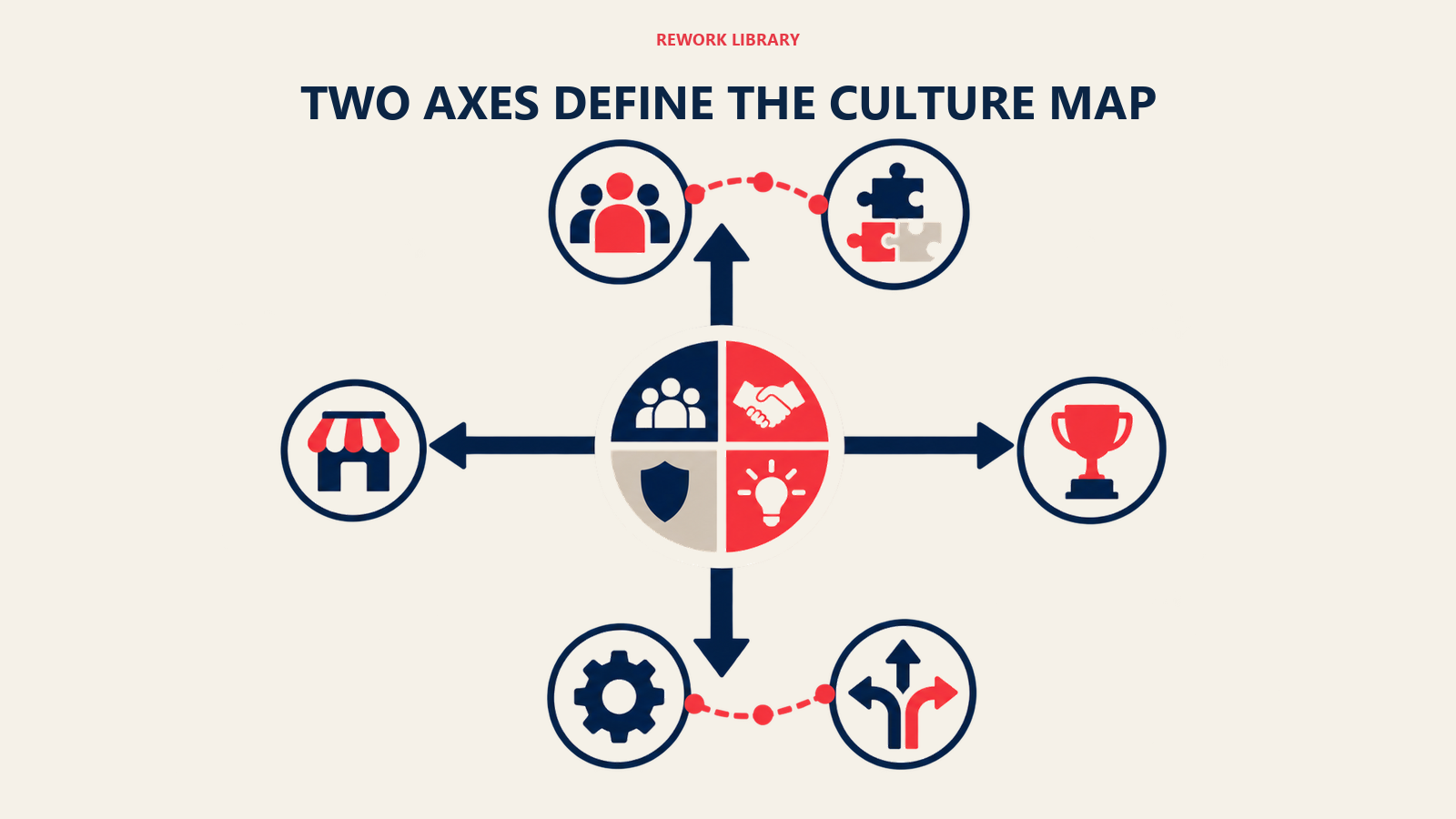
Flexibility and Discretion vs. Stability and Control
Does the organization prize adaptability, individual initiative, and room to improvise, or does it prize predictability, standardized process, and tight control? Neither answer is wrong. A hospital's billing department and its emergency research lab can sit at opposite ends of this axis and both be doing exactly what their function requires.
Internal Focus and Integration vs. External Focus and Differentiation
Does the organization's attention point inward, toward cohesion, morale, and how the team works together, or outward, toward the market, competitors, and customers? Again, both are legitimate. A finance team's internal focus on process integrity is not a flaw next to a sales team's outward focus on the competitive landscape. They are optimizing for different things by design.
Cross those two axes and you get a four-quadrant map. Each quadrant represents a coherent, internally consistent set of values, and here is the part that gives the framework its name: the quadrants genuinely compete with each other. Maximizing flexibility usually costs you some control. Maximizing internal cohesion usually costs you some external edge. You cannot max out all four corners at once, which is exactly why every organization ends up leaning toward some quadrants over others.
The Four Culture Types
The framework names four culture types, each defined by a different combination of focus and operating preference.
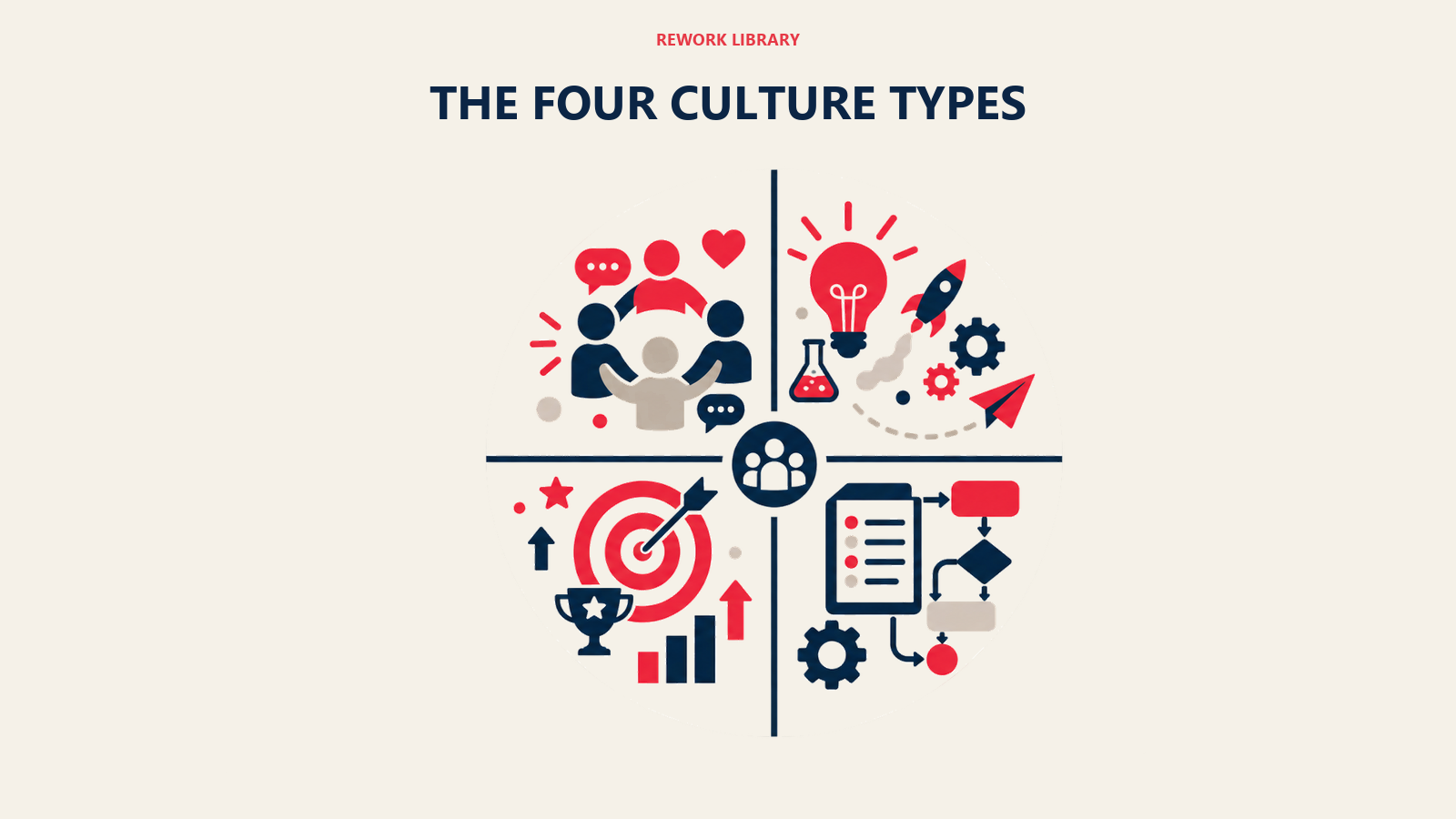
Clan Culture: Collaborate
Clan culture sits in the flexible, internally focused quadrant. It runs on shared values, mentorship, and a sense of belonging closer to an extended family than a hierarchy. Decisions tend to happen by consensus, and the loudest signal of success is loyalty and morale rather than market share.
| Dimension | Clan culture |
|---|---|
| Core focus | Collaboration, cohesion, and people development |
| Leader style | Mentor, facilitator, parent-like figure who builds consensus |
| Strengths | High trust, low turnover of engaged staff, fast informal communication |
| Risks | Slow, consensus-heavy decisions; can drift into conflict-avoidance; struggles to scale past close relationships |
| Where it fits | Early-stage teams, founder-led companies, people-heavy service businesses |
Adhocracy Culture: Create
Adhocracy sits in the flexible, externally focused quadrant. It values innovation, risk-taking, and being first to market over predictable process. The word comes from "ad hoc": teams form around a project, ship something, and disband, rather than sitting inside a permanent org chart.
| Dimension | Adhocracy culture |
|---|---|
| Core focus | Innovation, experimentation, and speed to market |
| Leader style | Entrepreneur, visionary, risk-taker comfortable with ambiguity |
| Strengths | Fast iteration, tolerance for productive failure, attracts people who want to build something new |
| Risks | Burnout from constant change, weak documentation and handoffs, projects that never converge into a stable product |
| Where it fits | Product-led startups, R&D labs, creative and design agencies |
Market Culture: Compete
Market culture sits in the stable, externally focused quadrant. Despite the name, this is not about literal markets, it is about a results-driven internal culture built around competition, hitting targets, and winning against rivals and against last quarter's own numbers.
| Dimension | Market culture |
|---|---|
| Core focus | Results, competitiveness, and hitting measurable targets |
| Leader style | Hard-driving, demanding, competitor who sets aggressive goals |
| Strengths | Clear accountability, strong external focus on customers and competitors, high output |
| Risks | Burnout, internal competition that undermines collaboration, short-termism that trades long-term health for this quarter's number |
| Where it fits | Sales-driven organizations, scaling companies chasing growth targets, private equity-owned businesses under pressure to perform |
Hierarchy Culture: Control
Hierarchy sits in the stable, internally focused quadrant. It values structure, clear reporting lines, and predictable process above speed or charisma. This is the culture type most people picture when they hear "bureaucracy," and it is not automatically a bad thing: some environments genuinely need it.
| Dimension | Hierarchy culture |
|---|---|
| Core focus | Efficiency, consistency, and predictable process |
| Leader style | Coordinator, organizer, administrator who values procedure |
| Strengths | Reliability, low error rates, clear accountability chains, easier compliance |
| Risks | Slow to adapt, resistant to change, can smother initiative under process for its own sake |
| Where it fits | Regulated industries, manufacturing, government, large operations and finance functions |
Key Facts
- The Competing Values Framework traces back to a 1983 study by Robert Quinn and John Rohrbaugh, who statistically analyzed the criteria researchers used to judge organizational effectiveness and found two underlying tensions, not one right answer. Source: ValueBasedManagement.net
- The Organizational Culture Assessment Instrument, the diagnostic tool Cameron and Quinn built on top of the framework, has been used in more than 10,000 organizations and by over 100,000 individuals worldwide. Source: Regent University
- A large validation study of 71,776 employees across 168 healthcare facilities found the four-culture-type structure held up more cleanly for managers than for non-supervisory staff, a real limit worth knowing before leaning too hard on a single survey result. Source: PMC
Most Companies Are a Blend, Not a Single Type
No real organization lives in a single quadrant. The OCAI itself is built around this reality: respondents split 100 points across four statements per question, one statement per culture type, which produces a mixed profile rather than a single label. Most companies end up with one dominant quadrant and a clear secondary one, plus meaningful variation by function.
A fast-growing SaaS company is a good example. Product and engineering often run closer to adhocracy, prizing fast iteration and tolerance for failed experiments. Sales often runs closer to market, chasing quota and competitive share. Finance and legal usually sit closer to hierarchy, because predictable, auditable process is the job. None of that is dysfunction. It becomes a problem only when the mix stops matching what the business actually needs, for example when a company that has scaled past its early stage still runs every function like a founder-led clan with no process at all.
How to Diagnose Your Organization's Culture Type
The standard way to measure this is the OCAI, the instrument Cameron and Quinn built directly on the framework. It works through six questions, covering dominant characteristics, organizational leadership, management of employees, organizational glue, strategic emphases, and criteria of success. For each question, respondents split 100 points across four statements, one representing each culture type, first describing the culture as it is now, then again describing the culture they would prefer.
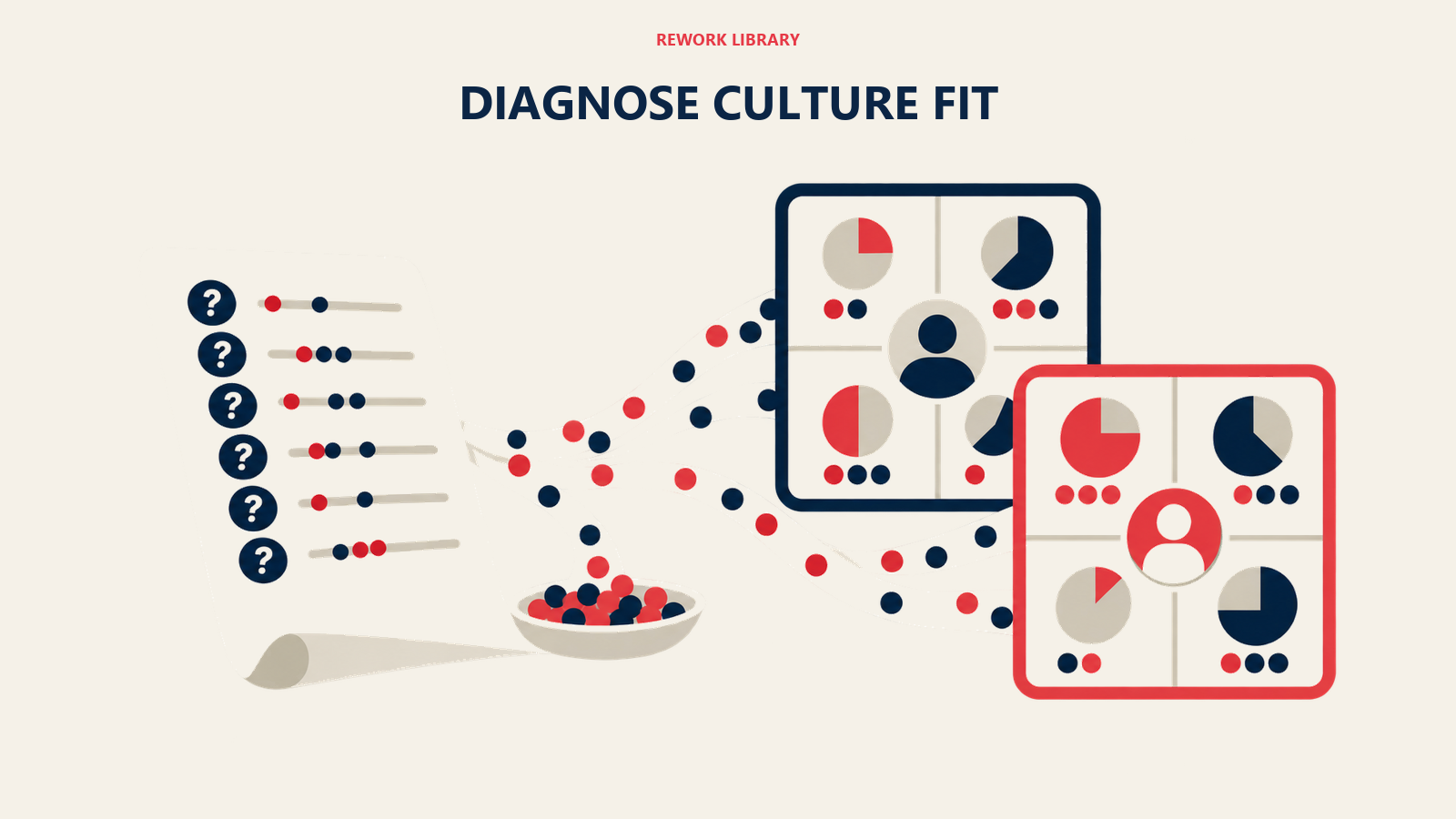
That "now versus preferred" gap is where the real insight lives. A single snapshot tells you your current mix. The gap between current and preferred tells you where the organization feels the friction, whether people want more flexibility than they currently have, more structure, more external focus, or more internal cohesion.
You do not need an expensive consulting engagement to get a useful first read. A short internal version works if you are honest about a few things:
Survey a real cross-section, not just leadership. Leaders and individual contributors routinely score the same company differently, and the individual contributor view is usually closer to the culture people actually experience day to day.
Run it by function, not just company-wide. A single company-wide score hides the fact that your engineering org and your finance org may sit in different quadrants for good reason. Diagnosing at the function level tells you where the friction actually sits.
Treat the result as a conversation starter, not a verdict. The score is a prompt for "does this match what our strategy actually needs right now," not a label to defend or feel judged by.
No Culture Type Is "Best," Fit Is What Matters
The most common mistake leaders make with this framework is treating one quadrant as the goal, usually adhocracy, because innovation sounds better in a pitch deck than process does. That misses the entire point of a framework built on competing values: every quadrant has a real cost, and the right one depends on what your strategy and your current stage actually require.
An adhocracy culture with zero hierarchy underneath it does not stay creative for long, it becomes chaotic, because nobody can ship what the lab invents. A hierarchy culture with zero adhocracy underneath it does not stay efficient for long either, it becomes brittle, because nothing new gets built while the market moves on without it. The healthiest organizations usually keep a dominant type that fits their current stage and strategy, while deliberately protecting a secondary type that offsets its weakest edge.
It is also worth being honest about the model's limits. A large-scale validation study across 168 healthcare facilities found the four-type structure fit management-level respondents more cleanly than it fit non-supervisory employees, which is a useful reminder that no single instrument perfectly captures how culture feels from every seat in the building. Use the framework to start a real conversation about trade-offs, not to end one with a tidy label.
How Culture Shifts From One Quadrant to Another
Culture type is not fixed, but it also does not move because leadership announces new values. It moves the same way business culture moves in general: through the systems that actually shape behavior, hiring criteria, what gets measured, what gets rewarded, and what a high performer can get away with.
A common, healthy arc looks like this. Early-stage companies often start closer to clan, because a small team with close relationships and high trust is genuinely the fastest way to move before formal process exists. As the company scales, pressure builds toward market and adhocracy at once, market because growth targets demand it, adhocracy because product still needs room to experiment. Eventually, parts of the business, usually finance, security, and any regulated function, need to shift toward hierarchy simply because the cost of an error at scale is much higher than it was at ten people.
The failure mode is not moving through this arc, it is skipping the deliberate part. A company that grows from clan straight into market without anyone actively choosing which parts of the business need hierarchy ends up with the worst version of both: cutthroat internal competition with no process to catch the mistakes it creates. Real shifts require the same systems-level work covered in culture architecture: redesigning hiring, promotion, and incentive systems on purpose, rather than hoping a new values poster does the work.
The Competing Values Framework in the Age of AI
AI agents complicate this map in a specific way. Adhocracy-leaning teams are often the fastest to adopt AI tools and agentic workflows, because speed and experimentation are already the culture's default setting. But agents making real decisions, sending real messages, and touching real systems raise the same control questions that used to belong mostly to hierarchy culture: who is accountable when an agent gets it wrong, what needs a human in the loop, and what audit trail has to exist before an agent gets more autonomy.
That tension is not a reason to avoid agents, it is a reason to be deliberate about which quadrant is deciding your AI rollout. A pure adhocracy approach to agent autonomy without any hierarchy-style guardrails is how AI cultural debt accumulates fast. We cover the deeper shift this creates in what AI-native culture actually looks like and in the Frontier Firm and the rise of the agent boss, both of which are really this same clan-versus-hierarchy tension playing out with a non-human teammate in the room.
Where to Go Next
This article sits in Section 1 of the collection, alongside the other core models for understanding what culture actually is. From here:
- What is business culture?, the pillar article this framework fits into
- How business culture differs across the world, for how national culture layers on top of these four types
- Hofstede's cultural dimensions explained, for the national-level model that pairs with this company-level one
- Why teams stay silent in meetings, for what happens when a hierarchy-leaning culture suppresses the wrong signals
- Psychological safety, for the specific behaviors that make any of these four types actually work in practice
Frequently Asked Questions about the Competing Values Framework
What is the Competing Values Framework in simple terms?
It's a model, developed by researchers Kim Cameron and Robert Quinn, that maps organizational culture on two axes, flexibility versus stability and internal focus versus external focus. Crossing those axes produces four culture types: clan, adhocracy, market, and hierarchy, and most real organizations run a blend of them rather than a single pure type.
What are the four culture types in the Competing Values Framework?
Clan (collaborative, internally focused, family-like), adhocracy (innovative, externally focused, entrepreneurial), market (results-driven, externally focused, competitive), and hierarchy (process-driven, internally focused, structured). Each has real strengths and real risks, and none is universally "the best" one.
Who created the Competing Values Framework?
The underlying two-axis model came from a 1983 study by Robert Quinn and John Rohrbaugh on organizational effectiveness. Kim Cameron and Robert Quinn later adapted it specifically to describe organizational culture and built the Organizational Culture Assessment Instrument (OCAI) to measure it.
What is OCAI and how is it different from the Competing Values Framework?
The Competing Values Framework is the underlying theory. OCAI, the Organizational Culture Assessment Instrument, is the practical survey tool Cameron and Quinn built on top of it. Respondents split 100 points across four statements per question, once for their current culture and once for their preferred culture, which produces a measurable profile across all four types.
Can an organization have more than one culture type at once?
Yes, and almost every real organization does. Most companies have one dominant type and a clear secondary type, and different functions inside the same company often lean toward different quadrants for good reason, for example product leaning adhocracy while finance leans hierarchy.
Which culture type is the best one to have?
None of them, on their own. Each quadrant has genuine strengths and genuine risks, and the right mix depends on your strategy and stage. An early-stage startup usually needs more clan and adhocracy, while a regulated or scaling operation usually needs a stronger dose of market and hierarchy underneath it.
How do you diagnose which culture type your company actually has?
Run an OCAI-style survey across a real cross-section of the company, not just leadership, ideally broken out by function rather than company-wide only. Compare the "current culture" score to the "preferred culture" score. The gap between the two tells you where people feel the most friction and where a shift might actually be worth pursuing.
Does the Competing Values Framework apply the same way to every level of an organization?
Not perfectly. A large validation study across 168 healthcare facilities found the four-type structure fit management-level respondents more cleanly than it fit non-supervisory staff. Treat any single survey result as a useful conversation starter about trade-offs rather than a precise, uniform measurement of how everyone experiences the culture.
How does the Competing Values Framework relate to AI and agentic workplaces?
Adhocracy-leaning teams tend to adopt AI agents fastest because experimentation is already their default, but agent autonomy raises the same accountability and control questions hierarchy culture was built to answer. Companies rolling out agents well tend to borrow deliberately from both quadrants rather than letting one culture type run the rollout unchecked.
The Competing Values Framework earns its name honestly: every quadrant genuinely costs you something in another quadrant, and there is no combination that maximizes all four at once. That is not a flaw in the model, it is the most useful thing it tells you. The question worth asking is not "which culture type should we have," it is "which mix does our actual strategy need right now, and which one are we running instead."

Co-Founder, Rework.com
On this page
- Where the Competing Values Framework Came From
- The Two Axes That Define Every Culture Type
- Flexibility and Discretion vs. Stability and Control
- Internal Focus and Integration vs. External Focus and Differentiation
- The Four Culture Types
- Clan Culture: Collaborate
- Adhocracy Culture: Create
- Market Culture: Compete
- Hierarchy Culture: Control
- Key Facts
- Most Companies Are a Blend, Not a Single Type
- How to Diagnose Your Organization's Culture Type
- No Culture Type Is "Best," Fit Is What Matters
- How Culture Shifts From One Quadrant to Another
- The Competing Values Framework in the Age of AI
- Where to Go Next