Culture Playbooks and Culture Decks: What Makes Them Work
Turn this article into takeaways for your work.


Each assistant summarizes the article only for you and suggests best practices for your work.
Updated August 2026
A culture playbook (or culture deck) is a written document that spells out how an organization actually expects people to behave, decide, and work together, distinct from a values poster because it is specific enough to guide a real decision and gets updated as the company changes. The four most cited examples, Netflix, Valve, HubSpot, and GitLab, all became famous for different reasons, and none of them work as a template you can copy word for word.
That last part gets skipped constantly. A founder reads about Netflix's deck, downloads a template, swaps in their own logo, and wonders six months later why nothing changed. The document was never the mechanism. The mechanism was whatever forced someone at Netflix, Valve, HubSpot, or GitLab to actually write down an uncomfortable truth about how their company works, then live with the consequences of publishing it.
This guide covers what a culture playbook actually is, what made each of the four famous examples work (and where each one strains under scrutiny), the difference between a living document and a vanity poster, how to write your own without the vanity-poster trap, and the honest complication of documenting AI-use norms now that some of the work described in these documents gets done by something other than a person.
What Is a Culture Playbook or Culture Deck?
The two terms cover the same idea with different packaging. A culture deck is usually a slide presentation, built to be skimmed and shared externally, the way Netflix's 2009 slides spread across the internet. A culture playbook or handbook is usually a longer, text-based document meant to be read and referenced, the way GitLab's handbook functions as an operating manual. Both exist to answer one question a new hire, a manager under pressure, or a candidate deciding whether to accept an offer keeps asking: how does this place actually work when nobody senior is in the room?
That question is also the test for whether the document is real. A values poster answers "what do we say we care about." A working culture playbook answers "what will actually happen to me if I do X." The distinction matters because most companies produce the first and call it the second, a pattern covered in more depth in organizational culture vs. climate vs. values.
Why These Documents Exist in the First Place
Nobody writes a 100-slide culture deck for fun. Three practical pressures usually force it into existence.
Hiring at speed. Once a company is interviewing dozens of people a month, culture cannot be transmitted one conversation at a time. A written document becomes the only scalable way to filter for fit before an offer goes out, which is part of why onboarding for culture leans so heavily on whatever document already exists.
Decision-making without a manager in the room. As a company grows, more decisions happen without anyone senior present. A playbook is an attempt to pre-answer the judgment calls that used to get made informally, by whoever happened to be near the founder's desk.
Employer branding. This one is less noble and more common than most companies admit. A polished culture deck recruits. HubSpot has been explicit that its Culture Code functions as a marketing asset for talent, not just an internal reference, and that mixed purpose shapes what does and does not make it into the final version.
Those three pressures pull in different directions. A document optimized for recruiting reads well and says little. A document optimized for actually resolving disputes reads awkwardly and says a lot. The four examples below sit at different points on that spectrum, and that is the most useful thing to notice about them.
Four Culture Documents Everyone Cites (and What Actually Made Each One Work)
Netflix's Culture Deck: candor as the enforcement mechanism
Reed Hastings and then-Chief Talent Officer Patty McCord published a slide deck internally titled "Netflix Culture: Freedom and Responsibility" in 2009. It spread to the point where Meta COO Sheryl Sandberg reportedly called it "the most important document ever to come out of the Valley," and it has been cited in Harvard Business Review's account of Netflix's HR approach as a turning point in how tech companies think about culture documentation.
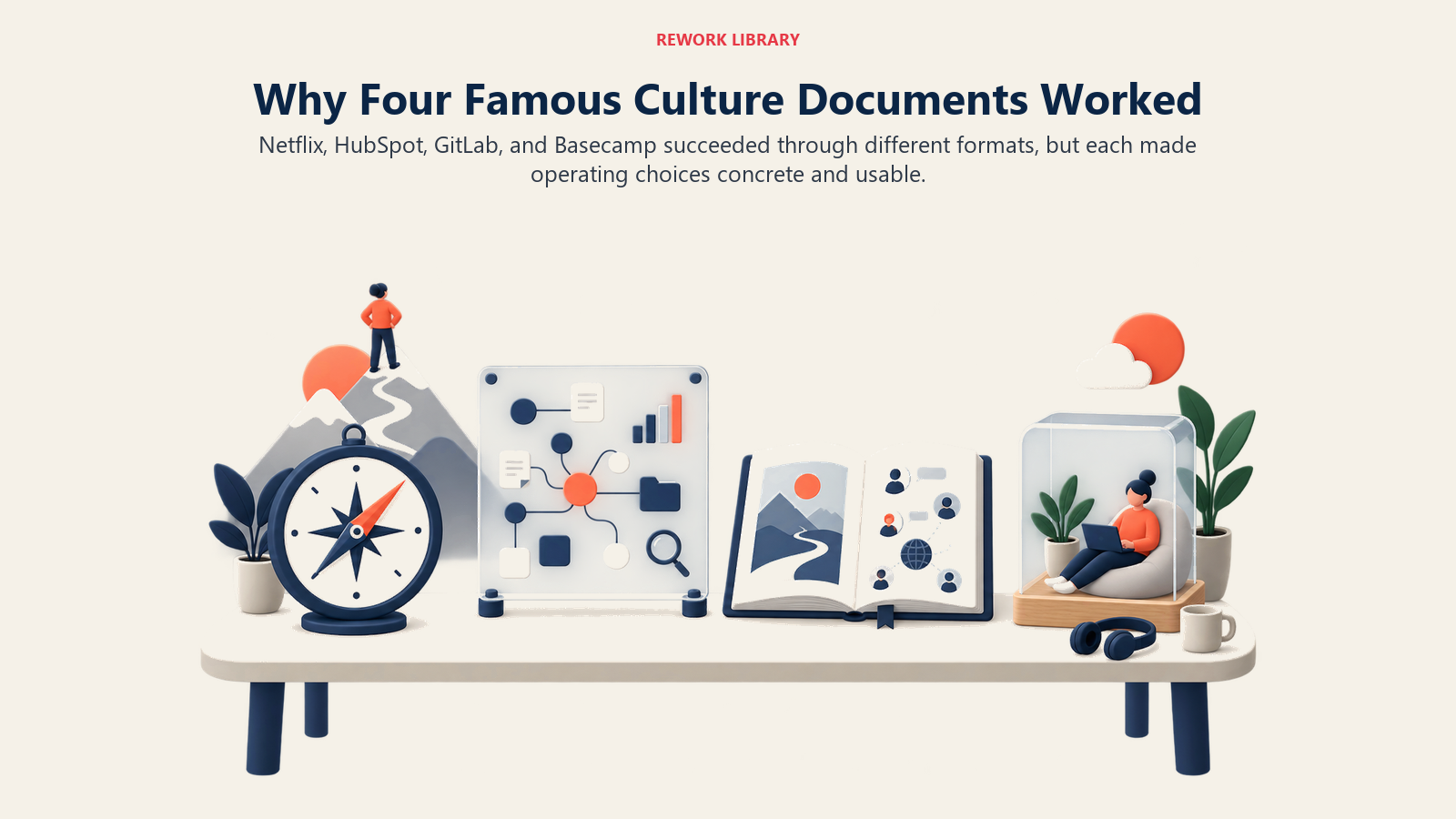
What actually made it land was not the slide design. It was the willingness to write down specific, defensible, sometimes harsh policies and explain the reasoning instead of hiding behind a euphemism, most notably Netflix's stance that adequate performance gets a severance package, not a improvement plan. Whether or not a reader agrees with that policy, the document earns credibility by naming it plainly instead of dressing it up.
Netflix has since revised the document more than once. The 2024 rewrite, retitled "Netflix Culture: The Best Work of Our Lives," replaced the "Freedom and Responsibility" framing with "People over Process" and cut the text roughly in half, down to about 2,264 words. That revision itself is a useful data point: a culture document that never gets edited again is usually a sign the company stopped treating it as a living description and started treating it as a museum piece.
Valve's Handbook for New Employees: flatness as a filter, not just a perk
Valve's internal onboarding handbook leaked publicly in 2012, subtitled "a fearless adventure in knowing what to do when no one's there telling you what to do." It described a famously flat structure: no formal managers, employees choose which projects to work on, and desks are on wheels so people can physically move to whatever team they want to join.
The part that gets lost in most retellings is that this structure functions as a brutal filter, not a perk. A handbook that tells new hires nobody will assign them work is also quietly saying that people who need structure to be productive will struggle and probably leave. Later reporting, including accounts from former employees describing an informal, hard-to-navigate power structure hiding behind the flat org chart, is a useful reminder that a document describing the intended culture and the lived experience inside a company are not automatically the same thing, which is exactly the gap this article covers below.
HubSpot's Culture Code: culture treated as a product
HubSpot first published its Culture Code as a public slide deck in 2013. It has been viewed more than five million times on SlideShare and has been revised over 25 times since, according to HubSpot's own account of the document's history. The deck popularized the phrase "solve for the customer" and the idea that a culture document should be updated the way a product roadmap gets updated, not written once and framed.
That iteration cadence is the real lesson, more than any specific value in the deck. HubSpot has also been candid, including in its own careers blog, about mistakes made along the way and cultural debt the company had to actively fix rather than just narrate. A company willing to publish "here is what we got wrong and changed" is doing something closer to real culture work than a company that only ever publishes the flattering version.
GitLab's Handbook: documentation as the default, not the exception
GitLab runs one of the largest fully remote companies in the world and treats its public handbook, now well over 2,000 pages, as the primary source of truth for how the company operates, not a supplement to verbal culture. The principle GitLab calls "handbook-first" means a decision or process is not considered real until it is written down where anyone, including customers and competitors, can read it.
This is the most operationally useful example of the four for a distributed team, closely tied to the norms covered in culture in remote and hybrid teams. A public handbook forces precision that an internal-only document does not, because vague language is far more visible when strangers can read it too. The tradeoff is real: maintaining a document at that scale requires genuine ownership, which most companies underestimate when they start their own.
Key Facts
- Netflix's original 2009 culture deck, created by Reed Hastings and Patty McCord, is widely credited with Meta COO Sheryl Sandberg's description of it as "the most important document ever to come out of the Valley." Source: TechCrunch
- Netflix's 2024 rewrite of its culture memo, retitled "The Best Work of Our Lives," cut the document to roughly 2,264 words, down from more than 3,800 in the prior version. Source: Variety
- HubSpot's Culture Code deck has been viewed more than five million times on SlideShare and revised more than 25 times since its 2013 debut. Source: HubSpot Careers Blog
- GitLab's public handbook runs to more than 2,000 pages and is treated as the primary operating document for one of the largest all-remote companies in the world. Source: GitLab Handbook
- Roughly 75% of companies studied in MIT Sloan's Culture 500 research have a published set of core values, but the correlation between how heavily a company emphasizes a value and how employees actually rate the company on that value hovers near zero. Source: MIT Sloan Management Review
- About 60% of employees admit they do not read their company's handbook in full, and nearly half of Millennial employees say they skip most of it. Source: Business Wire
Living Document vs. Vanity Poster
Most companies do not consciously choose which one they are building. The choice gets made by default, through a handful of small habits.
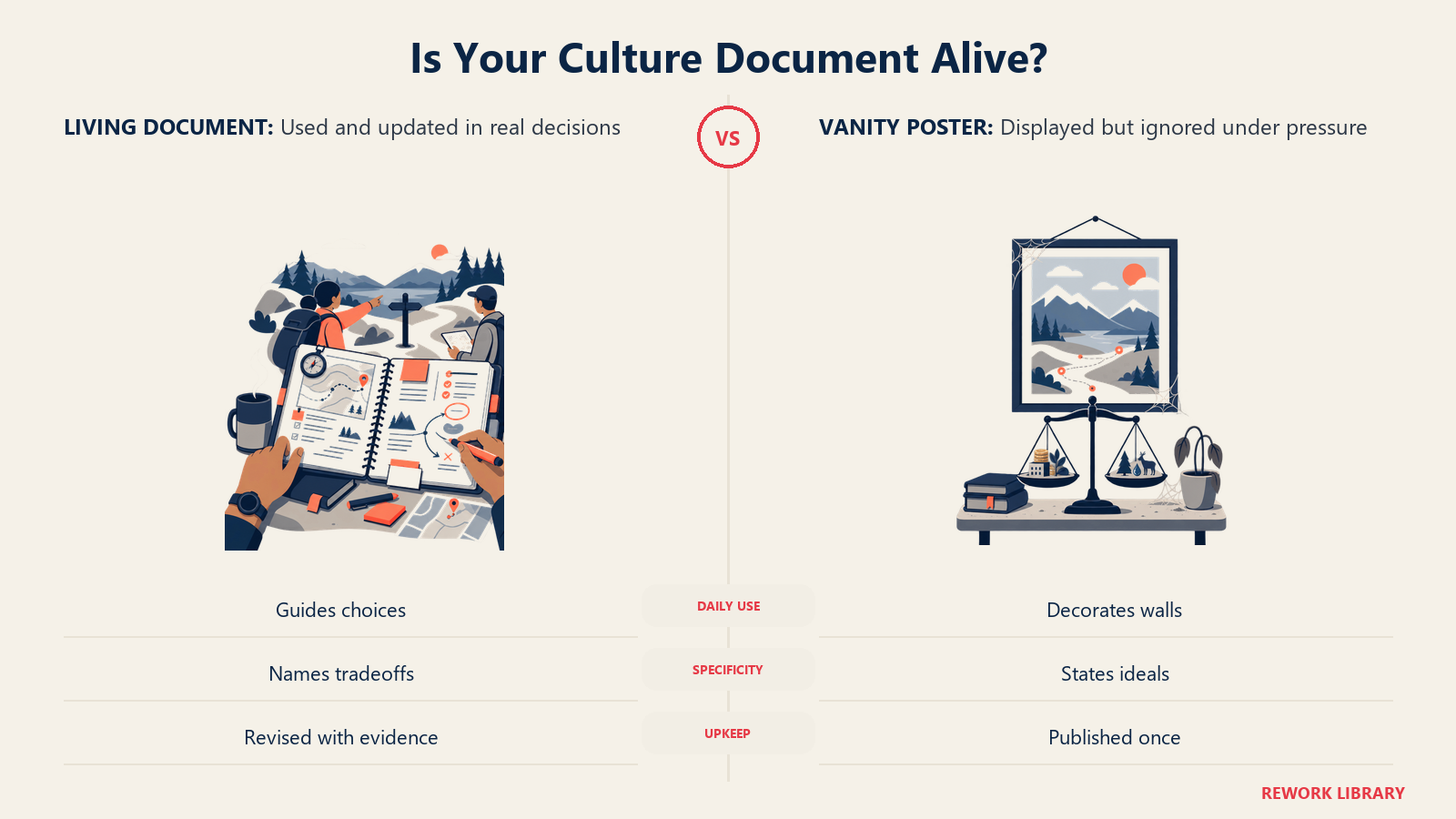
| Signal | Vanity poster | Living document |
|---|---|---|
| Who can point to a recent update | Nobody; last touched at founding or a rebrand | Named owner, visible edit history |
| What happens when it is violated | Nothing, or it depends who violated it | A predictable, described consequence |
| Where it lives | A slide in the onboarding deck nobody reopens | Searchable, linked from daily tools |
| What it says about failure | Only success stories and aspirational language | Named mistakes and what changed after them |
| Who wrote it | Leadership or HR, alone, at a retreat | Built from real decisions, reviewed by the people it governs |
| How specific the language is | Adjectives: "innovative," "collaborative," "customer-first" | Decision rules: what happens, who decides, under what condition |
A document can start in the left column and move to the right one. GitLab's handbook and HubSpot's Culture Code both got there through repeated, visible revision, not through getting the first draft right. The one habit almost every living document shares is a named owner who is accountable for keeping it current, the same ownership question covered in leadership's role in shaping culture.
The Gap Between the Deck and the Lived Reality
The uncomfortable finding underneath all four examples above is that a well-written document does not guarantee a matching lived experience. MIT Sloan's Culture 500 research, built from natural language analysis of more than a million Glassdoor reviews, found that emphasizing a value in official communications essentially does not predict whether employees experience that value day to day. Publishing values and living them turned out to be almost unrelated activities in the data.
Valve's own history illustrates the same gap from a different angle. The public handbook described a flat, autonomy-driven culture, and later accounts from former employees described an informal, harder-to-navigate power structure operating underneath the flat org chart. Neither account has to be entirely wrong for both to be true: a document can accurately describe the intended structure while an unwritten, informal layer of influence still runs the actual day-to-day decisions. This is the same dynamic Schein's three levels of culture describes: the espoused values in a document sit above the unstated assumptions that actually drive behavior, and only real decisions under pressure reveal which one is really in charge.
The practical takeaway is not cynicism about documentation. It is that a playbook needs a second system alongside it, one that checks whether the document and the lived experience are still the same thing. That is the entire purpose of running a periodic culture audit, covered in how to measure company culture, and it is the difference between a company that occasionally rewrites its deck out of habit and one that rewrites it because the audit found a gap worth closing, the same discipline behind how to change organizational culture more broadly.
How to Write Your Own Culture Playbook
Step 1: Start from decisions that already happened, not values you wish were true
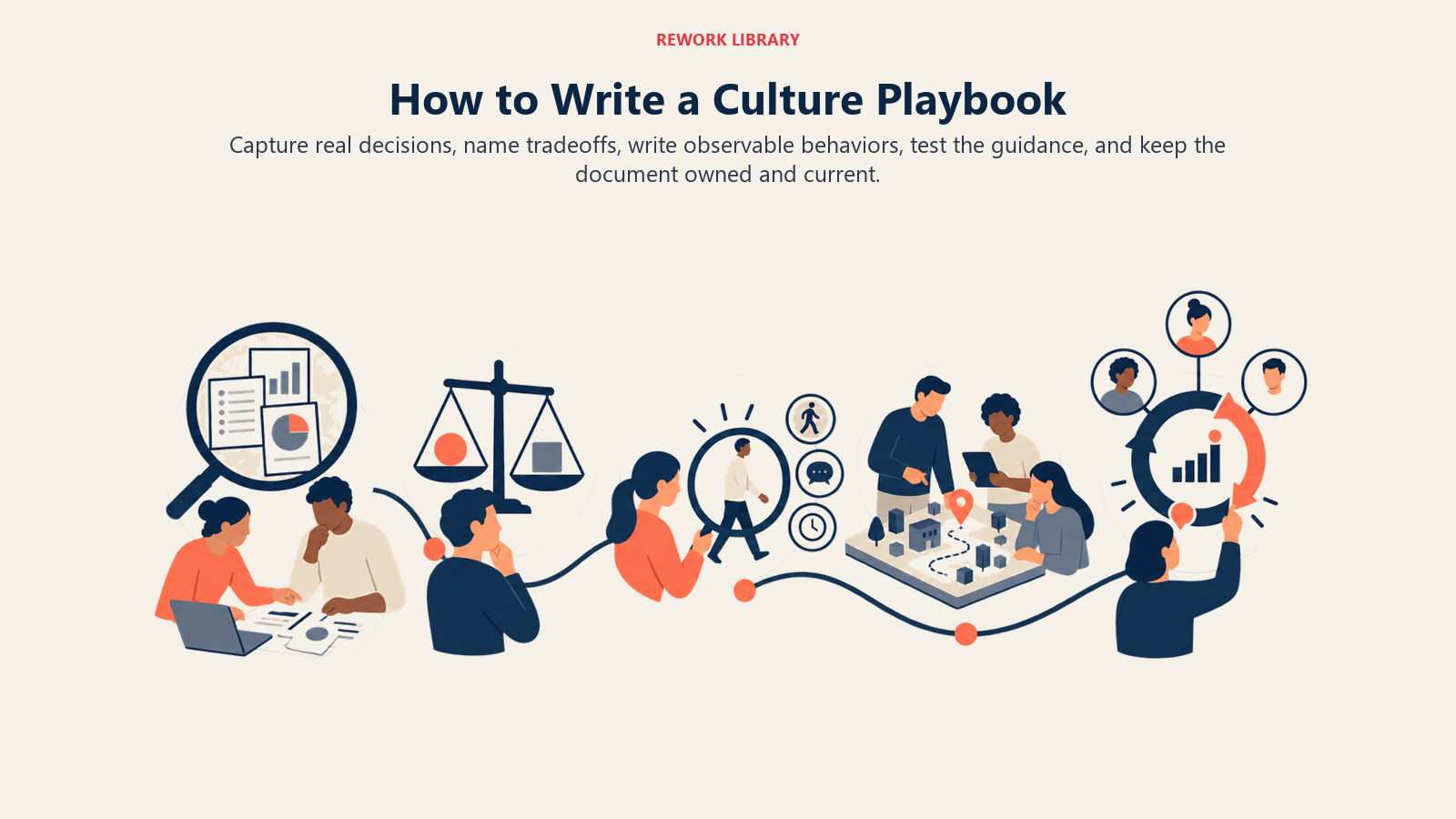
Pull the last handful of hard calls leadership actually made under pressure: a deadline honored or broken, a policy exception granted or denied, a high performer disciplined or given a pass. Write down what those decisions reveal, not what leadership hopes the next reader concludes. The step-by-step version of this exercise, including the pressure-test question that separates a real value from an aspirational one, is covered in how to define company values.
Step 2: Write for the edge case, not the easy case
Every generic culture statement sounds fine when things are going well. The test of a real playbook is whether it says anything useful when a deadline and a stated value collide, when a top performer breaks a rule, or when a remote employee in a different time zone cannot attend the meeting where a decision gets made. If the document is silent on the hard cases, it has not actually been written yet, it has only been drafted.
Step 3: Assign an owner and a revision cadence before publishing
A document with no named owner decays the moment the person who wrote it moves to a different role. Decide now who updates it, on what cadence, and what triggers an off-cycle revision (a policy change, a new office, a shift to remote-first work). GitLab's handbook works at scale specifically because updating it is a normal, expected part of everyone's job, not a special project someone gets assigned once a year.
Step 4: Make it easy to find and hard to ignore
A playbook buried in a slide deck from a two-year-old onboarding session does not function as a living document, no matter how well it was written. Link to specific sections from the tools people actually use daily: the project tracker, the internal wiki, the onboarding checklist described in onboarding for culture. Given that most employees admit they skip most of a handbook on first read, discoverability during the moments the document is actually needed matters more than a single thorough read-through on day one.
Step 5: Publish the mistakes, not just the wins
HubSpot's public willingness to name a cultural mistake it later fixed is a rare and useful pattern. A playbook that only narrates successes reads as marketing, and employees can tell the difference immediately. Naming a real failure and the change that followed does more to establish credibility than any well-worded values statement, because it demonstrates the document actually gets used to make hard calls, not just to look good in a job posting.
Documenting AI-Use Norms in the Playbook
One genuinely new section belongs in a 2026 culture playbook that none of the four famous examples above needed to address at the time they were written: what the norms are when part of the work gets done by an AI agent instead of a person.
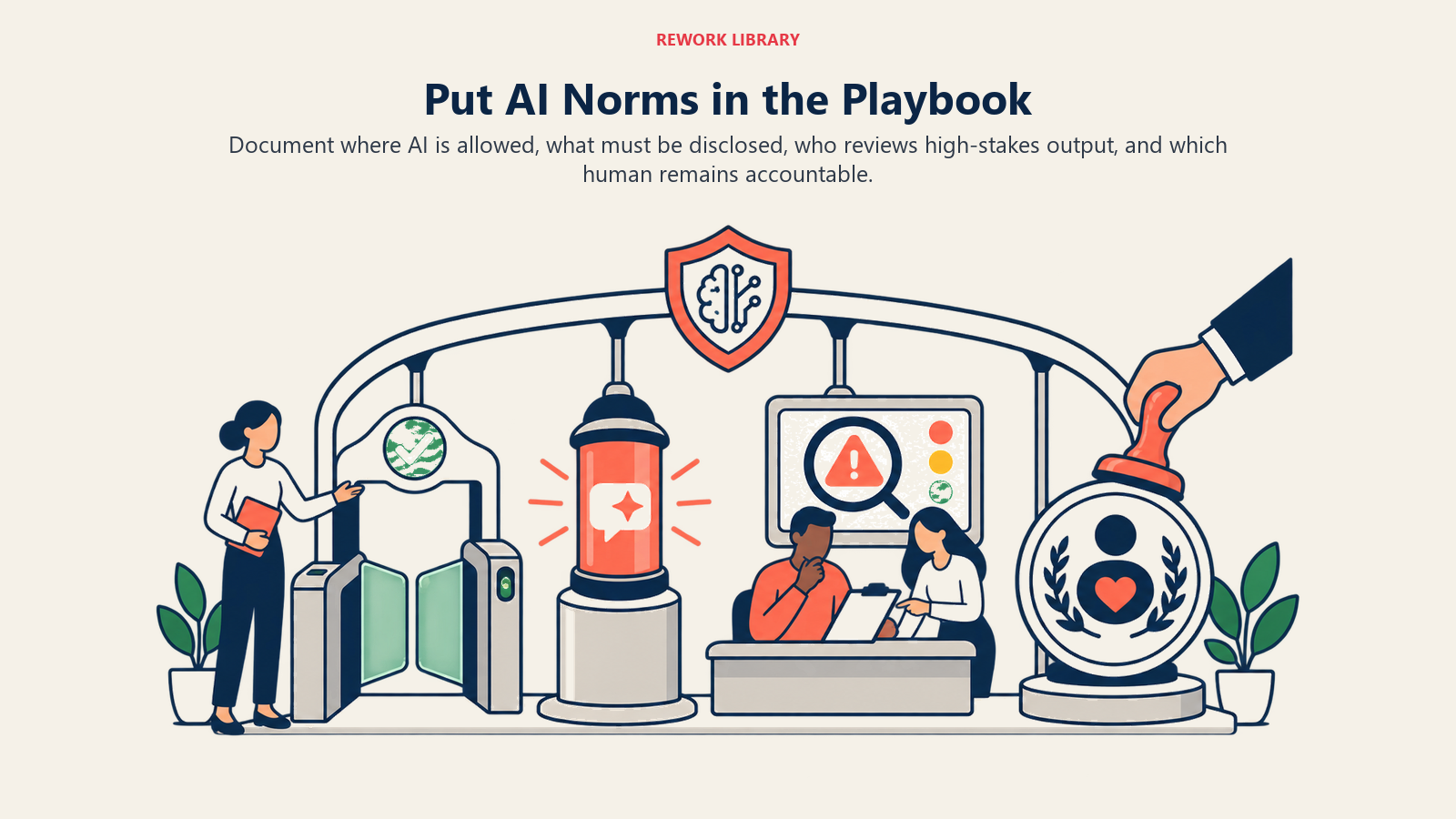
SHRM's 2026 research on AI policy found that only about a quarter of organizations with an AI policy describe it as clear and actually workable in practice, with most either too vague to guide a real decision or so narrowly tied to a specific tool that it becomes outdated within months. That is the exact same failure mode covered throughout this article, applied to a newer category of decision: a policy too generic to answer a real question is not really a policy.
A working version answers a short, specific set of questions instead of a broad philosophical stance on AI: When does a person need to disclose that AI helped produce something a customer or colleague will see? Who is responsible for checking AI-generated work before it ships, and does that review happen with the same rigor a human's work would get? What happens when someone lets an obvious AI-generated error through because reviewing it felt slower than trusting it? That last question maps directly onto what is AI-native culture and the specific etiquette questions covered in AI etiquette and workplace norms: disclosure, attribution, and knowing when not to use the tool at all.
The deeper point connects back to everything above. A values statement was always tested by whether it survived contact with an inconvenient, real decision. An AI-use policy faces the identical test the first time an agent produces something wrong under a deadline. The document that survives that moment intact was worth writing. The one that gets quietly ignored was always a poster.
Where to Go Next
- What is business culture? for the foundational models a playbook should be built on
- How to define company values for the process behind the content that goes into a playbook
- How to measure company culture for checking whether the document still matches the lived reality
- Signs of a toxic culture for what it looks like when the gap between deck and reality goes unchecked too long
Frequently Asked Questions about Culture Playbooks and Culture Decks
What is the difference between a culture deck and an employee handbook?
A culture deck is usually a shorter slide presentation built to be shared widely and skimmed, the format Netflix and HubSpot made famous. An employee handbook or playbook is typically a longer, text-based reference meant to be searched and consulted, the format GitLab and Valve used. Both aim to answer the same question: how does this company actually work.
Why did the Netflix culture deck become so famous?
It was one of the first widely shared internal documents to state specific, sometimes uncomfortable HR policies in plain language instead of vague corporate phrasing, and it was published publicly on SlideShare in 2009 where it spread rapidly. Meta COO Sheryl Sandberg reportedly called it "the most important document ever to come out of the Valley," which accelerated its reach further.
Should a small company copy Netflix's or GitLab's culture document?
Not word for word. Each document reflects the specific size, stage, and structure of the company that wrote it, GitLab's 2,000-plus page handbook exists because it runs a fully remote company at scale, which a 20-person company does not need yet. Borrow the underlying discipline, specific language and a real update cycle, not the exact policies.
How do you know if a culture playbook is a living document or just a vanity poster?
Check whether anyone can point to a recent, specific update and name who owns it. A living document has a visible edit history and describes real consequences for violating it. A vanity poster was written once, usually at a retreat or during a rebrand, and nobody remembers the last time it changed.
How often should a company update its culture playbook?
There is no fixed interval, but a document that goes years without a substantive edit is a warning sign, not evidence of stability. HubSpot has revised its Culture Code more than 25 times since 2013, and Netflix rewrote its culture memo in 2024 after years of running the prior version. Treat a major structural change (going remote, a new leadership team, rapid headcount growth) as a trigger for revision.
Does a culture playbook actually change employee behavior?
Only if it is tied to real systems, hiring criteria, performance reviews, promotion decisions, not left as a standalone reference. MIT Sloan's Culture 500 research found close to zero correlation between how strongly a company emphasizes a stated value and how employees rate the company on that same value, which suggests the document alone does very little without enforcement behind it.
What should a culture playbook say about AI use at work?
At minimum, it should answer when AI-assisted work needs to be disclosed, who is responsible for reviewing it before it reaches a customer or colleague, and what happens when a person lets an AI error through because checking it felt inconvenient. A vague, tool-specific AI policy tends to go stale within months, the same failure mode that sinks generic values statements.
Who should own writing the culture playbook, HR or leadership?
Both, but neither alone. Leadership needs to be the one who agrees to enforce it, since a document published without a genuine willingness to act on it is worse than no document, while whoever owns the ongoing edits, often an HR or People function, keeps it current enough to stay a living reference instead of decaying into a poster.
Netflix, Valve, HubSpot, and GitLab did not get famous for their formatting. Each document earned its reputation because it said something specific enough to be tested against a real decision, and the company behind it was willing to be judged by whether it lived up to its own words. A copied template skips straight to the words and misses the part that actually mattered: the willingness to write down something true, publish it where it could be checked, and let people hold the company to it.

Co-Founder, Rework.com
On this page
- What Is a Culture Playbook or Culture Deck?
- Why These Documents Exist in the First Place
- Four Culture Documents Everyone Cites (and What Actually Made Each One Work)
- Netflix's Culture Deck: candor as the enforcement mechanism
- Valve's Handbook for New Employees: flatness as a filter, not just a perk
- HubSpot's Culture Code: culture treated as a product
- GitLab's Handbook: documentation as the default, not the exception
- Key Facts
- Living Document vs. Vanity Poster
- The Gap Between the Deck and the Lived Reality
- How to Write Your Own Culture Playbook
- Step 1: Start from decisions that already happened, not values you wish were true
- Step 2: Write for the edge case, not the easy case
- Step 3: Assign an owner and a revision cadence before publishing
- Step 4: Make it easy to find and hard to ignore
- Step 5: Publish the mistakes, not just the wins
- Documenting AI-Use Norms in the Playbook
- Where to Go Next