How Company Culture Drives (or Kills) Innovation
Turn this article into takeaways for your work.


Each assistant summarizes the article only for you and suggests best practices for your work.
Updated August 2026
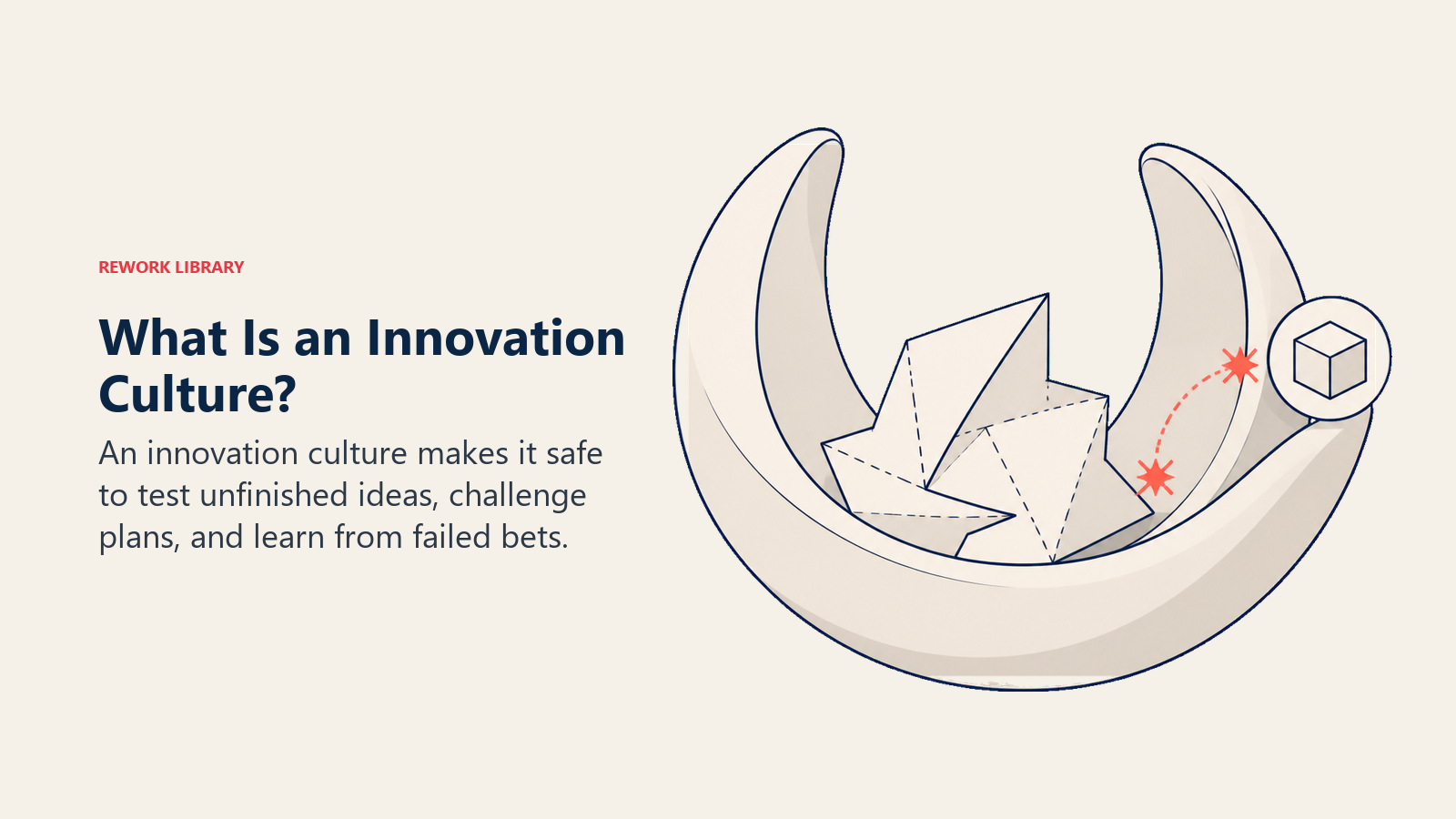
A culture of innovation is an organizational environment where people feel safe proposing untested ideas, disagreeing with a leader's plan, and admitting an experiment failed, without expecting to be punished for any of it. It is a behavioral condition, not a budget line, a hackathon, or an "innovation lab" with beanbags.
Most companies get this backward. They fund an innovation team, buy some new software, and wait for breakthrough ideas to show up. Then they wonder why nothing changes, while a leaner competitor with a fraction of the R&D budget keeps shipping things that actually work. The difference usually is not talent, and it is rarely money. It is whether the culture around those people rewards the specific, uncomfortable behaviors that innovation requires: floating a half-formed idea, arguing with someone more senior, and living with a failed bet instead of hiding it. This article covers what that culture actually looks like, the conditions that produce it, what quietly kills it, and how leaders build one without losing the ability to execute.
What a Culture of Innovation Actually Means
"Innovation culture" gets used loosely enough that it is worth being precise. It does not mean a company is full of creative people, has a design team, or holds quarterly hackathons. Creativity is an individual trait. Culture is what determines whether that creativity ever leaves someone's head and becomes a product decision, and whether a good idea survives contact with a skeptical VP.
A useful test: in this organization, what happens to the person who says "I think our roadmap is wrong" in a room full of more senior people? In a genuine innovation culture, that person gets heard, maybe argued with, and is not punished for having spoken. In most organizations, that person learns, once, not to do it again, and the culture has just taught everyone watching the same lesson without saying a word.
Why Culture Beats Budget as the Real Innovation Engine
R&D spending is the easiest lever to pull and, on its own, one of the weakest predictors of innovation results. Companies that pour money into research while leaving fear, hierarchy, and short-term pressure untouched tend to get more research, not more innovation. The behavioral conditions around the spending decide whether it turns into anything.
Key Facts
- More than 80% of executives say innovation is among their top three priorities, yet fewer than 1 in 10 report being satisfied with their organization's innovation performance. Source: McKinsey
- Innovation stayed a top-three priority for 64% to 83% of firms every year from 2021 to 2024, but the share of executives who see their own company as an innovation leader fell by 24 percentage points over that period. Source: BCG
- BCG's 20-year analysis found top innovators outperformed the broader market by 2.4 percentage points annually, with the gap widening most during downturns like the Great Recession and the pandemic, not during boom years. Source: BCG
- Companies with above-average management-team diversity report innovation revenue 19 percentage points higher than companies with below-average diversity (45% of total revenue versus 26%). Source: BCG
- Google's two-year Project Aristotle study of more than 180 teams found psychological safety, the concept developed by Harvard's Amy Edmondson, was the strongest factor separating its highest-performing, most innovative teams from the rest. Source: Google re:Work
That last gap, a shrinking share of executives who genuinely believe their own company innovates well even as spending and stated priority hold steady, is the tell. Money and intent were never the scarce resource. The willingness to act on an uncomfortable idea is.
The Cultural Conditions That Make Innovation Possible
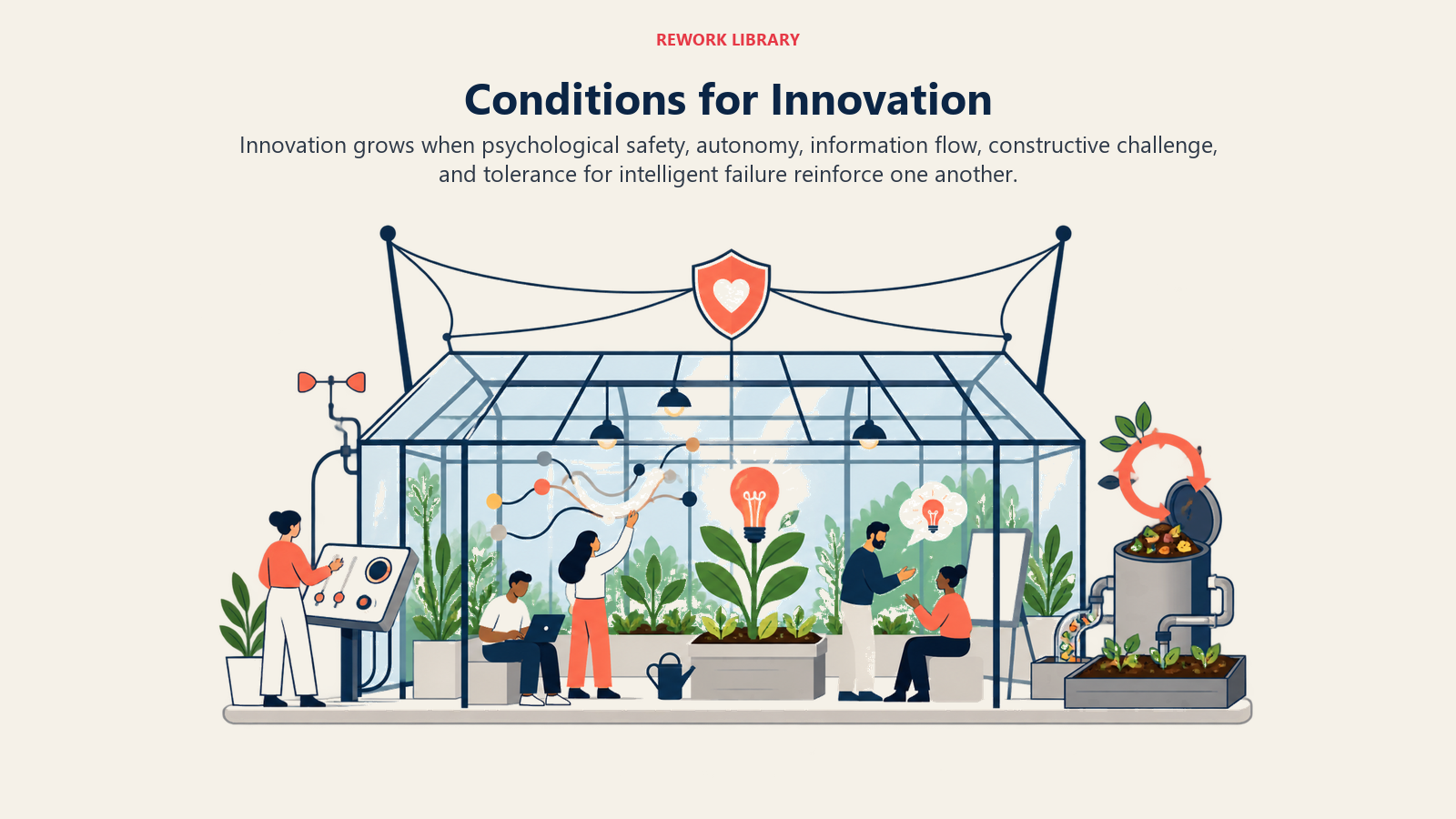
Innovative companies share a small set of cultural traits that show up again and again in the research and in how well-known innovators actually operate. None of them are free, and all of them are choices leadership makes on purpose.
Psychological Safety to Fail
Edmondson's research is blunt on this point: it is not failure organizations need to eliminate, it is the fear of failure, because fear is what stops people from surfacing the mistake, the bad number, or the idea that contradicts the plan while there is still time to act on it. A team that punishes the messenger trains everyone to stop sending messages.
Pixar built this into its process on purpose. In a 2008 Harvard Business Review piece, co-founder Ed Catmull described the Braintrust, a standing group of directors and storytellers who review every film in progress and give unfiltered, sometimes brutal feedback on unfinished work, with no authority to force a change. The director keeps creative control, but the film gets torn apart by peers long before an audience ever sees it. Every Pixar film, by Catmull's own account, "sucks" at some early stage. The culture that lets a team say that out loud, and keep working, is what turns a bad first draft into a finished one instead of quietly shipping it as-is.
Tolerance for Risk and Productive Dissent
Innovation requires betting on things that might not work, and it requires people willing to argue that a popular plan is wrong before it launches, not after it fails. Amazon's leadership principle "disagree and commit" exists precisely because consensus-seeking is slow and tends to produce safe, average decisions. The principle asks people to voice real disagreement, lets a decision get made anyway, and then asks everyone, including the people who disagreed, to commit fully to making it work.
Jeff Bezos framed the stakes for this kind of risk tolerance directly in his 2016 shareholder letter: "Day 2 is stasis. Followed by irrelevance. Followed by excruciating, painful decline. Followed by death. And that is why it is always Day 1." The argument is not that every bet should pay off. It is that an organization allergic to any bet at all is choosing a slower, quieter version of the same outcome.
Slack: Time and Resources Without an Immediate Return
Every hour scheduled against a deliverable is an hour that cannot be spent chasing an unproven idea. The famous examples, 3M's long-running policy letting researchers spend a slice of their time on self-directed projects, and Google's own version in its early years, exist because both companies learned that fully utilized time produces execution, not discovery. An organization running at 100% capacity on committed work has no room left to notice, let alone chase, the idea that was not on anyone's roadmap.
Diversity of Thought
Homogeneous teams agree with each other faster, which feels efficient and is actually a liability for innovation. Different professional backgrounds, functions, and lived experience surface different assumptions to question and different failure modes to catch before they ship. This is closely related to why hiring for culture fit vs. culture add matters so much for innovation specifically: a team that only hires people who already think like the founder will keep confirming what the founder already believes.
Intellectual Honesty
The hardest condition to fake is a genuine willingness to kill your own idea when the evidence says to. Innovative cultures reward the person who runs the experiment that disproves their own hypothesis as much as the person whose bet paid off, because both outcomes produced real information. Cultures that only reward the winning bet quietly teach people to stop running experiments that might not win, which is a much larger cost than it looks like from the outside.
What Kills an Innovation Culture
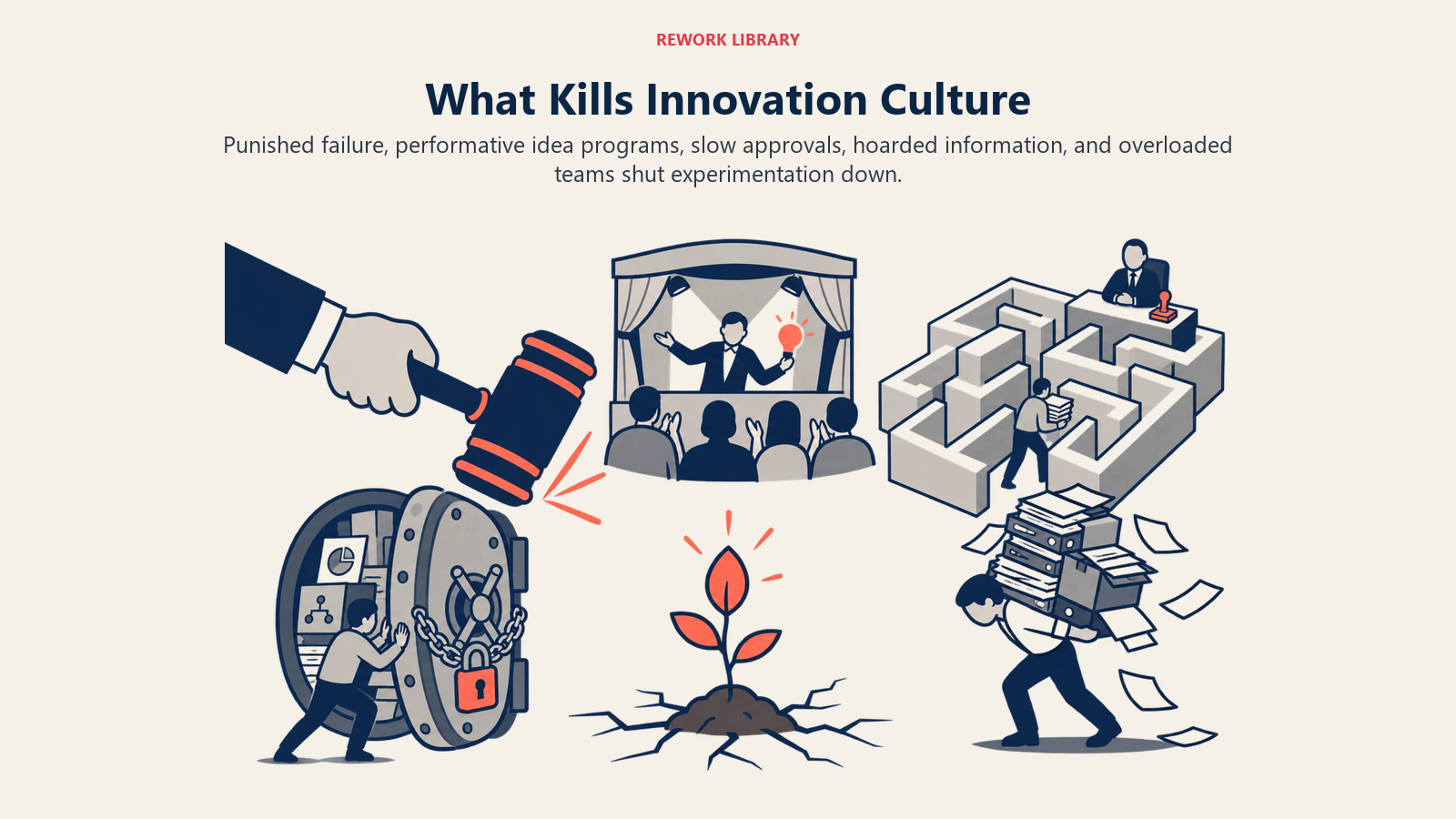
The failure modes are more common than the successes, and they rarely announce themselves. They show up as a slow drift toward safety that nobody explicitly chose.
Fear and Blame
A single visible instance of someone getting punished for a failed experiment teaches an entire organization faster than any values poster. Employees do the math instantly: the downside of a failed idea is career-damaging, and the upside of a successful one is a line in a performance review. Under that math, the rational move is to stop proposing anything risky. This is one of the fastest routes into a toxic culture, and the fear it produces is functionally identical whether the trigger was innovation risk or something else entirely.
Consensus and Conformity
Groupthink is efficient and comfortable, which is exactly why it is dangerous. When disagreement reliably gets read as being difficult, or when the loudest or most senior voice in the room wins by default (the "HiPPO," highest-paid person's opinion), the group stops generating genuinely different options and starts converging early on whatever the most powerful person in the room already believed walking in. The pattern behind this, and why entire rooms of smart people stay quiet instead of raising an objection, is covered in why teams stay silent in meetings.
Short-Termism
Quarterly pressure is the natural enemy of anything that will not pay off this quarter. Innovation has a long, uncertain gestation period and a real failure rate along the way, both of which are hard to defend in a review focused on this quarter's numbers. Organizations under sustained short-term pressure systematically defund the exploratory work first, because it is the easiest line to cut without an immediate, visible consequence. The irony is that this trade-off usually shows up later as a competitiveness problem nobody can trace back to the quarter it started in.
How to Build a Culture of Innovation
None of the five conditions above install themselves. They require the same kind of deliberate system design as any other culture change, covered in more depth in how to change organizational culture.
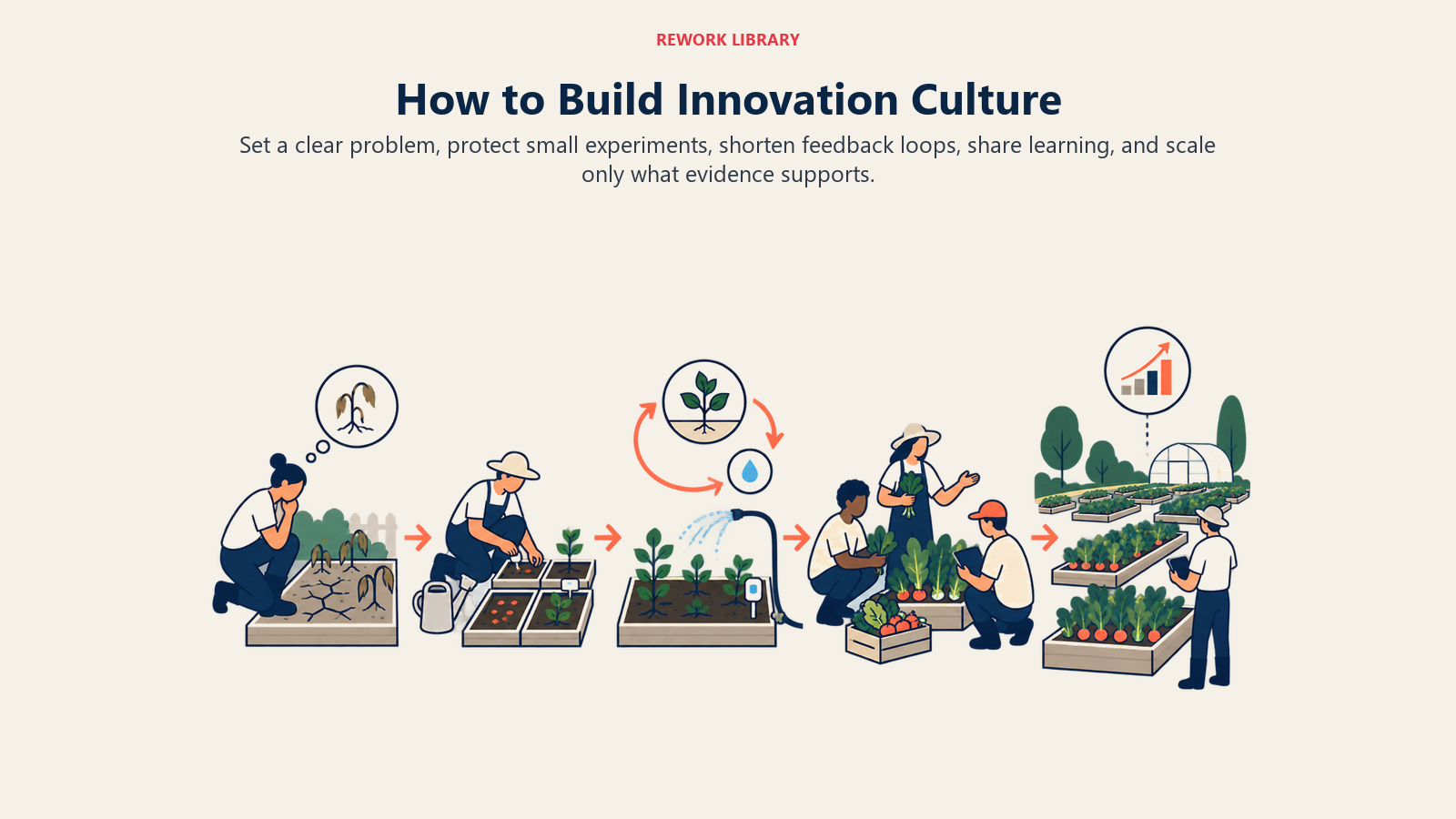
Reward the attempt, not just the outcome. If performance reviews only credit successful launches, you are optimizing for people who only propose safe bets. Recognize well-run experiments that failed for the right reasons alongside the ones that succeeded.
Protect real time, not token time. An "innovation day" that gets cancelled the moment a deadline slips teaches people the exploratory time was never real. Protected time only builds trust once it survives its first conflict with a deadline.
Build psychological safety as infrastructure, not a slogan. This starts with how leaders react in the room the first time someone disagrees with them in public. Building trust in the workplace covers the daily behaviors that make people willing to take that risk again.
Separate the post-mortem from the performance review. A blameless retrospective process, focused on what the system allowed rather than who to punish, is what actually produces the honest information leaders need to improve. Confusing the two turns every retrospective into a trial nobody wants to speak honestly in.
Diversify who is in the room for early-stage decisions. Pull in people from outside the usual function before an idea calcifies, not after it has already shipped and failed publicly.
The operational side of this, running the retros, tracking which experiments are live, keeping cross-functional handoffs from getting lost between HR, product, and ops, is easier to sustain when it is not scattered across five disconnected tools. That is the kind of unglamorous consistency Rework's Work Ops tools are built to support, not a substitute for the leadership behaviors above.
The Tension With Execution Culture
Innovation and execution genuinely pull in different directions, and pretending otherwise is how a strategy gets undermined by its own operating model. The Competing Values Framework names this directly: adhocracy culture (flexible, external, tolerant of risk) is where new ideas get generated, while market and hierarchy cultures (stable, focused on results and process) are where those ideas get scaled reliably. Both are legitimate. Neither is sufficient alone.
The organizations that manage this well run what researchers call an ambidextrous structure: a core business optimized for disciplined execution, and a genuinely separate space, different metrics, different review cadence, sometimes a different physical location, where exploratory work is protected from the core's short-term pressure. Trying to run both modes in the same team with the same quarterly targets is the most common way well-intentioned innovation efforts quietly die. This same tension gets sharper during fast growth, covered in scaling culture in hypergrowth, when the pressure to standardize everything for speed can crowd out the very looseness that produced the company's original ideas.
Innovation Culture in the Age of AI
AI is a genuinely useful innovation tool: it compresses the distance between an idea and a working prototype, and it can generate more raw variations for a team to evaluate than any group of humans could produce by hand in the same time. Used well, that speed gives a team more shots at a good idea inside the same quarter.
It does not replace the cultural conditions above, and treating it like a substitute is a real risk. A team can generate a hundred AI-drafted concepts and still ship nothing new if the culture around them still punishes the person who champions the risky one over the safe one. Speed of idea generation does not fix a fear of dissent; it just produces more ideas that never leave the drawer. The human side of the equation, whose judgment decides which AI-generated option is worth defending in the room, and whether that person feels safe defending it, still runs on the same trust and safety dynamics covered throughout this article. What is AI-native culture covers how organizations are adapting these norms as AI tools take on more of the early-stage creative work, without losing the human ownership and dissent that decide what actually ships.
Where to Go Next
- What is business culture, for the foundational models this article builds on
- Psychological safety at work, for the trust mechanism underneath every condition in this article
- The link between culture and performance, for how these same dynamics show up in execution quality more broadly
- Building a culture of accountability, for how blameless accountability differs from blame culture
Frequently Asked Questions about Culture of Innovation
What is a culture of innovation?
A culture of innovation is an organizational environment where people feel safe proposing untested ideas, disagreeing with leadership, and admitting when an experiment failed, without expecting to be punished for any of it. It is a set of behaviors the culture rewards or punishes, not a budget, a lab, or a hackathon.
Does spending more on R&D actually create more innovation?
Not reliably on its own. BCG's 20-year analysis of innovation performance found no consistent link between R&D spending levels and total shareholder return; what mattered more was investing in the right capabilities and initiatives. Money without psychological safety, tolerance for risk, and time to explore tends to produce more research output, not more shipped innovation.
What kills innovation culture the fastest?
Publicly punishing someone for a failed experiment is one of the fastest ways to end an innovation culture, because every employee who witnesses it updates their behavior immediately, whether or not leadership intended the lesson. Consensus-seeking and short-term quarterly pressure are close behind, since both quietly defund exploratory work before it can pay off.
How is psychological safety related to innovation?
Psychological safety is the belief that speaking up, disagreeing, or admitting a mistake will not lead to punishment or humiliation. Harvard's Amy Edmondson and Google's Project Aristotle research both found it to be the strongest predictor of high-performing, innovative teams, because it is what lets a bad early idea get challenged and improved before it ships instead of being defended quietly until it fails in public.
Can a company be innovative and highly disciplined about execution at the same time?
Yes, but usually not inside the same team running the same metrics. Ambidextrous organizations run a core business optimized for reliable execution alongside a genuinely separate space, different review cadence and often different leadership, where new ideas get explored without the core's short-term pressure killing them before they mature.
How does diversity affect innovation culture?
BCG's research on management-team diversity found companies with above-average diversity reported innovation revenue 19 percentage points higher than companies with below-average diversity. Different backgrounds and functions surface different assumptions to question, which is one reason hiring for culture add rather than pure culture fit tends to serve innovation better over time.
Does AI make a strong innovation culture less important?
No, if anything it raises the stakes. AI can generate more raw ideas and prototypes faster than a team could by hand, but it does not decide which of those ideas is worth defending in a room, or whether the person who believes in the risky option feels safe pushing for it. That judgment still depends entirely on the psychological safety and tolerance for dissent the culture provides.
Innovation is not a department, a budget, or a slogan on the careers page. It is what happens the first time someone in the room disagrees with the plan, and whether the organization rewards them for saying so or quietly teaches them not to next time. Companies that get this right did not do it by hiring more creative people. They did it by building a culture where a good idea can survive contact with a skeptical room, and a failed experiment can be discussed honestly instead of buried.

Co-Founder, Rework.com
On this page
- What a Culture of Innovation Actually Means
- Why Culture Beats Budget as the Real Innovation Engine
- Key Facts
- The Cultural Conditions That Make Innovation Possible
- Psychological Safety to Fail
- Tolerance for Risk and Productive Dissent
- Slack: Time and Resources Without an Immediate Return
- Diversity of Thought
- Intellectual Honesty
- What Kills an Innovation Culture
- Fear and Blame
- Consensus and Conformity
- Short-Termism
- How to Build a Culture of Innovation
- The Tension With Execution Culture
- Innovation Culture in the Age of AI
- Where to Go Next