Culture Fit vs Culture Add: Hiring for Culture Without Cloning It
Turn this article into takeaways for your work.


Each assistant summarizes the article only for you and suggests best practices for your work.
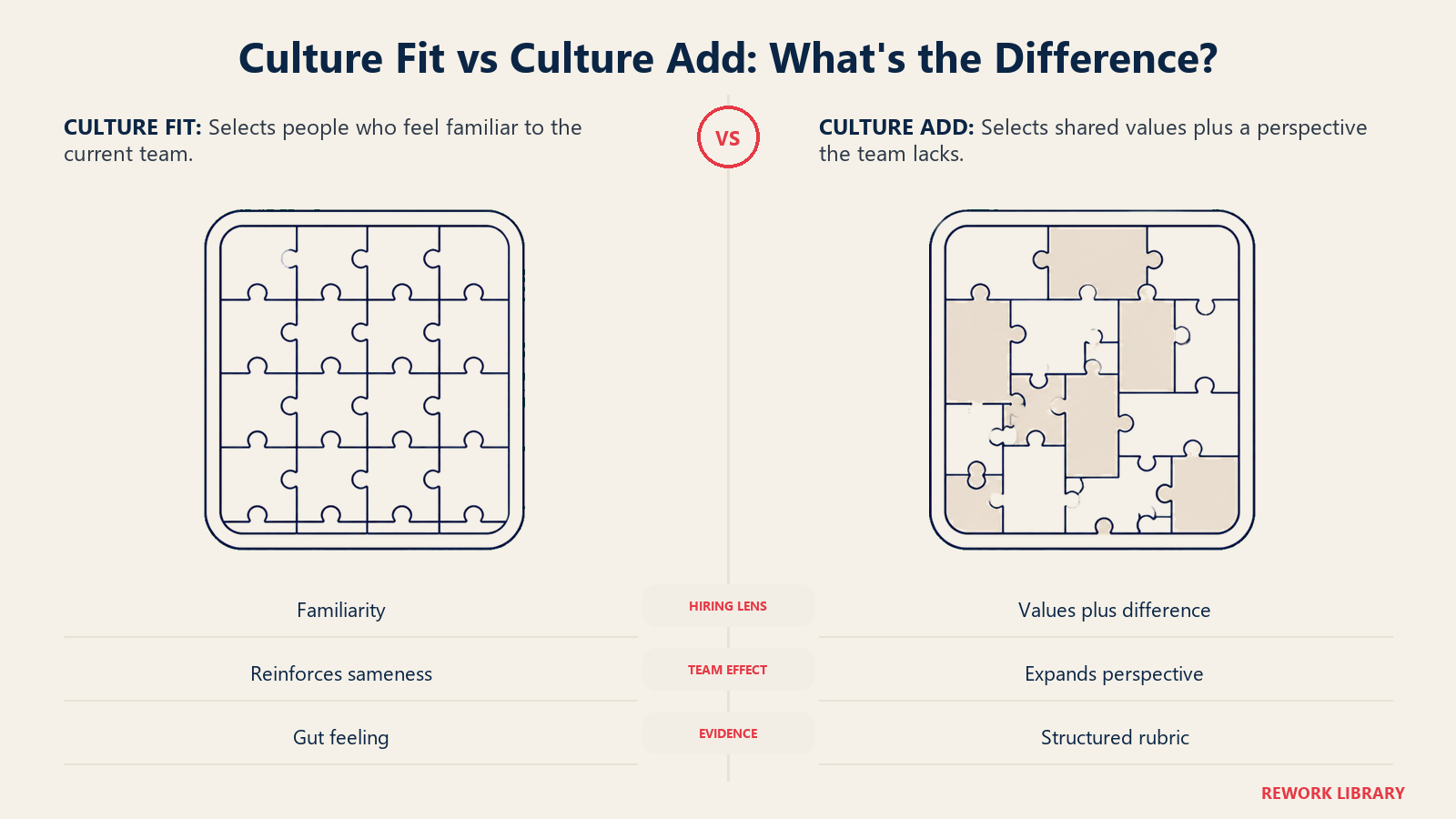
Culture fit vs culture add is the difference between hiring people who feel comfortably familiar and hiring people who strengthen what a company stands for while thinking, working, and living differently than the people already there. Culture fit asks "does this person feel like us?" Culture add asks "does this person share our values and bring something we don't already have?" The first question tends to produce a workforce that looks, sounds, and thinks like whoever is doing the hiring. The second is built to avoid that trap on purpose.
The distinction sounds like semantics until it plays out in an actual hiring loop. Two candidates walk out of the same panel with identical scorecards on skills and experience. One gets an offer because the interviewer "just clicked" with them. The other gets passed over because something felt "off," even though nobody can point to a specific competence gap. That gut feeling is doing a lot of unexamined work, and it is rarely as neutral as it feels in the moment.
Why "Culture Fit" Quietly Becomes a Bias Filter
Culture fit started as a reasonable idea: don't hire someone whose values clash with how the company operates. A candidate who believes deadlines are optional probably won't thrive on a team running tight delivery cycles, regardless of talent. That's a legitimate concern, and it has nothing to do with where someone grew up or what they do on weekends.
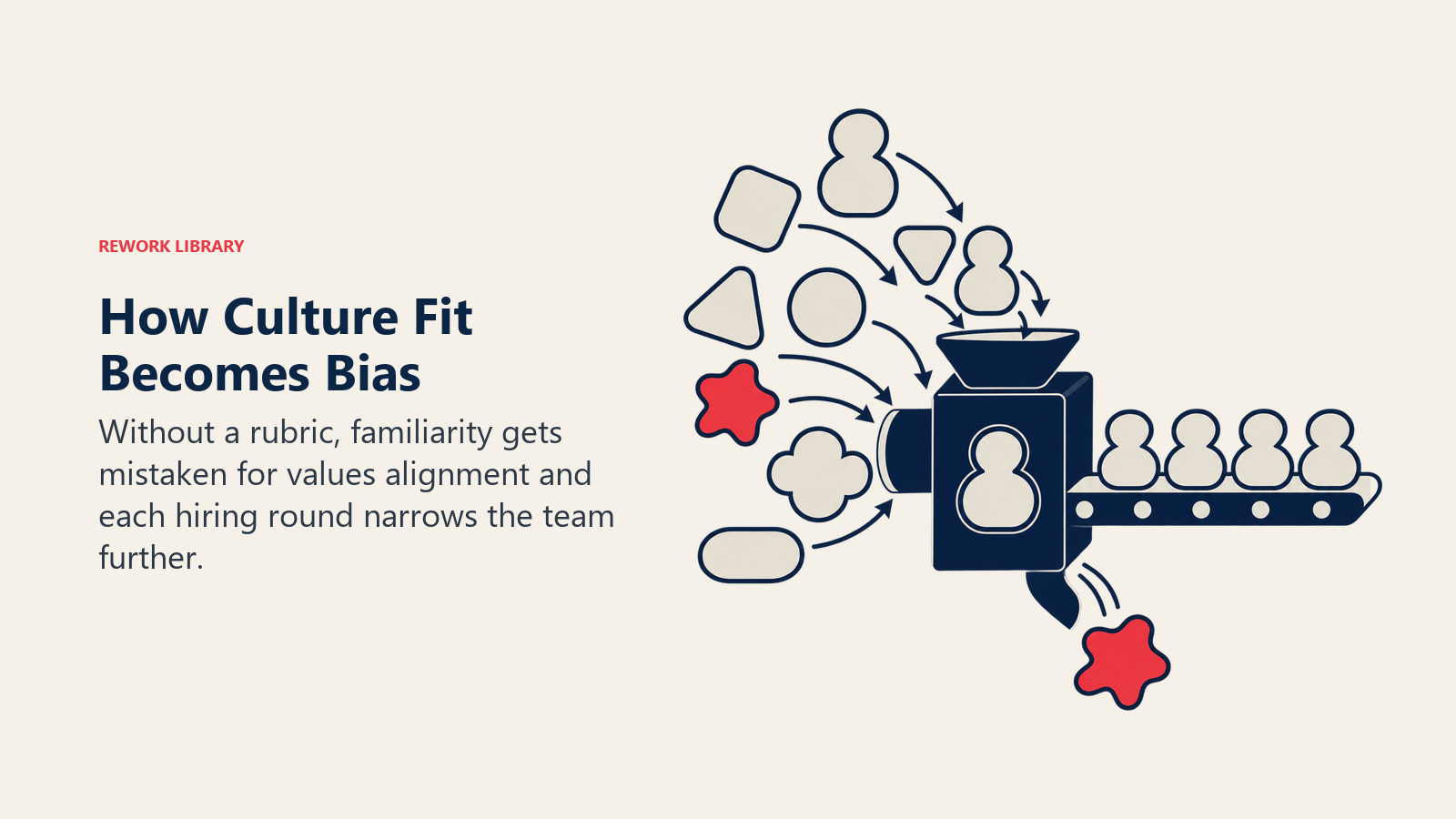
The problem is what "fit" turns into once it leaves the values conversation and enters the interview room unchecked. Sociologist Lauren Rivera's landmark study of hiring at elite professional service firms found that evaluators routinely assessed fit based on shared leisure activities, hobbies, and self-presentation style, and that these cultural similarity judgments often outweighed concerns about a candidate's actual productivity. In practice, "culture fit" became a proxy for "reminds me of myself," and that proxy systematically filtered out otherwise qualified candidates from lower-income and less privileged backgrounds.
The Three Ways Fit Goes Wrong
It rewards familiarity, not alignment. An interviewer who shares a candidate's school, neighborhood, or hobbies will often read that overlap as shared values, even when the two things are unrelated. Familiarity feels like chemistry. It is not the same as someone who will uphold the team's standards under pressure.
It has no rubric, so nobody can be held accountable to it. "Would I grab a beer with this person?" is not a scoreable question. Without a defined standard, every interviewer applies their own private definition of fit, one that tends to cluster around whatever the existing team already looks like.
It compounds with each hiring round. Once a team is mostly one type of person, "fit" starts meaning "matches the current team," locking in its blind spots and comfort zones. A team that hires purely for fit gets narrower with every cycle, because each new hire is measured against an increasingly homogeneous baseline.
Key Facts
- A landmark study of hiring at elite professional service firms found that "cultural fit" assessments based on shared hobbies and self-presentation often outweighed concerns about candidates' actual productivity. Source: Lauren Rivera, American Sociological Review
- Companies in the top quartile for ethnic and cultural diversity are 36% more likely to post above-average profitability than bottom-quartile companies. Source: McKinsey, Diversity Wins
- Companies with above-average leadership diversity report innovation revenue 19 percentage points higher, and EBIT margins 9 points higher, than companies with below-average diversity. Source: Boston Consulting Group
- Structured interviews have a predictive validity of .51 for job performance, versus .38 for unstructured interviews, roughly a third more accurate at predicting who will actually succeed. Source: Schmidt & Hunter meta-analysis
- Candidates who go through a structured interview process report a better experience, and rejected candidates rate the process 35% more positively than those interviewed unstructured. Source: Google re:Work
- Decades of research show socially diverse groups outperform homogeneous ones on complex problem-solving, because working with people who think differently forces everyone to prepare more carefully and question assumptions they would otherwise skip. Source: Katherine Phillips, Scientific American
What Culture Add Actually Means
Culture add flips the question. Instead of asking whether a candidate matches the existing team, it asks two things: does this person genuinely share the organization's core values, and does this person bring a perspective, background, skill, or way of working the team does not already have? Both questions have to be answered yes. Culture add is not "hire anyone different." It is "hire people who are values-aligned and additive," a meaningfully higher bar than fit, not a lower one.
This matters because the term sometimes gets caricatured as diversity for its own sake, disconnected from performance. It isn't. Culture add still screens hard for what makes someone trustworthy: does this person tell the truth when something goes wrong, do they follow through, do they treat people well when nobody senior is watching. What it drops is the unrelated overlay of shared hobbies, alma mater, or background that fit tends to smuggle in alongside those legitimate questions. As the numbers above show, homogeneous teams are not a neutral default. They are a specific choice with a specific, measurable cost.
How to Hire for Values Without Hiring for Sameness
Getting from fit to add is not a philosophy change you announce in an all-hands. It is a set of specific changes to how interviews actually run.
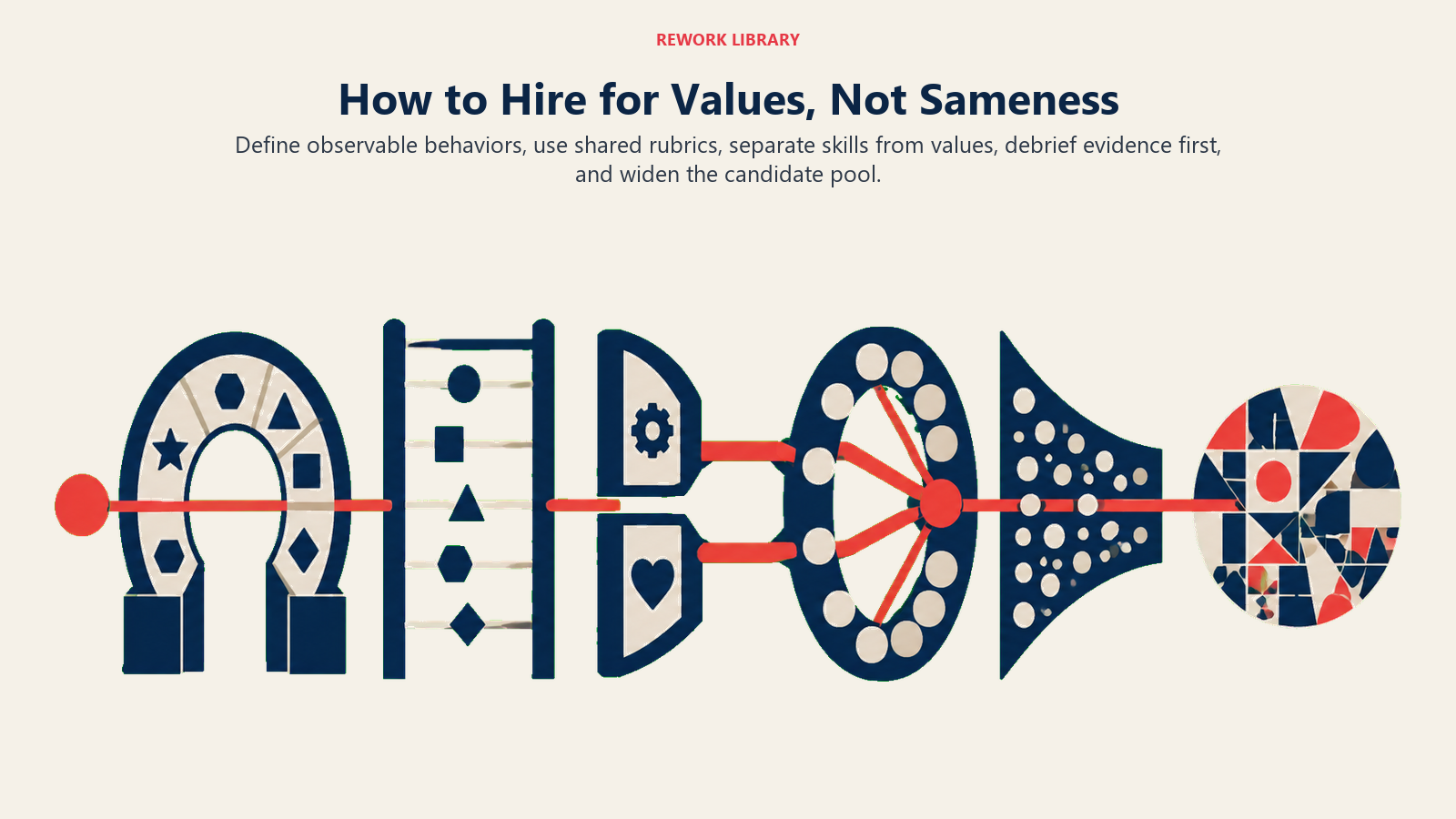
Define Values as Observable Behaviors, Not Vibes
"We value ownership" is not something an interviewer can screen for directly. It has to become a behavior you can ask about and score: has this person kept fixing a problem after it stopped being their responsibility? Have they told a manager bad news before being asked? Write down the two or three behaviors that actually represent each stated value and use those as interview criteria instead of the abstract word. How to define company values covers turning a values list into something concrete enough to hire and manage against.
Use Structured Interviews With a Shared Rubric
The single highest-leverage fix here is removing improvisation from the process. As the Key Facts above show, structured interviews are both more predictive of performance and rated more fairly by candidates than the unstructured version, including candidates who end up rejected. Every interviewer asks the same core questions, scores against the same rubric, and writes down evidence before discussing impressions as a group. This alone removes most of the room for "I just had a good feeling."
Separate the Skills Panel From the Values Panel
Values questions get contaminated when they're mixed into a technical interview, because the more subjective judgment tends to bleed into the score. Run a dedicated values conversation with its own interviewer and rubric, focused on past behavior: "tell me about a time you disagreed with a decision you had to carry out anyway" reveals more about real values tension than any hypothetical question does.
Debrief Facts Before Feelings
In the hiring committee discussion, require each interviewer to state the specific evidence behind their score before sharing a general impression. "She gave two examples where she flagged a risk before it became a problem" is evidence. "I really liked her energy" is not, and it disproportionately favors whoever reminds the room of themselves. Evidence first, gut feeling second, catches most fit-style reasoning before it becomes a decision.
Widen Where Candidates Come From
Culture add hiring collapses back into culture fit if the pipeline is narrow, because you can only add what actually shows up in the pool. If every candidate comes from the same three schools or the same referral network, the panel is choosing among people who already look alike before the interview starts. Diversifying sourcing is a pipeline decision, not an interview-day one, and has to happen upstream of the rubric work above.
The DEI and Innovation Connection
Hiring for culture add is often framed as a diversity, equity, and inclusion initiative, and it is one, but the research behind it is really about how groups think, not simply about representation. Diverse groups do not outperform homogeneous ones because they are individually smarter. They outperform because interacting with people who see things differently forces everyone to prepare more carefully and question assumptions they would otherwise skip. Homogeneous teams feel easier to work in, and that ease is exactly the problem: it comes from skipping the friction that catches bad ideas before they ship.
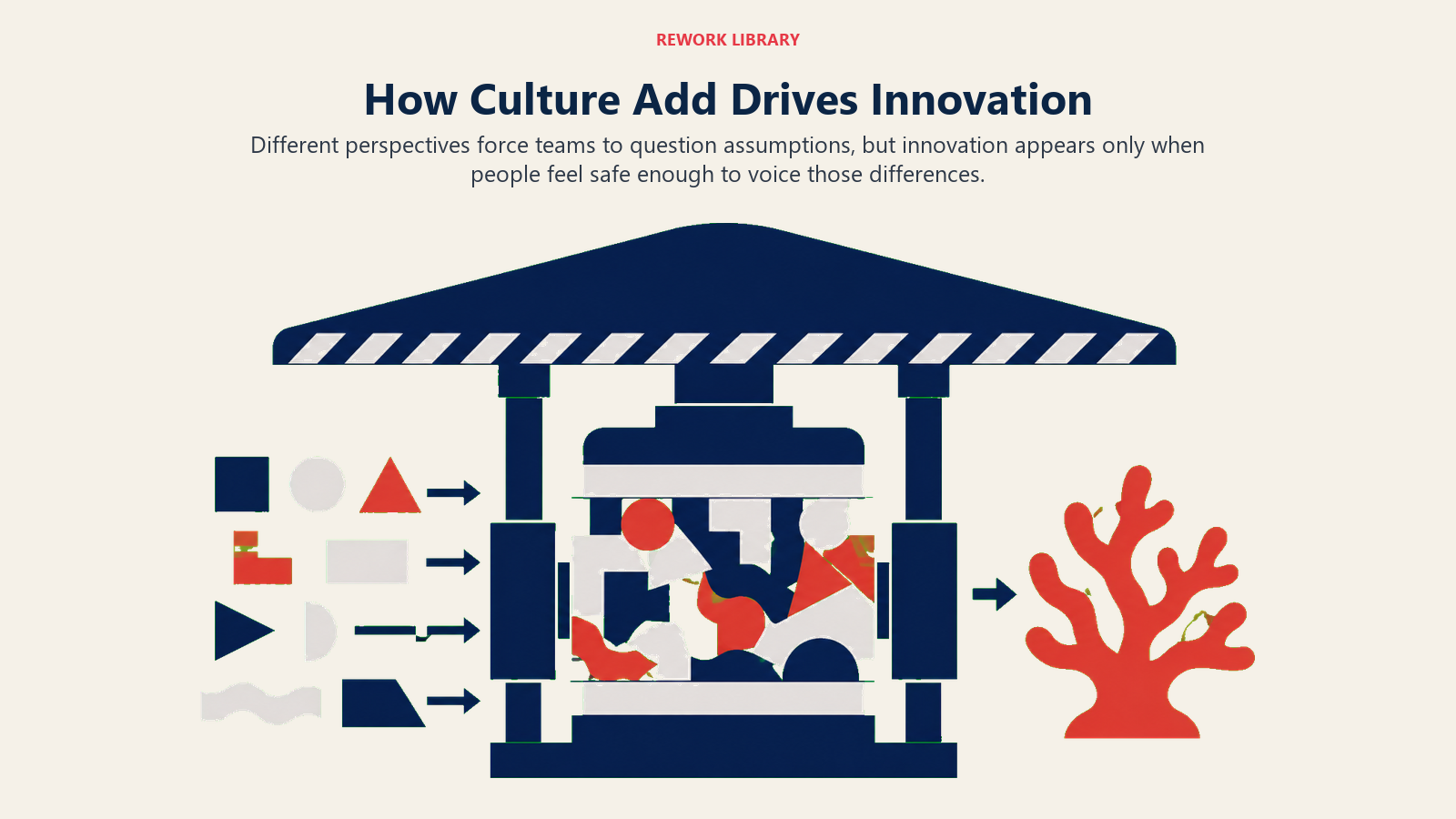
This is also where culture add connects back to psychological safety at work. Adding different perspectives only pays off if people feel safe voicing them. A team that hires for culture add and then punishes the first person who disagrees has done half the work and captured none of the benefit. The hiring change and the safety-to-speak-up change have to land together, or the diversity of thought you hired for goes quiet.
Global and distributed teams add another layer worth naming directly: what looks like a "fit" problem in an interview is sometimes a cross-cultural communication difference, not a values mismatch. A candidate from a high-context culture who answers indirectly, or one from a more hierarchical business culture who defers to seniority in the room, can read as "not assertive enough" to an interviewer expecting direct, low-context self-promotion. Managing a multicultural team, hierarchical vs egalitarian cultures, and The Culture Map, explained all cover the communication patterns worth knowing before you mistake a cultural style for a values gap.
When Fit Still Matters
None of this means "fit" is a meaningless word or that anything goes. A narrow set of things is worth screening for directly, and calling that screening "fit" is fine as long as it stays scoped to genuine non-negotiables rather than vague comfort.
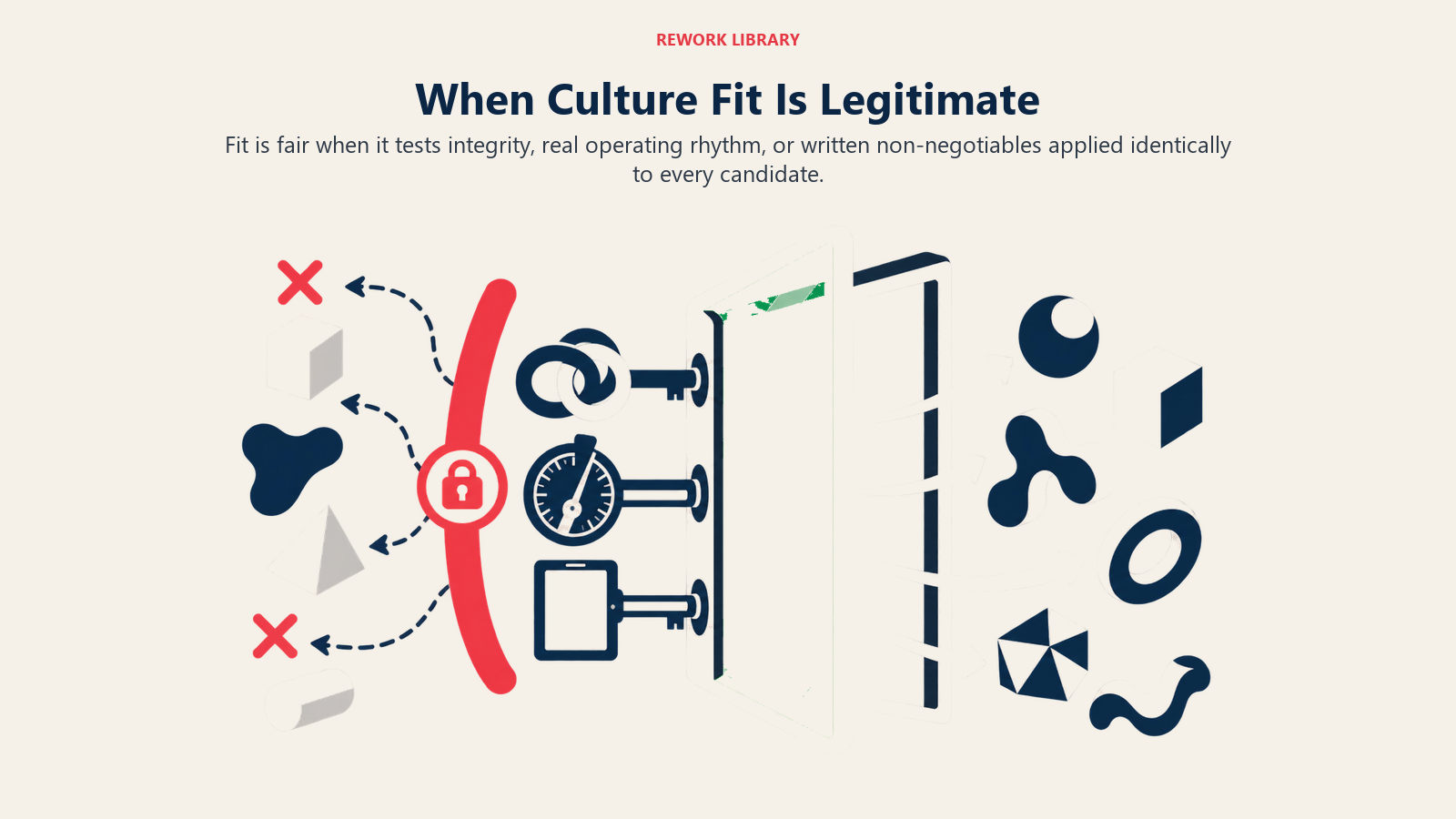
Integrity and honesty are non-negotiable everywhere. A candidate who is evasive about a past mistake, or who describes cutting corners as a strength, is a values mismatch regardless of talent. This is a baseline trust question, not a diversity question, and it applies to every hire.
Pace and operating rhythm can be a legitimate mismatch. Someone who thrives on long, deliberate planning cycles may genuinely struggle on a team that ships daily and expects decisions in hours, and vice versa. That is worth testing directly, as a working-style question, separate from background or personality.
Explicit, written non-negotiable values are fair game. If a company has defined behaviors it will not compromise on, say "we never ship without a rollback plan," screening for alignment with that specific, written standard is legitimate. The line is whether the standard is written down and applied the same way to every candidate, or whether it is an unwritten feeling one interviewer reaches for after the fact.
The test that separates legitimate fit from disguised bias: could you write the standard down, apply it identically to every candidate, and defend it to someone who doesn't share your background? If yes, it's a real value. If the honest answer is "I'd know it when I saw it," that's the fit trap talking.
Practical Hiring Guardrails
A short checklist for any hiring process that claims to hire for culture:
- Every stated value has two to three observable behaviors, written down before interviews start, not improvised in the room.
- Interviews are structured: same questions, same rubric, same scoring scale, for every candidate for a given role.
- A values interview exists as its own dedicated stage, run by a trained interviewer, separate from the skills assessment.
- Debriefs require interviewers to cite specific evidence before sharing general impressions; someone names it when a comment is vibe, not evidence.
- Sourcing channels are audited periodically for how narrow the actual candidate pool is, not just how the final hire looks.
- "Not a culture fit" is banned as a standalone rejection reason. If it's the real reason, name the specific behavior or value gap it stands for.
None of this requires new software. It requires a written rubric, a debrief discipline, and a manager willing to interrupt the room when "good vibes" starts doing the work evidence should be doing. Where tooling helps is in the unglamorous parts: the same structured scorecard on every candidate for a role, confirmation every interviewer filled it in, and a consistent record of what was actually said. That is closer to what Rework's People app is built to support: consistent process, not the judgment calls themselves.
A Note on AI in Hiring
AI tools increasingly screen resumes, summarize interview notes, and even score candidate responses, and it is worth being honest about what that does to fit versus add. A model trained on a company's past hires will learn whatever pattern actually produced them, including decades of "fit"-based screening. Left unchecked, AI screening can automate cultural matching bias at a speed no interviewer could reach alone, hardening the exact pattern culture add hiring is trying to break. The same guardrails above apply to it directly: the model's criteria need to be as explicit and behavior-based as a human rubric, and someone needs to periodically check what pattern it actually learned, not just what it was told to learn.
Where to Go Next
Culture fit vs culture add is really a hiring-system question wrapped inside a bigger culture question: what does this organization actually reward, and does the hiring process reinforce that or quietly work against it. From here:
- What is business culture?, for the broader system of levers that shape culture
- How to define company values, for turning values into the behaviors a rubric needs
- Onboarding for culture, for how values-alignment continues after the offer is signed
- Psychological safety at work, for making sure the perspectives you hired for actually get voiced
The fastest way to tell whether a hiring process runs on fit or add is to listen to how rejections get explained. "Not a fit" with no specifics behind it is fit doing its quiet work. A rejection anchored to a specific value or behavior the candidate didn't demonstrate, applied the same way to everyone, is add. The words in the job posting rarely change. What changes is whether anyone can defend the standard out loud.

Co-Founder, Rework.com
On this page
- Why "Culture Fit" Quietly Becomes a Bias Filter
- The Three Ways Fit Goes Wrong
- Key Facts
- What Culture Add Actually Means
- How to Hire for Values Without Hiring for Sameness
- Define Values as Observable Behaviors, Not Vibes
- Use Structured Interviews With a Shared Rubric
- Separate the Skills Panel From the Values Panel
- Debrief Facts Before Feelings
- Widen Where Candidates Come From
- The DEI and Innovation Connection
- When Fit Still Matters
- Practical Hiring Guardrails
- A Note on AI in Hiring
- Where to Go Next