Culture and Employer Brand: Why Reputation Can't Outrun Reality
Turn this article into takeaways for your work.


Each assistant summarizes the article only for you and suggests best practices for your work.
Updated August 2026
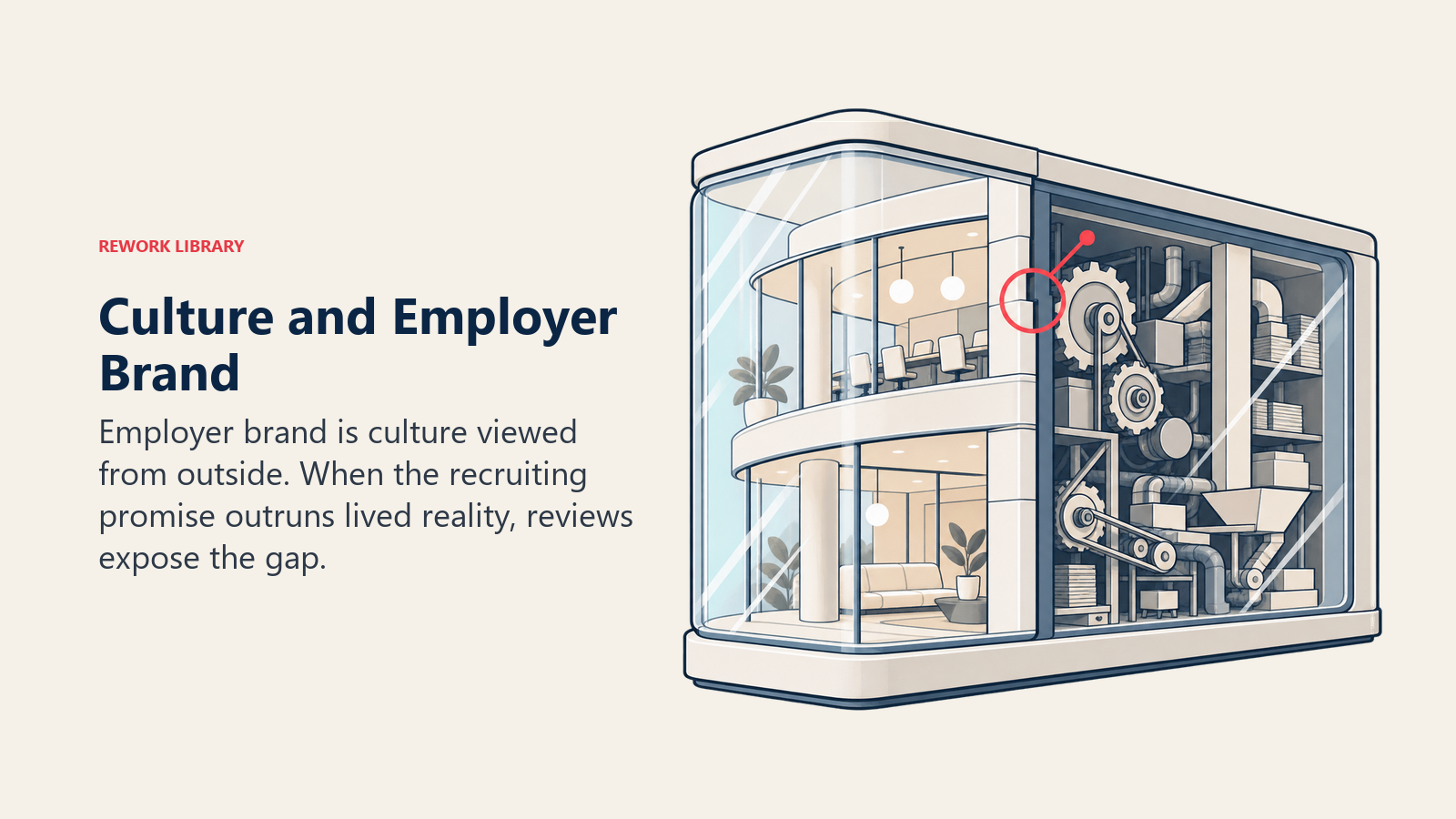
Employer brand is the outside-facing reputation of what it's actually like to work somewhere, built from how candidates, the public, and former employees perceive a company's culture, values, and treatment of people. It functions less like marketing and more like a mirror: an accurate brand reflects real culture back to the market, and an inflated one collapses the moment a candidate's lived experience contradicts what they were told.
That distinction used to be easier to blur. A careers page, a slick recruiting video, and a handful of curated testimonials could carry an employer brand for years, because there was no easy way for an outside candidate to check the claim against reality. Review sites changed that permanently. Now a candidate can read hundreds of anonymous, dated, specific accounts of what a company is like before ever speaking to a recruiter, and they do, in large numbers, before they apply. This article covers what an employer brand actually is versus an employee value proposition, why reviews function as an honest culture signal whether or not a company wants them to, the authenticity gap that forms when recruiting marketing outruns the real experience, why a genuine culture is the cheapest and most durable recruiting asset a company can build, how candidate experience itself is a culture signal, and what's changing now that candidates are starting to judge companies on how they use AI in hiring.
What Employer Brand Actually Is, and What It Isn't
Employer brand is not a logo, a tagline, or a "careers" page redesign. Those are artifacts, the same visible layer Edgar Schein's model describes as the least reliable evidence of what an organization actually believes. Employer brand is the reputation that forms in the market from the accumulated experience of everyone who has worked there, interviewed there, or heard from someone who did. A company does not get to fully control it. It can only influence it, mostly by controlling the thing the reputation is actually about: the real culture underneath.
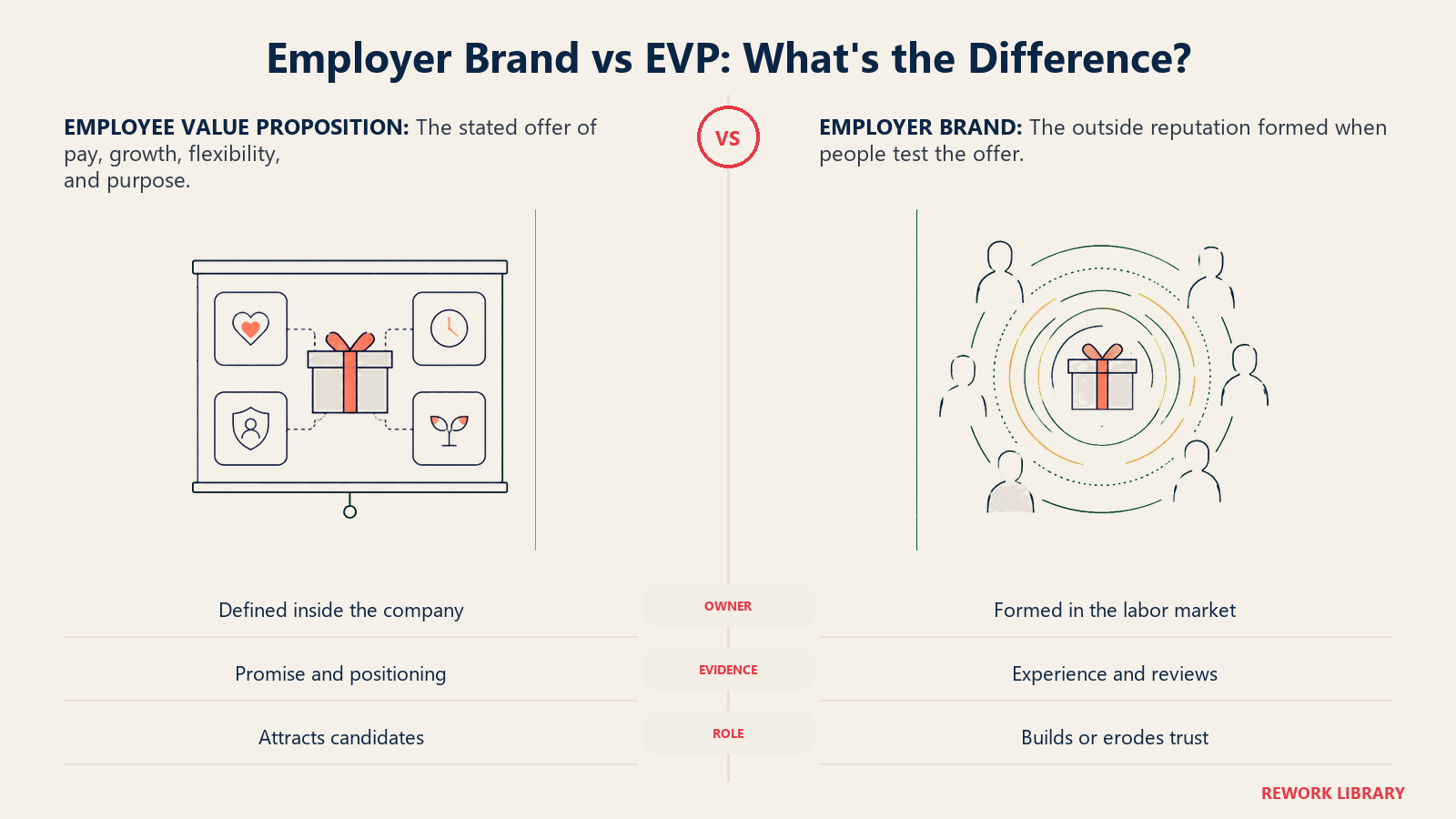
Employer Brand vs. Employee Value Proposition (EVP)
The employee value proposition, or EVP, is the internal statement of what an employer offers in exchange for someone's work: pay, growth, flexibility, purpose, the specific reasons a good candidate should choose this job over a comparable one elsewhere. Employer brand is what happens when that EVP meets the outside world and gets tested against reality by people who have no reason to be generous. A strong EVP that nobody delivers on in practice does not produce a strong employer brand. It produces a gap, and gaps are exactly what review sites are built to surface.
SHRM's Global Employee Monitor, a quarterly survey of workers across 26 countries, finds that pay remains the single highest-ranked factor in decisions to join, stay, or leave an organization, while workplace culture and leadership are more strongly associated with whether someone stays than with whether they felt drawn to apply in the first place. That split matters for how you think about EVP and employer brand separately: the EVP has to be competitive enough to get someone through the door, but it's the lived culture that decides whether the brand they walked in believing turns out to be true.
Why You Can't Buy an Employer Brand You Don't Have
A common instinct when recruiting gets harder is to spend on employer branding: better photography, a more polished pitch, a bigger presence at career fairs. None of that is wasted if the underlying culture backs it up. All of it becomes a liability if it doesn't, because a mismatch between the pitch and the experience does not stay quiet anymore. It gets written down, dated, and published somewhere a future candidate will read it before they ever get to a recruiter's polished version of the story.
Key Facts
- Pay remains the single highest-ranked factor influencing whether workers join, stay with, or leave an organization, while compensation, job security, workplace culture, and leadership are more strongly associated with retention than with initial attraction. Source: SHRM Global Employee Monitor
- 77% of adults would consider a company's culture before applying for a job there, 56% say culture matters more than salary for job satisfaction, and 73% would not apply to a company unless its values aligned with their own. Source: Glassdoor multi-country survey
- 64% of U.S. hiring managers admit their company misrepresented some aspect of a role or the hiring process, most often by understating how difficult the job or team environment actually is. Source: Resume Genius 2026 Hiring Trends Report, via Forbes
- 26% of recent hires say a mismatch between what they were promised and what they found would be enough to make them restart their job search, and 78% of dissatisfied new hires say they plan to leave within the year. Source: Forbes, citing Resume Genius and ZipRecruiter data
- Only 8% of job seekers believe AI makes the hiring process more fair, and 46% say their trust in hiring has decreased over the past year, with 42% pointing directly at AI as the reason. Source: Greenhouse 2026 Candidate AI Interview Report
- 87% of job seekers say it's important for employers to be transparent about their own use of AI in hiring, a transparency standard most companies have not yet met. Source: Greenhouse 2026 Candidate AI Interview Report
Glassdoor, LinkedIn, and Reviews as a Culture Signal
Review platforms did something to employer brand that no amount of recruiting budget can undo: they made culture legible to strangers before the strangers ever apply. A candidate weighing an offer no longer has to take a recruiter's word for what the team is like. They can read a year's worth of specific, dated accounts from people with no stake in making the company look good, and they overwhelmingly do exactly that before deciding where to apply.
What Reviews Actually Measure
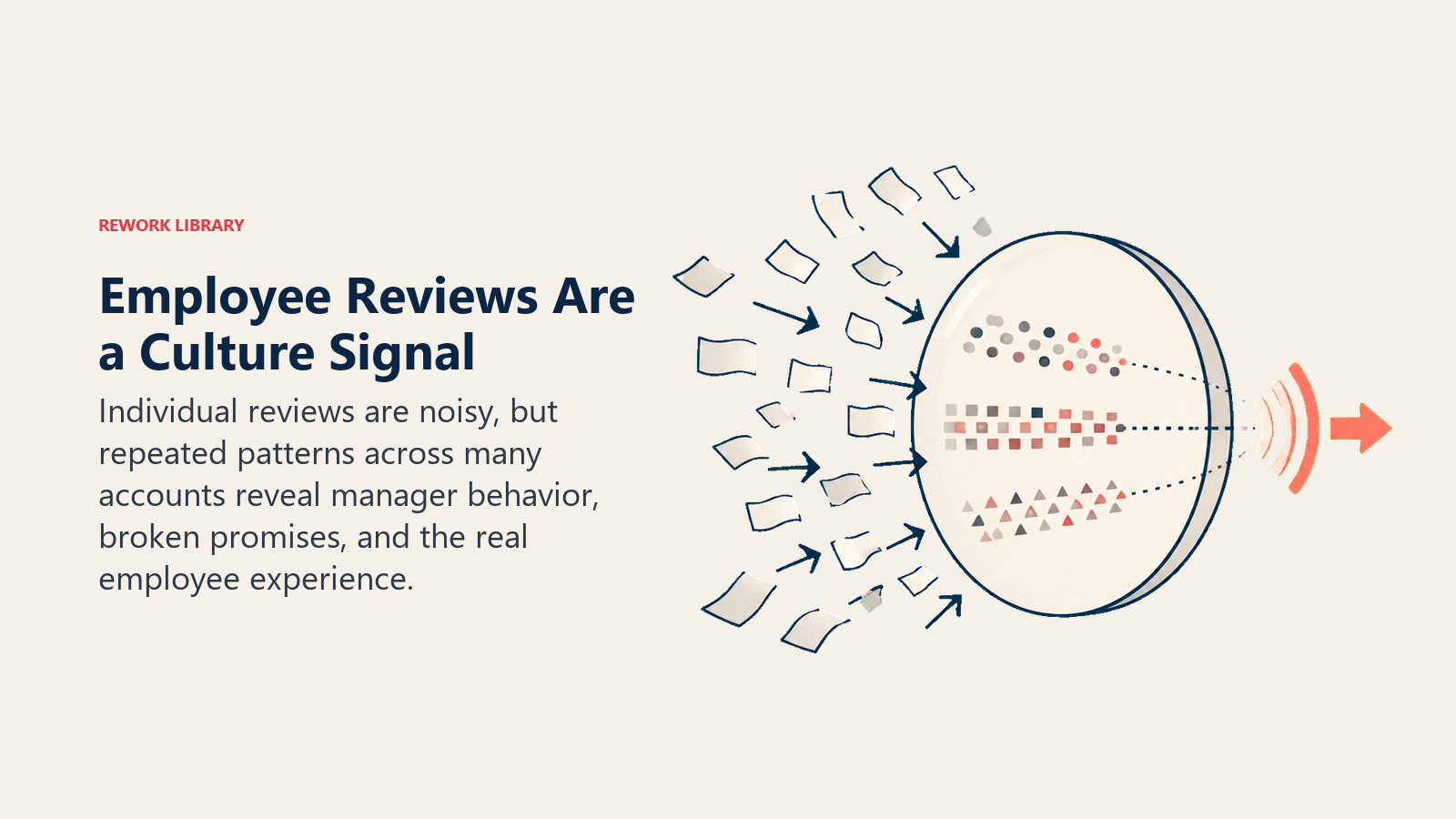
Reviews are noisy individually. A single bad one might be an outlier, a disgruntled exit, a personality clash that says more about one manager than the whole company. But in aggregate, across dozens or hundreds of reviews, patterns emerge that are hard to fake in either direction: recurring complaints about the same kind of manager behavior, consistent praise for the same specific benefit, the same phrase showing up independently across reviewers who never spoke to each other. That convergence is closer to what culture and engagement surveys try to capture internally, except it's happening publicly, continuously, and without the company controlling the sample or the framing.
This is also why review-site scores correlate so strongly with the same signs of a toxic culture that show up in internal exit data. Favoritism, public humiliation, and broken promises don't stay contained to the people who experienced them. They get written down, and the next candidate reads it as a preview rather than a rumor.
Why You Can't Manage Your Way to a Good Score
Employers routinely try to improve their review-site standing the way they'd manage any other metric: respond to negative reviews, encourage happy employees to post, run a campaign around a rating milestone. Responding well to reviews genuinely helps, both because it signals the company is listening and because it gives context a bare review can't. But none of it moves the underlying number for long if the daily experience behind the reviews hasn't changed. A wave of solicited five-star reviews after a rough patch reads as exactly what it is to anyone who scrolls past it to the detailed one-star review from three months earlier describing the same problem in specific terms. Review management can polish the surface. It cannot manufacture the pattern underneath, and candidates have gotten good at telling the difference.
The Authenticity Gap: When the Brand Promise Doesn't Match the Reality
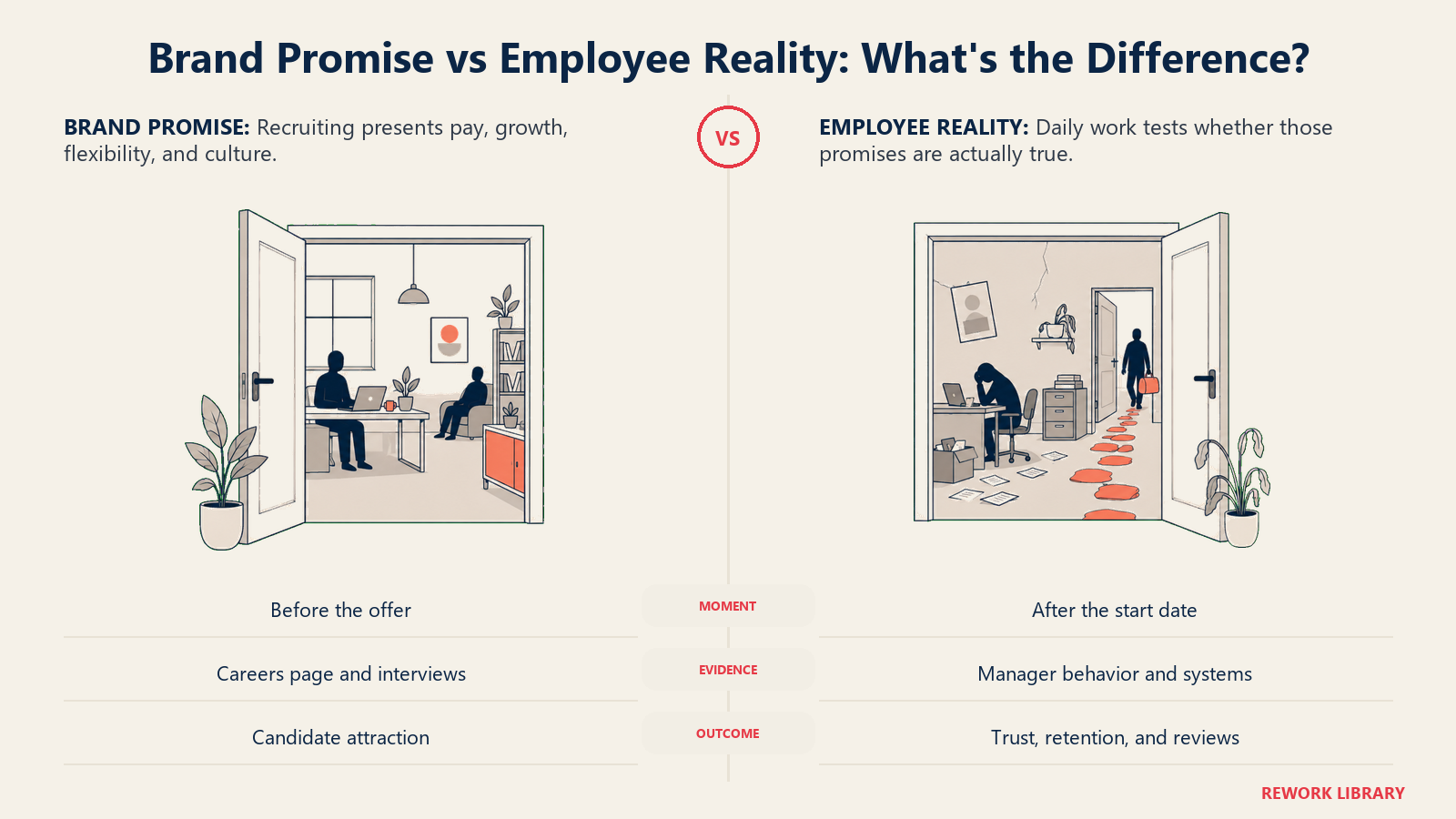
The authenticity gap is the space between what a company's recruiting marketing promises and what a new hire actually finds once they start. Every employer has some version of this gap, because recruiting materials are, by nature, a highlight reel. The gap becomes a problem only when it's large enough, or dishonest enough, that a reasonable new hire feels misled rather than pleasantly surprised.
How the Gap Forms
The gap rarely starts as deliberate deception. It usually starts with a recruiter or hiring manager describing the role and team the way they wish it were, or the way it was a year ago before a reorg, a departure, or a strategy shift changed the day-to-day reality. Nearly two in three U.S. hiring managers admit their company has misrepresented some aspect of a role or the hiring process, most commonly by understating how difficult the job or team environment actually is, or by giving an inaccurate hiring timeline. None of that requires bad intent. It just requires optimism outrunning honesty at the exact moment a candidate is deciding whether to accept an offer.
The gap widens further once culture fit and culture add get confused with simply telling candidates what they want to hear. A hiring process built around making candidates feel good rather than giving them an accurate picture produces a higher acceptance rate and a worse first ninety days, because the new hire arrives having built expectations the real job can't support.
The Cost of Getting Caught
The gap is expensive precisely because it doesn't surface immediately. It surfaces after someone has already resigned from their old job, moved, or turned down another offer, at the exact moment they have the least leverage to walk away and the most reason to feel trapped. A meaningful share of recent hires say a mismatch between what they were promised and what they found would be enough to restart their job search, and dissatisfied new hires who feel misled are far more likely to plan an exit within the year. Every one of those departures becomes a fresh, specific, dated review, which is how one bad hiring cycle compounds into a multi-year employer brand problem instead of a one-time miss.
Onboarding for culture covers the mechanism in more detail: new hires spend their first weeks testing whether what they were told matches what they experience, and they answer that question fast. An authenticity gap discovered in week two doesn't just cost that one hire. It becomes the honest, unfiltered review the next candidate reads before they even get to a recruiter's version of the story.
How a Real Culture Becomes Your Strongest Recruiting Asset
The flip side of the authenticity gap is the cheapest recruiting advantage most companies never fully capture: a culture that is genuinely good, described accurately, sells itself far more efficiently than any amount of paid promotion sells a culture that isn't.
Employees Are the Real Employer Brand Channel
The most credible source of information about what it's like to work somewhere has never been the careers page. It's current and former employees, in reviews, on LinkedIn, in conversations candidates have with people they actually trust. A company with strong psychological safety and real trust between people and leadership produces employees who talk about the place honestly and, often, favorably, without being asked to and without being incentivized to. That word-of-mouth channel cannot be bought at any price, because its entire credibility comes from the fact that nobody is paying for it.
Building the EVP From the Inside Out
The durable way to strengthen an employer brand is to work backward from real culture rather than forward from a marketing brief. Start with defining company values that describe what actually gets rewarded, not what sounds good on a wall. Then check the gap regularly: does what leadership says on a careers page match what measuring company culture actually reveals internally. When the two converge, the employer brand takes care of itself, because reviews and referrals simply confirm what the recruiting story already says. When they diverge, no amount of brand spend closes the gap; it only makes the eventual reviews angrier.
Candidate Experience Is Part of the Culture, Not Separate From It
Candidate experience gets treated as a recruiting metric, something to optimize for faster time-to-fill or a better offer-acceptance rate. It's more accurately described as the first exposure a candidate gets to the real culture, delivered before they've signed anything and before the company has any real incentive to keep performing for them.
The Interview Process Is a Preview
How a company runs its hiring process, whether interviewers show up prepared, whether feedback arrives on the timeline promised, whether a rejected candidate is treated with basic respect, is a direct sample of how that company treats people when there's nothing obligating it to. A disorganized, disrespectful, or dishonest hiring process is rarely an isolated failure of the recruiting function. It's usually a preview of the same disorganization or disrespect that shows up later in performance reviews, project handoffs, and how commitments get kept.
| What the candidate experiences | What it actually signals |
|---|---|
| Interviewers show up on time, prepared, and give a clear timeline | Meetings and commitments are generally respected internally |
| Rejected candidates get a real, personal reason instead of silence | Direct, honest feedback is normal here, not the exception |
| The job description matches what interviewers describe | Recruiting marketing and lived reality are kept in sync deliberately |
| Interview panel reflects the team's actual seniority mix and diversity | The team described in the pitch is the team that actually exists |
| A rescheduled interview gets handled smoothly and apologetically | Process breakdowns are treated as normal friction, not someone's fault to hide |
None of these signals are subtle to the person on the receiving end. A candidate who gets ghosted after a final round, or who is interviewed by a panel that looks nothing like the team they were pitched, has just learned something real about the culture, whether or not the company meant to teach it.
Employer Brand in the Age of AI
Candidates are now evaluating a dimension of employer brand that barely existed a few years ago: how a company uses AI in the hiring process itself, and whether it's honest about doing so. This isn't a future consideration to plan for later. It's already shaping how the current hiring cycle is perceived, and it's an early, concrete version of the same AI etiquette question companies are working through internally with their own employees.
The trust numbers here are stark. Only 8% of job seekers believe AI makes hiring more fair, even as AI-assisted interviews and screening have become common. Nearly half say their trust in hiring overall has dropped in the past year, and most of them blame AI specifically, not the broader labor market. The gap isn't really about AI adoption itself; candidates increasingly expect some AI involvement in a modern hiring process. The gap is about disclosure. The overwhelming majority of job seekers say transparency about a company's own AI use matters to them, and a candidate who discovers only mid-interview that they were being evaluated by an algorithm forms a specific, negative, and highly shareable impression of the company's honesty, one that reads as a direct extension of the same authenticity gap covered earlier in this article, just applied to a newer technology.
This connects to a broader shift companies are working through as they figure out what an AI-native culture actually looks like: the honest version of AI adoption is disclosed, bounded, and paired with real human judgment, while the version that erodes trust is quiet, unbounded, and discovered by accident. Candidates are applying that same test to hiring itself, and an employer brand built on quietly automating candidate evaluation without saying so is building the exact kind of gap that a single viral review can turn into a much bigger problem than the efficiency gain was worth.
Where to Go Next
- What is business culture?, for the underlying definition employer brand ultimately reflects
- Signs of a toxic culture, for the patterns that show up first in reviews, long before they show up in exit interviews
- Culture fit vs. culture add, for how hiring for the wrong thing widens the authenticity gap this article describes
- How to measure company culture, for checking whether the internal reality matches the external story before a candidate does
An employer brand is not something a company builds separately from its culture and then attaches to it. It's the culture, read back by people who have every reason to be skeptical and, increasingly, a public place to say what they found. Your brand is already being written, in reviews, in what employees tell their friends, in whether new hires stay. The only real question is whether it matches what recruiting promised. Close that gap and the brand takes care of itself. Leave it open and no amount of polished careers-page copy will cover what people actually felt.

Co-Founder, Rework.com
On this page
- What Employer Brand Actually Is, and What It Isn't
- Employer Brand vs. Employee Value Proposition (EVP)
- Why You Can't Buy an Employer Brand You Don't Have
- Key Facts
- Glassdoor, LinkedIn, and Reviews as a Culture Signal
- What Reviews Actually Measure
- Why You Can't Manage Your Way to a Good Score
- The Authenticity Gap: When the Brand Promise Doesn't Match the Reality
- How the Gap Forms
- The Cost of Getting Caught
- How a Real Culture Becomes Your Strongest Recruiting Asset
- Employees Are the Real Employer Brand Channel
- Building the EVP From the Inside Out
- Candidate Experience Is Part of the Culture, Not Separate From It
- The Interview Process Is a Preview
- Employer Brand in the Age of AI
- Where to Go Next