What Is an AI Pattern? The Building Block of Business AI

Turn this article into takeaways for your work.


Each assistant summarizes the article only for you and suggests best practices for your work.
A VP of Sales at a 200-person B2B company recently sat through three back-to-back vendor demos. All three called themselves "AI-powered." All three promised to "transform" her sales team. She left the afternoon unable to explain what differentiated any of them, or whether her team needed any of them at all.
She's not alone. The noise around AI is loud, but the vocabulary to cut through it is quiet. Most operators evaluate AI tools feature by feature. They compare bullet points in a sales deck instead of asking what class of problem the tool actually solves.
AI patterns fix that. They give you a level of abstraction between raw capabilities and full agent workflows. Once you know the patterns, you can look at any AI tool and say: "That's a Scoring plus Routing pattern. We already have that. Do we need a second one?" Or: "That's a RAG Assistant. We don't have that yet. Should we?"
That's a different conversation than "their AI sounds smarter than the other AI."
What an AI pattern is
An AI pattern is a named, repeatable combination of 2 to 4 ACE capabilities (Ingest, Analyze, Predict, Generate, Execute) that addresses a recurring business problem.
The word "pattern" borrows from software engineering, where software design patterns are named solutions to common problems in code. The Gang of Four's patterns (Observer, Singleton, Factory, etc.) didn't invent new programming. They named recurring structures so developers could recognize and reuse them. The same logic applies to business AI.
AI patterns sit at Level 2 of the ACE Framework. They're above raw capabilities, which are the atomic verbs (Ingest alone, Predict alone), and below full AI Agents, which are complete role-level workflows built from multiple patterns. The foundation for all of this is what business AI actually means in practice, worth reading first if you haven't.
The key properties of a pattern:
- Named: it has a stable label ("RAG Assistant," "Scoring plus Routing") that teams can use to communicate precisely
- Repeatable: the same combination of capabilities solves the same class of problem across different industries and contexts
- Bounded: it addresses a specific, recurring business problem, not everything at once
- Composable: patterns combine to form more complex agents
If someone says "we're building a RAG Assistant for our HR team," you know exactly what they mean: a system that ingests a knowledge base, retrieves relevant documents from it, and generates answers. You can evaluate it, compare vendors for it, and anticipate its failure modes. You couldn't do any of that if they just said "we're building an AI for HR."
Key Facts: AI Patterns and Business Adoption
- 88% of organizations report regular AI use in at least one business function, yet only 39% report AI has generated measurable EBIT impact (McKinsey State of AI, 2025)
- 79% of enterprises face challenges adopting AI despite high investment, with misaligned tool selection cited as the top barrier (Writer Enterprise AI Adoption Report, 2026)
- Companies that systematically reuse AI components and frameworks report $3.70 in value for every dollar invested, versus $1.20 for ad-hoc deployments (PwC AI Predictions, 2026)
Why patterns matter in practice
The gap between AI adoption and actual value almost always traces back to teams buying tools without understanding what class of problem those tools solve.
B2B teams that categorize vendor tools by pattern class, rather than feature list, reduce redundant AI spend by an average of 30%, according to Gartner's enterprise AI vendor management guidance (Gartner, 2025). Pattern vocabulary makes the redundancy visible where feature lists hide it.
Before pattern-level thinking, teams evaluated AI tools in two ways, both flawed.
The first way was feature comparison: list every feature, score each vendor on a scale, buy whoever wins. The problem is that features don't map to problems. Two tools can share 40 feature-checkboxes and solve completely different business problems. Or they can look different on paper and be functionally identical.
The second way was vendor category: buy the "lead scoring tool" or the "sales intelligence platform." Categories have marketing definitions, not functional ones. One vendor's "sales intelligence platform" might do Predict plus Execute, scoring and auto-routing leads. Another's might do Ingest plus Analyze, summarizing account research. They're in the same "category" but use different capabilities to solve different problems.
Pattern thinking fixes both. When you evaluate a tool at the pattern level, you're asking: which class of problem does this solve, and which capability recipe does it use? That question cuts through feature noise and category blur.
It also prevents redundancy. Most companies discover, when they audit their AI tools against patterns, that they have three tools doing Analyze plus Generate and zero tools doing Predict plus Execute. The pattern audit shows the gap and the redundancy in the same view.
How patterns are composed: a worked example
Walk through a support ticket arriving in your queue. It's a complaint from a customer about a billing error.
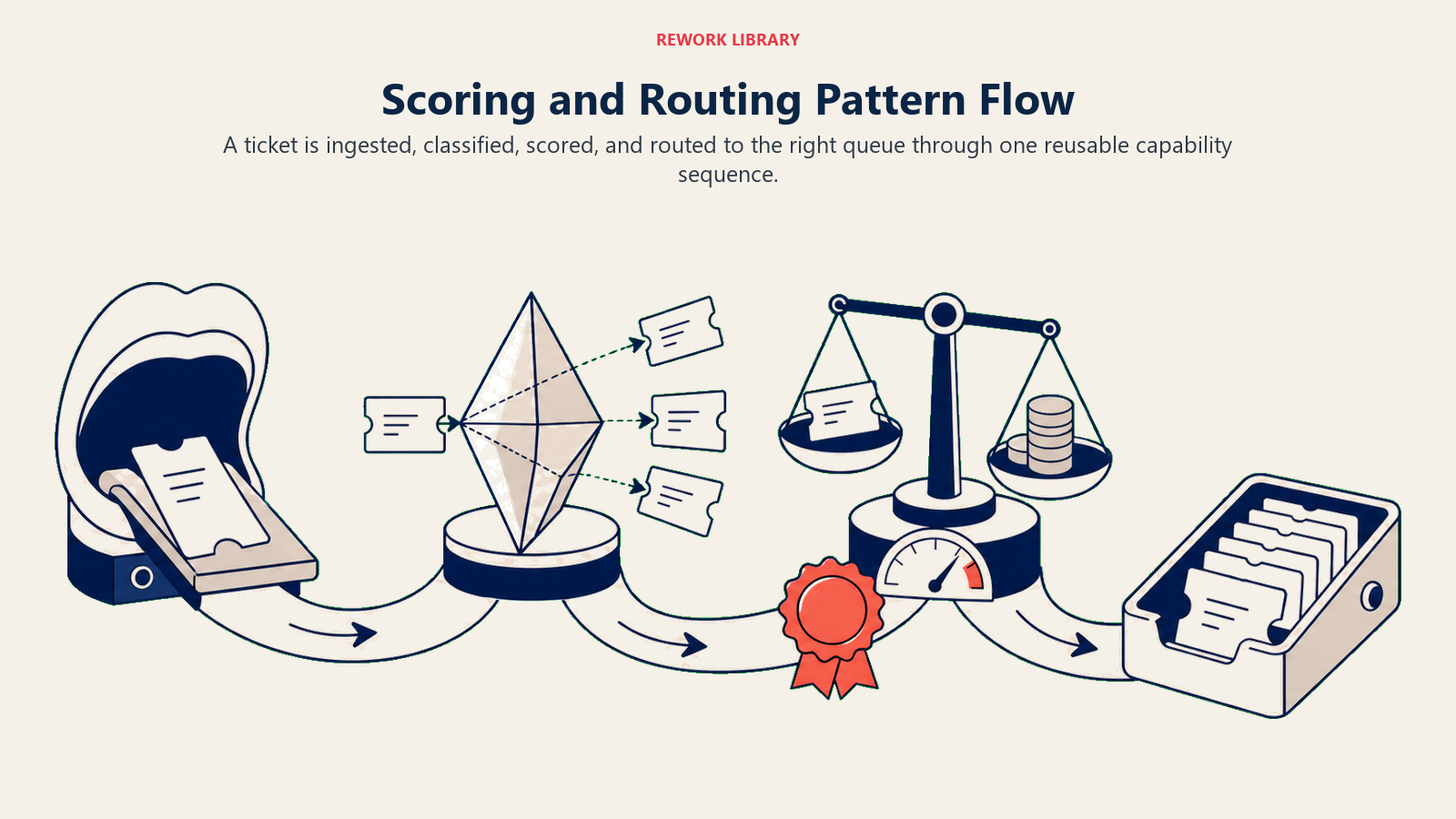
Step 1: Ingest. The ticket text comes in. If it's an audio message, transcription converts it to text. The system takes in the raw signal.
Step 2: Analyze. The system classifies the ticket: billing issue, urgency level high, customer segment enterprise. It extracts the key entity, the customer account number, the disputed charge.
Step 3: Predict. Based on the customer's account history and the type of issue, the system scores the priority and the routing destination. Enterprise billing escalations score differently than starter-plan refund requests.
Step 4: Execute. The system routes the ticket to the billing specialist queue, sets a service level agreement (SLA) flag, and creates a follow-up task in the CRM.
That's the Scoring and Routing pattern. Its formula in capability notation: Ingest (incoming record) → Analyze (extract features) → Predict (score) → Execute (route / assign).
You can reuse that same pattern recipe for different business problems: résumé screening (Ingest résumé → Analyze qualifications → Predict fit score → Execute recruiter assignment), insurance claims (Ingest claim form → Analyze coverage details → Predict risk level → Execute fast-track or review), fraud detection (Ingest transaction → Analyze behavior → Predict anomaly score → Execute approve / flag / deny).
Same pattern. Different industry. Different data. Same capability recipe.
The Pattern Reducibility Principle
Any business AI use case, no matter how complex it sounds in a vendor demo, reduces to a combination of 2 to 4 ACE capabilities arranged into one of roughly 10 named patterns. If a use case cannot be mapped to this structure, it is either multiple patterns stacked (an agent) or it is a capability alone (not yet a pattern). Naming the pattern makes the use case auditable, comparable, and reusable across contexts.
Patterns vs. capabilities vs. agents: three levels
These three levels are related but distinct, and conflating them is where most AI conversations go sideways.
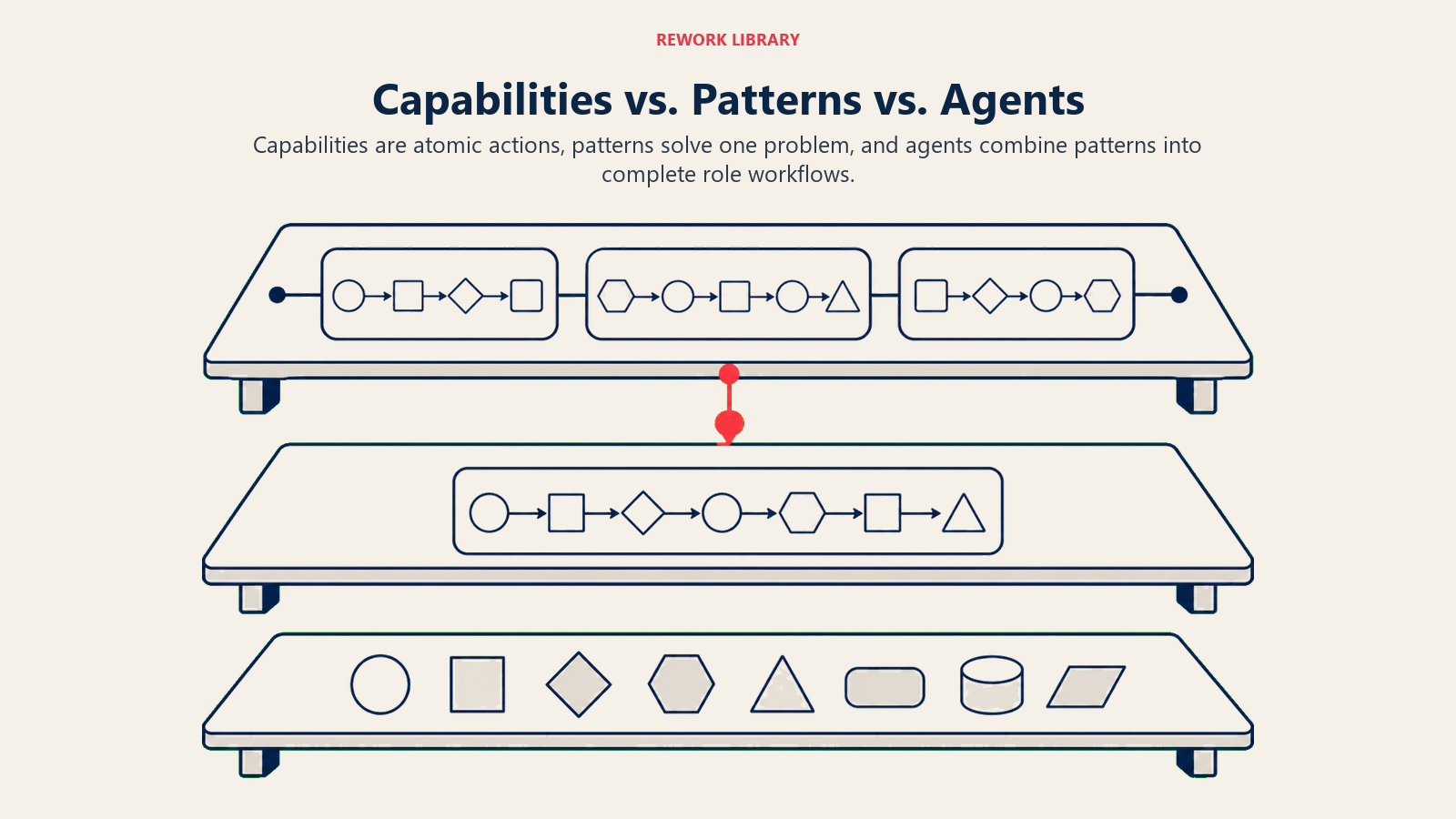
Capabilities are atomic. A single capability does one thing: Ingest takes in information, Analyze makes sense of it, Predict estimates probability, Generate produces an artifact, Execute changes external state. Capabilities are like individual musical notes. Useful, but not yet a song.
Patterns are recipes. They combine 2 to 4 capabilities to solve a specific, named business problem. The RAG Assistant combines Ingest, Analyze, and Generate to answer questions from a knowledge base. Meeting Intelligence combines Ingest, Analyze, Generate, and Execute to turn recorded calls into CRM notes and team summaries. Patterns are the recognizable musical phrases.
Agents are full workflows. A role-level AI Agent uses multiple patterns together to serve one function. The AI Support Agent uses the RAG Assistant pattern, the Scoring plus Routing pattern, and the Workflow Copilot pattern together. Agents are complete compositions.
When you evaluate a vendor, you need to be precise about which level they operate at. A "lead scoring AI" is a pattern (Scoring plus Routing). A "sales AI assistant" is likely an agent, multiple patterns: research, scoring, summarization, drafting. A "sentiment analysis API" is a capability (pure Analyze). These require different evaluation criteria and different integration investments. Gartner projects that 40% of enterprise applications will feature task-specific AI agents by 2026, up from less than 5% today, which makes the pattern-vs-agent distinction more operationally important than ever.
Enterprise technology leaders who can distinguish patterns from agents reduce AI integration project overruns by up to 40%, because they scope the correct number of capability integrations from the start (Forrester, 2025). The next section shows exactly why that distinction matters when you're sitting across from a vendor.
The 10 core patterns
About 10 patterns cover 90% of real-world business AI. A McKinsey analysis of 400+ enterprise AI deployments found that the top 10 use-case categories accounted for 89% of all measured business value (McKinsey Global AI Value Study, 2024). Here they are in capability notation.
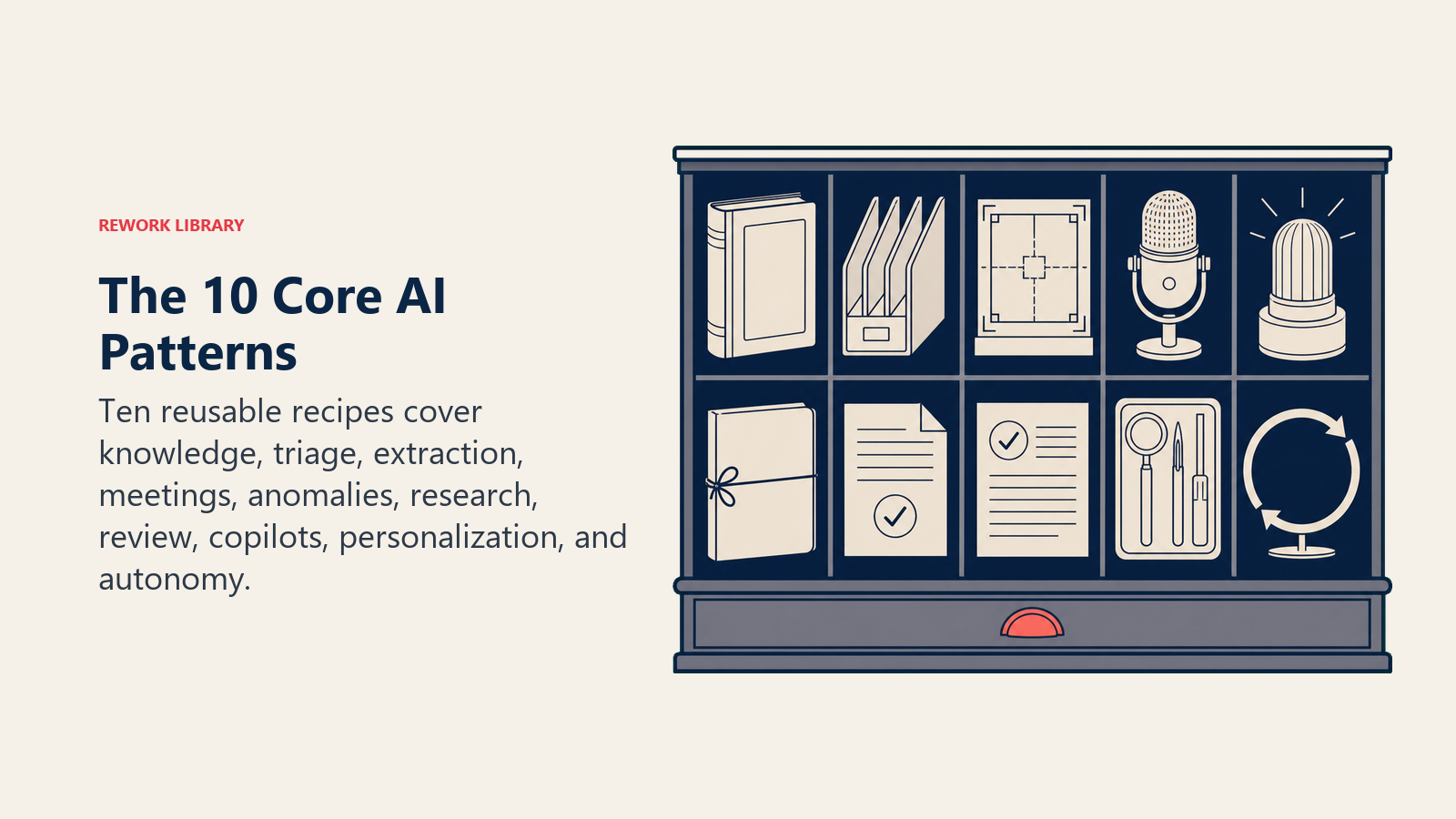
| Pattern | Capability formula | Business problem |
|---|---|---|
| RAG Assistant | Ingest (question) → Analyze (retrieve docs) → Generate (answer with citations) | Employees need answers from large internal knowledge bases |
| Scoring plus Routing | Ingest (record) → Analyze (features) → Predict (score) → Execute (route) | Inbound items need triage: leads, tickets, applications, claims |
| Vision Extract | Ingest (image/scan) → Analyze (extract fields) → Generate (structured record) → Execute (push to system) | Information trapped in images and PDFs needs to become database rows |
| Meeting Intelligence | Ingest (audio/video) → Analyze (transcript + topics) → Generate (summary/notes) → Execute (distribute) | Meeting knowledge dies after the call; notes never flow to the right system |
| Anomaly Agent | Ingest (stream) → Analyze (baseline) → Predict (flag outliers) → Execute (alert/block/escalate) | Unknown unknowns: things that shouldn't happen but do |
| Generative Research | Ingest (multi-source corpus) → Analyze (synthesize) → Generate (report/brief) | Hours of reading compressed to minutes for a researched answer |
| Document Review | Ingest (document) → Analyze (clauses/fields) → Predict (vs. template) → Generate (flags/summary) | Reviewing long documents for compliance, risk, or missing elements |
| Workflow Copilot | Ingest (user context) → Analyze (intent) → Generate (suggestion) → Execute (with approval) → repeat | A user doing repetitive knowledge work wants a peer-level assistant |
| Personalization Engine | Ingest (behavior) → Analyze (profile) → Predict (preferences) → Generate (content) → Execute (deliver) | Serve relevant content or offers to each user at scale |
| Autonomous Agent | All 5 capabilities in a loop until goal met | Multi-step goals requiring tool-use, decisions, and backtracking |
Each pattern article in this collection goes deep on one of these: real examples, failure modes, when to choose it over alternatives, and what ROI to expect.
Pattern thinking in practice: an RFP example
Here's how pattern thinking changes a purchasing decision.
A Director of Customer Success is evaluating three "customer success AI" tools. Without pattern thinking, she compares feature lists. All three claim to do "health scoring," "risk alerts," and "QBR preparation." The demos look similar.
With pattern thinking, she asks each vendor to describe their capability formula for each feature. She quickly discovers:
- Vendor A does health scoring with a Predict capability based on product usage telemetry. That's a true Anomaly Agent pattern, and it requires integration with the product analytics system. If that integration doesn't exist, the feature doesn't work.
- Vendor B does health scoring with a Generate capability: it reads recent email and meeting transcripts and produces a sentiment-based "health score." That's closer to a Workflow Copilot pattern. It's faster to deploy but less quantitative.
- Vendor C does both: Predict on usage data for the objective score, Generate from communication history for the qualitative view. That's two patterns combined, which means higher integration cost but higher fidelity.
Now she has a real question: does her team have the product telemetry integration built out? If yes, Vendor A or C might be worth the investment. If no, Vendor B might be the better starting point.
That's pattern thinking applied to procurement. Not feature comparison. Problem-class recognition.
What patterns don't do
Patterns are vocabulary, not strategy. Knowing the 10 patterns doesn't tell you which patterns your business needs right now, in what order, or what ROI to expect. That requires knowing your current data quality, your integration capacity, and where your team's biggest time sinks are.
Patterns also don't map one-to-one to vendors. One vendor can implement multiple patterns. One pattern can be served by many vendors. The pattern names belong to the problem class, not to any product. The buy-vs-build decision for each pattern is a separate question, one that pattern vocabulary makes easier to reason through.
And patterns aren't stages. You don't graduate from RAG Assistant to Autonomous Agent. Some companies run RAG Assistants in production and don't need anything more complex. Others run Autonomous Agents for narrow use cases while most of their stack is Scoring plus Routing. The right pattern is the one that fits the problem, not the most sophisticated-sounding one.
Rework Analysis: The pattern vocabulary problem is a procurement problem first, a technology problem second. Most enterprises overspend on AI not because the tools are bad but because buyers lack a shared language for what "class of problem" each tool addresses. Organizations that adopt a pattern-level evaluation framework before issuing RFPs consistently find 2 to 3 redundant tool categories in their existing stack, and they redirect that budget toward gaps. The 10 ACE patterns give procurement teams a checklist that maps directly to capability coverage, not feature marketing.
Frequently Asked Questions
What is an AI pattern in business?
An AI pattern is a named, repeatable combination of 2 to 4 ACE capabilities (Ingest, Analyze, Predict, Generate, Execute) that solves a specific recurring business problem. Patterns sit between raw capabilities and full AI agents, giving teams a stable vocabulary for evaluating, buying, and building AI without relying on vendor marketing language.
How many AI patterns cover most business use cases?
About 10 core patterns cover roughly 90% of real-world business AI use cases. McKinsey's analysis of 400+ enterprise deployments found that the top 10 use-case categories accounted for 89% of all measured business value. The 10 patterns range from RAG Assistant (knowledge retrieval) to Autonomous Agent (multi-step goal execution).
What is the difference between an AI pattern and an AI agent?
A pattern is a single named recipe of 2 to 4 capabilities solving one specific problem, such as Scoring plus Routing for lead triage. An agent is a full role-level workflow that combines multiple patterns, such as a Sales AI Agent that uses Generative Research, Scoring plus Routing, and Workflow Copilot patterns together. Gartner projects 40% of enterprise apps will feature task-specific agents by 2026.
Why does pattern thinking improve AI procurement decisions?
Pattern thinking lets buyers ask "which class of problem does this tool solve?" instead of comparing feature checklists. Teams that categorize vendors by pattern class reduce redundant AI spend by an average of 30% (Gartner, 2025) because pattern audits reveal when multiple tools serve identical capability formulas, and they expose gaps where no tool covers a needed pattern.
What is the ACE Framework and how does it relate to AI patterns?
The ACE Framework defines five atomic AI capabilities: Ingest, Analyze, Predict, Generate, and Execute. AI patterns are Level 2 of the ACE Framework, sitting above individual capabilities and below full agents. Each pattern has a capability formula written in ACE notation, such as Ingest plus Analyze plus Generate for the RAG Assistant pattern.
Can one vendor implement multiple AI patterns?
Yes. A single AI platform can implement multiple patterns. And the same pattern can be served by many different vendors. Pattern names belong to the problem class, not to any product. This is why evaluating vendors at the pattern level is more useful than evaluating by product category, since product categories are marketing definitions while patterns are functional ones.
What is the Pattern Reducibility Principle?
The Pattern Reducibility Principle states that any business AI use case reduces to a combination of 2 to 4 ACE capabilities arranged into one of roughly 10 named patterns. If a use case cannot be mapped to this structure, it is either an agent (multiple patterns stacked) or a single capability (not yet a pattern). This principle makes AI use cases auditable and comparable across vendors and industries.
Learn more
- How AI Patterns Combine Capabilities Into Solutions
- Why 10 Patterns Cover 90 Percent of Business AI Use Cases
- Choosing the Right AI Pattern for Your Problem
- The Risk Gradient Across AI Patterns
- The ACE Framework: A Periodic Table for Business AI
- The Scoring and Routing Pattern
- Stacking Patterns to Build AI Agents
- Buy vs. Build Decision for Each AI Pattern
- The Autonomous Agent Pattern

Co-Founder, Rework.com