Sequencing AI Patterns in a Multi-Year Roadmap

Turn this article into takeaways for your work.


Each assistant summarizes the article only for you and suggests best practices for your work.
Most AI roadmaps fail not because the patterns are wrong, but because the sequencing is.
Deploying an Autonomous Agent in Year 1, before a Workflow Copilot is in place and before the CRM data it depends on is clean, is like building the penthouse before the foundation. The penthouse is a great idea. The timing is the problem.
This article is for CTOs, COOs, and VPs of Operations who own the AI roadmap and need to answer the question: given what we have today, in what order do we build this? It combines three planning dimensions: technical dependencies (what patterns need what data and what previous patterns), risk sequencing (what's reversible versus what creates organizational debt), and change capacity (how much transformation a team can absorb per year without breaking).
Why sequencing matters
Patterns are not independent. They compose. Meeting Intelligence produces structured call summaries that feed into Scoring and Routing. Scoring + Routing creates rep capacity that a Workflow Copilot can fill with better-quality work. An Autonomous Agent runs all five ACE capabilities in sequence, which means every weakness in every upstream pattern propagates into the agent's outputs.
This means the order you deploy patterns determines the ceiling of what you can build later. A sales team that deploys Meeting Intelligence in Year 1 enters Year 2 with 12 months of structured call data, calibrated conversation topics, and a team that has learned to trust AI-generated summaries. A team that skips Meeting Intelligence and tries to deploy an Autonomous Sales Agent in Year 2 is building on an empty foundation.
There are three reasons sequencing fails in practice.
Key Facts: AI Roadmap Sequencing
- Only 1 in 5 AI initiatives achieve measurable ROI, and just 1 in 50 deliver true transformation. Poor sequencing is cited alongside data quality as the primary cause, not model selection. (Blackbox Theory Enterprise AI Analysis, 2026)
- Enterprise-wide AI deployment at scale consistently takes 12-24 months when done correctly. Teams that attempt to compress this to under 6 months see a 4x higher abandonment rate by month 9.
- Organizations that follow a disciplined phased roadmap report 66% achieving productivity gains, 53% reporting enhanced decision-making, and 40% achieving hard cost reductions. (SpaceO Technologies AI Implementation Report, 2026)
Vendor influence: Vendors sell their most sophisticated product, not the product you're ready for. An Autonomous Agent contract is a larger deal than a Meeting Intelligence deployment. The incentive alignment is wrong.
Executive excitement: Boards and executives are exposed to frontier AI capabilities and ask for them by name. "We need an AI agent for sales" is a directive that bypasses the readiness conversation.
Impatience with incremental ROI: Year-1 patterns (RAG Assistant, Meeting Intelligence) have measurable but modest ROI. Year-3 patterns have transformational ROI potential. Teams sometimes skip the modest wins to chase the transformational ones, and arrive at Year 3 with no infrastructure to support them. McKinsey's research finds that only about one-third of organizations report measurable financial ROI from AI, with poor sequencing and lack of enterprise-wide strategy cited as the leading causes, not model quality.
"Teams that deploy Meeting Intelligence in Year 1 enter Year 2 with 12 months of structured call data, a calibrated model, and a team that trusts AI summaries. Teams that skip Meeting Intelligence and deploy an Autonomous Sales Agent in Year 2 are building on an empty foundation. The Year 2 agent underperforms. The team concludes AI doesn't work. Both conclusions are wrong." (Rework AI Roadmap Analysis, 2026)
The four sequencing principles
Sequencing works when patterns are ordered by dependency, risk, feedback speed, and time-to-value instead of by excitement.
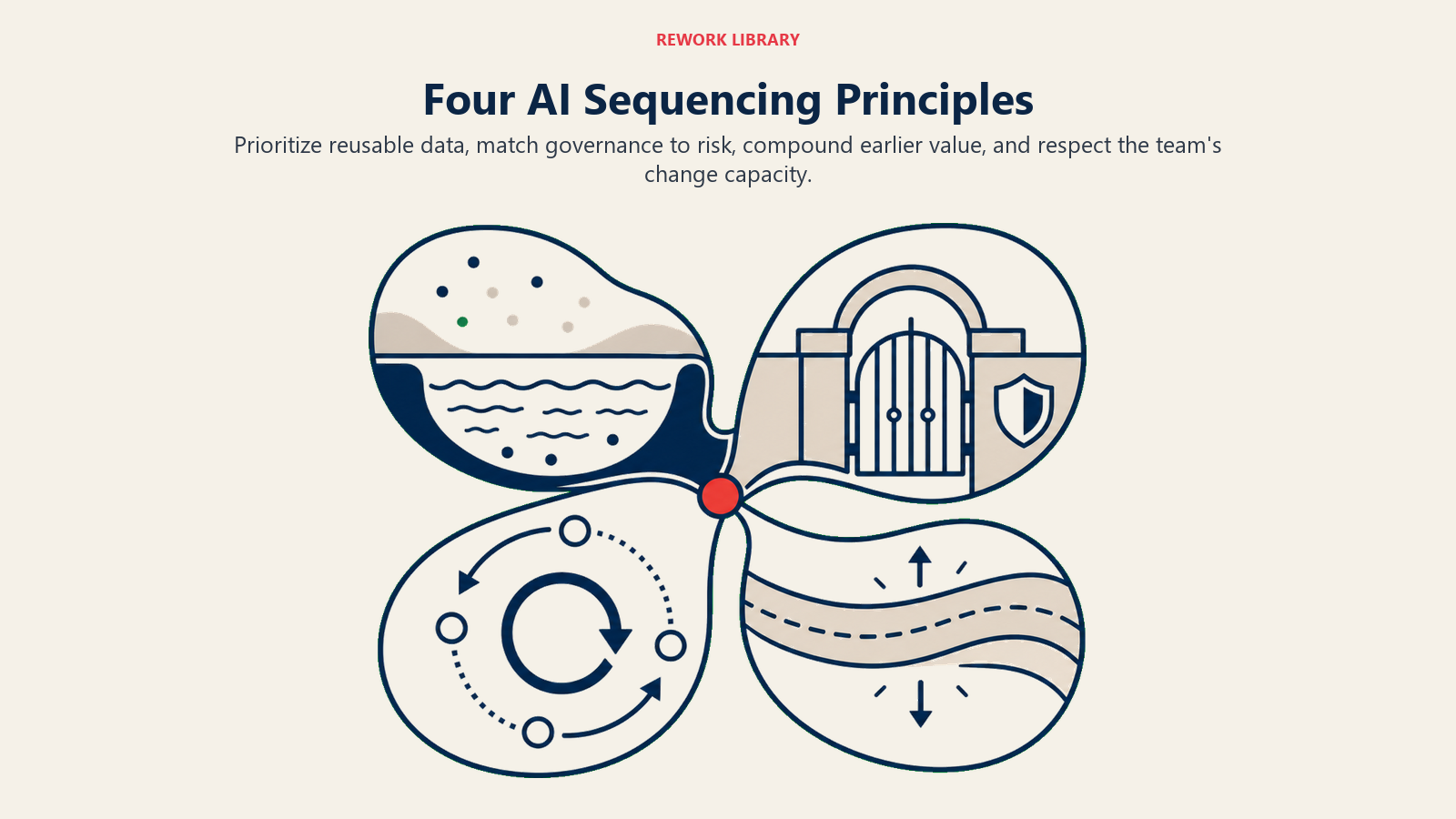
These principles explain the underlying logic. Use them to adjust the year-by-year framework for your specific situation.
1. Prerequisites before dependents. Every pattern has a data prerequisite and often a pattern prerequisite. Scoring + Routing needs labeled historical outcomes before the model can score anything. Meeting Intelligence needs call recordings before it can produce summaries. Anomaly Agent needs 60-90 days of baseline data before alerts are meaningful. Map your prerequisites first. They determine what's deployable, not your wishlist.
2. Low-risk patterns before high-risk. Risk in the ACE Framework concentrates at the Execute step. A RAG Assistant that gives a wrong answer is embarrassing. An Autonomous Agent that sends a wrong email to a customer is an incident. Start with patterns where errors are visible, reversible, and low-stakes. Build the team's judgment about AI error rates before deploying patterns where errors have external consequences.
3. High-feedback-loop patterns before low-feedback-loop. Some patterns produce outcomes you can measure quickly: Meeting Intelligence summaries are right or wrong on the same day. Others take quarters to validate: Scoring + Routing's accuracy on leads only shows up in win/loss data 3-6 months later. Deploy patterns with fast feedback loops first. They build calibration faster and generate the labeled outcomes that later, slower-feedback patterns need.
4. Patterns with fast time-to-value before patterns with slow ROI. Organizational patience for AI investment is finite. Early wins buy political capital for later, harder work. RAG Assistant deployments typically show measurable time savings in weeks. An Autonomous Agent may take six months to calibrate before it reliably completes tasks without intervention. The sequencing should build credibility early.
Year 1: Build the foundation
Year 1 should prove value with low-risk patterns while creating the data foundation for more complex stacks later.
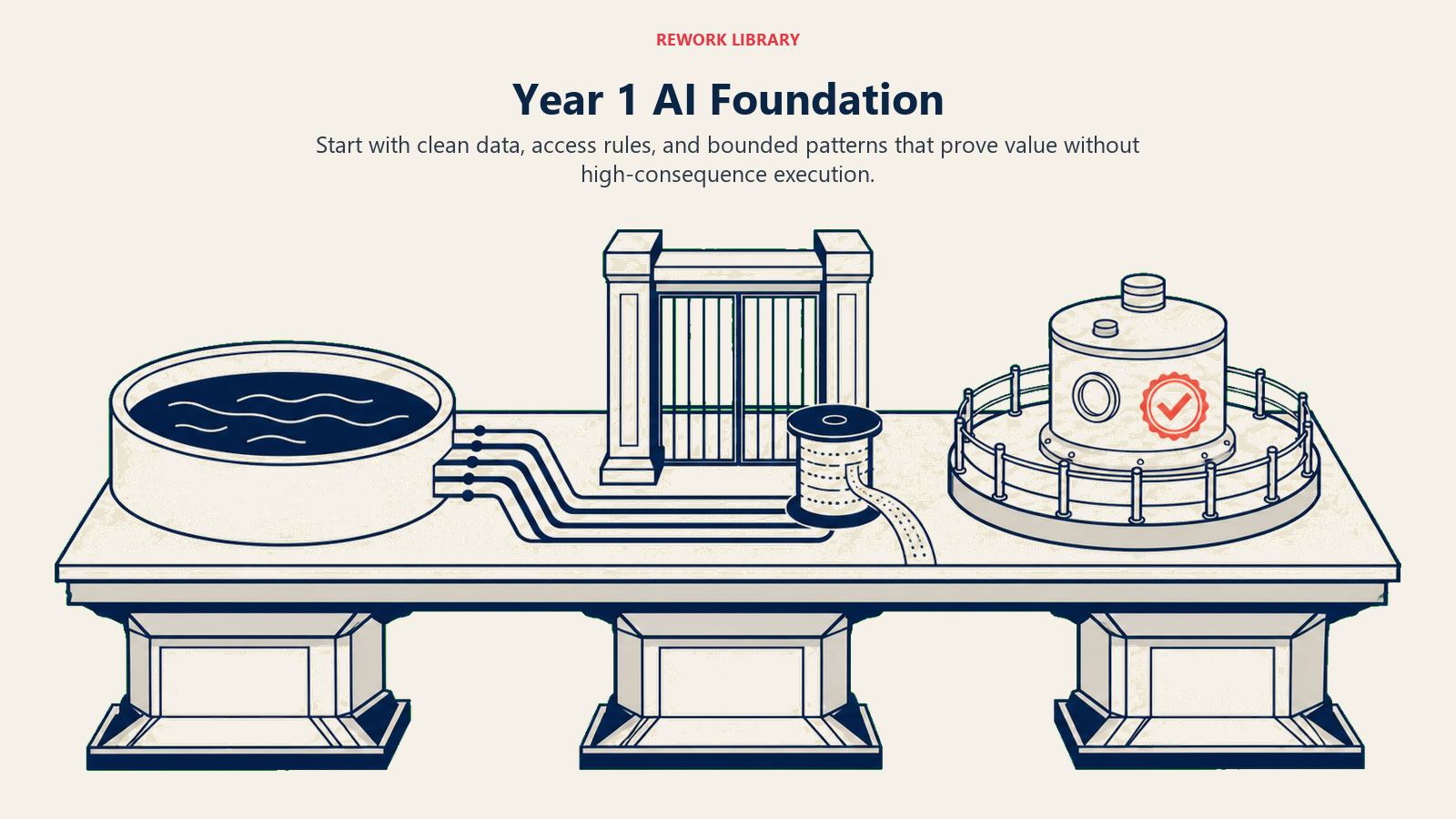
Year 1 is about patterns with low data prerequisites, measurable ROI in weeks rather than months, and low execution risk.
Sales: Meeting Intelligence + RAG Assistant
Meeting Intelligence requires call recordings and a CRM integration. Most modern sales teams have both. Deploy it first in sales because the ROI is visible (call summaries, action items pushed to CRM, reduced rep admin time) and the error recovery is simple (wrong summary = rep corrects it). By the end of Year 1, you have 12 months of structured call data and a sales team that has normalized trusting AI for post-call work. Sales call recording and transcript analysis shows what this looks like in practice.
RAG Assistant on the sales knowledge base (product docs, competitive battle cards, pricing FAQs) reduces the time reps spend hunting for answers. Deploy this in parallel with Meeting Intelligence. The knowledge base audit required to make RAG work well (removing stale docs, resolving contradictions) is also useful housekeeping for everything else you'll build on top of it.
Support: RAG Assistant + Scoring + Routing
Support RAG is often the easiest first deployment in the company. Support ticket data is usually well-structured, historical, and clean. An RAG Assistant on past resolved tickets and knowledge base articles starts returning value in days. Scoring + Routing in support (triage by urgency, route by topic) is Year 1 material because the outcome labels already exist (resolution time, escalation rate) and routing feedback is fast.
Finance: Vision Extract
Vision Extract on invoices, receipts, and expense forms is high-value, low-risk, and technically straightforward. The data is physical documents that you already process manually. The AI replaces a manual step, not a human judgment. Errors are easy to spot. ROI is denominated in processing hours, which is easy to measure.
HR: RAG Assistant
HR policy Q&A is an immediate win. Employees ask the same questions constantly (how much PTO do I have, what's the parental leave policy, how do I submit a reimbursement?). A RAG Assistant on the employee handbook reduces HR admin load immediately. The knowledge base for this is usually small and well-maintained, which makes it one of the lowest-risk RAG deployments.
Year 2: Extend with compound patterns
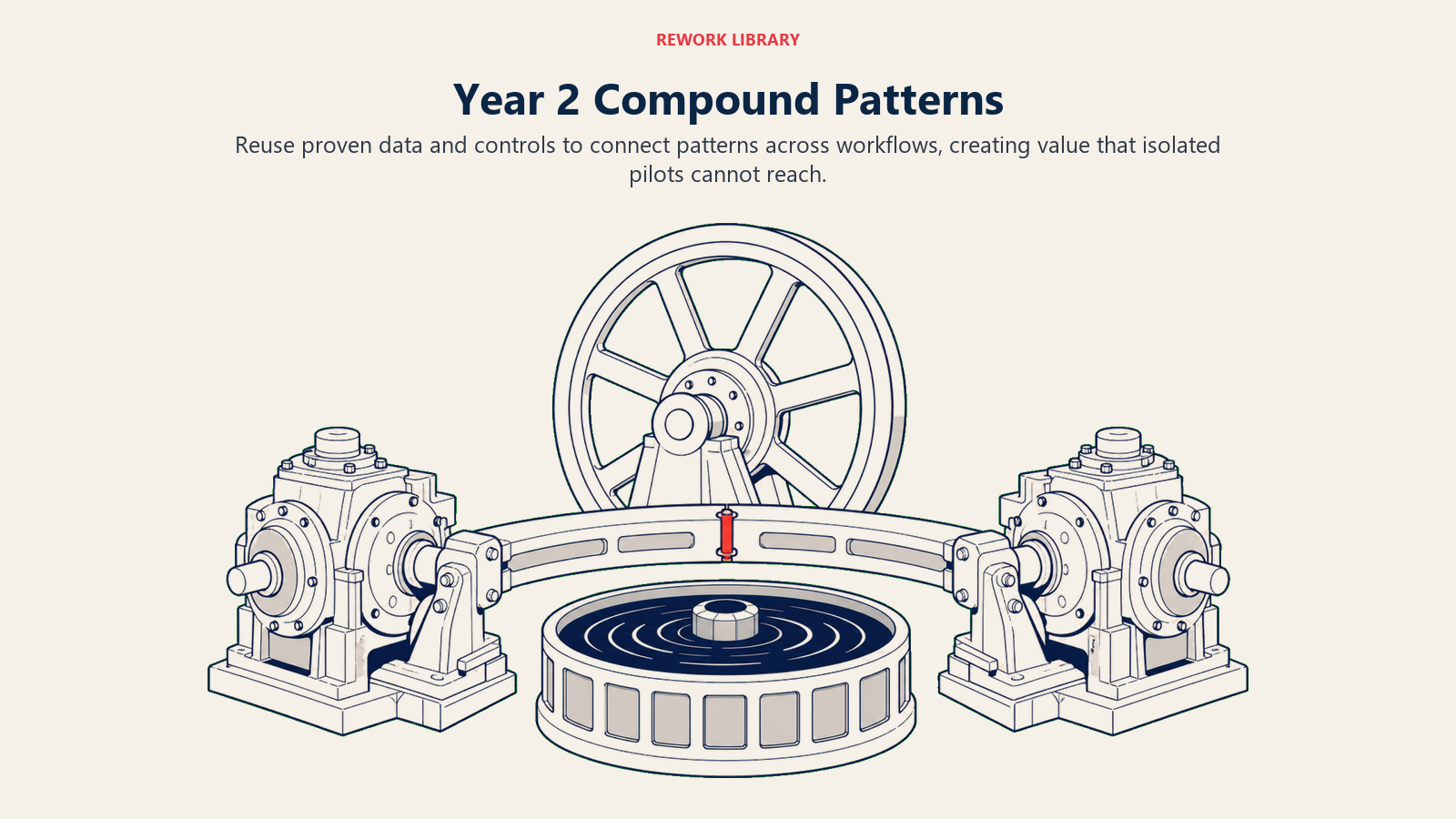
Year 2 builds on Year 1 data and infrastructure. The patterns at this stage require prerequisites that Year 1 work has established.
Sales: Workflow Copilot + Scoring + Routing expansion
A Workflow Copilot in the CRM (suggesting next actions, drafting follow-up emails, surfacing account intelligence) requires context integration that takes engineering work to set up. That work is straightforward in Year 2 if you've already connected Meeting Intelligence to the CRM. The reps have also spent 12 months learning to act on AI suggestions, which means adoption is smoother than if the Copilot had been introduced cold.
Scoring + Routing expansion means moving from simple lead prioritization to full routing logic: territory assignment, rep specialization matching, capacity-aware distribution. This requires 12 months of scored-lead data from Year 1 to calibrate on. Don't attempt this calibration from cold start.
Support: Workflow Copilot + Anomaly Agent
A support Workflow Copilot (suggesting responses based on past tickets, flagging similar past issues) requires the ticket history that a Year 1 RAG deployment has been accumulating. Deploy the Copilot after you have 12 months of agent interactions in the system.
Anomaly Agent in support monitors for unusual ticket patterns (sudden spike in a topic, drop in resolution rates, unusual escalation volumes). Deploy this in Year 2 after you have a stable baseline from Year 1's support operations.
Finance: Document Review + Anomaly Agent
Document Review on vendor contracts, vendor agreements, and AP documents requires a library of standard templates and known clause patterns. That library often doesn't exist until someone has to build it. Year 1 is when that library gets built as part of the Vision Extract implementation. Year 2 is when Document Review can use it. Anomaly Agent on expense patterns and financial anomalies requires a stable transaction baseline from Year 1.
HR: Scoring + Routing for recruiting
Resume screening and candidate routing using AI Scoring + Routing requires a pipeline of labeled historical hiring decisions. Year 1 for HR produces the structured data about who was interviewed, who advanced, and who was hired. Year 2 can train on that labeled data to build a scoring model.
Year 3: Deploy the complex layer
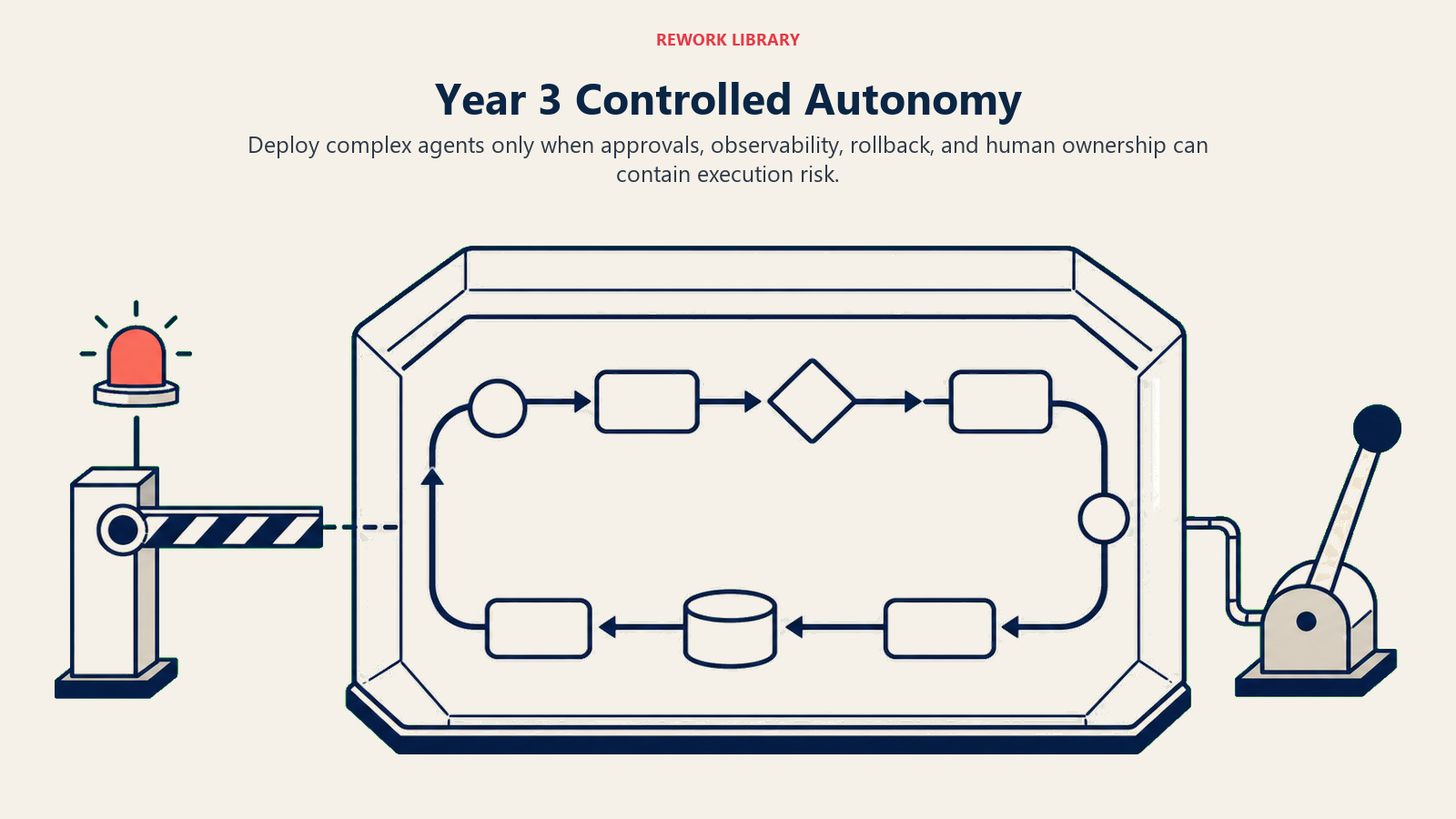
Year 3 is for patterns that require organizational maturity, strong governance, and the data infrastructure built in Years 1 and 2.
Autonomous Agent for specific contained use cases
Autonomous Agents are Year 3 because they compose all five ACE capabilities, which means every weakness in upstream patterns propagates through them. The organization also needs 2 years of experience with AI errors and recovery before it can set appropriate trust levels for autonomous execution.
Start with contained use cases: a research agent that never touches the CRM, a document drafting agent that always requires human approval before sending. Expand autonomy as confidence in the infrastructure justifies it.
Full Personalization Engine
A Personalization Engine needs 2+ years of behavioral data to build meaningful individual profiles. It also needs the content infrastructure and delivery system to act on personalization signals. This takes time to build. Year 3 is when the data and infrastructure are mature enough for personalization to work.
Full AI Agents at the role level
The AI Sales Operator, AI Support Agent, AI Finance Analyst (see the ACE Framework Level 3) are combinations of 2-5 patterns working together. They're Year 3 deployments because all their component patterns need to be working and calibrated first. The AI Sales Ops implementation roadmap is a full worked example of how one function sequences through this progression. See Stacking Patterns to Build AI Agents for how these compositions work architecturally.
| Year | Patterns (Sales) | Patterns (Support) | Patterns (Finance) | Patterns (HR) | Key milestone |
|---|---|---|---|---|---|
| Year 1 | Meeting Intelligence, RAG Assistant | RAG Assistant, Scoring + Routing | Vision Extract | RAG Assistant | First metric moved within 30 days |
| Year 2 | Workflow Copilot, Scoring + Routing expansion | Workflow Copilot, Anomaly Agent | Document Review, Anomaly Agent | Scoring + Routing (recruiting) | Compound ROI from Year 1 data |
| Year 3 | Autonomous Agent (contained scope), AI Sales Operator | Autonomous Agent (Tier 1), full AI Support Agent | Document Automation | Autonomous Screening | Role-level AI Agent operating |
"Governance infrastructure commands a 40% year-over-year budget premium because organizations that skip governance in Year 1 spend Year 2 retrofitting audit trails onto patterns that weren't designed with them. Build governance early, even when it feels like overhead on simple patterns. The patterns it feels like overhead for are the practice runs." (Rework Governance Implementation Data, 2026)
Recalibrating mid-roadmap
Mid-roadmap recalibration is how teams keep a staged AI plan honest when adoption, data quality, or ROI signals lag.
The year-by-year framework assumes Year 1 goes according to plan. It often doesn't. Here's how to recognize when Year 2 work needs to be pushed.
Signs you're not ready for Year 2:
- Year 1 patterns are running but nobody can cite a metric they moved
- CRM data quality problems that Year 1 surfaced haven't been resolved
- The team's trust in Year 1 AI outputs is below 70% ("the summaries are usually wrong" is a red flag)
- Governance infrastructure for Year 1 patterns (audit trails, review processes) isn't in place
Signs you're ahead of schedule:
- Year 1 patterns produced measurable ROI in 60 days
- The team proactively asks for more AI capabilities
- Data quality improved during Year 1 implementation (as a side effect of integration work)
- Governance and approval processes are documented and functioning
The cost of rushing is underappreciated. Deploying Year 2 patterns before Year 1 prerequisites are stable doesn't save time. It creates compound failures: the Year 2 pattern underperforms, the team loses confidence, and Year 1 patterns get questioned too. One failed premature deployment sets the entire roadmap back more than a deliberate one-quarter delay would have.
The Pattern Roadmap Sequence
The Pattern Roadmap Sequence is a three-phase deployment framework that organizes AI patterns by their dependency position, risk profile, and data readiness requirements across three deployment years. Year 1 is defined by patterns with no upstream dependencies, fast feedback loops, and low execution risk: RAG Assistant, Meeting Intelligence, Vision Extract. Year 2 adds patterns that compound value from Year 1 data: Workflow Copilot, Scoring and Routing expansion, Anomaly Agent. Year 3 deploys patterns requiring organizational maturity, cross-pattern infrastructure, and governance depth: Autonomous Agent, full role-level AI Agents. The sequence is not rigid. It is calibrated against the four sequencing principles when specific conditions are met ahead of schedule or behind it.
Rework Analysis: Based on analysis of AI roadmap outcomes across McKinsey, BCG, and Rework's own implementation data, the Pattern Roadmap Sequence produces an average time-to-first-measurable-ROI of 6-8 weeks for Year 1 patterns and 12-18 months for Year 3 patterns. Teams that attempt Year 3 patterns in Year 1 spend an average of 14 months with no measurable output before either abandoning the project or reverting to the Year 1 starting point. The most expensive AI investment is a Year 3 pattern deployed before Year 1 infrastructure exists.
Change capacity as a sequencing constraint
Even when technical prerequisites are met, teams have a finite capacity for AI-driven change. BCG's AI Transformation Is a Workforce Transformation research shows that the organizations achieving the highest AI returns invest heavily in change management alongside deployment, and that rushing past change capacity constraints consistently produces lower adoption rates. A useful heuristic: most departments can absorb one significant workflow change per quarter without process disruption.
"Significant workflow change" means any deployment that changes how the team does a core daily task. Meeting Intelligence changes how reps close out calls. A Workflow Copilot changes how reps write emails. Scoring + Routing changes how reps prioritize their day. These are significant. Multiple significant changes in the same quarter create confusion, resentment, and low adoption.
A practical planning approach: identify the 3-4 significant workflow changes each function needs to make over 3 years. Spread them across quarters. Prioritize changes that unlock the next change (Meeting Intelligence before Workflow Copilot because MeetingIntel data makes the Copilot context richer).
Governance maturity as a sequencing prerequisite
Governance capabilities compound the same way patterns do. The audit trail infrastructure you build for Year 1 Scoring + Routing is the same infrastructure you'll need for Year 3 Autonomous Agent. The escalation process you define for Year 1 RAG errors is the training run for the escalation process you'll need when the Autonomous Agent makes a more consequential mistake.
You can't govern an Autonomous Agent in Year 3 if you've never built a governance process for simpler Execute actions in Years 1 and 2. See Governance Requirements by AI Pattern for the specific governance infrastructure each pattern needs.
Build governance early, even when it feels like overhead on simple patterns. The patterns it feels like overhead for are the practice runs.
Calibrating the roadmap to your situation
The year-by-year structure above is a typical mid-market deployment. Your roadmap may differ if:
- Your data is unusually mature: If you already have 3 years of labeled CRM data and clean structured records, Scoring + Routing may be Year 1 rather than Year 2 work.
- Your industry has regulatory constraints: Financial services and healthcare have governance requirements that push some patterns to later years regardless of technical readiness.
- Your team size limits parallelism: A 20-person company can't deploy 4 patterns across 4 functions in Year 1. Prioritize by highest-ROI function and go deeper rather than wider.
See Buy vs. Build Decision for Each AI Pattern for how vendor availability affects sequencing. And Common AI Pattern Combinations by Department shows how different functions tend to sequence their pattern deployments in practice.
Pattern Dependencies and Prerequisites is the most important companion to this article. It maps exactly which patterns block which other patterns, so you can verify your planned sequence against the dependency graph before committing.
The roadmap's job isn't to show the most ambitious scenario. It's to show the sequence that actually builds, starting from where you are.
Frequently Asked Questions
What is the most common AI roadmap sequencing mistake?
Deploying Year 3 patterns (Autonomous Agent, full role-level AI Agents) before Year 1 patterns are established. Vendors incentivize this because larger deployments are larger contracts. Executives accelerate this because frontier capabilities are what they hear about at conferences. The result is a Year 3 agent running on empty Year 1 infrastructure, producing underperformance that the team misattributes to "AI not working" rather than to missing prerequisites.
What is the Pattern Roadmap Sequence?
The Pattern Roadmap Sequence is a three-year deployment framework organizing AI patterns by dependency position, risk profile, and data readiness requirements. Year 1 covers low-risk, fast-feedback patterns with no upstream dependencies. Year 2 adds compound patterns that build on Year 1 data. Year 3 deploys patterns requiring cross-pattern infrastructure and governance maturity. The sequence is calibrated, not rigid, with four principles for when to accelerate or delay.
How long does Year 1 of an AI roadmap typically take to show ROI?
Well-executed Year 1 patterns (RAG Assistant, Meeting Intelligence, Vision Extract) produce their first measurable metric improvement within 30-60 days of deployment. Organizations following a disciplined roadmap report 66% achieving productivity gains. The three-year benchmark for a fully sequenced roadmap is 3x ROI on the total investment.
Can a company skip Year 2 and go straight from Year 1 to Year 3?
In isolated cases where data and infrastructure are unusually mature, some Year 3 patterns can be accessed earlier. But skipping Year 2 is almost always slower, not faster. Year 2 patterns (Workflow Copilot, Anomaly Agent) build the labeled data, calibrated models, and governance infrastructure that Year 3 patterns depend on. Teams that attempt to skip Year 2 typically spend 12-14 months in the Year 3 deployment with underperforming results, then revert to Year 2 work anyway.
What signals tell you that you're not ready for the next year's patterns?
Year 1 patterns are running but no one can cite a specific metric they moved. CRM data quality issues surfaced during Year 1 haven't been resolved. The team's trust in Year 1 AI outputs is below 70%. Governance infrastructure (audit trails, review processes) isn't documented and functioning. Any of these signals means Year 2 patterns will underperform for the same reasons Year 1 patterns are underperforming.
Why does governance need to be built in Year 1 rather than deferred?
Governance capabilities compound the same way patterns do. The audit trail infrastructure built for Year 1 Scoring and Routing is the same infrastructure needed for Year 3 Autonomous Agent. The escalation processes defined for Year 1 errors are the training runs for Year 3 consequences. Organizations that skip Year 1 governance spend Year 2 retrofitting audit trails at a 40% budget premium. Build governance early even when it feels like overhead.
Learn more

Co-Founder, Rework.com
On this page
- Why sequencing matters
- The four sequencing principles
- Year 1: Build the foundation
- Year 2: Extend with compound patterns
- Year 3: Deploy the complex layer
- Recalibrating mid-roadmap
- The Pattern Roadmap Sequence
- Change capacity as a sequencing constraint
- Governance maturity as a sequencing prerequisite
- Calibrating the roadmap to your situation
- Learn more